The Fiske Reading Machine: The 1920s Precursor to the Kindle
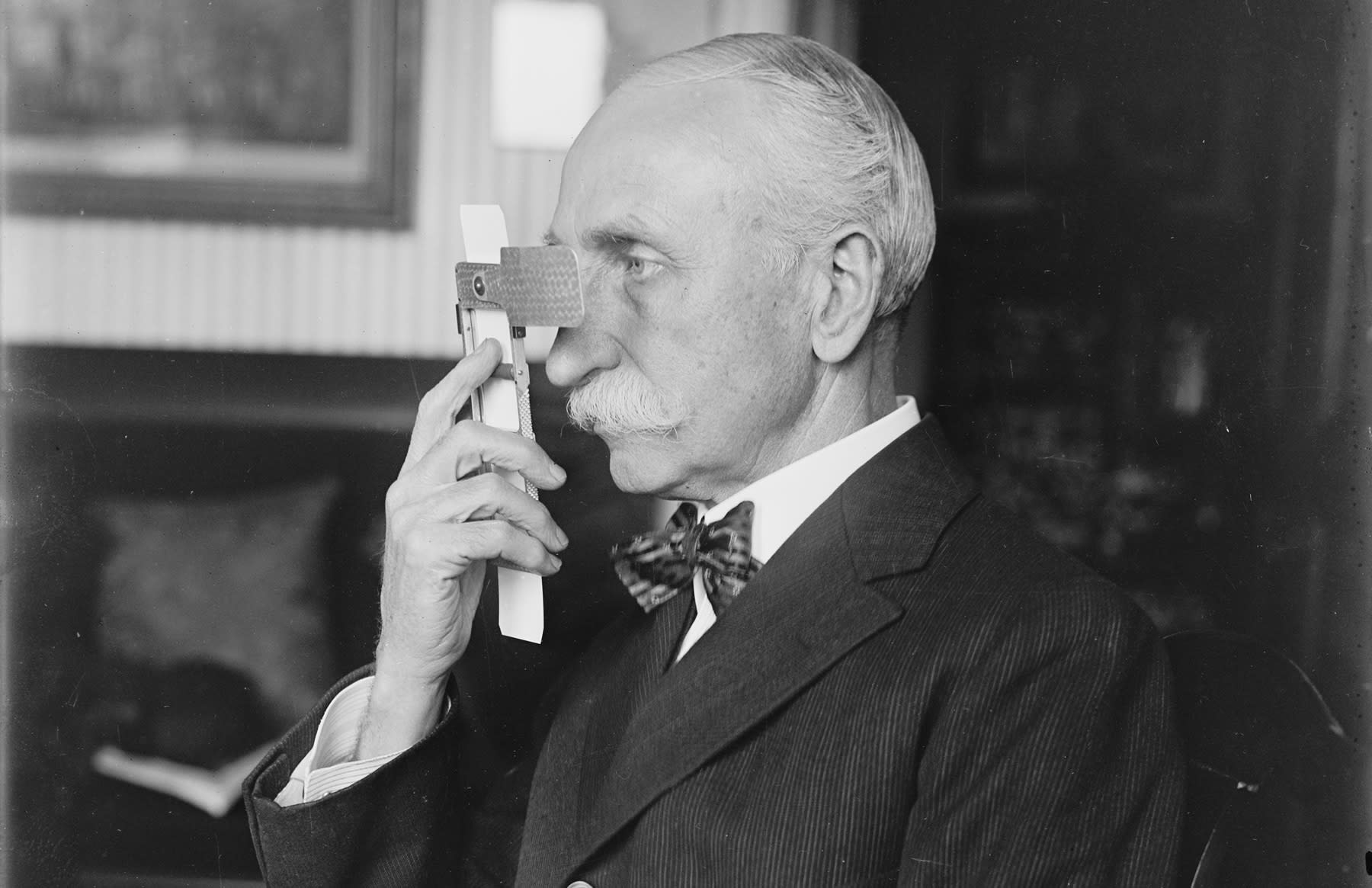
The Sony Librie, the first e‑reader to use a modern electronic-paper screen, came out in 2004. Old as that is in tech years, the basic idea of a handheld device that can store large amounts of text stretches at least eight decades farther back in history. Witness the Fiske Reading Machine, an invention first profiled in a 1922 issue of Scientific American. “The instrument, consisting of a tiny lens and a small roller for operating this eyepiece up and down a vertical column of reading-matter, is a means by which ordinary typewritten copy, when photographically reduced to one-hundredth of the space originally occupied, can be read with quite the facility that the impression of conventional printing type is now revealed to the unaided eye,” writes author S. R. Winters.
Making books compatible with the Fiske Reading Machine involved not digitization, of course, but miniaturization. According to the patents filed by inventor Bradley Allen Fiske (eleven in all, between 1920 and 1935), the text of any book could be photo-engraved onto a copper block, reduced ten times in the process, and then printed onto strips of paper for use in the machine, which would make them readable again through a magnifying lens. A single magnifying lens, that is: “A blinder, attached to the machine, can be operated in obstructing the view of the unused eye.” (Winters adds that “the use of both eyes will doubtless involve the construction of a unit of the reading machine more elaborate than the present design.”)
“Fiske believed he had single-handedly revolutionized the publishing industry,” writes Engadget’s J. Rigg. “Thanks to his ingenuity, books and magazines could be produced for a fraction of their current price. The cost of materials, presses, shipping and the burden of storage could also be slashed. He imagined magazines could be distributed by post for next to nothing, and most powerfully, that publishing in his format would allow everyone access to educational material and entertainment no matter their level of income.” Considering how the relationship between readers and reading material ultimately evolved, thanks not to copper blocks and magnifiers and tiny strips of paper but to computers and the internet, it seems that Fiske was a man ahead of his time.
Alas, the Fiske Reading Machine itself was just on the wrong side of technological history. Even as Fiske was refining its design, “microfilm was beginning to catch on,” and “while it initially found its feet in the business world — for keeping record of cancelled checks, for example — by 1935 Kodak had begun publishing The New York Times on 35mm microfilm.” Despite the absolute prevalence that format soon attained in the world of archiving, “the appetite for miniaturized novels and handheld readers never materialized in the way Fiske had imagined.” Nor, surely, could he have imagined the form the digital, electronic-paper-screened, and slim yet hugely capacious form that the e‑reader would have to take before finding success in the marketplace — yet somehow without quite displacing the paper book as even he knew it.
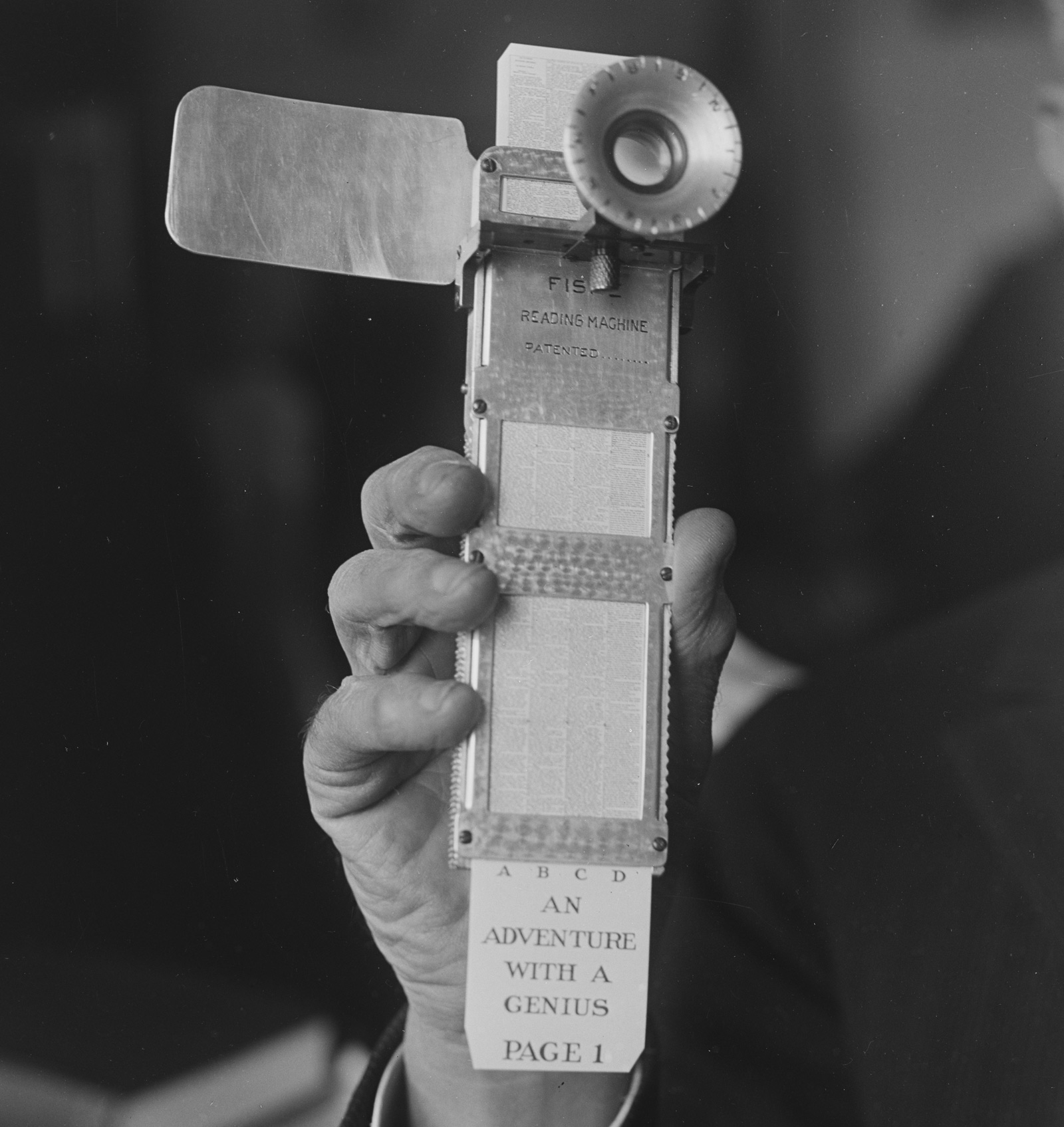
via Engadget
Related content:
Napoleon’s Kindle: See the Miniaturized Traveling Library He Took on Military Campaigns
The Page Turner: A Fabulous Rube Goldberg Machine for Readers
Based in Seoul, Colin Marshall writes and broadcasts on cities, language, and culture. His projects include the Substack newsletter Books on Cities, the book The Stateless City: a Walk through 21st-Century Los Angeles and the video series The City in Cinema. Follow him on Twitter at @colinmarshall or on Facebook.
Read More...An Asbestos-Bound, Fireproof Edition of Ray Bradbury’s Fahrenheit 451 (1953)
Even by the extreme standards of dystopian fiction, the premise of Ray Bradbury’s Fahrenheit 451 can seem a little absurd. Firemen whose job is to set fires? A society that bans all books? Written less than a decade after the fall of the Third Reich, which announced its evil intentions with book burnings, the novel explicitly evokes the kind of totalitarianism that seeks to destroy culture—and whole peoples—with fire. But not even the Nazis banned all books. Not a few academics and writers survived or thrived in Nazi Germany by hewing to the ideological orthodoxy (or at least not challenging it), which, for all its terrifying irrationalism, kept up some semblance of an intellectual veneer.
The novel also recalls the Soviet variety of state repression. But the Party apparatus also allowed a publishing industry to operate, under its strict constraints. Nonetheless, Soviet censorship is legendary, as is the survival of banned literature through self-publishing and memorization, vividly represented by the famous line in Mikhail Bulgokov’s The Master and Margarita, “Manuscripts don’t burn.”
Bulgakov, writes Nathaniel Rich at Guernica, is saying that “great literature… is fireproof. It survives its critics, its censors, and even the passage of time.” Bulgakov wrote from painful experience. When his diary was discovered by the NKVD in 1929, then returned to him, he “promptly burned it.” Sometime afterward, during the long composition of his posthumously published novel, he burned the manuscript, then later reconstructed it from memory.
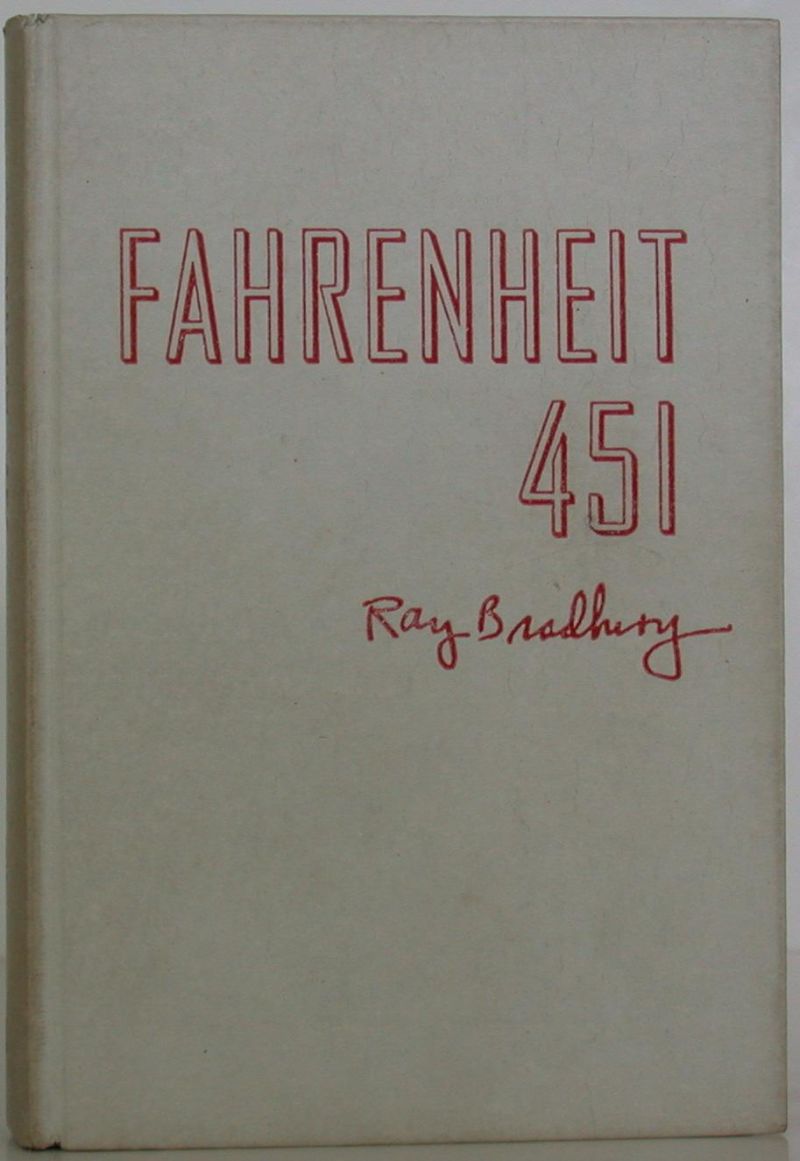
These examples bring to mind the exiled intellectuals in Bradbury’s novel, who have memorized whole books in order to one day reconstruct literary culture. Europe’s totalitarian regimes provide essential background for the novel’s plot and imagery, but its key context, Bradbury himself noted in a 1956 radio interview, was the anti-Communist paranoia of the U.S. in the early 1950s. “Too many people were afraid of their shadows,” he said, “there was a threat of book burning. Many of the books were being taken off the shelves at that time.” Reading the novel as a chilling vision of a future when all books are banned and burned makes the artifact pictured above particularly poignant—an edition of Fahrenheit 451 bound in fireproof asbestos.
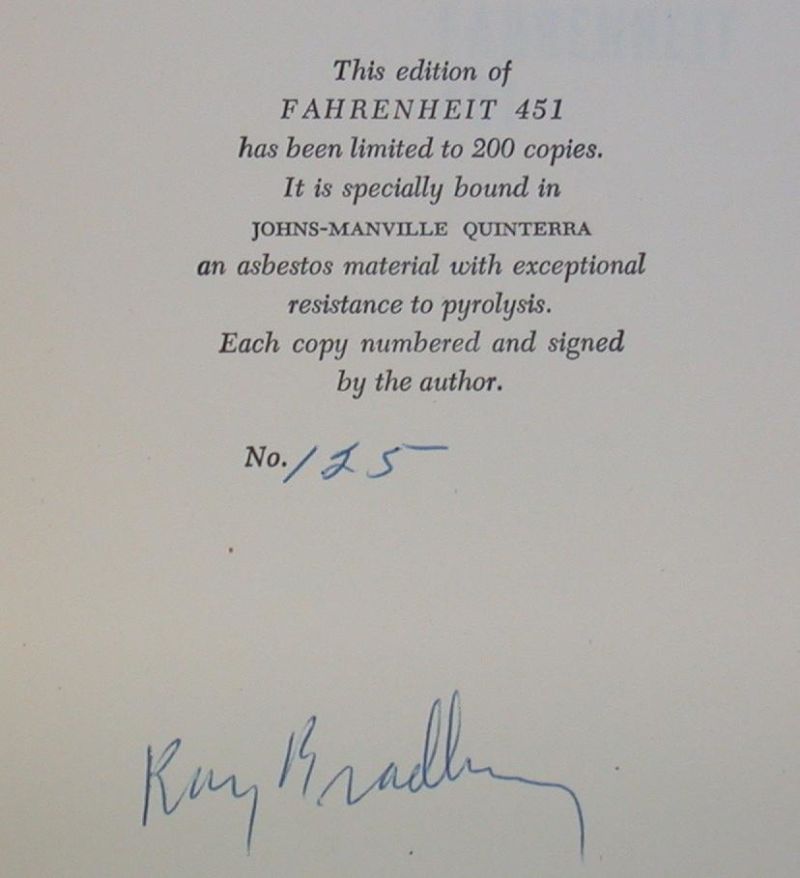
Released in 1953 by Ballantine in a limited run of two-hundred signed copies, the books were “bound in Johns-Manville Qinterra,” notes Lauren Davis at io9, “a chrysolite asbestos material.” Now the fireproof covers, with their “exceptional resistance to pyrolysis,” are “much sought after by collectors” and go for upwards of $20,000. A fireproof Fahrenheit 451, on the one hand, can seem a little gimmicky (its pages still burn, after all). But it’s also the perfect manifestation of a literal interpretation of the novel as a story about banning and book burning. All of us who have read the novel have likely read it this way, as a vision of a repressive totalitarian nightmare. As such, it feels like a product of mid-twentieth century fears.
Rather than fearing mass book burnings, we seem, in the 21st century, on the verge of being washed away in a sea of information (and dis- and mis-information). We are inundated with writing—in print and online—such that some of us despair of ever finding time to read the accumulating piles of books and articles that daily surround us, physically and virtually. But although books are still published in the millions, with sales rising, falling, then rising again, the number of people who actually read seems in danger of rapidly diminishing. And this, Bradbury also said, was his real fear. “You don’t have to burn books to destroy a culture,” he claimed, “just get people to stop reading them.”
We’ve misread Fahrenheit 451, Bradbury told us in his later years. It is an allegory, a symbolic representation of a grossly dumbed-down society, hugely oppressive and destructive in its own way. The firemen are not literal government agents but symbolic of the forces of mass distraction, which disseminate “factoids,” lies, and half-truths as substitutes for knowledge. The novel, he said, is actually about people “being turned into morons by TV.” Add to this the proliferating amusements of the online world, video games, etc. and we can see Bradbury’s Fahrenheit 451 not as a dated representation of 40s fascism or 50s repression, but as a too-relevant warning to a distractible society that devalues and destroys education and factual knowledge even as we have more access than ever to literature of every kind.
Related Content:
Josh Jones is a writer and musician based in Durham, NC. Follow him at @jdmagness
Read More...Discover Friedrich Nietzsche’s Typewriter, the Curious “Malling-Hansen Writing Ball” (Circa 1881)
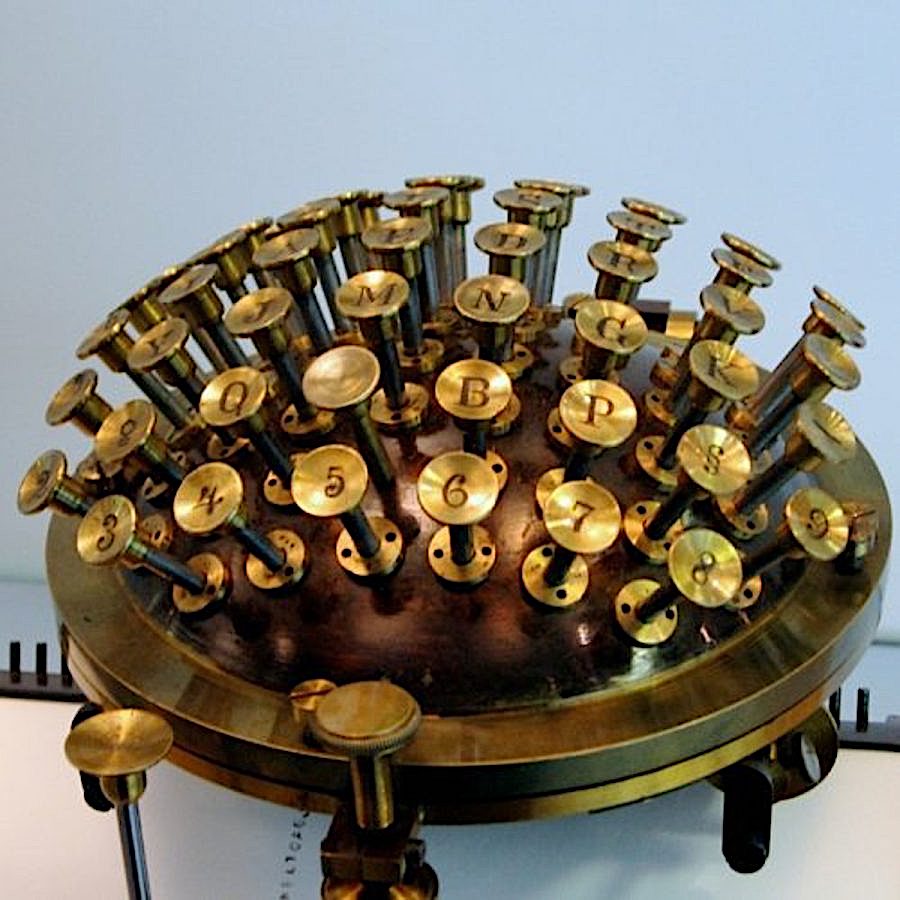
During his final decade, Friedrich Nietzsche’s worsening constitution continued to plague the philosopher. In addition to having suffered from incapacitating indigestion, insomnia, and migraines for much of his life, the 1880s brought about a dramatic deterioration in Nietzsche’s eyesight, with a doctor noting that his “right eye could only perceive mistaken and distorted images.”
Nietzsche himself declared that writing and reading for more than twenty minutes had grown excessively painful. With his intellectual output reaching its peak during this period, the philosopher required a device that would let him write while making minimal demands on his vision.
So he sought to buy a typewriter in 1881. Although he was aware of Remington typewriters, the ailing philosopher looked for a model that would be fairly portable, allowing him to travel, when necessary, to more salubrious climates. The Malling-Hansen Writing Ball seemed to fit the bill:
In Dieter Eberwein’s free Nietzches Screibkugel e‑book, the vice president of the Malling-Hansen Society explains that the writing ball was the closest thing to a 19th century laptop. The first commercially-produced typewriter, the writing ball was the 1865 creation of Danish inventor Rasmus Malling-Hansen, and was shown at the 1878 Paris Universal Exhibition to journalistic acclaim:
“In the year 1875, a quick writing apparatus, designed by Mr. L. Sholes in America, and manufactured by Mr. Remington, was introduced in London. This machine was superior to the Malling-Hansen writing apparatus; but the writing ball in its present form far excels the Remington machine. It secures greater rapidity, and its writing is clearer and more precise than that of the American instrument. The Danish apparatus has more keys, is much less complicated, built with greater precision, more solid, and much smaller and lighter than the Remington, and moreover, is cheaper.”
Despite his initial excitement, Nietzsche quickly grew tired of the intricate contraption. According to Eberwein, the philosopher struggled with the device after it was damaged during a trip to Genoa; an inept mechanic trying to make the necessary repairs may have broken the writing ball even further. Still, Nietzsche typed some 60 manuscripts on his writing ball, including what may be the most poignant poetic treatment of typewriters to date:
“THE WRITING BALL IS A THING LIKE ME:
MADE OF IRON YET EASILY TWISTED ON JOURNEYS.
PATIENCE AND TACT ARE REQUIRED IN ABUNDANCE
AS WELL AS FINE FINGERS TO USE US.”
In addition to viewing several of Nietzsche’s original typescripts at the Malling-Hansen Society website, those wanting a closer look at Nietzsche’s model can view it in the video below.
Note: This post originally appeared on our site in December 2013.
Ilia Blinderman is a Montreal-based culture and science writer. Follow him at @iliablinderman.
Related Content:
Mark Twain Wrote the First Book Ever Written With a Typewriter
The Keaton Music Typewriter: An Ingenious Machine That Prints Musical Notation
The Enduring Analog Underworld of Gramercy Typewriter
Read More...An AI Generated, Never-Ending Discussion Between Werner Herzog and Slavoj Žižek
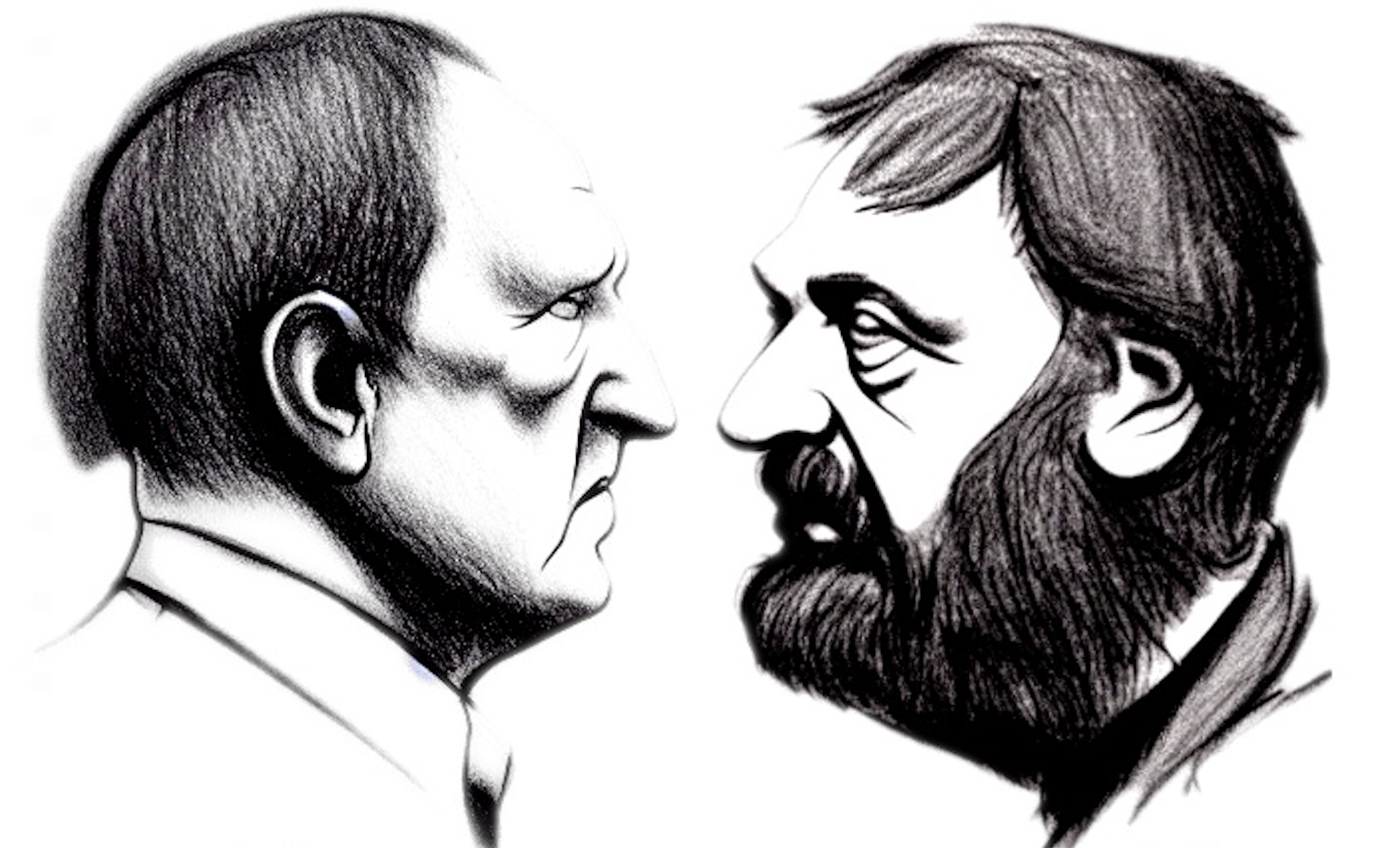
From the site Infinite Conversation comes an AI generated, never-ending discussion between Werner Herzog and Slavoj Žižek. What’s the point of this AI generated conversation? The creator explains:
As of late 2022, it’s cheap and easy to produce AI-generated content that is superficially good and surprisingly similar to “the real thing”. This applies to videos resembling celebrities (commonly known as Deepfakes) or, as in the case of the Infinite Conversation, speech.
This project aims to raise awareness about the ease of using tools for synthesizing a real voice. Right now, any motivated fool can do this with a laptop in their bedroom. This changes our relationship with the media we consume online and raises questions about the importance of authoritative sources, breach of trust and gullibility.
Will this technology lead to a massive proliferation of sub-optimal-quality content? Should we simply distrust anything we see online? As new tools are developed to help identify generated content, I recommend maintaining a skeptical stance, particularly when the source/channel of information doesn’t seem reliable and when the claims seem preposterous or outrageous.
Ultimately, I don’t see this as a technical problem, but as a human one. We all share a duty to educate the coming generations about the new paradigm while focusing on forming compassionate individuals who would not misuse these awesome powers.
As an AI optimist, I remain hopeful that we will be able to regulate ourselves, and that we will take experiments such as the Infinite Conversation for what they are: a playful way to help us imagine what our favorite people would do, if we had unlimited access to their minds. Art and Philosophy, here exemplified by Bavarian director Werner Herzog and Slovenian philosopher Slavoj Žižek, can guide us while navigating these treacherous waters.
Listen to the endless Herzog-Žižek conversation here.
If you would like to support the mission of Open Culture, consider making a donation to our site. It’s hard to rely 100% on ads, and your contributions will help us continue providing the best free cultural and educational materials to learners everywhere. You can contribute through PayPal, Patreon, and Venmo (@openculture). Thanks!
Related Content
Werner Herzog Offers 24 Pieces of Filmmaking and Life Advice
Slavoj Žižek: What Fulfils You Creatively Isn’t What Makes You Happy
Werner Herzog Narrates the Touching, Existential Journey of a Plastic Bag
Read More...
Bruce Springsteen Performs Moving Acoustic Versions of “Thunder Road,” “The Rising” & “Land of Hope & Dreams” on the Howard Stern Show
After trying for 35 years, the Howard Stern Show finally landed an interview with Bruce Springsteen–an interview that lasted 2 hours and 15 minutes and covered a tremendous amount of ground. Along the way, Springsteen talked about his song-writing process and the origins of his classic songs, and then performed some acoustic versions, alternating between guitar and piano. Above and below, you can watch stirring performances of “Thunder Road,” “The Rising,” “Land of Hope and Dreams,” “Born to Run, and “Tougher Than the Rest.”
Those who have the Sirius XM app can watch the entire performance online. For those who don’t, you can always sign up for a free trial to the service.
Land of Hope and Dreams
The Rising
Tougher Than the Rest
Born to Run
If you would like to support the mission of Open Culture, consider making a donation to our site. It’s hard to rely 100% on ads, and your contributions will help us continue providing the best free cultural and educational materials to learners everywhere. You can contribute through PayPal, Patreon, and Venmo (@openculture). Thanks!
Related Content
Read More...Making Sense of Nathan Fielder’s The Rehearsal with Pretty Much Pop: A Culture Podcast #136
Mark Linsenmayer, Lawrence Ware, Sarahlyn Bruck, and Al Baker convene an emergency podcast recording to react to this mind-bending, possibly immoral HBO comedy docuseries, wherein Fielder helps ordinary people rehearse difficult personal confrontations, but this plan goes off the rails after 1.5 episodes out of the six that made up its first season.
This series builds upon Fielder’s previous show where he comedically tried to help businesses, Nathan for You, whose ground-breaking finale (“Finding Frances”) discovered The Rehearsal‘s format. Is Nathan himself the main butt of the joke, or is he punching down? Are there better ways to show the failings of reality TV? How does this kind of embarrassment humor differ from Borat and its ilk? Maybe the show is not as much about these people going through their rehearsals as an examination of the process of rehearsing itself that Fielder has devised.
Feel free to listen to us to find out what it’s all about, but you will be best served by watching this indescribable show yourself before experiencing this episode.
A few relevant articles also considering the show include:
- “Four Ways of Looking at The Rehearsal” by Alissa Wilkinson
- “The Cruel and Arrogant Gaze of Nathan Fielder’s ‘The Rehearsal’” by Richard Brody
- “How The Rehearsal Pushes the Boundaries of Reality TV” by Adrian Horton
- “Nathan Fielder Can’t Stop Faking It in The Rehearsal” by Joy Press
- “Oregon-filmed ‘The Rehearsal’ inspires critical debate: ‘Intensely comical’ or ‘cruel?’” by Kristi Turnquist
Follow us @law_writes, @sarahlynbruck, @ixisnox, @MarkLinsenmayer.
Hear more Pretty Much Pop. Support the show and hear bonus talking for this and nearly every other episode at patreon.com/prettymuchpop or by choosing a paid subscription through Apple Podcasts. This podcast is part of the Partially Examined Life podcast network.
Pretty Much Pop: A Culture Podcast is the first podcast curated by Open Culture. Browse all Pretty Much Pop posts.
Read More...Watch World War II Unfold Day by Day: An Animated Map
In the story of World War II we all know, a handful of murderous villains and flawed yet capable defenders of democracy drive the narrative. The authors of a Kings College London project argue that this conventional history shows “a preoccupation with the culpability of statesmen.…. Above all else, the debate about war in 1939 revolves around personalities.” But there is another way to see the causes of war: through the escalating arms race of the 1930s, despite the global push for disarmament following World War I’s devastation.
The leaders of Germany, Italy and Japan wanted war, yet their ability to wage it, and the ways in which that war played out, came down to logistical contests between war machines. “First in Berlin, then in Rome and finally in Tokyo,” writes historian Joseph Maiolo, “the ebb and flow of arms competition compelled leaders to make now-or-never decisions about war.” Such decisions produced a wealth of unintended consequences, and led to catastrophic losses of life. Air, sea, and land power created at an unheard-of industrial scale turned war into an assembly line-like process that “would see humans as no more than pieces of a larger military-industrial machine,” as theorist of war Manuel De Landa writes.
Thus, we see the enormity of the casualties of WWII. Millions of soldiers were fed to the front lines in “the need to prepare for future total wars that would demand sweeping mobilization,” writes Maiolo. Wars for global supremacy demanded all of the state’s capital, especially its human resources. The animated map above tells that story in raw numbers: “WWII Every Day with Army Sizes.” Beginning with Germany’s declaration of war on Poland on September 1st, 1939, the map covers the entirety of the war, showing numbers — sometimes in the tens of millions — fluctuating wildly along the front lines of every theater.
1939 may be the only logical starting point for this presentation. Yet when it comes to understanding why World War II claimed more lives than any other war in history, the explanation must begin several years earlier with arms dealers and generals seeking bigger and bigger budgets for more sophisticated weaponry. As technical problems increased so too did the human costs, until the struggle for global supremacy during WWII became a proliferating race toward mutually assured destruction after the war’s end.
Related Content:
Watch World War II Rage Across Europe in a 7 Minute Time-Lapse Film: Every Day From 1939 to 1945
Josh Jones is a writer and musician based in Durham, NC. Follow him at @jdmagness
Read More...Discover Nüshu, a 19th-Century Chinese Writing System That Only Women Knew How to Write
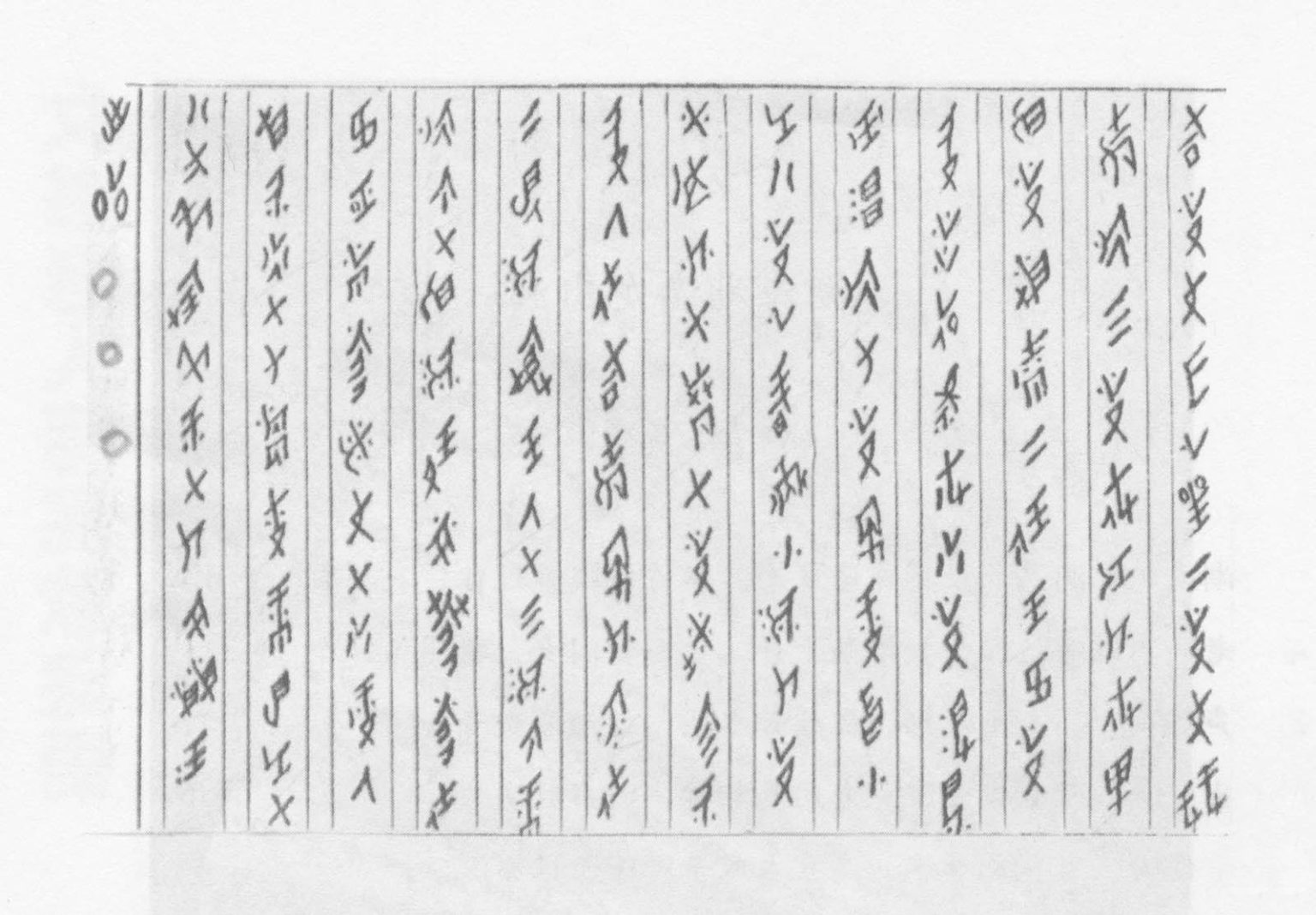
Literacy in Chinese may now be widely attained, but it isn’t easily attained. Just a century ago it wasn’t widely attained either, at least not by half of the Chinese speakers alive. As a rule, women once weren’t taught the thousands of logographic characters necessary to read and write in the language. But in one particular section of the land, Jiangyong County in Hunan province, some did master the 600 to 700 characters of a phonetic script made to reflect the local dialect and now called Nüshu (女书), or “women’s writing.”
In its heyday, Nüshu’s users had a variety of names for it, “including ‘mosquito writing,’ because it is a little slanted and with long ‘legs,’ ” writes Ilaria Maria Sala in a Quartz piece on the script’s history. Its greatest concentration of practitioners lived in “the village of Shangjiangxu, where young girls exchanged small tokens of friendly affection, such as fans decorated with calligraphy or handkerchiefs embroidered with a few auspicious words.”
Other, more formal occasions for the use of Nüshu, included when girls decided to “make a full-fledged pact of closeness with one another that they were ‘best friends’ — jiebai zimei or ‘sworn sisters’ — a relationship that was recognized as valuable and even necessary for them in the local social system. Such a once-obscure chapter of Chinese history has proven irresistible to readers from a variety of cultures in recent decades.
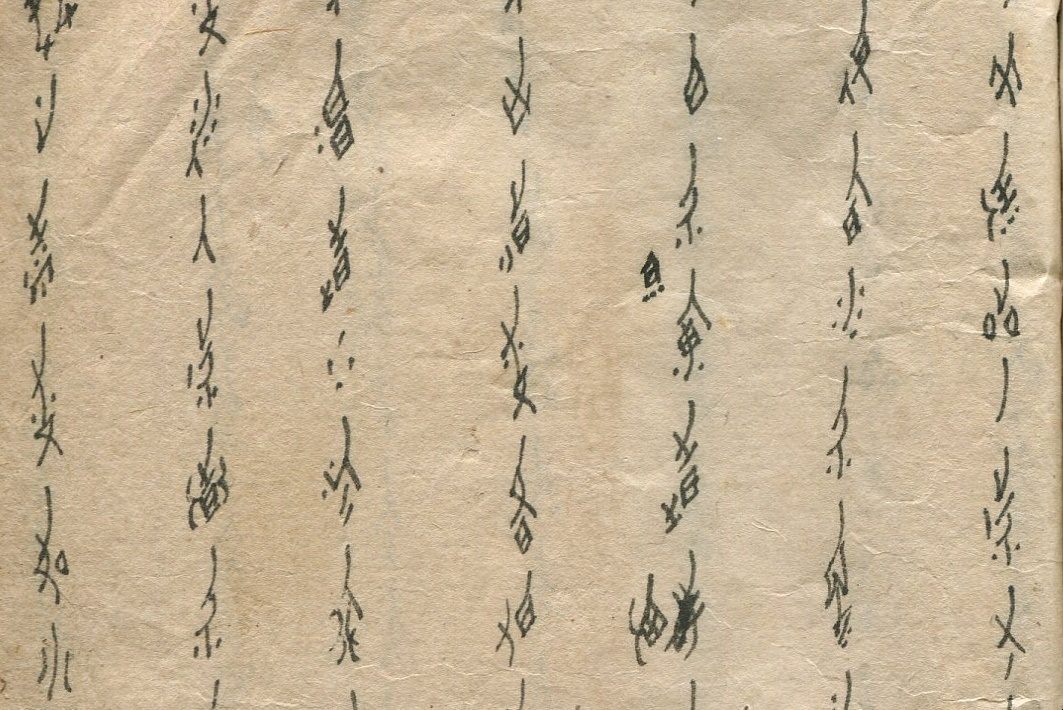
“Most interpretations and headlines have been about a ‘secret language’ that women used, preferably to communicate their pain,” writes Sala, which struck her as evidence of people taking the story of Nüshu and “reading into it what they wanted, regardless of what it meant.” Yet such an interpretation has surely done its part to spread interest in the near-extinct’s script’s revival, described by BBC.com’s Andrew Lofthouse as originating in “the tiny village of Puwei, which is surrounded by the Xiao river and only accessible via a small suspension bridge.” After three Nüshu writers were discovered there in the eighties, “it became the focal point for Nüshu research. In 2006, the script was listed as a National Intangible Cultural Heritage by the State Council of China, and a year later, a museum was built on Puwei Island.”
There training is provided to the few select “interpreters or ‘inheritors’ of the language, learning to read, write, sing and embroider Nüshu.” Ironically, Lofthouse adds, “much of what we know about Nüshu is due to the work of male researcher Zhou Shuoyi” who happened to hear of it in the nineteen-fifties and was later persecuted during Mao Zedong’s Cultural Revolution — a treatment that included 21 years in a labor camp — for having researched such an artifact of the feudal past. Once a useful tool for expressing emotions and performing social rituals socialization, Nüshu had become politically dangerous. What it becomes now, half a century later and with its renewal only just beginning, is up to its new learners.
Related content:
How Writing Has Spread Across the World, from 3000 BC to This Year: An Animated Map
Based in Seoul, Colin Marshall writes and broadcasts on cities, language, and culture. His projects include the Substack newsletter Books on Cities, the book The Stateless City: a Walk through 21st-Century Los Angeles and the video series The City in Cinema. Follow him on Twitter at @colinmarshall or on Facebook.
Read More...There Are Eight Forms of Intelligence, Not Just One: Which Apply to You?
Intelligence is a fraught subject of discussion, and only becoming more so. Among the frameworks developed safely to approach it, one has gained special prominence: the theory championed by developmental psychologist Howard Gardner, author of the book Frames of Mind: The Theory of Multiple Intelligences. And how many such intelligences are there? In the Big Think video above — posted in 2016, 33 years after Frames of Mind — he names ten: language, logic and mathematics, musical, spatial, bodily-kinesthetic, interpersonal, intrapersonal, naturalist, teaching, and existential.
Some of these may strike you as only tangentially related to intelligence, traditionally defined. Gardner has considered this: “People say, ‘Well, music’s a talent, it’s not an intelligence.’ And I say, ‘Well, why, if you’re good with words, is that an intelligence, but if you’re good with tones and rhythms and timbres…”
Nobody, in his telling, has ever come up with a convincing response. Hence his mission to expand the definition of intelligence beyond the aggregate measure of brainpower long known as the general intelligence factor — or more commonly, “g factor” — to encompass the sort of skills whose usefulness we can see in the real world, away from the constructed rigors of psychometric tests.
“Whether there’s eight intelligences or ten or twelve is less important to me than having broken the monopoly of a single intelligence, which sort of labels you for all time,” says Gardner. You can see eight of his intelligences broken down in more detail — and perhaps even identify your own strongest suit — in the Practical Psychology video just above. Gardner also expresses optimism about our ability to develop different intelligences: you can choose to concentrate on a specific one, but “if you want to be a jack of all trades and be very well-rounded, then you’re probably going to want to nurture the intelligences which aren’t that strong.” Whatever your own view on multiple intelligences, don’t forget how the old saying originally went in full: “Jack of all trades, master of none, though often better than a master of one.”
Related content:
Why You Do Your Best Thinking In The Shower: Creativity & the “Incubation Period”
Based in Seoul, Colin Marshall writes and broadcasts on cities, language, and culture. His projects include the Substack newsletter Books on Cities, the book The Stateless City: a Walk through 21st-Century Los Angeles and the video series The City in Cinema. Follow him on Twitter at @colinmarshall or on Facebook.
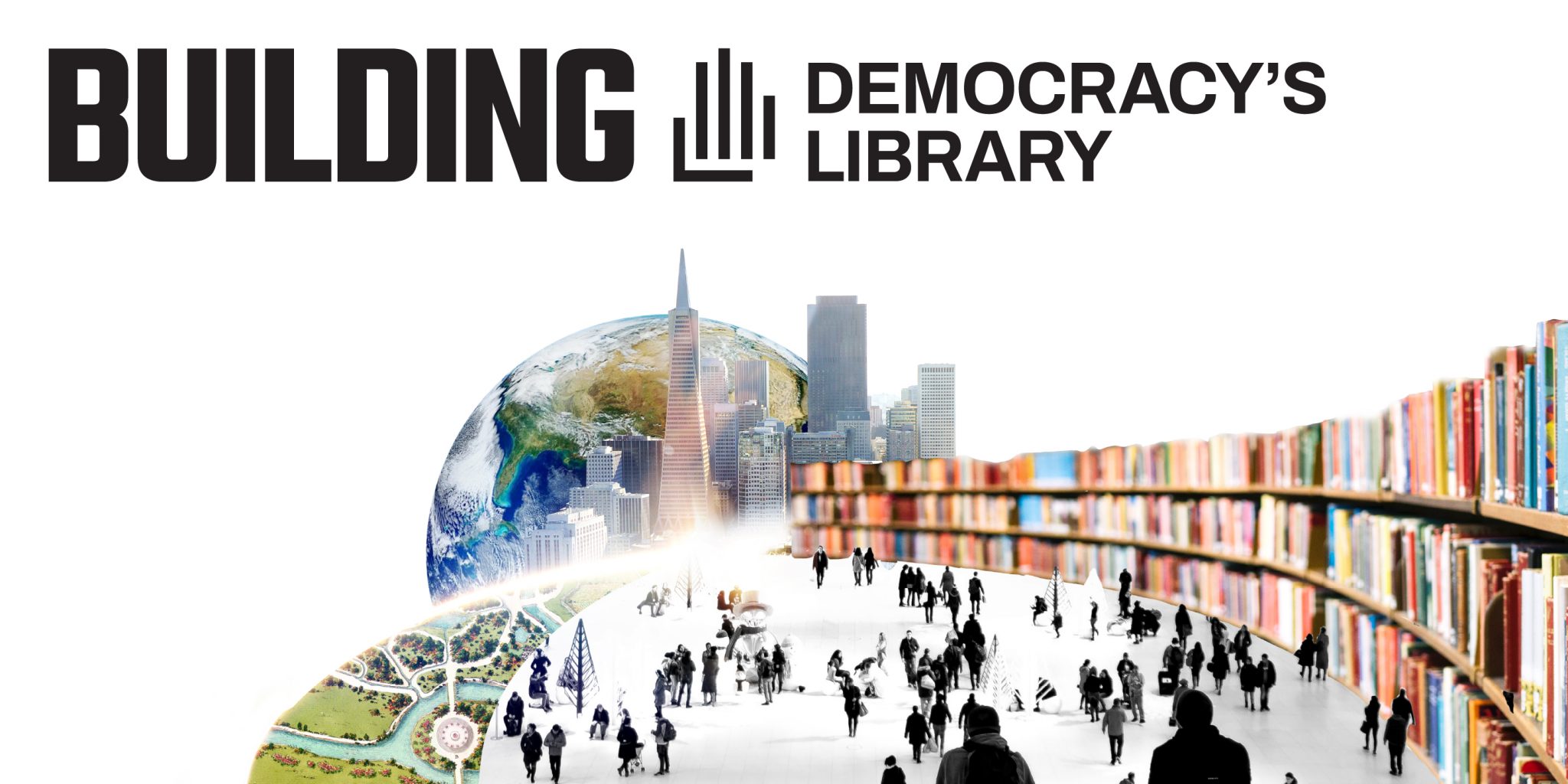
Read More...The Internet Archive Launches Democracy’s Library, a Free Online Library of 500,000 Documents Supporting Democracy
“Democracy is the worst form of government except all those other forms that have been tried from time to time.” So said Winston Churchill, perhaps not suspecting how frequently the remark would be quoted in the decades thereafter. Time and experience continue to reveal to us democracy’s liabilities, but also — at least in certain societies — the nature of its surprising staying power. Since well before Churchill’s time, democracy and its workings have been objects of fascination the world over. So have its central questions, not least the one of just how to maintain the “informed citizenry” on which its operation supposedly depends.
The Internet Archive has just launched its own kind of answer in the form of Democracy’s Library. “A free, open, online compendium of government research and publications from around the world,” the site offers citizens a way to “leverage useful research, learn about the workings of their government, hold officials accountable, and be more informed voters.”
Collected from a variety of governmental bodies like the United States’ National Agricultural Library, Foreign Broadcast Information Service, and National Institute of Standards and Technology Research Library — as well as Statistics Canada and Public Accounts of Canada — its materials were ostensibly produced for the public, but haven’t always been easy to find. It total, there are more than 500,000 documents in the collection.
“Governments have created an abundance of information and put it in the public domain, but it turns out the public can’t easily access it,” says Brewster Kahle, founder of the Internet Archive. He gives one of the series of talks that comprise “Building Democracy’s Library,” the launch celebration that took place last week and that you can still watch in the video above. Its proceedings go into quite a bit of detail about the efforts of acquisition and organization that went into this project, as well as the nature of its mission. For this isn’t just an effort to document democracy, but to strengthen it by making the information it produces available as conveniently as possible to as many citizens as possible. And no matter the country of which you count yourself a citizen, you can start browsing Democracy’s Library here.
Related content:
Does Democracy Demand the Tolerance of the Intolerant? Karl Popper’s Paradox
Based in Seoul, Colin Marshall writes and broadcasts on cities, language, and culture. His projects include the Substack newsletter Books on Cities, the book The Stateless City: a Walk through 21st-Century Los Angeles and the video series The City in Cinema. Follow him on Twitter at @colinmarshall or on Facebook.
Read More...Support Us
We're hoping to rely on loyal readers, rather than erratic ads. Please click the Donate button and support Open Culture. You can use Paypal, Venmo, Patreon, even Crypto! We thank you!

About Us

Open Culture scours the web for the best educational media. We find the free courses and audio books you need, the language lessons & educational videos you want, and plenty of enlightenment in between.
Advertise With Us
FREE UPDATES!
GET OUR DAILY EMAIL
Get the best cultural and educational resources on the web curated for you in a daily email. We never spam. Unsubscribe at any time.
FOLLOW ON SOCIAL MEDIA
Open Culture editor Dan Colman scours the web for the best educational media. He finds the free courses and audio books you need, the language lessons & movies you want, and plenty of enlightenment in between.
Advertise With Us

