Watch Björk, Age 11, Read a Christmas Nativity Story on an Icelandic TV Special (1976)
The holidays can be hard, starting in October when the red and green decorations begin muscling in on the Halloween aisle.
Most Wonderful Time of the Year, you say? Oh, go stuff a stocking in it, Andy Williams!
The majority of us have more in common with the Grinch, Scrooge, and/or the Little Match Girl.
Still, it’s hard to resist the preternaturally mature 11-year-old Björk reading the nativity story in her native Icelandic, backed by unsmiling older kids from the Children’s Music School in Reykjavík.
Particularly since I myself do not speak Icelandic.
The fact that it’s in black and white is merely the blueberries on the spiced cabbage.
It speaks highly of the Icelandic approach to education that a principal’s office regular who reportedly chafed at her school’s “retro, constant Beethoven and Bach bollocks” curriculum was awarded the plum part in this 1976 Christmas special for the National Broadcasting Service.
It would also appear that little Björk, the fiercely self-reliant latchkey kid of a Bohemian single mother, was far and away the most charismatic kid enrolled in the Barnamúsikskóli.
(Less than a year later her self-titled first album sold 7000 copies in Iceland—a modest amount compared to Adele’s debut, maybe, but c’mon, the kid was 11! And Iceland’s population at the time was a couple hundred thousand and change.)
As to the above performance’s religious slant, it wasn’t a reflection of her personal beliefs. As she told the UK music webzine Drowned in Sound in 2011:
…nature is my religion, in a way… I think everybody has their own private religion. I guess what bothers me is when millions have the same one. It just can’t be true. It’s just…what?
Still, it probably wasn’t too controversial that the programmers elected to cleave to the reason in the season. Icelandic church attendance may be low-key, but the overwhelming majority of its citizens identify as Lutheran, or some other Christian denomination.
(They also believe in elves and 13 formerly fearsome Yule Lads, descendants of the ogres Grýla and Leppalúði. By the time Björk appeared on earth, they had long since evolved, through a combination of foreign influence and public decree, into the kinder, gentler, not quite Santa-esque version, addressing the studio audience at the top of the act.)
Note: An earlier version of this post appeared on our site in 2015.
Related Content:
Hear the Album Björk Recorded as an 11-Year-Old: Features Cover Art Provided By Her Mom (1977)
Ayun Halliday is an author, illustrator, and Chief Primatologist of the East Village Inky zine. She is proud to originated the role of Santa’s mortal consort, Mary, in her Jewish husband Greg Kotis’ Nordic-themed holiday fantasia, The Truth About Santa. Follow her @AyunHalliday
Read More...The History of Western Art in 23 Minutes: From the Prehistoric to the Contemporary
Among the ranks of Open Culture readers, there are no doubt more than a few art-history majors. Perhaps you’ve studied the subject yourself, at one time or another — and perhaps you find that by now, you remember only certain scattered artists, works, and movements. What you need is a grand narrative, a broad story of art itself, and that’s just what you’ll find in the video above from Youtube channel Behind the Masterpiece. True to its title, “A Brief History of Art Movements” briefly describes, and provides a host of visual examples to illustrate, 22 phases in the development of art in just 23 minutes.
The journey begins in prehistory, with cave paintings from 40,000 years ago apparently created “as a way to share information.” Then comes the art of antiquity, when increasingly literate societies “started creating the earliest naturalistic images of human beings,” not least to enforce “religious and political ideologies.” The religiosity intensified in the Middle Ages, when artists “depicted clear, iconic images of religious figures” — as well as their oddly aged-looking babies — “and decorated them with extensive use of gold and jewels as a way to attract more people to the church.”
When many us think of art history — whether we studied it or not — our minds go straight to the subsequent period, the Renaissance, during which “artists started to appreciate cultural subjects like art, music, and theater” as well. They created “portrait paintings, anatomically correct sculptures, and symmetrical architecture,” and the invention of the printing press greatly expanded the pool of potential appreciators. Then, in the Baroque movement, enormously skilled artists like Bernini and Caravaggio “emphasized extravagance and emotion,” and other forms followed suit with more intense embellishments of their own.
From eighteenth-century France emerged the “playful and utopian” Rococo period, which was followed by the backward-looking “interest in renewed simplicity” that characterized Neoclassicism, which was followed by Romanticism, a movement whose artists “looked within and found inspiration in their own imaginations, and the nature around them.” It was the leveling French Revolution that brought about the conditions for the rise of Realism, with its focus on “depicting real people in everyday life,” the kind of subjects to that point overlooked in major works of art.
In the second half of the nineteenth century the development of art hit the gas, bringing on the imperfect vitality of Impressionism, the daring subjectivity of Post-Impressionism, the extreme subjectivity of Expressionism, and the sinuous luxury of Art Nouveau. Technology had always been a factor in how art changes, but in the twentieth century — as Cubism gave way to Futurism, Dadaism, Surrealism, and the Bauhaus — it came to the fore. This brings us up to living memory: movements like Abstract Expressionism, Pop Art, Minimalism, and the inclination of today’s artists to deal in “ideas rather than aesthetics,” all on display in most any museum you care to visit. Or at least they are in the museums of the West, there being, after all, a whole world of other art histories out there to understand besides.
Related content:
Free Art & Art History Courses
100,000 Free Art History Texts Now Available Online Thanks to the Getty Research Portal
An Introduction to 100 Important Paintings with Videos Created by Smarthistory
Tate Kids Presents Introductions to Art Movements: Cubism, Impressionism, Surrealism & More
Based in Seoul, Colin Marshall writes and broadcasts on cities, language, and culture. His projects include the Substack newsletter Books on Cities, the book The Stateless City: a Walk through 21st-Century Los Angeles and the video series The City in Cinema. Follow him on Twitter at @colinmarshall or on Facebook.
Read More...How to Get Dressed & Fight in 14th Century Armor: A Reenactment
For a medieval knight, physical combat in a full suit of armor could hardly have been a simple matter — but then, nor could the task of putting it on in the first place. You can see the latter depicted in the video above from Norwegian history buff Ola Onsrud. He describes the armor as a “detailed reconstruction based on the effigy of the Black Prince (1330–1376) in the Canterbury Cathedral, other relevant effigies, paintings in fourteenth-century manuscripts and late fourteenth-century armor displayed in The Royal Armories in Leeds.” If you’ve so much as glanced at such imagery, Onsrud’s armor should strike you as looking quite like the real deal.
But this is functional clothing, after all, and as such must be put to the test. Onsrud does so in the video just below, a demonstration of how the wearer of such armor would actually do hand-to-hand combat. “To make comments, the visor of my helmet is open through most of the video,” he notes.
“This will of course make my face an interesting target for my adversary.” In a real medieval battle, of course, the helmet would be closed, and thus the combatants wouldn’t simply aim for the face. As Onsrud explains, the idea is to use one’s sword “against the weak spots of the armor. After finding a weak spot, I can put all my body weight behind it and drive it in.”
Medieval suits of armor turn out not to be as impenetrable as they look. Onsrud runs down a few of their major weak points, including the insides of the gloves, the armpits, and — most wince-inducingly of all — the groin. The defense capability of armor also varied depending upon the weapons used; even the best-suited-up had reason to fear an enemy with a poleaxe. “But the absolute best way to take down an armored knight is by using a lance from a horse,” especially a horse “galloping up to 40 kilometers an hour” whose combined weight with its rider could reach 700 kilograms. Surely even the most committed reenactor won’t do that on Youtube.
Related content:
How to Make and Wear Medieval Armor: An In-Depth Primer
What It’s Like to Actually Fight in Medieval Armor
How Well Can You Move in Medieval Armor?: Medievalist Daniel Jaquet Gives It a Try in Real Life
What’s It Like to Fight in 15th Century Armor?: A Surprising Demonstration
Based in Seoul, Colin Marshall writes and broadcasts on cities, language, and culture. His projects include the Substack newsletter Books on Cities, the book The Stateless City: a Walk through 21st-Century Los Angeles and the video series The City in Cinema. Follow him on Twitter at @colinmarshall or on Facebook.
Read More...How to Read Ancient Egyptian Hieroglyphs: A British Museum Curator Explains
If you want to learn to read hieroglyphics, you must first learn that (with apologies to the artists behind “You Never Knew”) there are no such things as hieroglyphics. There are only hieroglyphs, as the British Museum’s curator of ancient writing Ilona Regulski explains in the video just above, and hieroglyphic is the adjectival form. You may remember Regulski from another British Museum video we’ve featured here on Open Culture, about what the Rosetta Stone actually says — which she knows because she can actually read it, not just in the ancient Greek language, but in the ancient Egyptian one. Here, she explains how to interpret its once utterly mysterious symbols.
It would take an incurious viewer indeed not to be captivated by their first glimpse of hieroglyphs, which possess a kind of detail and beauty little seen in other writing systems. Or at least they do when carved into stone, Regulski explains; in more everyday contexts, the impressive arrangements of owls, ankhs, baskets, eyes, and bread loaves took on a more simplified, abstracted form.
Either way, it makes use of a complex and distinctive grammatical system about which we can draw a good deal of insight from examining a single inscription: in this case, an inscription on a lintel glorifying Amenemhat III, “one of the most famous kings of ancient Egypt.”
Those who feel their historical-linguistic curiosity piqued would do well to visit the British Museum’s current exhibition “Hieroglyphs: Unlocking Ancient Egypt,” which runs until February 19th of next year. If you can’t make it to London, you can still go a bit deeper with the video below. Drawn the Great Courses series “Decoding the Secrets of Egyptian Hieroglyphs,” it features Egyptologist Bob Brier’s breakdown of such relevant concepts as phonetics, determinatives, and ideograms, as well as guided exercises in sentence translation and name transliteration. After demonstrating admirable hieroglyphic penmanship (certainly compared to most moderns), Brier leaves us with a homework assignment — just the sort of thing the ancient Egyptians themselves were doing a few millennia ago.
Related content:
An Animated History of Writing: From Ancient Egypt to Modern Writing Systems
You Could Soon Be Able to Text with 2,000 Ancient Egyptian Hieroglyphs
What Ancient Egyptian Sounded Like & How We Know It
An Ancient Egyptian Homework Assignment from 1800 Years Ago: Some Things Are Truly Timeless
A 4,000-Year-Old Student ‘Writing Board’ from Ancient Egypt (with Teacher’s Corrections in Red)
Based in Seoul, Colin Marshall writes and broadcasts on cities, language, and culture. His projects include the Substack newsletter Books on Cities, the book The Stateless City: a Walk through 21st-Century Los Angeles and the video series The City in Cinema. Follow him on Twitter at @colinmarshall or on Facebook.
Read More...Succession Star Brian Cox Teaches Hamlet’s Soliloquy to a 2‑Year-Old Child
Perhaps you’ve seen Scottish actor Brian Cox perform with the Royal Shakespeare Company in critically-acclaimed performances of The Taming of The Shrew and Titus Andronicus. Or, more likely, you’ve seen him in the blockbuster HBO series, Succession. But there’s perhaps another role you haven’t seen him in: tutor of toddlers. A number of years back, Cox taught Theo, then only 30 months old, the famous soliloquy from Hamlet, hoping to show there’s a Shakespearean actor in all of us. Later, Cox talked to the BBC about his “masterclass” with Theo and what he took away from the experience. Watch him muse right below:
If you would like to support the mission of Open Culture, consider making a donation to our site. It’s hard to rely 100% on ads, and your contributions will help us continue providing the best free cultural and educational materials to learners everywhere. You can contribute through PayPal, Patreon, and Venmo (@openculture). Thanks!
Related Content:
Watch Brian Cox of “Succession” Read Hunter S. Thompson’s Profanity-Laden Letter
Pink Floyd’s David Gilmour Sings Shakespeare’s Sonnet 18
The History of Ancient Rome in 20 Quick Minutes: A Primer Narrated by Brian Cox
Read More...The First Kiss Captured on Film: Behold “The Kiss” Shot by Photography Pioneer Eadweard Muybridge (1887)
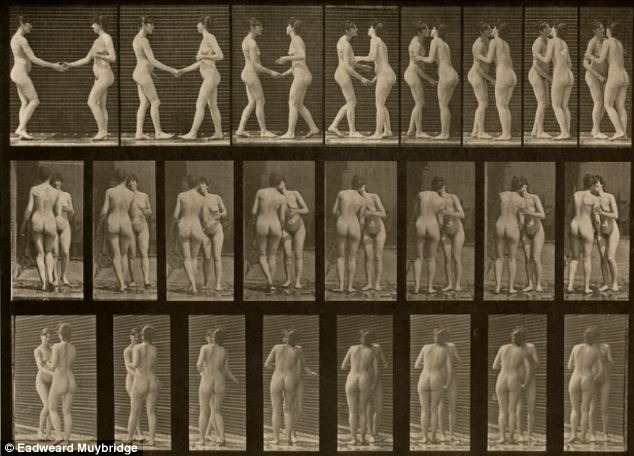
Every moving image we watch today descends, in a sense, from the work of Eadweard Muybridge. In the 1870s he devised a method of photographing the movements of animals, a study he expanded to humans in the 1880s. This constituted a leap toward the development of cinema, though you wouldn’t necessarily know it by looking at the best-known images he produced, such as the set of cards known as The Horse in Motion. You may get a more vivid sense of his photography’s import by seeing it in animated GIF form, as previously featured here on Open Culture, including the very first kiss on film.
Though he often worked with nude models, “Muybridge was not into smut and eroticism,” says Flashbak. “His rapid-fire sequential photographs of two naked women kissing served to aid his studies of human and animal movement. It was in the interests of art and science Muybridge secured the services of two women, invited them to undress and photographed them kissing.” This turns out to be somewhat more plausible than it sounds: the Muybridge online archive notes that “because of Victorian sexual taboos Muybridge was not able to photograph men and women naked together,” and in any case it was commonly believed that “women had little or no sex drive.”

Whatever its relationship to public morality at the time, Muybridge’s kiss suggested the shape of things to come. For a long time after the invention of cinema, writes the New York Times’ A. O. Scott, “a kiss was all the sex you could show on-screen.” Today, “we sometimes look back on old movies as artifacts of an innocent, more repressive time,” but the rich history of “the cinematic kiss” reveals “yearning and hostility, defiance and pleading, male domination and female assertion. There are unlikely physical contortions and suggestive compositions, sometimes imposed by the anti-lust provisions of the code” — the censorious “Hays Code” that restricted the content of American movies between 1934 and 1968 — “sometimes by the desire to breathe new formal life into a weary convention.” Muybridge may have been the first to figure out how to capture a kiss, but generations of filmmakers have had to reinvent the practice over and over ever since.
Related content:
Watch After the Ball, the 1897 “Adult” Film by Pioneering Director Georges Méliès (Almost NSFW)
Based in Seoul, Colin Marshall writes and broadcasts on cities, language, and culture. His projects include the Substack newsletter Books on Cities, the book The Stateless City: a Walk through 21st-Century Los Angeles and the video series The City in Cinema. Follow him on Twitter at @colinmarshall or on Facebook.
Read More...When the World Got Introduced to the Amazing Compact Disc (CD) in 1982
The first compact discs and players came out in October of 1982. That means the format is now 40 years old, which in turn means that most avid music-listeners have never known a world without it. In fact, all of today’s teenagers — that most musically avid demographic — were born after the CD’s commercial peak in 2002, and to them, no physical medium could be more passé. Vinyl records have been enjoying a long twenty-first-century resurgence as a premium product, and even cassette tapes exude a retro appeal. But how many understand just what a technological marvel the CD was when it made its debut, with (what we remember as) its promise of “perfect sound forever”?
“You could argue that the CD, with its vast data capacity, relatively robust nature, and with the further developments it spurred along, changed how the world did virtually all media.” So says Alec Watson, host of the Youtube channel Technology Connections, previously featured here on Open Culture for his five-part series on RCA’s SelectaVision video disc system.
But he’s also made a six-part miniseries on the considerably more successful compact disc, whose development “solved the central problem of digital sound: needing a for-the-time-absurdly massive amount of raw data.” Back then, computer hard drives had a capacity of about ten megabytes, whereas a single disc could hold up to 700 megabytes.
Figuring out how to encode that much information onto a thin 120-millimeter disc required serious resources and engineering prowess (available thanks to the involvement of two electronics giants, Sony and Philips), but it constituted only one of the technological elements needed for the CD to become a viable format. Watson covers them all in this miniseries, beginning with the invention of digital sound itself (including the Nyquist-Shannon sampling theorem on which it depends). He also explains such physical processes as how a CD player’s laser reads the “pits” and “lands” on a disc’s surface, producing a stream of numbers subsequently converted back into an audio signal for our listening pleasure.
The CD has also changed our relationship to that pleasure. “If CDs marked a new era, it is perhaps as much in the way they suggest specific ways of interacting with recorded music as in questions of fidelity,” writes The Quietus’ Daryl Worthington. “The fact CDs can be programmed, and tracks easily skipped, is perhaps their most significant feature when it comes to their legacy. They loosened up the album as a fixed document.” Paradoxically, “they’re also the format par excellence for the album as a comprehensive, self-contained unit to be played from start to finish.” Even if you can’t remember when last you put one on, fourteen million of them were sold last year, as against five million vinyl LPs and 200,000 cassettes. At 40, the CD may no longer feel like a miraculous technology, but we can hardly count it out just yet.
Related content:
The Story of How Beethoven Helped Make It So That CDs Could Play 74 Minutes of Music
The Story of the MiniDisc, Sony’s 1990s Audio Format That’s Gone But Not Forgotten
How Vinyl Records Are Made: A Primer from 1956
A Celebration of Retro Media: Vinyl, Cassettes, VHS, and Polaroid Too
Based in Seoul, Colin Marshall writes and broadcasts on cities, language, and culture. His projects include the Substack newsletter Books on Cities, the book The Stateless City: a Walk through 21st-Century Los Angeles and the video series The City in Cinema. Follow him on Twitter at @colinmarshall or on Facebook.
Read More...Joni Mitchell Tells Elton John the Stories Behind Her Iconic Songs: “Both Sides Now,” “Carey” & More
When Joni Mitchell heard the great cabaret artist Mabel Mercer in concert, she was so struck by the older woman’s rendition of “Both Sides Now,” the enduring ballad Mitchell wrote at the tender age of 23, that she went backstage to show her appreciation:
… but I didn’t tell her that I was the author. So, I said, y’know, I’ve heard various recordings of that song, but you bring something to it, y’know, that other people haven’t been able to do. You know, it’s not a song for an ingenue. You have to bring some age to it.
Well, she took offense. I insulted her. I called her an old lady, as far as she was concerned. So I got out of there in a hell of a hurry!
But I think I finally became an old lady myself and could sing the song right.
This is just one of many candid treats to be found in Mitchell’s interview with Elton John, for his Apple Music 1 show Rocket Hour.
For the most part, Mitchell’s reminiscences coalesce around various iconic tracks from her nearly sixty years in the music industry.
“Carey,” off Mitchell’s 1971 album Blue, sparks memories of an exploding stove during a hippie-era sojourn in Matala on Crete’s south coast, with an Odyssey reference thrown in for good measure.
“Amelia” was hatched, as were most of the tunes on 1976’s Hejira, while Mitchell was on a solo road trip in a secondhand Mercedes, an experience that caused her to dwell on the first female aviator to cross the Atlantic solo. (She scribbled down lyrics that had come to her at the wheel whenever she pulled over for lunch.)
Regarding “Sex Kills” from 1994’s Turbulent Indigo, John quotes a Rolling Stone article in which Mitchell discussed the “ugliness” she was detecting in popular music:
I think it’s on the increase. Especially towards women. I’ve never been a feminist, but we haven’t had pop songs up until recently that were so aggressively dangerous to women.
“What did you mean by that?” John asks. “ People saying rap music with ‘my hos’ and stuff like that?”
“Oh, well, y’know, yeah,” Mitchell says, “Hos and booty, y’know, hahahah.”
She may not seem overly fussed about it now, but don’t get her started on what young women wear to the Grammys!
John also invited Mitchell to discuss three songs that have influenced her.
Her picks:
Lambert, Hendricks & Ross’s “Charleston Alley” (a musical epiphany as a high schooler at a college party)
Edith Piaf’s “Les Trois Cloches” (a musical epiphany as an 8‑year-old at a birthday party)
And Chuck Berry’s “Johnny B. Goode” (dancing ‘round the jukebox at Saskatoon swimming pool)
Circling back to “Both Sides Now,” Mitchell prefers the orchestral arrangement she recorded as an alto in 2002 to the original’s girlish soprano, with its possibly unearned perspective. (“It’s not a song for an ingenue…”)
When I performed it, the orchestra gathered around me and I’ve played with classical musicians before and they were always reading the Wall Street Journal behind their sheet music and they always treat you like it’s a condescension to be playing with you, but everybody, the men — Englishmen! — were weeping!
Perhaps you too will be moved to tears, as singer-songwriter Brandi Carlile was during a performance of “Both Sides Now” as part of the 2022 Newport Folk Festival’s Joni Jam, Mitchell’s first show in 22 years, owing to a period of major disillusionment with the music business as well as a 2015 brain aneurysm.
Tune into more episodes of Elton John’s Rocket Hour here.
Related Content
Songs by Joni Mitchell Re-Imagined as Pulp Fiction Book Covers & Vintage Movie Posters
Hear Demos & Outtakes of Joni Mitchell’s Blue on the 50th Anniversary of the Classic Album
- Ayun Halliday is the Chief Primatologist of the East Village Inky zine and author of Creative, Not Famous: The Small Potato Manifesto and the soon to be released Creative, Not Famous Activity Book. Follow her @AyunHalliday.
Read More...Celebrate Kurt Vonnegut’s 100 Birthday with a Collection of Songs Based on His Work
There’s a passage from Kurt Vonnegut’s Breakfast of Champions that crosses our desk a lot at this time of year. It’s the one in which he declares Armistice Day, which coincidentally falls on his birthday, sacred:
What else is sacred? Oh, Romeo and Juliet, for instance.
And all music is.
Here, here!
Hopefully Shakespeare won’t take umbrage if we skip over his doomed teenaged lovers to celebrate Kurt Vonnegut’s 11/11 Centennial with songs inspired by his work.
Take the Kilgore Trout Experience’s tribute to Sirens of Titan, above.
The driving force behind the KTE Tim Langsford, a drummer who mentors Autistic students at the University of Plymouth, was looking for ways to help his “foggy mind remember the key concepts, characters, and memorable lines that occur in each” of Vonnegut’s 14 books.
The solution? Community and accountability to an ongoing assignment. Langsford launched the Plymouth Vonnegut Collective in 2019 with a typewritten manifesto, inviting interested parties to read (or re-read) the novels in publication order, then gather for monthly discussions.
His loftier goal was for book club members to work collaboratively on a 14-track concept album informed by their reading.
They stuck to it, with efforts spanning a variety of genres.
Mother Night might make your ears bleed.
The psychedelic God Bless You, Mister Rosewater mixes quotes from the book with edited clips of the collective’s discussion of the novel.
The project pushed Langsford out from behind the drum kit, as well as his comfort zone:
It has taken an awful lot to be comfortable with the songs on which I sing. However, I have tried to invoke KV’s sense of creation as if no one is watching. It doesn’t matter so do it for yourself…. Although do I contradict that by sharing these things to the internet rather than trashing them unseen or unheard?!
Ah, but isn’t one of the most beautiful uses of the Internet as a tool for finding out what we have in common with our fellow humans?
Congratulations to our fellow Vonnegut fans in Plymouth, who will be celebrating their achievement and the legendary author’s 100th birthday with an event featuring poetry, art, music and film inspired by the birthday boy’s novels.
Folk rocker Al Stewart is another who “was drawn by the Sirens of Titan.” The lyrics make perfect sense if the novel is fresh in your mind:
But here in the yellow and blue of my days
I wander the endless Mercurian caves
Watching for the signs the Harmonians make
The words on the walls
The lyrics to Nice, Nice, Very Nice by Stewart’s peers in Ambrosia are pulled straight from the holy scripture of Bokononism, the religion Vonnegut invented in Cat’s Cradle.
The band gave the author a writing credit. He repaid the compliment with a fan letter:
I was at my daughter’s house last night, and the radio was on. By God if the DJ didn’t play our song, and say it was number ten in New York, and say how good you guys are in general. You can imagine the pleasure that gave me. Luck has played an enormous part in my life. Those who know pop music keep telling me how lucky I am to be tied in with you. And I myself am crazy about our song, of course, but what do I know and why wouldn’t I be? This much I have always known, anyway: Music is the only art that’s really worth a damn. I envy you guys.
If that isn’t nice, we don’t know what is.
Vonnegut’s best known work, the time-traveling, perennially banned anti-war novel, Slaughterhouse-Five, presents an irresistible songwriting challenge, judging from the number of tunes that have sprouted from its fertile soil.
Susan Hwang is uniquely immersed in all things Vonnegut, as founder of the Bushwick Book Club, a loose collective of musicians who convene monthly to present songs inspired by a pre-selected title — including almost every novel in the Vonnegut oeuvre, as well as the short stories in Welcome to the Monkey House and the essays comprising A Man Without a Country.
She was a Kurt Vonnegut Museum & Library 2022 Banned Books Week artist-in-residence.
She titled her recent EP of five Vonnegut-inspired songs, Everything is Sateen, a nod to the Sateen Dura-Luxe house paint Vonnegut’s abstract expressionist, Rabo Karabekian, favors in Bluebeard.
We’re fairly confident that Hwang’s No Answer, offered above as a thank you to crowdfunders of a recent tour, will be the bounciest adaptation of Slaughterhouse-Five you’ll hear all day.
Keep listening.
Sweet Soubrette, aka Ellia Bisker, another Bushwick Book Club fixture and one half of the goth-folk duo Charming Disaster, leaned into the horrors of Dresden for her Slaughterhouse-Five contribution, namechecking rubble, barbed wire, and the “mustard gas and roses” breath born of a night’s heavy drinking.
Songwriting musicologist Gail Sparlin’s My Blue Heaven: The Love Song of Montana Wildhack — seen here in a library performance — is as girlish and sweet as Valerie Perrine’s take on the character in George Roy Hill’s 1972 film of Slaughterhouse-Five.
Back in 1988, Hawkwind’s The War I Survived suffused Slaughterhouse-Five with some very New Wave synths…
The chorus of Sam Ford’s wistful So It Goes taps into the novel’s time traveling aspect, and touches on the challenges many soldiers experience when attempting to reintegrate into their pre-combat lives :
That ain’t the way home
Who says I wanna go home?
I’m always home
I’m always home.
Having invoked Vonnegut’s evergreen phrase, there’s no getting away without mentioning Nick Lowe’s 1976 power pop hit, though it may make for a tenuous connection.
Hi ho!
Still, tenuous connections can count as connections, especially when you tally up all the references to Cat’s Cradle’s secret government weapon, Ice Nine, in lyrics and band names.
Then there are the submerged references. We may not pick up on them, but we’re willing to believe they’re there.
Pearl Jam’s front man Eddie Vedder wrote that “books like Cat’s Cradle, God Bless You, Mr. Rosewater, Player Piano…they’ve had as much influence on me as any record I’ve ever owned.”
He also earned a permanent spot in the karass by passing out copies of Bluebeard to attendees at the 4th Annual Kokua Festival to benefit environmental education in Hawaii.
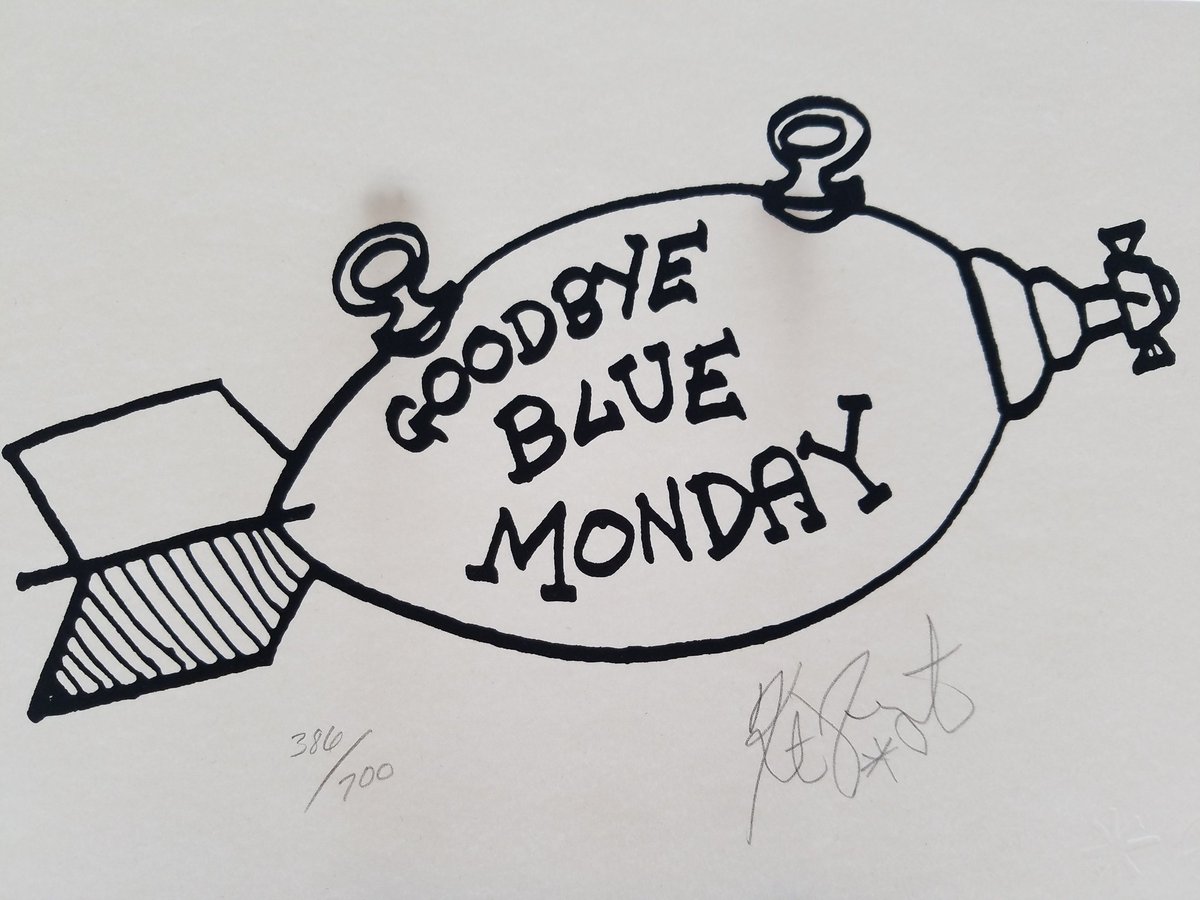
A memorable Breakfast of Champions illustration is said to have lit a flame with New Order, propelling Vonnegut out onto the dance floor.
And Ringo Starr edged his way to favorite Beatle status when he tipped his hat to Breakfast of Champions, dedicating his 1973 solo album to “Kilgore Trout and all the beavers.”
There are dozens more we could mention — you’ll find some of them in the playlist below — but without further ado, let’s welcome to the stage Special K and His Crew!
Yes, that’s Phish drummer (and major Vonnegut fan) Jon Fishman on vacuum.
But who’s that mystery front man, spitting Chaucer’s Canterbury Tales?
Happy 100th, Kurt Vonnegut! We’re glad you were born.
Related Content
Kurt Vonnegut Diagrams the Shape of All Stories in a Master’s Thesis Rejected by U. Chicago
Kurt Vonnegut Gives Advice to Aspiring Writers in a 1991 TV Interview
Kurt Vonnegut: Where Do I Get My Ideas From? My Disgust with Civilization
- Ayun Halliday is the Chief Primatologist of the East Village Inky zine and author, most recently, of Creative, Not Famous: The Small Potato Manifesto. Join her for a free Vonnegut Centennial Fanzine Workshop at the Kurt Vonnegut Museum & Library on November 19. Follow her @AyunHalliday.
Read More...The Rise and Fall of Concorde, the Midcentury Supersonic Jetliner That Still Inspires Awe Today
The popularity of the phrase “style over substance” has encouraged us to assume an inherent and absolute divide between those concepts. But as the most ambitious works of man remind us, style pushed to its limits its substance, and vice versa. This truth has been expressed in various specialized ways: architect Louis Sullivan’s maxim “form follows function,” for example, which went on to attain something like scriptural status among modernists of the mid-twentieth century. It was in that same era that aerospace engineering produced one of the most glorious proofs of the unity of style and substance, form and function, mechanics and aesthetics: Concorde, the supersonic jetliner that flew between 1976 and 2003.
Nobody who flew on Concorde (colloquially but not officially “the” Concorde) has forgotten it. The sharpness and length of its ascent; the thrust of the after-burner, pressing you into your seat like the acceleration of a high-performance sports car; the visible curvature of the Earth and the deep purple of the sky; the impeccable food and drink service that turned a flight between New York and London into a sumptuous French meal. A host of former passengers, crew members, and pilots reminisce vividly about all this in the BBC documentary Concorde: A Supersonic Story. That story is told more briefly in the Vox video at the top of the post, which asks the question, “This plane could cross the Atlantic in 3.5 hours. Why did it fail?”
The short answer has to do with business viability. At supersonic speeds an aircraft leaves a sonic boom in its wake, which relegated Concorde to transoceanic flights. Its inability to hold enough fuel to cross the Pacific left New York-London, operated by British Airways, as its sole viable route, with Air France also running between New York and Paris. For Concorde was an Anglo-French project, launched as a partnership between the two governments in 1962, at the height of the Space Age — and despite enormous subsequent cost overruns an effectively un-cancelable one, since one country couldn’t pull out without the other’s say-so.
With national pride at stake, French commitment did much to make Concorde what it was. “Because it went so fast, the V.I.P.s on board wouldn’t need much more, from an English point of view, than a sandwich, a cup of tea, and a glass of whiskey,” says Jonathan Glancey, author of Concorde: The Rise and Fall of the Supersonic Airliner. But the French said, “No, this a luxury aircraft,” and it was ultimately luxury — as well as a sleekly functional silhouette that never stopped looking futuristic — that kept Concorde going until its retirement in 2003. (Nor could the convenience factor be ignored, for investment bankers and international celebrities alike: “It’s always exciting to get to New York before you’ve left,” said frequent flier Sting.)
“The real flaw in Concorde was not technological but social,” writes Francis Spufford in the London Review of Books. “Those who commissioned it assumed that air travel would remain, as it was in 1962, something done by the rich: and not the mobile, hard-working managerial rich either, but the gilded upper-crust celebrity rich,” the original “jet set.” Alas, the future lay not with speed but volume: “The Boeing 747 was just as bold a leap into the unknown as Concorde, just as extreme in its departure from the norm; nothing so large had ever left the ground before. And Boeing’s gamble paid off.” Supersonic jetliners have nevertheless re-entered development in recent years, and if any come to market, they’ll surely do so with such luxuries unknown in the Space Age as personal, on-demand entertainment systems. But will anything they can show be as thrilling as Concorde’s cabin speedometer reaching mach two?
Related content:
An Animated History Of Aviation: From da Vinci’s Sketches to Apollo 11
NASA Captures First Air-to-Air Images of Supersonic Shockwaves Interacting in Flight
Based in Seoul, Colin Marshall writes and broadcasts on cities, language, and culture. His projects include the Substack newsletter Books on Cities, the book The Stateless City: a Walk through 21st-Century Los Angeles and the video series The City in Cinema. Follow him on Twitter at @colinmarshall, on Facebook, or on Instagram.
Read More...Support Us
We're hoping to rely on loyal readers, rather than erratic ads. Please click the Donate button and support Open Culture. You can use Paypal, Venmo, Patreon, even Crypto! We thank you!

About Us

Open Culture scours the web for the best educational media. We find the free courses and audio books you need, the language lessons & educational videos you want, and plenty of enlightenment in between.
Advertise With Us
FREE UPDATES!
GET OUR DAILY EMAIL
Get the best cultural and educational resources on the web curated for you in a daily email. We never spam. Unsubscribe at any time.
FOLLOW ON SOCIAL MEDIA
Open Culture editor Dan Colman scours the web for the best educational media. He finds the free courses and audio books you need, the language lessons & movies you want, and plenty of enlightenment in between.
Advertise With Us



