Meet Little Amal, the 12-Foot Puppet of a 10-Year-Old Syrian Girl, Who Has Been Touring the World
Little Amal is a 10-year-old Syrian girl from a small village near Aleppo, a refugee and unaccompanied minor, who’s traveled over 9,000 kilometers over the last 15 months, hoping to reunite with her mother.
Little Amal is also a 12-foot tall rod puppet, operated by three performers — one on stilts inside her molded cane torso, to operate her head, face and legs, with two more taking charge of her hands.
As her creators, Handspring Puppet Company co-founders Adrian Kohler and Basil Jones, explain above, Amal’s puppeteers must enter a group mind state when interacting with the crowds who turn out to meet her at free, community-created events:
If the person inside on the stilts decides to turn left, the other two have to respond immediately as the arms would, so they all think the same thought.
Amal, who travels with three times as many puppeteers as are required for any given appearance and two back up versions of herself in case of malfunction, is truly a miracle of non-verbal communication.
As a child who doesn’t speak the language of the countries she has visited, she expresses herself with gestures, and seemingly involuntary micro-movements.
She bows graciously in both greeting and farewell, taking extra time to touch hands with little children.
She swivels her head, eagerly, if a bit apprehensively, taking in her surroundings.
Her lips part in wonder, revealing a row of pearly teeth.
Her big, expressive eyes are operated by the performer on stilts, using a trackpad on a tiny computer.
The lightweight ribbons that make up her long hair, pulled none too tidily away from her face with a floppy bow, catch the breeze as she towers above her well wishers.
After stops in Turkey, Greece, Italy, Switzerland, Germany, Belgium, France and the UK, Little Amal landed in New York City, where members of the Metropolitan Opera Orchestra and Children’s Chorus serenaded her with Evening Song from Philip Glass’ opera Satyagraha as she passed through John F. Kennedy International Airport.
The New York Times’ Matt Stevens described the scene as Amal came into view:
As her head peeked out from above metal barriers, Little Amal widened her eyes as she took in the arrivals terminal at Kennedy International Airport on Wednesday. She looked left, then right, clutching her big green suitcase with its rainbow and sun stickers. She was, as newcomers to New York City so often are, a little nervous, and a little lost…(she) appeared transfixed by the music — much like the many travelers strolling by with their suitcases appeared transfixed by the 12-foot-tall puppet suddenly towering before them. Still, she was trepidatious, a tad reluctant to approach the orchestra. At least, that is, until a chorus member — a girl wearing a sunflower yellow shirt — went up to her and took her by the hand.
With 50 events in 20 days, Little Amal had a packed schedule that included a nightime visit to Jane’s Carousel in Brooklyn Bridge Park and an early morning trip along Coney Island’s boardwalk. Unlike most first time visitors, she spent time in Queens, Staten Island and The Bronx.
A New Orleans style second line processional escorted her a little over a dozen blocks, from Lincoln Center, where she interacted with dancers and performance artist Machine Dazzle, to the American Museum of Natural History, above.
New York’s immigrant history was evident in Little Amal’s tour of the Lower East Side and Chinatown, with stops at the Tenement Museum and the Clemente Soto Vélez Cultural & Educational Center.
With every appearance, Amal’s incredibly lifelike movements and dignified reserved turned adults as well as children turned into believers, while bringing attention to the tens of thousands of children who have fled war and persecution in their home countries.
See photos and read more about Little Amal’s past and future travels here.
Download a free Little Amal activity and education pack here.
Related Content
Jim Henson Teaches You How to Make Puppets in Vintage Primer From 1969
The Hand Puppets That Bauhaus Artist Paul Klee Made for His Young Son
Albert Einstein Holding an Albert Einstein Puppet (Circa 1931)
- Ayun Halliday is the Chief Primatologist of the East Village Inky zine and author, most recently, of Creative, Not Famous: The Small Potato Manifesto. Follow her @AyunHalliday.
Read More...The French Designed a Fake Replica of Paris to Fool German Bombers During World War I
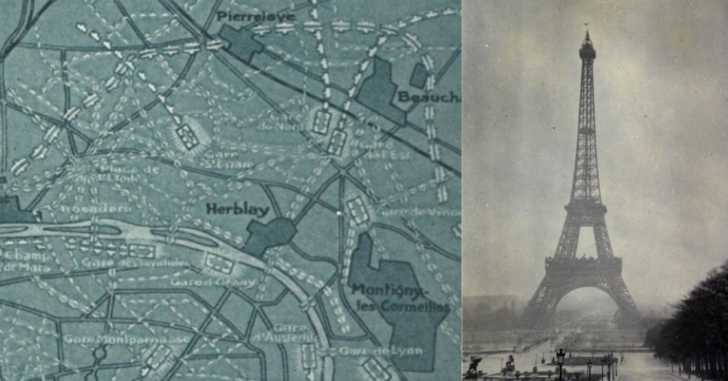
Paris counts among the most beloved cities on Earth, a status that owes in part to the relative lack of damage taken in during both World Wars. The desire to protect and preserve Paris thus runs high today, but then, it also did a century ago. The prospect of the city’s obliteration during what was then called the Great War inspired an especially ambitious defensive scheme. “At the beginning of 1917, a wild idea was floated,” writes the Daily Beast’s Allison McNearney. “Why not build a replica of Paris just outside of the city and fool German bombers into dropping their destructive loads where only the decoys made of wood and fabric could be harmed.”
This Paris leurre (decoy) is the subject of the 35-minute British Pathé documentary above, Illusion: The City That Never Was. Its detailed plan “called for the construction of three separate ‘sham’ neighborhoods just outside of the city”: a large train station modeled after Gare du Nord, a replica city center with its own Champs-Élysées, and a “faux industrial zone with factories and other indications of wartime production.”
Built mostly out of wood and fabric, these remote uninhabited quarters were to be equipped with elements like working street lighting — designed by Fernand Jacopozzi, later famed for his illumination of the Eiffel Tower — and a moving train.
As it turned out, the train was one of the few elements of this elaborate fake City of Light actually constructed. “In 1918, before the project could be completed, the war came to an end and the government quickly moved to dismantle their secret project and suppress all information concerning its existence,” writes McNearney. Only in the twenty-first century has this World War I‑era push to build a fake Paris come to light. Though never completed, its sheer ambition speaks to France’s own conception of its capital as a store of priceless cultural and historical heritage. In a sense, Paris is civilization, or at least French civilization. One must ask: would humanity go to the same lengths to protect it today?
Related content:
Color Footage of the Liberation of Paris, Shot by Hollywood Director George Stevens (1944)
How France Hid the Mona Lisa & Other Louvre Masterpieces During World War II
See Berlin Before and After World War II in Startling Color Video
Based in Seoul, Colin Marshall writes and broadcasts on cities, language, and culture. His projects include the Substack newsletter Books on Cities, the book The Stateless City: a Walk through 21st-Century Los Angeles and the video series The City in Cinema. Follow him on Twitter at @colinmarshall or on Facebook.
Read More...DALL‑E, the New AI Art Generator, Is Now Open for Everyone to Use

If you spend any time at all on social media, you’ll have glimpsed the work of DALL‑E, OpenAI’s now-famous artificial-intelligence engine that generate images from simple text descriptions. A velociraptor dressed like Travis Bickle, American Gothic starring Homer and Marge Simpson, that astronaut riding a horse on the moon: like any the-future-is-now moment, especially in recent years on the internet, DALL-E’s rise has produced a host of artifacts as impressive as they are ridiculous. Now you can try to top them in both of those dimensions yourself, since not just DALL‑E but the new, improved, higher-resolution DALL‑E 2 has just opened for public use.

“How do you use DALL‑E 2?” You might well ask, and Creative Bloq has a guide for you. “The tool generates art based on text prompts,” it explains. “On the face of it, that couldn’t be more simple. Once you’ve completed the DALL‑E 2 sign up to open an account, you use the program in your browser on the DALL‑E 2 website. You type in a description of what you want, and DALL‑E will create the image.”
Of course, some prompts produce more visually interesting results than others. The guide recommends that you consult the DALL‑E 2 prompt book, which gets into how best to phrase your descriptions in order to inspire the richest combinations of subject, texture, style, and form.

“Even the creators of DALL‑E 2 don’t know what the tool knows and doesn’t know. Instead, users have to work out what it’s capable of doing and how to get it to do what they want.” And indeed, that’s the part of the fun. DALL-E’s own interface recommends that you “start with a detailed description,” and with a little experimentation you’ll discover that specificity is key. The renderings of “an eight-bit Nintendo game designed by Hiroshige” and “a cyberpunk downtown Los Angeles scene painted by Rembrandt” strike me as credible enough for a first effort, but adding just a few more words opens up entirely new realms of surprise and incongruity.
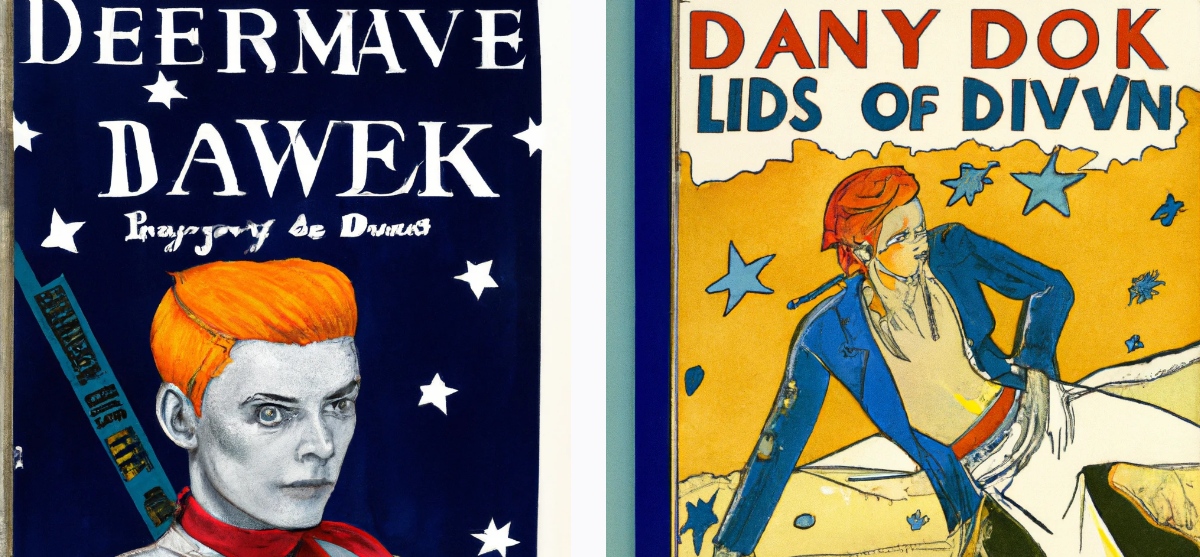
Just above, we have two of DALL-E’s infinitely many possible attempts to visualize “the cover of an old Ernest Hemingway pulp novel about the adventures of David Bowie.” Though the designs look entirely plausible, the titles highlight the technology’s already-notorious inability to come up with intelligible text. Other limitations of the newly public DALL‑E, according to Ars Technica’s Benj Edwards, include the requirement to provide your phone number and other information in order to sign up, the ownership of the generated images by OpenAI, and the necessity to purchase “credits” to generate more images after you’ve run through your initial free 50. Still, there’s nothing quite like typing in a few words and summoning up works of art no one has ever seen before to make you feel like you’re living in the twenty-first century. You can sign up here.
Related content:
Discover DALL‑E, the Artificial Intelligence Artist That Lets You Create Surreal Artwork
Based in Seoul, Colin Marshall writes and broadcasts on cities, language, and culture. His projects include the Substack newsletter Books on Cities, the book The Stateless City: a Walk through 21st-Century Los Angeles and the video series The City in Cinema. Follow him on Twitter at @colinmarshall or on Facebook.
Read More...How Rick Astley’s “Never Gonna Give You Up” Went from 80s Pop Smash to Bastion of Internet Culture: A Short Documentary
It was an isolating existence, being a Rick Astley fan at the turn of the millennium. I was in high school at the time, and it was on a weekend-morning cable-TV binge that I happened first to hear his music — albeit just a few seconds of it — on a commercial for one of those order-by-phone nostalgia compilations. Intrigued by the contrast of the unabashed nineteen-eighties production, equally energetic and synthetic, against Astley’s powerful, unusually textured voice, I went straight to AudioGalaxy for the MP3. Even before I’d heard its whole three and a half minutes, I was hooked. The song of which I speak is, of course, “Together Forever.”
You’ve got to remember that, two decades ago, Astley’s debut single “Never Gonna Give You Up” hadn’t yet racked up a billion views on Youtube. Nor could you even find it on Youtube; nor, come to that, could you find anything on Youtube, since it didn’t exist. It was then quite easy to be unaware of the song, and indeed of Astley himself, given that he’d burnt out and retired from the music business in the mid-nineteen-nineties. If you’d heard of him, you might well have written him off as an eighties flash-in-the-pan. (Yet to be resurrected by the retro gods, the aesthetics of that decade were still at their nadir of fashionability.) But in its day, “Never Gonna Give You Up” was a pop phenomenon of rare distinction.
The short Vice documentary above recounts how Astley became an overnight sensation, bringing in the singer himself as well as his original production team: Mike Stock, Matt Aitken, and Pete Waterman, the trio who created the sound of British eighties pop. It was while playing with a band in his small northern hometown that Astley caught Stock Aitken Waterman’s ear, and soon thereafter he found himself working as a “tea boy” in their London studio. At that time he lived at Waterman’s home, and after overhearing the latter screaming at his girlfriend through his giant eighties phone, he made a fateful remark: “You’re never gonna give her up, are you?”
From there, “Never Gonna Give You Up” seems practically to have written itself, though its producers admit to having ill sensed its potential during recording. Shelved for a time, the song was finally included on a magazine mix tape, at which point it went the eighties equivalent of viral: airplay on the independent Capital London soon crossed over to a variety of mainstream radio formats. “They hadn’t got a clue that he was a white guy,” says Waterman, nor, as Astley himself adds, that he “looked about eleven years old.” All was soon revealed by the music video — then still a novel form — hastily and somewhat amateurishly produced in the wake of the single’s chart-topping success.
These not-unappealing incongruities inspired one of my fellow Millennials, a young enlisted man named Sean Cotter, to relaunch Astley’s hit into the zeitgeist in 2007. “I immediately knew I wanted to make this thing into a meme,” he says, and so he invented “rickrolling,” the prank of sending an unrelated-looking link that actually leads to the “Never Gonna Give You Up” video. Despite originating in a spirit of mockery, it enabled the comeback Astley had been tentatively attempting in the preceding years. Today, at a distance from the eighties and the two-thousands alike, we can finally hear “Never Gonna Give You Up” for what it is: an inspired work of pop songcraft that reflects the distinctive appeal of both its era and its performer — or as Astley puts it, “a bloody hit, man.”
Related content:
Rick Astley Sings an Unexpectedly Enchanting Cover of the Foo Fighters’ “Everlong”
Student Rickrolls Teacher By Sneaking Rick Astley Lyrics into Quantum Physics Paper
Based in Seoul, Colin Marshall writes and broadcasts on cities, language, and culture. His projects include the Substack newsletter Books on Cities, the book The Stateless City: a Walk through 21st-Century Los Angeles and the video series The City in Cinema. Follow him on Twitter at @colinmarshall or on Facebook.
Read More...Watch Vintage Videos Capturing Life in Japan from the 1960s Through Today
Just yesterday, Japan fully re-opened its borders to tourism after a long period of COVID-19-motivated closure. This should prove economically invigorating, given how much demand to visit the Land of the Rising Sun has built up over the past couple of years. Even before the pandemic, Japan had been a country of great interest among world travelers, and for more than half a century at that. Much of that attractiveness has, of course, to do with its distinctive nature, which manifests both deep tradition and hyper-modernity at once.
But some of it also has to do with the fact that, since rising from the devastation of the Second World War, Japan has hardly shied away from self-promotion. “A Day in Tokyo,” the short film at the top of the post, was produced by the Japan National Tourism Organization in 1968.
Its vivid color footage of Japan’s great metropolis, “the world’s largest and liveliest,” captures everyday life as it was then lived in Tokyo’s department stores, stock exchanges, construction sites, and zoos.
The film puts a good deal of emphasis on the capital’s still-ongoing postwar transformation: “In a constant metabolic cycle of destruction and creation, Tokyo progresses at a dizzying pace,” declares the film’s narrator. “People who haven’t seen Tokyo for ten years, or even five, would scarcely recognize it today.” And if Tokyo was dizzying in the late nineteen-sixties, it became positively disorienting in the eighties. On the back of that era’s economic bubble, Japan looked about to become the wealthiest country in the world, and Tokyoites both worked and played accordingly hard.
This two-part compilation of scenes from Japan in the eighties conveys that time with footage drawn from a variety of sources, including feature films (not least Itami Jūzō’s beloved 1985 ramen comedy Tampopo.) “It was a magical place at a magical time,” remembers one American commenter who lived in Japan back then. “Everything seemed possible. Everybody was prospering. Almost every crazy business idea seemed to succeed. People were happy and shared their happiness and good fortune with others. It was like no other place on earth.”
As dramatically as the bubble burst at the end of the eighties, Japanese life in the subsequent “lost decades” has also possessed a richness of its own. You can see it in this compilation of footage of Japan in the nineties and two-thousands from the same channel, TRNGL. Though it no longer seemed able to buy up the rest of the world, the country had by that era built up a global consciousness of its culture by exporting its films, its animation, its music, its video games, and much more besides. Even if you haven’t seen this Japan in person, you’ve come to know it through its art and media.
If you’re considering making the trip, this video of “Japan nowadays” will give you a sense of what you’ve been missing. The Tokyo of the twenty-first century shown in its clips certainly isn’t the same city it was in 1968. Yet it remains “an intermingling of Orient and Occident, seemingly new, but actually old,” as the narrator of “A Day in Tokyo” puts it. “Beneath its modern exterior, there still lingers an atmosphere of past glories. The citizens remain unalterably Japanese, and yet this great city is able to accommodate and understand people of all races, languages, and beliefs” — people now arriving by the thousands once again.
Related content:
The Entire History of Japan in 9 Quirky Minutes
1850s Japan Comes to Life in 3D, Color Photos: See the Stereoscopic Photography of T. Enami
Hand-Colored 1860s Photographs Reveal the Last Days of Samurai Japan
Based in Seoul, Colin Marshall writes and broadcasts on cities, language, and culture. His projects include the Substack newsletter Books on Cities, the book The Stateless City: a Walk through 21st-Century Los Angeles and the video series The City in Cinema. Follow him on Twitter at @colinmarshall or on Facebook.
Read More...The Entire Archives of Radical Philosophy Go Online: Read Essays by Michel Foucault, Alain Badiou, Judith Butler & More (1972–2022)
On a seemingly daily basis, we see attacks against the intellectual culture of the academic humanities, which, since the 1960s, have opened up spaces for leftists to develop critical theories of all kinds. Attacks from supposedly liberal professors and centrist op-ed columnists, from well-funded conservative think tanks and white supremacists on college campus tours. All rail against the evils of feminism, post-modernism, and something called “neo-Marxism” with outsized agitation.
For students and professors, the onslaughts are exhausting, and not only because they have very real, often dangerous, consequences, but because they all attack the same straw men (or “straw people”) and refuse to engage with academic thought on its own terms. Rarely, in the exasperating proliferation of cranky, cherry-picked anti-academia op-eds do we encounter people actually reading and grappling with the ideas of their supposed ideological nemeses.
Were non-academic critics to take academic work seriously, they might notice that debates over “political correctness,” “thought policing,” “identity politics,” etc. have been going on for thirty years now, and among left intellectuals themselves. Contrary to what many seem to think, criticism of liberal ideology has not been banned in the academy. It is absolutely the case that the humanities have become increasingly hostile to irresponsible opinions that dehumanize people, like emergency room doctors become hostile to drunk driving. But it does not follow therefore that one cannot disagree with the establishment, as though the University system were still beholden to the Vatican.
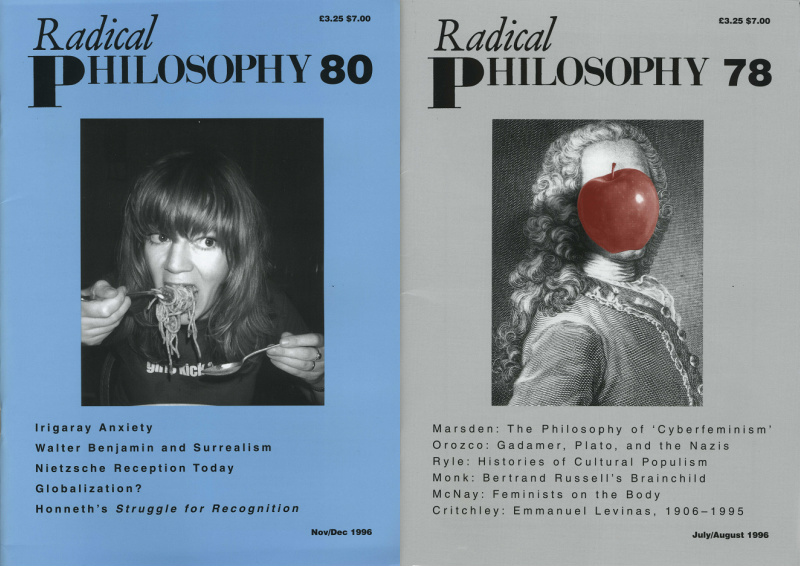
Understanding this requires work many people are unwilling to do, either because they’re busy and distracted or, perhaps more often, because they have other, bad faith agendas. Should one decide to survey the philosophical debates on the left, however, an excellent place to start would be Radical Philosophy, which describes itself as a “UK-based journal of socialist and feminist philosophy.” Founded in 1972, in response to “the widely-felt discontent with the sterility of academic philosophy at the time,” the journal was itself an act of protest against the culture of academia.
Radical Philosophy has published essays and interviews with nearly all of the big names in academic philosophy on the left—from Marxists, to post-structuralists, to post-colonialists, to phenomenologists, to critical theorists, to Lacanians, to queer theorists, to radical theologians, to the pragmatist Richard Rorty, who made arguments for national pride and made several critiques of critical theory as an illiberal enterprise. The full range of radical critical theory over the past 45 years appears here, as well as contrarian responses from philosophers on the left.
Rorty was hardly the only one in the journal’s pages to critique certain prominent trends. Sociologists Pierre Bourdieu and Loic Wacquant launched a 2001 protest against what they called “a strange Newspeak,” or “NewLiberalSpeak” that included words like “globalization,” “governance,” “employability,” “underclass,” “communitarianism,” “multiculturalism” and “their so-called postmodern cousins.” Bourdieu and Wacquant argued that this discourse obscures “the terms ‘capitalism,’ ‘class,’ ‘exploitation,’ ‘domination,’ and ‘inequality,’” as part of a “neoliberal revolution,” that intends to “remake the world by sweeping away the social and economic conquests of a century of social struggles.”
One can also find in the pages of Radical Philosophy philosopher Alain Badiou’s 2005 critique of “democratic materialism,” which he identifies as a “postmodernism” that “recognizes the objective existence of bodies alone. Who would ever speak today, other than to conform to a certain rhetoric? Of the separability of our immortal soul?” Badiou identifies the ideal of maximum tolerance as one that also, paradoxically, “guides us, irresistibly” to war. But he refuses to counter democratic materialism’s maxim that “there are only bodies and languages” with what he calls “its formal opposite… ‘aristocratic idealism.’” Instead, he adds the supplementary phrase, “except that there are truths.”
Badiou’s polemic includes an oblique swipe at Stalinism, a critique Michel Foucault makes in more depth in a 1975 interview, in which he approvingly cites phenomenologist Merleau-Ponty’s “argument against the Communism of the time… that it has destroyed the dialectic of individual and history—and hence the possibility of a humanistic society and individual freedom.” Foucault made a case for this “dialectical relationship” as that “in which the free and open human project consists.” In an interview two years later, he talks of prisons as institutions “no less perfect than school or barracks or hospital” for repressing and transforming individuals.
Foucault’s political philosophy inspired feminist and queer theorist Judith Butler, whose arguments inspired many of today’s gender theorists, and who is deeply concerned with questions of ethics, morality, and social responsibility. Her Adorno Prize Lecture, published in a 2012 issue, took up Theodor Adorno’s challenge of how it is possible to live a good life in bad circumstances (under fascism, for example)—a classical political question that she engages through the work of Orlando Patterson, Hannah Arendt, Ludwig Wittgenstein, and Hegel. Her lecture ends with a discussion of the ethical duty to actively resist and protest an intolerable status quo.
You can now read for free all of these essays and hundreds more at the Radical Philosophy archive, either on the site itself or in downloadable PDFs. The journal, run by an ‘Editorial Collective,” still appears three times a year. The most recent issue features an essay by Lars T. Lih on the Russian Revolution through the lens of Thomas Hobbes, a detailed historical account by Nathan Brown of the term “postmodern,” and its inapplicability to the present moment, and an essay by Jamila M.H. Mascat on the problem of Hegelian abstraction.
If nothing else, these essays and many others should upend facile notions of leftist academic philosophy as dominated by “postmodern” denials of truth, morality, freedom, and Enlightenment thought, as doctrinaire Stalinism, or little more than thought policing through dogmatic political correctness. For every argument in the pages of Radical Philosophy that might confirm certain readers’ biases, there are dozens more that will challenge their assumptions, bearing out Foucault’s observation that “philosophy cannot be an endless scrutiny of its own propositions.”
Enter the Radical Philosophy archive here.
Note: This post was originally published on our site in March, 2018.
Related Content:
Introducing Ergo, the New Open Philosophy Journal
History of Modern Philosophy: A Free Online Course
On the Power of Teaching Philosophy in Prisons
Josh Jones is a writer and musician based in Durham, NC. Follow him at @jdmagness
Read More...John Oliver’s Show on World-Class Art Museums & Their Looted Art: Watch It Free Online
From John Oliver comes a comic take on a serious subject–how Western museums have often built their collections, especially in antiquities, through looting art from colonized nations. In this 34 minute episode, Oliver discusses “some of the world’s most prestigious museums, why they contain so many stolen goods, [and] the market that continues to illegally trade antiquities.” It’s one of the latest episodes from HBO’s Last Week Tonight with John Oliver.
If you would like to support the mission of Open Culture, consider making a donation to our site. It’s hard to rely 100% on ads, and your contributions will help us continue providing the best free cultural and educational materials to learners everywhere. You can contribute through PayPal, Patreon, and Venmo (@openculture). Thanks!
Related Content
The British Museum is Full of Looted Artifacts
Take a Virtual Reality Tour of the World’s Stolen Art
When Pablo Picasso and Guillaume Apollinaire Were Accused of Stealing the Mona Lisa (1911)
Read More...Artist Makes Astonishing Armor for Cats & Mice
As a child, Jeff De Boer, the son of a sheet metal fabricator, was fascinated by the European plate armor collection in Calgary’s Glenbow Museum:
There was something magical or mystical about that empty form, that contained something. So what would it contain? A hero? Do we all contain that in ourselves?
After graduating from high school wearing a partial suit of armor he constructed for the occasion, De Boer completed seven full suits, while majoring in jewelry design at the Alberta College of Art and Design.
A sculpture class assignment provided him with an excuse to make a suit of armor for a cat. The artist had found his niche.
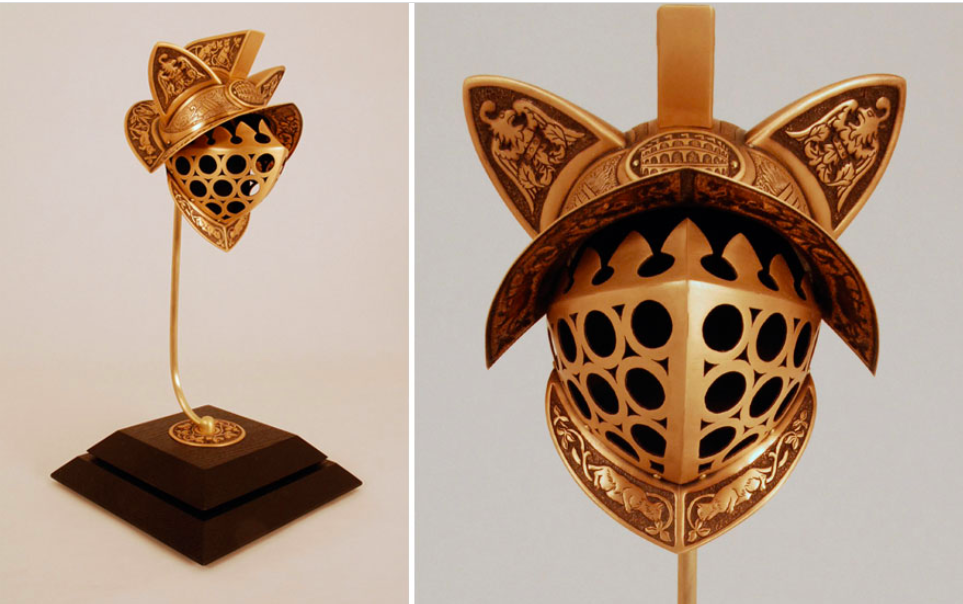
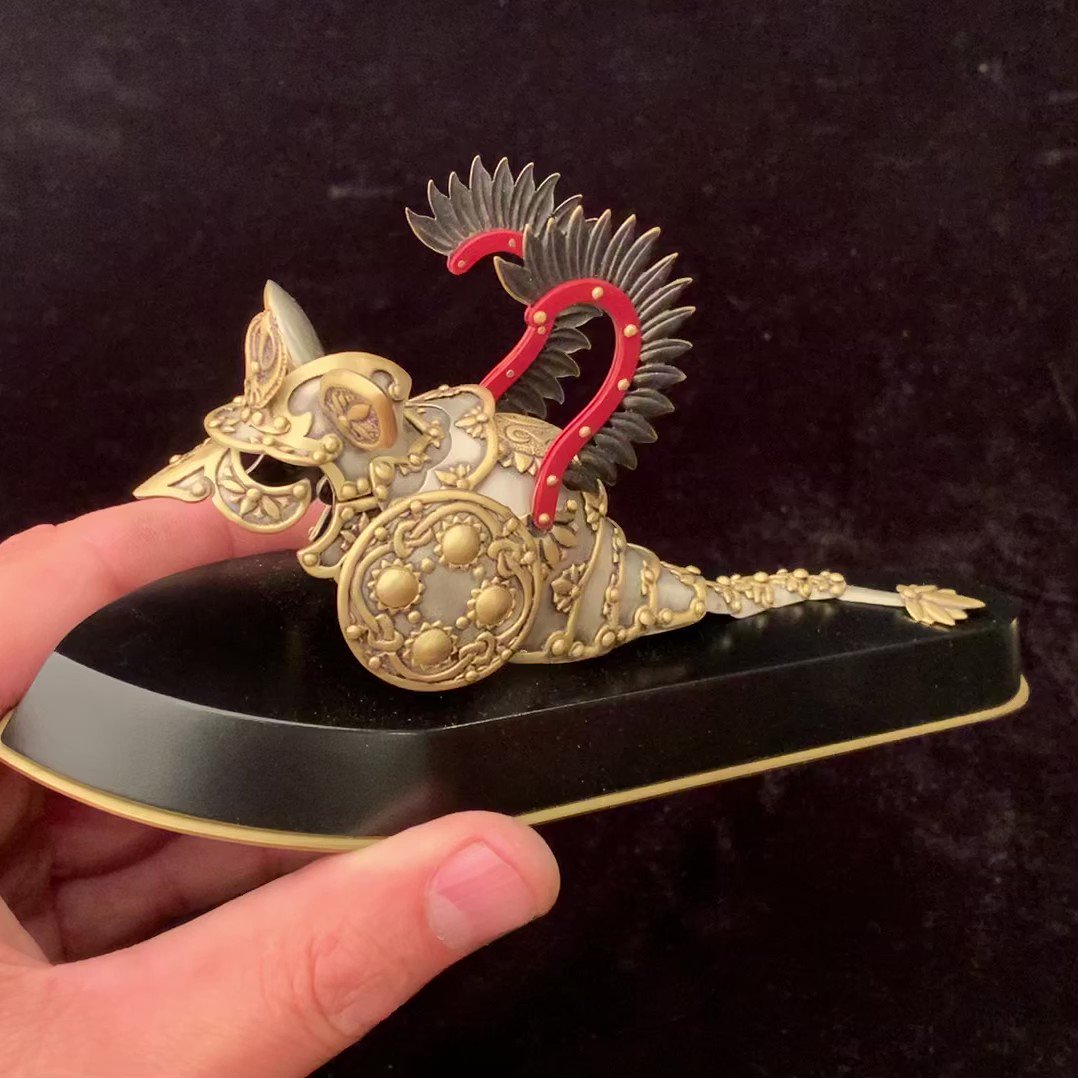
Using steel, silver, brass, bronze, nickel, copper, leather, fiber, wood, and his delicate jewelry making tools, DeBoer became the cats’ armorer, spending anywhere from 50 to 200 hours producing each increasingly intricate suit of feline armor. A noble pursuit, but one that inadvertently created an “imbalance in the universe”:
The only way to fix it was to do the same for the mouse.


“The suit of armor is a transformation vehicle. It’s something that only the hero would wear,” De Boer notes.
Fans of David Petersen’s Mouse Guard series will need no convincing, though no real mouse has had the misfortune to find its way inside one of his astonishing, custom-made creations.
Not even a taxidermy specimen, he revealed on the Making, Our Way podcast:
It’s not an altogether bad idea. The only reason I don’t do it is that hollow suit of armor like you might see in a museum, your imagination will make it do a million things more than if you stick a mouse in it will ever do. I have put armor on cats. I can tell you, it’s nothing like what you think it’s going to be. It’s not a very good experience for the cat. It does not fulfill any fantasies about a cat wearing a suit of armor.
Though cats were his entry point, De Boer’s sympathies seem aligned with the underdog — er, mice. Equipping humble, hypothetical creatures with exquisitely wrought, historical protective gear is a way of pushing back against being perceived differently than one wishes to be.
Accepting an Honorary MFA from his alma mater earlier this year, he described an armored mouse as a metaphor for his “ongoing cat and mouse relationship with the world of fine art…a mischievous, rebellious being who dares to compete on his own terms in a world ruled by the cool cats.”
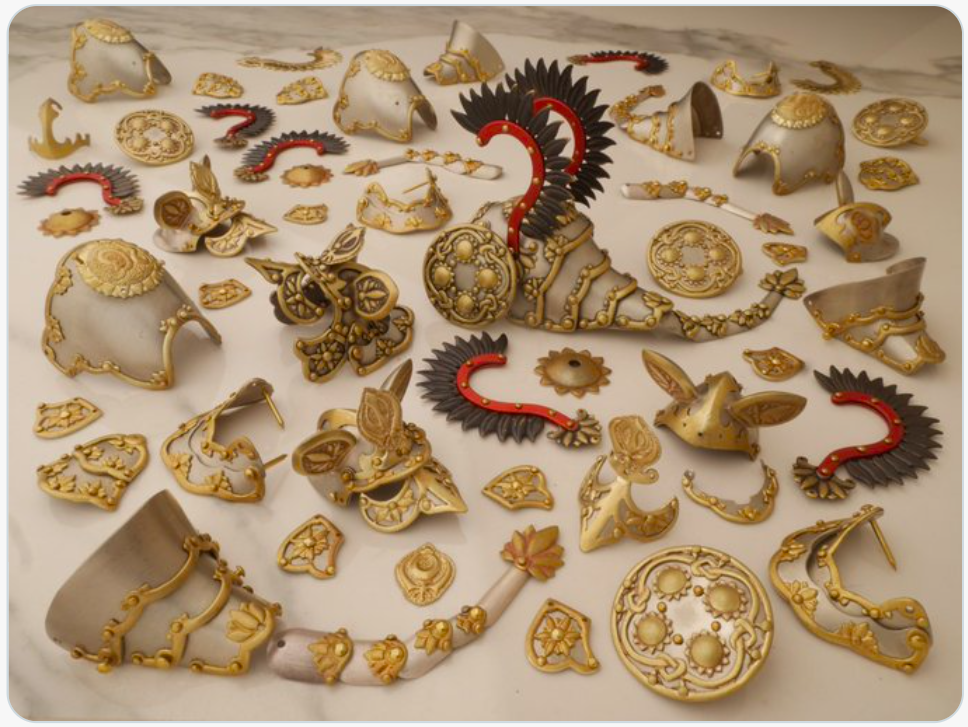
Each tiny piece is preceded by painstaking research and many reference drawings, and may incorporate special materials like the Japanese silk haori-himo cord lacing the shoulder plates to the body armor of a Samurai mouse family.
Additional creations have referenced Mongolian, gladiator, crusader, and Saracen styles — this last perfect for a Persian cat.


“I mean, “Why not?” he asks in his TED‑x Talk,Village Idiots & Innovation, below.
His latest work combines elements of Maratha and Hussar armor in a veritable puzzle of minuscule pieces.
See more of Jeff De Boer’s cat and mouse armor on his Instagram.
Related Content
What’s It Like to Fight in 15th Century Armor?: A Surprising Demonstration
Cats in Medieval Manuscripts & Paintings
- Ayun Halliday is the Chief Primatologist of the East Village Inky zine and author, most recently, of Creative, Not Famous: The Small Potato Manifesto. Follow her @AyunHalliday.
Read More...Lizzo Plays James Madison’s Priceless, 200-Year-Old Crystal Flute
In the annals of modern popular music, one does not find a surfeit of flautists. Tim Weisberg, in partnership with singer-songwriter Dan Fogelberg, did score a modest his or two in the seventies. More incongruously, Jethro Tull’s Ian Anderson set his band apart with his decision to take up the flute not long before their earliest performances. But today, outside the realm of orchestral music, there is surely no higher-profile flautist than Lizzo. Though best known as a pop singer, she continues to put to use the flute skills she honed at the University of Houston, without which she wouldn’t have been able to handle a precious piece of American history.
Last month, writes the Library of Congress’ April Slayton, one of that institution’s librarians Carla Hayden “saw that the one and only Lizzo was coming to D.C. for a concert.” Given that “the Library has the world’s largest flute collection,” Hayden took the opportunity to point out that fact to the pop star on Twitter. “One of about 1,700 flutes in the collection, she teased, is the crystal flute made for President James Madison by Claude Laurent — a priceless instrument that Dolley Madison rescued from the White House in April 1814 as the British entered Washington, DC during the War of 1812.. Might she want to drop by and play a few bars?”
Indeed she did, with results you can see in the video above: at the Library itself, Lizzo tries out one of the collection’s many flutes; then she plays the crystal flute itself on onstage at Capitol One Arena, having been handed it by the instrument’s own security detail. “It’s like playing out of a wine glass,” she tells her thrilled audience. One wonders if the comparison would ever have occurred to its first owner: “It’s not clear if Madison did much with the flute other than admire it,” Slayton writes, “but it became a family heirloom and an artifact of the era.” Now it has become a uniting symbol of American culture past and present: however forward-looking the Founding Fathers were, we can safely say they never imagine twerking.
The Library of Congress has posted pictures of Lizzo’s visit on Flickr. See them here.
Related content:
Butterfly Lands on Flutist’s Face During Flute Competition: The Show Must Go On
Hear the World’s Oldest Instrument, the “Neanderthal Flute,” Dating Back Over 43,000 Years
Hear a 9,000 Year Old Flute — the World’s Oldest Playable Instrument — Get Played Again
The Library of Congress Makes 25 Million Records From Its Catalog Free to Download
Based in Seoul, Colin Marshall writes and broadcasts on cities, language, and culture. His projects include the Substack newsletter Books on Cities, the book The Stateless City: a Walk through 21st-Century Los Angeles and the video series The City in Cinema. Follow him on Twitter at @colinmarshall or on Facebook.
Read More...Behold the Medieval Wound Man: The Poor Soul Who Illustrated the Injuries a Person Might Receive Through War, Accident or Disease

Do you swoon at the sight of blood?
Suffer paper cuts as major trauma?
Cover your eyes when the knife comes out in the horror movie?
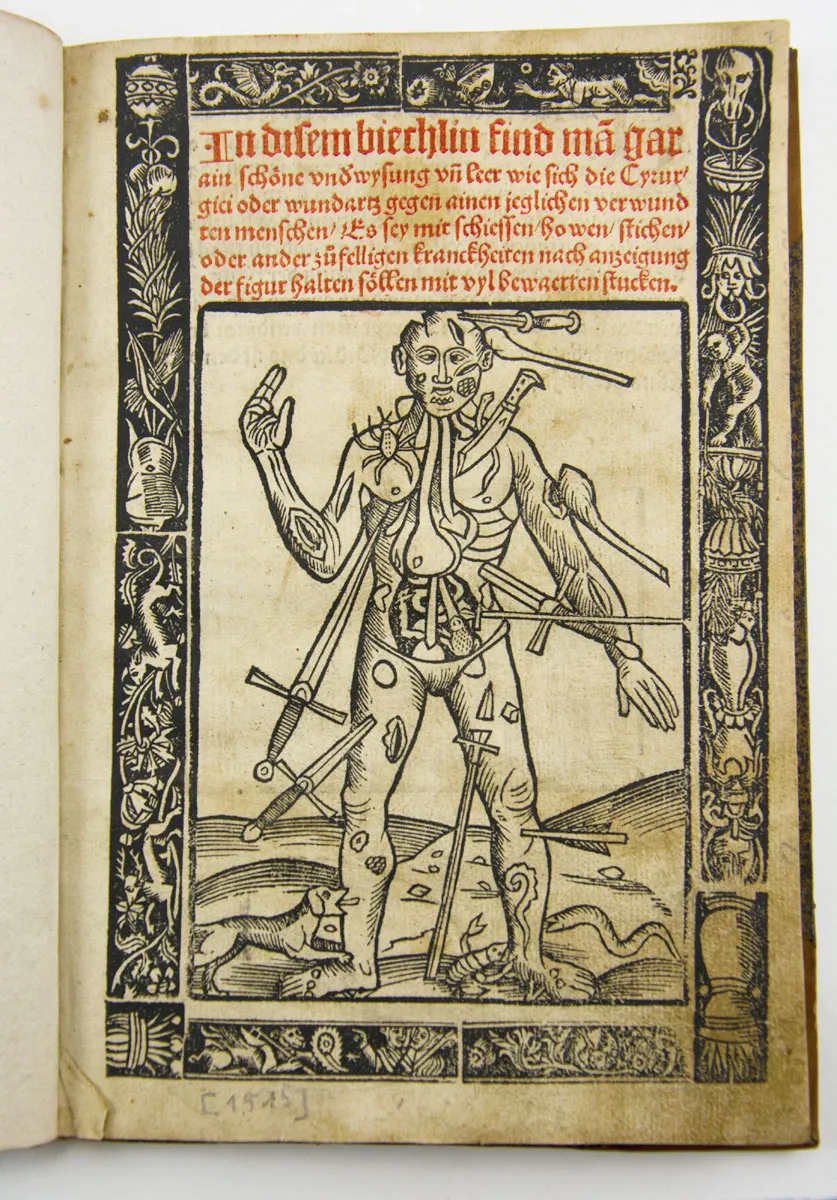
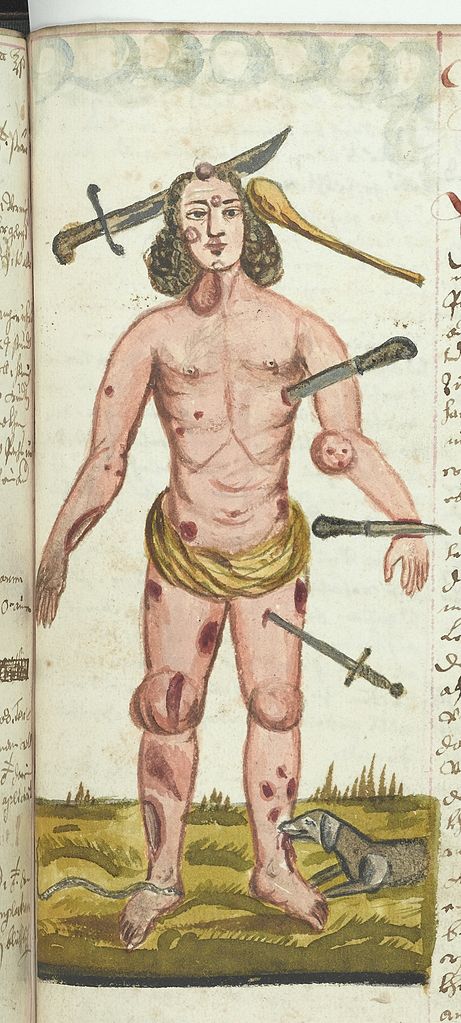
If so, and also if not, fall to your knees and give thanks that you’re not the Wound Man, above.
A staple of medieval medical history, he’s a grisly compendium of the injuries and external afflictions that might befall a mortal of the period- insect and animal bites, spilled entrails, abscesses, boils, infections, plague-swollen glands, piercings and cuts, both accidental and deliberately inflicted.
Any one of these troubles should be enough to fell him, yet he remains upright, displaying every last one of them simultaneously, his expression stoic.

He’s hard to look at, but as art historian Jack Hartnell , author of Medieval Bodies: Life, Death and Art in the Middle Ages writes in British Art Studies:
The Wound Man was not a figure designed to inspire fear or to menace. On the contrary, he represented something more hopeful: an imaginative and arresting herald of the powerful knowledge that could be channelled and dispensed through the practice of medieval medicine.
A valuable educational resource for surgeons for some three centuries, he began cropping up in southern Germany in the early 1400s. In an essay for the Public Domain Review, Hartnell notes how these early specimens served “as a human table of contents”, directing interested parties to the specific passages in the various medical texts where information on existing treatments could be found.

The protocol for injuries to the intestines or stomach called for stitching the wound up with a fine thread and sprinkling it with an antihemorrhagic powder made from wine, hematite, nutmeg, white frankincense, gum arabic, bright red sap from the Dracaena cinnabari tree and a restorative quantity of mummy.
The Wound Man evolved along with medical knowledge, weapons of warfare and art world trends.

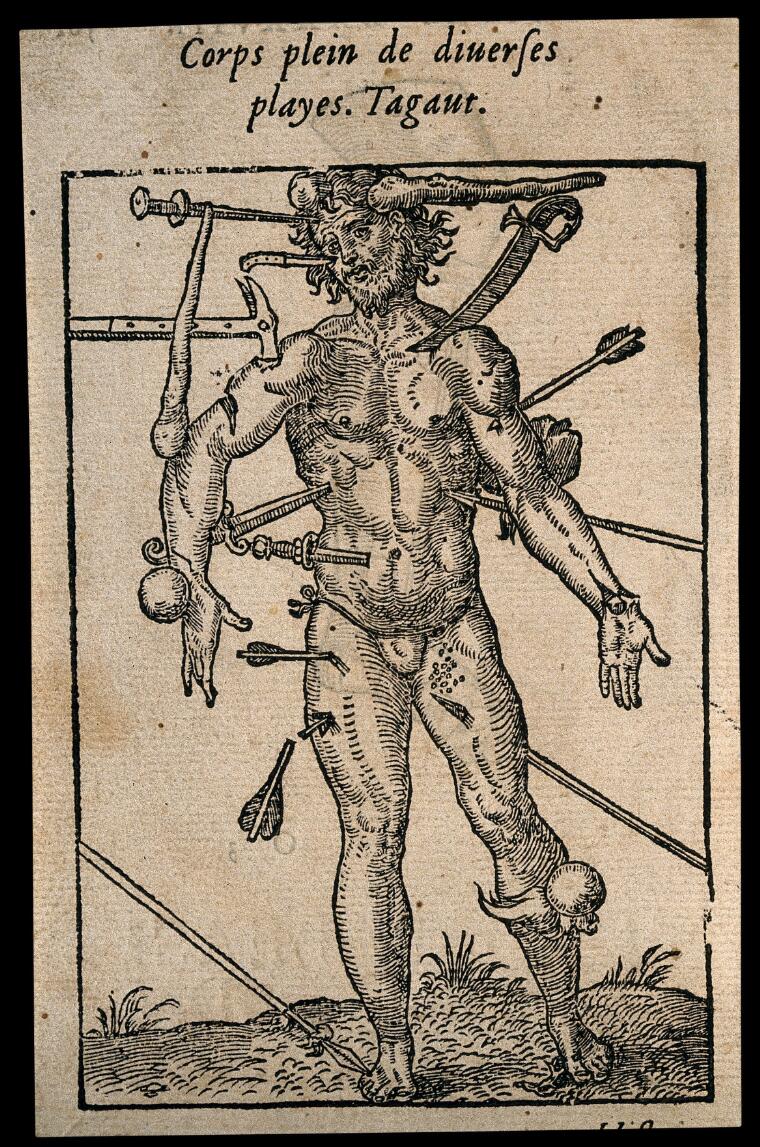
The woodcut Wound Man in Hans von Gersdorff’s 1517 landmark Fieldbook of Surgery introduces cannonballs to the ghastly mix.

And the engraver Robert White’s Wound Man in British surgeon John Browne’s 1678 Compleat Discourse of Wounds loses the loincloth and grows his hair, morphing into a neoclassical beauty in the Saint Sebastian mold.
Surgical knowledge eventually outpaced the Wound Man’s usefulness, but popular culture is far from ready for him to lay down and die, as evidenced by recent cameos in episodes of Hannibal and the British comedy quiz show, QI.
Delve into the history of the Wound Man in Jack Hartnell’s British Art Studies article “Wording the Wound Man.”
Related Content
1,000-Year-Old Illustrated Guide to the Medicinal Use of Plants Now Digitized & Put Online
- Ayun Halliday is the Chief Primatologist of the East Village Inky zine and author, most recently, of Creative, Not Famous: The Small Potato Manifesto. Follow her @AyunHalliday.
Read More...Support Us
We're hoping to rely on loyal readers, rather than erratic ads. Please click the Donate button and support Open Culture. You can use Paypal, Venmo, Patreon, even Crypto! We thank you!

About Us

Open Culture scours the web for the best educational media. We find the free courses and audio books you need, the language lessons & educational videos you want, and plenty of enlightenment in between.
Advertise With Us
FREE UPDATES!
GET OUR DAILY EMAIL
Get the best cultural and educational resources on the web curated for you in a daily email. We never spam. Unsubscribe at any time.
FOLLOW ON SOCIAL MEDIA
Open Culture editor Dan Colman scours the web for the best educational media. He finds the free courses and audio books you need, the language lessons & movies you want, and plenty of enlightenment in between.
Advertise With Us

