Woody Allen Answers 12 Unconventional Questions He Has Never Been Asked Before
Woody Allen hates personal publicity. He doesn’t appear on talk shows or attend the Oscars. He rarely gives interviews, even when he has a new film to promote. But a few years back Allen opened up to filmmaker Robert B. Weide for the making of Woody Allen: A Documentary, which aired last year in the American Masters series on PBS. “He never refused a request,” Weide told PBS, “and he never declined to answer a question.” At one point Weide asked Allen a series of twelve questions that he was reasonably sure Allen had never been asked before. The resulting interview, shown above, is included as an extra in the DVD version of the film and offers a fascinating little portal into the reclusive filmmaker’s personality.
Related Content:
Meetin’ WA: Jean-Luc Godard Meets Woody Allen in 26 Minute Film
How Woody Allen Discovered Ingmar Bergman, and How You Can Too
Read More...Neil deGrasse Tyson Answers the Big Enchilada Question, “Does the Universe Have a Purpose?”
Neil deGrasse Tyson was asked by the Templeton Foundation to answer the unanswerable question “Does the Universe Have a Purpose?” He read his answer aloud, and Minute Physics helped animate it. If you head to the Templeton Foundation web site, you can find replies by other leading intellectuals, including Lawrence Krauss, Jane Goodall, and Elie Wiesel.
For more pearls of wisdom from Tyson, check out the following:
Neil deGrasse Tyson Lists 8 (Free) Books Every Intelligent Person Should Read
Neil deGrasse Tyson Delivers the Greatest Science Sermon Ever
Stephen Colbert Talks Science with Astrophysicist Neil deGrasse Tyson
Read More...Woody Guthrie’s Fan Letter To John Cage and Alan Hovhaness (1947)
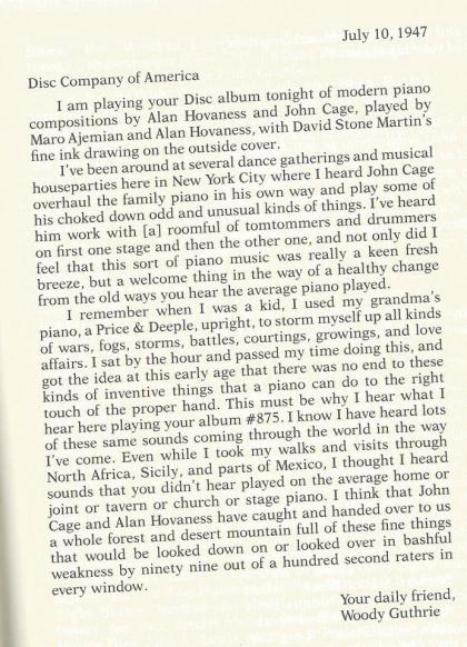
I’ve always felt a certain close affinity with Woody Guthrie. Could be my admiration for his unstinting working-man’s politics or that he hails from my mother’s home state of Oklahoma. Those are strong appeals, and I suppose it’s all of that and more: Guthrie could carve out compact granite sentences even Robert Frost would envy. If the letter above doesn’t convince you, read the man’s autobiography. In the letter, the unapologetic working-class folksinging Okie who embodied depression-era authenticity writes to “Disc Company of America” to enthuse over John Cage for his “overhaul of the family piano” and his “choked down odd and unusual kinds of things.”
Odd and unusual are two words that spring to mind when imagining Guthrie writing a letter in praise of Cage. (He also praises Armenian composer Alan Hovhaness—Guthrie spells it “Hovaness”). Written in 1947, it is the kind of text one wants to quote in its entirety. Fortunately, we have the reproduction above, and you can read it for yourself. What isn’t reproduced is the postscript, in which Guthrie wrote: “I need something like this oddstriking music to match the things I feel in my soul tonight.” He also wrote that that morning, his wife, Marjorie, had “given birth to a big 7‑pound boy”—Arlo.
Guthrie’s letter references a (now extremely rare) two-disc set entitled Piano Compositions by Alan Hovhaness and John Cage played by Maro Ajemian and Alan Hovhanes, featuring a hand-drawn cover by acclaimed jazz-record illustrator David Stone Martin. According to LA Times music critic Mark Swed, the Cage composition on Guthrie’s 78-rpm record was the prepared piano solos from Cage’s Amores, composed in 1943. Below, watch a performance of the “oddstriking” Amores by Spanish ensemble Neopercusión.
Thanks to Tristan for pointing us to this letter originally blogged over at Stool Pigeon.
Josh Jones is a doctoral candidate in English at Fordham University and a co-founder and former managing editor of Guernica / A Magazine of Arts and Politics.
Read More...The Epistemology of Dr. Seuss & More Philosophy Lessons from Great Children’s Stories

Now for a story which “raises questions about the theory and nature of knowledge.” An elephant “hears a faint noise coming from a small speck of dust; it seems to him like a tiny person is calling out for help.” He “finds it peculiar that a dust speck could speak so he reasons that there must be a very small creature on it. Without being able to see the creature, he seems to know it is there and that it is his duty to save it from harm. The other animals in the jungle see him speak to the dust speck and find it impossible that there could be a creature living on it.” Met with only disbelief, “he holds tight to what he knows is true and learns from the voice that there exists an entire universe.” At last, the speck’s resident tiny townspeople “come together and make enough noise for the animals to hear; they have proven their existence and the jungle animals are able to know what Horton has known all along.” Most of us have read this classic children’s book, Horton Hears a Who! by Dr. Seuss. But how many of us have probed its “questions about the nature of human knowledge”?
The last paragraph’s quoted text all comes from Teaching Children Philosophy’s Horton Hears a Who module. The project, an outgrowth of Mount Holyoke College professor Tom Wartenberg’s course “Philosophy for Children,” comes premised on the notion not only that youngsters can learn philosophy, but that they possess minds particularly well-suited to its study. Teaching Children Philosophy draws out the relevant philosophical issues and questions from the books they’ve been reading already, from the epistemology of Horton Hears a Who! to the metaphysics of Sylvester and the Magic Pebble to philosophy of mind in Harold and the Purple Crayon. Targeted toward parents, educators, and kids themselves, the site promises great solace to any philosophically minded reader (or reader-aloud) of children’s stories who feel they have long since exhausted the depths of these beloved slim volumes. “How does Horton know that this voice means there is a person on the speck?” “Is the moon that Harold draws the same as the moon we can see in the sky at night?” “If Sylvester is still a donkey because he thinks, what happens when Sylvester is not thinking?” You supply the children’s books, and Wartenberg and company supply the philosophy.
Related content:
Free Philosophy Courses from our Collection of 550 Free Online Courses from Top Universities
Colin Marshall hosts and produces Notebook on Cities and Culture. Follow him on Twitter at @colinmarshall.
Read More...Leonard Bernstein’s First “Young People’s Concert” at Carnegie Hall Asks, “What Does Music Mean?”
We’ve written before about the public service Leonard Bernstein rendered the American public as an ambassador of classical music. Bernstein made some appearances on an arts and culture program called Omnibus in the 50s, and in 1972, as the Charles Eliot Norton Professor of Poetry at Harvard, he delivered a masterful series of public lectures. Through his various appearances on radio and television programs, he succeeded brilliantly in making high art accessible to the average person. In January of 1958, just two weeks after taking over duties as the director of the New York Philharmonic, Bernstein took up a tradition in American orchestras called “young people’s concerts.” He would lead a total of 53 such concerts, even after his tenure at the Philharmonic ended in 1969, continuing as conductor emeritus until 1972. The concerts were first broadcast on Saturday mornings, but for a few years, CBS—probably in reaction to FCC director Newton Minow’s 1961 “vast wasteland” speech about the state of television—moved the program to prime time. Bernstein made the concerts central to his work at the Philharmonic, describing them in hindsight as “among my favorite, most highly prized activities of my life.”
The first concert (above), entitled “What Music Means,” begins with Rossini’s “William Tell Overture.” While the orchestra works away with precision, the camera cuts to the faces of astonished kids reacting to what they knew at the time as the theme to The Lone Ranger TV show. Bernstein then stops the piece, the kids cry out “Lone Ranger!” and he deftly pivots from this disarming moment to a fascinating discussion of why music isn’t about “stories,” isn’t about “anything, it just is.” He communicates his formalist theory without dumbing-down or condescension, but with clarity and passion. Stripping away the popular notion that every work of art has some inherent “meaning” (or “hidden,” or “deep” meaning), Bernstein shows his young audience instead how all art–“high” or “low”–is first and foremost about aesthetic pleasure, and appreciation begins with an understanding of how any given work can only appeal to our emotions through the senses. Music, Bernstein insists, is just “made of notes.”
This concert, at Carnegie Hall, was the first of its kind to be televised. Later episodes marked the first concerts to be televised from New York’s Lincoln Center. The remaining three parts of “What Music Means” are available here (Part 2, Part 3, Part 4), and a full version (with Spanish subtitles) can be found here.
Josh Jones is a doctoral candidate in English at Fordham University and a co-founder and former managing editor of Guernica / A Magazine of Arts and Politics.
Read More...
Nine Classic Superman Cartoons Restored and Now on YouTube
At the top of this post, you can watch 1941’s Superman, a short nominated for an Academy Award and (according to 1,000 animation professionals) the 33rd greatest cartoon of all time. When you’ve done that, how about eight more of the Man of Steel’s most aesthetically distinctive, pristinely restored animated adventures? Warner Brothers has just posted them, free for the watching, to their YouTube channel. They originally came out of Fleischer Studios, which animation buffs will know meant a true mark of quality back then. “Then,” in this case, means the early 1940s, and these Fleischer-produced Superman shorts brazenly bear the stylistic mark of that era. But if their rich, clean-lined look bursting with Technicolor strikes our eyes today as vintage, it also has a certain retro timelessness — if that doesn’t sound like too much of a contradiction in terms. No wonder they call this the Golden Age of Animation.
Just below, you’ll find Fleischer’s second Superman short, Mechanical Monsters, in which our hero battles exactly those. After it came Billion Dollar Limited, The Arctic Giant, The Bulleteers, The Magnetic Telecope, Electric Earthquake, Volcano, and Terror On The Midway and more— all within a span of under two years.
After 1942, Paramount handed the Superman contract to Famous Studios, which rose out of Fleischer’s dissolution. Eight additional shorts emerged, none now held in regard nearly as high as any of the Fleischer productions.
Where Fleischer possessed a surfeit of imagination, Famous seemed to suffer a deficit. (Their Second World War-themed Superman debut was titled Japoteurs.) But those first eight have enjoyed a long lifespan, particularly as high-profile influences. The Superman animated television series of the 1990s owes them a debt, as does even that same decade’s Batman series. Fans of Japanese animation will recognize the larcenous robots of Mechanical Monsters in Hayao Miyazaki’s series Lupin III and feature Castle in the Sky, and even the thoroughly irreverent Fox cartoon The Tick paid them homage. So, Hollywood types straining to dream up the next Superman franchise reboot: spend time with these still-entertaining, still-impressive pieces of animation, Hollywood cartoons like nothing Hollywood has put out since.
If you would like to support the mission of Open Culture, consider making a donation to our site. It’s hard to rely 100% on ads, and your contributions will help us continue providing the best free cultural and educational materials to learners everywhere. You can contribute through PayPal, Patreon, and Venmo (@openculture). Thanks!
via Cartoon Brew
Related content:
The Best Animated Films of All Time, According to Terry Gilliam
When Super Heroes Get Old and Retire to Miami
Free Vintage Cartoons: Bugs Bunny, Betty Boop and More
Colin Marshall hosts and produces Notebook on Cities and Culture. Follow him on Twitter at @colinmarshall.
Read More...Google Presents an Interactive Visualization of 100,000 Stars
Stargazers of all ages will enjoy the latest Google experiment designed for Chrome. One Hundred Thousand Stars is an interactive map of space including the locations of—you guessed it—more than 100,000 stars.
Rendered in three dimensions, our knowable, mapped galaxy is both staggeringly vast and easy to navigate. With imagery and data from NASA and the European Space Agency, Google’s Chrome Workshop built a 3D model of our little corner of the universe.
You can preview One Hundred Thousand Stars above. Or you can enter the map, click on the upper left corner, and take a tour of your own. You’ll start just beyond the stars that astronomers have studied and named. Swipe all the way into our own solar system. The first thing you’ll notice is that Pluto isn’t included, inviting a new mnemonic for the planet names (My Very Earnest Mother Just Served Us Nectarines?). That hazy cloud about a light year from the sun is the Oort Cloud, a mass of comets that’s thought to mark the outer edge of the sun’s gravitational pull.
Swipe out a bit to see 87 relatively nearby stars. Click on their names to read about them. Sirius is the brightest in the night sky, partly because of its own luminosity but also because it is comparatively close to Earth. Vega is so well studied that its brightness is used as the baseline to classify stars according to their color.
Swipe out further for a galactic view of the Milky Way. It appears as a beautiful illuminated disc centered around a bright bulge. This shape is called the Galactic Plane. Click and drag to tilt the disc this way and that. Totaling to some 400 billion stars and as many planets, the Milky Way does in fact bulge at its center, though astronomers think that the true core is really an intense black hole.
Notice the tiny icon to “Toggle Spectral Index” up in the left corner. On one setting, each cloud is pixilated to highlight its color (a key identifier for astronomers).
Here’s where it helps to know a little about stars and how they form. Stars begin as clouds of mostly hydrogen, becoming gradually so dense through the process of nuclear fusion that even gravity cannot make them fly apart.
The amount of light a star gives off is measured as different colors and temperatures. “Hotter” stars are younger and give off more blue light, and so are indicated as blue. “Cool” stars are older, give off less blue light, and are indicated as red.
By the way, the music behind One Hundred Thousand Stars is by Sam Hulick, whose music gamers may recognize from Mass Effect.
Kate Rix writes about digital media and education. Visit her website and her blog, thenifty.blogspot.com.
Read More...Hear the 1962 Beatles Demo that Decca Rejected: “Guitar Groups are on Their Way Out, Mr. Epstein”
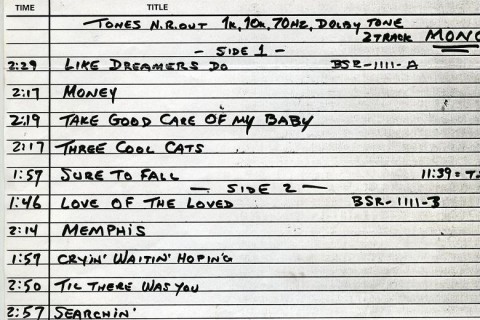
It’s been called the biggest mistake in music history. On New Year’s Day 1962, Decca Records had the opportunity to hear two new bands. One was Brian Poole and the Tremeloes. The other was an obscure group from Liverpool called the Beatles. Of course, Decca chose the Tremeloes. “Guitar groups are on their way out, Mr. Epstein,” was what the label’s senior A&R man, Dick Rowe, reportedly said to Beatles manager Brian Epstein. The Beatles, who at that time included Pete Best on drums, recorded 15 songs on New Year’s Day at the Decca Studios in London and selected 10 for their demo tape. The original 10-song tape (see the hand-written list of tracks below) will be auctioned today in London. Organizers expect it to sell for around $30,000. Despite all the pre-auction hype, the demo tracks themselves have been around for decades on bootleg and “grey market” records. And they’re online. You can listen below and decide for yourself: If you were a record company executive, would you have signed the Beatles?
- “Like Dreamers Do” (Lennon-McCartney)
- “Money (That’s What I Want)” (Gordy/Bradford)
- “Till There Was You” (Meredith Willson)
- “The Sheik of Araby” (Smith/Wheeler/Snyder)
- “To Know Her is to Love Her” (Phil Spector)
- “Take Good Care of My Baby” (King/Goffin)
- “Memphis, Tennessee” (Chuck Berry)
- “Sure to Fall (In Love with You)” (Cantrell/Claunch/Perkins)
- “Hello Little Girl” Lennon-McCartney)
- “Three Cool Cats” (Leiber/Stoller)
- “Crying, Waiting, Hoping” (Buddy Holly)
- “Love of the Loved” (Lennon-McCartney)
- “September in the Rain” (Warren/Dubin)
- “Bésame Mucho” (Consuelo Velásquez)
- “Searchin’ ” (Leiber/Stoller)
Related content:
The Making of the Beatles Song ‘Tomorrow Never Knows’
‘Here Comes the Sun’: The Lost Guitar Solo by George Harrison
The ‘Strawberry Fields Forever’ Demos: The Making of a Beatles Classic
Read More...New MOOC Introduces You to the Wonderful World of Infographics & Data Visualization
Hans Rosling, a professor of global health at Sweden’s Karolinska Institute, became something of an internet celebrity because of his knack for presenting data in extremely imaginative ways. As you’ll see above, he’s the master of data visualization. Now, thanks to a new MOOC from the Knight Center for Journalism in the Americas at the University of Texas at Austin, you can develop some of these skills yourself. The free course, Introduction to Infographics and Data Visualization, begins on January 12th and runs 6 weeks. The course is not taught by Rosling (sigh), but the current version of the course has drawn more than 2,000 people from 109 countries. Introduction to Infographics and Data Visualization has been added to our collection of our Complete List of MOOCs and Certificate Courses.
Read More...Existential Moments with Theo Jansen and His Amazing Kinetic Sculptures, the Strandbeests
One gets the impression that Theo Jansen subscribes to Danish Philosopher Soren Kierkegaard’s maxim : Once you label me, you negate me.
(Aw hell, just accidentally negated Kierkegaard again…)
In any event, no single label can suffice where Jansen is concerned. A maker of kinetic sculptures who resists defining himself as an artist. A trained physicist who celebrates evolution as a ‘miracle.’ An early morning optimist. An evening depressive. An engineer of life, preoccupied by death.
All this is to say, Theo Jansen is an original, as compelling as the awesome, lumbering creatures he conjures from plastic tubing and wind. Hear him speak for himself, above. Watch his Strandbeests in action below. And don’t feel bad if the labels you’ve spent a lifetime amassing begin to feel a bit narrow compared.
- Ayun Halliday built a Rube Goldberg Device under duress.
Read More...
Support Us
We're hoping to rely on loyal readers, rather than erratic ads. Please click the Donate button and support Open Culture. You can use Paypal, Venmo, Patreon, even Crypto! We thank you!

About Us

Open Culture scours the web for the best educational media. We find the free courses and audio books you need, the language lessons & educational videos you want, and plenty of enlightenment in between.
Advertise With Us

FREE UPDATES!
GET OUR DAILY EMAIL
Get the best cultural and educational resources on the web curated for you in a daily email. We never spam. Unsubscribe at any time.
FOLLOW ON SOCIAL MEDIA

Open Culture editor Dan Colman scours the web for the best educational media. He finds the free courses and audio books you need, the language lessons & movies you want, and plenty of enlightenment in between.
Advertise With Us

