Sun Ra Plays a Music Therapy Gig at a Psychiatric Hospital & Inspires a Patient to Talk for the First Time in Years
For some time now it has been fashionable to diagnose dead famous people with mental illnesses we never knew they had when they were alive. These postmortem clinical interventions can seem accurate or far-fetched, and mostly harmless—unless we let them color our appreciation of an artist’s work, or negatively influence the way we treat eccentric living personalities. Overall, I tend to think the state of a creative individual’s mental health is a topic best left between patient and doctor.
In the case of one Herman Poole Blount, aka Sun Ra—composer, bandleader of free jazz ensemble the Arkestra, and “embodiment of Afrofuturism”—one finds it tempting to speculate about possible diagnoses, of schizophrenia or bipolar disorder, for example. Plenty of people have done so. This makes sense, given Blount’s claims to have visited other planets through astral projection and to himself be an alien from another dimension. But ascribing Sun Ra’s enlightening, enlivening mytho-theo-philosophy to illness or dysfunction truly does his brilliant mind a disservice, and clouds our appreciation for his completely original body of work.
In fact, Sun Ra himself discovered—fairly early in his career when he went by the name “Sonny”—that his music could perhaps alleviate the suffering of mental illness and help bring patients back in touch with reality. In the late 50’s, the pianist and composer’s manager, Alton Abraham, booked his client at a Chicago psychiatric hospital. Sun Ra biographer John Szwed tells the story:
Abraham had an early interest in alternative medicine, having read about scalpel-free surgery in the Philippines and Brazil. The group of patients assembled for this early experiment in musical therapy included catatonics and severe schizophrenics, but Sonny approached the job like any other, making no concessions in his music.
Sun Ra had his faith in this endeavor rewarded by the response of some of the patients. “While he was playing,” Szwed writes, “a woman who it was said had not moved or spoken for years got up from the floor, walked directly to his piano, and cried out ‘Do you call that music?’” Blount—just coming into his own as an original artist—was “delighted with her response, and told the story for years afterward as evidence of the healing powers of music.” He also composed the song above, “Advice for Medics,” which commemorates the psychiatric hospital gig.
It is surely an event worth remembering for how it encapsulates so many of the responses to Sun Ra’s music, which can—yes—confuse, irritate, and bewilder unsuspecting listeners. Likely still inspired by the experience, Sun Ra recorded an album in the early sixties titled Cosmic Tones for Mental Therapy, a collection of songs, writes Allmusic, that “outraged those in the jazz community who thought Eric Dolphy and John Coltrane had already taken things too far.” (Hear the track “And Otherness” above.) But those willing to listen to what Sun Ra was laying down often found themselves roused from a debilitating complacency about what music can be and do.
Note: An earlier version of this post appeared on our site in 2015.
Related Content:
A Collection of Sun Ra’s Business Cards from the 1950s: They’re Out of This World
Sun Ra Applies to NASA’s Art Program: When the Inventor of Space Jazz Applied to Make Space Art
Josh Jones is a writer and musician based in Durham, NC. Follow him at @jdmagness
Read More...Download 9,200+ Free Films from the Prelinger Archives: Documentaries, Cartoons & More
Depending on how you reckon it, the “American century” has already ended, is now drawing to its close, or has some life left in it yet. But whatever its boundaries, that ambiguous period has been culturally defined by one medium above all: film, or more broadly speaking, motion pictures. These very words might start a series of clips rolling in your mind, a highlight reel of industrial developments, political speeches, protest marches, sports victories, NASA missions, and foreign wars. But that represents just a tiny fraction of America on film, much more of which you can easily discover with a visit to the Prelinger Archives.
Rick Prelinger founded the Prelinger Archives in 1982 with the mission of preserving “ephemeral films.” According to the program of a 2002 series he introduced at the Berkeley Art Museum and Pacific Film Archive a couple of decades later, these are “typically educational, industrial, or amateur films,” often made to serve a “pragmatic and narrow purpose. It is only by chance that many of them survive.”
These pieces of “throwaway media” — of which the Prelinger Archives now has some 30,000 — include newsreel-type documentaries, works of political propaganda, instructional productions for use in schools and workplaces, and a great many home movies that offer candid glimpses into everyday American lives.
As any enthusiast of mid-twentieth-century American culture would hope, the Prelinger Archives also has its oddities: take the 1923 Felix the Cat cartoon at the top of the post, overdubbed with voices (and a reference to “hippies”) in the nineteen-sixties. Their free online collections at the Internet Archive (which contains 9,229 films as of this writing) and Youtube, contain everything from a 1942 profile of the art scene in San Francisco (the Prelinger Archives’ current home); to “You and Your Family,” the kind of home-life primer that would be ridiculed half a century later on Mystery Science Theater 3000; to “While Brave Men Die…,” surely the only pro-Vietnam War documentary to feature Joan Baez.
If you really want to see the United States, as we’ve previously said here on Open Culture, you’ve got to drive across the country. What holds true in life also holds true in film, and the Prelinger Archives’ digitization and uploading have made it possible to experience the history of the great American road trip through the eyes — or the eight-millimeter cameras — of travelers who took it in the forties, fifties, and sixties, rolling through sites of interest from the Grand Canyon and Mount Rushmore to the Corn Palace. If a culture is preserved most clearly through its ephemera, then there’s a whole lot more America awaiting us in the Prelinger Archives.
Related content:
4,000+ Free Movies Online: Great Classics, Indies, Noir, Westerns, Documentaries & More
Free: British Pathé Puts Over 85,000 Historical Films on YouTube
1,000,000 Minutes of Newsreel Footage by AP & British Movietone Released on YouTube
The Public Domain Project Makes 10,000 Film Clips, 64,000 Images & 100s of Audio Files Free to Use
Download 6600 Free Films from The Prelinger Archives and Use Them However You Like
Based in Seoul, Colin Marshall writes and broadcasts on cities, language, and culture. His projects include the Substack newsletter Books on Cities, the book The Stateless City: a Walk through 21st-Century Los Angeles and the video series The City in Cinema. Follow him on Twitter at @colinmarshall or on Facebook.
Read More...Learn the Korean Language with Hundreds of Episodes of Let’s Speak Korean Free Online
What with the rise of Korean pop culture over the past decade or so — the virality of Psy’s “Gangnam Style,” BTS’ rise on the Billboard chart, Bong Joon-ho’s Academy Award for Parasite, and the worldwide Netflix phenomenon that was Squid Game — the Korean language is now avidly studied around the world. Back in the nineties, few in Korea would have imagined that possible, and fewer still in the West. I vividly remember the first day of an extracurricular computer-programming class I took in high school, whose instructor began his lecture by saying, “Look, coding is hard. I don’t expect you to learn it in two weeks any more than I’d expect you to learn Korean in two weeks.” Sure, I thought. But who would want to learn Korean?
Fast-forward 25 years, and — irony of ironies — here I am living in Seoul. Not only do I now speak Korean (with considerable room for improvement, mind you), I published a book in Korean last month. In the seemingly unending round of newspaper, radio, and television interviews I’ve subsequently had to give about it, I’ve often been asked how I managed to learn the language. There is, of course, no one perfectly effective strategy, no matter what subject you’re studying, but I do feel as if I received a lot of help early on by binge-watching a show called Let’s Speak Korean. Originally aired on Arirang, Korea’s English-language television network, it soon made its way to Youtube, where you can watch hundreds of episodes that start teaching the Korean language from the very basics onward.
The most recent Let’s Speak Korean series, which ran for five seasons in the mid-two-thousands, is available in this set of playlists. You can also watch earlier versions of the show made in 1999 and 1997, each of which has its own teaching style employing different grammatical forms and sample dialogues — as well as hosts and foreign participants in the roles of the students. I feel permanently cast in the role of the student in my real Korean life, despite residing here for the better part of a decade now, speaking Korean (and indeed writing in it) on a daily basis. It’s been a journey, and like any attempt to master a language, the end is never in sight. But at least I can look back at Let’s Speak Korean and fondly remember that there was a time when I didn’t know 은/는 from 이/가, 하면 된다 from 해도 된다, or ‑거든 from ‑더라고. (Admittedly, I still have trouble with those last.)
Related content:
Learn 48 Languages Online for Free: Spanish, Chinese, English & More
Watch More than 400 Classic Korean Films Free Online Thanks to the Korean Film Archive
The Writing Systems of the World Explained, from the Latin Alphabet to the Abugidas of India
Let’s Learn Japanese: Two Classic Video Series to Get You Started in the Language
Based in Seoul, Colin Marshall writes and broadcasts on cities, language, and culture. His projects include the Substack newsletter Books on Cities, the book The Stateless City: a Walk through 21st-Century Los Angeles and the video series The City in Cinema. Follow him on Twitter at @colinmarshall or on Facebook.
Read More...Gertrude Stein Gets a Snarky Rejection Letter from a Publisher (1912)
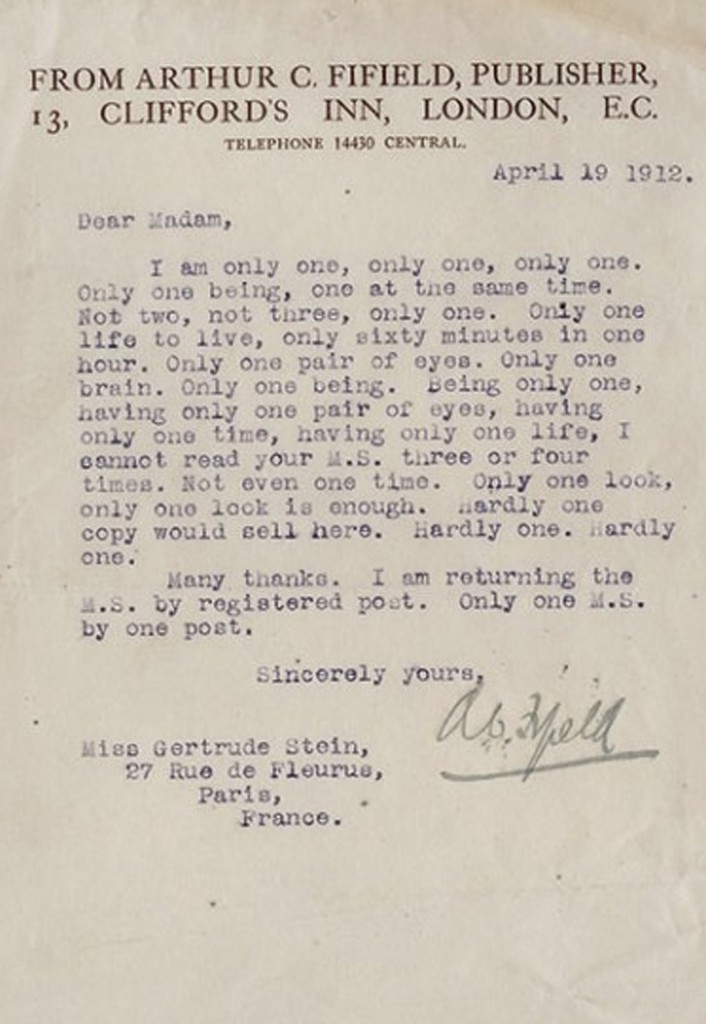
Gertrude Stein considered herself an experimental writer and wrote what The Poetry Foundation calls “dense poems and fictions, often devoid of plot or dialogue,” with the result being that “commercial publishers slighted her experimental writings and critics dismissed them as incomprehensible.” Take, for example, what happened when Stein sent a manuscript to Alfred C. Fifield, a London-based publisher, and received a rejection letter mocking her prose in return. According to Letters of Note, the manuscript in question was published many years later as her modernist novel, The Making of Americans: Being a History of a Family’s Progress (1925). You can hear Stein reading a selection from the novel below.
If you would like to support the mission of Open Culture, consider making a donation to our site. It’s hard to rely 100% on ads, and your contributions will help us continue providing the best free cultural and educational materials to learners everywhere. You can contribute through PayPal, Patreon, and Venmo (@openculture). Thanks!
Related Content:
Gertrude Stein Sends a “Review” of The Great Gatsby to F. Scott Fitzgerald (1925)
No Women Need Apply: A Disheartening 1938 Rejection Letter from Disney Animation
Alice B. Toklas Reads Her Famous Recipe for Hashish Fudge (1963)
Read More...The Song From the 1500’s That Blows Rick Beato Away: An Introduction to John Dowland’s Entrancing Music
In 2006, Sting released an album called Songs from the Labyrinth, a collaboration with Bosnian lutenist Edin Karamazov consisting mostly of compositions by Renaissance composer John Dowland. This was regarded by some as rather eccentric, but to listeners familiar with the early music revival that had already been going on for a few decades, it would have been almost too obvious a choice. For Dowland had long since been rediscovered as one of the late sixteenth and early seventeenth century’s musical superstars, thanks in part to the recordings of classical guitarist and lutenist Julian Bream.
“When I was a kid, I went to the public library in Fairport, New York, where I’m from, and I got this Julian Bream record,” says music producer and popular Youtuber Rick Beato (previously featured here on Open Culture) in the video above. Beato describes Bream as “one of the greatest classical guitarists who ever lived” and credits him with having “popularized the classical guitar and the lute and renaissance music.” The particular Bream recording that impressed the young Beato was of a John Dowland composition made exotic by distance in time called “The Earl of Essex Galliard,” a performance of which you can watch on Youtube.
Half a century later, Beato’s enjoyment for this piece seems undiminished — and indeed, so much in evidence that this practically turns into a reaction video. Listening gets him reminiscing about his early Dowland experiences: “I would put on this Julian Bream record of him playing lute, just solo lute, and I would sit there and I would putt” — his father having been golf enthusiast enough to have installed a small indoor putting green — and “imagine living back in the fifteen-hundreds, what it would be like.” These pretend time-travel sessions matured into a genuine interest in early music, one he pursued at the New England Conservatory of Music and beyond.
What a delight it would have been for him, then, to find that Sting had laid down his own version of “The Earl of Essex Galliard,” sometimes otherwise known as “Can She Excuse My Wrongs.” In one especially striking section, Sting takes “the soprano-alto-tenor-bass part” and records the whole thing using only layers of his own voice: “there’s four Stings here,” Beato says, referring to the relevant digitally manipulated scene in the music video, “but there’s actually more than four voices.” Songs from the Labyrinth may only have been a modestly successful album by Sting’s standards, but it has no doubt turned more than a few middle-of-the-road pop fans onto the beauty of English Renaissance music. If Beato’s enthusiasm has also turned a few classic-rock addicts into John Dowland connoisseurs, so much the better.
Related content:
The History of the Guitar: See the Evolution of the Guitar in 7 Instruments
Bach Played Beautifully on the Baroque Lute, by Preeminent Lutenist Evangelina Mascardi
Watch All of Vivaldi’s Four Seasons Performed on Original Baroque Instruments
Based in Seoul, Colin Marshall writes and broadcasts on cities, language, and culture. His projects include the Substack newsletter Books on Cities, the book The Stateless City: a Walk through 21st-Century Los Angeles and the video series The City in Cinema. Follow him on Twitter at @colinmarshall or on Facebook.
Read More...The Beautiful Art of Making Japanese Calligraphy Ink Out of Soot & Glue
Founded in 1577, Kobaien remains Japan’s oldest manufacturer of sumi ink sticks. Made of soot and animal glue, the ink stick—when ground against an inkstone, with a little water added—produces a beautiful black ink used by Japanese calligraphers. And, often, a 200-gram ink stick from Kobaien can cost over $1,000.
How can soot and animal glue command such a high price? As the Business Insider video above shows, there’s a fine art to making each ingredient—an art honed over the centuries. Watching the artisans make the soot alone, you immediately appreciate the complexity beneath the apparent simplicity. When you’re done watching how the ink gets made, you’ll undoubtedly want to watch the artisans making calligraphy brushes, an art form that has its own fascinating history. Enjoy!
Related Content
Read More...Hear the Evolution of Mozart’s Music, Composed from Ages 5 to 35
More than a quarter of a millennium after he composed his first pieces of music, different listeners will evaluate differently the specific nature of Wolfgang Amadeus Mozart’s genius. But one can hardly fail to be impressed by the fact that he wrote those works when he was five years old (or, as some scholars have it, four years old). It’s not unknown, even today, for precocious, musically inclined children of that age to sit down and put together simple melodies, or even reasonably complete songs. But how many of them can write something like Mozart’s “Minuet in G Major”?
The video above, which traces the evolution of Mozart’s music, begins with that piece — naturally enough, since it’s his earliest known work, and thus honored with the Köchel catalogue number of KV 1. Thereafter we hear music composed by Mozart at various ages of childhood, youth, adolescence, and adulthood, accompanied by a piano roll graphic that illustrates its increasing complexity.
And as with complexity, so with familiarity: even listeners who know little of Mozart’s work will sense the emergence of a distinctive style, and even those who’ve barely heard of Mozart will recognize “Piano Sonata No. 16 in C major” when it comes on.
Mozart composed that piece when he was 32 years old. It’s also known as the “Sonata facile” or “Sonata semplice,” despite its distinct lack of easiness for novice (or even intermediate) piano players. It’s now cataloged as KV 545, which puts it toward the end of Mozart’s oeuvre, and indeed his life. Three years later, the evolutionary listening journey of this video arrives at the “Requiem in D minor,” which we’ve previously featured here on Open Culture for its extensive cinematic use to evoke evil, loneliness, desperation, and reckoning. The piece, KV 626, contains Mozart’s last notes; the unanswerable but nevertheless irresistible question remains of whether they’re somehow implied in his first ones.
Related content:
Hear All of Mozart in a Free 127-Hour Playlist
Hear the Pieces Mozart Composed When He Was Only Five Years Old
Read an 18th-Century Eyewitness Account of 8‑Year-Old Mozart’s Extraordinary Musical Skills
Mozart’s Diary Where He Composed His Final Masterpieces Is Now Digitized and Available Online
What Movies Teach Us About Mozart: Exploring the Cinematic Uses of His Famous Lacrimosa
Based in Seoul, Colin Marshall writes and broadcasts on cities, language, and culture. His projects include the Substack newsletter Books on Cities, the book The Stateless City: a Walk through 21st-Century Los Angeles and the video series The City in Cinema. Follow him on Twitter at @colinmarshall or on Facebook.
Read More...Radiohead’s “Creep” Sung by a 1,600-Person Choir in Australia
Everybody can sing. Maybe not well. But why should that stop you? That’s the basic philosophy of Pub Choir, an organization based in Brisbane, Australia. At each Pub Choir event, a conductor “arranges a popular song and teaches it to the audience in three-part harmony.” Then, the evening culminates with a performance that gets filmed and shared on social media. Anyone (18+) is welcome to attend.
Above, you can watch a PubChoir performance, with 1600 choir members singing a moving version of Radiohead’s “Creep.” On their YouTube channel, you can also find Pub Choir performances of Coldplay’s “Yellow,” Toto’s “Africa,” and The Bee Gees “How Deep Is Your Love.”
Find other choir performances in the Relateds below.
Related Content
A Big Choir Sings Patti Smith’s “Because the Night”
A Choir with 1,000 Singers Pays Tribute to Sinéad O’Connor & Performs “Nothing Compares 2 U”
Watch David Byrne Lead a Massive Choir in Singing David Bowie’s “Heroes”
Patti Smith Sings “People Have the Power” with a Choir of 250 Fellow Singers
Read More...3,000 Illustrations of Shakespeare’s Complete Works from Victorian England, Presented in a Digital Archive
“We can say of Shakespeare,” wrote T.S. Eliot—in what may sound like the most backhanded of compliments from one writer to another—“that never has a man turned so little knowledge to such great account.” Eliot, it’s true, was not overawed by the Shakespearean canon; he pronounced Hamlet “most certainly an artistic failure,” though he did love Coriolanus. Whatever we make of his ambivalent, contrarian opinions of the most famous author in the English language, we can credit Eliot for keen observation: Shakespeare’s universe, which can seem so sprawlingly vast, is actually surprisingly spare given the kinds of things it mostly contains.
This is due in large part to the visual limitations of the stage, but perhaps it also points toward an author who made great works of art from humble materials. Look, for example, at a search cloud of the Bard’s plays.
You’ll find one the front page of the Victorian Illustrated Shakespeare Archive, created by Michael John Goodman, an independent researcher, writer, educator, curator and image-maker. The cloud on the left features a galaxy composed mainly of elemental and archetypal beings: “Animals,” “Castles and Palaces,” “Crowns,” “Flora and Fauna,” “Swords,” “Spears,” “Trees,” “Water,” “Woods,” “Death.” One thinks of the Zodiac or Tarot.
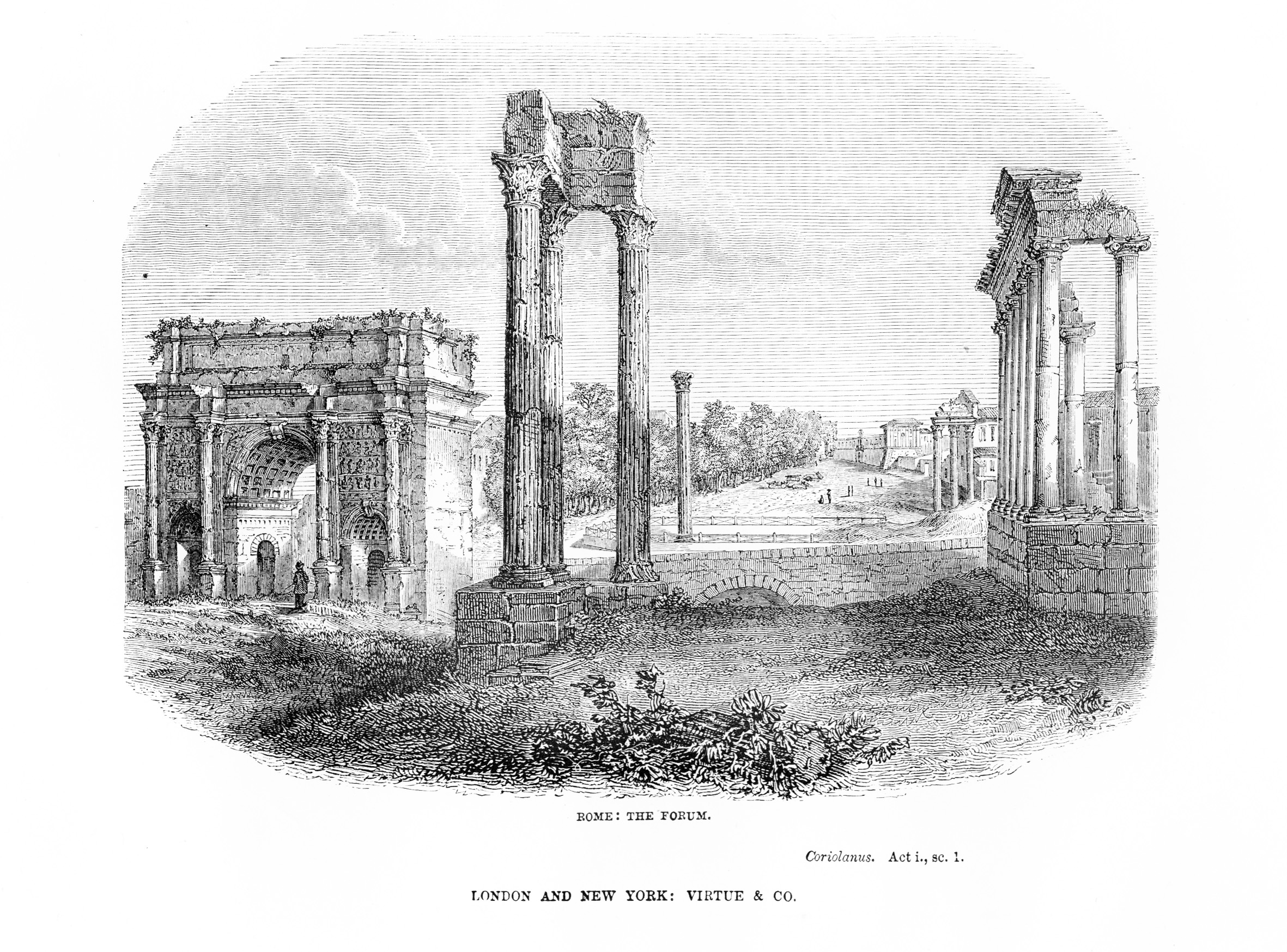
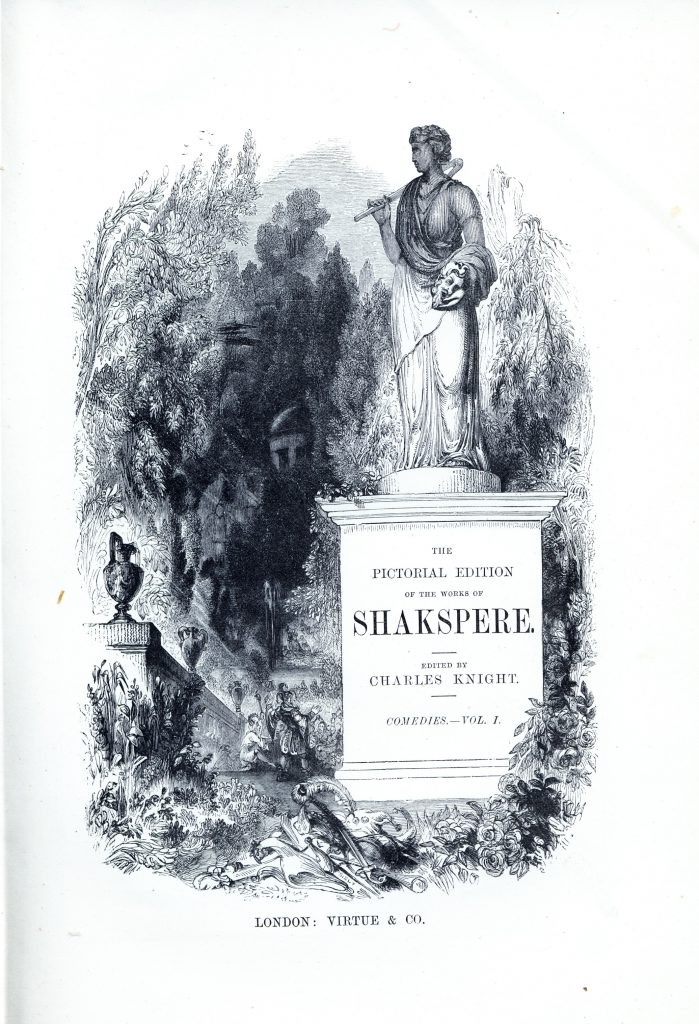
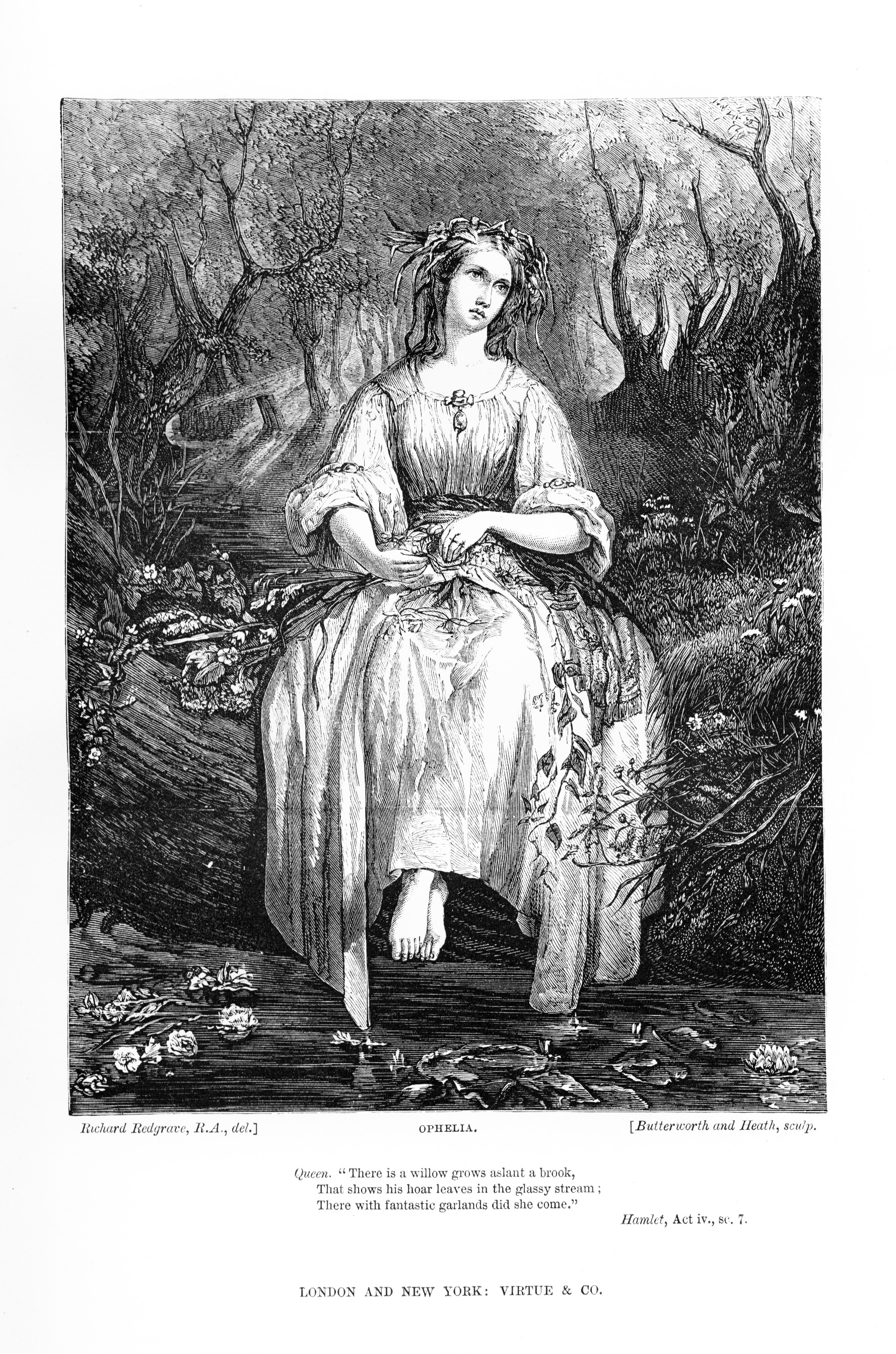
This particular search cloud, however, does not represent the most prominent terms in the text, but rather the most prominent images in four collections of illustrated Shakespeare plays from the Victorian period. Goodman’s site hosts over 3000 of these illustrations, taken from four major UK editions of Shakespeare’s Complete Works published in the mid-19th century. The first, published by editor Charles Knight, appeared in several volumes between 1838 and 1841, illustrated with conservative engravings by various artists. Knight’s edition introduced the trend of spelling Shakespeare’s name as “Shakspere,” as you can see in the title page to the “Comedies, Volume I,” at the top of the post. Further down, see two representative illustrations from the plays, the first of Hamlet’s Ophelia and second Coriolanus’ Roman Forum, above.
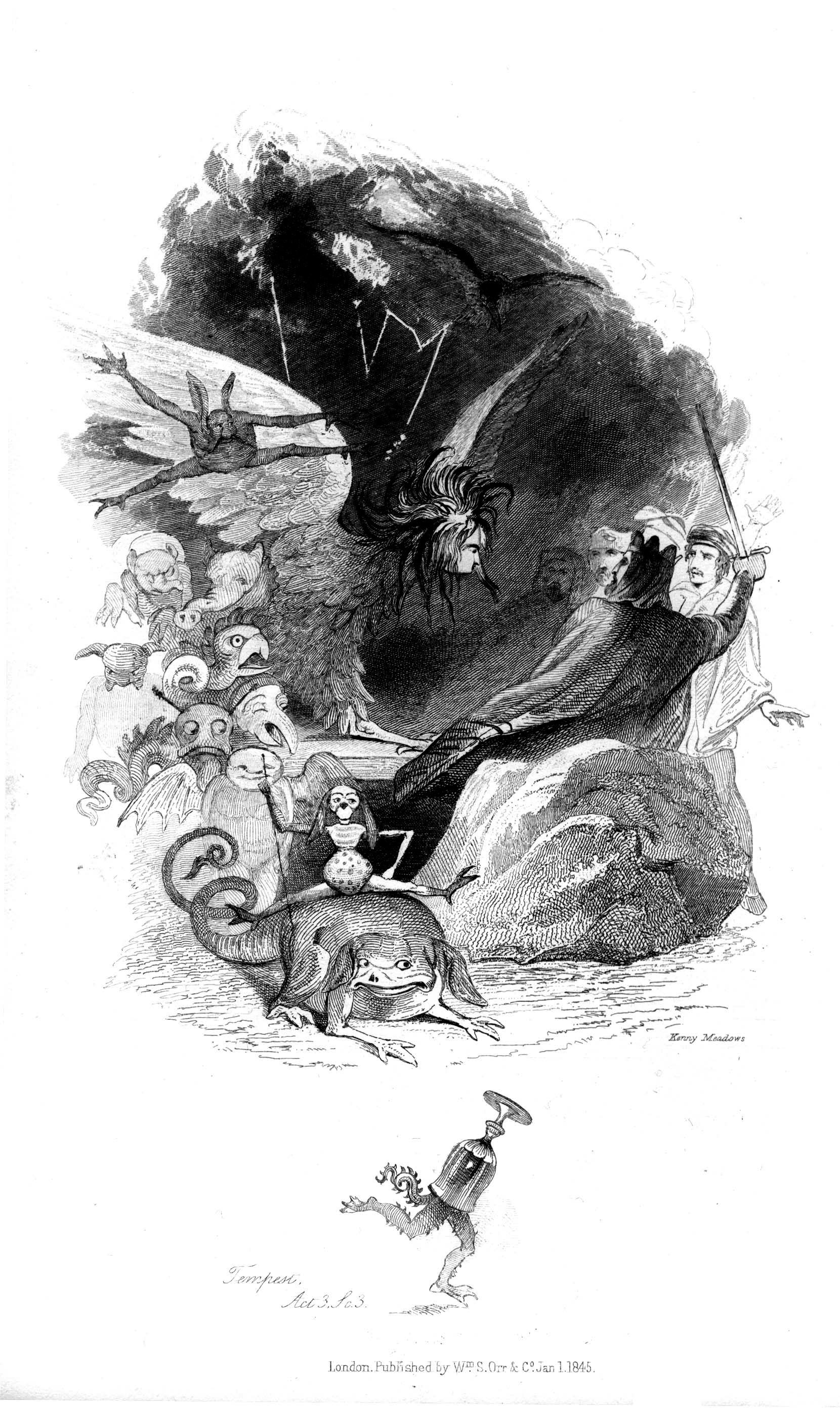
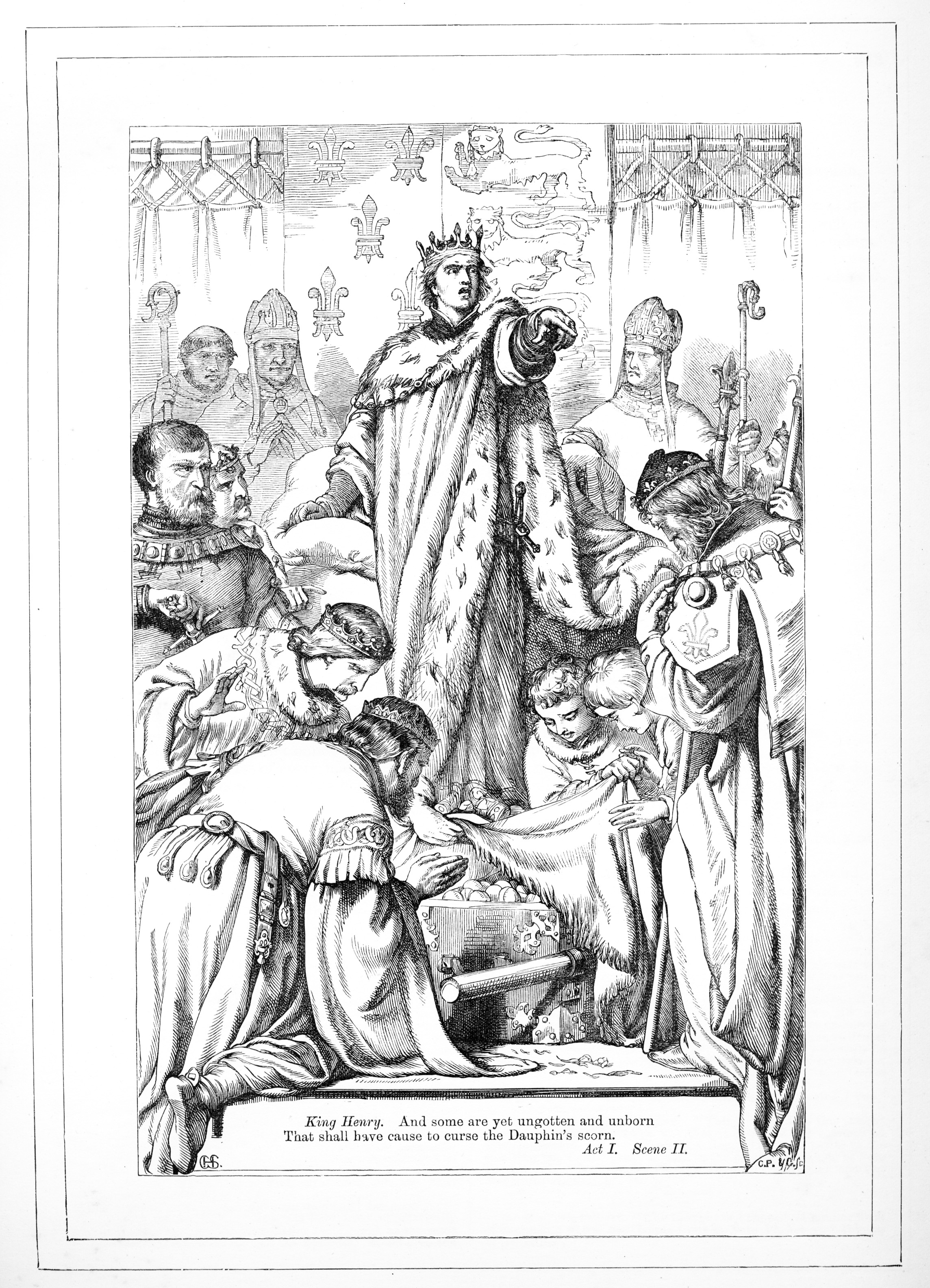
Part of a wave of “early Victorian populism” in Shakespeare publishing, Knight’s edition is joined by one from Kenny Meadows, who contributed some very different illustrations to an 1854 edition. Just above, see a Goya-like illustration from The Tempest. Later came an edition illustrated by H.C. Selous in 1864, which returned to the formal, faithful realism of the Knight edition (see a rendering of Henry V, below), and includes photograuvure plates of famed actors of the time in costume and an appendix of “Special Wood Engraved Illustrations by Various Artists.”
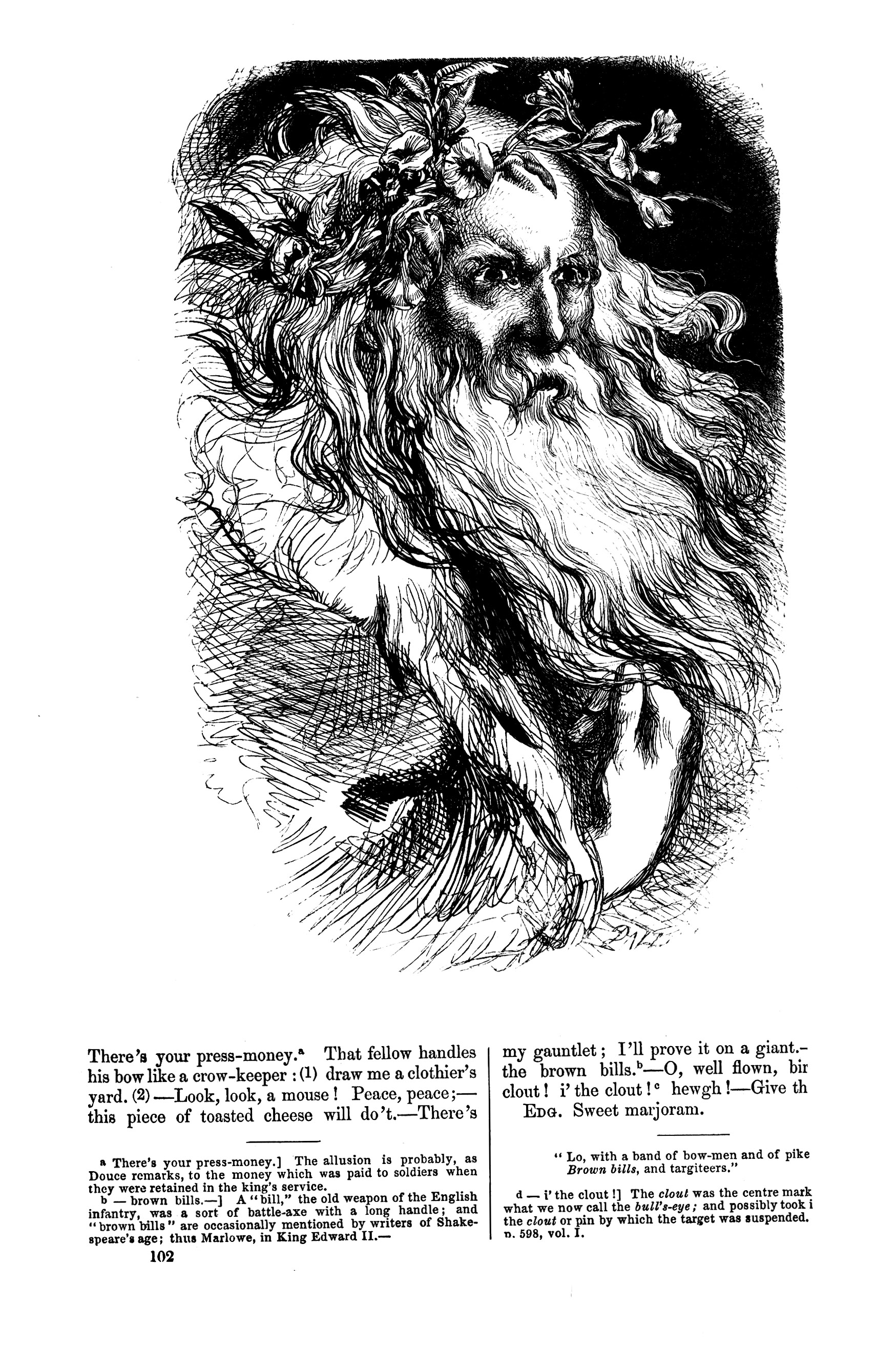
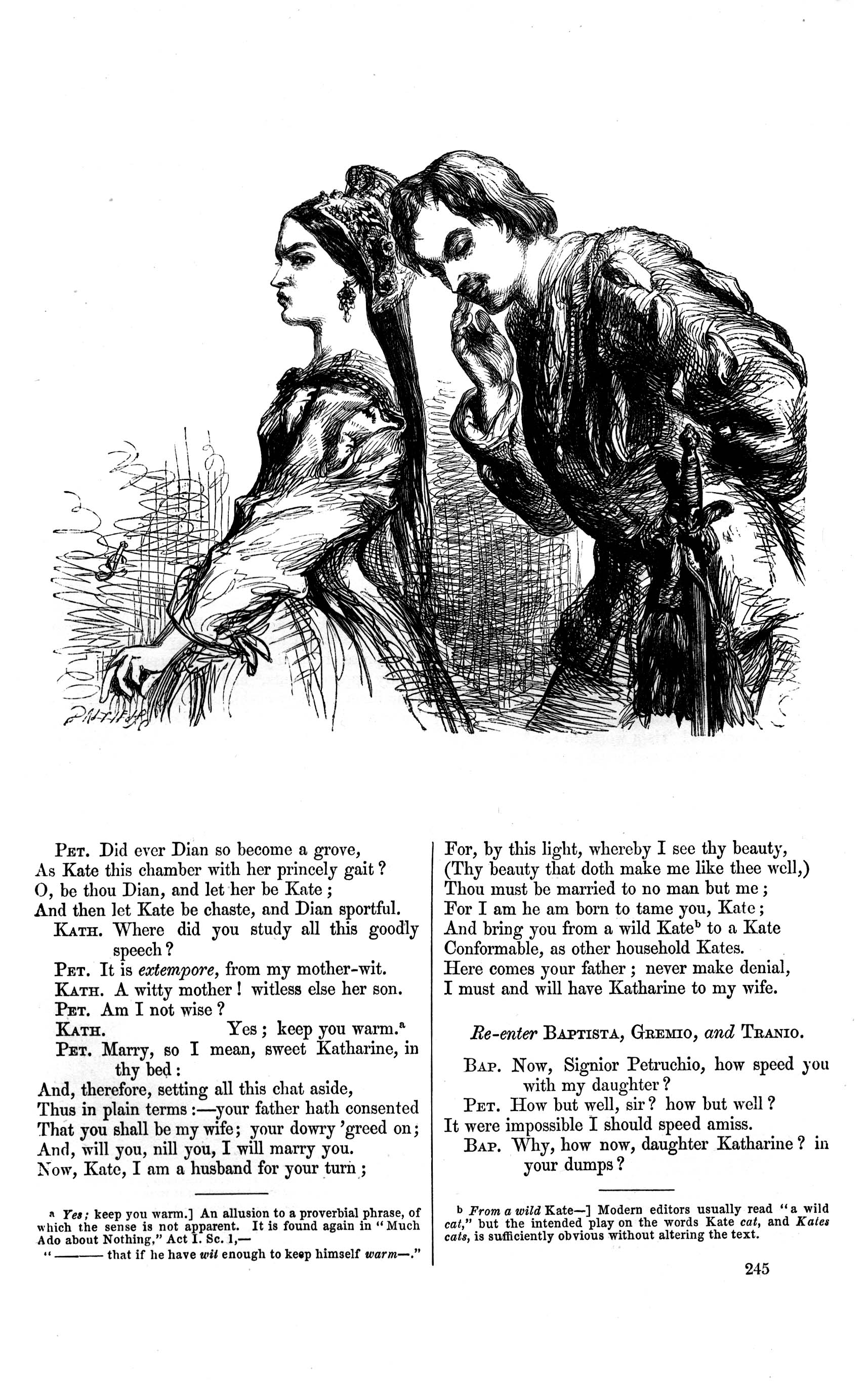
The final edition whose illustrations Goodman has digitized and catalogued on his site features engravings by artist John Gilbert. Also published in 1864, the Gilbert may be the most expressive of the four, retaining realist proportions and mise-en-scène, yet also rendering the characters with a psychological realism that is at times unsettling—as in his fierce portrait of Lear, below. Gilbert’s illustration of The Taming of the Shrew’s Katherina and Petruchio, further down, shows his skill for creating believable individuals, rather than broad archetypes. The same skill for which the playwright has so often been given credit.
But Shakespeare worked both with rich, individual character studies and broader, archetypal, material: psychological realism and mythological classicism. What I think these illustrated editions show us is that Shakespeare, whoever he (or she) may have been, did indeed have a keen sense of what Eliot called the “objective correlative,” able to communicate complex emotions through “a skillful accumulation of imagined sensory impressions” that have impressed us as much on the canvas, stage, and screen as they do on the page. The emotional expressiveness of Shakespeare’s plays comes to us not only through eloquent verse speeches, but through images of both the starkly elemental and the uniquely personal.
Spend some time with the illustrated editions on Goodman’s site, and you will develop an appreciation for how the plays communicate differently to the different artists. In addition to the search clouds, the site has a header at the top for each of the four editions. Click on the name and you will see front and back matter and title pages. In the pull-down menus, you can access each individual play’s digitized illustrations by type—“Histories,” “Comedies,” and “Tragedies.” All of the content on the site, Goodman writes, “is free through a CC license: users can share on social media, remix, research, create and just do whatever they want really!”
Update: This post originally appeared on our site in 2016. Since then, Goodman has been regularly updating the Victorian Illustrated Shakespeare Archive with more editions, giving it more richness and depth. These editions include “one published by John Tallis, which features famous actors of the time in character.” This also includes “the first ever comprehensive full-colour treatment of Shakespeare’s plays with the John Murdoch edition.” The archive, Goodman tells us, “now contains ten editions of Shakespeare’s plays and is fairly comprehensive in how people were experiencing Shakespeare, visually, in book form in the 19th Century.”
Related Content:
Take a Virtual Tour of Shakespeare’s Globe Theatre in London
Read All of Shakespeare’s Plays Free Online, Courtesy of the Folger Shakespeare Library
Josh Jones is a writer and musician based in Durham, NC. Follow him at @jdmagness
Read More...The Evolution of Animation, 1833–2017: From the Phenakistiscope to Pixar
This year has given us occasion to revisit the 1928 Disney cartoon Steamboat Willie, what with its entry — and thus, that of an early version of a certain Mickey Mouse — into the public domain. Though it may look comparatively primitive today, that eight-minute black-and-white film actually represents a great many advancements in the art and technology of animation since its inception. You can get a sense of that entire process, just about, from the video above, “The Evolution of Animation 1833–2017,” which ends up at The LEGO Batman Movie but begins with the humble phenakistiscope.
First introduced to the public in 1833, the phenakistiscope is an illustrated disc that, when spun, creates the illusion of motion. Essentially a novelty designed to create an optical illusion (the Greek roots of its name being phenakizein, or “deceiving,” and óps, or “eye”), it seems to have attained great popularity as a children’s toy in the nineteenth century, and it later became capable of projection and gained utility in scientific research. Pioneering motion photographer Eadweard Muybridge’s Zoopraxiscope, now immortalized in cinema history as a predecessor of the movie projector, was based on the phenakistiscope.
The first moments of “The Evolution of Animation” include a couple of phenakistiscopes, but soon the compilation moves on to clips starring somewhat better-known figures from the early twentieth century like Little Nemo and Gertie the Dinosaur. But it’s only after Steamboat Willie that animation undergoes its real creative explosion, bringing to whimsical and hyperkinetic life not just human characters but a host of animals, trees, and non-living objects besides. After releasing the monumental Snow White in 1937, Disney dominated the form both technologically and artistically for at least three decades. Though this video does contain plenty of Disney, it also includes the work of other studios that have explored quite different areas of the vast field of possibility in animation.
Take, for example, the psychedelic Beatles movie Yellow Submarine, the French-Czech surrealist science-fiction fable Fantastic Planet, the stop-motion between-holidays spectacle of The Nightmare Before Christmas, and of course, the depth and refinement of Hayao Miyazaki’s Studio Ghibli, beginning with Nausicaä of the Valley of the Wind (which came before the formation of the studio itself). From the mid-nineties — with certain notable exceptions, like Wallace & Gromit: The Movie and Charlie Kaufman’s AnomaLisa — computer-generated 3D animation more or less takes over from the traditional varieties. This has produced a number of features widely considered masterpieces, most of them from the now-Disney-owned Pixar. But after experiencing the history of the form in miniature, it’s tempting to hope that the next stage of the animation’s evolution will involve the rediscovery of its past.
Related content:
Behold the World’s Oldest Animation Made on a Vase in Iran 5,200 Years Ago
Gertie the Dinosaur: The Mother of all Cartoon Characters (1914)
Early Japanese Animations: The Origins of Anime (1917–1931)
Based in Seoul, Colin Marshall writes and broadcasts on cities, language, and culture. His projects include the Substack newsletter Books on Cities, the book The Stateless City: a Walk through 21st-Century Los Angeles and the video series The City in Cinema. Follow him on Twitter at @colinmarshall or on Facebook.
Read More...Support Us
We're hoping to rely on loyal readers, rather than erratic ads. Please click the Donate button and support Open Culture. You can use Paypal, Venmo, Patreon, even Crypto! We thank you!

About Us

Open Culture scours the web for the best educational media. We find the free courses and audio books you need, the language lessons & educational videos you want, and plenty of enlightenment in between.
Advertise With Us
FREE UPDATES!
GET OUR DAILY EMAIL
Get the best cultural and educational resources on the web curated for you in a daily email. We never spam. Unsubscribe at any time.
FOLLOW ON SOCIAL MEDIA
Open Culture editor Dan Colman scours the web for the best educational media. He finds the free courses and audio books you need, the language lessons & movies you want, and plenty of enlightenment in between.
Advertise With Us

