The Cult of the Criterion Collection: The Company Dedicated to Gathering & Distributing the Greatest Films from Around the World
There was a time, not so very long ago, when many Americans watching movies at home neither knew nor cared who directed those movies. Nor did they feel particularly comfortable with dialogue that sometimes came subtitled, or with the “black bars” that appeared below the frame. The considerable evolution of these audiences’ general relationship to film since then owes something to the adoption of widescreen televisions, but also to the Criterion Collection: the home-video brand that has been targeting its prestige releases of acclaimed films squarely at cinephiles — and even more so, at cinephiles with a collecting impulse — for four decades now.
“The company’s first release was a LaserDisc edition of Citizen Kane that included supplementary materials like a video essay and extensive liner notes on the provenance of the negative from which the restoration was made,” writes the New York Times’ Magazine’s Joshua Hunt in a recent piece on how Criterion became a (or perhaps the) cinematic tastemaker.
“Next came King Kong, which featured the first ever audio-commentary track, inspired, as an afterthought, by the stories that the film scholar Ronald Haver told while supervising the tedious process of transferring the film from celluloid.”
With the coming of the more successful DVD format in the late nineteen-nineties, such audio-commentary tracks became a staple feature of video releases, Criterion or otherwise. They were a godsend to the cinephiles of my generation coming of age in that era, a kind of informal but intensive film school taught by not just expert scholars but, often, the auteurs themselves. “Some of the earliest were recorded by Martin Scorsese for the Taxi Driver and Raging Bull LaserDiscs, which helped cement his influence on an entire generation of young directors” — including a certain Wes Anderson, who would go on to record commentary tracks for the Criterion releases of his own pictures.
At this point, Criterion has “become the arbiter of what makes a great movie, more so than any Hollywood studio or awards ceremony.” It’s also amassed an unusually dedicated customer base, as explained in the Royal Ocean Film Society video “The Cult of the Criterion Collection.” “We’re at a point in film culture where brands are increasingly more popular than products,” says host Andrew Saladino, a self-confessed Criterion devotee. “More and more, it seems as though the films and the people who made them are secondary to the name and logo of the company behind them,” a phenomenon that Criterion — itself a kind of media universe — somehow both participates in and rises above.
“While studios and streaming services chase audiences by producing endless sequels and spinoffs,” writes Hunt, “Criterion has built a brand that audiences trust to lead them.” I can testify to its having led me to the work of auteurs from Chris Marker to Jacques Tati, Akira Kurosawa to Yasujiro Ozu, Robert Altman to Nicolas Roeg. Today, budding cinema enthusiasts can even benefit from the advice of famous directors and actors for navigating its now‑1,650-title-strong catalog through its “Criterion closet” video series. Recently, that closet has hosted the likes of Paul Giamatti, Willem Dafoe, and Wim Wenders, who pulls off the shelf a copy of his own Until the End of the World — which Criterion released, of course, in its nearly five-hour-long director’s cut. “I always think this is maybe the best thing I’ve done in my life,” he says, “but then again, who am I to judge?”
Related content:
The Art of Restoring Classic Films: Criterion Shows You How It Refreshed Two Hitchcock Movies
Martin Scorsese Names His Top 10 Films in the Criterion Collection
Steve Buscemi’s Top 10 Film Picks (from The Criterion Collection)
Slavoj Žižek Names His Favorite Films from The Criterion Collection
120 Artists Pick Their Top 10 Films in the Criterion Collection
A Celebration of Retro Media: Vinyl, Cassettes, VHS, and Polaroid Too
Based in Seoul, Colin Marshall writes and broadcasts on cities, language, and culture. His projects include the Substack newsletter Books on Cities, the book The Stateless City: a Walk through 21st-Century Los Angeles and the video series The City in Cinema. Follow him on Twitter at @colinmarshall or on Facebook.
Read More...Learn to Become a Supply Chain Data Analyst with Unilever’s New Certificate Program

Supply chains—we never thought too much about them. That is, until the pandemic, when supply chains experienced severe disruptions worldwide, leaving us waiting for products for weeks, if not months. That’s when we started appreciating the importance of supply chains and their resilience.
Companies like Unilever rely on supply chains to manufacture their goods (e.g., Dove, Lipton, and Ben & Jerry’s) and then move them around the globe. For Unilever, it’s essential that their supply chains remain efficient and strong. Working in partnership with Coursera, the company has created a new Supply Chain Data Analyst Professional Certificate to help entry-level professionals learn more about using data to manage effective supply chains. Designed to be completed in roughly four months, the certificate consists of four courses: 1) Supply Chain Management and Analytics, 2) Using Data Analytics in Supply Chain, 3) Implementing Supply Chain Analytics, and 4) Supply Chain Software Tools.
As students move through the program, they will learn how to “achieve cost savings, reduce lead times, enhance customer satisfaction, and adapt to changing market conditions through data-driven insights and analytical approaches.” They will also learn key skills like demand forecasting and how to monitor supply chains for security risks.
Emphasizing real-world experience, students will “take on the role of an analyst for a fictitious consumer goods company specializing in organic farm to table consumer products. With over 20 unique assignments, [students will] use spreadsheets and visualization tools to analyze data and make recommendations.”
You can audit the four courses for free, or sign up to earn a shareable certificate for a fee. Students who select the latter option will be charged $49 per month. Coursera estimates that the certificate will take four months to complete, assuming you’re dedicating 10 hours per week. That amounts to about $200 in total. You can enroll here.
For those interested, Unilever has also recently released a new Digital Marketing Analyst Certificate, which you can find here.
In addition, until March 31, 2024, Coursera is offering $100 off of Coursera Plus, which will let you take 7,000 courses (including the ones above) and not pay for the certificates. If you plan to take a lot of courses, and want to earn certificates, it can be a cost effective approach.
Note: Open Culture has a partnership with Coursera. If readers enroll in certain Coursera courses and programs, it helps support Open Culture.
Related Content
Generative AI for Everyone: A Free Course from AI Pioneer Andrew Ng
Read More...Laurence Fishburne Reads a Former Slave’s Incredible Letter to His Old Master (1865)
Lawrence Fishburne brings a degree of gravity to his roles offered by few other living actors. That has secured his place in pop culture as Morpheus from The Matrix, for example. But he could even marshal it early in his career, as evidenced by his role as Apocalypse Now’s “Mr. Clean,” which he took on at just fourteen years old. But it was a much more recent performance he gave for Letters Live, which you can see in the video above, that clearly brings out the qualities that have made him a beloved and enduring figure onscreen: not just his moral seriousness, but this sense of humor as well.
“To my old master,” Fishburne begins, getting a laugh right away. The letter in question, previously featured here on Open Culture, was originally written in 1865 by a man named Jourdon Anderson, who had escaped a life of slavery in Tennessee with his wife the previous year. Having since fallen on hard times, that former master had written to Anderson and asked him to come back to work on the plantation. “I have often felt uneasy about you,” Anderson writes. “I thought the Yankees would’ve hung you before this for harboring Rebs that they found at your house,” among other crimes he recalls.
Having set himself and his family up in Ohio, Anderson could hardly have felt tempted to go down South again. “I want to know particularly what the good chance is you propose to give me,” he writes. “I am doing tolerably well here. I get $25 a month, with victuals and clothing, have a comfortable home for Mandy — the folks call her Mrs. Anderson — and the children, Millie, Jane, and Grundy, go to school and are learning well.” But “if you will write and say what wages you will give me, I will better be able to decide whether it will be to my advantage to move back again.”
Fishburne delivers these lines with a thick layer of irony, as Anderson no doubt intended. “Mandy says she would be afraid to go back without some proof that you were disposed to treat us kindly and justly, and we have concluded to test your sincerity by asking you to send us our wages for the time that we served you.” When Fishburne says that, he practically gets a standing ovation, and indeed, the letter met with a favorable reception in its day as well — not from Colonel P. H. Anderson himself, but from the readers of the newspapers in which it was reprinted. In the end, Jourdon Anderson kept his freedom, and got fame lasting more than a century after his death to go with it.
Related content:
“Ask a Slave” by Azie Dungey Sets the Historical Record Straight in a New Web Series
Based in Seoul, Colin Marshall writes and broadcasts on cities, language, and culture. His projects include the Substack newsletter Books on Cities, the book The Stateless City: a Walk through 21st-Century Los Angeles and the video series The City in Cinema. Follow him on Twitter at @colinmarshall or on Facebook.
Read More...
A Day in Tokyo: A 1968 Film Captures a City Reborn 23 Years After Its Destruction
During World War II, Tokyo sustained heavy damage, especially with the bombings conducted by the U.S. military in March 1945. Known as Operation Meetinghouse, US air raids destroyed 16 square miles in central Tokyo, leaving 100,000 civilians dead and one million homeless. Tokyo didn’t recover quickly. It took until the 1950s for reconstruction to really gain momentum. But gain momentum it did. By 1964, Tokyo found itself largely rebuilt, modernized, and ready to host the Olympics. That brings us to the 1968 film above, A Day in Tokyo, created by the Japan National Tourism Organization (JNTO) to promote tourism in the rebuilt city.
The website Japanese Nostalgic Car sets the scene:
The year 1968 was a special time for Japan. It was emerging as a modern country. The Tokyo Olympics had just been held a few years prior. Bullet trains, high-speed expressways, and color television broadcasts were spreading throughout the land. The year before saw the Toyota 2000GT and Mazda Cosmo Sport, Japan’s contemporary sports cars, debut. It must have been incredibly exciting.
In the 23-minute film above, you can revisit this moment of transformation and renewal, when Tokyo—as the film’s narrator put it—combined the best of new and old. Here, in the “constant metabolic cycle of destruction and creation, Tokyo progresses at a dizzying pace.” And it’s a sight to behold. Enjoy.
Related Content
Behold the Unique Beauty of Japan’s Artistic Manhole Covers
Read More...Free Coloring Books from Libraries & Museums: Download & Color Thousands of Free Images (2024)

Launched by The New York Academy of Medicine Library in 2016, Color Our Collections is “an annual coloring festival on social media during which libraries, museums, archives and other cultural institutions around the world share free coloring content featuring images from their collections.” In February, the project released its 2024 archive of coloring books, allowing you to download, print and color thousands of images from 93 libraries and museums. The collection includes submissions from The Newberry Library, the National Library of Medicine, Europeana, the Harley-Davidson Archives, Stanford University Libraries, the Southeast Asia Digital Library and more. Happy coloring!
Note: When you navigate to a specific coloring book within the collection, you may initially encounter a blank section on the page. Please scroll down to locate the actual download link for the coloring book.
Related Content
The Very First Coloring Book, The Little Folks’ Painting Book (Circa 1879)
The First Adult Coloring Book: See the Subversive Executive Coloring Book From 1961
Read More...When Frank Lloyd Wright Designed a Plan to Turn Ellis Island Into a Futuristic Jules Verne-Esque City (1959)
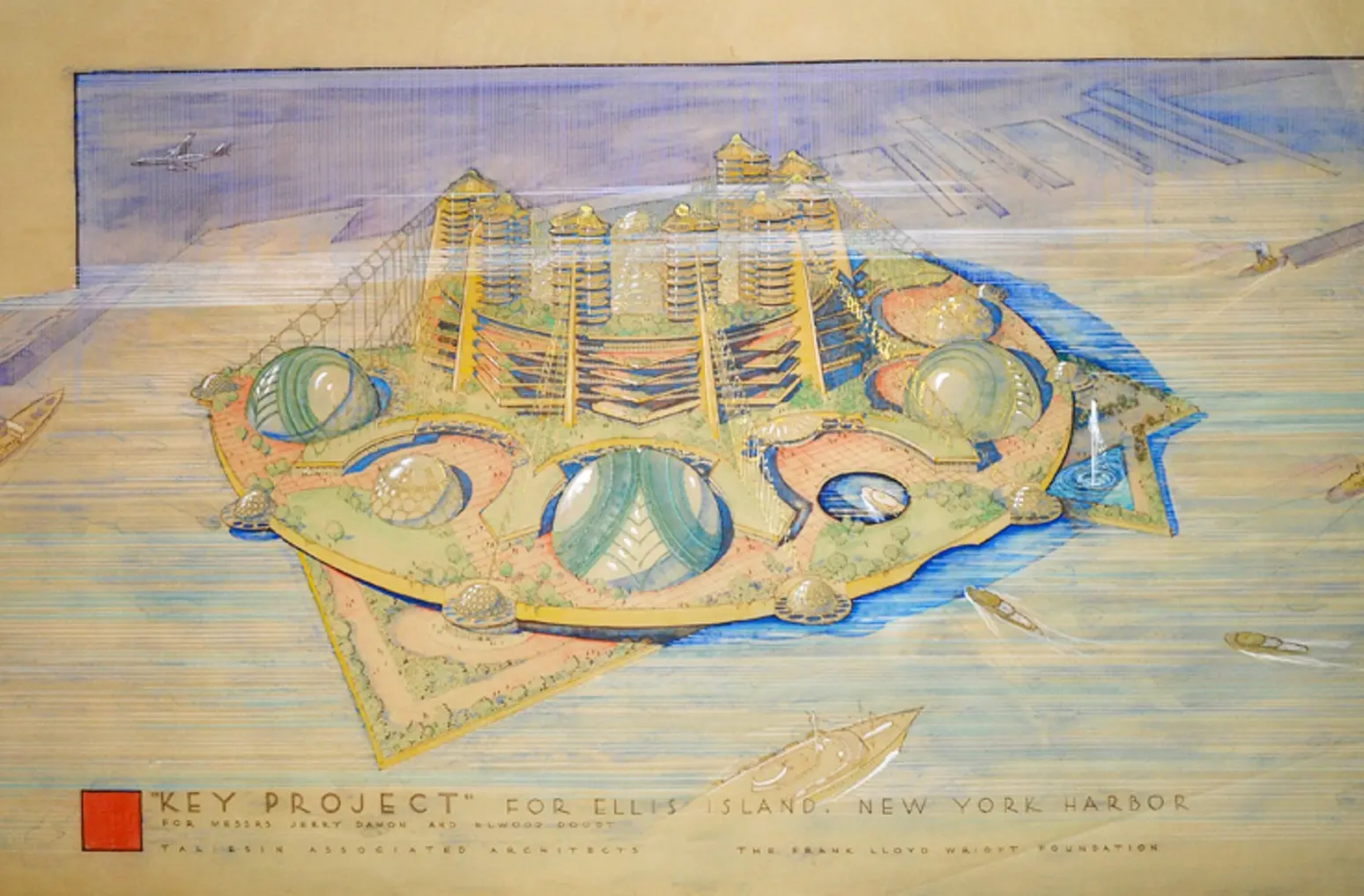
The very words “Ellis Island” bring to mind a host of sepia-toned images, shaped by both American historical fact and national myth. Officers employed there really did inspect the eyelids of new arrivals with buttonhooks, for example, but they didn’t actually make a policy of changing their names, however foreign they sounded. You can learn this and much else besides by paying a visit to the National Immigration Museum on Ellis Island, which opened in 1990, 36 years after the closure of the immigrant inspection and processing station itself. But if Frank Lloyd Wright had had his way, you could live on Ellis Island — and what’s more, you’d never need to leave it.
“After Ellis Island was decommissioned in 1954 as the nation’s gateway to the world’s huddled masses, the U.S. General Services Administration (GSA) chose an all-American path: opening the site to developers,” write Sam Lubell and Greg Goldin at the Gotham Center for New York City History. When NBC radio and television announcer Jerry Damon and director Elwood Doudt pitched to Wright the ambitious idea of redeveloping the disused island into a “completely self-contained city of the future,” the architect replied that the project was “virtually made to order for me.” Alas, Wright died just before they could all meet and hammer out the details, but not before he’d drawn up a preliminary but vivid plan.
Damon and Doudt carried on with what the late Wright has named the “Key Project.” “Its Jules Verne-esque design, based on Wright’s sketches, was resolutely futuristic,” write Lubell and Goldin. A “circular podium” on the island would support “apartments for 7,500 residents, rising like a stack of offset, alternating dishes. Above these dwelling floors, and separated by sundecks, would be a crescent of seven corrugated, candlestick-shaped towers containing more apartments and a 500-room hotel.” At the center of it all, Wright placed “a huge globe, seemingly pockmarked by eons of meteor collisions, and held aloft by plastic canopies protecting the plazas below.”
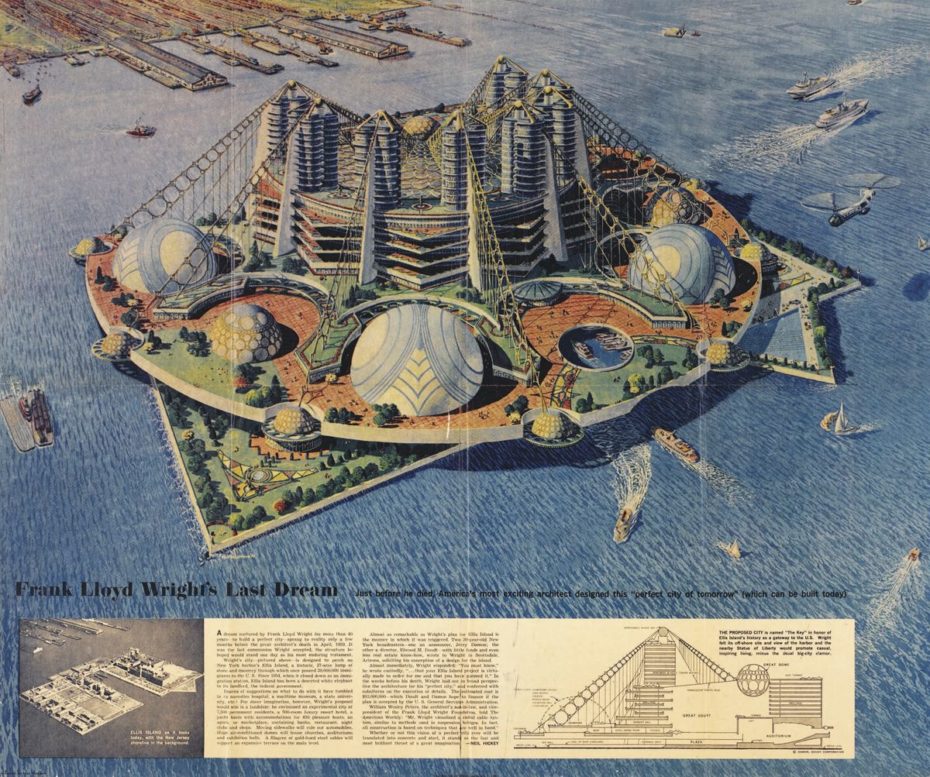
It’s easy to imagine the execution of this Space Age urban utopia not quite living up to Wright’s vision — and, indeed, to imagine it having fallen by now into just as thorough a state of dilapidation as did Ellis Island’s original buildings. But it’s also fascinating to consider what could have been Wright’s final commission as the acme of the evolution of his thinking about the urban space itself. A quarter-century earlier, he’d been obsessed with the quasi-rural development he called Broadacre City; just a few years before his death, he came up with the Illinois Mile-High Tower, a megastructure that would practically have constituted a metropolis in and of itself. The Key Project, as Damon and Doudt promoted it, would have offered “casual, inspired living, minus the usual big-city clamor”: the kind of marketing language we hear from developers still today, though not backed by the genius of the most renowned architect in American history.
Related content:
Frank Lloyd Wright Designs an Urban Utopia: See His Hand-Drawn Sketches of Broadacre City (1932)
Why Frank Lloyd Wright Designed a Gas Station in Minnesota (1958)
Portraits of Ellis Island Immigrants Arriving on America’s Welcoming Shores Circa 1907
Based in Seoul, Colin Marshall writes and broadcasts on cities, language, and culture. His projects include the Substack newsletter Books on Cities, the book The Stateless City: a Walk through 21st-Century Los Angeles and the video series The City in Cinema. Follow him on Twitter at @colinmarshall or on Facebook.
Read More...An Architectural Tour of Sagrada Família, Antoni Gaudí’s Audacious Church That’s Been Under Construction for 142 Years
In less than a year and a half, the centenary of Antoni Gaudí’s death will be here. Faced with this fact, especially dedicated enthusiasts of Catalan architecture may already be planning their festivities. But we can be sure where the real pressure is felt: the Basílica i Temple Expiatori de la Sagrada Família, Gaudí’s most famous building, which — as of tomorrow — has been under construction for 142 years. When it first broke ground in 1882, Gaudí wasn’t involved at all, but when he took over the project the following year, he re-envisioned it in a distinctive combination of the Gothic and Art Nouveau styles. The rest, as they say, is history: a troubled, unpredictable history continuing to this day, explained by architecture-and-history Youtuber Manuel Bravo in the video above.
Though it isn’t yet complete, you can visit Sagrada Família; indeed, it’s long been the most popular tourist attraction in Barcelona. The experience of marveling at the basilica’s astonishing degree of detail and not-quite-of-this-Earth structure is worth the price of admission, which has helped to fund its ongoing construction. But you’ll appreciate it on a higher level if you go with someone who can explain its many unusual features, both architectural and religious — someone with as much knowledge ad enthusiasm as Bravo, whom we’ve previously featured here on Open Culture for his videos on Pompeii, Venice, the Great Pyramids of Giza, and the Duomo di Firenze.
With Sagrada Família’s pyramidal shape, Bravo explains, Gaudí “hoped to suggest a connection between the human and the divine.” Its three façades are dedicated to the birth, death, and eternal life of Jesus Christ, to whom the central and tallest of its planned eighteen towers will be dedicated. The cathedral’s exterior alone constitutes an “authentic Bible of stone,” but it can hardly prepare you to step into the interior, with its “beautiful play of space, light, and color.” As Bravo puts it, “the protagonist here is the space itself,” envisioned by Gaudí as “a huge forest” involving no un-nature-like straight lines. All of it showcases “the combination of aesthetics and efficiency” that defines the architect’s work.
Bravo’s video runs a bit over twenty minutes, but you could spend much, much longer appreciating every aspect of Sagrada Família, those completed in Gaudí’s lifetime as well as those completed by the many devoted artisans who have continued his work for almost 100 years now. The architect “knew quite well that he would not live to see the temple completed,” says Bravo, hence his having “left behind so many models and drawings” for his successors to go on. They’re working on a 2026 deadline, but as Bravo notes, given the interruptions inflicted by COVID-19, “that date seems unlikely.” But then, has there ever been as unlikely a building as Sagrada Família?
Related content:
Venice Explained: Its Architecture, Its Streets, Its Canals, and How Best to Experience Them All
Take a High Def, Guided Tour of Pompeii
What the Great Pyramids of Giza Originally Looked Like
Based in Seoul, Colin Marshall writes and broadcasts on cities, language, and culture. His projects include the Substack newsletter Books on Cities, the book The Stateless City: a Walk through 21st-Century Los Angeles and the video series The City in Cinema. Follow him on Twitter at @colinmarshall or on Facebook.
Read More...An Animated Introduction to the Rosetta Stone, and How It Unlocked Our Understanding of Egyptian Hieroglyphs
In 1799, Napoleon’s army encountered a curious artifact in Egypt, a black stone that featured writing in three different languages: Egyptian Hieroglyphs, Demotic Egyptian, and Ancient Greek. Before long, English troops captured the stone and brought it to the British Museum in 1802—where it remains today. The animated video above, created by Egyptologist Franziska Naether, explains “how scholars decoded the ancient message of the Rosetta Stone,” a painstaking process that took decades to complete. By the 1850s, philologists had unlocked the meaning of Egyptian hieroglyphs and, with them, the secrets of ancient Egyptian civilization.
Related Content
What the Rosetta Stone Actually Says
How to Read Ancient Egyptian Hieroglyphs: A British Museum Curator Explains
Read More...An Introduction to the Astrolabe, the Medieval Smartphone

Image by Anders Sandberg, via Wikimedia Commons
Asked to imagine the character of everyday life in the Middle Ages, a young student in the twenty-twenties might well reply, before getting around to any other details, that it involved no smartphones. But even the flashiest new technologies have long evolutionary histories, and, in certain notable respects, even the smartphone has a medieval ancestor. That would be the astrolabe, an especially fascinating eleventh-century example of which was recently discovered at the Fondazione Museo Miniscalchi-Erizzo in Verona. It was identified by University of Cambridge historian Federica Gigante, who’s been making the media rounds to explain the context and function of this striking and historic device.
“It’s basically the world’s earliest smartphone,” Gigante says in an NPR All Things Considered segment. “With one simple calculation, you can tell the time, but you can also do all sorts of other things.” In a visual New York Times feature, Franz Lidz and Clara Vannucci add that astrolabes, which resembled “large, old-fashioned vest pocket watches,” also allowed their users to determine “distances, heights, latitudes and even (with a horoscope) the future.”
Gigante tells them that, when she got the chance to pay the Miniscalchi-Erizzo astrolabe closer scrutiny, she could identify Arabic inscriptions, “faint Hebrew markings,” and Western numerals, which made this particular artifact “a powerful record of scientific exchange between Muslims, Jews and Christians over nearly a millennium.”
In the video above, Seb Falk, author of The Light Ages: The Surprising Story of Medieval Science, demonstrates how to use an astrolabe to calculate the time. It is, admittedly, a more complicated affair than glancing at the screen of your phone, analogies to which have become irresistible in these discussions. “Like the smartphone, the astrolabe came into being during times of economic prosperity — in that case, likely during the height of the Roman Empire,” writes Smithsonian ‘s Laura Poppick. Though functional astrolabes were made of ordinary wood or metals, the surviving examples tend to be ornately engraved brass, which provided status value to the high-end market. In that respect, too, the astrolabe resembles the “conceptual ancestor to the iPhone 7” — a device that, in the eyes of technophiles here in 2024, now looks fairly medieval itself.
Related content:
The Ancient Astronomy of Stonehenge Decoded
The World’s First Mobile Phone Shown in 1922 Vintage Film
Based in Seoul, Colin Marshall writes and broadcasts on cities, language, and culture. His projects include the Substack newsletter Books on Cities, the book The Stateless City: a Walk through 21st-Century Los Angeles and the video series The City in Cinema. Follow him on Twitter at @colinmarshall or on Facebook.
Read More...The Book of Colour Concepts: A New 800-Page Celebration of Color Theory, Including Works by Newton, Goethe, and Hilma af Klint
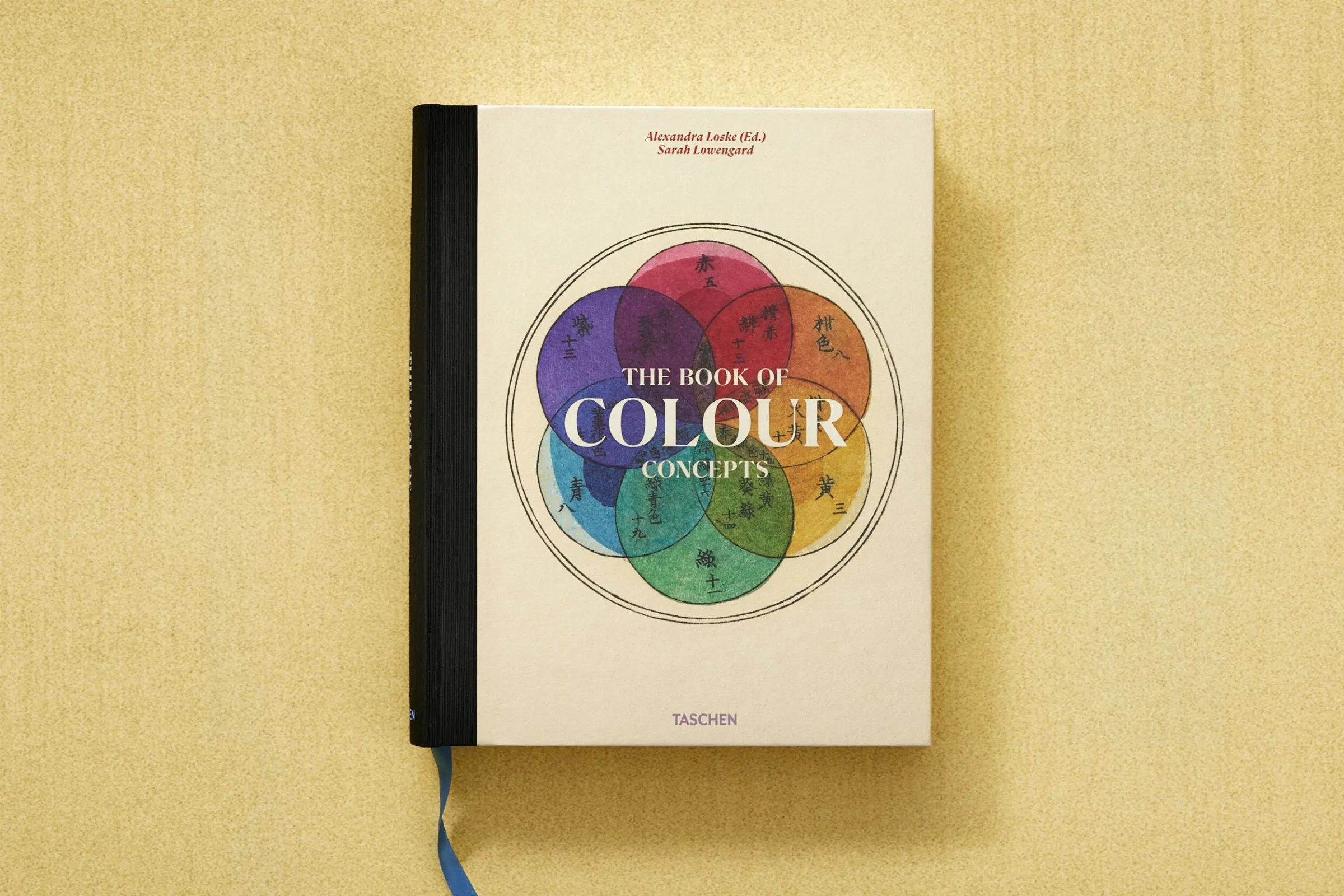
The Book of Colour Concepts will soon be published by Taschen in a multilingual edition, containing text in English, French, German, and Spanish. This choice makes its abundance of explanatory scholarship widely accessible at a stroke, but even those who read none of those four languages can enjoy the book. For it takes a deep dive — with Taschen’s characteristic visual lavishness — into one of the truly universal languages: that of color. Throughout its two volumes, The Book of Colour Concepts presents more than 1000 images drawn from four centuries’ worth of “rare books and manuscripts from a wealth of institutions, including the most distinguished color collections worldwide.”
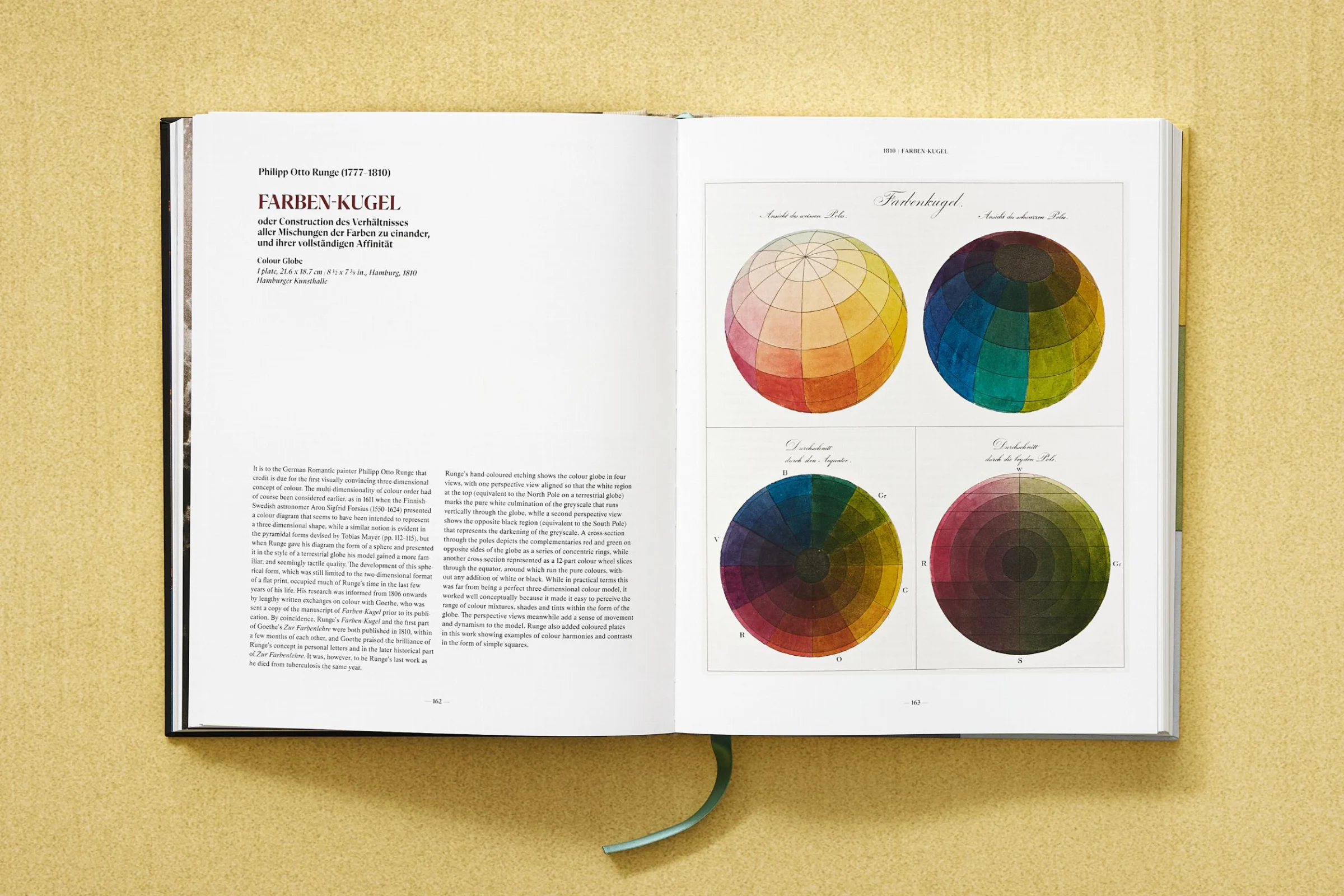
Reproduced within are selections from more than 65 books and manuscripts, including such “seminal works of color theory” as Isaac Newton’s Opticks and Johann Wolfgang von Goethe’s Zur Farbenlehre, as previously featured here on Open Culture.
Kate Mothes at Colossal adds that “readers will also find studies from Color Problems, the early 20th-century handbook by Emily Noyes Vanderpoel, which described theories that would trend in subsequent decades in design and art, like Joseph Albers’s series Homage to the Square.” In The Book of Colour Concepts’ 800 pages also appear a variety of works that don’t belong, strictly speaking, to the field of color theory, such as a botanical notebook by the spiritualist and early abstract artist Hilma af Klint.
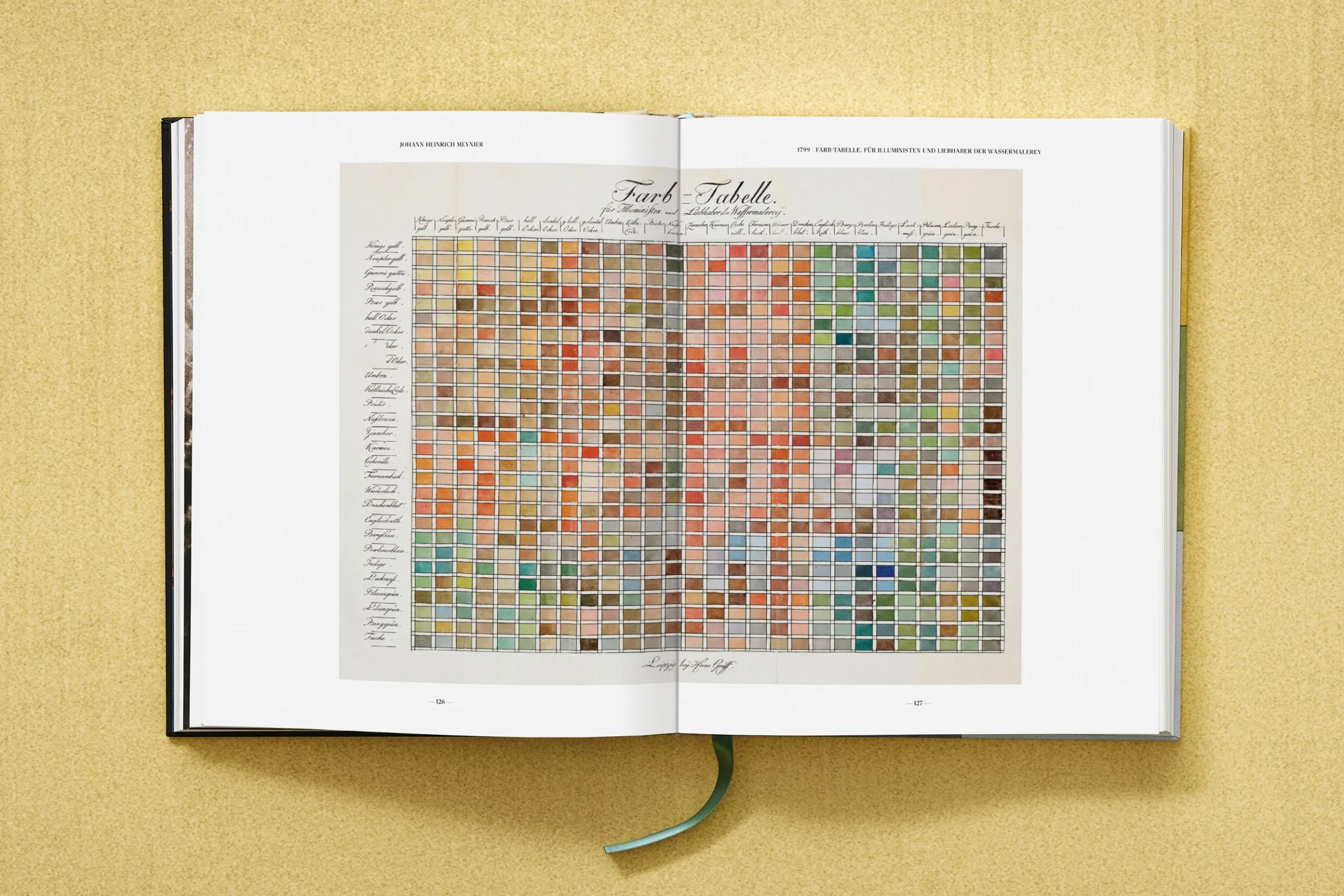
Co-authors Sarah Lowengard and Alexandra Loske bring serious credentials to this endeavor: Lowengard is a historian of technology and science with more than 40 years’ experience as an “artisan color-maker,” and Loske is an art historian and curator who specializes in “the role of women in the history of color.” Both would no doubt agree on the special value of revisiting the history of this particular subject here in the early twenty-first century, with all its discourse about the disappearance of color from our everyday lives. It’s worrisome enough that spoken and written languages outside the English-French-German-Spanish league seem to be declining; relegating ourselves to an ever-narrowing vocabulary of color would be an even graver loss indeed.
Related content:
A 900-Page Pre-Pantone Guide to Color from 1692: A Complete High-Resolution Digital Scan
The Vibrant Color Wheels Designed by Goethe, Newton & Other Theorists of Color (1665–1810)
Based in Seoul, Colin Marshall writes and broadcasts on cities, language, and culture. His projects include the Substack newsletter Books on Cities, the book The Stateless City: a Walk through 21st-Century Los Angeles and the video series The City in Cinema. Follow him on Twitter at @colinmarshall or on Facebook.
Read More...Support Us
We're hoping to rely on loyal readers, rather than erratic ads. Please click the Donate button and support Open Culture. You can use Paypal, Venmo, Patreon, even Crypto! We thank you!

About Us

Open Culture scours the web for the best educational media. We find the free courses and audio books you need, the language lessons & educational videos you want, and plenty of enlightenment in between.
Advertise With Us
FREE UPDATES!
GET OUR DAILY EMAIL
Get the best cultural and educational resources on the web curated for you in a daily email. We never spam. Unsubscribe at any time.
FOLLOW ON SOCIAL MEDIA
Open Culture editor Dan Colman scours the web for the best educational media. He finds the free courses and audio books you need, the language lessons & movies you want, and plenty of enlightenment in between.
Advertise With Us


