67 Logical Fallacies Explained in 11 Minutes
Fallacies—notes Purdue’s Writing Lab—“are common errors in reasoning that will undermine the logic of your argument. Fallacies can be either illegitimate arguments or irrelevant points, and are often identified because they lack evidence that supports their claim. Avoid these common fallacies in your own arguments and watch for them in the arguments of others.” Purdue’s website then highlights a number of the mental traps that students often fall into—for example, the slippery slope, begging the claim, circular arguments, the red herring, and more. But if you want a rapid-fire introduction to many more logical fallacies, look no further than the video above. In 11 minutes, you will come across ones you may not have known about before—from the No True Scotsman and the Texas Sharpshooter, to the Tu QuoQue and the Ignoratio Elenchi. But it also has some timeless ones we see every day. Indeed who among us hasn’t experienced the Sunk Cost Fallacy at work, or the Ad Hominem attack on TV?
Related Content
Daniel Dennett Presents Seven Tools For Critical Thinking
Philosophy Referee Hand Signals
Read More...How Photos Were Transmitted by Wire in 1937: The Innovative Technology of a Century Ago
When did you last send someone a photo? That question may sound odd, owing to the sheer commonness of the act in question; in the twenty-twenties, we take photographs and share them worldwide without giving it a second thought. But in the nineteen-thirties, almost everyone who sent a photo did so through the mail, if they did it at all. Not that there weren’t more efficient means of transmission, at least to professionals in the cutting-edge newspaper industry: as dramatized in the short 1937 documentary above, the visual accompaniment to a sufficiently important scoop could also be sent in mere minutes through the miracle of wire.
“Traveling almost as fast as the telephone story, wired photos now go across the continent with the speed of light,” declares the narrator in breathless newsreel-announcer style. “It’s not a matter of sending the whole picture at once, but of separating the picture into fine lines, sending those lines over a wire, and assembling them at the other end.”
Illustrating this process is a clever mechanical prop involving two spindles on a hand crank, and a length of rope printed with the image of a car that unwinds from one spindle onto the other. To ensure the viewer’s complete understanding, animated diagrams also reveal the inner workings of the actual scanning, sending, and receiving apparatus.
This process may now seem impossibly cumbersome, but at the time it represented a leap forward for mass visual media. In the decades after the Second World War, the same basic principle — that of disassembling an image into lines at one point in order to reassemble it at another — would be employed in the homes and offices of ordinary Americans by devices such as the television set and fax machine. We know, as the viewers of 1937 didn’t, just how those analog technologies would change the character of life and work in the twentieth century. As for what their digital descendants will do to the twenty-first century, as they continue to break down all existence into not lines but bits, we’ve only just begun to find out.
Related content:
The History of Photography in Five Animated Minutes: From Camera Obscura to Camera Phone
Watch a Local TV Station Switch From Black & White to Color for First Time (1967)
Creative Uses of the Fax Machine: From Iggy Pop’s Bile to Stephen Hawking’s Snark
From the Annals of Optimism: The Newspaper Industry in 1981 Imagines its Digital Future
Based in Seoul, Colin Marshall writes and broadcasts on cities, language, and culture. His projects include the Substack newsletter Books on Cities, the book The Stateless City: a Walk through 21st-Century Los Angeles and the video series The City in Cinema. Follow him on Twitter at @colinmarshall or on Facebook.
Read More...Aldous Huxley, Dying of Cancer, Left This World Tripping on LSD (1963)
Aldous Huxley put himself forever on the intellectual map when he wrote the dystopian sci-fi novel Brave New World in 1931. (Listen to Huxley narrating a dramatized version here.) The British-born writer was living in Italy at the time, a continental intellectual par excellence.
Then, six years later, Huxley turned all of this upside down. He headed West, to Hollywood, the newest of the New World, where he took a stab at writing screenplays (with not much luck) and started experimenting with mysticism and psychedelics — first mescaline in 1953, then LSD in 1955. This put Huxley at the forefront of the counterculture’s experimentation with psychedelic drugs, something he documented in his 1954 book, The Doors of Perception.
Huxley’s experimentation continued until his death in November 1963. When cancer brought him to his deathbed, he asked his wife to inject him with “LSD, 100 µg, intramuscular.” He died tripping later that day, just hours after Kennedy’s assassination. Three years later, LSD was officially banned in California.
By way of footnote, it’s worth mentioning that the American medical establishment is now giving hallucinogens a second look, conducting controlled studies of how psilocybin and other psychedelics can help treat patients dealing with cancer, obsessive-compulsive disorder, post-traumatic stress disorder, drug/alcohol addiction and end-of-life anxiety.
For a look at the history of LSD, we recommend the 2002 film Hofmann’s Potion by Canadian filmmaker Connie Littlefield. You can watch it here.
If you would like to support the mission of Open Culture, consider making a donation to our site. It’s hard to rely 100% on ads, and your contributions will help us continue providing the best free cultural and educational materials to learners everywhere. You can contribute through PayPal, Patreon, and Venmo (@openculture). Thanks!
Related Content:
Ken Kesey’s First LSD Trip Animated
Hear Aldous Huxley Narrate His Dystopian Masterpiece, Brave New World
Aldous Huxley Predicts in 1950 What the World Will Look Like in the Year 2000
Read More...How Was the Great Pyramid Built?; What Did the Ancient Egyptian Language Sound Like?; Were There Bars in Ancient Egypt?: An Egyptologist Answers These Questions & More from Internet Users
What did ancient Egyptians sound like? What did they eat and drink? What ancient Egyptian medicine and tools do we still use in modern times? Why did they practice mummification? Above, Laurel Bestock, a professor from Brown University, discusses everything you ever wanted to know about Ancient Egypt. Not a stranger to popular media productions—Bestock appears in a recent National Geographic production, Egypt’s Lost Wonders—the professor fields every question that comes her way, no matter how big or small. All along, she gives “outstanding and very down-to-earth explanations,” notes a fellow professor in the YouTube comments. For my money, the best part comes at the 10:40 mark when she deciphers and reads hieroglyphs. Enjoy.
If you would like to support the mission of Open Culture, consider making a donation to our site. It’s hard to rely 100% on ads, and your contributions will help us continue providing the best free cultural and educational materials to learners everywhere. You can contribute through PayPal, Patreon, and Venmo (@openculture). Thanks!
Related Content
How to Read Ancient Egyptian Hieroglyphs: A British Museum Curator Explains
Read More...When a Medieval Monk Crowdsourced the Most Accurate Map of the World, Creating “the Google Earth of the 1450s”
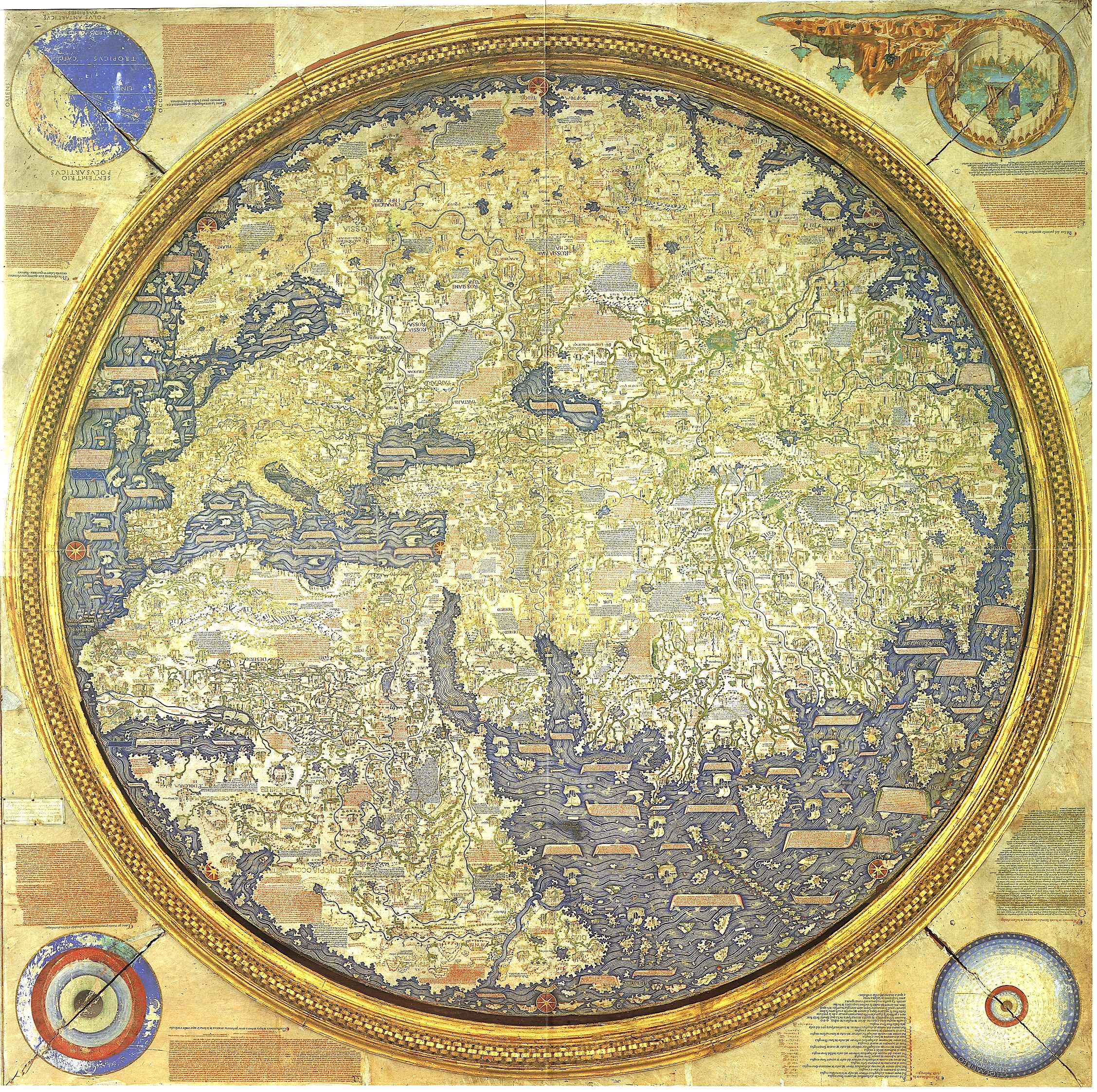
If we want to know the precise geographical location of, say, a particular church in Madrid, video arcade in Tokyo or coffee shop in Addis Ababa, we can figure it out in a matter of seconds. This is, in historical terms, a recent development indeed: many of us remember when the most detailed cartographical information we could get about distant lands (or for that matter, most of our own land) revealed to us only its cities and major roads — assuming we even had a world atlas at hand. Now, younger people take for granted the knowledge of not just where every place in the world is, but what it looks like, what its prices are, and what its visitors have said about it.
We live today, in other words, in the dream of Fra Mauro, the Venetian cartographer-monk of the late Middle Ages who created the most detailed and accurate world map to that point in human history. “As a young man, Fra Mauro had been a soldier and merchant of the famed Venice Merchant Fleet,” says the site of New World Cartographic. “His travels with the fleet around the Mediterranean and the Middle East resulted in his becoming interested in mapping, and he eventually settled in the monastery of San Michelle on the island of Murano, in the Venice Lagoon, where he became a lay brother.” In the early 1450s, “he was commissioned by King Afonso V of Portugal to create a map of the world.”
Portugal’s will to dominate world trade, which required the most detailed maps possible, was matched by Fra Mauro’s will to gather information about every corner of Earth, no matter how far-flung. And he could do that without leaving Venice: as Atlas Obscura’s Adam Kessler writes, “Arab traders and world explorers passed through the port, giving Fra Mauro an incomparable source of gossip and tall tales about the world. The fall of Constantinople, occurring a few years before the map was finished, would also have provided a rich source of well-traveled refugees, presumably willing to swap their stories for some bread or beer.” Not only did the map’s physical creation require a team of collaborators, the gathering of its contents relied upon the fifteenth-century equivalent of crowdsourcing.
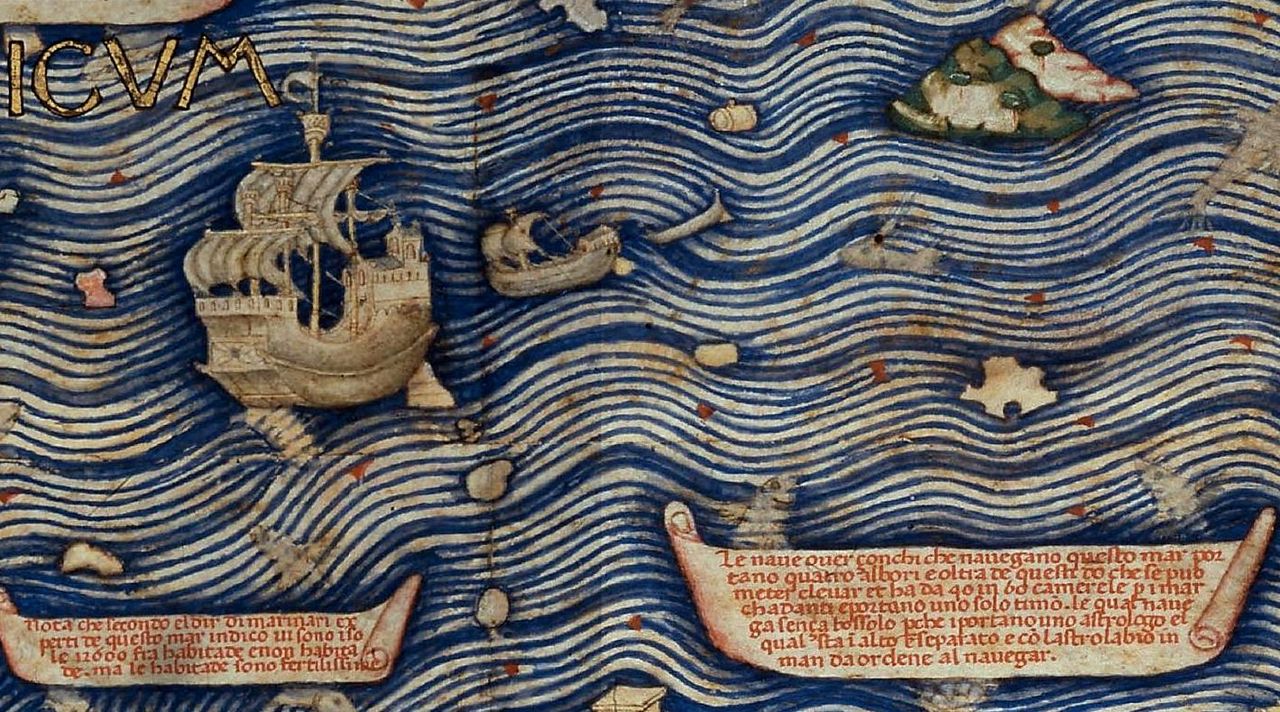
This chapter of cartographical history invites such technological analogies: Kessler calls Fra Mauro’s completed mappa mundi “the Google Earth of the 1450s.” Despite his religious affiliation with the monastery of San Michele, Fra Mauro’s efforts produced an unprecedentedly radical rendition of the world. Breaking with religious tradition, he didn’t put Jerusalem in the center; “the Garden of Eden was relegated to a sidebox, not shown in a real geographic location.” His scrupulousness made him the first cartographer “to depict Japan as an island, and the first European to show that you could sail all the way around Africa.” While his map was “the most accurate ever made at the time,” its more than 3,000 annotations do contain plenty of tall tales, often of literal giants. But are they really much less trustworthy than the average twenty-first-century user review?
Related Content:
The World Map That Introduced Scientific Mapmaking to the Medieval Islamic World (1154 AD)
Explore the Hereford Mappa Mundi, the Largest Medieval Map Still in Existence (Circa 1300)
Europe’s Oldest Map: Discover the Saint-Bélec Slab (Circa 2150–1600 BCE)
Based in Seoul, Colin Marshall writes and broadcasts on cities, language, and culture. His projects include the Substack newsletter Books on Cities, the book The Stateless City: a Walk through 21st-Century Los Angeles and the video series The City in Cinema. Follow him on Twitter at @colinmarshall or on Facebook.
Read More...23 Minutes of Charles Schulz Drawing Peanuts
Anyone can learn to draw the cast of Peanuts, but few can do it every day for nearly half a century. The latter, as far as we know, amounts to a group of one: Charles Schulz, who not only created that world-famous comic strip but drew it single-handed throughout its entire run. He was, as a nineteen-sixties CBS profile put it, “a one-man production team: writer, humorist, social critic.” That clip opens the video above, which compiles footage of Schulz drawing Peanuts while making observations on the nature of his craft. “When you draw a comic strip, if you’re going to wait for inspiration, you’ll never make it,” he says. “You have to become professional enough at this so that you can almost deliberately set down an idea at will.”
Schulz’s dedication to his work may have been an inborn trait, but he didn’t find his way to that work only through his particular abilities. His particular inabilities also played their part: “I studied art in a correspondence course, because I was afraid to go to art school,” he says in a later BBC segment.
“I couldn’t see myself sitting in a room where everyone else in the room could draw much better than I.” With better writing skills, “perhaps I would have tried to become a novelist, and I might have become a failure.” With better drawing skills, “I might have tried to become an illustrator or an artist. I would’ve failed there. But my entire being seems to be just right for being a cartoonist.”
In drawing, he also found a medium of thought. “The really practical way of getting an idea, when you have nothing really to draw, is just taking a blank piece of paper and maybe drawing one of the characters in a familiar pose, like Snoopy sleeping on top of the doghouse,” he says. Then, you might naturally “imagine what would happen if, say, it began to snow. And so you’d doodle in a few snowflakes, something like that. Perhaps you would be led to wonder what would happen if it snowed very hard, and the snow covered him up completely.” If you continue on to draw, say, Snoopy’s loyal friend Woodstock being similarly snowed in, you’re well on your way to a complete strip. Now do it 17,897 times, and maybe you’ll qualify for Schulz’s league.
Related content:
Charles Schulz Draws Charlie Brown in 45 Seconds and Exorcises His Demons
Umberto Eco Explains the Poetic Power of Charles Schulz’s Peanuts
Hergé Draws Tintin in Vintage Footage (and What Explains the Character’s Enduring Appeal)
Cartoonists Draw Their Famous Cartoon Characters While Blindfolded (1947)
The Enduring Appeal of Schulz’s Peanuts — Pretty Much Pop: A Culture Podcast #116
Based in Seoul, Colin Marshall writes and broadcasts on cities, language, and culture. His projects include the Substack newsletter Books on Cities, the book The Stateless City: a Walk through 21st-Century Los Angeles and the video series The City in Cinema. Follow him on Twitter at @colinmarshall or on Facebook.
Read More...Nobel Prize-Winning Psychologist Daniel Kahneman (RIP) Explains the Key Question Every Investor Must Ask, and Why It’s a Fool’s Errand to Pick Stocks
This past week, the influential psychologist and economist Daniel Kahneman passed away at age 90. The winner of the 2002 Nobel Prize in Economic Sciences, Kahneman wrote the bestselling book Thinking, Fast and Slow where he explained the two systems of thinking that shape human decisions. These include “System 1,” which relies on fast, automatic and unconscious thinking, and then “System 2,” which requires attention and concentration and works more slowly. And it’s the interplay of these two systems that profoundly shapes the quality of our decisions in different parts of our lives, including investing.
In the interview above, Steve Forbes asks why individual investors persist in believing that they can pick stocks successfully over time, despite ample evidence to the contrary. Drawing on his research, Kahneman describes the “illusion of skill,” where investors “get the immediate feeling that [they] understand something,” which is much “more compelling than the knowledge of statistics that tells you that you don’t know anything.” Here, System 1 creates the “illusion of skill,” and it overwhelms the slower analytical thinking found in System 2—the System that could use data to determine that stock picking is a fool’s errand. When Forbes asks if investors should ultimately opt for index funds instead of individual stocks, Kahneman replies “I am a believer in index funds,” that is, unless you have very rare information that allows you to pick stocks successfully.
Later in the interview, Kahneman touches on another important subject. In his mind, the first question every investor should ask is not how much money should I plan to make, but rather, “How much can I afford to lose.” Every investor should assess their risk tolerance, in part so that you can handle turbulence in the market and stick with your initial investment plan. If you are not aware of your risk tolerance, “when things go bad, you will want to change what you are doing, and that’s the disaster in investing… Loss aversion can kill you.” He continues, “Emotions are indeed your enemy. The worst thing that could happen to you … is to make a decision and not stick with it, so that you bail out when things go badly, so that you sell low and buy high. That is not a recipe for doing well in the stock market, or anywhere.” Ideally, you should figure out upfront how much you want to put in the stock market, and how much you want to keep out, so that you can psychologically manage the ups and downs of investing.
From here, Kahneman comes to his most important piece of advice for investors: Know yourself in terms of what you could regret. If you are prone to regret, if investing makes you feel insecure and lose sleep at night, then you should adopt a “regret minimization strategy” and create a more conservative portfolio to match it. Read more about that here. Also see Chapters 31 (Risk Policies) and 32 (Keep Score) in Thinking, Fast and Slow where Kahneman talks more about investing.
This post originally appeared on our sister/side-project site, Open Personal Finance.
Related Content on Open Personal Finance:
All the Financial Advice You’ll Ever Need Fits on a Single Index Card
Essential Advice for Any Investor from Jack Bogle, the Founder of Vanguard
Warren Buffett Explains the Power of Compound Interest
Read More...
How to Rewire Your Brain in 6 Weeks: A BBC Reporter Explores How Everyday Life Changes Can Alter Our Brains
If you suspect that your brain isn’t quite suited for modern life, you’re not alone. In fact, that state of mind has probably been closer to the rule than the exception throughout modernity itself. It’s just that the mix of things we have to think about keeps changing: “The school run. Work calls. Inflation. Remember your lines,” says BBC science reporter Melissa Hogenboom in the video above. “Our brain never evolved for any of this, and yet here we are, getting on with it as best we can, and it’s all thanks to our brain’s incredible capacity to adapt, to learn, to grow” — the very subject she investigates in this series, Brain Hacks.
In search of neuroscientifically sound “hacks to help strengthen crucial connections and keep our minds younger in the process,” Hogenboom put herself through a “a six-week brain-altering course.” The first segment of the series finds her entering into a meditation program she describes in this article: “For 30 minutes a day, either as one single session or two 15-minute sessions, I practiced a guided mindfulness meditation by listening to a recording.” In addition, she had a weekly session with University of Surrey professor of clinical psychology Thorsten Barnhofer, who also appears in the video.
Can meditation, and the oft-discussed “mindfulness” it emphasizes, keep our minds from wandering away from what we really need to think about? “Mind-wandering is something that, of course, might be helpful in many ways,” says Barnhofer, “but it’s also something that can go awry. This is where repetitive thinking comes in, where ruminative thinking comes in, where worry comes in. Those are the factors which increase stress,” increasing the presence of hormones like cortisol. And “if levels of cortisol remain high, that can actually become toxic for your brain, for regions of your brain which are very plastic.” Stress, as Hogenboom sums it up, “is a direct inhibitor of neuroplasticity.”
“Research has found that after only a few months of mindfulness training, certain depression and anxiety symptoms can ease,” Hogenboom writes, and her own experience seems also to point in that direction. A brain scan performed after her meditation course found that “one half of my amygdala – an almond-shaped structure important for emotional processing – had reduced in volume,” possibly because the practice “buffers stress seen in the amygdala.” It also revealed growth in her cingulate cortex, “part of the limbic system that is involved in our behavioral and emotional responses,” which indicates “increased control of that area.” Hogenboom acknowledges that these changes “could also be random,” since “the brain is constantly changing anyway”; the trick, however and whenever possible, is to nudge it toward change for the better.
Bonus: Below, science journalist Daniel Goleman talks about mindfulness and how you can change your brain in 10 minutes with daily meditation.
Related Content:
Meditation 101: A Short, Animated Beginner’s Guide
How Meditation Can Change Your Brain: The Neuroscience of Buddhist Practice
How Yoga Changes the Brain and May Guard Against Alzheimer’s and Dementia
5 Ways to Build an Alzheimer’s‑Resistant Brain: Neuroscientist Lisa Genova Explains
Based in Seoul, Colin Marshall writes and broadcasts on cities, language, and culture. His projects include the Substack newsletter Books on Cities, the book The Stateless City: a Walk through 21st-Century Los Angeles and the video series The City in Cinema. Follow him on Twitter at @colinmarshall or on Facebook.
Read More...What Earth Could Look Like in 2050 If We Do Nothing About Climate Change
?si=SRzcFjCCIvDbQ1f7
What could our future world look like if we continue to do nothing about climate change? That’s the question posed by a new TED ED video, written by Shannon Odell and directed by Sofia Pashaei. We are already seeing the effects of climate change. If you’re paying even a little attention, you’re feeling the hotter summers (which is reflected in the data). You’re noticing the increasing number of droughts. You’re seeing the growing number of forest fires, etc. So, “what will our world look like in the next 30 to 80 years, if we continue on the current path?” With the video above, get a glimpse of the possible world to come.
Related Content
Carl Sagan Warns Congress about Climate Change (1985)
Frank Capra’s Science Film The Unchained Goddess Warns of Climate Change in 1958
Read More...
David Lynch Explains Why Depression Is the Enemy of Creativity–and Why Meditation Is the Solution
David Lynch has a variety of notions about what it takes to make art, but suffering is not among them. “This is part of the myth, I think,” he said in one interview. “Van Gogh did suffer. He suffered a lot. But I think he didn’t suffer while he was painting.” That is, “he didn’t need to be suffering to do those great paintings.” As Lynch sees it, “the more you suffer, the less you want to create. If you’re truly depressed, they say, you can’t even get out of bed, let alone create.” This relationship between mental state and creativity is a subject he’s addressed over and over again, and the video above assembles several of those instances from over the decades. It may come as a surprise that the auteur of Blue Velvet, Twin Peaks, and Mulholland Drive, recommends meditation as the solution.
That certainly won’t come as a surprise, however, to anyone familiar with Lynch’s worldview. Here on Open Culture, we’ve previously featured Lynch’s explanation of how meditation boosts creativity, his drawing depicting how meditation works, his method of getting ideas through meditation, and his conversations about meditation with the likes of Paul McCartney and Moby.
In the video below, he lays out how his favorite kind of meditation, the Transcendental variety, has the potential to drive out not just depression, but also negativity, tension, stress, anxiety, sorrow, anger, hate, and fear. These are grand promises, but not without interest to the non-meditating Lynch fan curious about the mind behind his work, both of which were once widely assumed to be deeply troubled indeed.
“Do you think you’re a genius, or a really sick person?” CBC correspondent Valerie Pringle asks him in a Blue Velvet-era interview included in the compilation at the top of the post. “Well, Valerie,” he responds, “I don’t know.” He did not, at that time, speak publicly about his meditation practice, but by the late nineties he’d begun to discuss personal matters much more freely. In one Charlie Rose interview, a clip from which appears in the video, he even tells of the time he went to therapy. The beginning of this story makes it in, but not the end: Lynch asked his new therapist “straight out, right up front, ‘Could this process that we’re going to go through affect creativity?’ And he said, ‘David, I have to be honest with you, it could” — whereupon Lynch shook the man’s hand and walked right back out the door.
Related content:
One Hour of David Lynch Listening to Rain, Smoking & Reflecting on Art
David Lynch Muses About the Magic of Cinema & Meditation in a New Abstract Short Film
Based in Seoul, Colin Marshall writes and broadcasts on cities, language, and culture. His projects include the Substack newsletter Books on Cities, the book The Stateless City: a Walk through 21st-Century Los Angeles and the video series The City in Cinema. Follow him on Twitter at @colinmarshall or on Facebook.
Read More...Support Us
We're hoping to rely on loyal readers, rather than erratic ads. Please click the Donate button and support Open Culture. You can use Paypal, Venmo, Patreon, even Crypto! We thank you!

About Us

Open Culture scours the web for the best educational media. We find the free courses and audio books you need, the language lessons & educational videos you want, and plenty of enlightenment in between.
Advertise With Us
FREE UPDATES!
GET OUR DAILY EMAIL
Get the best cultural and educational resources on the web curated for you in a daily email. We never spam. Unsubscribe at any time.
FOLLOW ON SOCIAL MEDIA
Open Culture editor Dan Colman scours the web for the best educational media. He finds the free courses and audio books you need, the language lessons & movies you want, and plenty of enlightenment in between.
Advertise With Us

