Last fall, OpenAI started letting users create custom versions of ChatGPT–ones that would let people create AI assistants to complete tasks in their personal or professional lives. In the months that followed, some users created AI apps that could generate recipes and meals. Others developed GPTs to create logos for their businesses. You get the picture.
This cutting-edge course will guide you through the exciting journey of creating and deploying custom GPTs that cater to diverse industries and applications. Imagine having a virtual assistant that can tackle complex legal document analysis, streamline supply chain logistics, or even assist in scientific research and hypothesis generation. The possibilities are endless! Throughout the course, you’ll delve into the intricacies of building GPTs that can use your documents to answer questions, patterns to create amazing human and AI interaction, and methods for customizing the tone of your GPTs. You’ll learn how to design and implement rigorous testing scenarios to ensure your AI assistant’s accuracy, reliability, and human-like communication abilities. Prepare to be amazed as you explore real-world examples and case studies, such as:
1. GPT for Personalized Learning and Education: Craft a virtual tutor that adapts its teaching approach based on each student’s learning style, providing personalized lesson plans, interactive exercises, and real-time feedback, transforming the educational landscape.
2. Culinary GPT: Your Personal Recipe Vault and Meal Planning Maestro. Step into a world where your culinary creations come to life with the help of an AI assistant that knows your recipes like the back of its hand. The Culinary GPT is a custom-built language model designed to revolutionize your kitchen experience, serving as a personal recipe vault and meal planning and shopping maestro.
3. GPT for Travel and Business Expense Management: A GPT that can assist with all aspects of travel planning and business expense management. It could help users book flights, hotels, and transportation while adhering to company policies and budgets. Additionally, it could streamline expense reporting and reimbursement processes, ensuring compliance and accuracy.
4. GPT for Marketing and Advertising Campaign Management: Leverage the power of custom GPTs to analyze consumer data, market trends, and campaign performance, generating targeted marketing strategies, personalized messaging, and optimizing ad placement for maximum engagement and return on investment.
As a side note, Jules White (the professor) also designed another course previously featured here on OC. It focuses on prompt engineering for ChatPGPT.
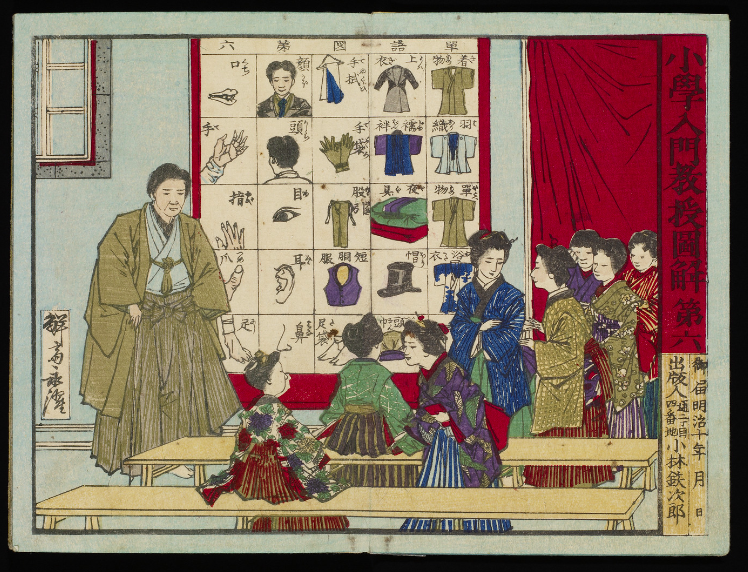
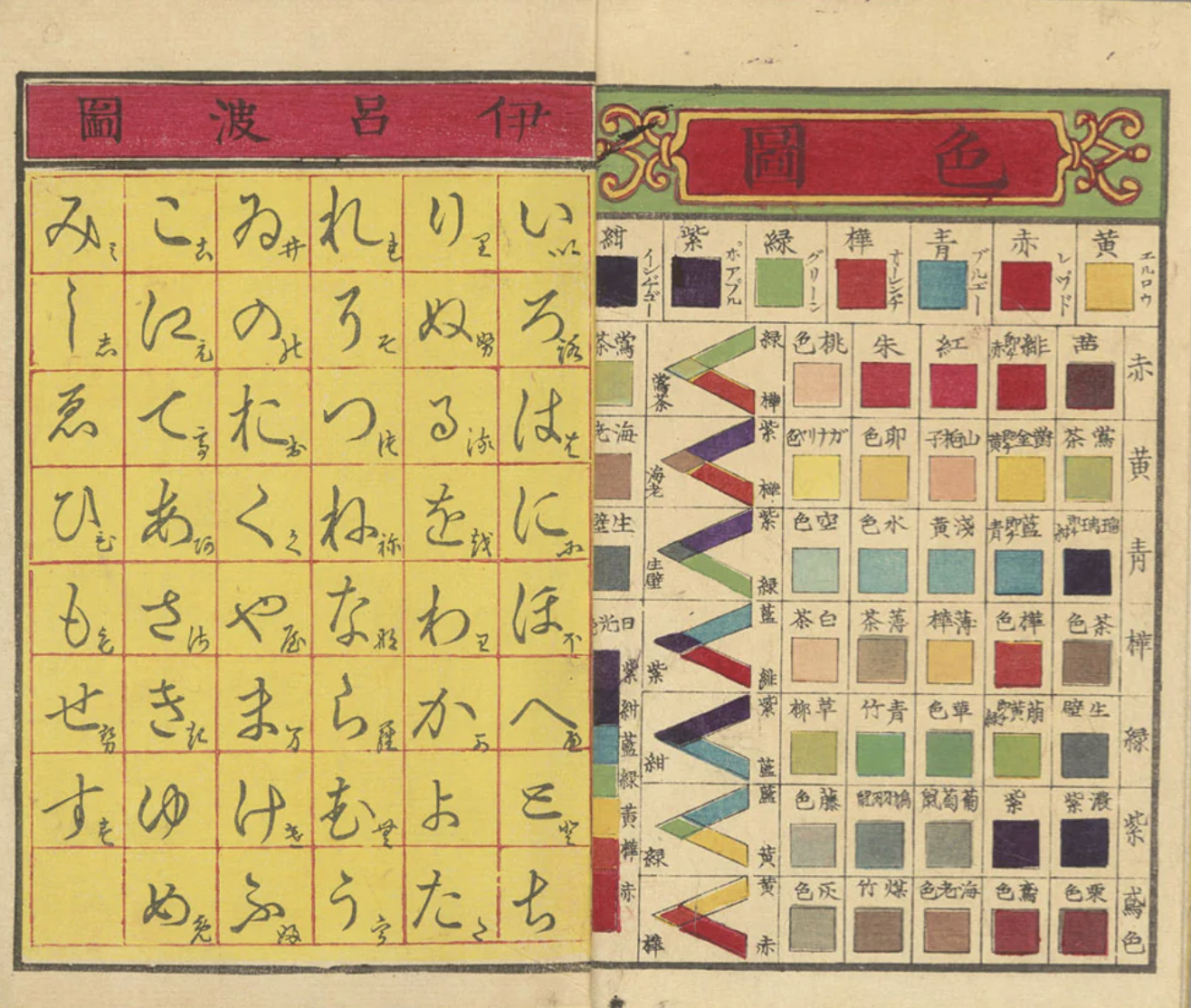
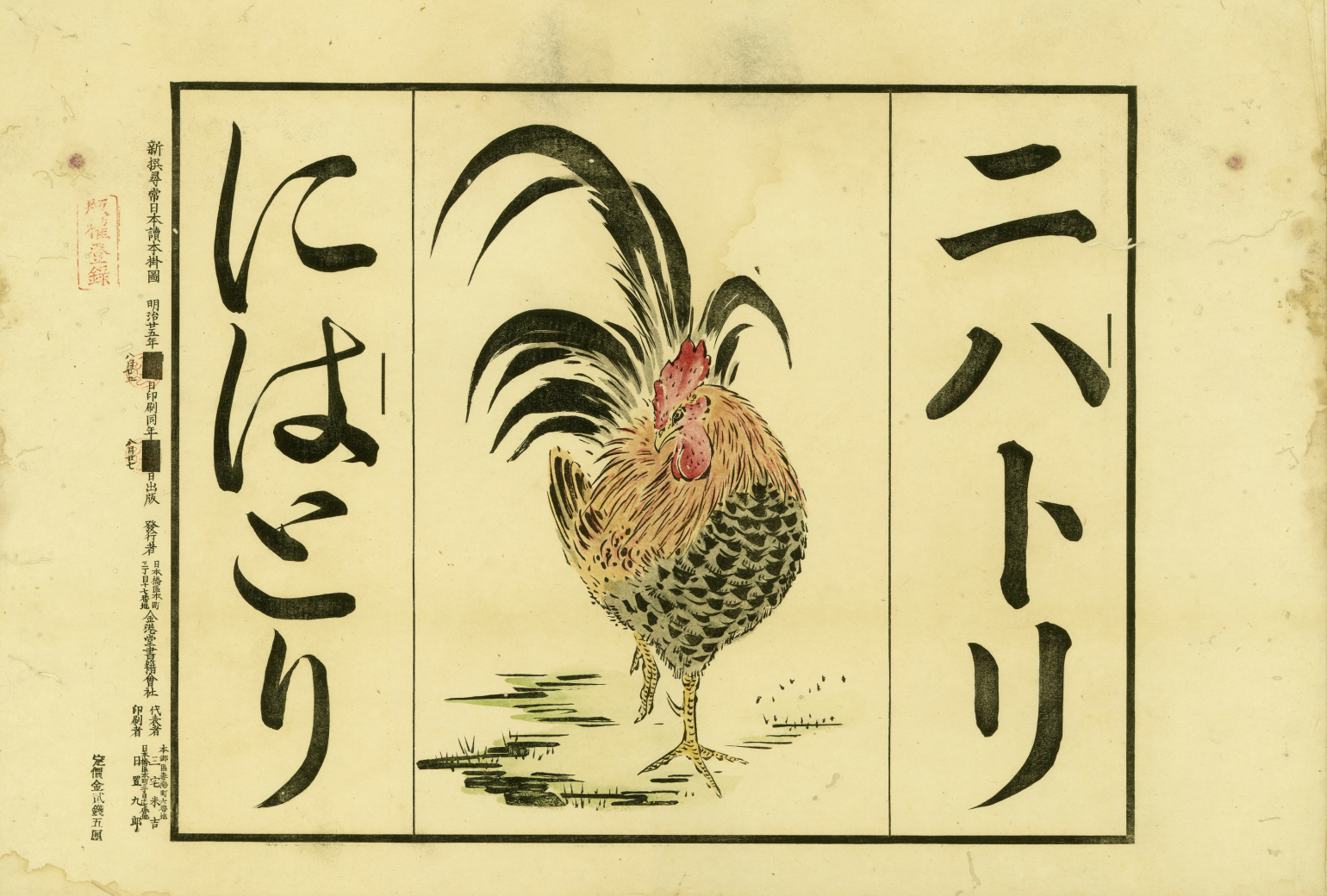
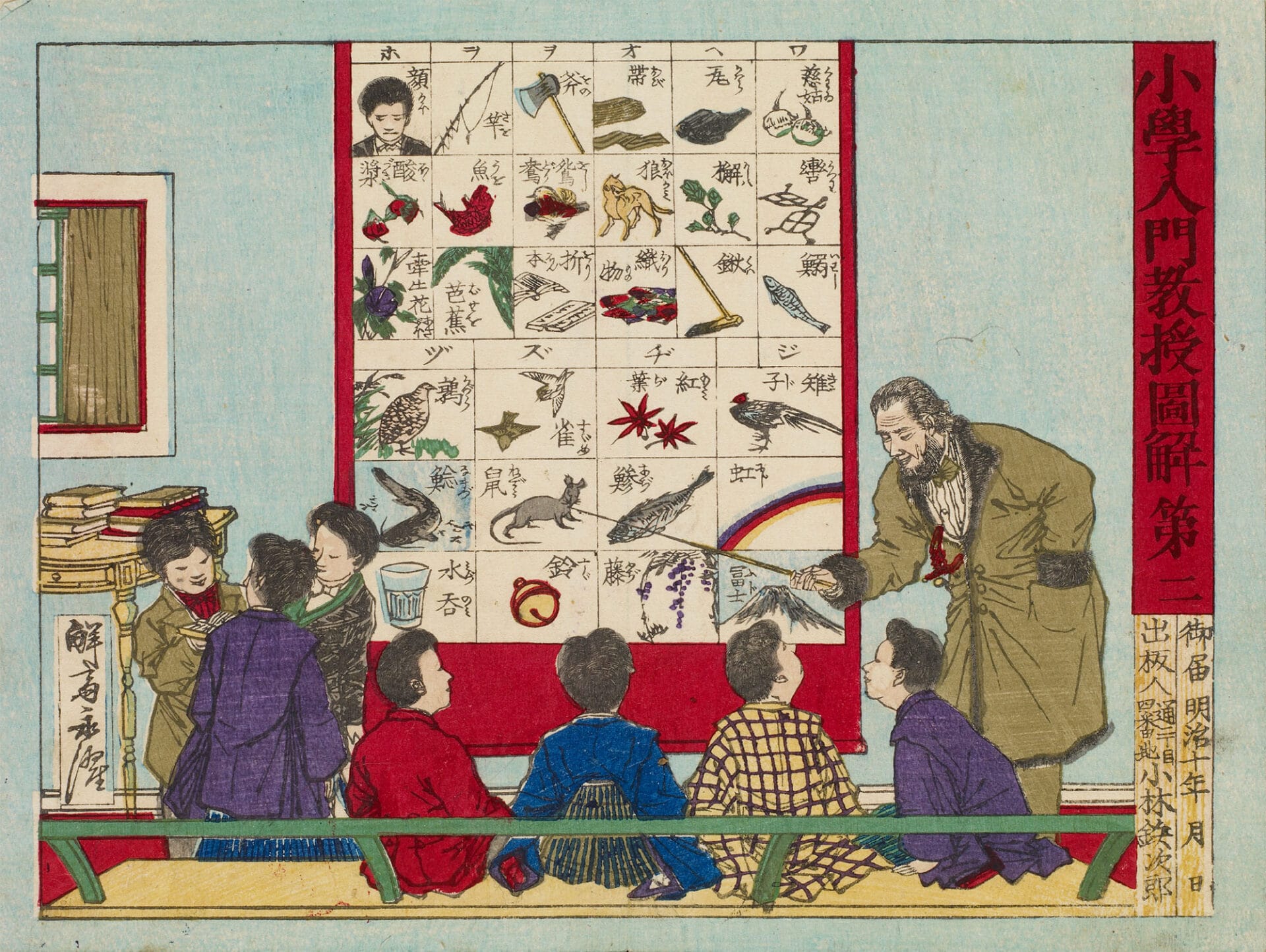
The same even holds true for Japanese schoolbooks and other educational materials, a digital archive of which you can explore on the web site of Japan’s National Institute for Educational Policy Research. “Ranging from brush painting guides to elementary readers to the geography of Koshi Province — now the Hokuriku region — hundreds of digital scans reveal what students were learning in school more than 100 years ago,” writes Colossal’s Kate Mothes.
Certain publications, like the epistolary 冨士野往来 (“Mount Fuji Comings and Goings”) from 1674, date back much further. But only a couple of centuries later did Japanese books start integrating the colorful artwork that still looks so vivid to us today. You’ll find particularly rich examples of such books in the sections of the archive dedicated to educational pictures, wall charts, and sugoroku, a kind of traditional board game.
Originally produced, for the most part, in the mid-to-late nineteenth century (though with some items as recent as the time of World War II), these provide a look at the worldview that Japan presented to its young students during a period when, not long emerged from more than 200 years of deliberate isolation, the country was taking in foreign influence — and especially Western influence — at a breakneck pace.
But despite a variety of proposed dramatic language reforms (which would later include the wholesale adoption of English), Japan would continue almost exclusively to speak and read Japanese. If you’re interested in learning it yourself, the reading materials in this archive will surely work as well for you as they did for the students of the eighteen-nineties. And even if you’re not, they’re still timeless object lessons in educational illustration and design. Enter the collection here.
Based in Seoul, Colin Marshall writes and broadcasts on cities, language, and culture. His projects include the Substack newsletterBooks on Cities, the book The Stateless City: a Walk through 21st-Century Los Angeles and the video series The City in Cinema. Follow him on Twitter at @colinmarshall or on Facebook.
More than thirty years after the formal dissolution of the Union of Soviet Socialist Republics, few around the world have a clear understanding of how life actually worked there. That holds less for the larger political and economic questions than it does for the routine mechanics of day-to-day existence. These had a way of being even more complex in the regions where the USSR came up against the rest of the world. Take the German capital of Berlin, which, as everyone knows, was formerly divided into East and West along with the country itself — but which, as not everyone knows, but as clarified in a nineteen-eighties informational video previously featured here on Open Culture, was entirely surrounded by East Germany.
You can learn much else about life on the edges of the Federal Republic of Germany and the German Democratic Republic from the new neo video above, “How the Berlin Wall Worked.” The first thing to clarify is that, even after the division of Germany, the Berlin Wall wasn’t always there; for a time the narrator explains, with “socialism and capitalism, two different nations, and even two different currencies, were separated only by streets.”
Many “lived in one part of the city but worked in the other: East Berliners took jobs in the West in order to benefit from the stronger currency, while West Berliners got their haircuts in the East at prices that were much cheaper to them.” Kurfürstendamm’s shop windows displayed the purchasable glories of capitalism; just a few streets away, Stalinallee swelled with proudly socialist architecture.
But on August 13th, 1961, “Berlin woke up to a divided city.” The GDR immediately began on a wall between East and West “made out of concrete and topped off with barbed wire,” though it couldn’t command the resources to build its whole length quite so solidly right away. Over time, however, the wall was “consistently upgraded with more and more increasing security features.” By 1975, it had become the structure we remember, consisting of not just one but two concrete walls, and between them a barbed-wire signal fence, tank traps, mats of steel needles known as “Stalin’s grass,” and watchtowers manned by armed guards. “Virtually impossible to cross” in its day, the formidable Berlin Wall now exists primarily as a cultural phenomenon: a memory, a series of tourist sites, a sometimes-misused cultural reference. Living in South Korea, I can’t help but ask myself if the same will ever be said of the DMZ.
Based in Seoul, Colin Marshall writes and broadcasts on cities, language, and culture. His projects include the Substack newsletterBooks on Cities, the book The Stateless City: a Walk through 21st-Century Los Angeles and the video series The City in Cinema. Follow him on Twitter at @colinmarshall or on Facebook.
FYI. Google and MIT RAISE have partnered to create a free course for teachers and educators, one designed to show teachers how they can use generative AI tools to save “time on everyday tasks, personaliz[e] instruction to meet student needs, and enhanc[e] lessons and activities in creative ways.” According to the course description, in this two-hour self-paced course, teachers can learn how to use generative AI tools to:
Create engaging lesson plans and materials. For example with generative AI, they can input their specific lesson plan and tailor it to student interests like explaining science using sports analogies.
Tailor instruction for different abilities. Imagine a teacher who has 25 or 30 kids in their classroom. With generative AI, that teacher can easily modify the same lesson for different reading levels in their class.
Save time on everyday tasks like drafting emails and other correspondence. For instance, if a student is out sick teachers can create summaries of that day’s lessons to help make sure the student doesn’t fall behind.
For those teachers who complete the course, they will “earn a certificate that they can present to their district for professional development (PD) credit, depending on district and state requirements.” Sign up for the course here.
If you know more than a few millennials, you probably know someone who reveres Calvin and Hobbes as a sacred work of art. That comic strip’s cultural impact is even more remarkable considering that it ran in newspapers for only a decade, from 1985 to 1995: barely an existence at all, by the standards of the American funny pages, where the likes of Garfield has been lazily cracking wise for 45 years now. Yet these two examples of the comic-strip form could hardly be more different from each other in not just their duration, but also how they manifest in the world. While Garfield has long been a marketing juggernaut, Calvin and Hobbes creator Bill Watterson has famously turned down all licensing inquiries.
That choice set him apart from the other successful cartoonists of his time, not least Charles Schulz, whose work on Peanuts had inspired him to start drawing comics in the first place. Calvin and Hobbes may not have its own toys and lunchboxes, but it does reflect a Schulzian degree of thoughtfulness and personal dedication to the work. Like Schulz, Watterson eschewed delegation, creating the strip entirely by himself from beginning to end. Not only did he execute every brushstroke (not a metaphor, since he actually used a brush for more precise line control), every theme discussed and experienced by the titular six-year-old boy and his tiger best friend was rooted in his own thoughts.
“One of the beauties of a comic strip is that people’s expectations are nil,” Watterson said in an interview in the twenty-tens. “If you draw anything more subtle than a pie in the face, you’re considered a philosopher.” However modest the medium, he spent the whole run of Calvin and Hobbes trying to elevate it, verbally but even more so visually. Or perhaps the word is re-elevate, given how his increasingly ambitious Sunday-strip layouts evoked early-twentieth-century newspaper fixtures like Little Nemo and KrazyKat, which sprawled lavishly across entire pages. Even if there could be no returning to the bygone golden age of the comic strip, he could at least draw inspiration from its glories.
Ironically, from the perspective of the twenty-twenties, Watterson’s work looks like an artifact of a bygone golden age itself. In the eighties and nineties, when even small-town newspapers could still command a robust readership, the comics section had a certain cultural weight; Watterson has spoken of the cartoonist’s practically unmatched ability to influence the thoughts of readers on a daily basis. In my case, the influence ran especially deep, since I became a Calvin and Hobbes-loving millennial avant la lettre while first learning to read through the Sunday funnies. It took no time at all to master Garfield, but when I started getting Calvin and Hobbes, I knew I was making progress; even when I didn’t understand the words, I could still marvel at the sheer exuberance and detail of the art.
Calvin and Hobbes also attracted enthusiasts of other generations, not least among other cartoonists. Joel Allen Schroeder’s documentary Dear Mr. Watterson features more than a few of them expressing their admiration for how he raised the bar, as well as for how his work continues to enrapture young readers. Its timelessness owes in part to its lack of topical references (in contrast to, say, Doonesbury, which I remember always being the most formidable challenge in my days of incomplete literacy), but also to its understanding of childhood itself. Like Stephen King, a creator with whom he otherwise has little in common, Watterson remembers the exotic, often bizarre textures reality can take on for the very young.
He also remembers that childhood is not, as J. M. Coetzee once put it, “a time of innocent joy, to be spent in the meadows amid buttercups and bunny-rabbits or at the hearthside absorbed in a storybook,” but in large part “a time of gritting the teeth and enduring.” Being six years old has its pleasures, to be sure, but it also comes with strong doses of tedium, powerlessness, and futility, which we tend not to acknowledge as adults. Calvin and Hobbes showed me, as it’s shown so many young readers, that there’s a way out: not through studiousness, not through politeness, and certainly not through following the rules, but through the power of the imagination to re-enchant daily life. If it gets you sent to your room once in a while, that’s a small price to pay.
Based in Seoul, Colin Marshall writes and broadcasts on cities, language, and culture. His projects include the Substack newsletterBooks on Cities, the book The Stateless City: a Walk through 21st-Century Los Angeles and the video series The City in Cinema. Follow him on Twitter at @colinmarshall or on Facebook.
So many writers have been gardeners and have written about gardens that it might be easier to make a list of those who didn’t. But even in this crowded company, Emily Dickinson stands out. She not only attended the fragile beauty of flowers with an artist’s eye—before she’d written any of her famous verse—but she did so with the keen eye of a botanist, a field of work then open to anyone with the leisure, curiosity, and creativity to undertake it.
“In an era when the scientific establishment barred and bolted its gates to women,” Brain Pickings’ Maria Popova writes, “botany allowed Victorian women to enter science through the permissible backdoor of art.”
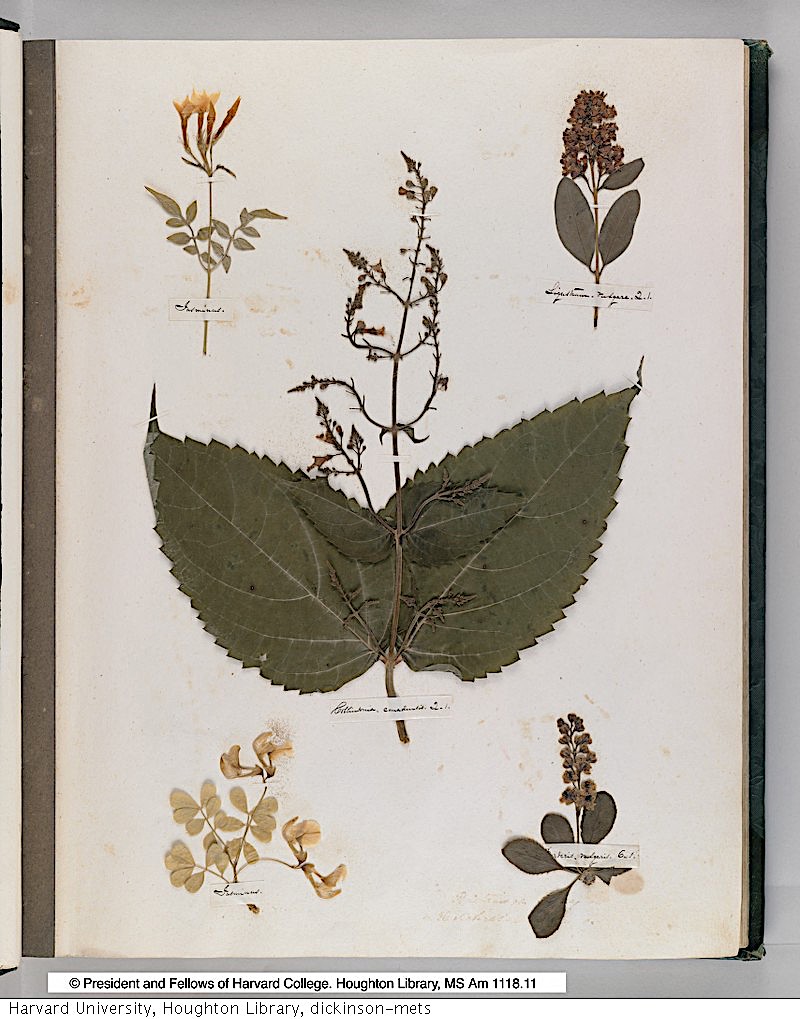
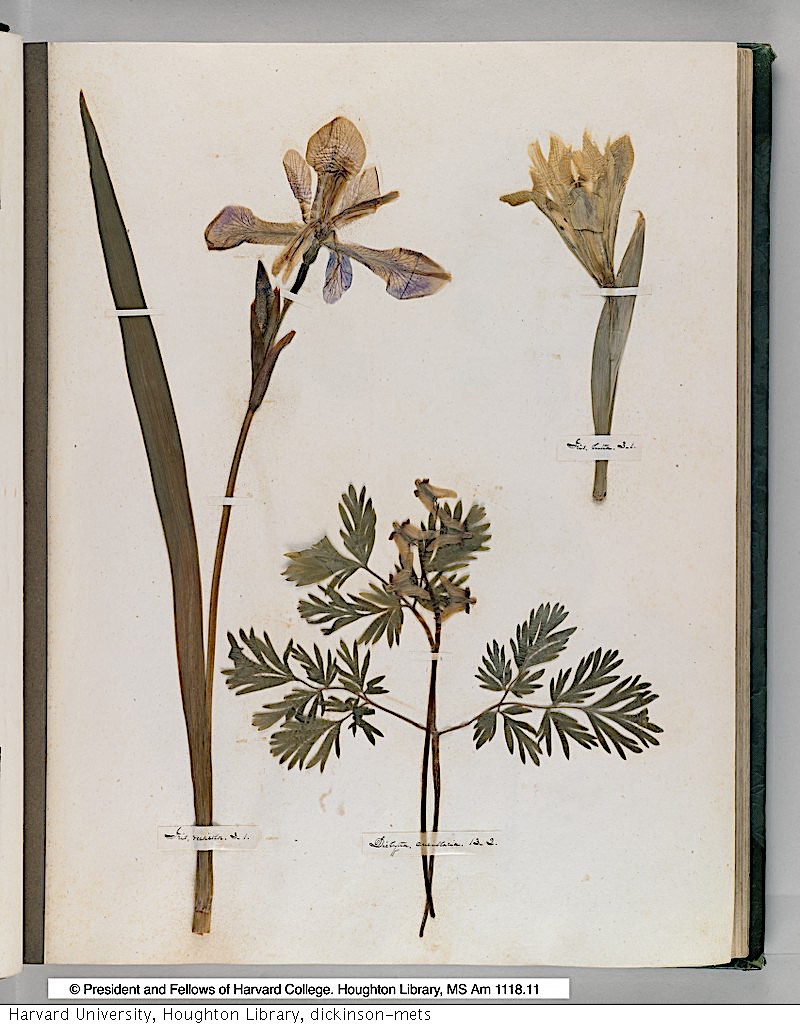
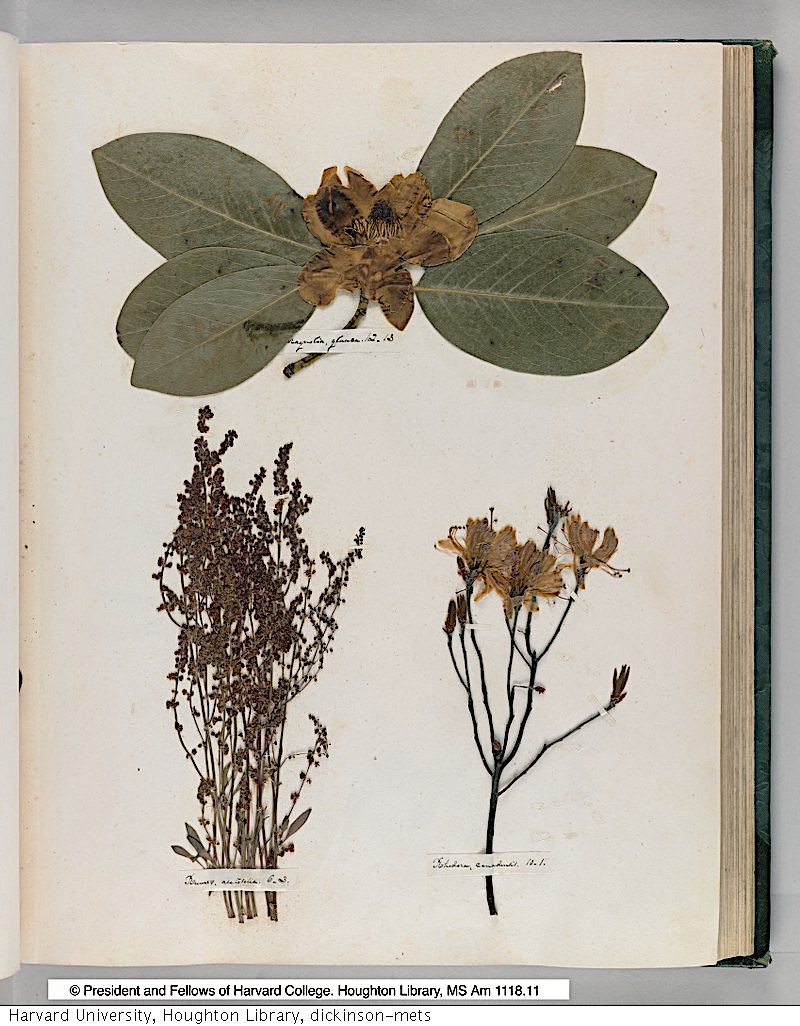
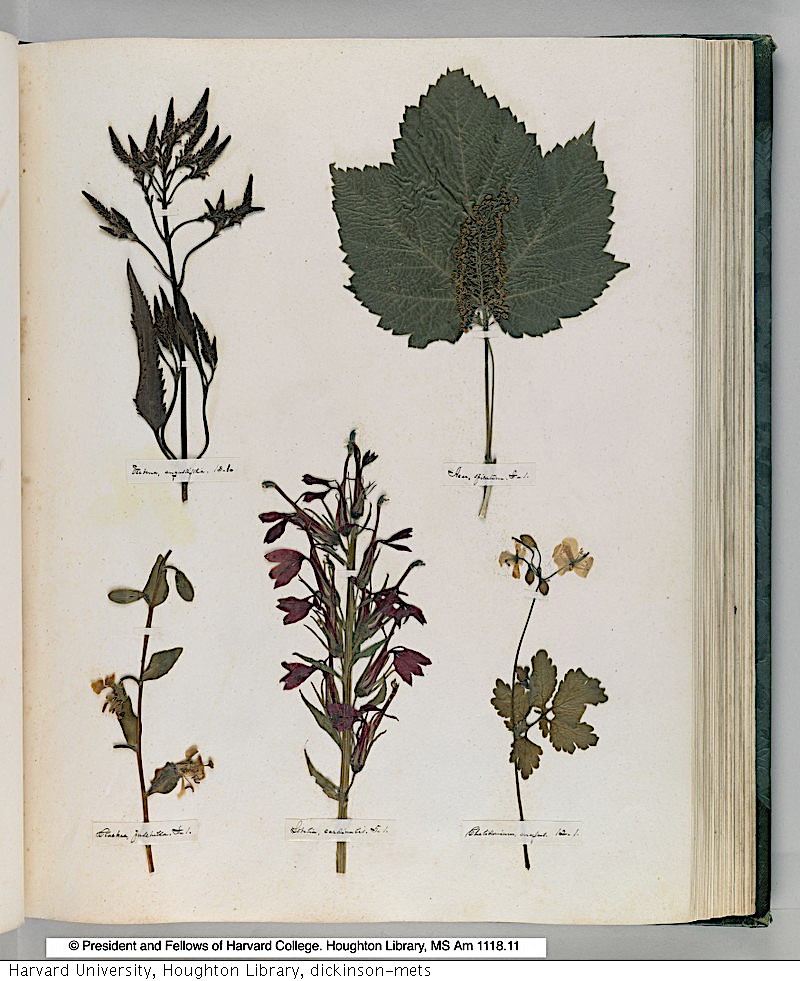
Assembled in a patterned green album bought from the Springfield stationer G. & C. Merriam, the herbarium contains 424 specimens arranged on 66 leaves and delicately attached with small strips of paper. The specimens are either native plants, plants naturalized to Western Massachusetts, where Dickinson lived, or houseplants. Every page is accompanied by a transcription of Dickinson’s neat handwritten labels, which identifies each plant by its scientific name.
The book is thought to have been finished by the time she was 14 years old. Long part of Harvard’s Houghton Library collection, it has also long been treated as too fragile for anyone to view. The only access has come in the form of grainy, black and white photographs. For the past few years, however, scholars and lovers of Dickinson’s work have been able to see the herbarium in these stunning reproductions.
The pages are so formally composed they look like paintings from a distance. Though mostly unknown as a poet in her life, Dickinson was locally renowned in Amherst as a gardener and “expert plant identifier,” notes Sara C. Ditsworth. The herbarium may or may not offer a window of insight into Dickinson’s literary mind. Houghton Library curator Leslie A. Morris, who wrote the forward to the facsimile edition, seems skeptical. “I think that you could read a lot into the herbarium if you wanted to,” she says, “but you have no way of knowing.”
And yet we do. It may be impossible to separate Dickinson the gardener and botanist from Dickinson the poet and writer. As Ditsworth points out, “according to Judith Farr, author of The Gardens of Emily Dickinson, one-third of Dickinson’s poems and half of her letters mention flowers. She refers to plants almost 600 times,” including 350 references to flowers. Both her herbarium and her poetry can be situated within the 19th century “language of flowers,” a sentimental genre that Dickinson made her own, with her elliptical entwining of passion and secrecy.
The first two specimens in Dickinson’s herbarium are the jasmine and the privet: “You have jasmine for poetry and passion” in the language of flowers, Morris points out, “and privet,” a hedge plant, “for privacy.” There is no need to see this arrangement as a prediction of the future from the teenage botanist Dickinson. Did she plan from adolescence to become a recluse poet in later life? Perhaps not. But we can certainly “read into” the language of her herbarium some of the same great themes that recur over and over in her work, carried across by images of plants and flowers. See Dickinson’s complete herbarium at Harvard Library’s digital collections here, or purchase a (very expensive) facsimile edition of the book here.
Note: Note: An earlier version of this post appeared on our site in 2019.
Studio Ghibli fans are still pondering the meaning of Hayao Miyazaki’s The Boy and the Heron, which came out last year. Though by some measure the studio’s most lavish feature yet — not least by the measure of it being the most expensive film yet produced in Japan — it’s also the one least amenable to simple interpretation. Even more so than in his previous work, Miyazaki seems to have intended to make a movie less to be explained than to be experienced. Just as the titular young protagonist descends into a bizarre but captivating underworld and returns, changed, to reality, so does the viewer.
If you’ve seen The Boy and the Heron, hearing its very title (which in Japan is 君たちはどう生きるか, or How Do You Live?) will bring back to mind a host of vivid images: the roving back of bulbous-featured grannies obsessed with non-perishable foodstuffs; the posturing of the middle-age Birdman, stuffed into his avian flight suit; the pyrotechnic feats of the young Lady Himi; and above all, perhaps, the floating cascades of Warawara, those adorably round spirits who — in painstaking Ghibli fashion — appear to have been animated individually, each with its own personality. Now, you can download stills from these and other scenes at Studio Ghibli’s official web site.
These come as an expansion to Ghibli’s existing collection, previously featured here on Open Culture, of free-to-download images from their library of titles. They’re offered, the site explains, “solely for personal use by individual fans to further enjoy Studio Ghibli films.” And indeed, they may have no effect stronger than making you want to watch The Boy and the Heron again, the more deeply to feel what Miyazaki intended with his “final” picture. Not that the latest of his retirements has stuck: last fall, Ghibli president Toshio Suzuki reported that the octogenarian Miyazaki was back in the office, planning his next film. If he has more realms yet to explore, animation-lovers around the world will surely follow him. Find the images from The Boy and the Heronhere.
Based in Seoul, Colin Marshall writes and broadcasts on cities, language, and culture. His projects include the Substack newsletterBooks on Cities, the book The Stateless City: a Walk through 21st-Century Los Angeles and the video series The City in Cinema. Follow him on Twitter at @colinmarshall or on Facebook.
Los Pollos Hermanos, Madrigal Electromotive, Mesa Verde Bank and Trust, Davis & Main: Attorneys at Law—all of these brands come from the Breaking Bad/Better Call Saul universe. They also appear in the Fictional Brands Archive, a website dedicated to “fictional brands found in films, series and video games.” Taking the brands seriously as brands, the site draws on research from a new book written by Lorenzo Bernini entitled Fictional Brand Design. And, with its many entries, the site provides a “comprehensive view of each fictional brand, framing them in their own fictional context and documenting their use and execution in source work.”
Here in the twenty-twenties, a hopeful young novelist might choose to enroll in one of a host of post-graduate programs, and — with luck — there find a willing and able mentor. Back in the nineteen-thirties, things worked a bit differently. “In the spring of 1934, an aspiring writer named Arnold Samuelson hitchhiked from Minnesota to Florida to see if he could land a meeting with his favorite author,” says Nicole Bianchi, narrator of the InkWell Media video above. “The writer he had picked to be his mentor? Ernest Hemingway.”
What Hemingway offered Samuelson was something more than a literary mentorship. “This young man had one other obsession,” Hemingway writes in a 1935 Esquire piece. “He had always wanted to go to sea.” And so “we gave him a job as a night watchman on the boat which furnished him a place to sleep and work and gave him two or three hours’ work each day at cleaning up and a half of each day free to do his writing.” To Hemingway’s irritation, Samuelson proved not just a clumsy hand on the Pilar, but a fount of questions about how to craft literature — something Hemingway gives the impression of considering easier done than said.
Nevertheless, in the Esquire piece, Hemingway condenses this long back-and-forth with Samuelson into a dialogue containing lessons that “would have been worth fifty cents to him when he was twenty-one.” He first declares that “good writing is true writing,” and that such truth depends on the writer’s conscientiousness and knowledge of life. As for the value of imagination, “the more he learns from experience the more truly he can imagine.” But even the most world-weary novelist must “convey everything, every sensation, sight, feeling, place and emotion to the reader,” and that requires round after round of revision, so you might as well do the first draft in pencil.
As far as the writing itself, Hemingway recommends reading over at least your last two or three chapters at the start of each day, and repeats his well-known dictum always to leave a little water in the well at the end so that “your subconscious will work on it all the time.” But all will be for naught if you haven’t read enough great books so as to “write what hasn’t been written before or beat dead men at what they have done.” Don’t compete with living writers, whom Hemingway saw as propped up by “critics who always need a genius of the season, someone they understand completely and feel safe in praising, but when these fabricated geniuses are dead they will not exist.”
The video focuses on a series of mental exercises Hemingway explains to Samuelson. Recall an exciting experience, such as that of catching a fish, and “find what gave you the emotion, what the action was that gave you the excitement. Then write it down making it clear so the reader will see it too and have the same feeling you had.” Remember conflicts and try to understand all the points of view: “If I bawl you out try to figure out what I’m thinking about as well as how you feel about it. If Carlos curses Juan think what both their sides of it are. Don’t just think who is right.” When other people talk, “listen completely. Don’t be thinking what you’re going to say.”
Underlying this characteristically straightforward advice is the commandment to find ways out of your own head and into the perspective of the rest of humanity. The necessary habits of observation can be cultivated anywhere: at sea, yes, but also in the city, where you can “stand outside the theatre and see how people differ in the way they get out of taxis or motor cars.” In the event, Samuelson never did become a novelist, though he did write a memoir about his year under Hemingway’s tutelage. Whatever the experience taught Samuelson, it brought Hemingway to a resolution of his own: “If any more aspirant writers come on board the Pilar let them be females, let them be very beautiful and let them bring champagne.”
Based in Seoul, Colin Marshall writes and broadcasts on cities, language, and culture. His projects include the Substack newsletterBooks on Cities, the book The Stateless City: a Walk through 21st-Century Los Angeles and the video series The City in Cinema. Follow him on Twitter at @colinmarshall or on Facebook.
We're hoping to rely on loyal readers, rather than erratic ads. Please click the Donate button and support Open Culture. You can use Paypal, Venmo, Patreon, even Crypto! We thank you!
Open Culture scours the web for the best educational media. We find the free courses and audio books you need, the language lessons & educational videos you want, and plenty of enlightenment in between.
Get the best cultural and educational resources on the web curated for you in a daily email. We never spam. Unsubscribe at any time.
FOLLOW ON SOCIAL MEDIA
Open Culture editor Dan Colman scours the web for the best educational media. He finds the free courses and audio books you need, the language lessons & movies you want, and plenty of enlightenment in between.