Richard Brautigan’s Story, ‘One Afternoon in 1939,’ Read From a Wooden Spool
Today is the birthday of Richard Brautigan, whose funny and imaginative books were a touchstone for the 1960s counterculture and have remained an inspiration to free spirits ever since. He would have been 77.
In this video, uploaded to the Internet exactly a year ago, Ianthe Brautigan Swensen reads her father’s story, “One Afternoon in 1939,” from his collection Revenge of the Lawn. Ianthe was one year old in 1961 when her father sat down with a portable typewriter on a family camping trip to write his most famous work, Trout Fishing in America, and she was 24 when he took his own life in 1984. Now she’s a writer and a teacher.
In 2001 Brautigan Swensen published You Can’t Catch Death: A Daughter’s Memoir about her life with a difficult but loving father who liked to take her with him to his favorite San Francisco haunts during the 60s. “When I’m here,” she told the San Francisco Chronicle on a visit to the city in 2000, “I still feel my father walking the streets, I still feel my hand in his. And that’s a very happy feeling.”
If you would like to support the mission of Open Culture, consider making a donation to our site. It’s hard to rely 100% on ads, and your contributions will help us continue providing the best free cultural and educational materials to learners everywhere. You can contribute through PayPal, Patreon, and Venmo (@openculture). Thanks!
Read More...30 Renowned Writers Speaking About God & Reason
This past summer, Jonathan Pararajasingham, a neurosurgeon in London, created a montage of 100 renowned academics, mostly all scientists, talking about their thoughts on the existence of God. (Find it in two parts here and here.) Now’s he back with a new video, 30 Renowned Writers Speaking About God. It runs 25 minutes, and it offers as much a critique of orthodox religious belief as it does a literary tribute to humanism and rationalism. Isaac Asimov, Arthur C. Clarke, Salman Rushdie (who kindly tweeted us this weekend), Margaret Atwood, Philip Roth — they all make an appearance. The full list of writers appears below the jump.
And, before we close, let me say this. Whenever we post videos like these, we get the question. Why the occasional focus on atheism/rationalism/humanism? And the simple answer comes down to this: If you cover writers, academics and scientists, the thinking skews in that direction. Yes, there are exceptions, but they are in shorter supply. But if someone pulls them together and makes a montage, we’ll likely feature it too. H/T RichardDawkins.net
Note: As you may have noticed, we have been experiencing intermittent outages over the past couple of days. Our host, Dreamhost, has been stumbling more than we’d like. So we’re figuring out alternatives and hopefully making a move soon. Our apologies for the inconvenience!
Read More...The Last (Faxed) Poem of Charles Bukowski
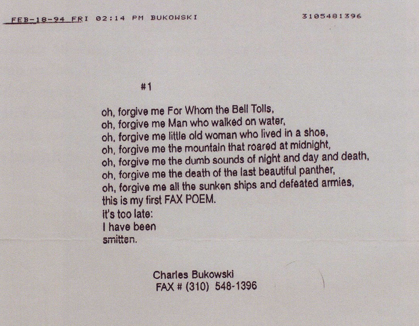
On February 18, 1994, Charles Bukowski had a fax machine installed in his home and immediately sent his first Fax poem to his publisher:
oh, forgive me For Whom the Bell Tolls,
oh, forgive me Man who walked on water,
oh, forgive me little old woman who lived in a shoe,
oh, forgive me the mountain that roared at midnight,
oh, forgive me the dumb sounds of night and day and death,
oh, forgive me the death of the last beautiful panther,
oh, forgive me all the sunken ships and defeated armies,
this is my first FAX POEM.
It’s too late:
I have been
smitten.
Alas this was also Bukowski’s last poem. Just 18 days after Bukowski embraced technology, the poet (once famously called the “laureate of American lowlife” by Pico Iyer) died of leukemia in California. He was 73 years old. According to John Martin at Black Sparrow Press, the Fax poem has never been published or collected in a book. Booktryst has a whole lot more on the story, and we have the singer/songwriter Tom Waits reading Charles Bukowski’s poem, The Laughing Heart. You can also listen to three other Bukowski poems (in audio) here on YouTube:
- Bluebird
- Something For The Touts, The Nuns, The Grocery Clerks, And You
- The Secret to My Endurance (read by Bukowski himself)
Find more great reads in our collection of Free Audio Books.
Read More...The Lost Guitar Solo for “Here Comes the Sun” by George Harrison, Discovered by George Martin
Here Comes the Sun — it’s one of George Harrison’s contributions to Abbey Road (1969). And, among the many great Beatles’ songs, it’s my sentimental favorite. While we’re feeling sentimental, let me bring you this — Dhani Harrison, the son of the late guitarist, returns to the recording studio (presumably at Abbey Road) with George Martin, the Beatles’ legendary producer, and Martin’s son Giles. Together, they play with the mix of “Here Comes the Sun,” and then the wondrous little moment of discovery happens. They stumble upon the long lost guitar solo that never made the final cut. It’s a pleasure to see.
If you would like to support the mission of Open Culture, consider making a donation to our site. It’s hard to rely 100% on ads, and your contributions will help us continue providing the best free cultural and educational materials to learners everywhere. You can contribute through PayPal, Patreon, and Venmo (@openculture). Thanks!
H/T @WFMU
Related Content
Guitarist Randy Bachman Demystifies the Opening Chord of ‘A Hard Day’s Night’
George Harrison Explains Why Everyone Should Play the Ukulele, With Words and Music
Watch George Harrison’s Final Interview and Performance (1997)
Read More...A Tour Inside Salvador Dalí’s Labyrinthine Spanish Home
Along the Costa Brava in northern Spain, in the little seaside village of Portlligat, sits the house that became Salvador Dalí’s main residence in 1930. It started off as a small fisherman’s hut. Then Dalí went to work on the structure, renovating it little by little over the next 40 years, creating a living, breathing, labyrinthine home that reflects the artist’s one-of-a-kind aesthetic. Writing about the house, the author Joseph Pla once said:
The decoration of the house is surprising, extraordinary. Perhaps the most exact adjective would be: never-before-seen. I do not believe that there is anything like it, in this country or in any other.… Dalí’s house is completely unexpected.… It contains nothing more than memories, obsessions. The fixed ideas of its owners. There is nothing traditional, nor inherited, nor repeated, nor copied here. All is indecipherable personal mythology.… There are art works (by the painter), Russian things (of Mrs. Gala), stuffed animals, staircases of geological walls going up and down, books (strange for such people), the commonplace and the refined, etc.
For many, it’s a long trip to Portlligat, and only eight people can visit the house at a time. So today we’re featuring a video tour of Dalí’s Spanish home. The interior shots begin around the 1:30 mark. If you love taxidermy, you won’t be wasting your time.
If you would like to support the mission of Open Culture, consider making a donation to our site. It’s hard to rely 100% on ads, and your contributions will help us continue providing the best free cultural and educational materials to learners everywhere. You can contribute through PayPal, Patreon, and Venmo (@openculture). Thanks!
Related Content:
Destino: The Salvador Dalí – Disney Collaboration 57 Years in the Making
Salvador Dalí Appears on “What’s My Line? in 1952
Alfred Hitchcock Recalls Working with Salvador Dalí on Spellbound
Un Chien Andalou: Revisiting Buñuel and Dalí’s Surrealist Film
Read More...Alain de Botton Wants a Religion for Atheists: Introducing Atheism 2.0
Last summer Alain de Botton, one of the better popularizers of philosophy, appeared at TEDGlobal and called for a new kind of atheism. An Atheism 2.0. This revised atheism would let atheists deny a creator and yet not forsake all the other good things religion can offer — tradition, ritual, community, insights into living a good life, the ability to experience transcendence, taking part in institutions that can change the world, and the rest.
What he’s describing kind of sounds like what already happens in the Unitarian Church … or The School of Life, a London-based institution founded by de Botton in 2008. The school offers courses “in the important questions of everyday life” and also hosts Sunday Sermons that feature “maverick cultural figures” talking about important principles to live by. Click here and you can watch several past sermons presented by actress Miranda July, physicist Lawrence Krauss, author Rebecca Solnit, and Alain de Botton himself.
If Atheism 2.0 piques your interest, you’ll want to pre-order de Botton’s soon-to-be-published book, Religion for Atheists: A Non-Believer’s Guide to the Uses of Religion.
Thanks to Elana for sending this our way.
Related Content:
Atheism: A Rough History of Disbelief, with Jonathan Miller
Read More...Watch Sunday & Wild Life: Two Animated Shorts Just Nominated for an Oscar
When the 2012 Academy Award nominations were announced yesterday, there must have been plenty of smiles at the National Film Board of Canada. For the eighth time, the Canadian film producer/distributor scored a double nomination in the same category. In this case, Sunday by Patrick Doyon, and Wild Life by Amanda Forbis and Wendy Tilby, were selected as finalists for Best Animated Short Film.
Thanks to the NFB, you can watch Sunday (above) and Wild Life (below) online for a limited time, along with the NFB’s nine Oscar-winning films. The film provider also makes hundreds of free movies available via the web and the iPad — something to keep in mind for a good rainy day.
More great films can be found in our collection of 450 Free Movies Online.
Read More...Apocalypse Not Quite Yet: Why Solar Storms Won’t End the World in 2012
With the largest solar storm since 2005 lighting up the night skies this week after a pair of solar flares sent streams of charged particles hurtling toward the earth, prophets of doom have been lighting up the Internet.
Bob Thiel, a self-described “Church History and End Times Examiner” and author of 2012 and the Rise of the Secret Sect, wrote yesterday: “Worse solar flares will ultimately happen after the ‘Great Tribulation’ begins (Revelation 16: 8–9), and one or more that affect satellites and electricity could happen even today.” Hmm. Interesting.
Although very serious questions do exist about the readiness of our electric power grid and satellite infrastructure to withstand a major solar storm like the one in 1859 that shorted out telegraph wires and caused aurorae so bright a crew of gold miners in Colorado reportedly got out of bed in the middle of the night to cook breakfast, the current increase in solar activity is part of a regular 11-year cycle and poses no special risk, according to NASA heliophysicist Alex Young. (See the video above.) And anyway, Young says, the peak isn’t expected to hit until 2014, well after the Mayan calendar has run its course.
For an interesting discussion about the past week’s solar activity you can listen to Phil Plait, author of Discover Magazine’s “Bad Astronomy” blog, in an interview yesterday with Patt Morrison of Los Angeles public radio KPCC. And for a look at the earth-directed coronal mass ejection of January 22, you can watch another NASA video below.
Read More...Jim Henson’s Zany 1963 Robot Film Uncovered by AT&T: Watch Online
Before Jim Henson joined Sesame Street in 1969, the great puppeteer took on various projects during the 60s, sometimes creating experimental films (for example, the Oscar-nominated short Time Piece), other times producing primers on puppet making, and then pursuing the occasional commercial project — like the one just uncovered by AT&T.
Back in 1963, Henson was asked to create a short film for a Bell Data Communications Seminar held in Chicago. The conference organizers sent a three-page memo to Henson outlining the main themes of the conference — one being the strange and sometimes fraught relationship between man and machine. Henson’s film only runs three minutes, but it gets the message across … and then some.
If you would like to support the mission of Open Culture, consider making a donation to our site. It’s hard to rely 100% on ads, and your contributions will help us continue providing the best free cultural and educational materials to learners everywhere. You can contribute through PayPal, Patreon, and Venmo (@openculture). Thanks!
Related Content:
Jim Henson Teaches You How to Make Puppets in Vintage Primer From 1969
Jim Henson Creates an Experimental Animation Explaining How We Get Ideas (1966)
Jim Henson’s Original, Spunky Pitch for The Muppet Show
Read More...Nine PAC Ads from Stephen Colbert Spoof U.S. Election System
What to do about the sanctioned distortion of our political system? It’s hard to be optimistic when fixing the problem would realistically require a constitutional amendment. But that’s what Lawrence Lessig (Harvard law professor and founder of Creative Commons) is trying to do. Appearing at Google (see below), Lessig describes how special interests corrupt our political system, and what we can do to stop it. But even Lessig will admit that it’s an uphill battle.
That leaves us with the next best solution: turn a joke of an election system into a good joke. Enter Stephen Colbert. The comedian has created his own Super PAC (run by Jon Stewart) that comes complete with its own TV ads. The parody above — an attack ad on attack ads — makes its point pretty effectively. You can watch eight more Colbert PAC commercials here, and make a donation to his PAC here. And, if you’re feeling generous, you can show your support for Open Culture here.
Breaking News: Stephen Colbert ends quasi-presidential campaign
Read More...Support Us
We're hoping to rely on loyal readers, rather than erratic ads. Please click the Donate button and support Open Culture. You can use Paypal, Venmo, Patreon, even Crypto! We thank you!

About Us

Open Culture scours the web for the best educational media. We find the free courses and audio books you need, the language lessons & educational videos you want, and plenty of enlightenment in between.
Advertise With Us

FREE UPDATES!
GET OUR DAILY EMAIL
Get the best cultural and educational resources on the web curated for you in a daily email. We never spam. Unsubscribe at any time.
FOLLOW ON SOCIAL MEDIA

Open Culture editor Dan Colman scours the web for the best educational media. He finds the free courses and audio books you need, the language lessons & movies you want, and plenty of enlightenment in between.
Advertise With Us

