James Bond: 50 Years in Film (and a Big Blu-Ray Release)
The James Bond movie franchise began in 1962, with the release of Dr. No, starring a young Sean Connery. (Watch the original trailer here.) And it didn’t take long for the producers, Albert R. Broccoli and Harry Saltzman, to realize that they were onto something. Speaking in 1965, Broccoli and Saltzman (above) speculated that they had created “a modern mythology,” the Superman of their age, and a long-lasting “entertainment trend.” How right they were.
Fifty years have passed since audiences saw the first Bond movie. Seven actors have played James Bond in 22 films. And the next movie, Skyfall, will hit theaters in November, with Daniel Craig playing the lead role. This marks a cause for celebration (or at least a chance for Hollywood to ring the register). In the very near future, you can buy the complete James Bond Film Collection (22 titles in total) on Blu-ray for $199.99, which works out to $9 per film and that doesn’t factor in 130 hours of bonus material. The clip below will pitch you on the Blu-ray release that can be pre-ordered here. If you’re looking for free James Bond media, don’t miss Ian Fleming (the creator of the James Bond literary character) in conversation with Raymond Chandler in 1958 here.
Read More...Leonard Cohen’s New Album, Old Ideas: Stream It for Free Online
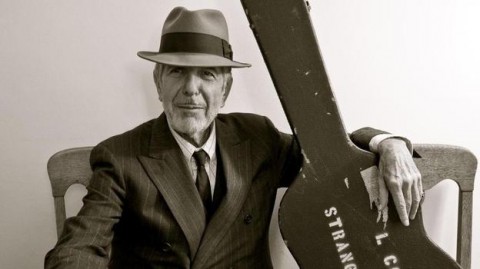 Fans of Leonard Cohen, you’ve waited patiently. Seven long years. Now it’s finally here. Cohen’s new album Old Ideas officially hits the streets next week. But it’s now streaming online for free courtesy of NPR. It will only last a limited time. So settle in now and listen to the ten tracks, which as Guardian critic Kitty Empire puts it, are not about “death, betrayal and God, juicy as these are,” but rather “the stuff that has made Cohen indispensable for six decades: desire, regret, suffering, misanthropy, love, hope, and hamming it up.”
The poetic lines of the first track, “Going Home,” have been published in The New Yorker. You can pre-order the album here. H/T @opedr
More Leonard Cohen Videos & Movies:
Ladies and Gentlemen… Mr. Leonard Cohen (1971 Documentary)
Leonard Cohen Recounts “How I Got My Song,” or When His Love Affair with Music Began
Leonard Cohen Reads “The Future” (Not Safe for Work)
Leonard Cohen: I’m Your Man. Watch the Film
Read More...Global Warming: A Free Course from UChicago Explains Climate Change
Two weeks ago, we featured Harvard Thinks Green, a series of six TED-style lectures presented by Harvard experts, each focusing on the environment and strategies for reversing climate change. One thing Harvard Thinks Green didn’t offer was a primer on climate change itself, a good scientific explanation of the underlying problem. Enter Global Warming (YouTube), a 23-lecture course presented by David Archer, a professor in the Department of The Geophysical Sciences at the University of Chicago. The first half of the class explains climate physics and how the climate works; the second half shows how human activity and ever-increasing carbon levels disrupt the equilibrium of the environment, creating a very uncertain future for generations to come. The first, short lecture above outlines the scope of the class.
Originally presented at UChicago in Fall 2009, Archer’s course was geared to non-science majors and taught in conjunction with his textbook, Global Warming: Understanding the Forecast, which happens to be available on Amazon here. Global Warming (YouTube) is now listed in our collection, 1,700 Free Online Courses from Top Universities.
If you would like to support the mission of Open Culture, consider making a donation to our site. It’s hard to rely 100% on ads, and your contributions will help us continue providing the best free cultural and educational materials to learners everywhere. You can contribute through PayPal, Patreon, and Venmo (@openculture). Thanks!
Related Content:
132 Years of Global Warming Visualized in 26 Dramatically Animated Seconds
A Song of Our Warming Planet: Cellist Turns 130 Years of Climate Change Data into Music
Sally Ride Warns Against Global Warming; Wonders If Technology Can Save Us From Ourselves
Prof. Brian Cox Has a Maddening Conversation with a Climate Science-Denying Politician
Read More...Star Wars Uncut: The Epic Fan Film
In 2009, Brooklyn-based Web developer Casey Pugh was looking for a new way to explore the potential of crowd-sourcing when he hit upon an idea of galactic proportions. He took the original 1977 Star Wars film (later known as Episode IV: A New Hope in the chronologically ordered six-part series) and chopped it into 15-second pieces, inviting fans from around the world to choose a piece and re-create it in whatever medium they liked: live-action, puppetry, animation, you name it. Three years and one Emmy Award later, Pugh and his team have put the best pieces together and (with the blessing of Star Wars creator George Lucas) released the finished film, Star Wars Uncut: The Director’s Cut. It runs a fun two hours and five minutes. You can watch the complete movie above and learn more on the official website.
If you would like to support the mission of Open Culture, consider making a donation to our site. It’s hard to rely 100% on ads, and your contributions will help us continue providing the best free cultural and educational materials to learners everywhere. You can contribute through PayPal, Patreon, and Venmo (@openculture). Thanks!
Related Star Wars Goodies:
Star Wars the Musical: The Force is Strong in this One
Darth Vader’s Theme in the Style of Beethoven
Kurt Russell Auditions for Star Wars
The Star Wars Holiday Special (1978): It’s Oh So Kitsch
Read More...Michel Foucault: Free Lectures on Truth, Discourse & The Self (UC Berkeley, 1980–1983)

Image by Nemomain, via Wikimedia Commons
Michel Foucault (1926–1984) was an enormously influential French philosopher who wrote, among other things, historical analyses of psychiatry, medicine, the prison system, and the function of sexuality in social organizations. He spent some time during the last years of his life at UC Berkeley, delivering several lectures in English. And happily they were recorded for posterity:
- Four Lectures on Truth and Subjectivity (1980)
- Six Lectures on Discourse and Truth (1983)
- Three Lectures on “The Culture of the Self” (1983)
These last lectures are also available on YouTube (in audio format).
One of Foucault’s more controversial and memorable books was Discipline and Punish (1977), which traced the transition from the 18th century use of public torture and execution to–less than 50 years later–the prevalence of much more subtle uses of power, with a focus on incarceration, rehabilitation, prevention, and surveillance.
Here he is in 1983 commenting on that book (thanks for the link to Seth Paskin). The Partially Examined Life podcast recently discussed the book with Katharine McIntyre, doctoral candidate at Columbia. Foucault’s image of the panopticon well captures modern privacy concerns in the electronic age.
Finally, we leave you with a Schoolhouse Rock-style presentation of Foucault’s book The History of Sexuality, Volume 1 and some vintage video of Foucault’s 1971 debate with Noam Chomsky. Foucault’s lectures have been added to our list of Free Philosophy Courses, part of our big collection, 1,700 Free Online Courses from Top Universities.
If you would like to support the mission of Open Culture, consider making a donation to our site. It’s hard to rely 100% on ads, and your contributions will help us continue providing the best free cultural and educational materials to learners everywhere. You can contribute through PayPal, Patreon, and Venmo (@openculture). Thanks!
Mark Linsenmayer runs the Partially Examined Life philosophy podcast and blog. He also performs with the Madison, WI band New People.
Related Content:
Jacques Lacan, Academic Rock Star, Gives a Public Lecture, 1972
Lovers and Philosophers — Jean-Paul Sartre & Simone de Beauvoir Together in 1967
100 Free Online Philosophy Courses (Part of Our List of 875 Free Courses Online)
Read More...An Animated Tour of Fallingwater, One of Frank Lloyd Wright’s Finest Creations
Fallingwater was designed by Frank Lloyd Wright in 1935. Construction began a year later and was eventually completed in 1939. Many consider Fallingwater one of Wright’s finest creations. Hence why Smithsonian Magazine counted it as one of the 28 Places to See Before You Die. Now, thanks to the mini movie above, you can watch the building of Fallingwater take place right before your eyes, and then take a tour of the house. It’s all done in computer graphics and runs 4+ minutes. And, as one reader tells us, the “video is as real as it gets.” You can learn more about the film and the house at this web site.
For more Frank Lloyd Wright, you’ll also want to visit the R.W. Lindholm Service Station, a gas station designed by the famous architect in the 1930s. We’ll take you on a virtual tour right here.
Read More...Remembering the Soulful Etta James
“When I’m singing blues,” Etta James once said, “I’m singing life.”
Hers was a difficult life. The legendary singer, who died this morning at the age of 73 after a long struggle with leukemia, was born Jamesetta Hawkins on January 25, 1938, to an unwed 14-year-old girl, and her life was marked by drug addiction and emotional volatility. Through it all, James rose to become one of the most influential and admired singers of the second half of the 20th century.
“There’s a lot going on in Etta James’ voice,” Bonnie Raitt told Rolling Stone in 2008. “A lot of pain, a lot of life but, most of all, a lot of strength. She can be so raucous and down one song, and then break your heart with her subtlety and finesse the next.”
Her greatest hit came in 1961, with the soulful ballad “At Last.” For another side of James’s versatile style, listen and watch above, as she performs the gospel-influenced “Something’s Got a Hold on Me” in 1962. To learn more about James, and to watch video highlights from her career, see today’s article by Ben Greenman on The New Yorker’s “Culture Desk” blog. And over at the Guardian, see Richard Williams selection of 10 Classic Etta James Performances.
In 1997, James summed things up in an interview with Rolling Stone: “Life’s been rough,” she said, “but life’s been good. If I had to go back and do it all over again, I would live it the exact same way.”
Read More...Everything You Wanted to Know About Coffee in Three Minutes
Coffee — it’s the fuel of the modern world and certainly this site. And, if you believe this video (apparently not made by Starbucks or the American coffee lobby), it’s the greatest, safest addiction around. Take it all with a grain of salt … while you drink your morning (or afternoon) cup of joe.
More Related Coffee Items:
How to Drink Coffee at Zero Gravity
David Lynch’s Organic Coffee (Barbie Head Not Included)
Follow us on Facebook, Twitter and now Google Plus.
Read More...A Rare Interview with Fritz Lang and His 1931 Masterpiece of Suspense, M
“I made my films with a kind of sleepwalking security,” says Fritz Lang. “I did things which I thought were right. Period.” Thus begins this fascinating interview with the great Austrian-born director.
The interview was conducted by William Friedkin, director of The French Connection and The Exorcist, in February of 1975, a little more than a year before Lang’s death. Lang talks about his early life as a runaway. (“Any decent human being should run away from home.”), his entry into theatre and film as a young man, his German masterpieces Metropolis and M, and a chilling encounter in 1933 with the Nazi Minister of Propaganda Joseph Goebbels that provoked him to flee Germany the same day.
The story of Lang’s escape has all the elements of a cinematic thriller, but biographers have cast doubt on its veracity, citing passport records which indicate that Lang left Germany some time after the meeting with Goebbels, and that he returned on brief trips several times that year. But the anecdote, along with Lang’s reflections on his life and on the nature of fate, provide a fascinating look into the great filmmaker’s character.
The conversation above, which runs 50 minutes, was edited down from a much longer set of interviews. According to the Torino Film Festival website, Friedkin originally intended to use the Lang material for a documentary on horror cinema, to be called A Safe Darkness, but there is no discussion of the horror genre in this version.
As an extra bonus from our collection of Free Movies Online, we present the film Lang most wanted to be remembered for, M. (See below.) The film was made in 1931, and was the first by Lang to incorporate sound. Peter Lorre makes his screen debut as a man guilty of unspeakable crimes. In its introduction to the film, the Criterion Collection writes: “In his harrowing masterwork M, Fritz Lang merges trenchant social commentary with chilling suspense, creating a panorama of private madness and public hysteria that to this day remains the blueprint for the psychological thriller.”
M, by Fritz Lang:
Read More...The Disney Cartoon That Introduced Mickey Mouse & Animation with Sound (1928)
In 1927, The Jazz Singer starring Al Jolson, one of the first great “talkies” to use synchronized singing and speech, hit American theaters and thrilled audiences. Knowing that change was afoot, Walt Disney spent $4,986 to create his first sound cartoon, Steamboat Willie (1928). Remembering the film many years later, Disney said:
The effect on our little audience was nothing less than electric. They responded almost instinctively to this union of sound and motion. I thought they were kidding me. So they put me in the audience and ran the action again. It was terrible, but it was wonderful! And it was something new!
These technical innovations make Steamboat Willie rather legendary. But the film retains landmark status for another reason. It marked the first public debut of Mickey Mouse and his girlfriend Minnie, two of the most recognized cartoon characters worldwide. Ub Iwerks, the celebrated Disney animator, first brought Mickey to life, and we have been living with him ever since — although, as you will see, his personality has softened over time.
You can see Mickey starring in two other early animations: Plane Crazy (1929) where the Mouse imitates America’s hero at the time, Charles Lindbergh. And The Gallopin’ Gaucho, another 1928 release.
Steamboat Willie appears in the Animation Section of our collection, 4,000+ Free Movies Online: Great Classics, Indies, Noir, Westerns, Documentaries & More.
If you would like to support the mission of Open Culture, consider making a donation to our site. It’s hard to rely 100% on ads, and your contributions will help us continue providing the best free cultural and educational materials to learners everywhere. You can contribute through PayPal, Patreon, and Venmo (@openculture). Thanks!
Related Content:
How Walt Disney Cartoons Are Made
The Making of a Nazi: Disney’s 1943 Animated Short
Destino: The Salvador Dalí – Disney Collaboration 57 Years in the Making
Gertie the Dinosaur: The Mother of all Cartoon Characters
Read More...Support Us
We're hoping to rely on loyal readers, rather than erratic ads. Please click the Donate button and support Open Culture. You can use Paypal, Venmo, Patreon, even Crypto! We thank you!

About Us

Open Culture scours the web for the best educational media. We find the free courses and audio books you need, the language lessons & educational videos you want, and plenty of enlightenment in between.
Advertise With Us

FREE UPDATES!
GET OUR DAILY EMAIL
Get the best cultural and educational resources on the web curated for you in a daily email. We never spam. Unsubscribe at any time.
FOLLOW ON SOCIAL MEDIA

Open Culture editor Dan Colman scours the web for the best educational media. He finds the free courses and audio books you need, the language lessons & movies you want, and plenty of enlightenment in between.
Advertise With Us


