Steve Jobs Muses on What’s Wrong with American Education, 1995
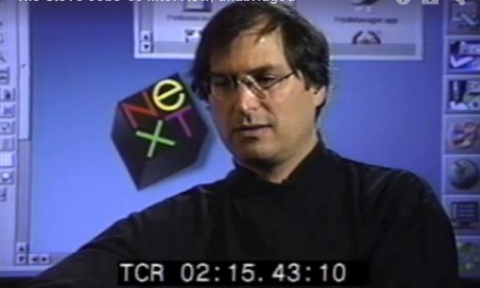
In late October, Computerworld unearthed a lengthy interview with Steve Jobs originally recorded back in 1995, when Jobs was at NeXT Computer, and still two years away from his triumphant return to Apple. Filmed as part of an oral history project, the wide-ranging interview begins with Jobs’ childhood and his early school days, and it all sets the stage for Jobs to muse on the state of public education in America. He began:
I’d like the people teaching my kids to be good enough that they could get a job at the company I work for, making a hundred thousand dollars a year. Why should they work at a school for thirty-five to forty thousand dollars if they could get a job here at a hundred thousand dollars a year? Is that an intelligence test? The problem there of course is the unions. The unions are the worst thing that ever happened to education because it’s not a meritocracy. It turns into a bureaucracy, which is exactly what has happened. The teachers can’t teach and administrators run the place and nobody can be fired. It’s terrible.
Asked what changes he would make, Jobs continued:
I’ve been a very strong believer in that what we need to do in education is to go to the full voucher system. I know this isn’t what the interview was supposed to be about but it is what I care about a great deal.… The problem that we have in this country is that [parents] went away. [They] stopped paying attention to their schools, for the most part. What happened was that mothers started working and they didn’t have time to spend at PTA meetings and watching their kids’ school. Schools became much more institutionalized and parents spent less and less and less time involved in their kids’ education. What happens when a customer goes away and a monopoly gets control … is that the service level almost always goes down.
And so the answer. Vouchers, entrepreneurship and market competition:
I’ve suggested as an example, if you go to Stanford Business School, they have a public policy track; they could start a school administrator track. You could get a bunch of people coming out of college tying up with someone out of the business school, they could be starting their own school. You could have twenty-five year old students out of college, very idealistic, full of energy instead of starting a Silicon Valley company, they’d start a school. I believe that they would do far better than any of our public schools would. The third thing you’d see is I believe, is the quality of schools again, just in a competitive marketplace, start to rise. Some of the schools would go broke. A lot of the public schools would go broke. There’s no question about it. It would be rather painful for the first several years.… The biggest complaint of course is that schools would pick off all the good kids and all the bad kids would be left to wallow together in either a private school or remnants of a public school system. To me that’s like saying “Well, all the car manufacturers are going to make BMWs and Mercedes and nobody’s going to make a ten thousand dollar car.” I think the most hotly competitive market right now is the ten thousand dollar car area. You’ve got all the Japanese playing in it. You’ve got General Motors who spent five million dollars subsidizing Saturn to compete in that market. You’ve got Ford which has just introduced two new cars in that market. You’ve got Chrysler with the Neon.…
The full transcript appears here. Or, if you want to watch the interview on video, you can jump to Computerworld, where, rather lamely, you will need to register before watching the actual talk. Bad job by Computerworld.
Related Content:
Download Free Copy of Steve Jobs Biography; Plus Interview with Author
Steve Jobs Demos the First Macintosh in 1984
Steve Jobs Narrates the First “Think Different” Ad (Never Aired)
Read More...David Crosby & Graham Nash at Occupy Wall Street; Echoes of Woodstock
First came Willie Nelson, Pete Seeger, and Arlo Guthrie, and now Crosby & Nash (sans Stills). Playing yesterday at Occupy Wall Street, their short set included Military Madness, What Are Their Names, They Want It All, Teach Your Children (above), and Long Time Gone, which they sang during their heyday at Woodstock more than 40 years ago. A long time gone, indeed.
All of this provides a good excuse to post another favorite video of ours — CSN’s one-time bandmate Neil Young playing Ohio, a now canonical song from the protest movement songbook. The haunting clip was recorded live at Massey Hall in 1971, and appears on one of the finer acoustic guitar LPs.
More Occupy Videos:
Noam Chomsky at Occupy Boston
Slavoj Zizek Takes the Stage at Occupy Wall Street
Joseph Stiglitz and Lawrence Lessig at Occupy Wall Street
Read More...
Visualizing Bach: Alexander Chen’s Impossible Harp
“Music,” Gottfried Leibniz famously said, “is the pleasure the human mind experiences from counting without being aware that it is counting.” Computer artist Alexander Chen makes this pleasure visible with Baroque.Me, his geometric computer animation of the Prelude to Johann Sebastian Bach’s Cello Suite No. 1 in G major.
Chen visualized the piece by imagining a harp with strings that would automatically morph into different lengths according to the principles of Pythagorean tuning. “It’s math based on the fraction 2/3,” writes Chen on his blog. “I started with the longest string, setting it to a symbolic length of pixels. When cut to 2/3 length, it goes up a fifth. Cut its length by 1/2 and it goes up an octave. 3/4 length, one fourth. From these simple numbers I calculated the relative string lengths of all the notes in the piece.” He used eight strings because the Prelude’s phrasing is in groups of eight notes. The strings are “plucked” by two symmetrical pairs of nodes that revolve at a uniform rate, rather like a digital music box.
Chen, 30, lives in Brooklyn, NY, and works in the Google Creative Lab. One of his most popular pieces for Google was the Les Paul Doodle, which allows users to digitally strum the guitar strings. Chen grew up learning music and computer programming in parallel. He plays the classical viola, but with the Bach animation he wanted to remove the performer’s interpretive element from the music. “It’s a piece that I’ve heard a lot since I was a kid,” Chen told the BBC recently. (See the “Mathematical Music” podcast, Nov. 3.) “People always bring different levels of expression to it. People play to different tempos and they add a lot of dynamics, or less dynamics. But what I wanted to let the computer do was just kind of to play in a really neutral way, because what I really wanted to express was how much emotion and intensity is just in the data of the notes themselves. I think that’s really where the beauty of the piece at its core is.”
To hear the Prelude with the interpretive element back in, you can watch this video of Pablo Casals performing it in 1954:
Read More...Social Media in the Age of Enlightenment and Revolution
As the French like to say, plus ça change, plus c’est la même chose. The more things change, the more they stay the same. Before there was Twitter, Facebook and Google+ (click to follow us), Europeans living in the seventeenth and eighteenth centuries had to deal with their own version of information overload. Emerging postal systems, the proliferation of short letters called billets, and the birth of newspapers and pamphlets all pumped unprecedented amounts of information — valuable information, gossip, chatter and the rest — through newly-emerging social networks, which eventually played a critical role in the French Revolution, much like Twitter and Facebook proved instrumental in organizing the Arab Spring.
These historical social networks are being carefully mapped out by scholars at Stanford. Above, we have Anaïs Saint-Jude painting the historical picture for us. Below Dan Edelstein gives you a closer look at Stanford’s Mapping the Republic of Letters project.
via Stanford University News
Read More...Alfred Hitchcock Reveals The Secret Sauce for Creating Suspense
Speaking at an AFI Seminar in 1970, Alfred Hitchcock revealed the essential ingredients that went into making his films. When he stripped everything away, what Hitchcock really cared about was creating suspense films (not mystery films) and getting the suspense element right. In the famous clip above, the director explains why suspenseful scenes have to simmer for a time and then cool down properly. Things can’t be brought to a rapid boil and then be quickly taken off the stove. Hitchcock once made that mistake in his 1936 film, Sabotage. (Watch the offending scene right below or find the full film here.)
Of course, Hitchcock learned from his mistake, and thereafter shot countless scenes where the suspense builds in the right way. But we particularly wanted to find one scene that pulls off the bomb scenario, and so here it goes. From 1957 to 1959, Hitchcock produced Suspicion, a television series for NBC, and he personally directed one episode called “Four O’Clock”. It features a watchmaker who suspects his wife of having an affair, and so, filled with jealousy, he decides to murder her with a bomb made by his own hands. Things take an unexpected turn, however, when two burglars tie him up in the basement with the ticking bomb. We leave you with the final, climactic scene.
You can watch the full episode here. Enjoy.
If you would like to support the mission of Open Culture, consider making a donation to our site. It’s hard to rely 100% on ads, and your contributions will help us continue providing the best free cultural and educational materials to learners everywhere. You can contribute through PayPal, Patreon, and Venmo (@openculture). Thanks!
Related Content:
16 Free Hitchcock Movies Online
Alfred Hitchcock Explains the Plot Device He Called the ‘MacGuffin’
Alfred Hitchcock’s 7‑Minute Master Class on Film Editing
Read More...Open Culture Now on Google +
 Just a very quick fyi: Today, we launched an official Google+ page for Open Culture. It’s another way to get intelligent media delivered to your digital doorstep each day, and to share it with friends. If you don’t have a Google+ account, you can create one here, and Wired has a nice little primer on using the service here.
Beyond Google+, we also have an active presence on Facebook and particularly Twitter. So if you want a double dose of Open Culture, you now know where to find it…
Read More...The Wonderful, Wooden Marble Adding Machine
Canadian software developer Matthias Wandel enjoys spending his spare time creating wooden contraptions that combine a childlike sense of wonder with an engineer’s knowledge of mechanics. One of his most popular creations so far is this six-bit binary adding machine, which has tallied nearly one and a half million views on YouTube. As Rick Regan explains at Exploring Binary, the machine functions like a low-tech integrated circuit. “It uses wood instead of silicon, gravity instead of voltage, and marbles instead of current,” he writes. “We don’t need no stinkin’ CMOS!”
The idea came to Wandel after he noticed that one of his earlier marble machines incorporated logic-like elements. “It had occurred to me,” he writes on his woodworking site, “that perhaps with an insane amount of perseverance, it might be possible to build a whole computer that runs on marbles.” To illustrate the point Wandel built the adding machine, which stores the binary states of six bits and can add numbers from one to 63. The result may be more cool than practical, writes Regan, “but it certainly is educational. It illustrates basic principles of binary numbers, binary arithmetic, and binary logic.”
You can learn more about the machine on Wandel’s Web page, and about the underlying logic and mathematics at Exploring Binary.
If you would like to support the mission of Open Culture, consider making a donation to our site. It’s hard to rely 100% on ads, and your contributions will help us continue providing the best free cultural and educational materials to learners everywhere. You can contribute through PayPal, Patreon, and Venmo (@openculture). Thanks!
Read More...Calculus Lifesaver: A Free Online Course from Princeton
It’s rare that we get to cover math here. So here it goes: Adrian Banner, a lecturer at Princeton, has put together a lecture series (in video) that will help you master calculus, a subject that has traditionally frustrated many students. The 24 lectures (find them on Vimeo) were originally presented as review sessions for Princeton introductory calculus courses offered in 2006, and each session runs about two hours. It’s worth noting that Banner has used the lectures to develop a handy book, The Calculus Lifesaver: All the Tools You Need to Excel at Calculus. To find this course (and many others like it), look in the Math section of our collection of 1500 Free Online Courses. Here you will also find Calculus Revisited: Single Variable Calculus, a vintage introductory course filmed by MIT in 1970. Consider it a classic…
Related Content:
Multiplication: The Vedic Way
Miss USA 2011: Should Schools Teach Evolution? … or Math?
Read More...Hunter S. Thompson’s The Rum Diary: a ‘Warped Casablanca’
In early 1960, Hunter S. Thompson was just 22 years old and his journalism career was already on the skids. His last two jobs had ended badly. At one place he was fired for insubordination; at the other, for smashing the office candy machine in a fit of rage after it swallowed his money. So he drifted down to San Juan, Puerto Rico, and took a job at a newspaper called El Sportivo. His beat: bowling.
The newspaper went out of business a few months later, but Thompson transformed his experiences into a novel, The Rum Diary. In the prologue he describes the atmosphere of a San Juan newsroom peopled with shiftless expatriates:
They ran the whole gamut from genuine talents and honest men, to degenerates and hopeless losers who could barely write a post card–loons and fugitives and dangerous drunks, a shoplifting Cuban who carried a gun in his armpit, a half-wit Mexican who molested small children, pimps and pederasts and human chancres of every description, most of them working just long enough to make the price of a few drinks and a plane ticket.
Thompson finished the novel in 1961, but his career as a fiction writer was soon eclipsed by a growing recognition of his gift for narrative journalism, and The Rum Diary wasn’t published until 1998. As soon as it came out there was talk of a film adaptation. “Hunter’s dream,” said historian Douglas Brinkley, “was to have The Rum Diary as a movie, because I think he always saw it as a kind of warped Casablanca.”
Thompson killed himself before that dream ever came to fruition. After more than a decade of delays, a film version of The Rum Diary finally opened last weekend to mixed reviews and small audiences. Johnny Depp plays the alcoholic newpaperman Paul Kemp as if he were a young Thompson: more laid back than the gonzo journalist of Fear and Loathing in Las Vegas, but with the same peculiar alienation and low, muttering voice. Director Bruce Robinson creates the vivid atmosphere of a Caribbean boomtown inhabited by shady businessmen, clueless tourists, drunken journalists and resentful natives. But the story is like its protagonist: adrift, irresolute.
To learn about Thompson’s early efforts to get the story made into a movie, you can watch The Rum Diary Back Story, filmed from 1998 through 2002 by Wayne Ewing. It documents the author’s initial pride at the long-overdue publication of the novel, followed by his growing frustration with the glacial progress in turning it into a movie. Ewing filmed Thompson at his home in Colorado and in a fireside meeting at Depp’s home in California. In one comical scene (episode eight) Warren Zevon reads aloud an insulting letter Thompson had sent to a producer.
Episode One is above, and the rest can be seen by following these links to Episode Two, Episode Three, Episode Four, Episode Five, Episode Six, Episode Seven, Episode Eight, Episode Nine and Episode Ten.
Related Content:
Johnny Depp Reads Letters From Hunter S. Thompson
Hunter S. Thompson Gets Confronted by the Hell’s Angels
Hunter S. Thompson Interviews Keith Richards
Read More...
Duelity: Creationist and Darwinist Origin Stories Animated
Produced at the Vancouver Film School, this split-screen animation tells the story of Earth’ s origins from a creationist and Darwinist/evolutionist point of view. To make things more interesting (spoiler: stop reading now if you want to maintain the element of surprise), the scientific story is told using religious language, whereas the Biblical version is told as if it were the scientific one. The slightly confusing conclusion (its’ a zinger) shows how the language we use to present ideas influences their perception. And the ironic use of infographics tops off this visual and linguistic experiment.
On the homepage of the project, you can watch the videos separately and download them. Also, the YouTube channel of Vancouver Film School is always worth a visit.
By profession, Matthias Rascher teaches English and History at a High School in northern Bavaria, Germany. In his free time he scours the web for good links and posts the best finds on Twitter.
Read More...Support Us
We're hoping to rely on loyal readers, rather than erratic ads. Please click the Donate button and support Open Culture. You can use Paypal, Venmo, Patreon, even Crypto! We thank you!

About Us

Open Culture scours the web for the best educational media. We find the free courses and audio books you need, the language lessons & educational videos you want, and plenty of enlightenment in between.
Advertise With Us

FREE UPDATES!
GET OUR DAILY EMAIL
Get the best cultural and educational resources on the web curated for you in a daily email. We never spam. Unsubscribe at any time.
FOLLOW ON SOCIAL MEDIA

Open Culture editor Dan Colman scours the web for the best educational media. He finds the free courses and audio books you need, the language lessons & movies you want, and plenty of enlightenment in between.
Advertise With Us

