David Lynch’s “Crazy Clown Time,” Stream the New Album
 A quick fyi: We previewed the title track a few weeks back. Now, you can stream the full album for free, courtesy of NPR. But don’t delay, the free tracks will only linger for a limited time.…
Related Content:
David Lynch Talks Meditation with Paul McCartney
David Lynch’s Organic Coffee (Barbie Head Not Included)
David Lynch on his Favorite Movies and Filmmakers
Read More...How Much Does The Entire, Big Internet Weigh?
5 million terabytes of information. That’s what you get when you bundle up all of the emails, videos, photos, web sites and sundry materials available on the web. Now here’s the big question: how much does all of that information weigh? No spoilers here. We’ll let the folks at VSauce give you the answer.
PS The 5 million terabytes figure was given by Eric Schmidt in 2005. So the figure is a bit dated, but it doesn’t take away from the gist of the exercise…
Read More...Kim Kardashian Gets Divorced; Salman Rushdie Writes Limerick
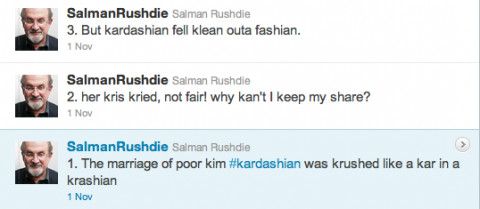 Perhaps you know the backstory; perhaps you don’t. This week, socialite and reality “star” Kim Kardashian announced that her 72-day marriage to Kris Humphries will end in divorce. In response, the tabloids buzzed … and famed author Salman Rushdie (Midnight’s Children, The Satanic Verses and The Moor’s Last Sigh) took to Twitter and offered up a nice little limerick. It starts with the blue section and moves up the page…
Follow the author at @SalmanRushdie, and us at @openculture.
Related Content:
Salman Rushdie on Machiavelli’s Bad Rap
Read More...Jim Jarmusch: The Art of the Music in His Films
In the early 1980s, aspiring filmmaker Jim Jarmusch immersed himself in New York’s underground music scene. He played keyboards–a “fairly primitive Moog synthesizer”–in places like CBGB and the Mudd Club with a No Wave band called The Del-Byzanteens and was deeply influenced by the spirit of punk rock. “The aesthetics of that scene really gave me the courage to make films,” Jarmusch later recalled. “It was not about virtuosity. It was about expression.”
Over the years, Jarmusch cast musicians instead of actors in many of his films: Joe Strummer, Tom Waits, John Lurie, Iggy Pop–all had something in common. Each had stood up against commercial pressure from the mainstream popular culture. Jarmusch carried the same uncompromising spirit into the creation of his films.
In the discussion above, recorded sometime after the release of 1999’s Ghost Dog, Jarmusch explains his approach to using music in film.
The opening sequence of Jarmusch’s 1986 film Down by Law (above) rolls to the groove of Tom Waits’s “Jockey Full of Bourbon,” from the classic Rain Dogs album. Waits himself plays a leading role in the film. His music fits perfectly into the atmosphere of the story, writes Juan A. Suárez in his critical study, Jim Jarmusch: “Waits’s songs tell of fractured romances set in an underworld of drifters, pimps, and prostitutes–to a large extent the milieu of the film. And both Jarmusch’s film and Waits’s songs recycle retro idioms. The visual style of Down by Law draws from a number of 1940s and 1950s studio genres, while Waits’s songs are replete with pastiches of polka, waltz, classic blues, and Caribbean rhythms.”
For the surreal 1995 western Dead Man (sampled in the montage above) Jarmusch enlisted Neil Young to compose and perform the soundtrack. “To me,” Young is quoted as saying at the outset of the project by Jonathan Rosenbaum in his BFI Modern Classics book on the film, “the movie is my rhythm section and I will add a melody to that.” Young recorded his minimalist score, much of it improvised, in a large warehouse in San Francisco while watching a rough cut of the film. Young played all the instruments: electric and acoustic guitars, pump organ and a detuned piano.
The other-worldly, sometimes jarring music baffled a few of the critics. “A mood might have developed here,” wrote Roger Ebert in a scathing review, “had it not been for the unfortunate score by Neil Young, which for the film’s final 30 minutes sounds like nothing so much as a man repeatedly dropping his guitar.” Others heard genius. Rock historian Greil Marcus, in his “Ten reasons why Neil Young’s “Dead Man” is the best music for the dog days of the 20th century,” wrote: “The music, as you listen, separates from the movie even as it frames scenes, banter, recitals. It gets bigger and more abstract, and it becomes hard to understand how any film, showing people doing this or that in specific, non-abstract ways, could hold it.”
If you would like to support the mission of Open Culture, consider making a donation to our site. It’s hard to rely 100% on ads, and your contributions will help us continue providing the best free cultural and educational materials to learners everywhere. You can contribute through PayPal, Patreon, and Venmo (@openculture). Thanks!
Related Content:
The Music in Quentin Tarantino’s Films: Hear a 5‑Hour, 100-Song Playlist
New Jim Jarmusch Documentary on Iggy Pop & The Stooges Now Streaming Free on Amazon Prime
Jim Jarmusch’s Anti-MTV Music Videos for Talking Heads, Neil Young, Tom Waits & Big Audio Dynamite
Read More...Joan Didion Reads From New Memoir, Blue Nights, in Short Film Directed by Griffin Dunne
A mere twenty months after Joan Didion’s husband, John Gregory Dunne, died of a heart attack, Didion’s only child, Quintana Roo Dunne, contracted pneumonia, lapsed into septic shock and passed away. She was only 39 years old. Didion grappled with the first death in her 2005 bestseller, The Year of Magical Thinking. Now, with her new memoir Blue Nights, she turns to her child’s passing, to a parent’s worst fear realized. In this short film shot by her nephew, director Griffin Dunne, Didion reads from Blue Nights. The scene opens with memories from her daughter’s wedding and ends with some big existential questions and the refrain, “When we talk about mortality we are talking about our children.”
This “audiobook for the eyes,” as Griffin Dunne calls it, runs six plus minutes. The actual Blue Nights audio book is now available on Audible.
A big thanks goes to @opedr for sending the Didion clip our way…
Read More...Noam Chomsky at Occupy Boston
Noam Chomsky joined the faculty of MIT in 1955, and, soon enough established himself as “the father of modern linguistics.” (Watch him debate Michel Foucault in 1971.) During the 60s, he also firmly positioned himself as a leading public intellectual taking aim at American foreign policy and global capitalism, and we regularly saw him engaging with figures like William F. Buckley.
All of these years later, it’s quite fitting that Chomsky, now 82 years old, would pay a visit to Occupy Boston and deliver a talk in the Howard Zinn Memorial Lecture Series. Why has our political system become more responsive to corporations than citizens? How has wealth become increasingly concentrated in the hands of an ever smaller elite — a plutocracy, to put it simply? And why do billionaire hedge fund managers enjoy a lower tax rate than maligned school teachers and pretty much everyone else? Chomsky explains how we got to this point, and what’s to be done about it. Find his talk in three parts: Part 1 (above), Part 2 and Part 3. via Dangerous Minds.
More Occupy Videos:
Willie Nelson, Pete Seeger, and Arlo Guthrie at Occupy Wall Street
Slavoj Zizek Takes the Stage at Occupy Wall Street
Joseph Stiglitz and Lawrence Lessig at Occupy Wall Street
Read More...Hans Rosling Uses Ikea Props to Explain World of 7 Billion People
According to United Nations demographers, the world’s population likely topped 7 billion on Monday, and we’ll now steam forward, hitting 9.3 billion by 2050. 7 billion is a newsworthy milestone, to be sure. But what does this number really mean? To put things in perspective, we’re featuring a recent TED Talk by Hans Rosling, a professor of global health who presents data in imaginative ways. His presentations can get wildly digital. (Just watch 200 Countries & 200 Years in 4 Minutes). But not so in this case. The props are simple goods bought at IKEA, and they do more than an adequate job explaining the past, present and future of global population growth.
Read More...Filmmaking Advice from Quentin Tarantino and Sam Raimi (NSFW)
At Comic-Con 2009, some aspiring filmmakers had the chance to ask real-deal directors how to make it in the business. Sam Raimi offered some very tangible and practical advice — advice that probably any young director should take to heart. Then Quentin Tarantino followed up with some colorful recommendations (at the 2:20 mark) that may be more inspirational/aspirational than achievable. Robert Rodriguez and Guillermo del Toro also offer their thoughts.…
Related Content:
Tarantino’s Favorite Films Since 1992
Cracking Tarantino (Award-winning Film From Brazil)
John Irving: The Road Ahead for Aspiring Novelists
Read More...Names of Paris Métro Stops Acted Out: Photos by Janol Apin
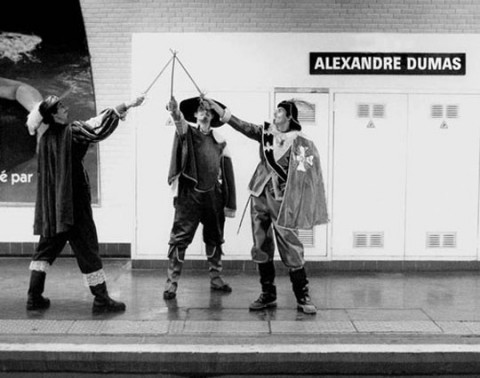 A little fun for anyone who has spent time on the Paris Métro, which carries millions of passengers through 301 often artfully-named stops each day. Shot during the 1990s by Janol Apin, this collection of photos takes the names of real stations and acts them out in imaginative ways. Enjoy the rest here. H/T @MatthiasRascher
Follow us on Facebook and Twitter and we’ll keep pointing you to free cultural goodies daily…
Read More...Bertrand Russell Explains How Smoking Paradoxically Saved His Life
In 1959, Bertrand Russell, then pushing 90, could still give a good interview. We have previously featured vintage video of Russell sending a message to people living 1,000 years in the future and also contemplating the existence/non-existence of God. Now comes more footage from ’59, and this time he tells us all about how smoking a pipe saved his life. It makes for a good anecdote (get more on his near-death experience here), though not an endorsement for taking up the habit.…
If you would like to support the mission of Open Culture, consider making a donation to our site. It’s hard to rely 100% on ads, and your contributions will help us continue providing the best free cultural and educational materials to learners everywhere. You can contribute through PayPal, Patreon, and Venmo (@openculture). Thanks!
Related Content:
Bertrand Russell’s Ten Commandments for Living in a Healthy Democracy
Bertrand Russell & Other Big Thinkers in BBC Lecture Series (Free)
Download Free Courses from Famous Philosophers: From Bertrand Russell to Michel Foucault
Bertrand Russell Lists His 20 Favorite Words in 1958 (and What Are Some of Yours?)
Read More...Support Us
We're hoping to rely on loyal readers, rather than erratic ads. Please click the Donate button and support Open Culture. You can use Paypal, Venmo, Patreon, even Crypto! We thank you!

About Us

Open Culture scours the web for the best educational media. We find the free courses and audio books you need, the language lessons & educational videos you want, and plenty of enlightenment in between.
Advertise With Us

FREE UPDATES!
GET OUR DAILY EMAIL
Get the best cultural and educational resources on the web curated for you in a daily email. We never spam. Unsubscribe at any time.
FOLLOW ON SOCIAL MEDIA

Open Culture editor Dan Colman scours the web for the best educational media. He finds the free courses and audio books you need, the language lessons & movies you want, and plenty of enlightenment in between.
Advertise With Us

