Curated Song Collections to Match the Rhythms of Your Day
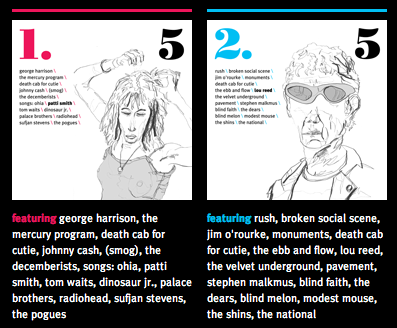
We love the design and overall layout of The Illuminated Playlists by Brooklyn-based designer Adam Parks, but the real delight of the website is its sound, not its look. Parks has grouped 21 music collections into four categories, from slow to very fast (or rather, Adagio to Presto), so you can choose a playlist depending on the pace of your current activity or mood.
As a DJ, Parks has made consistently solid choices, culling from both the classics (Bob Dylan, Neal Young, Rolling Stones, Curtis Mayfield) and more recent artists (TV on the Radio, The Decemberists, Arcade Fire, etc.). These aren’t the lists you would use to impress the cool kids with your eclecticism, ironic tastes, or love of the obscure, but if you’re just looking for great soundtracks for the shifting rhythms of the day, they’re a perfect fit. Dive in here.
We’d love to see similar collections for jazz and classical — we might just need to make a few of our own.
via Metafilter
Sheerly Avni is a San Francisco-based arts and culture writer. Her work has appeared in Salon, LA Weekly, Mother Jones, and many other publications. You can follow her on twitter at @sheerly.
Read More...A Building Salvador Dali Could Love
You’ve seen buildings magically transformed into artistic canvases before — the Astronomical Clock Tower in Prague; the iconic buildings at Cambridge University; and then this facade in Ukraine. But have you seen the audience take control of the architectural painting? That’s what happened in Lyon, France during the “Fête des lumières,” held last December. Throw an audio analysis algorithm and a microphone into the mix, and the audience now drives the surreal architectural show…
via BoingBoing
Read More...Doonesbury Confronts Creationism in the Classroom
 Garry Trudeau has taken on creationism before. He’s doing it again, this time commenting on the oxymoronic “Louisiana Science Education Act,” which allows the teaching of creationism in the public classroom. You can view Trudeau’s cartoon in full, and in high res here.
Baba Brinkman: The Rap Guide to Evolution
Canadian “geek rapper” Baba Brinkman first garnered popular attention with a well-received, well-reviewed rap adaptation of Chaucer’s Canterbury Tales at the Edinburgh Fringe Festival. (To get a sense of the project, check out this brief scene from “The Pardoner’s Tale.”) And we also previously featured his brilliant work on Macmillan’s What’s Your English? campaign.
Brinkman has brought his follow-up show, a fascinating homage to Charles Darwin called “The Rap Guide to Evolution,” to New York City, where it’s getting rave reviews. In the video above, he explains how he went about putting the project together, and how evolutionary science enriched his understanding of the violence and anger so prevalent in the music he loves. The whole talk is great, but if you want to start off with a taste of the rap itself, skip forward to minute 9:03.
Related Content:
The Climate Scientist Rap (Warning: Offensive Language)
Sheerly Avni is a San Francisco-based arts and culture writer. Her work has appeared in Salon, LA Weekly, Mother Jones, and many other publications. You can follow her on twitter at @sheerly.
Read More...Jean-Luc Godard’s After-Shave Commercial for Schick
The Dziga Vertov Group (1968–1972) was a film collective co-founded by Jean-Luc Godard and Jean-Pierre Gorin, named after the pioneering documentary filmmaker Dziga Vertov. Anti-auteur, anti-verité, anti-bourgeois and anti-capitalist, the DVG was also the most radical of the French film collectives, and so, of course, it managed to land a great advertising gig.
But don’t call it a sellout. According to at least one account, Godard and Gorin managed to stick it to their ad agency. Furthermore, they delivered full-throttle irony: Their Schick commercial features a young man and woman arguing over a news broadcast about Palestine … and Palestine was also the subject of an ill-fated 1970 DGV project called “Until Victory.” You can read the fascinating back-story of that film here.
And for the movie geeks: Yes, the actress is Godard regular Juliet Berto.
Related Content:
Jean-Luc Godard Meets Woody Allen
Ingmar Bergman’s Soap Commercials Wash Away the Existential Despair
Fellini’s Fantastic TV Commercials
Wes Anderson’s New Commercials Sell the Hyundai Azera
Sheerly Avni is a San Francisco-based arts and culture writer. Her work has appeared in Salon, LA Weekly, Mother Jones, and many other publications. You can follow her on twitter at @sheerly.
Read More...Introduction to Political Philosophy: A Free Yale Course
Stephen B. Smith, a political science professor at Yale University since 1984, has made available a 24-lecture course, Introduction to Political Philosophy, which covers Plato, Aristotle, Machiavelli, Hobbes, Locke, Rousseau, and Tocqueville.
His approach is highly literary. In his Republic lectures, for instance, he spends a good chunk of the time discussing the metaphors and characters involved. One of Smith’s major concerns is what citizenship amounts to. The lecture above is on Plato’s “Apology,” and while this may be Plato’s most famous work (with its dictum that “The unexamined life is not worth living”), it’s less about political philosophy than about the virtuous life. Smith sees these topics as intimately related, and in his closing lecture, he gives a defense of patriotism, saying that in the ivy league environment, expressing an interest in patriotism is like confessing an interest in child pornography.
Despite his engaging style, he speaks somewhat slowly. If your listening device offers a “double speed” feature, I recommend using this. You can obtain the whole series on the web: Yale web site — YouTube — iTunes (audio) — iTunes (video). You can also find the course in the Philosophy section of our collection, 1,700 Free Online Courses from Top Universities.
Mark Linsenmayer runs the Partially Examined Life philosophy podcast and blog. He also performs with the Madison, WI band New People.
Related Content:
Oxford’s Free Introduction to Philosophy: Stream 41 Lectures
Read More...Blind Guitarist Lives Out Dream at U2 Show
What can I say? I’m a sucker for these feel-good moments. This past weekend, Adam Bevell, who lost his sight more than two decades ago, attended his 20th U2 concert in Nashville. Throughout the show, he held up a sign that read “Blind Guitar Player: Bring Me Up!” And eventually Bono took him up on the offer, inviting him on stage to strum along to “All I Want is You” and then letting him leave with a little party favor — Bono’s green guitar. A class act.
You can catch Adam talking about his experience and playing some more guitar here. And if you like moments like these, then don’t miss this feelin’-groovy moment from Paul Simon’s recent show in Toronto.
via @Metafilter
Read More...How Alice Herz-Sommer, the Oldest Holocaust Survivor, Survived the Horrific Ordeal with Music
What you’re watching is the trailer for the documentary Alice Dancing Under the Gallows by Nick Reed, to be released later this year. At 110, Alice Herz-Sommer is the oldest Holocaust survivor. Her story is both touching and inspiring.
Alice was born in Prague — then part of the Austro-Hungarian Empire — in 1903. She started playing the piano as a child and took lessons with Conrad Ansorge, a student of Liszt. At 16, she attended the master class at Prague’s prestigious German musical academy. Later, Alice became a respected concert pianist in Prague. Through her family, she also knew Franz Kafka. All of this changed when the Nazis occupied Czechoslovakia in March 1939. Along with other Jews living in Prague, Alice was initially forced to live in Prague’s ghetto before being deported to the Theresienstadt concentration camp in 1943, along with her five-year-old son Raphael. Eventually her whole family, including her husband, cellist Leopold Sommer, and her mother, were sent to Auschwitz, Treblinka and Dachau, where they were killed.
Alice and her son survived Theresienstadt because the Nazis used this particular concentration camp to show the world how “well” the inmates were treated. A propaganda film by the Nazis was shot and a delegation from the Danish and International Red Cross was shown around in 1943. To boost morale, Alice and many other imprisoned musicians regularly performed for the inmates. Despite the unimaginable living conditions, Alice and her son survived. They moved to Israel after the war, where she taught music. In 1986, she moved to London, where she still lives. Her son died in 2001 (obituary here).
The way Alice dealt with those horrible times is particularly inspiring. She says about the role of music: “I felt that this is the only thing which helps me to have hope … it’s a sort of religion actually. Music is … is God. In difficult times you feel it, especially when you are suffering.” When asked by German journalists if she hated Germans, she replied: “I never hate, and I will never hate. Hatred brings only hatred.”
Extra material: Art Therapy Blog has a transcript of the trailer, memorable quotes by Alice and two BBC Radio interviews with her. Alice’s life story is told in the book A Garden of Eden in Hell.
By profession, Matthias Rascher teaches English and History at a High School in northern Bavaria, Germany. In his free time he scours the web for good links and posts the best finds on Twitter.
Read More...Bertrand Russell & Other Big Thinkers in BBC Lecture Series (Free)

Back in 1948, Britain was making another difficult transition, moving from the trauma of World War II to the chill of the Cold War. Hoping to give radio listeners some clarity on contemporary affairs, the BBC began airing an annual series of lectures — the Reith Lectures — that featured leading thinkers of the day. 60 years later, the tradition continues, and during this long stretch, some legendary figures have graced the BBC’s airwaves: Michael Sandel, Edward Said, John Searle, John Kenneth Galbraith, George Kennan, and Robert Oppenheimer, just to name a few. (And, yes, the list unfortunately skews heavily male.)
Late last month, the BBC put the complete audio archive online, which gives you access to 240 lectures in total. Where’s the best place to start? How about at the beginning, with the inaugural lectures presented by philosopher Bertrand Russell in 1948. His lecture series, Authority and the Individual, delved into an age old question in political philosophy — the individual and his/her relationship with communities and states. The head of the BBC later groused that Russell spoke “too quickly and had a bad voice.” But the real complaints came from the Soviets, who interpreted Russell’s lectures as an attack on Communism. You can find the lectures here; the first lecture appears at the bottom of the page.
Note: Our Twitter friends around the world said that they could almost universally access the lectures. If you experience any geo-restricting, we apologize in advance.
Related Content:
Bertrand Russell Sends a Message to the Future
Read More...Alfred Hitchcock Recalls Working with Salvador Dali on Spellbound
In 1945 Alfred Hitchcock had to explain one of Hollywood’s unwritten rules to Salvador Dali: No, you can’t pour live ants all over Ingrid Bergman! Hitchcock had approached Dali for help with a dream sequence in his upcoming thriller, Spellbound, starring Bergman and Gregory Peck. He was unhappy with the fuzziness of Hollywood dream sequences. “I wanted to convey the dream with great visual sharpness and clarity–sharper than film itself,” Hitchcock recalled in his 1962 interview with François Truffaut. “I wanted Dali because of the architectural sharpness of his work. Chirico has the same quality, you know, the long shadows, the infinity of distance and the converging lines of perspective. But Dali had some strange ideas. He wanted a statue to crack like a shell falling apart, with ants crawling all over it. And underneath, there would be Ingrid Bergman, covered by ants! It just wasn’t possible.”
This clip permanently resides in our collection of Cultural Icons, which lets you see/hear great cultural figures in video & audio. And don’t miss our collection of Free Hitchcock movies.
If you would like to support the mission of Open Culture, consider making a donation to our site. It’s hard to rely 100% on ads, and your contributions will help us continue providing the best free cultural and educational materials to learners everywhere. You can contribute through PayPal, Patreon, and Venmo (@openculture). Thanks!
Read More...Support Us
We're hoping to rely on loyal readers, rather than erratic ads. Please click the Donate button and support Open Culture. You can use Paypal, Venmo, Patreon, even Crypto! We thank you!

About Us

Open Culture scours the web for the best educational media. We find the free courses and audio books you need, the language lessons & educational videos you want, and plenty of enlightenment in between.
Advertise With Us

FREE UPDATES!
GET OUR DAILY EMAIL
Get the best cultural and educational resources on the web curated for you in a daily email. We never spam. Unsubscribe at any time.
FOLLOW ON SOCIAL MEDIA

Open Culture editor Dan Colman scours the web for the best educational media. He finds the free courses and audio books you need, the language lessons & movies you want, and plenty of enlightenment in between.
Advertise With Us

