Clare Torry’s Rare Live Performances of “Great Gig in the Sky” with Pink Floyd
When Clare Torry went into the studio to record her now-legendary vocals for Pink Floyd’s “Great Gig in the Sky,” the centerpiece of 1973’s Dark Side of the Moon, neither the singer nor the band was particularly impressed with each other. David Gilmour remembered the moment in an interview on the album’s 30th anniversary:
Clare Torry didn’t really look the part. She was Alan Parsons’ idea. We wanted to put a girl on there, screaming orgasmically. Alan had worked with her previously, so we gave her a try. And she was fantastic. We had to encourage her a little bit. We gave her some dynamic hints: “Maybe you’d like to do this piece quietly, and this piece louder.” She did maybe half a dozen takes, and then afterwards we compiled the final performance out of all the bits. It wasn’t done in one single take.
Asked the follow-up question “what did she look like?,” Gilmour replied, “like a nice English housewife.”
Torry, for her part, was hardly starstruck. “If it had been the Kinks,” she later said, “I’d have been over the moon.” She also remembers the session very differently. “They had no idea what they wanted,” she says. Told only “we don’t want any words,” she decided to “pretend to be an instrument.” She remembers “having a little go” and knocking out the session in a couple takes.
This Rashomon scenario involves not only faulty memory but also the legal question as to who composed the song’s melody and vocal concept—a question eventually decided, in 2004, in Torry’s favor, entitling her to royalties.
She clearly wasn’t about to become a touring member of the band, even after the album’s massive success and two subsequent tours. Still, while Torry may not have suited Gilmour’s physical preferences for female singers, and while she may not have thought much of Pink Floyd, she has appeared live with their different iterations over the years, including a show at the Rainbow Theatre in London just months after the album’s release (further up). Later, in 1987, Torry appeared again, this time with Roger Waters at Wembley Stadium on his K.A.O.S. on the Road Tour.
Torry would then join the David Gilmour-led Pink Floyd in 1990 for “Great Gig in the Sky” at Knebworth. I do not think she resembles an English housewife in the concert film at the top—or at least no more than the rest of the band look like middle-aged English husbands. But she still pulls off the soaring vocal, more or less, seventeen years after she first stepped into the studio, having little idea who Pink Floyd was or what would become of that fateful session.
Note: An earlier version of this post appeared on our site in 2020.
Related Content:
How Conflict Helped Create Pink Floyd’s “Comfortably Numb” and Its Legendary Guitar Solos
Hear Pink Floyd’s “Great Gig in the Sky” Played on the Theremin
Josh Jones is a writer and musician based in Durham, NC.
Read More...The Splendid Book Design of the 1946 Edition of Gibbon’s Decline and Fall of the Roman Empire

In 1929, the book publisher George Macy founded The Limited Editions Club (LEC), an imprint tasked with publishing finely illustrated limited editions of classic books. In the years to come, Macy worked with artists like Matisse and Picasso, and photographers like Edward Weston, to produce books with artistic illustrations on their inner pages. And sometimes The Limited Editions Club even turned its design focus to other parts of the book. Take for example this 1946 edition of Edward Gibbon’s The Decline and Fall of the Roman Empire and its pretty amazing spine design.
Created by Clarence P. Hornung, the design captures the essence of Gibbon’s classic, showing Roman pillars progressively crumbling as your eyes move from Volume 1 to Volume 7. George Macy later called the collection, which also features illustrations by the great 18th-century printmaker Giovanni Battista Piranesi, “the most herculean labor of our career.”
Find more information about this 1946 edition here. Or, if you have deep pockets, purchase a copy here.
Note: an earlier version of this post appeared on our site in June 2015.
If you would like to support the mission of Open Culture, consider making a donation to our site. It’s hard to rely 100% on ads, and your contributions will help us continue providing the best free cultural and educational materials to learners everywhere. You can contribute through PayPal, Patreon, and Venmo (@openculture). Thanks!
Related Content:
How Rome Began: The History As Told by Ancient Historians
157 Animated Minimalist Mid-Century Book Covers
Read More...David Bowie Picks His 12 Favorite David Bowie Songs
Admit it, your list of favorite Bowie songs is full of the big hits. Hell, maybe it’s all hits; there’s no shame in that. Digging deep into the crates will yield many an overlooked surprise, many a subtle sleeper, cut-up classic, and electronic experiment. But if all you’ve got is Changesbowie—the 1990 compilation that became, for some generations, a definitive statement of his career—you’ve still got a collection of songs the likes of which have never been heard before or since in modern pop.
Completists may grouch, but even resident Bowie scholars/local record store clerks have an “Ashes to Ashes,” “’Heroes’,” “Changes,” or “Modern Love” in their top ten. Whether ardent or casual fans, we connect with Bowie’s music through milestones, both in his career and in our own lives. This truth has been exploited. In 2008, Mike Schiller at PopMatters bemoaned the fact that almost 20 Bowie compilation albums had been released, a few of which “don’t really seem to court any greater purpose whatsoever.”
Given this surfeit of Bowie compilations on the market, Schiller’s initial groaning reaction to news of yet another (“Oh, good Lord. Another David Bowie collection?”) seems apposite. Except this collection, iSELECT: BOWIE, released in 2008 to readers of the U.K.’s Mail on Sunday, then later in an official CD and digital edition, “is actually something special.” Bowie “picked the tracklist himself. Even more than that, the tracklist actually looks like something he’d have picked himself, rather than having a manager or publicist pick it for him.”
iSELECT: BOWIE
1. “Life On Mars?” (from the album Hunky Dory)
2. “Sweet Thing/Candidate/Sweet Thing” (from the album Diamond Dogs)
3. “The Bewlay Brothers” (from the album Hunky Dory)
4. “Lady Grinning Soul” (from the album Aladdin Sane)
5. “Win” (from the album Young Americans)
6. “Some Are” (currently exclusive to this compilation)
7. “Teenage Wildlife” (from the album Scary Monsters)
8. “Repetition” (from the album Lodger)
9. “Fantastic Voyage” (from the album Lodger)
10. “Loving The Alien” (from the album Tonight)
11. “Time Will Crawl (MM Remix)” (new remix by David Bowie)
12. “Hang On To Yourself [live]” (from the album Live Santa Monica ’72)
See the full tracklist above and hear a playlist of his picks at the top. If we put all our lists of favorites together, we might see a very high percentage of “Life on Mars?” picks. We’re in excellent company; it’s Bowie’s number one favorite song of his. But how many of his other picks might we choose? The eight-and-a-half minute “Sweet Thing”/”Candidate”/”Sweet Thing (Reprise)” from Diamond Dogs? “Win” from Young Americans or “The Bewlay Brothers” from Hunky Dory?
Aside from “Life on Mars?” and the far lesser-collected “Loving the Alien” and “Time Will Crawl,” none of his twelve selections were released as singles. There are no songs from two of the most acclaimed Bowie albums, Low and ’Heroes’, unless we count “Some Are” a bonus track included on the Low 1991 rerelease. There are two tracks from Lodger, the third and least accessible of his vaunted Berlin trilogy, and only one selection from Ziggy Stardust, and it ain’t “Ziggy Stardust.”
If anyone else handed you this list of favorite Bowie tracks, you’d be skeptical. Who puts “Hang On To Yourself” (Live Santa Monica ’72) above any of the studio tracks on that classic 1972 breakout album? David Bowie, that’s who. And who knows, if you’d asked him the day before or after, he might have picked twelve different songs. There’s no telling how seriously he took the exercise, but in the newspaper release, he did “casually [pen] his inspirations for the songs and the recording processes behind them,” notes Allmusic’s Jason Lymangrover.
On his choice of “Teenage Wildlife,” for example, Bowie commented: “So it’s late morning and I’m thinking, ‘New song and a fresh approach. I know. I’m going to do a Ronnie Spector. Oh yes I am. Ersatz just for one day.’ And I did and here it is. Bless. I’m still very enamoured of this song and would give you two ‘Modern Love’s for it anytime…” Bowie got to experience his own music in a way no one else could. iSELECT: BOWIE gets behind the greatest hits collections for a glimpse at the way he heard and remembered his catalogue.
Note: An earlier version of this post appeared on our site in 2019.
Related Content:
David Bowie’s 100 Must Read Books
The Art Collection of David Bowie: An Introduction
How David Bowie Used William S. Burroughs’ Cut-Up Method to Write His Unforgettable Lyrics
Josh Jones is a writer and musician based in Durham, NC.
Read More...How Nick Drake’s “River Man” Has Captivated Generation after Generation of Listeners
In 1999, Volkswagen aired a television commercial for the Golf Mk3 Cabrio. Dealerships were soon inundated with calls, as popular culture history remembers it, but not from people inquiring about the car. Rather, they were desperate to know the name of the song soundtracking the ad’s footage of a top-down night drive to a house party. For all they knew, it was a new single from an up-and-coming young man with an acoustic guitar and sensitivity exquisite enough to cut through the sound and fury of turn-of-the-millennium pop. In fact, the song had come out 27 years before, and the artist had been dead for 25 of them. Thus began the obscure English singer-songwriter Nick Drake’s belated ascent to stardom.
“Pink Moon,” the song from the VW Spot (a late replacement for The Church’s eighties hit “Under the Milky Way”), was the title cut from Drake’s third and final album, which closed a recording career not even three years long. It had begun in 1969, with the debut Five Leaves Left. If listeners of the late nineties curious enough to pick it up — or, as had just become possible, download it from file-sharing networks — could hardly have been disappointed, they still wouldn’t have been prepared for its second track, “River Man.”
Described by Ian MacDonald as “one of the sky-high classics of post-war English popular music,” the song combines Drake’s hauntingly evocative lyricism and unconventional guitar tuning with a rich layer of orchestrated strings that stops just short of cloying, all in jazzy 5/4 time.
As music YouTuber Charles Cornell points out in the video at the top of the post, you’ll no doubt recognize that time signature from Dave Brubeck’s “Take Five,” which makes that highly unusual rhythm feel natural. So does “River Man,” though the more closely you listen to it, the more musically daring it sounds, even if you don’t have the theoretical language to explain it as Cornell does. There is, for example, no chorus, which couldn’t have helped its chances of radio airplay at the time, nor could the song’s somber and reflective mood. “The counterculture was carnivalesque, its optimism compulsory,” MacDonald writes. “Drake saw deeper.” It’s hardly implausible, in fact, to read the song as a Blakean and Buddhistic allegory of an individual faced with a choice between the concrete, cyclical reality of human affairs and the unknown realms beyond.
Drake composed “River Man” during his brief time at Cambridge, and the books written about him quote acquaintances from that period describing it as a remarkable step forward in his artistic evolution. During the Five Leaves Left sessions, he sang and played guitar live with the orchestra, whose arrangements (by the bandleader Harry Robinson, then known on British TV for his novelty band Lord Rockingham’s XI) filled space Drake had deliberately left in the composition. The strings, in other words, weren’t an incongruous attempt at sweetening, as Phil Spector would perform on the Beatles’ “The Long and Winding Road” the following year, but an integral part of the song. Drake’s solo performance of it on BBC Radio 2’s Night Ride (a broadcast hosted by none other than John Peel) sounds captivating, but incomplete. On the Five Leaves Left version, every element works together to make “River Man” enduring — and, in every sense, transcendent.
Related content:
How John Lennon Wrote the Beatles’ Best Song, “A Day in the Life”
Paul Simon Tells the Story of How He Wrote “Bridge Over Troubled Water” (1970)
How a Fake Cartoon Band Made “Sugar Sugar” the Biggest Selling Hit Single of 1969
Based in Seoul, Colin Marshall writes and broadcasts on cities, language, and culture. He’s the author of the newsletter Books on Cities as well as the books 한국 요약 금지 (No Summarizing Korea) and Korean Newtro. Follow him on the social network formerly known as Twitter at @colinmarshall.
Read More...The First Live Performance of Nirvana’s “Smells Like Teen Spirit” (1991)
It’s almost 35 years ago now that Nirvana’s video for “Smells Like Teen Spirit” debuted on MTV’s 120 Minutes and, for better or worse, inaugurated the grunge era. The video (below) arrived as a shock and a thrill to a generation too young to remember punk and sick of the steady stream of cheesy corporate dance music and hair metal that characterized the late-80s. For everyone outside the small Seattle scene that nurtured them and the tape-trading kids in the know, the band seemed to arrive out of nowhere as a total angst-ridden package, and the MTV video, by first-time director Samuel Bayer, seemed bracingly anarchic and raw at the time.
But a look at the first live performance of “Teen Spirit” (above) makes it seem pretty tame by comparison. The video’s a little grainy and low-res, which suits the song just fine. Live, “Teen Spirit’s” disturbing undertones are more pronounced, its quiet-loud dynamics more forceful, and the energy of the crowd is real, not the thrashing around of a bunch of teenage extras. Not a cheerleader in sight, but I think this would have grabbed me more than the pep rally-riot-themed MTV video did when it debuted a few months later. Despite their anti-corporate stance, Nirvana was a casualty of their own success, eaten up by the machinery they despised. Their best moments are still the unscripted and unpredictable. For contrast, zip back to 1991 and watch the MTV video below.
Note: An earlier version of this post appeared on our site in 2012.
Related Content:
Nirvana’s Home Videos: Watch Nirvana Rehearse in Krist Novoselic’s Mother’s House (1988)
Nirvana Before They Were Nirvana: Watch Their 1988 Performance Recorded in a Radio Shack
Nirvana Refuses to Mime Along to “Smells Like Teen Spirit” on Top of the Pops (1991)
Josh Jones is a writer and musician based in Durham, NC.
Read More...The Lost Scenes of Orson Welles’ The Magnificent Ambersons Are Being Controversially Restored with AI
When television mogul Ted Turner died earlier this month, it gave cinephiles occasion to remember his brief but high-profile foray into colorization. In the mid-nineteen-eighties, he commissioned for broadcast colorized versions of more than 100 classic movies, from The Treasure of the Sierra Madre to It’s a Wonderful Life to Casablanca. It was only thanks to a clause specifying a black-and-white picture in Orson Welles’ contract with RKO that Citizen Kane never got the full Turner treatment. That blessedly failed project is now being invoked again in comparison with the startup Fable Studio’s enterprise, underway even now, of using artificial intelligence to restore Welles’ sophomore feature The Magnificent Ambersons, which was notoriously mutilated by the studio before its release in 1942.
The recut happened in Welles’ absence. After the attack on Pearl Harbor, he received what sounds like something more than a request from Nelson Rockefeller, then the government’s Coordinator of Inter-American Affairs, to go to Brazil and shoot a documentary about Carnival in the interest of “Pan-American unity.” Due to a disastrous test screening, as Welles explains in the clip from a 1982 Arena broadcast above, “it was thought by everyone in Hollywood, while I was in South America, that it was too ‘downbeat,’ a famous Hollywood word at the time.” Yet the entire film, to his mind, was about the downfall of the titular family, who lose their wealth and prestige as the society they knew slips out from underneath them during the transformations of the early automobile age: not a widely resonant theme, it seems, in mid-twentieth-century America.
“They destroyed Ambersons,” Welles says of the RKO’s recut, “and the picture itself destroyed me.” Yet even the Bowdlerized version has more than a few admirers. Among them is Edward Saatchi, the movie-loving advertising-company scion behind this AI restoration and/or reconstruction project. “His Amazon-backed generative‑A.I. platform, Showrunner, would feed off the data from the extant version of the film to prompt entire new scenes, based on voluminous production materials that survived, including scripts, photographs, and detailed notes,” writes the New Yorker’s Michael Schulman. “For emotional authenticity, Fable would first shoot live actors, then overlay the footage with the digitized voices and likenesses of the long-dead cast members.” The result has the potential to be unsettling on several levels at once.
As Schulman emphasizes, the film’s concern with the human cost of a technological revolution is hardly lost on Saatchi. “With all their speed forward, they may be a step backward in civilization,” says Joseph Cotten’s character, an early automobile investor, in a scene from the studio cut. “It may be that they won’t add to the beauty of the world or the life of men’s souls — I’m not sure. But automobiles have come, and almost all outward things are going to be different because of what they bring.” Even the human mind, he speculates, will be “changed in subtle ways,” a process clearly in effect by the forties. As far as the consequences of AI, we can already see how it’s begun changing the thinking of its early adopters. Saatchi himself displays an ambivalence about the technology, describing it as “potentially the end of human creativity” but also going full-speed-ahead with his unauthorized work on The Magnificent Ambersons — which, at the very least, he’s keeping in black-and-white.
Related content:
AI “Completes” Keith Haring’s Unfinished Painting and Controversy Erupts
Discover the Lost Films of Orson Welles
Based in Seoul, Colin Marshall writes and broadcasts on cities, language, and culture. He’s the author of the newsletter Books on Cities as well as the books 한국 요약 금지 (No Summarizing Korea) and Korean Newtro. Follow him on the social network formerly known as Twitter at @colinmarshall.
Read More...Every Book of the Bible Explained in One Video
Whether we’re religious or not, we can all agree that the Bible isn’t just a book. In fact, it’s at least 66 of them, 39 Old Testament and 27 in the New, and that’s just in the Protestant tradition. Even if you’ve never read a single page of the Bible, you may well have a decent idea of what quite a few of those books contain: the stories of Adam, Eve, Noah, and the creation in Genesis; the plagues and Moses parting the Red Sea in Exodus; the various depictions of Jesus in the Gospels that define his popular image; the apocalyptic grotesqueries of Revelation. That’s even likelier to be true if you watch Hochelaga, the YouTube channel that just came out with a new video explaining all those stories and everything in between.
The result is long, to be sure, but not as long as you might expect: Hochelaga creator Tommie Trelawny manages to cover the 66 books of the Bible in two hours, the length of an ordinary feature film. For visuals, he draws upon the history of Western art, whose connections with Christianity and penchant for depicting the religion’s central events goes without saying.
In the case of biblical figures like Jonah, Job, or Lot’s wife (before or after her conversion into a pillar of salt), we’ve developed our own mental images at least through cultural osmosis, informed or not by the visions of Renaissance masters. But how many of us can call so easily scenes from the books of Obadiah, Haggai, or Philemon up in our mind’s eye?
This video may prove most helpful in providing a “big picture” of the Bible, allowing viewers with no experience of biblical scholarship to place isolated episodes to which they’ve heard references all their lives in context with each other. And yet, it’s also entirely possible that they’ll come out of these two hours wondering to what extent all these parts really fit together in the first place. Collected from material originally written over centuries and in various forms, not to mention passed through the vagaries of translation, the Bible could hardly be expected to present itself with polished coherence. Whether or not you believe it contains the word of God, you could well feel ready, after Hochelaga’s overview, to grapple with its text in all its linguistic richness, its surprising contradictions, and its moral grandeur — as well as its more-than-occasional strangeness.
Related Content:
Christianity Through Its Scriptures: A Free Course from Harvard University
Why Real Biblical Angels Are Creepy, Beastly, and Hardly Angelic
What Happened to Jesus’ Twelve Disciples After the Bible — It Wasn’t Pretty
Based in Seoul, Colin Marshall writes and broadcasts on cities, language, and culture. He’s the author of the newsletter Books on Cities as well as the books 한국 요약 금지 (No Summarizing Korea) and Korean Newtro. Follow him on the social network formerly known as Twitter at @colinmarshall.
Read More...The Tarot Card Deck Created by Salvador Dalí
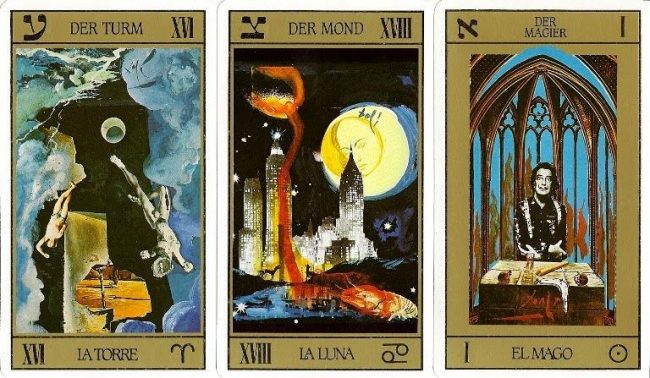
The Tarot has long been a tool of charlatans. But it has also long been embraced by brilliant, unconventional thinkers, many of whom themselves have a touch of the charlatan about them (and who would just as likely admit it with a smile). William Butler Yeats was a fan, as is visionary Chilean filmmaker, artist, writer, and psychonaut Alejandro Jodorowsky, who has recorded his own Youtube series explaining his take on this classic mode of divination. With its archetypal symbolism, the Tarot’s appeal to artists should be obvious. Most of them, like Jodorowsky, find far more interesting uses for it than fortune-telling. “You must not talk about the future,” Jodorowsky tells us in his series, “the future is a con. The tarot is a language that talks about the present.”
What might another visionary artist, Salvador Dalí, think of Jodorowsky’s Tarot interpretations? We’ll never know, but I suspect he would find them enchanting. Not only do the two seem like kindred spirits, but Dalí devoted some part of his life to the Tarot, designing his own deck in the 70s.
Initially, the project arrived as a commission from producer Albert Broccoli for the James Bond film Live and Let Die. “Likely inspired by his wife Gala, who nurtured his interest in mysticism,” writes Chicago’s Museum of Contemporary Art, “Dalí eagerly got to work, and continued the project of his own accord when the contractual deal fell through.”
It was just around this time that the Tarot saw a massive resurgence in popularity. The occult interests of the 60s counterculture were mainstreamed in the 70s thanks to books like Stuart Kaplan’s Tarot Cards for Fun and Fortune Telling. But while Dalí had channeled the vivid psychedelia of the age in an earlier illustration project, 1969’s Alice and Wonderland, his Tarot deck, writes Lisa Rainwater at Galo magazine, “actually shows reserve. Yes, reserve—as if his reverence for the tarot nearly humbles him.” His knack for “fanatical self-promotion” does get the better of him eventually: he chooses his own face to represent the Magician (above).
Overall, the deck combines the eclectic origins of occult practices with Dalí’s own unmistakable sensibility. Dalí’s Tarot is “a pastiche of old-world art, surrealism, kitsch, Christian iconography and Greek and Roman sculpture. Many of his recurring motifs such as the rose, the fly and the bull’s head are found throughout the deck.” First published in a limited edition in 1984—and reissued since in editions by TASCHEN and in book form by other publishers—the deck included an introductory booklet that reads, in Spanish, English, and French:
The Wizard (Arcanum I), Salvador Dalí, has transformed with his exceptional art and his marvelous talent the 78 golden plates of ‘The fabulous book of Thot’ into as many artistic marvels, each one of them duly signed by the hand of this unmatchable, internally famous painter … such an extraordinary artistic creation does not detract, in any way, from the Tarot’s close symbolism. On the contrary, it enhances with its captivating beauty, the Tarot’s esoteric and plastic meaning.
See a preview video of the full Dalí deck above, purchase a limited edition set here, or a much more affordable version here.
Note: An earlier version of this post appeared on our site in 2016.
Related Content:
Alejandro Jodorowsky Explains How Tarot Cards Can Give You Creative Inspiration
The Fascinating History of Tarot Card Decks: From the Renaissance to the Modern Day
Meet the Forgotten Female Artist Behind the World’s Most Popular Tarot Deck (1909)
Behold the Sola-Busca Tarot Deck, the Earliest Complete Set of Tarot Cards (1490)
Josh Jones is a writer and musician based in Durham, NC.
Read More...Watch the Moment When the Wreck of the Titanic Was First Discovered (1985)
The wreck of the RMS Titanic has never ceased to command attention, from pop-cultural fascination to scientific scrutiny and everything in between. That can make it seem, especially to the younger generations, as if humanity has been gazing upon its remains since they first settled at the bottom of the North Atlantic Ocean. In fact, the precise location of the shipwreck went unknown for more than 73 years, between the day of the disaster, April 15th, 1912, and that of the discovery, September 1, 1985. In the video above, you can watch the very moment debris from the Titanic first came into the view of Argo, the unmanned undersea camera used by the researchers seeking it out.
“Somebody should get Bob,” says one of the crew as soon as it becomes clear, even on their low-resolution black-and-white monitor, that they’re looking at man-made objects on the sea floor. And well they should have: the Bob in question is oceanographer and Argo inventor Robert Ballard, who’d been actively thinking about how to find the Titanic since at least the early nineteen-seventies and boarded Woods Hole Oceanographic Institute’s R/V Knorr with intent to find it.
In truth, the voyage was financed by the U.S. Navy, which had much less interest in finding the wreck of the Titanic than those of the USS Scorpion and Thresher, two nuclear submarines lost in the sixties. If Ballard could look for them, so the deal went, he could use the expedition’s spare time and resources on his life’s mission.
After determining that the Scorpion and Thresher had imploded, Ballard and the Knorr crew continued on to the general area in which the Titanic sank. Knowing that the infamously “unsinkable” ocean liner would have been subject to the same mighty undersea pressure, they kept their eyes open, through Argo, for similarly scattered fragments rather than intact sections of the hull. As the video shows us, the strategy worked: only when a trail of debris leads them to an identifiable boiler, proof positive that they’d found what they were looking for, does the cheer go up. Ballard would go on to discover other widely known shipwrecks — the battleship Bismarck, the aircraft carrier USS Yorktown in 1998 — but one suspects that nothing quite matches that first Titanic high.
Related content:
The Fascinating Engineering of the Titanic: How the Great Ocean Liner Was Built
Watch 80 Minutes of Never-Released Footage Showing the Wreckage of the Titanic (1986)
Titanic Survivor Interviews: What It Was Like to Flee the Sinking Luxury Liner
Watch the Titanic Sink in Real-Time
See the Well-Preserved Wreckage of Ernest Shackleton’s Ship Endurance Found in Antarctica
Based in Seoul, Colin Marshall writes and broadcasts on cities, language, and culture. He’s the author of the newsletter Books on Cities as well as the books 한국 요약 금지 (No Summarizing Korea) and Korean Newtro. Follow him on the social network formerly known as Twitter at @colinmarshall.
Read More...Nearly 50 Years Later, WKRP in Cincinnati Becomes a Real Radio Station
It took nearly 50 years. WKRP in Cincinnati is no longer just a TV sitcom. It’s now a real radio station in Cincinnati.
A Cincy-area FM station, known as “The Oasis,” has adopted the WKRP call letters after acquiring them from a nonprofit radio station in North Carolina. The Raleigh-based station put the call letters up for auction as part of a fundraising effort. And then The Oasis snapped them up.
To mark the official launch last week, the station played the TV show’s theme song for six straight hours. Moving forward, the station will continue playing classic rock from the ’60s through the ’80s — much like the music featured on the 1978–82 sitcom. As a bonus, Gary Sandy, who played program director Andy Travis, has recorded promos for the revived WKRP. If the original show was before your time, you can watch some episodes on YouTube. Enjoy…
If you would like to support the mission of Open Culture, consider making a donation to our site. It’s hard to rely 100% on ads, and your contributions will help us continue providing the best free cultural and educational materials to learners everywhere. You can contribute through PayPal, Patreon, and Venmo (@openculture). Thanks!
Related Content
All the Music Played on MTV’s 120 Minutes: A 2,500-Video Youtube Playlist
All of the Songs Played on “WKRP in Cincinnati” in One Playlist: Stream 202 Classic Tracks
MTV Rewind Lets You Revisit 40,000 Music Videos & Commercials from the Golden Age of MTV
Read More...
Support Us
We're hoping to rely on loyal readers, rather than erratic ads. Please click the Donate button and support Open Culture. You can use Paypal, Venmo, Patreon, even Crypto! We thank you!

About Us

Open Culture scours the web for the best educational media. We find the free courses and audio books you need, the language lessons & educational videos you want, and plenty of enlightenment in between.
Advertise With Us

FREE UPDATES!
GET OUR DAILY EMAIL
Get the best cultural and educational resources on the web curated for you in a daily email. We never spam. Unsubscribe at any time.
FOLLOW ON SOCIAL MEDIA

Open Culture editor Dan Colman scours the web for the best educational media. He finds the free courses and audio books you need, the language lessons & movies you want, and plenty of enlightenment in between.
Advertise With Us

