Christopher Nolan Picks 15 Favorite Films from the Criterion Closet
Maybe you’ve already seen Christopher Nolan’s new cinematic interpretation of the Odyssey more than once; maybe you don’t know whether you’ll ever get around to it at all. Either way, you’ve got to admit that the man makes films in a way very few living directors do. His combination of blockbuster-scale spectacle and personal vision, a rare experience indeed at the theater these days, can really only be achieved by filmmakers with a thoroughgoing love of the medium. Most of us will require no further proof of that love than this new video capturing his visit to the Criterion Closet, that both hallowed and much-YouTubed space jam-packed with releases from the most widely known home-video brand for cinephiles.
Unsurprisingly, it’s not his first visit. “Last time I was here, there were no cameras, and I got to just come and steal some films,” he says, “but now I’m singing for my supper.” Unlike some filmmakers, he doesn’t play it cool for the audience; rather, he immediately starts pulling down Don Siegel’s neo-noir Hemingway adaptation The Killers, a five-picture John Cassavetes box set, and Al Reinert’s Brian Eno-scored NASA documentary For All Mankind. It’s not a surprise to see him go for an Orson Welles movie, but the one that first catches his eye is Mr. Arkadin, which Welles “made all over the world in the scrappiest, most sort of homemade, put-his-friends-together, grab-some-costumes, find-an-interesting-location kind of way.”
Fritz Lang’s The Testament of Dr. Mabuse, he recalls, provided him and his brother-collaborator inspiration for the Joker as famously portrayed by Heath Ledger in The Dark Knight. The complete Apu trilogy by Satyajit Ray reminds him that, however great an impact the first of those films made on him, he never did watch the other two. For many moviegoers in the English-speaking world of the mid-twentieth century, Ray’s work was some of the first “world cinema” they’d ever seen; Nolan’s fellow cinephile-auteur Martin Scorsese has done his part to bolster that tradition with his World Cinema Project series, and Nolan pulls off the shelf one of its volumes featuring pictures from Cuba, Indonesia, Iran, and elsewhere.
Though technically British, Nolan is the partially Chicago-raised son of an American mother long since accepted as a kind of Hollywood native. His taste in movies, too, reflects a streak of high Americanism, which manifests in selections like Spike Lee’s Malcolm X, David Lynch’s Lost Highway, Carl Franklin’s One False Move, and Richard Linklater’s Boyhood. (As for Robert Altman’s satirical thriller The Player, it would be hard to imagine how he couldn’t appreciate its wickedly incisive depiction of “the Industry.”) Coming to the end of his Closet time, he also manages to grab Godfrey Reggio’s Qatsi trilogy, which constitutes “one of the great pieces of pure cinema,” and Carroll Ballard’s The Black Stallion, a childhood favorite that stayed with him. Like all the most successful filmmakers, Nolan understands that you’ve got to end strong, and in a way that doesn’t require explanation: hence, perhaps, his final choice of Citizen Kane.
Related content:
Francis Ford Coppola Picks His Favorite Criterion Movies & Gives Advice to Filmmakers
Jim Jarmusch Picks His Favorite Films from the The Criterion Collection
Based in Seoul, Colin Marshall writes and broadcasts on cities, language, and culture. He’s the author of the newsletter Books on Cities as well as the books 한국 요약 금지 (No Summarizing Korea) and Korean Newtro. Follow him on the social network formerly known as Twitter at @colinmarshall.
Read More...The Origins of the Monsters in Homer’s Odyssey: The Cyclops, Sirens, Scylla & More
Despite having been composed about two and a half millennia before the invention of cinema, Homer’s Odyssey has offered tempting material to generation after generation of filmmakers. Part of the appeal is, of course, the work’s age, which obviates the need for potentially frustrating rights negotiations. But what really captures a director’s imagination about retelling the story of Odysseus’ long journey back to Ithaca must have a great deal to do with the host of monsters he encounters along the way. The giant cannibal Laestrygonians; the sirens, whose call forces Odysseus to lash himself to the mast of his ship; Scylla and Charybdis, guardians of the Strait of Messina; and perhaps most memorably of all, the towering cyclops Polyphemus.
Many or most of these fearsome characters are familiar to us even if we’ve never read the Odyssey, or indeed seen any of its adaptations. In everyday speech, we invoke the sirens’ call when describing an irresistible temptation, or Scylla and Charybdis when describing any set of equal and opposite pitfalls. And it would be a rare man, woman, or even sufficiently educated child who can’t identify the defining feature of a cyclops.
But long before all of these could enter the modern lexicon, they had to be invented in antiquity. In the new Hochelaga video above, host Tommie Trelawny investigates their origins, going over theories that suggest that some or all of these monsters had already made fairly long cultural journeys of their own before Homer put them in Odysseus’ path.
The myth of the cyclops could have been inspired by elephant skulls with large central nasal cavities, or perhaps by a brutish inversion of eyes as a signal of intelligence. It could have been a series of colossal Bronze Age stone statues on the island of Sardinia that constituted the basis for the Laestrygonians. As for the sirens, which we imagine as beautiful women, the pre-Christian ancient Greeks envisioned them as strange winged creatures making promises of knowledge. Scylla and Charybdis, representations of the destructive forces of nature, were a way of reifying the Strait of Messina’s inherent perils. Whatever their origins, all these challengers to Odysseus’ homecoming still fire up the imaginations of filmmakers, especially filmmakers inclined to high-tech spectacle: Christopher Nolan, for instance, the theatrical release of whose Odyssey begins tomorrow. We all know that the hero gets home in the end, but we’ll buy tickets for the monsters.
Related content:
Watch the First Spectacular Film Adaptation of the Odyssey (1911)
Hear What Homer’s Odyssey Sounded Like When Sung in the Original Ancient Greek
Memento Mori: How Smiling Skeletons Have Reminded Us to Live Fully Since Ancient Times
Based in Seoul, Colin Marshall writes and broadcasts on cities, language, and culture. He’s the author of the newsletter Books on Cities as well as the books 한국 요약 금지 (No Summarizing Korea) and Korean Newtro. Follow him on the social network formerly known as Twitter at @colinmarshall.
Read More...A 3,000-Year-Old Painter’s Palette from Ancient Egypt, with Traces of the Original Colors Still In It

It’s a good bet that your first box of crayons or watercolors was a simple affair of six or so colors… just like the palette belonging to Amenemopet, vizier to Pharaoh Amenhotep III (c.1391 — c.1354 BC), a pleasure-loving patron of the arts whose rule coincided with a period of great prosperity.
Amenemopet’s well-used artist’s palette, above, resides in the Egyptian wing of New York City’s Metropolitan Museum of Art.
Over 3000 years old and carved from a single piece of ivory, the palette is marked “beloved of Re,” a royal reference to the sun god dear to both Amenhotep III and Akhenaton, his son and successor, whose worship of Re resembled monotheism.
As curator Catharine H. Roehrig notes in the Metropolitan’s publication, Life along the Nile: Three Egyptians of Ancient Thebes, the palette “contains the six basic colors of the Egyptian palette, plus two extras: reddish brown, a mixture of red ocher and carbon; and orange, a mixture of orpiment (yellow) and red ocher. The painter could also vary his colors by applying a thicker or thinner layer of paint or by adding white or black to achieve a lighter or darker shade.”
(Careful when mixing that orpiment into your red ocher, kids. It’s a form of arsenic.)
Other minerals that would have been ground and combined with a natural binding agent include gypsum, carbon, iron oxides, blue and green azurite and malachite.

The colors themselves would have had strong symbolism for Amenhotep and his people, and the artist would have made very deliberate—regulated, even—choices as to which pigment to load onto his palm fiber brush when decorating tombs, temples, public buildings, and pottery.
As Jenny Hill writes in Ancient Egypt Online, iwn—color—can also be translated as “disposition,” “character,” “complexion,” or “nature.” She delves into the specifics of each of the six basic colors:
Wadj (green) also means “to flourish” or “to be healthy.” The hieroglyph represented the papyrus plant as well as the green stone malachite (wadj). The color green represented vegetation, new life and fertility. In an interesting parallel with modern terminology, actions which preserved the fertility of the land or promoted life were described as “green.”
Dshr (red) was a powerful color because of its association with blood, in particular the protective power of the blood of Isis…red could also represent anger, chaos and fire and was closely associated with Set, the unpredictable god of storms. Set had red hair, and people with red hair were thought to be connected to him. As a result, the Egyptians described a person in a fit of rage as having a “red heart” or as being “red upon” the thing that made them angry. A person was described as having “red eyes” if they were angry or violent. “To redden” was to die and “making red” was a euphemism for killing.
Irtyu (blue) was the color of the heavens and hence represented the universe. Many temples, sarcophagi and burial vaults have a deep blue roof speckled with tiny yellow stars. Blue is also the color of the Nile and the primeval waters of chaos (known as Nun).
Khenet (yellow) represented that which was eternal and indestructible, and was closely associated with gold (nebu or nebw) and the sun. Gold was thought to be the substance which formed the skin of the gods.
Hdj (white) represented purity and omnipotence. Many sacred animals (hippo, oxen and cows) were white. White clothing was worn during religious rituals and to “wear white sandals” was to be a priest…White was also seen as the opposite of red, because of the latter’s association with rage and chaos, and so the two were often paired to represent completeness.
Kem (black) represented death and the afterlife to the ancient Egyptians. Osiris was given the epithet “the black one” because he was the king of the netherworld, and both he and Anubis (the god of embalming) were portrayed with black faces. The Egyptians also associated black with fertility and resurrection because much of their agriculture was dependent on the rich dark silt deposited on the river banks by the Nile during the inundation. When used to represent resurrection, black and green were interchangeable.

If you would like to support the mission of Open Culture, consider making a donation to our site. It’s hard to rely 100% on ads, and your contributions will help us continue providing the best free cultural and educational materials to learners everywhere. You can contribute through PayPal, Patreon, and Venmo (@openculture). Thanks!
Note: An earlier version of this post appeared on our site in 2021.
Related Content:
Wonders of Ancient Egypt: A Free Online Course from the University of Pennsylvania
Pyramids of Giza: Ancient Egyptian Art and Archaeology–a Free Online Course from Harvard
Take a 3D Tour Through Ancient Giza, Including the Great Pyramids, the Sphinx & More
What Ancient Egyptian Sounded Like & How We Know It
Ayun Halliday is an author, illustrator, theater maker in NYC.
Read More...The Declaration of Independence Performed by Morgan Freeman, Benicio del Toro, Winona Ryder & Other Actors
Some successful Hollywood producers spend their money on yachts, sports teams, and European castles. Norman Lear’s biggest purchase, or at least his most famous one, was a copy of the Declaration of Independence. He did not, of course, buy the kind of reproduction any tourist can pick up at the gift shop of a major American historic site, but a “Dunlap broadside,” one of 200 or so run off by Philadelphia printer John Dunlap on the very night of July 4th, 1776. After handing over $8.1 million in exchange for the document in 2001, Lear put it on tour, and it thereafter made years of public appearances all around the country, including at the 2002 Olympics, Super Bowl XXXVI, and the Live 8 concert in the city where it was made.
Lear’s purchase also inspired a film, as it might well do for any man with his connections. Co-produced by Lear and the late Rob Reiner, another Hollywood enthusiast of American politics, the 2001 short at the top of the post captures a dramatic reading of the Declaration of Independence by a lineup of big stars of the day, including the likes of Michael Douglas, Winona Ryder, Edward Norton, Renée Zellweger, and Benicio del Toro.
Their performances were all shot together at Independence Hall in Philadelphia by Conrad Hall, the famed cinematographer of Cool Hand Luke, Butch Cassidy and the Sundance Kid, Marathon Man, and American Beauty, on July 4, 2001.
These 25 years later, the film remains an invigorating refresher on what the Declaration of Independence actually says. Don’t think of it as the next best thing to reading that hallowed document: as Morgan Freeman tells us in his introduction, Thomas Jefferson “intended for the declaration to be performed, and not just read. Its words and rhythms were written to be spoken, in proud and defiant tones in grand public places.” His fellow thespians deliver them with the aplomb of a country that understood itself as supreme in the world, though one does now feel a certain irony in their speaking in the mid-summer of 2001, just months before that confidence would be terribly shaken. American history, it turned out, had not yet ended; even now, on the 250th anniversary of the United States’ independence, it may have just barely begun.
Related content:
Bertrand Russell’s 10 Commandments for Living in a Healthy Democracy
John Wayne Recites the Pledge of Allegiance
Based in Seoul, Colin Marshall writes and broadcasts on cities, language, and culture. He’s the author of the newsletter Books on Cities as well as the books 한국 요약 금지 (No Summarizing Korea) and Korean Newtro. Follow him on the social network formerly known as Twitter at @colinmarshall.
Read More...The Great Moon Hoax of 1835: Where “Fake News” Began
Thinking back to the many childhood grocery-store trips made with their parents, Americans of a certain age will remember nothing so vividly as the Weekly World News. It always stood out on the checkout stand’s impulse-buy rack, in part because of its adherence to stark yet jumbled black-and-white cover designs even as all the other magazines grew slicker and simpler. But what really caught our young and impressionable eyes had even more to do with the contrast between the surrounding publications’ mundane coverage of home, family, and celebrity and the WWN’s unfailingly, screamingly outlandish headlines: “I WAS BIGFOOT’S LOVE SLAVE!” “WILD WEST TOWN ON VENUS!” “BAT BOY LEADS COPS ON 3 STATE CHASE!”
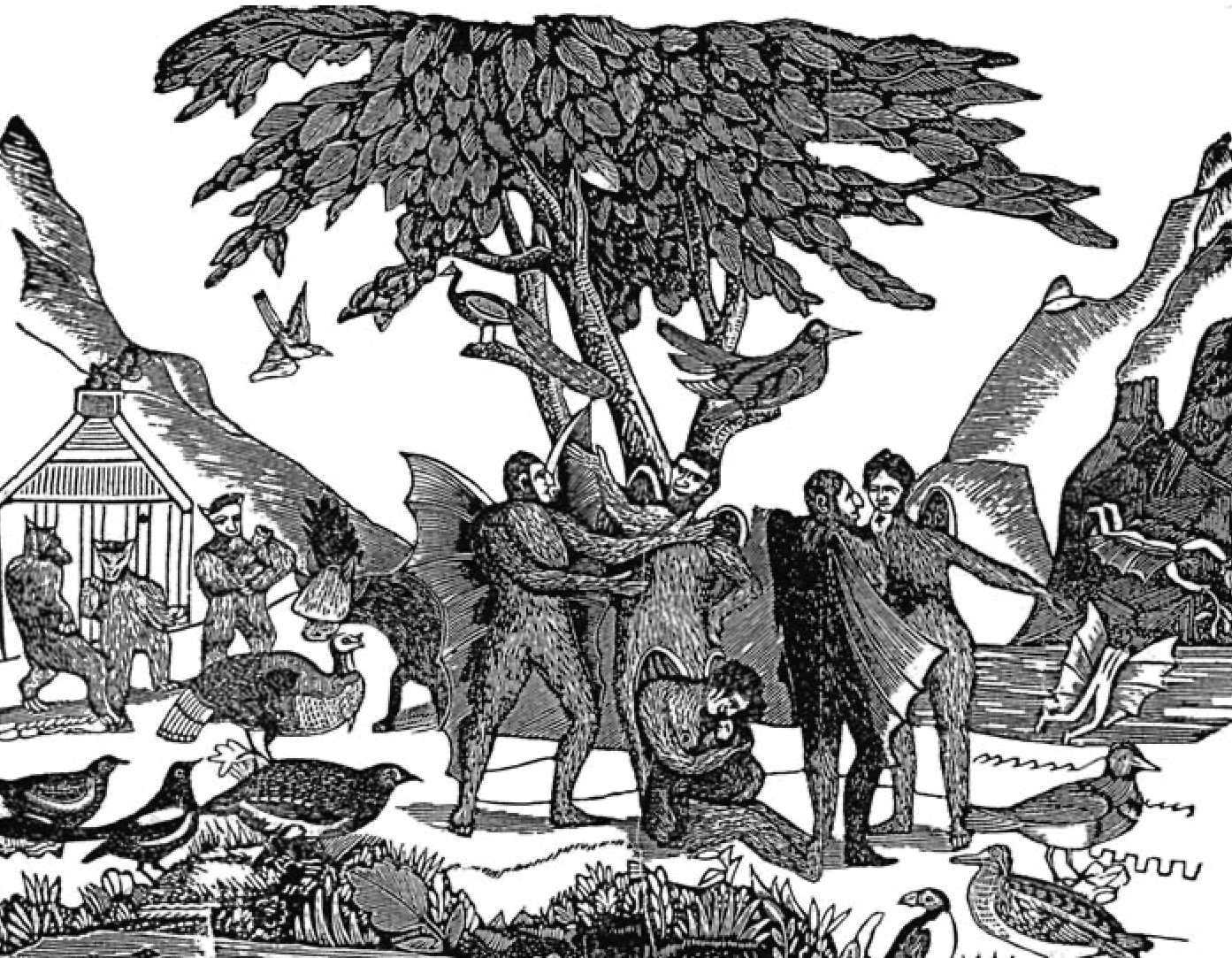
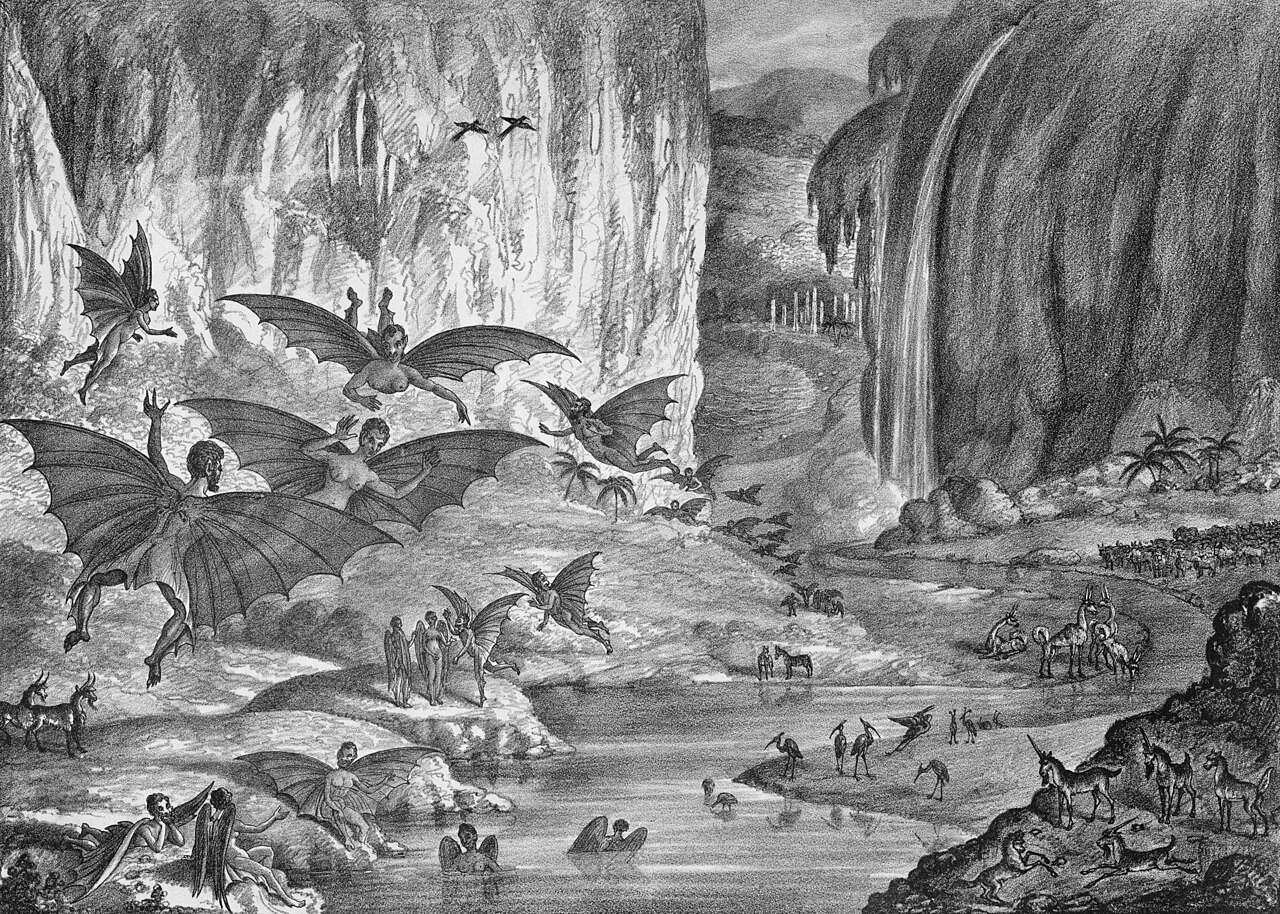
For many of us, the temptation to buy (or at least flip through) an issue of the WWN lay in keeping up with the exploits of Bat Boy, the most prominent of many fictional characters to which its extravagantly lurid yet oddly sober stories returned again and again. Though introduced only in 1992, he has notable ancestors in his industry: take the “Vespertilio-homo,” or “man-bat,” a race found to have made its home on the moon in 1835.
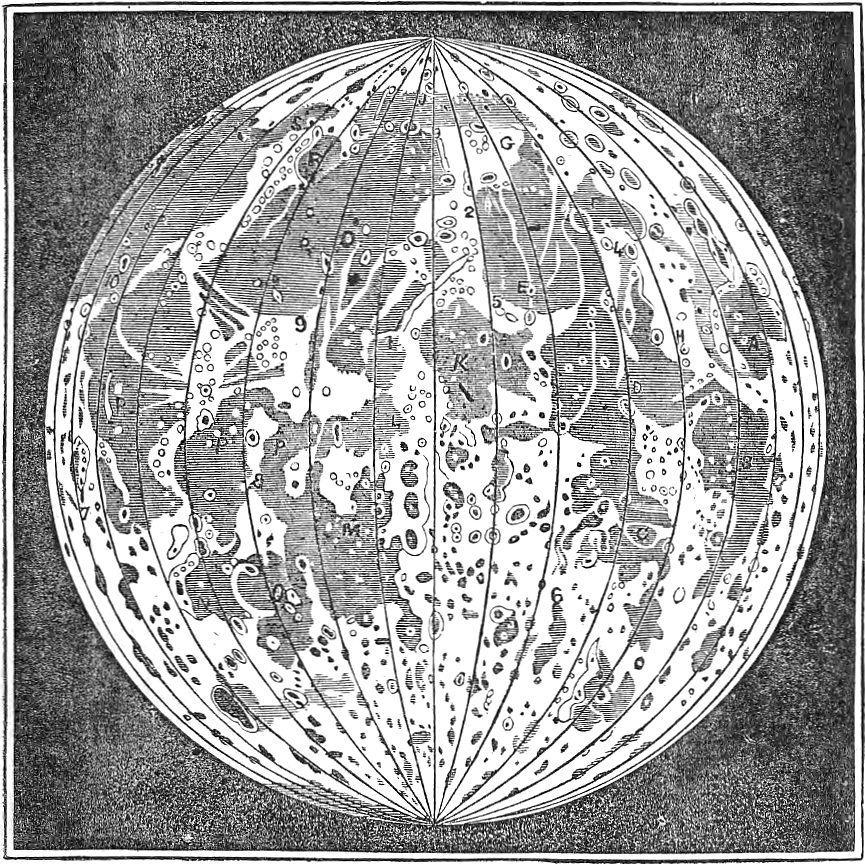
Or at least that’s what the readers of New York newspaper the Sun were told in a series of illustrated articles, later collected in book form, that credited the discovery to the astronomer Sir John Herschel. Herschel was real, but as the Sun admitted the following month, the Vespertilio-homo wasn’t — nor were the unicorn-goats, miniature zebras, and beavers walking on their hind legs reportedly also seen through his telescope.
The “Great Moon Hoax,” as it’s now known, and about which you can learn more from the BBC video at the top of the post, wasn’t Herschel’s doing. A reporter called Richard Adams Locke admitted to the fabrication, seemingly motivated by a desire to boost the circulation of the Sun, one of the many “penny paper” tabloids of the day that lived and died by sensation and scandal, and also to make light of the extravagant astronomical claims then in the air. Much like the writers of the Weekly World News — or later, the Onion — Locke wanted less to fool readers than to entertain them by satirizing an over-credulous popular culture. Yet what he pioneered was, quite literally, “fake news,” though that label by now refers to media created with clear intent to deceive. The world has changed since the eighteen-thirties, and indeed, even since Bat Boy’s late twentieth-century heyday, when the WWN predicted his election as President of the United States in 2028. Stranger things have certainly happened.
via Boing Boing
Related content:
“Moon Hoax Not”: Short Film Explains Why It Was Impossible to Fake the Moon Landing
The 1957 “Spaghetti-Grows-on-Trees” Hoax: One of TV’s First April Fools’ Day Pranks
The Birth of the Moon: How Did It Get There in the First Place?
Based in Seoul, Colin Marshall writes and broadcasts on cities, language, and culture. He’s the author of the newsletter Books on Cities as well as the books 한국 요약 금지 (No Summarizing Korea) and Korean Newtro. Follow him on the social network formerly known as Twitter at @colinmarshall.
Read More...How to Cook Like Frida Kahlo & Georgia O’Keeffe
It’s a myth that starving artists don’t eat.
They do, just not often or well. Their meals rarely rate recipes, let alone cookbooks.
Those cookbooks do exist though.…
The mostly conceptual Starving Artist Cookbook put together by EIDIA (aka artists Paul Lamarre and Melissa Wolf) comes close to the spirit of sustaining life through meager ingredients… like spaghetti or 4 pages of shredded Pravda.
Not so this other title, which approaches cute overload with an abundance of Instagram-worthy illustrated fare—mojitos, an unstructured berry tart, a “manly” burger.…
Do “starving” artists no longer fear being outed as posers?
Successful artists may not worry about that, as they eat whatever and however they want.
Andy Warhol had the taste of an eccentric child.
Marina Abramović takes the ascetic route.
Many have gladly traded the candle in the Chianti bottle for the most rarefied restaurants in town.
Georgia O’Keeffe and Frida Kahlo, PBS Digital Studios’ series the Art Assignment informed us, took cooking—and eating—seriously.
So seriously, their culinary efforts led to cookbooks, which the Art Assignment’s host, curator Sarah Urist Green, tried out on camera.
O’Keeffe, who grew up in Wisconsin on homemade yogurt, homemade cheese, and plentiful homegrown produce, ground her own flour in order to bake daily loaves of whole wheat bread.
Green treats viewers to a brief overview of O’Keeffe’s life and work as she struggles with the grinder. (You might get the same, or better, results if you take a $5 bill to a good bakery right at opening.)
She also tackles the wheat germ Tiger’s Milk smoothie advocated by Adelle Davis, a nutritionist whom O’Keeffe admired, and Green Chiles with Garlic and Oil and Fried Eggs, using recipes from the cookbooks A Painter’s Kitchen and Dinner with Georgia O’Keeffe.
Before attempting the same, you might want to watch the Kahlo-centric episode, above, in which Green discovers a much better method for roasting the poblano peppers she haplessly substituted for New Mexico chiles in O’Keeffe’s egg dish.
Here, they’re used for Chiles Rellenos, a dish whose pronunciation the self-effacing Green butchers, along with a multitude of other Spanish phrases, a fact not lost on the video’s Youtube commenters. They also take issue with the presence of plantains, her preparation of the Nopales Salad, and her cooking skills in general. No wonder Green—a self-proclaimed wussy where serranos are concerned—seems so eager to reach for a shot of tequila as dinner is finally served.
Green chose the dishes for this episode from Frida’s Fiestas: Recipes and Reminiscences of Life with Frida Kahlo by Marie-Pierre Colle and Kahlo’s stepdaughter, Guadalupe Rivera.
Kahlo herself learned to cook from her mother’s copy of El Nuevo Cocinero Mejicano, and from husband Diego Rivera’s first wife, Guadalupe (leading one to wonder if some of that cookbook’s recipes aren’t misattributed to the more famous cook).
As with the O’Keeffe video and the cookbooks cited herein, there’s a wealth of vintage photos and reproduced artwork on display.
Even though Green alludes to Kahlo’s dark side, sensitive stomachs might have trouble with the inclusion of the graphically violent Unos Quantos Piquetitos. Another painting, My Nurse and I is at least related to eating, if not cooking and recipes.
Those with stomachs of steel on the other hand can continue on to another Art Assignment—the supremely gross Meat Sculpture from the Futurist Cookbook.
Note: An earlier version of this post appeared on our site in 2017.
Related Content:
The Futurist Cookbook (1930) Tried to Turn Italian Cuisine into Modern Art
Salvador Dalí’s 1973 Cookbook Gets Reissued: Surrealist Art Meets Haute Cuisine
Andy Warhol’s Vibrant, Impractical, Illustrated Cookbook from 1959: A Feast for the Eyes
Ayun Halliday is an author, illustrator, theater maker in NYC.
Read More...This Man Has Been Drawing a Map of an Imaginary Land Since 1963
At one time or another, we all feel twinges of anxiety about what will constitute the legacy we leave behind. Jerry Gretzinger may well be subject to just the same discomfort, but at least he can point to the Map: an enormous representation, made of thousands and thousands of individually created and continually modified panels, of an entirely fictional land called Ukrania. You can see Jerry’s Map painstakingly laid out in its most up-to-date state in the new People Make Games video above. As interesting as the product is so far, the work that goes into it is just as compelling, which Gretzinger performs every day according to a complex and strictly defined set of procedures dictated by a deck of heavily modified playing cards.
It would take an astute listener to grasp the rules of the project the first time through, but they’re also available for supplementary study at the official site of Gretzinger’s map. They may bring to mind Brian Eno’s Oblique Strategies, the deck of cards printed with suggestions meant to dislodge creative jams in the music studio or elsewhere.
The map itself may look more reminiscent of the work of Henry Darger, another “outsider artist” who produced riots of color and haphazard-looking materials with an obsessive underlying order of their own. But unlike Darger, who died in obscurity only for his askew epics to be discovered among his belongings, Gretzinger has become famous for his creation in his lifetime, so much so that there exists an active subreddit of amateurs following his example.
Still, the Map did first have to be rediscovered. What Gretzinger began as the expansion of idle doodles in urban form made during breaks at the ball bearing factory in 1963 had to be shelved in the eighties, when a clothing business he’d started with his wife took off. A couple of decades thereafter, his son’s discovery of the Map in the attic inspired Gretzinger to resume work on it, which has continued apace ever since. When interviewed, he sounds less like a creator than an observer, helplessly watching as the city of Ukrania becomes more abstract as it grows — and as great swathes are inexorably consumed by a white space, made of scraps of his own correspondence and other life artifacts, that he portentously calls “the Void.” Now that he’s in his mid-eighties, Gretzinger appears to find it all more freighted with meaning than ever. Sooner or later, alas the Void comes for us all; what’s left to us is how we prepare for it.
via Metafilter
Related content:
Japanese Designer Creates Incredibly Detailed & Realistic Maps of a City That Doesn’t Exist
William Faulkner Draws Maps of Yoknapatawpha County, the Fictional Home of His Great Novels
Map of Middle-Earth Annotated by Tolkien Found in a Copy of Lord of the Rings
The Medieval City Plan Generator: A Fun Way to Create Your Own Imaginary Medieval Cities
Based in Seoul, Colin Marshall writes and broadcasts on cities, language, and culture. He’s the author of the newsletter Books on Cities as well as the books 한국 요약 금지 (No Summarizing Korea) and Korean Newtro. Follow him on the social network formerly known as Twitter at @colinmarshall.
Read More...How Can I Know Right From Wrong? Watch Philosophy Animations on Ethics Narrated by Harry Shearer
The history of moral philosophy in the West hinges principally on a handful of questions: Is there a God of some sort? An afterlife? Free will? And, perhaps most pressingly for humanists, what exactly is the nature of our obligations to others? The latter question has long occupied philosophers like Immanuel Kant, whose extreme formulation—the “categorical imperative”—flatly rules out making ethical decisions dependent upon particular situations. Kant’s famous example, one that generally gets repeated with a nod to Godwin, involves an axe murderer showing up at your door and asking for the whereabouts of a visiting friend. In Kant’s estimation, telling a lie in this case justifies telling a lie at any time, for any reason. Therefore, it is unethical.
In the video at the top of the post, Harry Shearer narrates a script about Kant’s maxim written by philosopher Nigel Warburton, with whimsical illustrations provided by Cognitive. Part of the BBC and Open University’s “A History of Ideas” series, the video—one of four dealing with moral philosophy—also explains how Kant’s approach to ethics differs from those of utilitarianism.
In the video above, Shearer describes the most utilitarian of thought experiments, the “Trolley Problem.” As described by philosopher Philippa Foot, this scenario imagines having to sacrifice the life of one for those of many. But there is a twist—the second version involves the added crime of physically murdering one person, up close and personal, to save several. An analogous but converse theory is that of philosopher Peter Singer (below) who proposes that our obligations to people in peril right in front of us equal our obligations to those on the other side of the world.
Finally, the last video surveys one of the thorniest issues in moral philosophical history—the “is/ought” divide, as problematic as the ancient Euthyphro dilemma. How, asked David Hume, are we to deduce moral principles from facts about the world that have no moral dimension? Particularly when those facts are never conclusive, are subject to revision, and when new ones get uncovered all the time? The question introduces a seemingly unbridgeable chasm between facts and values. Moral judgments founded on what is or isn’t “natural” flounder before our terror of much of what nature does, and the very partial and fallible nature of our knowledge of it.
The problem is as startling as Hume’s critique of causality, and in part caused Kant to remark that Hume had awakened him from a “dogmatic slumber.” What may strike viewers of the series is just how abstract these questions and examples are—how divorced from the messiness of real world politics, with the exception, perhaps, of Peter Singer. It may be instructive that political philosophy forms a separate branch in the West. While these problems are certainly difficult enough to trouble the sleep of just about any thoughtful person, in our day-to-day lives, our decision making process seems to be much messier, and much more situational, than we’re probably ever aware of.
Note: An earlier version of this post appeared on our site in 2015.
Related Content:
Free Online Philosophy Courses
What Makes Us Human?: Chomsky, Locke & Marx Introduced by New Animated Videos from the BBC
Josh Jones is a writer and musician based in Durham, NC.
Read More...The Map of Physics: Animation Shows How All the Different Fields in Physics Fit Together
From Newton’s mechanical calculations to Einstein’s general and special relativity to the baffling indeterminacy of quantum mechanics, the discipline of physics has become increasingly arcane and complex, and less and less governed by orderly laws. This presents a problem for the layperson, who struggles to understand how Newtonian physics, with its predictable observations of physical forces, relates to the parallax and paradox of later discoveries. “If you don’t already know physics,” says physicist Dominic Walliman in the video above, it’s difficult sometimes to see how all of these different subjects are related to each other.” So Walliman has provided a helpful visual aid: an animated video map showing the connections between classical physics, quantum physics, and relativity.
Newton’s laws of motion and gravitation and his invention of calculus best represent the first domain. Here we see the inseparable relationship between physics and math, “the bedrock that the world of physics is built from.” When we come to one of Newton’s less well-known pursuits, optics, we see how his interest in light waves anticipated James Clerk Maxwell’s work on electromagnetic fields. After this initial connection, the proliferation of subdisciplines intensifies: fluid mechanics, chaos theory, thermodynamics… the guiding force of them all is the study of energy in various states. The heuristics of classical physics prevailed, and worked perfectly well, until about 1900, when the clockwork universe of Newtonian mechanics exploded with new problems, both at very large and very small levels of description.
It is here that physics branches into relativity and quantum mechanics, which Walliman explains in brief. While we are likely familiar with the very basics of Einstein’s relativity, quantum physics tends to get a little less coverage in the typical course of a general education, due to its complexity, perhaps, as well as the fact that at their edges, quantum explanations fail. While quantum field theory, says Walliman, is “the best description of the universe we have,” once we come to quantum gravitation, we reach “the giant Chasm of Ignorance” that speculative and controversial ideas like string theory and loop quantum gravity attempt to bridge.
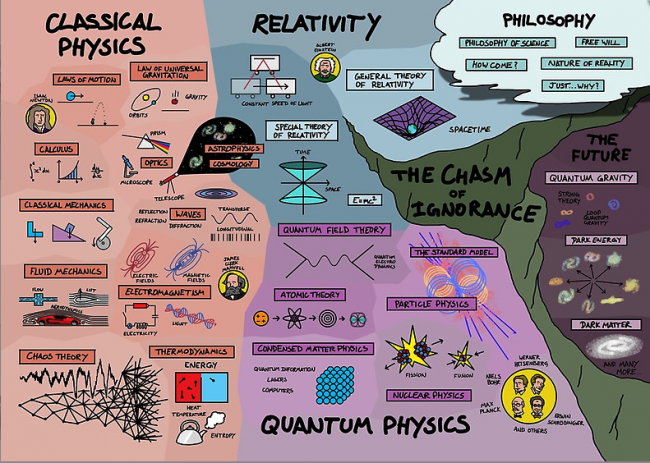
At the “Chasm of Ignorance,” our journey through the domains of physics ends, and we end up back in the airy realm where it all began, philosophy. Those of us with a typical general education in the sciences may find that we have a much better understanding of the field’s intellectual geography. As a handy reminder, you might even wish to purchase a poster copy of Walliman’s Map of Physics, which you can see en miniature above. (It’s also available as a digital download here.) Just below, the charming, laid-back physicist takes the stage in a TEDx talk to demonstrate effective science communication, explaining “quantum physics for 7 year olds,” or, as it were, 37, 57, or 77-year olds.
Note: An earlier version of this post appeared on our site in 2016.
Related Content:
The Story of Physics Animated in 4 Minutes: From Galileo and Newton, to Einstein
The Big Ideas of Stephen Hawking Explained with Simple Animation
An Animated Introduction to the Life & Work of Marie Curie, the First Female Nobel Laureate
Josh Jones is a writer and musician based in Durham, NC.
Read More...Time Travel Back to 1926 and Watch Wassily Kandinsky Make Art in Some Rare Vintage Video
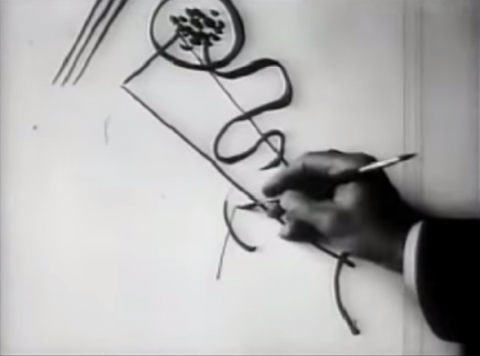
Have you ever wondered what it would be like to travel back in time and look over the shoulder of one of the early 20th century’s greatest artists to watch him work? In this brief film from 1926, we get to see the Russian painter Wassily Kandinsky as he turns a blank canvas into one of his distinctive abstract compositions.
The film was made at the Galerie Neumann-Nierendorf in Berlin by Hans Cürlis, a pioneer in the making of art documentaries. At the time, Kandinsky was teaching at the Bauhaus. It was the same year he published his second major treatise, On Point and Line to Plane. The contrasting straight lines and curves that Kandinsky paints in the movie are typical of this period, when his approach was becoming less intuitive and more consciously geometric.
Kandinsky believed that an artist could reach deeper truths by dispensing with the depiction of external objects and by looking within, and despite his analytic turn at the Bauhaus he continued to speak of art in deeply mystical terms. In On Point and Line to Plane, Kandinsky writes:
The work of Art mirrors itself upon the surface of our consciousness. However, its image extends beyond, to vanish from the surface without a trace when the sensation has subsided. A certain transparent, but defininite glass-like partition, abolishing direct contact from within, seems to exist here as well. Here, too, exists the possibility of entering art’s message, to participate actively, and to experience its pulsating life with all one’s senses.
Note: An earlier version of this post appeared on our site in 2012.
Related content:
Watch Footage of Claude Monet Painting in His Famous Garden at Giverny (1915)
Vintage Film: Watch Henri Matisse Sketch and Make His Famous Cut-Outs (1946)
Read More...Support Us
We're hoping to rely on loyal readers, rather than erratic ads. Please click the Donate button and support Open Culture. You can use Paypal, Venmo, Patreon, even Crypto! We thank you!

About Us

Open Culture scours the web for the best educational media. We find the free courses and audio books you need, the language lessons & educational videos you want, and plenty of enlightenment in between.
Advertise With Us

FREE UPDATES!
GET OUR DAILY EMAIL
Get the best cultural and educational resources on the web curated for you in a daily email. We never spam. Unsubscribe at any time.
FOLLOW ON SOCIAL MEDIA

Open Culture editor Dan Colman scours the web for the best educational media. He finds the free courses and audio books you need, the language lessons & movies you want, and plenty of enlightenment in between.
Advertise With Us

