Wes Anderson Picks Nine of His Favorite Criterion Films
Many an internet cinephile has wondered aloud if the Criterion Closet is a real place, or just a set thrown together to make videos when famous directors like Christopher Nolan, Francis Ford Coppola, or Jim Jarmusch drop by. It turns out indeed to exist, not only at Criterion’s offices in New York, but also elsewhere. The Criterion Mobile Closet, for example, has taken the label’s home-video library on the road since 2024, the 40th anniversary of the company’s foundation. If it comes to your town, queue up in as timely a fashion as possible, and you may get the chance to enter and remain inside for three minutes. That may sound brief, but no less an auteur than Wes Anderson takes almost a minute less to make his cinematic selections in the new video above.
The occasion was the Criterion Mobile Closet’s stop at the Hollywood Bowl, which coincided with the three-night concert event Music from the Films of Wes Anderson this past June. With a few days’ travel ahead of him, he picks out nine Criterion releases as viewing material to take along on “our road trip across America.”
With an eye toward pleasing the entire family, he goes mostly for “reliable, standby” classics, beginning with Alfred Hitchcock’s The 39 Steps and continuing on to Michael Powell and Emeric Pressburger’s The Red Shoes (“my daughter loves this movie”), and two from Ernst Lubitsch, Heaven Can Wait and Design for Living — a picture that must appeal to Anderson on several levels, not least in that it deals with Americans in Paris, a set of which he’s long been a member.
Other of Anderson’s more canonical picks include Preston Sturges’ The Lady Eve with Barbara Stanwyck, “one of the greatest actresses in the history of cinema, as everybody knows”; Stagecoach, which requires by way of introduction only the name of John Ford; and, from Satyajit Ray, not the celebrated Apu trilogy (which Nolan took home) but Charulata, the inspiration for the binocular shots in his own Moonrise Kingdom. He also pulls from the shelf Sydney Pollack’s Tootsie (“remember, Bill Murray is in there”), a somewhat more recent selection. What stands out even more is the practically brand new Flow, Latvian animator Gints Zilbalodis’ dialogue-free adventure movie with only animal characters. It may have yet to pass the test of time, but if the man who directed Isle of Dogs likes it — to say nothing of Criterion’s imprimatur — it’s surely worth a watch.
Related content:
Wes Anderson Names 12 of His Favorite Art Films
Jim Jarmusch Picks His Favorite Films from the The Criterion Collection
Based in Seoul, Colin Marshall writes and broadcasts on cities, language, and culture. He’s the author of the newsletter Books on Cities as well as the books 한국 요약 금지 (No Summarizing Korea) and Korean Newtro. Follow him on the social network formerly known as Twitter at @colinmarshall.
Read More...Discover J.R.R. Tolkien’s Personal Book Cover Designs for The Lord of the Rings Trilogy
In some rare cases, adaptations and interpretations of a literary work can surpass the source. Despite hundreds of valiant efforts on the part of fans, filmmakers, game/toy designers, and radio producers, this has never been true of the fully-realized fantasy world in J.R.R. Tolkien’s The Hobbit and The Lord of the Rings trilogy (not that it’s ever been anyone’s intent). As we noted in a previous post, Tolkien’s fictional world is so intricate, its sources so vast and varied, that Corey Olsen, “The Tolkien Professor,” has made it his entire life’s work to open that world up to students and curious readers, such as with his eight-part lecture series on The Hobbit.
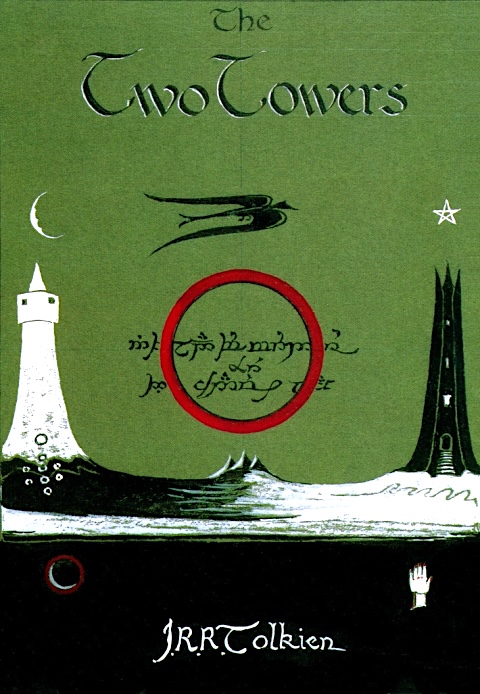
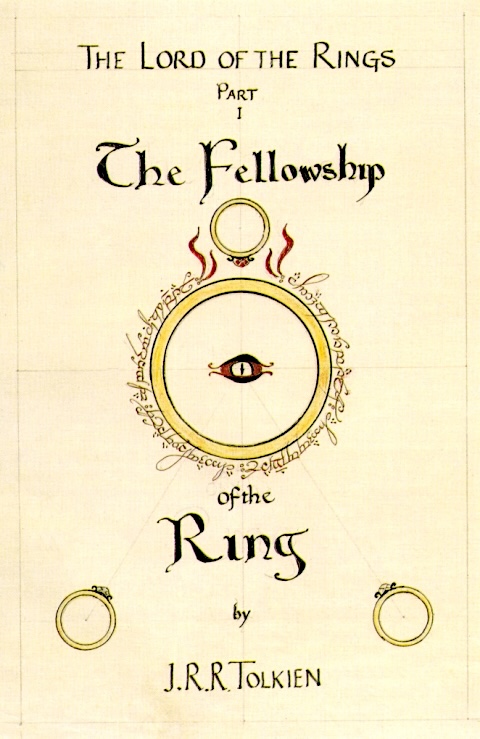
One might also add illustrators to the list of Tolkien interpreters above who have—in the almost ninety years since The Hobbit’s publication and more than seventy years since the first appearance of The Lord of the Rings trilogy—done their best to visualize Tolkien’s world. But perhaps no one did so better than the master himself. Long known as a visual artist as well as a literary one, Tolkien left behind over 100 illustrations for The Hobbit, one of which adorns 2011’s HarperCollins 75th anniversary edition of the book. He also created these original cover designs for each book in The Lord of the Rings trilogy.
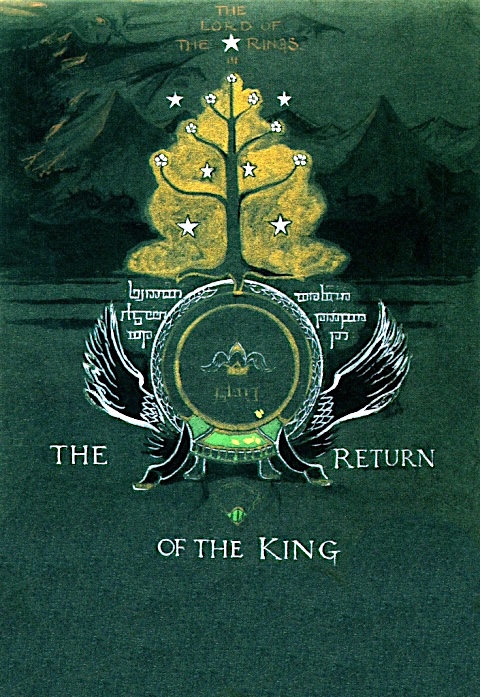
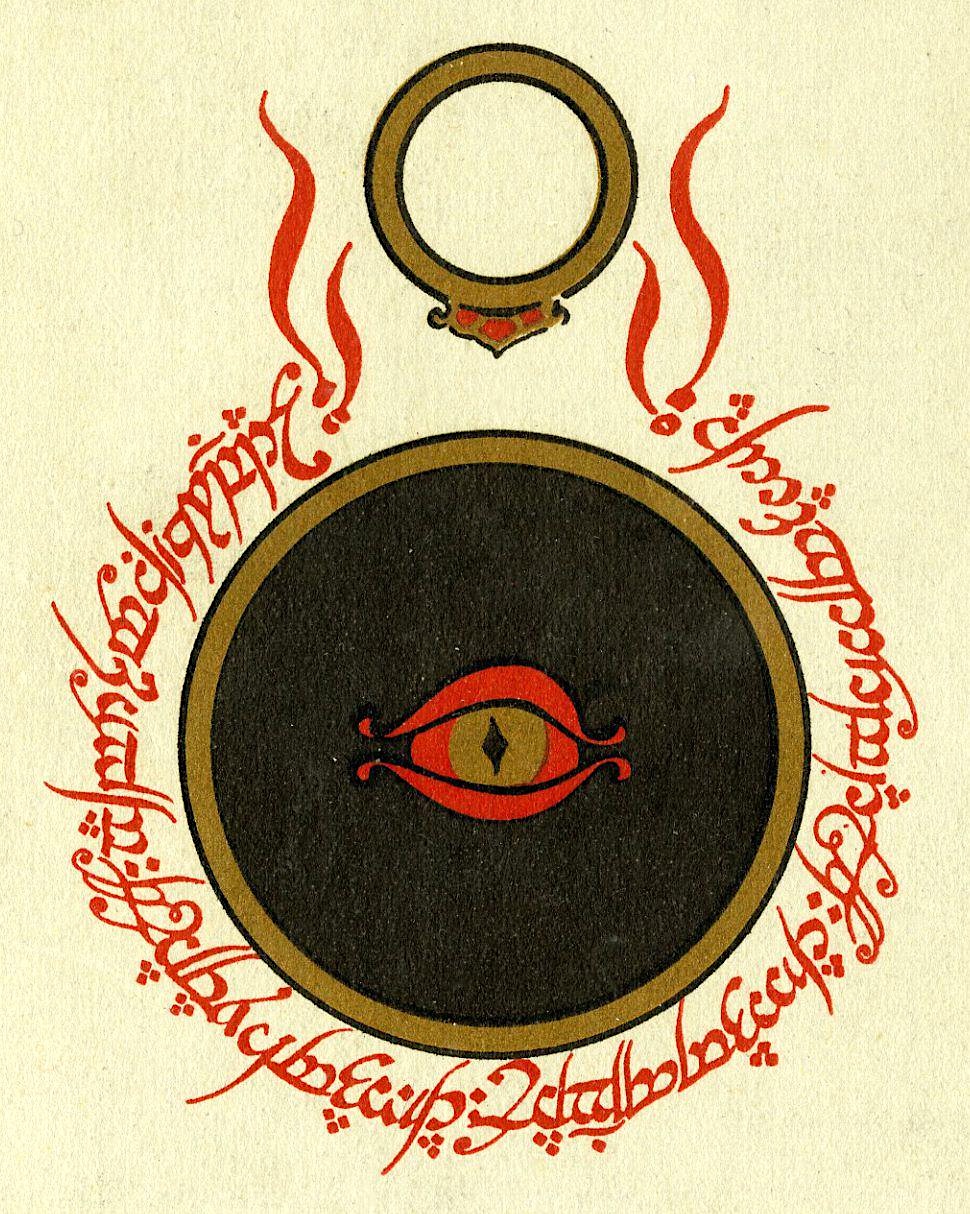
In the long and complex publication history of Tolkien’s most famous of works, it’s unclear if these designs ever made it onto books published during his lifetime, but the sigil in the center of The Fellowship of the Ring design (above), with its ominous eye of Sauron surrounded by elvish runes and topped by the one ring, did grace the elegant, minimalist covers of the first edition of the trilogy. Tolkien’s artwork received a thorough treatment in a 1995 monograph J.R.R. Tolkien Artist & Illustrator, which covers over 60 years of Tolkien’s life as an artist, and the magic of flickr brings us this compendium of Tolkien illustrations.
Note: An earlier version of this post appeared on our site in 2013.
Related Content:
The Art of the Book Cover Explained at TED
Vladimir Nabokov Marvels Over Different “Lolita” Book Covers
Jack Kerouac’s Hand-Drawn Cover for On the Road
Josh Jones is a writer and musician based in Durham, NC.
Read More...The Wisdom of David Bowie: On Art, Religion, Technology and More
It doesn’t quite ring true to call David Bowie a rock star. Ziggy Stardust, the neon synthetic-clad alien alter ego he both created and retired in the early seventies, was, of course, rock stardom outlandishly personified. But then, that was the concept of what turned out to be just one of many personae he deliberately crafted throughout the course of his career. That career was in music, primarily, but looking back on it today, more than a decade after Bowie’s death, it looks more like his medium was culture itself. That’s underscored by his interviews, clips from a variety of which appear in the new video above from YouTube channel T&H Inspiration.
Most of T&H’s most popular videos add visuals to speeches by the popularizer of Eastern philosophy Alan Watts, who’s been featured here on Open Culture before. He and Bowie had more in common than it may seem at first, beginning with an Englishness that remained thoroughgoing no matter how far out they ventured into the world.
Though Watts’ interest in Buddhism hardly needs stating, it’s worth remembering that he chose to be ordained as an Episcopalian priest rather than as a Buddhist monk. The young Bowie, for his part, very nearly took the latter path, studying under the late Lama Chime Rinpoche, who eventually told him he’d be better off going into the music business.
Bowie did so, of course, but with a new “sense of transience and change, which actually became fundamental to my life and my approach to it,” as he put it decades later. That sense manifests even in his early work, but embracing and even pursuing impermanence — the impermanence of sounds, of fashions, of hit records, of life itself — also kept him from getting mired in the irrelevance or auto-kitsch that threatens every superstar. Given the belief that nothing lasts forever, “looking for the source of one’s own being becomes much more important,” as does attempting artistic or intellectual challenges at the very edge of one’s abilities. Alan Watts would probably have agreed. The bigger question is, did he ever hear “Changes”?
Related Content:
David Bowie on Why It’s Crazy to Make Art — and We Do It Anyway (1998)
The Art Collection of David Bowie: An Introduction
How Leonard Cohen & David Bowie Faced Death Through Their Art: A Look at Their Final Albums
Based in Seoul, Colin Marshall writes and broadcasts on cities, language, and culture. He’s the author of the newsletter Books on Cities as well as the books 한국 요약 금지 (No Summarizing Korea) and Korean Newtro. Follow him on the social network formerly known as Twitter at @colinmarshall.
Read More...Why Americans Stopped Reading Books
The kids can’t read. Such has been the implication, even the declaration, made by a wave of articles in recent years. But the statement needs some qualification: the kids in question are American; what they can’t read is entire books, especially literary fiction; and it isn’t just the kids in the first place. It would be the rare reader, especially of a site like Open Culture, who could resist feeling any despair when confronted with, say, a study finding that only five percent of college English majors tested could understand the opening of Bleak House. But the real problem is broader, as reflected by the framing of the Jared Henderson video above, “Why Everyone Stopped Reading.”
Henderson points to several explanatory factors. The first is the way many American schools teach reading: for a time, they abandoned the method of phonics, which starts with basic individual sounds and builds from there, and went all in on something called “whole language learning,” which was based on teaching students to “infer the meanings of words from context.” The idea was that, rather than relying on rote drilling, the new system could cultivate a natural love for reading in young students. “The only problem is that whole language learning didn’t work,” and the resulting drop in literacy rates surely has something to do with the dramatic falloff of reading in general.
Other U.S. educational reforms, such as the nationwide push toward short informational texts and standardized testing, which prioritized information extraction over textual engagement, must also share the blame. This has produced an abundance of, to borrow the headline of Rose Horowitch’s much-circulated Atlantic piece from 2024, “Elite College Students Who Can’t Read Books.” Those same students, of course, have all come of age in the time of the smartphone, which does provide us with an “endless stream of text,” albeit of low-to-nonexistent literary merit — to say nothing of the infinite scroll of hyper-stimulating short-form videos absorbing ever-greater proportions of daily life, and not just that of the young.
“Americans, once members of a proudly literate society, read much less than they used to,” writes Horowitch in a new, in-depth piece on the country’s “post-literacy.” “Fewer than half of all adults reported having read a book of any kind in 2022. Only 38 percent read a novel or short story.” At the same time, “gambling has become a more common leisure activity than reading a book: Last year, 57 percent of Americans placed a bet.” The now-mainstream notion that America (and, in time, the world) is reverting from a textual to an oral culture was first foreseen by the likes of Marshall McLuhan, Neil Postman, and Walter J. Ong. But many here in the twenty-first century might hear their condition described in a more relatable fashion by David Bowie, in his Tin Machine period, nearly forty years ago.
Related content:
The Virtue of Owning Books You Haven’t Read: Why Umberto Eco Kept an “Antilibrary”
Based in Seoul, Colin Marshall writes and broadcasts on cities, language, and culture. He’s the author of the newsletter Books on Cities as well as the books 한국 요약 금지 (No Summarizing Korea) and Korean Newtro. Follow him on the social network formerly known as Twitter at @colinmarshall.
Read More...The Complete History of the Beatles as Told By Conan O’Brien
The world ended in the nineteen-sixties. Or rather, one world ended in the nineteen-sixties and gave way to another, a transition personified by no human beings more clearly than the Beatles. “They are lightning rods for so much that makes the sixties a revolutionary decade,” says The Rest Is History podcast co-host Tom Holland in the video above. “In all kinds of ways, in the twenty-first century, we’re living in the aftermath of what happened in the sixties, rather like people in the sixteenth century were living in the aftermath of what happened in the fifteen-twenties.” Many of the show’s regular listeners will grasp that analogy immediately, though perhaps fewer of those who’ve tuned in to this especially popular episode, in which Holland recounts the complete history of the Beatles with Conan O’Brien.
O’Brien has never made a secret of his Beatles obsession, but here he demonstrates it definitively by supplying most of the details of the band’s story himself. (That goes even for relatively obscure ones: he mentions, for example, the score Paul McCartney composed for the film The Family Way, featured earlier this year on Open Culture.) He also manages to win the trivia contest against Holland at Abbey Road Studios in the video just above, but then, he’d been studying in one sense or another for quite some time. A decade ago, he held his own in conversation with Mark Lewisohn, the first volume of whose painstaking three-part Beatles biography comes to nearly a thousand pages in the abridged edition. That was on his YouTube interview series Serious Jibber-Jabber, the predecessor to his current podcast Conan O’Brien Needs a Friend.
Holland and his co-host Dominic Sandbrook appeared on Conan O’Brien Needs a Friend last fall. They may have seemed an odd choice in a guest roster consisting mostly of comedians, actors, and musicians, but O’Brien himself has declared The Rest Is History “the best podcast in the world,” and their shows’ fan bases turn out not to be mutually exclusive. That wide-ranging conversation went stimulatingly enough to inspire a completion of the crossover just a few months thereafter, when Holland brought O’Brien to Abbey Road for an hour and a half of nothing but talk about the historical significance of the Beatles, whom O’Brien declares “a complete break from what happened before.” (Sandbrook, the rare non-appreciator of the Fab Four, absented himself from the discussion.)
O’Brien praises books like Lewisohn’s, as well as Ian Leslie’s more recent John & Paul: A Love Story in Songs, but his understanding of the group as a historical phenomenon suggests that he’s also read the work of critic Ian MacDonald. After Revolver, “it seemed to Western youth that The Beatles knew — that they had the key to current events and were somehow orchestrating them through their records.” So MacDonald writes in his book Revolution in the Head: The Beatles’ Records and the Sixties, whose title refers to “the true revolution of the Sixties”: an unconscious mental adaptation to the passage from a local reality of “consensus, hierarchy, and fixed values” to a global one of individualism, sensationalism, and “jealously leveled standards.” The Beatles didn’t cause those changes, as they themselves well understood. But they accepted the roles of its avatars, and more than 60 years after the rise of Beatlemania, we still live in the world they represented.
Related content:
How the Beatles Made their Most Acclaimed Album, Revolver, Released 60 Years Ago This Month
How the Beatles Wrote Their Songs: From Early Demos to Final Recordings
Conan O’Brien Writes Chicago Blues Songs With School Kids
Conan O’Brien Plays Charlie Rose, Talks Presidential History with Edmund Morris
Based in Seoul, Colin Marshall writes and broadcasts on cities, language, and culture. He’s the author of the newsletter Books on Cities as well as the books 한국 요약 금지 (No Summarizing Korea) and Korean Newtro. Follow him on the social network formerly known as Twitter at @colinmarshall.
Read More...The Secret History of the Antichrist
PayPal co-founder Peter Thiel has spoken publicly on a variety of issues from contrarian entrepreneurship to technical stagnation to geopolitical struggle. Lately, he’s drawn more attention with extended remarks on what would seem an unexpected subject: the Antichrist, a seemingly enlightened but deceptively malevolent figure or movement bent on putting the world under innovation-stifling unified control. The term itself may sound familiar, though many of us haven’t seen it referenced much in popular culture since the heyday of the Left Behind novel series that sold so well around the turn of the millennium. Whether or not it’s to your literary taste, that apocalypse narrative’s villain does adhere to the Antichrist archetype laid out in the Bible.
In the new Hochelaga video above, Tommie Trelawny goes back to the biblical texts to determine the origins of the Antichrist, whom humanity has portrayed as “a great deceiver who charms the world through false miracles, and with it, demands to be worshiped as god himself.” However large he looms in modern Christian storytelling, he’s referenced in only four passages of the Bible. The word Antichrist appears nowhere but in one of John’s epistles, which also warns that “even now many antichrists have come,” indicating, as Trelawny puts it, those who reject “that Jesus is the Christ, or Messiah.” As John saw it, some such individuals — including members of new sects like Gnosticism — were also dangerously charismatic, which aided the spread of their false doctrines.
The apostle Paul or one of his disciples, in a letter to the Thessalonians, foresees the rise of “a mysterious figure known only as ‘the lawless one,’ who will gain power by deceiving people through false miracles, and once in power, he will commit his greatest crime of all: ‘He will oppose and exalt himself over everything that is called God or worshiped, so that he sets himself up in God’s temple, proclaiming himself to be God.” For its part, the Book of Revelation adds “the arrival of a monstrous seven-headed beast,” and later, a companion with “the horns of a lamb but the voice of a dragon.” Thereafter comes the “mark of the beast,” 666 — or perhaps 616, Trelawny adds, given that either could be seen as code for Neron Kaisar in Greek or Nero Caesar in Latin, better known as the ancient Roman Emperor Nero. Some suspected him of being the Antichrist, especially if he orchestrated Rome’s great fire in order to consolidate his power and scapegoat the Christians.
Trelawny also gets into detail about the twice-excommunicated Holy Roman Emperor Frederick II, whom Pope Gregory IX saw as the prophesied “lawless one,” and even into the accusations of being the Antichrist flung back and forth during the Protestant Reformation and the flurry of printed pamphlets that drove its surrounding controversy. The latter story “shows a subtle change taking place in how people could understand the Antichrist. It was no longer just a single person; it could be an entire system or institution.” Throughout history, as underscored today by anonymous online debates as well as lectures delivered by Peter Thiel in Rome, “it seems that whatever people fear the most, from communism to globalism to regulation, the Antichrist can become.” If so, we’ll keep hearing about his imminent (or already accomplished) rise until humanity can get over its fears — and what a miracle that would be.
Related Content:
A Survival Guide to the Biblical Apocalypse
A Rare, Early Version of the King Arthur Legend Found & Translated
Paradise Lost Explained: How John Milton Wrote His Epic Religious Poem from Satan’s Perspective
Based in Seoul, Colin Marshall writes and broadcasts on cities, language, and culture. He’s the author of the newsletter Books on Cities as well as the books 한국 요약 금지 (No Summarizing Korea) and Korean Newtro. Follow him on the social network formerly known as Twitter at @colinmarshall.
Read More...Discover the Ancient Roman Shorthand Writing System with 4,000 Symbols Commissioned by Cicero
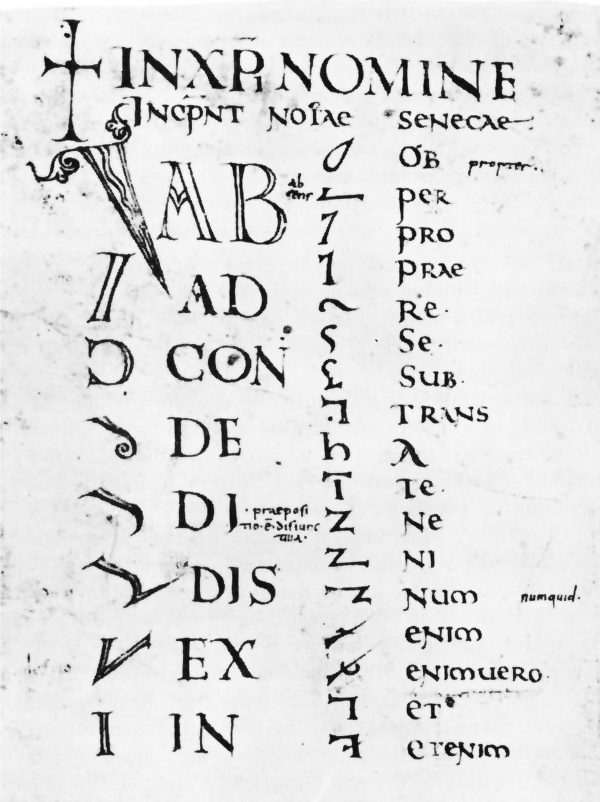
You can still type a symbol originally invented for Cicero nearly 21 centuries ago — at least if you configure your keyboard properly. The character ⁊ appears in Unicode as U+204A, but is better known as the “Tironian et”: the “et” is Latin for “and,” and the “Tironian” comes from its creator, a man named Tiro, or in full, Marcus Tullius Tiro. Tiro wasn’t a relative of Marcus Tullius Cicero, as you might expect, but rather his onetime slave: after being emancipated, he not only took on two of his former master’s names, but also remained his secretary and confidant. It was in that capacity that, at Cicero’s request, he created the system since known as Tironian notes.
Though now credited as “the father of stenography,” Tiro didn’t invent shorthand itself. Like so many developments in ancient Roman civilization, Hellenic inspiration was involved: no sooner did Cicero learn of the existence of Greek shorthand systems, so the story goes, than he asked Tiro to come up with one for Latin. It’s possible that he did so as early as 75 BC, when Cicero was assigned to Sicily and needed to encode his communications, especially those having to do with the corruption of local officials. Back in Rome, it became useful indeed for rapidly transcribing onto wax-covered tablets what the great orator had to say, in situations ranging from everyday dealings in the Forum to — as recorded by Plutarch — denouncing Catiline’s conspiracy to overthrow the Roman Republic.
Tiro created about 4,000 symbols to stand in for syllables, words, and other elements of language, and other of the system’s users, including Seneca, later brought the number up to 5,000. But “as Rome declined, so did shorthand,” writes Anita Kreitzman at the National Court Reporters Association. “The Emperor Justinian, in the sixth century, contemptuously forbade its use.” Yet Tironian notes survived, especially among the annotators of manuscripts, expanding and merging with other systems to contain 14,000 signs during the Carolingian dynasty. Alas, “Holy Roman Emperor Frederick II (1212–1250) considered the use of shorthand symbols ‘diabolical’ and ‘ordered the destruction of all shorthand characters.’ As a result, shorthand quickly became a lost art.”
Thereupon came the Dark Ages in which “learning and shorthand seemed to no longer exist.” Leave it to court reporters to equate abbreviation with civilization. Yet the association is hardly spurious, and can’t be accidental that its revival began in late sixteenth-century London, when the world’s transformation over the subsequent centuries was getting into motion. Many shorthand systems have risen and fallen since, and the digital technologies of recent decades have made the whole practice superfluous for most of us here in the twenty-first century. Yet we can still have ⁊, thanks to inadvertent preservation by the medieval Irish script and Gaelic type that use it as an ampersand. It may not have the same function in English, or even the Romance languages, but typing no other symbol could make us feel quite so Ciceronian.
Related content:
Alice in Wonderland, Hamlet, and A Christmas Carol Written in Shorthand (Circa 1919)
The Story of Lorem Ipsum: How Scrambled Text by Cicero Became Used by Typesetters Everywhere
What Ancient Latin Sounded Like, And How We Know It
The Writing Systems of the World Explained, from the Latin Alphabet to the Abugidas of India
Based in Seoul, Colin Marshall writes and broadcasts on cities, language, and culture. He’s the author of the newsletter Books on Cities as well as the books 한국 요약 금지 (No Summarizing Korea) and Korean Newtro. Follow him on the social network formerly known as Twitter at @colinmarshall.
Read More...226 Ansel Adams Photographs of Great American National Parks Are Now Online
Like many American stories, the story of the National Parks begins with pillage, death, deep cultural misunderstanding, and venture capitalism. According to Ken Burns’ film series The National Parks: America’s Best Idea, we can date the idea back to 1851, with the “discovery” of Yosemite by a marauding armed battalion that entered the land “searching for Indians, intent on driving the natives from their homelands and onto reservations.” The Mariposa Battalion, led by Captain James D. Savage, set fire to the Indians’ homes and storehouses after they had retreated to the mountains, “in order to starve them into submission.”
One member of the battalion, a doctor named Lafayette Bunnell, found himself entranced by the scenery amidst this destruction. “As I looked, a peculiar exalted sensation seemed to fill my whole being,” he wrote in his later accounts, “and I found myself in tears with emotion.” He named the place “Yosemite,” thinking it was the name of the Indian tribe the soldiers sought to force out or eradicate. The word, it turned out “meant something entirely different,” referring to people who should be feared: “It means, ‘they are killers.’”
In 1855, a failed English gold prospector turned the place into a tourist attraction, and people flooded West to see it, prompting New York worthies like Horace Greeley and Frederick Law Olmsted to lobby for its federal protection. In 1864, Abraham Lincoln deeded Yosemite Valley and the Mariposa Grove, with its giant sequoias, to the state of California. Ever since then, National Parks have been threatened—if not by the occasional political candidate and his billionaire backers hoping to privatize the land, then by oil and gas drilling, and by fire, rising seas, or other effects of climate change. Though the U.S. emptied many of the parks of their inhabitants, it is ironically only the actions of the federal government that prevent the process begun by the Mariposa Battalion from reaching its conclusion in the total despoliation of these landscapes. It is these landscapes that have most come to symbolize the national character, whether as background in Frederic Remington’s paintings of the Indian Wars or in the photographs of Ansel Adams, who began and sustained his career in Yosemite Valley. “Yosemite National Park,” writes the National Park Service’s website, “was Adams’ chief inspiration.”

Adams first became interested in visiting the National Park when he read In the Heart of the Sierras by James Hutchings—that failed English gold prospector. Thereafter, Adams photographed National Parks almost ritually, and in 1941, the National Park Service commissioned Adams to create a photo mural for the Department of the Interior Building in DC. The theme, the National Archives tells us, was to be “nature as exemplified and protected in the U.S. National Parks. The project was halted because of World War II and never resumed.” It must have felt like an especially sacred duty for Adams, who traveled the country photographing the Grand Canyon, Grand Teton, Kings Canyon, Mesa Verde, Rocky Mountain, Yellowstone, Yosemite, Carlsbad Caverns, Glacier, and Zion National Parks; Death Valley, Saguaro, and Canyon de Chelly National Monuments,” and other locations like the Boulder (now Hoover) Dam and desert vistas in New Mexico.
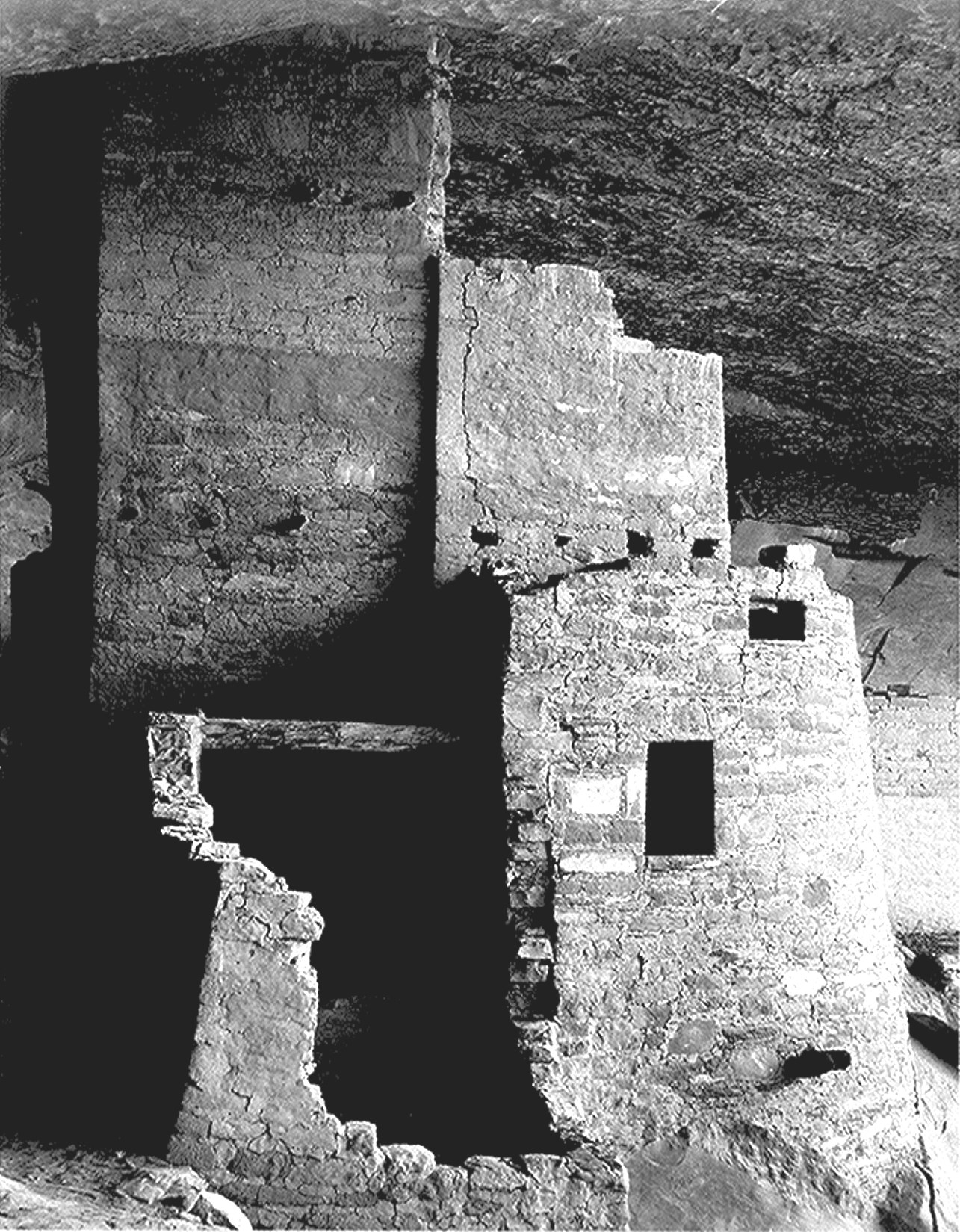
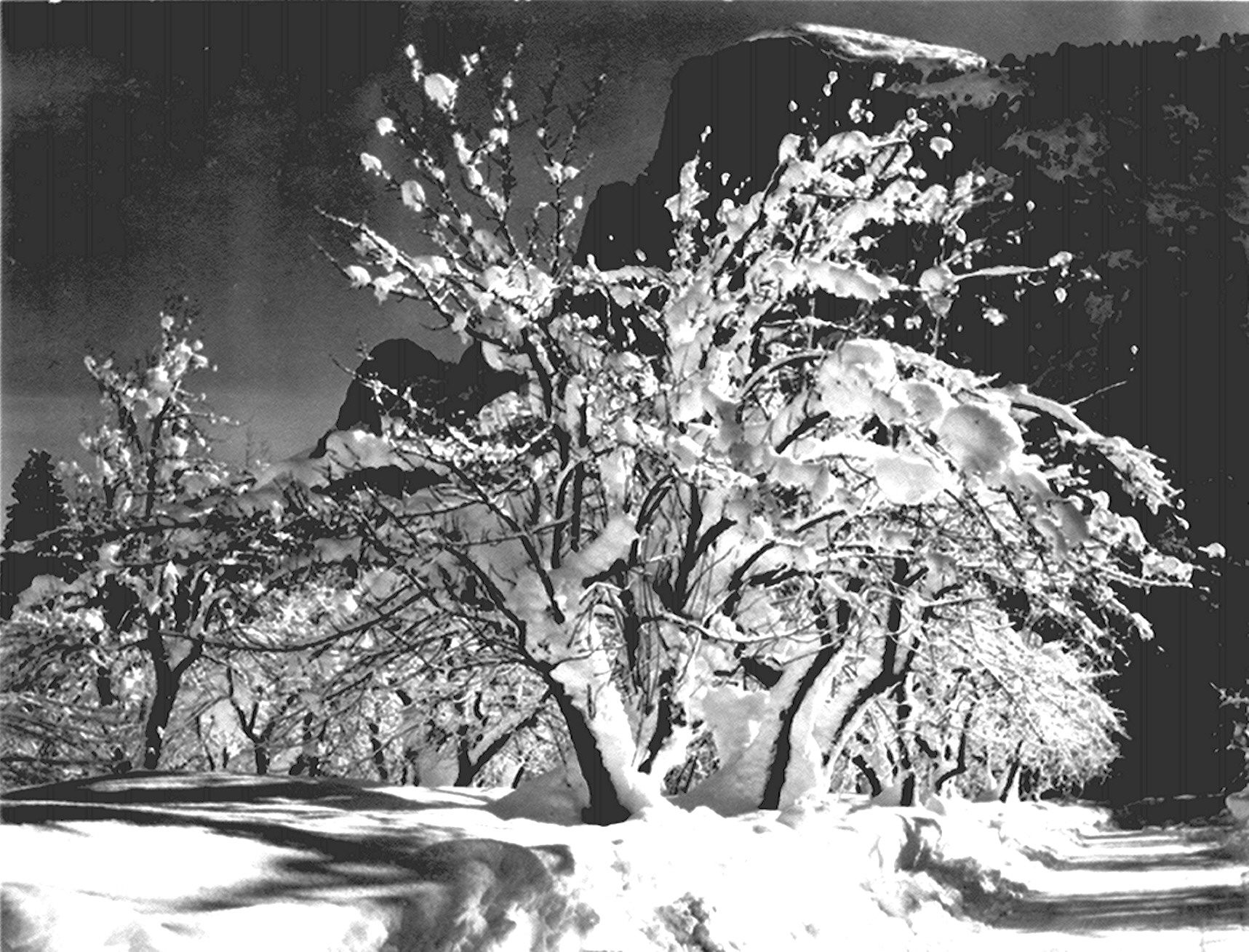
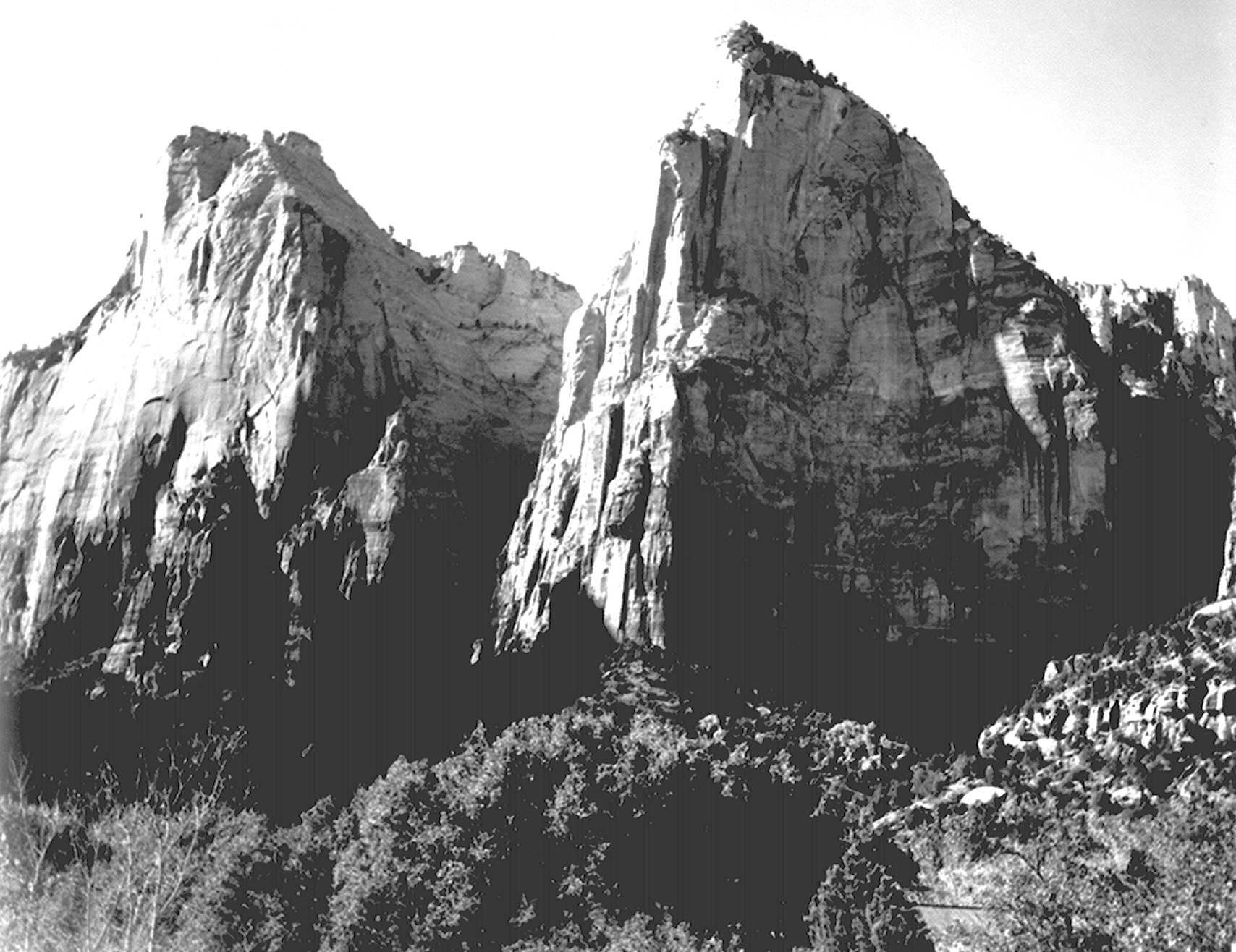
The photographs you see here are among the 226 taken by Adams for the project. They are now housed at the National Archives, and you can freely view them online or order prints at their site. At the top, we see a snow-covered tree from an apple orchard below Half Dome, Yosemite, where Adams had his first photographic “visualization” in 1927. Below it, the “Court of the Patriarchs” in Zion National Park, Utah. Further down, we have a breathtaking vision of the serpentine Grand Canyon, and just above, one of the few manmade structures, “Cliff Palace” at Mesa Verde National Park in Colorado. And here can you see a photograph of the Snake River in Grand Teton National Park.
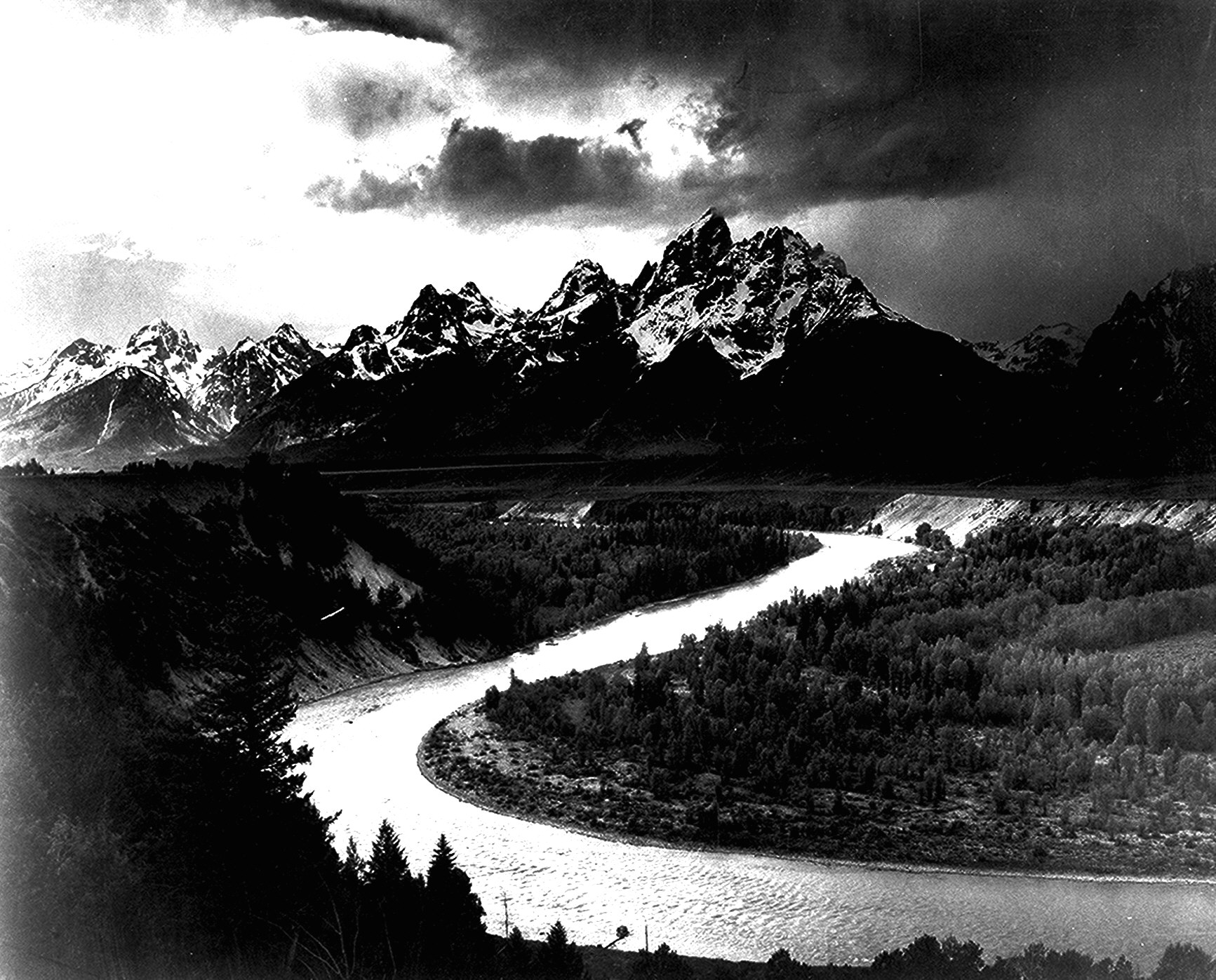
The mural project may have been abandoned, but Adams never stopped photographing the parks, or advocating for their protection and, in fact, the protection of “the entire environment,” as he told a Playboy interviewer in 1983. “Only two and a half percent of the land in this country is protected,” said Adams then: “Not only are we being fought in trying to extend that two and a half percent to include other important or fragile areas but we are having to fight to protect that small two and a half percent. It is horrifying that we have to fight our own Government to save our environment.”
You can peruse the collection of Ansel Adams’ National Park photos here.
An earlier version of this post appeared on our site in 2015.
Related Content:
Ansel Adams Reveals His Creative Process in 1958 Documentary
200 Ansel Adams Photographs Expose the Rigors of Life in Japanese Internment Camps During WW II
How to Take Photographs Like Ansel Adams: The Master Explains The Art of “Visualization”
Josh Jones is a writer and musician based in Durham, NC.
Read More...How Ancient Greek Warships Worked: The Engineering of the Trireme Explained in 3D Animation
Recall, if you will, the first time you read Book 2 of Homer’s Iliad. The section likely to have given you the most trouble — unless, of course, you’re blessed with an obsessive interest in ancient naval warfare — is the much-remarked-upon Catalogue of Ships, a rundown of not just the contingents of the Achaean army sailing to Troy, but also the ships they’re doing it in. However evocative Homer’s poetry, more than a few modern readers may face a certain difficulty imagining ancient Greek vessels for themselves. Fortunately for them, the YouTube channel Deconstructed recently put out the video above, which uses 3D imagery to explain the workings of an entire trireme, part by historically accurate part.
And what is a trireme? Two and a half millennia ago, says the video’s narrator, it was “the most powerful warship in the Mediterranean.” This despite the fact that it had “no engine, no cannons, and no heavy armor”: just “a narrow wooden hull, a bronze ram, and 170 men rowing in perfect rhythm.”
Welcome to ancient Greece, where raw, synchronized manpower could win a major war. Named for the “three superimposed tiers of one-man oars on each side of the vessel,” the trireme “pushed the technological limits of the ancient world, with every part of its design optimized for speed and maneuverability.” So swift was its acceleration, regardless of wind conditions, that a single strike of its bronze ram could prove decisive.
Among the most effective maneuvers for a fleet of triremes were the diekplous, in which the ships “rode through gaps in the enemy formation, then turned to attack the exposed sterns of opposing ships,” and the periplous, in which they sailed “around the enemy line to attack from the side or rear.” Not that Homer had reason to sing of such tactics, at least as performed by triremes, which were only put into use in the seventh century BC. That was five or six hundred years after the notional period of the legendary Trojan War, which, as the Iliad tells us, involved triaconters and penteconters, ships propelled by a mere 30 to 50 oarsmen as against the 170 stacked into the trireme. Even in those days, as Homer’s contemporary listeners would have felt, technology was marching on — with the technology of war at the forefront.
Related content:
Ancient Greek Armor Gets Tested in an 11-Hour Battle Simulation Inspired by the Iliad
How an Ancient Roman Shipwreck Could Explain the Universe
Hear the First Book of Homer’s Iliad Read Aloud in the Original Greek
Based in Seoul, Colin Marshall writes and broadcasts on cities, language, and culture. He’s the author of the newsletter Books on Cities as well as the books 한국 요약 금지 (No Summarizing Korea) and Korean Newtro. Follow him on the social network formerly known as Twitter at @colinmarshall.
Read More...Mark Twain Predicts the Internet in 1898: Read His Sci-Fi Crime Story, “From The ‘London Times’ in 1904”
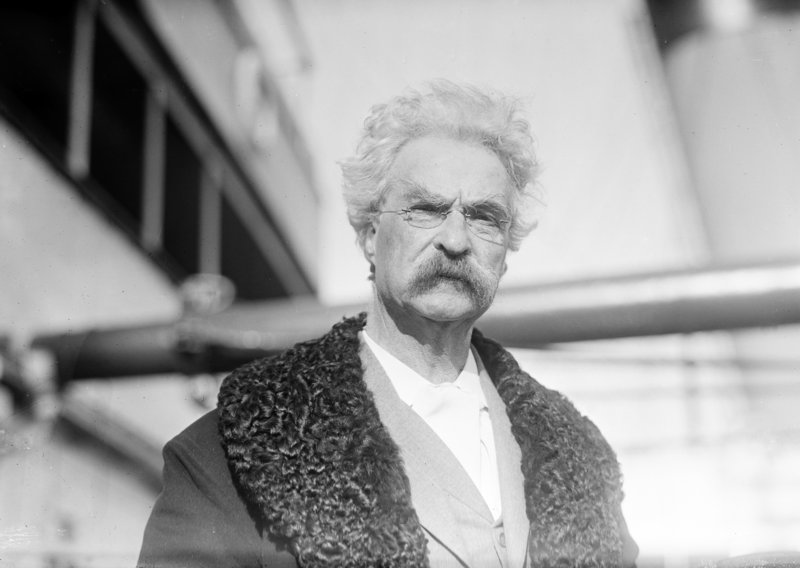
Most people know that Mark Twain wrote about Jim and Huckleberry Finn navigating down the Mississippi. Less well known is that he occasionally dabbled in the burgeoning genre of science fiction. His 1898 short story “The Great Dark” is about a ship that sails across a drop of water on a microscope slide. His novel A Connecticut Yankee in King Arthur’s Court is one of the first to explore time travel. And, in a short story called “From The ‘London Times’ in 1904,” Twain predicted the internet. In 1898. Read it here.
Set six years into the future, the story starts off as a crime mystery. Clayton, a quick-tempered army officer, is accused of murdering Szczepanik, the inventor of a new and promising device called the telelectroscope. The tale’s unnamed narrator describes it like this:
As soon as the Paris contract released the telelectroscope, it was delivered to public use, and was soon connected with the telephonic systems of the whole world. The improved ‘limitless-distance’ telephone was presently introduced and the daily doings of the globe made visible to everybody, and audibly discussable too, by witnesses separated by any number of leagues.
That sounds a lot like social media. Mark Twain dreamed up X and YouTube during the William McKinley administration.
Facing the hangman’s noose, Clayton asks for, and receives, a telelectroscope for his cell. As the narrator describes Clayton’s telelectroscopic revelry, it sounds uncannily like a bored cubicle dweller surfing the web at work.
…day by day, and night by night, he called up one corner of the globe after another, and looked upon its life, and studied its strange sights, and spoke with its people, and realized that by grace of this marvelous instrument he was almost as free as the birds of the air, although a prisoner under locks and bars. He seldom spoke, and I never interrupted him when he was absorbed in this amusement. I sat in his parlor and read, and smoked, and the nights were very quiet and reposefully sociable, and I found them pleasant. Now and then I would hear him say ‘Give me Yedo;’ next, ‘Give me Hong-Kong;’ next, ‘Give me Melbourne.’ And I smoked on, and read in comfort, while he wandered about the remote underworld, where the sun was shining in the sky, and the people were at their daily work.
The story itself is an admittedly minor work by the master of American fiction. In its last third, the story abruptly turns into a surprisingly sour satire about the sad state of our legal system. As Clayton is getting marched to the gallows, the narrator spots the guy Clayton supposedly murdered on the telelectroscope screen, standing in a crowd for the coronation of the new “Czar” of China. Even though no crime took place, Clayton is still sentenced to hang.
“From The ‘London Times’ in 1904” contains two long-running themes in Twain’s work and life. One is the absurdity of the courts – see, for example “The Facts in the Great Landslide Case.”
And the other is a fascination with technology. In spite of his folksy image, he was, as they say now, an early adopter. He was the first in his neighborhood to get a telephone. He may or may not have been the first major author to use a typewriter to write a novel. He lost his shirt investing in a Victorian-era startup hawking an exceedingly complex printing press called the Paige Compositor. And he allowed himself to be filmed by Thomas Edison in 1909, a year before his death.
One wonders what he would have thought of his telelectroscope in action.
Note: The character Szczepanik mentioned above was clearly named after a Polish inventor, Jan Szczepanik, who talked about creating a “telectroscope,” in the late 19th century. However, if you read a report in The New York Times in 1898, it becomes apparent that Szczepanik’s “telectroscope” wasn’t as visionary as what Twain had in mind.
Note: An earlier version of this post appeared on our site in 2014.
Related Content:
Mark Twain Wrote the First Book Ever Written With a Typewriter
Mark Twain Shirtless in 1883 Photo
Mark Twain Captured on Film by Thomas Edison in 1909. It’s the Only Known Footage of the Author.
Jonathan Crow is a Los Angeles-based writer and filmmaker.
Read More...Support Us
We're hoping to rely on loyal readers, rather than erratic ads. Please click the Donate button and support Open Culture. You can use Paypal, Venmo, Patreon, even Crypto! We thank you!

About Us

Open Culture scours the web for the best educational media. We find the free courses and audio books you need, the language lessons & educational videos you want, and plenty of enlightenment in between.
Advertise With Us

FREE UPDATES!
GET OUR DAILY EMAIL
Get the best cultural and educational resources on the web curated for you in a daily email. We never spam. Unsubscribe at any time.
FOLLOW ON SOCIAL MEDIA

Open Culture editor Dan Colman scours the web for the best educational media. He finds the free courses and audio books you need, the language lessons & movies you want, and plenty of enlightenment in between.
Advertise With Us

