David Byrne’s New Book Explores the Strange Afterlife of Good Ideas: From Vermeer’s Paintings to Roman Concrete & Dark Matter
David Byrne will always be most widely known as the co-founder and frontman of Talking Heads. That may count among the greatest possible achievements for any artist — to the minds of many an Open Culture reader, at least — but it must occasionally frustrate the man himself. Talking Heads broke up 35 years ago, but Byrne has only grown more and more productive since, recording his own albums, creating musicals, writing books, putting on PowerPoint presentations, and even designing bike racks. By now, his ideas have stretched so far beyond music that he’s considering the nature of ideas themselves, how they succeed or fail in catching on, and why they go in and out of acceptance over time. Hence his new book Sleeping Beauties: Why Good Ideas Go Dormant and How They Wake Up.
“I first saw the term ‘sleeping beauties’ (outside of the folktale or the Disney movie) when I went down a rabbit hole and stumbled on a paper from 2004 called “Sleeping Beauties in Science” by the scientometrics researcher Anthony van Raan at Leiden University,” Byrne writes in an excerpt of the book published online. (Scientometrics being, he adds, “the study of the impact and communication of science.”) He cites a favorite example of the astronomer Vera Rubin’s discovery, in the nineteen-seventies, of “evidence for dark matter, which is estimated to make up a large percentage of the universe.” Understanding her own observations required her to “question even her most basic assumptions — that matter must emit light and radiation. She was a visual thinker, and she used her data to create plots and sketches that revealed patterns within the numbers.”
Only decades later was Rubin’s counterintuitive vision of the universe supported by theoretical physicists and radio astronomers using ever more technologically advanced tools like “the powerful Hale Telescope, Kent Ford’s new spectrograph, and the Uhuru satellite, which tracked cosmic X‑rays.” In the Science Friday interview at the top of the post, Byrne brings up a much older, longer-sleeping beauty often featured here on Open Culture: ancient Roman concrete, the source of whose extraordinary strength and endurance was only determined a few years ago. Though especially vivid in technology and science, “this forgetting and then remembering, I knew from my own experience, wasn’t limited to academia,” he writes. “It happens in all kinds of fields and endeavors — music, art, literature, every kind of creative profession.”
As Adam Grant writes in the New York Times Book Review, the range of examples covered in Sleeping Beauties includes “how advocates reawakened Bach’s compositions and Vermeer’s paintings after one and two centuries of slumber; how technological advances rekindled theories of continental drift and black holes; how accidents resuscitated hand-washing and genetics; and how war renewed interest in the submarine and The Great Gatsby.” Making an appearance on Late Night with Seth Meyers, Byrne was asked if any of his own work has undergone a similar process of disinterest followed by rediscovery. “It’s kind of the opposite,” he replies. “There’s things that I’ve done where I go, ‘That one does not hold up that well at all’ ” — which, if the irony of cultural history continues to operate as usual, will be exactly the records the children of today’s Talking Heads fans put on most enthusiastically a few years down the line.
Related Content:
David Byrne’s New Illustrated Book Playfully Presents A History of the World (in Dingbats)
David Byrne: From Talking Heads Frontman to Leading Urban Cyclist
David Byrne: How Architecture Helped Music Evolve
Brian Eno Explores What Art Does in a New Book Co-Written with Artist Bette A
Based in Seoul, Colin Marshall writes and broadcasts on cities, language, and culture. He’s the author of the newsletter Books on Cities as well as the books 한국 요약 금지 (No Summarizing Korea) and Korean Newtro. Follow him on the social network formerly known as Twitter at @colinmarshall.
Read More...The Strange and Brilliant Inventions of Nikola Tesla
Even before the success of the electric car company that now bears his name, Nikola Tesla was a widely respected historical figure. Often, that respect could be based on surprisingly scant knowledge of the man’s life and accomplishments. Didn’t he do something with electricity? Wasn’t he involved in some kind of rivalry with Thomas Edison? Wouldn’t we all be enjoying wirelessly transmitted power, too cheap to meter, if his noble, solitary efforts hadn’t been thwarted by the establishment? Well, perhaps. Whatever dramatic satisfactions we find in Tesla’s story, we can only gauge his genius by surveying his actual inventions, four of which are explained in the new Lost in Time video above.
Tesla lived from 1856 to 1943, a period of such great technological change that, when he demonstrated a radio-controlled boat in an early phase of his career, some of the onlookers “were absolutely convinced that there was a trained monkey inside the boat, reading his hand signals.” The year was 1898, when the very idea of wireless control hadn’t entered anyone’s mind — but Tesla already foresaw a world of “vehicles that drive themselves, machines doing real work from thousands of kilometers away, and aircraft flown from a distance.” He may have been a tad early to that game, but his invention of the alternating current power system and the induction motor happened right on time.
At the end of the nineteenth century, “the race to get electricity to every household in America” was getting into gear. Thomas Edison’s direct current (DC) system technically worked, but would need a very large number of power stations to move power all over the continent. Tesla did his work on AC as a kind of correction to the shortcomings of DC, drawing what history remembers as a merciless negative-publicity campaign from Edison’s side. But none of its often-gruesome stunts meant to associate Tesla’s invention with death were a match for the success of AC’s implementation in the new power plant at Niagara Falls. More than 130 years later, AC has long powered the vast majority of homes. But if history had gone differently, the Tesla enthusiast can’t resist asking, would your house also be equipped with its own death ray?
In 1934, at one of his annual press conferences, the 78-year-old Tesla announced that he’d come up with his most important invention yet, a weapon so powerful that it could “end all wars.” Called ‘teleforce,’ it would fire beams so concentrated and energetic that they could destroy any target instantaneously upon contact. When he died in 1943, Tesla didn’t even leave sufficient documentation to tell whether the thing could have worked. He’d made slightly more progress on Wardenclyffe Tower, meant as a proof of concept for his grander vision of turning the Earth into a giant battery, filling it with electricity into which all humanity could tap at will. Industrialist J. P. Morgan had been footing the project’s bill, but cut off funding when it came out that the ever-ambitious Tesla really intended to build much more than what he’d promised, a wireless communication system — which, at that time, would have seemed like a pretty fantastical notion in itself.
Related content:
A Brief, Animated Introduction to Thomas Edison (and Nikola Tesla)
The Unlikely Friendship of Mark Twain and Nikola Tesla
Nikola Tesla’s Grades from High School & University: A Fascinating Glimpse
The Electric Rise and Fall of Nikola Tesla: As Told by Technoillusionist Marco Tempest
Based in Seoul, Colin Marshall writes and broadcasts on cities, language, and culture. He’s the author of the newsletter Books on Cities as well as the books 한국 요약 금지 (No Summarizing Korea) and Korean Newtro. Follow him on the social network formerly known as Twitter at @colinmarshall.
Read More...7 Tips from Edgar Allan Poe on How to Write Vivid Stories & Poems
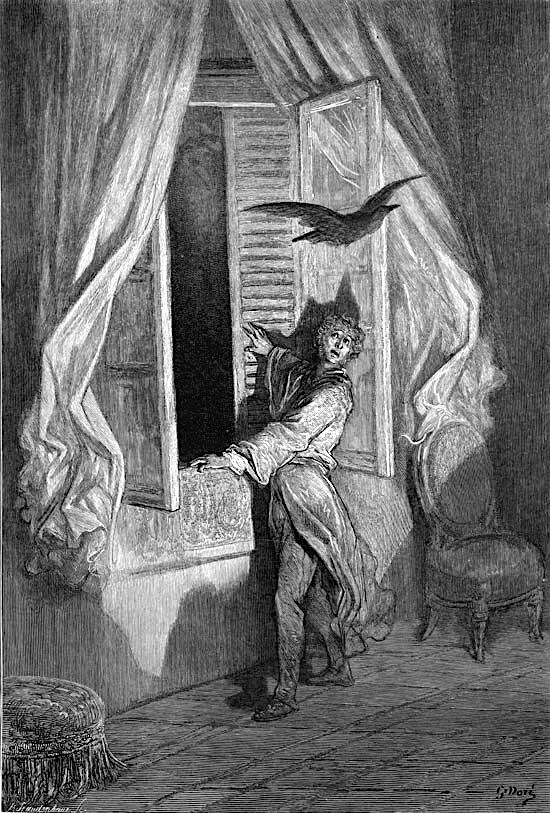
There may be no more a macabrely misogynistic sentence in English literature than Edgar Allan Poe’s contention that “the death… of a beautiful woman” is “unquestionably the most poetical topic in the world.” (His perhaps ironic observation prompted Sylvia Plath to write, over a hundred years later, “The woman is perfected / Her dead / Body wears the smile of accomplishment.”) The sentence comes from Poe’s 1846 essay “The Philosophy of Composition,” and if this work were only known for its literary fetishization of what Elisabeth Bronfen calls “an aesthetically pleasing corpse”—marking deep anxieties about both “female sexuality and decay”—then it would indeed still be of interest to feminists and academics, though not perhaps to the average reader.
But Poe has much more to say that does not involve a romance with dead women. The essay delivers on its title’s promise. It is here that we find Poe’s famous theory of what good literature is and does, achieving what he calls “unity of effect.” This literary “totality” results from a collection of essential elements that the author deems indispensable in “constructing a story,” whether in poetry or prose, that produces a “vivid effect.”
To illustrate what he means, Poe walks us through an analysis of his own work, “The Raven.” We are to take for granted as readers that “The Raven” achieves its desired effect. Poe has no misgivings about that. But how does it do so? Against commonplace ideas that writers “compose by a species of fine frenzy—an ecstatic intuition,” Poe has not “the least difficulty in recalling to mind the progressive steps of any of my compositions”—steps he considers almost “mathematical.” Nor does he consider it a “breach of decorum” to pull aside the curtain and reveal his tricks. Below, in condensed form, we have listed the major points of Poe’s essay, covering the elements he considers most necessary to “effective” literary composition.
- Know the ending in advance, before you begin writing.
“Nothing is more clear,” writes Poe, “than that every plot, worth the name, must be elaborated to its dénouement before any thing be attempted with the pen.” Once writing commences, the author must keep the ending “constantly in view” in order to “give a plot its indispensable air of consequence” and inevitability.
- Keep it short—the “single sitting” rule.
Poe contends that “if any literary work is too long to be read at one sitting, we must be content to dispense with the immensely important effect derivable from unity of impression.” Force the reader to take a break, and “the affairs of the world interfere” and break the spell. This “limit of a single sitting” admits of exceptions, of course. It must—or the novel would be disqualified as literature. Poe cites Robinson Crusoe as one example of a work of art “demanding of no unity.” But the single sitting rule applies to all poems, and for this reason, he writes, Milton’s Paradise Lost fails to achieve a sustained effect.
- Decide on the desired effect.
The author must decide in advance “the choice of impression” he or she wishes to leave on the reader. Poe assumes here a tremendous amount about the ability of authors to manipulate readers’ emotions. He even has the audacity to claim that the design of the “The Raven” rendered the work “universally appreciable.” It may be so, but perhaps it does not universally inspire an appreciation of Beauty that “excites the sensitive soul to tears”—Poe’s desired effect for the poem.
- Choose the tone of the work.
Poe claims the highest ground for his work, though it is debatable whether he was entirely serious. As “Beauty is the sole legitimate province of the poem” in general, and “The Raven” in particular, “Melancholy is thus the most legitimate of all poetical tones.” Whatever tone one chooses, however, the technique Poe employs, and recommends, likely applies. It is that of the “refrain”—a repeated “key-note” in word, phrase, or image that sustains the mood. In “The Raven,” the word “Nevermore” performs this function, a word Poe chose for its phonetic as much as for its conceptual qualities.
Poe claims that his choice of the Raven to deliver this refrain arose from a desire to reconcile the unthinking “monotony of the exercise” with the reasoning capabilities of a human character. He at first considered putting the word in the beak of a parrot, then settled on a Raven—“the bird of ill omen”—in keeping with the melancholy tone.
- Determine the theme and characterization of the work.
Here Poe makes his claim about “the death of a beautiful woman,” and adds, “the lips best suited for such topic are those of a bereaved lover.” He chooses these particulars to represent his theme—“the most melancholy,” Death. Contrary to the methods of many a writer, Poe moves from the abstract to the concrete, choosing characters as mouthpieces of ideas.
- Establish the climax.
In “The Raven,” Poe says, he “had now to combine the two ideas, of a lover lamenting his deceased mistress and a Raven continuously repeating the word ‘Nevermore.’” In bringing them together, he composed the third-to-last stanza first, allowing it to determine the “rhythm, the metre, and the length and general arrangement” of the remainder of the poem. As in the planning stage, Poe recommends that the writing “have its beginning—at the end.”
- Determine the setting.
Though this aspect of any work seems the obvious place to start, Poe holds it to the end, after he has already decided why he wants to place certain characters in place, saying certain things. Only when he has clarified his purpose and broadly sketched in advance how he intends to achieve it does he decide “to place the lover in his chamber… richly furnished.” Arriving at these details last does not mean, however, that they are afterthoughts, but that they are suggested—or inevitably follow from—the work that comes before. In the case of “The Raven,” Poe tells us that in order to carry out his literary scheme, “a close circumscription of space is absolutely necessary to the effect of insulated incident.”
Throughout his analysis, Poe continues to stress—with the high degree of repetition he favors in all of his writing—that he keeps “originality always in view.” But originality, for Poe, is not “a matter, as some suppose, of impulse or intuition.” Instead, he writes, it “demands in its attainment less of invention than negation.” In other words, Poe recommends that the writer make full use of familiar conventions and forms, but vary, combine, and adapt them to suit the purpose of the work and make them his or her own.
Though some of Poe’s discussion of technique relates specifically to poetry, as his own prose fiction testifies, these steps can equally apply to the art of the short story. And though he insists that depictions of Beauty and Death—or the melancholy beauty of death—mark the highest of literary aims, one could certainly adapt his formula to less obsessively morbid themes as well.
Note: An earlier version of this post appeared on our site in 2015.
Related Contents:
Gustave Doré’s Macabre Illustrations of Edgar Allan Poe’s “The Raven” (1884)
Edgar Allan Poe’s “The Raven,” Read by Christopher Walken, Vincent Price, and Christopher Lee
H.P. Lovecraft Gives Five Tips for Writing a Horror Story, or Any Piece of “Weird Fiction”
The Mystery of Edgar Allan Poe’s Death: 19 Theories on What Caused the Poet’s Demise
Josh Jones is a writer and musician based in Durham, NC.
Read More...Why the Maps of London, Tokyo, New York, and Other Major Cities Look the Way They Do
If you’re trying to understand a city, its map isn’t a bad place to start. Today, of course, we can call up an accurate map of practically any part of any city at any time we like, with detailed point-to-point directions available on command. Turn on the satellite view, street view, or 3D mode with its offer of every imaginable point of view, and you soon feel you’re engaging with less a representation of the city than the city itself. Yet the familiarity this makes us feel we possess is deceptive, a realization that comes afresh whenever our phone runs out of battery, leaving us barely able to find our way through even neighborhoods we’d thought we knew. Sheer habit can get us between the places we frequent, but that’s a far cry indeed from understanding the city as a whole.
That last is just what YouTuber Daniel Steiner attempts to do in his series of map explainers, which draws connections between the large-scale, abstracted view of the map and the concrete experience down on the street. He not only uses maps both current and historical to illuminate why the street network and neighborhood boundaries of a given city have taken the shape they have, but actually travels to that city and meets with experts equipped to point out physical traces of that process of urban evolution that escape the attention of most locals.
Those could be the infrastructural remnants of Roman London (or rather Londinium); the unloved Tokyo overpass where the major roads of old Japan once converged; the surveyor’s rod from the original gridding of Manhattan sticking out of what’s now Central Park; or the contours of Amsterdam even before its famous canals went in.
One visit to a city, of course, can hardly an understanding make. Steiner has so far returned to New York to create additional videos focusing on Broadway, Brooklyn, the Bronx, and Staten Island, and his examination of Los Angeles ends with a call for requests for more subjects to cover within the vast oddity of the southern California metropolis. His map explainers on other American cities from Chicago to Seattle to Savannah, Georgia also show great potential for follow-ups, to say nothing of how deep he could get into Mexico City after having told the story of how it used to be a lake. Part of these cities’ appeal lies in the fact that, no matter how long you spend in them, you can never get to know them completely, irresistible though it is to try. To the question of whether that attempt is best made top-down or bottom-up, Steiner’s videos respond implicitly — and convincingly — why not both?
Related content:
A Wonderful Archive of Historic Transit Maps: Expressive Art Meets Precise Graphic Design
The Genius Urban Design of Amsterdam: Canals, Dams & Leaning Houses
136 Maps Reveal Where Tourists & Locals Take Photos in Major Cities Across the Globe
Japanese Designer Creates Incredibly Detailed & Realistic Maps of a City That Doesn’t Exist
Based in Seoul, Colin Marshall writes and broadcasts on cities, language, and culture. He’s the author of the newsletter Books on Cities as well as the books 한국 요약 금지 (No Summarizing Korea) and Korean Newtro. Follow him on the social network formerly known as Twitter at @colinmarshall.
Read More...Discover the Lost Horror Series Deemed Too Shocking for BBC Television (1967)
High culture and new technology have never been a natural pairing. As our digital era has often underscored, media innovations tend to be adopted earliest to deliver the most puerile, sensation-driven content, with the more respectable stuff benefiting only later. When the BBC was introducing color broadcasting in the mid-nineteen-sixties, for instance, it was used for the likes of Thunderbirds, The Avengers, and The Benny Hill Show, respectable though those programs may now seem compared to what mainstream television would become in later decades. No color production of that period aimed quite as low as the anthology series Late Night Horror — or has since been raised so high in the minds of those who remember it.
“We must do everything we can from the very beginning to stimulate suspense, tension, atmosphere, potential horror and HORROR!” the show’s producer Harry Moore wrote in a memo to his staff in 1967. “If there is blood, let’s see the blood.” Just a few years before chocolate syrup circled the drain in Alfred Hitchcock’s Psycho, whose faintly anachronistic black-and-white cinematography only intensified its scariness, Late Night Horror had a mandate to paint the small screen red. As cultural legend has it, only six episodes were broadcast before complaints about its power to shock and disturb, or perhaps concerns about its increasing extremity, got it the axe from BBC management.
The idea that Late Night Horror was simply too scary for television — or British public television of the late sixties, in any case — has become more compelling over the decades in part because so little of the series itself has survived to receive the judgment of later generations of viewers. Only in 2016 did archivists discover a film copy of “The Corpse Can’t Play,” a story set at a children’s party that takes a deadly turn. Written by the prolific English novelist John Burke, the episode’s slow burn leads up to a grotesque finish that contrasts almost cheekily with the mundane domesticity of its setting. Alas, the recovered print was in black-and-white, so we don’t get to see the colors, sanguineous and otherwise, that would have made such an impact on viewers of nearly six decades ago.
Just this year, another episode was rediscovered: “No Such Thing as a Vampire” by Richard Matheson, author of I Am Legend and no fewer than sixteen Twilight Zone episodes. As of now, the other four episodes remain missing, and presumably erased under the perpetually cash-strapped BBC’s policy of erasing tapes for re-use in the mid-twentieth century. One of them, “William and Mary,” was based on a Roald Dahl story that had been previously adapted in 1961 for the series Way Out, and would be adapted again in 1979 for Tales of the Unexpected. At this point, even if a complete set of Late Night Horror tapes were to turn up in someone’s shed, the reality of the show could hardly be expected to compete with what its scattered fragments — especially its still-chilling opening sequence — inspire us to imagine. As every serious horror fan knows, it’s what we don’t see that scares us most.
via Mental Floss
Related content:
Watch The Twilight Zone’s Pilot Episode, Pitched by Rod Serling Himself (1959)
Alfred Hitchcock Presents a Chilling Tale by Roald Dahl (1960)
Alfred Hitchcock Presents Ghost Stories for Kids (1962)
Based in Seoul, Colin Marshall writes and broadcasts on cities, language, and culture. He’s the author of the newsletter Books on Cities as well as the books 한국 요약 금지 (No Summarizing Korea) and Korean Newtro. Follow him on the social network formerly known as Twitter at @colinmarshall.
Read More...In 1704, Isaac Newton Predicted That the World Will End in 2060
We have become quite used to pronouncements of doom, from scientists predicting the sixth mass extinction due to the measurable effects of climate change, and from religionists declaring the apocalypse due to a surfeit of sin. It’s almost impossible to imagine these two groups of people agreeing on anything other than the ominous portent of their respective messages. But in the early days of the scientific revolution—the days of Shakespeare’s contemporary Francis Bacon, and later 17th century Descartes—it was not at all unusual to find both kinds of reasoning, or unreasoning, in the same person, along with beliefs in magic, divination, astrology, etc.
Yet even in this maelstrom of heterodox thought and practices, Sir Isaac Newton stood out as a particularly odd co-existence of esoteric biblical prophecy, occult beliefs, and a rigid, formal mathematics that not only adhered to the inductive scientific method, but also expanded its potential by applying general axioms to specific cases.
Yet many of Newton’s general principles would seem totally inimical to the naturalism of most physicists today. As he was formulating the principles of gravity and three laws of motion, for example, Newton also sought the legendary Philosopher’s Stone and attempted to turn metal to gold. Moreover, the devoutly religious Newton wrote theological treatises interpreting Biblical prophecies and predicting the end of the world. The date he arrived at? 2060.
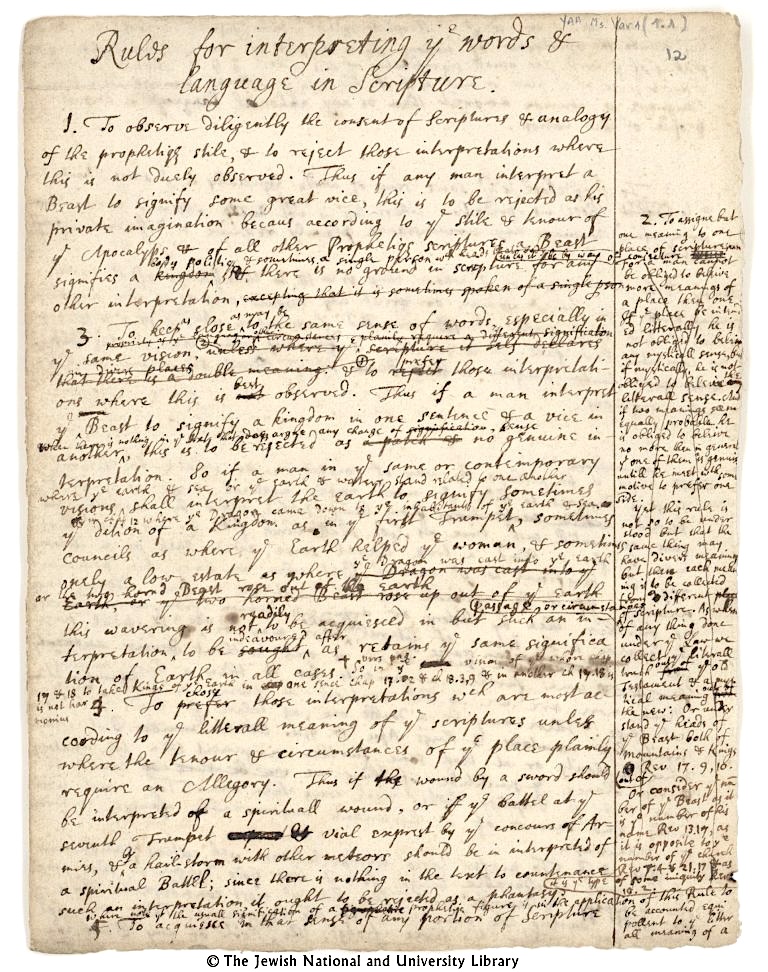
Newton seems, writes science blog Another Pale Blue Dot, “as confident of his predictions in this realm as he was in the rational world of science.” In a 1704 letter exhibited at Jerusalem’s Hebrew University, above, Newton describes his “recconing”:
So then the time times & half a time are 42 months or 1260 days or three years & an half, recconing twelve months to a yeare & 30 days to a month as was done in the Calendar of the primitive year. And the days of short lived Beasts being put for the years of lived [sic] kingdoms, the period of 1260 days, if dated from the complete conquest of the three kings A.C. 800, will end A.C. 2060. It may end later, but I see no reason for its ending sooner.
Newton further demonstrates his confidence in the next sentence, writing that his intent, “though not to assert” an answer, should in any event “put a stop the rash conjectures of fancifull men who are frequently predicting the time of the end.” Indeed. So how did he arrive at this number? Newton applied a rigorous method, that is to be sure.
If you have the patience for an exhaustive description of how he worked out his prediction using the Book of Daniel, you may read one here by historian of science Stephen Snobelen, who also points out how widespread the interest in Newton’s odd beliefs has become, reaching across every continent, though scholars have known about this side of the Enlightenment giant for a long time.
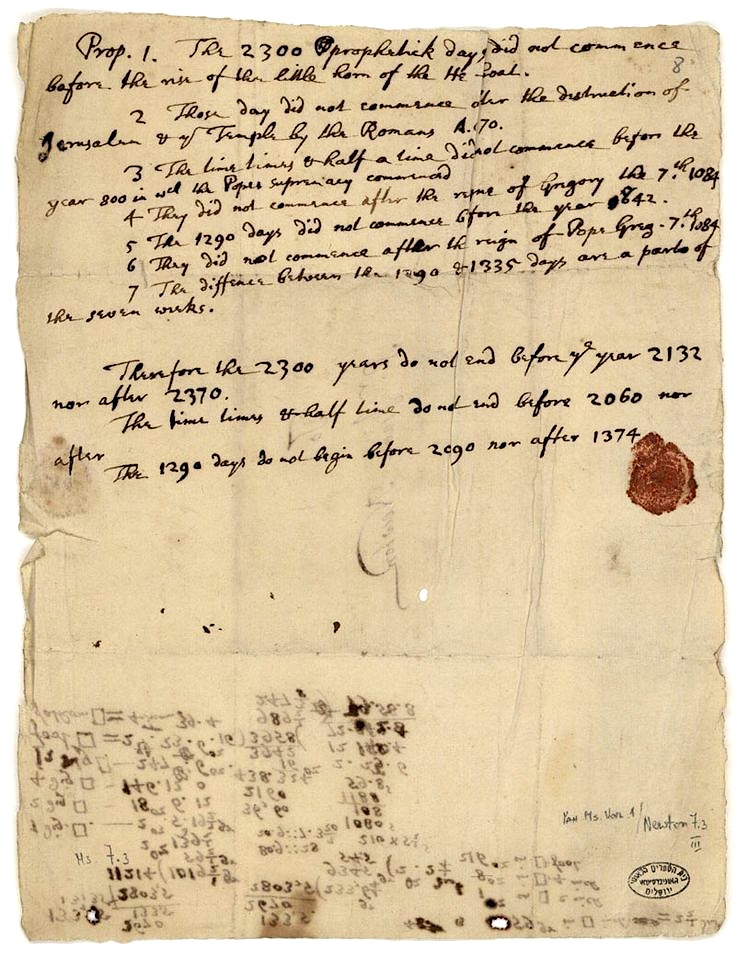
For a sense of the exacting, yet completely bizarre flavor of Newton’s prophetic calculations, see another Newton letter at the top of the post, transcribed below.
Prop. 1. The 2300 prophetick days did not commence before the rise of the little horn of the He Goat.
2 Those day [sic] did not commence a[f]ter the destruction of Jerusalem & ye Temple by the Romans A.[D.] 70.
3 The time times & half a time did not commence before the year 800 in wch the Popes supremacy commenced
4 They did not commence after the re[ig]ne of Gregory the 7th. 1084
5 The 1290 days did not commence b[e]fore the year 842.
6 They did not commence after the reigne of Pope Greg. 7th. 1084
7 The diffence [sic] between the 1290 & 1335 days are a parts of the seven weeks.
Therefore the 2300 years do not end before ye year 2132 nor after 2370.
The time times & half time do n[o]t end before 2060 nor after [2344]
The 1290 days do not begin [this should read: end] before 2090 [Newton might mean: 2132] nor after 1374 [sic; Newton probably means 2374]
The editorial insertions are Professor Snobelen’s, who thinks the letter dates “from after 1705,” and that “the shaky handwriting suggests a date of composition late in Newton’s life.” Whatever the exact date, we see him much less certain here; Newton pushes around some other dates—2344, 2090 (or 2132), 2374. All of them seem arbitrary, but “given the nice roundness of the number,” writes Motherboard, “and the fact that it appears in more than one letter,” 2060 has become his most memorable dating for the apocalypse.
It’s important to note that Newton didn’t believe the world would “end” in the sense of cease to exist or burn up in holy flames. His end times philosophy resembles that of a surprising number of current day evangelicals: Christ would return and reign for a millennium, the Jewish diaspora would return to Israel and would, he wrote, set up “a flourishing and everlasting Kingdom.” We hear such statements often from televangelists, school boards, governors, and presidential candidates.
As many people have argued, despite Newton’s conception of his scientific work as a bulwark against other theologies, it ultimately became a foundation for Deism and Naturalism, and has allowed scientists to make accurate predictions for hundreds of years. 20th century physics may have shown us a much more radically unstable universe than Newton ever imagined, but his theories are, as Isaac Asimov would put it, “not so much wrong as incomplete,” and still essential to our understanding of certain fundamental phenomena. But as fascinating and curious as Newton’s other interests may be, there’s no more reason to credit his prophetic calculations than those of the Millerites, Harold Camping, or any other apocalyptic doomsday sect.
Note: An earlier version of this post appeared on our site in 2015.
Related Content:
M.I.T. Computer Program Predicts in 1973 That Civilization Will End by 2040
Isaac Newton Creates a List of His 57 Sins (Circa 1662)
Isaac Newton Conceived of His Most Groundbreaking Ideas During the Great Plague of 1665
Videos Recreate Isaac Newton’s Neat Alchemy Experiments: Watch Silver Get Turned Into Gold
Josh Jones is a writer and musician based in Durham, NC.
Read More...Artists Frida Kahlo & Diego Rivera Visit Leon Trotsky in Mexico: Vintage Footage from 1938
Here’s some rare footage of the great Mexican painters Diego Rivera and Frida Kahlo paying a visit to exiled Soviet revolutionary Leon Trotsky and his wife, Natalia Sedova, in Coyoacán, Mexico, in 1938.
The Trotskys had arrived the year before, after Rivera petitioned the government of President Lázaro Cárdenas to grant the controversial Marxist leader and theorist sanctuary in Mexico. When the Trotskys arrived on a Norwegian oil tanker at the port city of Tampico in January of 1937, Rivera was not well, but Kahlo boarded the ship to welcome the Trotskys and accompanied them on an armored train to Mexico City. She invited the Trotskys to stay at her family home, La Casa Azul (the Blue House) in Coyoacán, now a section of Mexico City. By the time this footage was taken by a visiting American named Ivan Heisler, Trotsky and Kahlo had either had, or were about to have, a brief affair, and the friendship between the two couples would soon fall apart. In early 1939 Trotsky moved to another house in the same neighborhood, where he was assassinated in August of 1940.
If you would like to support the mission of Open Culture, consider making a donation to our site. It’s hard to rely 100% on ads, and your contributions will help us continue providing the best free cultural and educational materials to learners everywhere. You can contribute through PayPal, Patreon, and Venmo (@openculture). Thanks!
Note: An earlier version of this post appeared on our site in 2013.
Related Content:
Watch Moving Short Films of Frida Kahlo and Diego Rivera at the “Blue House”
This post was originally written in 2013.
Read More...How to Explain Complicated Things
You may remember a time when it was difficult to make it through the day without hearing someone cite a TED Talk. A major technological reason for that was streaming video’s new accessibility on practically everyone’s computer (especially those of people bored at work). A major cultural reason was there was a considerable demographic overlap between those who knew their way around the new video-sharing realms of the internet and those likely to want to hear a “thought leader” speak for eighteen minutes or less. Whether schools kill creativity, the mechanics of procrastination, what happens when you reply to spam e‑mail: these are just a few of the subjects that most aggressively captivated the minds of the suddenly large and chatty TED Talk audience of the late two-thousands and early twenty-tens.
Since those days, some of the most popular TED Talks ever given have undergone reputational re-evaluation. The robustness of the science undergirding Amy Cuddy’s “Your Body Language May Shape Who You Are” has been called into question, while Bill Gates’ “The Next Outbreak? We’re Not Ready,” from 2015, started to look a whole lot more prescient four or five years after it was uploaded.
But what makes a lecture people enjoy — and desire to get others watching — has less to do with its content than with its form and delivery. That’s one lesson we can take from the new animated video above, “How to Explain Something Complicated,” the eighth and most recent in TED-Ed’s series “Public Speaking 101”: something most of us, even if we’ve never dreamed of stepping onto TED’s (or merely TEDx’s) stage, have to face doing sooner or later.
When explaining any complex matter, from your startup’s mission to just how your brother met his bride, it helps to draw on familiar examples. This lesson does that using, naturally, a TED Talk, identifying and breaking down the ways in which social psychologist Daniel Gilbert’s “The Surprising Science of Happiness” exemplifies a suite of techniques in the public speaker’s arsenal. These include sparking your listener’s curiosity right away; introducing them to the first concept you’ll be discussing while doing so, as the base of a “tower” to be built one by one with subsequent concepts; and leading the audience to a “knowledge gap” that you later fill in with the “big idea” at the center of your talk. Surprise is important, and so are metaphors, the more vivid the better. In our age consumed with visions of smartphone addiction, global pandemics, and the AI apocalypse, TED Talks may seem a quaint artifact of a more naïvely techno-optimistic time. But the day will never come when we need no longer explain things — least of all ourselves.
Related Content:
Literary Theorist Stanley Fish Offers a Free Course on Rhetoric, or the Power of Arguments
Based in Seoul, Colin Marshall writes and broadcasts on cities, language, and culture. He’s the author of the newsletter Books on Cities as well as the books 한국 요약 금지 (No Summarizing Korea) and Korean Newtro. Follow him on the social network formerly known as Twitter at @colinmarshall.
Read More...How Else Marie Pade, a Prisoner in World War II, Became Denmark’s First Female Electronic Composer
Before she became a composer of electronic music, Else Marie Pade was a sick child listening to the radio. Frequent kidney inflammations consigned her to bed for long periods of time, which would constitute neither her last nor her harshest experience of confinement. She was still young when the Nazis occupied her homeland of Denmark during World War II, and perhaps her youth explains her decision to spit on a column of marching German soldiers. She escaped capture that day, running right into the Danish Resistance, for which she distributed underground newspapers and trained in the use of explosives to cut off the enemy’s telephone lines in the event of an Allied invasion. Arrested by the Gestapo in 1944, she never did get to execute that plan, but her real ambitions turned out to be much larger.
“I screamed out loud in fear and helplessness in my solitary cell — but no one came,” Pade wrote in an essay published in The Wire. “It was then I promised myself that if I survived this I would work with music for the rest of my life. And then I felt a strange calm: light, warmth and love were all around me. I was no longer alone. This was the turning point in my life.” The very next day, “I started scratching staves on the prison wall with my garter belt fastener, and wrote out the theme that had come to me, inspired by the vision of the night.” Though infuriated at first, the Commandant in charge told her he would “make sure that the Red Cross brought me music paper and writing utensils so I would refrain from violence and would not dirty the wall any more.”
Pade did all she could to compose during her time as a prisoner of war. After her transfer to the Frøslevlejren internment camp, she was reunited with her piano teacher Karen Brieg, who’d brought her into the Resistance in the first place. “Karen wrote out Danish songs for a three-part women’s choir, and I wrote schlagers — with which I wanted to earn money for music studies when we were released.” Her compatriots in the women’s barracks promised to give her the opportunity to study at the Royal Danish Academy of Music after the war’s end, which is exactly what she did. Though she entered the school with thoughts of becoming a pianist, a 1952 Danmarks Radio broadcast on Pierre Schaeffer’s musique concrète permanently changed the course of her artistic life.
Those sound collages turned musical experiences sent Pade back to her bouts of childhood sickness, during which her chief pleasures came from listening to the world around her. The result of this inspiration was the first work of electronic musique concrète composed in Denmark, A Day at Dyrehavsbakken. Learning from Schaeffer, and later from other electronic-music pioneers like Karlheinz Stockhausen, György Ligeti and Pierre Boulez, Pade developed the ability to realize the musical worlds she’s been exploring in her head all along. Their austere soundscapes could hardly be farther from the sentimental schlager ballads she’d written to keep spirits up in the barracks, but as you can hear in the selection from 1985 to 1995 presented in the compilation above, the sonic imagination that heard an ambient symphony in dripping sponges, whistling kettles, singing birds, and trotting horses remains exhilarating today.
Related content:
Hear Seven Hours of Women Making Electronic Music (1938–2014)
Daphne Oram Created the BBC’s First-Ever Piece of Electronic Music (1957)
What is Electronic Music?: Pioneering Electronic Musician Daphne Oram Explains (1969)
Based in Seoul, Colin Marshall writes and broadcasts on cities, language, and culture. He’s the author of the newsletter Books on Cities as well as the books 한국 요약 금지 (No Summarizing Korea) and Korean Newtro. Follow him on the social network formerly known as Twitter at @colinmarshall.
Read More...How to Memorize an Entire Chapter from “Moby Dick”: The Art and Science of Remembering Everything
Sometimes, when I can’t sleep, I mentally revisit the various homes of my childhood, wandering from room to room, turning on lights and peering in closets until I conk out.
Turns out these imaginary tours are also handy mnemonic tools, as Vox’s Dean Peterson explains above.
Hey, that’s good news… isn’t the subconscious rumored to do some heavy lifting in terms of processing information?
Peterson conquered a self-described bad memory, at least temporarily, by traipsing around his apartment, depositing vivid sentence-by-sentence clues that would eventually help him recite by heart one of his favorite chapters in Moby Dick.
In truth, he was planting these clues in his hippocampus, the relatively small structure in the brain that’s a critical player when it comes to memory, including the spatial memories that allow us to navigate familiar locations without seeming to give the matter any thought.
What made it stick was pairing his everyday coordinates to extraordinary visuals.
Chapter 37, for those keeping track at home, is a monologue for Captain Ahab in which he describes himself as not just mad but “madness maddened.” Here’s the first sentence:
I leave a white and turbid wake; pale waters, paler cheeks, where’er I sail.
Not the easiest text for 21st-century heads to wrap around, though with a little effort, most of us get the gist.
Let’s not get hung up on literary interpretation here, though, folks. Having settled on his front stoop as the first stop of his memory palace Peterson refrained from picturing frothy spume lapping at the lowermost step. Instead he plunked down a funeral wreath and director John Waters, pale of suit and cheek, weeping. Get it? White? Wake? Pale cheeks?
After which Peterson moved on to the next sentence.
There are 38 in all, and after several days of practice in which he mentally walked the image-strewn course of his apartment-cum-Memory Palace, Peterson was able to regale his coworkers with an off-book recitation.
The time factor will definitely be a letdown for those hoping for a low-commitment party trick.
Peterson spent three-to-four hours a day pacing his spatial memory, admiring the oddities he himself had placed there.
The incredulous comments from those questioning the efficiency of giving up half a day to memorize a page and a half are balanced by testimonials from those who’ve met with success, using the Memory Palace method to retain vast amounts of data prior to an exam.
That may, ultimately, be a better use of the Memory Palace. Peterson gets an A for spitting out the lines as written, but his expression is that of an actor auditioning with material he has not yet mastered. (No shade on Peterson’s acting talent or lack thereof—even great actors get this face when their lines are shaky. One friend doesn’t consider herself off book until she can get all the way through her monologue whilst hopping on one foot.)
For more information on building a Memory Palace, refer, as Peterson did, to author Joshua Foer’s Moonwalking With Einstein: The Art and Science of Remembering Everything, or to his appearance on Adam Grant’s TED Work Life podcast. Stream it here:
If you would like to go whale to whale with Peterson, below is the text that he installed in his Memory Palace, compliments of Herman Melville:
I leave a white and turbid wake; pale waters, paler cheeks, where’er I sail. The envious billows sidelong swell to whelm my track; let them; but first I pass.
Yonder, by ever-brimming goblet’s rim, the warm waves blush like wine. The gold brow plumbs the blue. The diver sun- slow dived from noon- goes down; my soul mounts up! she wearies with her endless hill. Is, then, the crown too heavy that I wear? this Iron Crown of Lombardy. Yet is it bright with many a gem; I the wearer, see not its far flashings; but darkly feel that I wear that, that dazzlingly confounds. ‘Tis iron- that I know- not gold. ‘Tis split, too- that I feel; the jagged edge galls me so, my brain seems to beat against the solid metal; aye, steel skull, mine; the sort that needs no helmet in the most brain-battering fight!
Dry heat upon my brow? Oh! time was, when as the sunrise nobly spurred me, so the sunset soothed. No more. This lovely light, it lights not me; all loveliness is anguish to me, since I can ne’er enjoy. Gifted with the high perception, I lack the low, enjoying power; damned, most subtly and most malignantly! damned in the midst of Paradise! Good night-good night! (waving his hand, he moves from the window.)
‘Twas not so hard a task. I thought to find one stubborn, at the least; but my one cogged circle fits into all their various wheels, and they revolve. Or, if you will, like so many ant-hills of powder, they all stand before me; and I their match. Oh, hard! that to fire others, the match itself must needs be wasting! What I’ve dared, I’ve willed; and what I’ve willed, I’ll do! They think me mad- Starbuck does; but I’m demoniac, I am madness maddened! That wild madness that’s only calm to comprehend itself! The prophecy was that I should be dismembered; and- Aye! I lost this leg. I now prophesy that I will dismember my dismemberer. Now, then, be the prophet and the fulfiller one. That’s more than ye, ye great gods, ever were. I laugh and hoot at ye, ye cricket-players, ye pugilists, ye deaf Burkes and blinded Bendigoes! I will not say as schoolboys do to bullies- Take some one of your own size; don’t pommel me! No, ye’ve knocked me down, and I am up again; but ye have run and hidden. Come forth from behind your cotton bags! I have no long gun to reach ye. Come, Ahab’s compliments to ye; come and see if ye can swerve me. Swerve me? ye cannot swerve me, else ye swerve yourselves! man has ye there. Swerve me? The path to my fixed purpose is laid with iron rails, whereon my soul is grooved to run. Over unsounded gorges, through the rifled hearts of mountains, under torrents’ beds, unerringly I rush! Naught’s an obstacle, naught’s an angle to the iron way!
Note: An earlier version of this post appeared on our site in 2019.
Related Content:
Hear Moby Dick Read in Its Entirety by Tilda Swinton, Stephen Fry, John Waters & Others
Play Mark Twain’s “Memory-Builder,” His Game for Remembering Historical Facts & Dates
The Neuroscience & Psychology of Procrastination, and How to Overcome It
Ayun Halliday is an author, illustrator, theater maker and Chief Primatologist of the East Village Inky zine.
Read More...Support Us
We're hoping to rely on loyal readers, rather than erratic ads. Please click the Donate button and support Open Culture. You can use Paypal, Venmo, Patreon, even Crypto! We thank you!

About Us

Open Culture scours the web for the best educational media. We find the free courses and audio books you need, the language lessons & educational videos you want, and plenty of enlightenment in between.
Advertise With Us

FREE UPDATES!
GET OUR DAILY EMAIL
Get the best cultural and educational resources on the web curated for you in a daily email. We never spam. Unsubscribe at any time.
FOLLOW ON SOCIAL MEDIA

Open Culture editor Dan Colman scours the web for the best educational media. He finds the free courses and audio books you need, the language lessons & movies you want, and plenty of enlightenment in between.
Advertise With Us

