Music Podcast Collection — Classical, Jazz, and Rock
Classical
- An Intimate Tour Through the Music of Yo-Yo Ma iTunes Feed Web Site
- Each episode of this podcast delves into the history of his career, and what led him to record each of the tracks of his current release Appassionato.
- Bach Podcast from Magnatune.com iTunes Feed Web Site
- 60 free minutes of Bach.
- Bach Festival of Philadelphia Feed Web Site
- Live performances of J.S. Bach works performed by various artists for The Bach Festival of Philadelphia.
- Boston Symphony Orchestra Conservatory iTunes Feed Web Site
- This educational podcast gives you an inside look at the symphony. Currently you will find a two season overview and recordings of Beethoven and Arnold Schoenberg.
- Classical Performance iTunes Feed Web Site
- Classical music performances from WGBH’s Studio One in Boston.
- Composers Datebooks iTunes Feed Web Site
- American Public Media’s Composers Datebook informs, engages, and entertains with timely information about composers of the past and present.
- Danmarks Radio — Mozart Symphonies Feed Web Site
- For the celebration of Mozart’s 250th anniversary, Denmark radio offered podcasts of nine Mozart symphonies by the Danish Radio Symphony Orchestra. Since the web site is in Danish, your best bet is to access these high quality MP3’s through the feed.
- Deutsche Welle
- Beethovenfest iTunes Feed Web Site
- Beethoven’s most famous symphonies performed by excellent young orchestras and new compositions by award-winning composers.
- Classical Masterpieces iTunes Feed Web Site
- Six master composers, six symphonies, a star conductor and a leading orchestra are the main ingredients of this remarkable musical feast.
- Beethovenfest iTunes Feed Web Site
- Gramophone Podcast Feed Web Site
- A monthly window into the world’s most authoritative classical music magazine, featuring an overview of the best releases, news, exclusive interviews with leading figures from the music world, and lots of great music.
- New Classical Tracks with Julie Amacher iTunes Feed Web Site
- Host Julie Amacher provides an in-depth exploration of a new classical music release each week.
- Naxos Classical Music Spotlight iTunes Feed Web Site
- A leading classical music label looks at new releases, as well as the performers and composers who make Naxos’ recordings.
- NPR Music iTunes Feed Web Site
- Reviews, musician interviews, live recordings from Morning Edition, All Things Considered, and other NPR programs.
- Philharmonia Orchestra Video Podcasts iTunes Feed Web Site
- A monthly series of video podcasts takes you behind the scenes with the Philharmonia Orchestra, including interviews with conductors, soloists and listening guides to famous pieces from the classical repertoire.
- Radio Sweden: Mozart iTunes Feed Web Site
- Swedish Radio has launched a Mozart Podcast to celebrate Mozart’s 250th birthday. They’ve been podcasting their own recordings from the 1940–1950s of Mozart’s operas.
- The Concert iTunes Feed Web Site
- Beethoven, Bach, Mozart and more from the Isabella Stewart Gardner museum in Boston.
- The Music of Masterworks iTunes Feed Web Site
- Sony BMG Masterworks provides podcasts featuring interviews with artists and upcoming releases.
- Wagner Operas Podcast iTunes Feed Web Site
- Features, among other things, performances from the Bayreuth Festival.
Jazz & Blues
- Bending Corners Feed Web Site
- BendingCorners explores the groove within: acid jazz, afro-beat, bop, cool jazz, cosmic jazz, dub, downtempo, electro-jazz, fusion, future jazz, groove jazz, jazzatronic, jazz dance, jazz-funk, jazz-rock, kozmigroov, modal, phusion, progressive, modern, nu-jazz, soul-jazz, spiritual, and world.
- Brooklyn Jazz Underground iTunes Web Site Blog
- A podcast looking at the Brooklyn jazz scene. Part music, part interview.
- Christian McBride Podcasts iTunes Feed Web Site
- Talks with and peformances by bassist Christian McBride. Includes some video clips.
- Detroit Jazz Stage iTunes Feed Web Site
- A monthly podcast featuring the best in the Detroit jazz scene.
- In the Groove, Jazz and Beyond iTunes Feed Web Site
- From Jazz masters of past and present to emerging new artists performing hard-bop jazz and fusion. Featuring Independent Jazz artists from around the world. A popular podcast.
- Jazz Corner Innerviews Feed Web Site
- Jazzcorner.com innerviews are vignettes with insightful commentary, interesting sound bites and lots of great music with great jazz masters and up and coming musicians. Each podcast ranges in time from 4 minutes to more than an hour.
- Jazz in Chicago iTunes Feed Web Site
- Interviews and information about the jazz scene in Chicago.
- Jazz Podcast from Magnatune iTunes Feed Web Site
- 60 minutes of straight, high quality jazz.
- NPR Piano Jazz Shorts iTunes Feed Web Site
- For more than twenty-five years, pianist Marian McPartland has welcomed a stellar line-up of jazz artists for conversation and improvisation on her Peabody Award-winning program. Piano Jazz showcases both acclaimed artists and up-and-coming performers.
- Pat Metheny — The Song X Podumentary iTunes Feed Web Site
- Guitarist Pat Metheny explores his influences, recordings, music and more on this intimate podcast series.
- Portland Jazz Jams Podshow iTunes Feed Web Site
- Live jazz jams, interviews with great players, and instructional materials, all coming out of the Portland jazz scene.
- Sonny Rollins Podcast iTunes Web Site
- A 12-part video podcast series to be released in monthly installments. It introduces Sonny Rollins, a major American jazz figure, to new listeners.
- Swing is in the Air iTunes Web Site
- Although swing is something of a focus here, this podcast coming out of Canada also looks at other jazz forms.
- The History of Chicago Blues iTunes Web Site
- Narrated by Buddy Guy, this enhanced and extensive podcast takes you on a tour (geographical and historical) of Chicago’s rich blues tradition.
- The Jazz Suite Feed Web Site
- This is a podcast dedicated to Jazz played by independent and indie artists that the major music labels have missed.
- The Night Passage Jazz Podcast iTunes Feed Web Site
- An English-language podcast coming out of Rome, Italy.
- The Traneumentary iTunes Feed Web Site
- A series of podcasts featuring the work of the jazz great, John Coltrane.
Rock
- Beatlegs Podcast iTunes Feed Web Site
- Features rare interviews or behind the scenes clips, followed by a rare outtake or live performance that few have heard before.
- Beatles Minute iTunes Feed Web Site
- A podcast coming out of Philadelphia that gives you short, daily tidbits about the band.
- Bob Dylan Podcast iTunes Web Site
- Patti Smith hosts music and conversation about Bob Dylan. His friends, early influences and collaborators discuss their close relationships with Dylan, the stories behind his greatest songs and other memorable moments of his career. Journalists and biographers add critical insights and provide historical contexts.
- Bono: The Rolling Stone Interview iTunes Feed Web Site
- Jann Wenner leads a long and wide-ranging interview with the lead singer of U2.
- Elvis Costello: The First Ten Years iTunes Feed Web Site
- Elvis Costello looks back at the beginning of his music career.
- George Harrison: Living in a Material World iTunes
- A look back at George Harrison’s 3rd solo album. Includes talks with artists who played on the album.
- John Lennon: The Rolling Stone Interview iTunes Feed Web Site
- Conducted by Jann Wenner (the founder of Rolling Stone Magazine) this famous 1970 interview with John Lennon was conducted shortly after The Beatles’ bitter breakup. Running over 3 hours, it is one of Lennon’s most extensive interviews, touching not just on the breakup, but also on art and politics, drugs, Yoko, primal therapy and more.
- John Lennon: The Lost Lennon Tapes iTunes Feed Web Site
- Originally presented by Westwood One in 1988, this podcast presents a collection of Lennon’s private tapes — tapes that include early recordings of The Beatles, radio interviews with John, demo tapes, chronicles of the Double Fantasy recording sessions, and private moments at home.
- Pet Sounds 40th Anniversary Podcast iTunes Web Site
- The Beach Boys look back at their album that is consistently considered their finest and an important one in the rock tradition. The podcast includes 15 tracks.
- Rolling Stone: Best New Bands (Video) iTunes
- The Beach Boys: The Warmth of the Sun iTunes Web Site
- Narrated by The Beach Boys themselves, this podcasts looks at the band’s artistry and complex legacy.
- The Elvis Presley Podcast iTunes Website
- This podcast, which features musical excerpts and interviews, revisits the King’s unparalleled musical career.
Also see our collection of Mp3 Music Blogs.
- An Aquarium Drunkard: Based in Los Angeles, this eclectic audio blog “bridges the gap between contemporary indie and vintage garage, psych-folk, country, New Orleans funk, R&B, soul and everything that falls in between.”
- Brooklyn Vegan: Here you get a New York City-centric, mostly-music blog that focuses on reporting music news, live show reviews, tour dates, and, yes, MP3’s.
- Cacophonous: A classical music MP3 blog.
- Chromewaves: Along with the ruminations of a self-confessed indie rock geek, you get an “MP3 of the Week” that features a random or not-so-random cover song.
- Daytrotter: Gives you “exclusive, re-worked, alternate versions of old songs and unreleased tracks by some of your favorite bands and by a lot of your next favorite bands.”
- Destination: Out: A jazz blog focusing on rare or out-of-print music. Typically publishes twice a week, and leaves songs available for about two weeks.
- Discobelle: A Sweden-based music blog that posts single tracks and remixes and occasionally exclusive mixes from DJs all around the world.
- Done Waiting: Part film, part music with MP3s.
- Elbows: A meta collection of great music blog posts, which collectively provides you a snapshot of what’s going on in the new genre of audio/music blogging.
- Fluxblog: One of the oldest and most commonly cited MP3 blogs, this site posts two MP3s every weekday along with more related information.
- Gorilla vs. Bear: One of the biggies worth checking out.
- I Guess I’m Floating: A good music blog with a good sprinkling of MP3s.
- Idolator: Maybe this summary will help: “When the internet came, we overthrew the pasty white tastemakers, the duplicitous music marketers and the manufactured pop idols. And then they all came back. This is Idolator. We’re so disappointed.”
- La Blogotheque: A well-regarded French language MP3 blog.
- Largehearted Boy: A “music blog featuring daily free and legal music downloads as well as news from the worlds of music, literature, and pop culture.”
- Marathon Packs: Writes about and lets you listen to interesting songs, to paraphrase the sites self-description. Keeps audio files posted for two weeks.
- Moistworks: An audio blog started in April 2004 (meaning it has a track record) that gets updated Monday through Friday.
- Motel De Moka: A daily blog posting eclectic playlists, including indie rock, acoustics and ambient.
- My Old Kentucky Blog: What’s new and hot in indie rock, pop, folk and hip-hop.
- Nothing But Green Lights: An MP3 blog that keeps track of indie, electro, folk & pop, all from the UK. The site only posts tracks that the internet is giving away for free, or ones that have been granted permission.
- Product Shop NYC: Although not exclusively an MP3 blog, you do get some MP3s worth your time here.
- Said the Gramophone: Launched in 2003, the site is among the first MP3 blogs and it offers a daily sampler of “really good songs,” although all songs are removed within a week or two of posting. The blog comes out of Canada.
- Six Eyes: An MP3 blog by Alan Williamson.
- Skatter Brain: A mostly indiepop music blog.
- So Much Silence: MP3s a plenty.
- Soul Crates: Your home for soul MP3s.
- Stereogum: A popular gossipy blog about the indie music scene. The site often posts MP3s of new music, plus offers record reviews, announces tour dates, and covers music festivals.
- The Hype Machine: The Hype Machine tracks and aggregates a variety of MP3 blogs. Another meta approach.
- The Music Slut: A comprehensive music blog with oodles of MP3s.
- Trrill: Another good classical music audio blog.
- WFMU Beware of the Blog: An MP3 blog run by WFMU, an independent freeform radio station broadcasting out of NYC.
- Who Needs Radio?: We believe in music, not money. We’re here to keep your ears alive.
- You Ain’t No Picasso: A good music blog with a very nice blogroll and MP3s too.
Complete Podcast Collection — Fill Your Ipod
 100s of cultural and educational podcasts. Email a friend about Open
Culture.
- Arts & Culture Podcasts
- Audio Book Podcasts
- Foreign Language Lesson Podcasts
- News/Information Podcasts
- Science Podcasts
- Technology Podcasts
- University Podcasts — All
- University Podcasts — Business School
Learn to Use Podcasts — Buy a New iPod (Amazon)
Music Podcast Collection
Classical
- Bach Podcast from Magnatune.com iTunes Feed Web Site
- 60 free minutes of Bach.
- Boston Symphony Orchestra Conservatory iTunes Feed Web Site
- This educational podcast gives you an inside look at the symphony. Currently you will find a two season overview and recordings of Beethoven and Arnold Schoenberg.
- Classical Performance iTunes Feed Web Site
- Classical music performances from WGBH’s Studio One in Boston.
- Composers Datebooks iTunes Feed Web Site
- American Public Media’s Composers Datebook informs, engages, and entertains with timely information about composers of the past and present.
- Danmarks Radio — Mozart Symphonies Feed Web Site
- For the celebration of Mozart’s 250th anniversary, Denmark radio offered podcasts of nine Mozart symphonies by the Danish Radio Symphony Orchestra. Since the web site is in Danish, your best bet is to access these high quality MP3’s through the feed.
- Deutsche Welle
- Beethovenfest iTunes Feed Web Site
- Beethoven’s most famous symphonies performed by excellent young orchestras and new compositions by award-winning composers.
- Classical Masterpieces iTunes Feed Web Site
- Six master composers, six symphonies, a star conductor and a leading orchestra are the main ingredients of this remarkable musical feast.
- Beethovenfest iTunes Feed Web Site
- New Classical Tracks with Julie Amacher iTunes Feed Web Site
- Host Julie Amacher provides an in-depth exploration of a new classical music release each week.
- Naxos Classical Music Spotlight iTunes Feed Web Site
- A leading classical music label looks at new releases, as well as the performers and composers who make Naxos’ recordings.
- NPR Music iTunes Feed Web Site
- Reviews, musician interviews, live recordings from Morning Edition, All Things Considered, and other NPR programs.
- Radio Sweden: Mozart iTunes Feed Web Site
- Swedish Radio has launched a Mozart Podcast to celebrate Mozart’s 250th birthday. They’ve been podcasting their own recordings from the 1940–1950s of Mozart’s operas.
- The Concert iTunes Feed Web Site
- Beethoven, Bach, Mozart and more from the Isabella Stewart Gardner museum in Boston.
- The Music of Masterworks iTunes Feed Web Site
- Sony BMG Masterworks provides podcasts featuring interviews with artists and upcoming releases.
- Wagner Operas Podcast iTunes Feed Web Site
- Features, among other things, performances from the Bayreuth Festival.
Jazz
- Bending Corners Feed Web Site
- BendingCorners explores the groove within: acid jazz, afro-beat, bop, cool jazz, cosmic jazz, dub, downtempo, electro-jazz, fusion, future jazz, groove jazz, jazzatronic, jazz dance, jazz-funk, jazz-rock, kozmigroov, modal, phusion, progressive, modern, nu-jazz, soul-jazz, spiritual, and world.
- BendingCorners explores the groove within: acid jazz, afro-beat, bop, cool jazz, cosmic jazz, dub, downtempo, electro-jazz, fusion, future jazz, groove jazz, jazzatronic, jazz dance, jazz-funk, jazz-rock, kozmigroov, modal, phusion, progressive, modern, nu-jazz, soul-jazz, spiritual, and world.
- Brooklyn Jazz Underground iTunes Web Site Blog
- A podcast looking at the Brooklyn jazz scene. Part music, part interview.
- Christian McBride Podcasts iTunes Feed Web Site
- Talks with and peformances by bassist Christian McBride. Includes some video clips.
- Detroit Jazz Stage iTunes Feed Web Site
- A monthly podcast featuring the best in the Detroit jazz scene.
- In the Groove, Jazz and Beyond iTunes Feed Web Site
- From Jazz masters of past and present to emerging new artists performing hard-bop jazz and fusion. Featuring Independent Jazz artists from around the world. A popular podcast.
- Jazz Corner Innerviews Feed Web Site
- Jazzcorner.com innerviews are vignettes with insightful commentary, interesting sound bites and lots of great music with great jazz masters and up and coming musicians. Each podcast ranges in time from 4 minutes to more than an hour.
- Jazz in Chicago iTunes Web Site
- Interviews and information about the jazz scene in Chicago.
- Jazz Podcast from Magnatune iTunes Feed Web Site
- 60 minutes of straight, high quality jazz.
- NPR Piano Jazz Shorts iTunes Feed Web Site
- For more than twenty-five years, pianist Marian McPartland has welcomed a stellar line-up of jazz artists for conversation and improvisation on her Peabody Award-winning program. Piano Jazz showcases both acclaimed artists and up-and-coming performers.
- Pat Metheny — The Song X Podumentary iTunes Web Site
- Guitarist Pat Metheny explores his influences, recordings, music and more on this intimate podcast series.
- Portland Jazz Jams Podshow iTunes Feed Web Site
- Live jazz jams, interviews with great players, and instructional materials, all coming out of the Portland jazz scene.
- Sonny Rollins Podcast iTunes Web Site
- A 12-part video podcast series to be released in monthly installments. It introduces Sonny Rollins, a major American jazz figure, to new listeners.
- Swing is in the Air iTunes Web Site
- Although swing is something of a focus here, this podcast coming out of Canada also looks at other jazz forms.
- The Jazz Suite Feed Web Site
- This is a podcast dedicated to Jazz played by independent and indie artists that the major music labels have missed.
- The Night Passage Jazz Podcast iTunes Feed Web Site
- An English-language podcast coming out of Rome, Italy.
- The Traneumentary iTunes Feed Web Site
- A series of podcasts featuring the work of the jazz great, John Coltrane.
Rock
- Beatlegs Podcast iTunes Feed Web Site
- Features rare interviews or behind the scenes clips, followed by a rare outtake or live performance that few have heard before.
- Beatles Minute iTunes Feed Web Site
- A podcast coming out of Philadelphia that gives you short, daily tidbits about the band.
- Bono: The Rolling Stone Interview iTunes Feed Web Site
- Elvis Costello: The First Ten Years iTunes Feed Web Site
- Elvis Costello looks back at the beginning of his music career.
- George Harrison: Living in a Material World iTunes
- A look back at George Harrison’s 3rd solo album. Includes talks with artists who played on the album.
- John Lennon: The Rolling Stone Interview iTunes Feed Web Site
- Conducted by Jann Wenner (the founder of Rolling Stone Magazine) this famous 1970 interview with John Lennon was conducted shortly after The Beatles’ bitter breakup. Running over 3 hours, it is one of Lennon’s most extensive interviews, touching not just on the breakup, but also on art and politics, drugs, Yoko, primal therapy and more.
- John Lennon: The Lost Lennon Tapes iTunes Feed Web Site
- Originally presented by Westwood One in 1988, this podcast presents a collection of Lennon’s private tapes — tapes that include early recordings of The Beatles, radio interviews with John, demo tapes, chronicles of the Double Fantasy recording sessions, and private moments at home.
- Pet Sounds 40th Anniversary Podcast iTunes Web Site
- The Beach Boys look back at their album that is consistently considered their finest and an important one in the rock tradition. The podcast includes 15 tracks.
- Rolling Stone: Best New Bands (Video) iTunes
- The Beach Boys: The Warmth of the Sun iTunes Web Site
- Narrated by The Beach Boys themselves, this podcasts looks at the band’s artistry and complex legacy.
Also see our collection of Mp3 Music Blogs.
- An Aquarium Drunkard: Based in Los Angeles, this eclectic audio blog “bridges the gap between contemporary indie and vintage garage, psych-folk, country, New Orleans funk, R&B, soul and everything that falls in between.”
- Brooklyn Vegan: Here you get a New York City-centric, mostly-music blog that focuses on reporting music news, live show reviews, tour dates, and, yes, MP3’s.
- Cacophonous: A classical music MP3 blog.
- Chromewaves: Along with the ruminations of a self-confessed indie rock geek, you get an “MP3 of the Week” that features a random or not-so-random cover song.
- Daytrotter: Gives you “exclusive, re-worked, alternate versions of old songs and unreleased tracks by some of your favorite bands and by a lot of your next favorite bands.”
- Destination: Out: A jazz blog focusing on rare or out-of-print music. Typically publishes twice a week, and leaves songs available for about two weeks.
- Discobelle: A Sweden-based music blog that posts single tracks and remixes and occasionally exclusive mixes from DJs all around the world.
- Done Waiting: Part film, part music with MP3s.
- Elbows: A meta collection of great music blog posts, which collectively provides you a snapshot of what’s going on in the new genre of audio/music blogging.
- Fluxblog: One of the oldest and most commonly cited MP3 blogs, this site posts two MP3s every weekday along with more related information.
- Gorilla vs. Bear: One of the biggies worth checking out.
- I Guess I’m Floating: A good music blog with a good sprinkling of MP3s.
- Idolator: Maybe this summary will help: “When the internet came, we overthrew the pasty white tastemakers, the duplicitous music marketers and the manufactured pop idols. And then they all came back. This is Idolator. We’re so disappointed.”
- La Blogotheque: A well-regarded French language MP3 blog.
- Largehearted Boy: A “music blog featuring daily free and legal music downloads as well as news from the worlds of music, literature, and pop culture.”
- Marathon Packs: Writes about and lets you listen to interesting songs, to paraphrase the sites self-description. Keeps audio files posted for two weeks.
- Moistworks: An audio blog started in April 2004 (meaning it has a track record) that gets updated Monday through Friday.
- Motel De Moka: A daily blog posting eclectic playlists, including indie rock, acoustics and ambient.
- My Old Kentucky Blog: What’s new and hot in indie rock, pop, folk and hip-hop.
- Nothing But Green Lights: An MP3 blog that keeps track of indie, electro, folk & pop, all from the UK. The site only posts tracks that the internet is giving away for free, or ones that have been granted permission.
- Product Shop NYC: Although not exclusively an MP3 blog, you do get some MP3s worth your time here.
- Said the Gramophone: Launched in 2003, the site is among the first MP3 blogs and it offers a daily sampler of “really good songs,” although all songs are removed within a week or two of posting. The blog comes out of Canada.
- Six Eyes: An MP3 blog by Alan Williamson.
- Skatter Brain: A mostly indiepop music blog.
- So Much Silence: MP3s a plenty.
- Soul Crates: Your home for soul MP3s.
- Stereogum: A popular gossipy blog about the indie music scene. The site often posts MP3s of new music, plus offers record reviews, announces tour dates, and covers music festivals.
- The Hype Machine: The Hype Machine tracks and aggregates a variety of MP3 blogs. Another meta approach.
- The Music Slut: A comprehensive music blog with oodles of MP3s.
- Trrill: Another good classical music audio blog.
- WFMU Beware of the Blog: An MP3 blog run by WFMU, an independent freeform radio station broadcasting out of NYC.
- Who Needs Radio?: We believe in music, not money. We’re here to keep your ears alive.
- You Ain’t No Picasso: A good music blog with a very nice blogroll and MP3s too.
When Charles Dickens Met Edgar Allan Poe
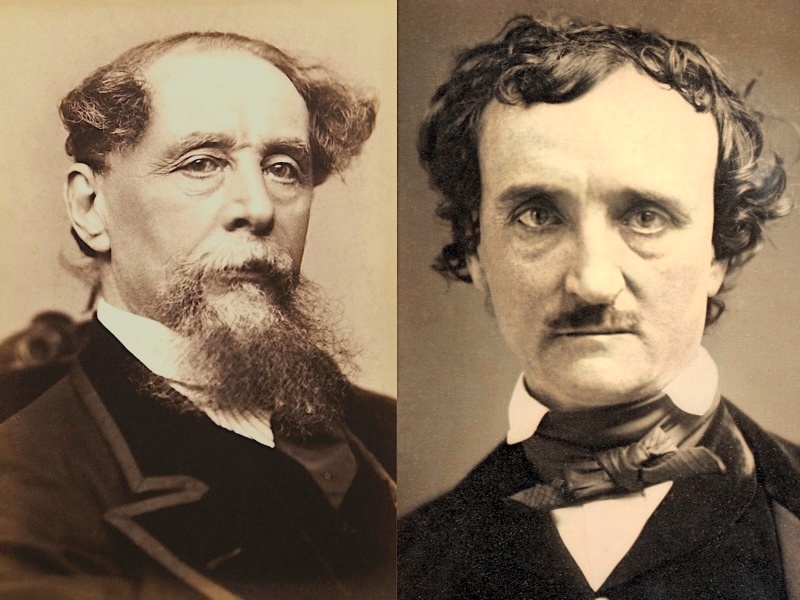
“There comes Poe with his raven,” wrote the poet James Russell Lowell in 1848, “like Barnaby Rudge, / Three-fifths of him genius and two-fifths sheer fudge.” Barnaby Rudge, as you may know, is a novel by Charles Dickens, published serially in 1841. Set during the anti-Catholic Gordon Riots of 1780, the book stands as Dickens’ first historical novel and a prelude of sorts to A Tale of Two Cities. But what, you may wonder, does it have to do with Poe and “his raven”?
Quite a lot, it turns out. Poe reviewed the first four chapters of Dickens’ Barnaby Rudge for Graham’s Magazine, predicting the end of the novel and finding out later he was correct when he reviewed it again upon completion. He was particularly taken with one character: a chatty raven named Grip who accompanies the simple-minded Barnaby. Poe described the bird as “intensely amusing,” points out Atlas Obscura, and also wrote that Grip’s “croaking might have been prophetically heard in the course of the drama.”
It chanced the following year the two literary greats would meet, when Poe learned of Dickens’ trip to the U.S.; he wrote to the novelist, and the two briefly exchanged letters (which you can read here). Along with Dickens on his six-month journey were his wife Catherine, his children, and Grip, his pet raven. When the two writers met in person, writes Lucinda Hawksley at the BBC, Poe “was enchanted to discover [Grip, the character] was based on Dickens’s own bird.”
Indeed Dickens’ raven, “who had an impressive vocabulary,” inspired what Dickens called the “very queer character” in Barnaby Rudge, not only with his loquaciousness, but also with his distinctively ornery personality. Dickens’ daughter Mamie described the raven as “mischievous and impudent” for its habit of biting the children and “dominating” the family’s mastiff, such that the bird was banished to the carriage house.
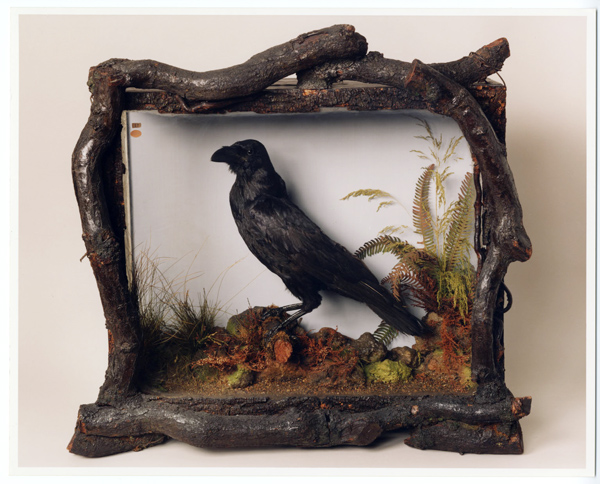
Image courtesy of the Free Library of Philadelphia.
But Dickens—who Jonathan Lethem calls the “greatest animal novelist of all time”—loved the bird, so much that he wrote movingly and humorously of Grip’s death, and had him stuffed. (A not unusual practice for Dickens; we’ve previously featured a letter opener Dickens had made from the paw of his cat, Bob.) The remains of the historical Grip now reside in the rare book section of the Free Library of Philadelphia, “a stuffed raven” writes The Washington Post’s Raymond Lane, “about the size of a big cat.” (See Grip above.)
Of the literary Grip’s influence on Poe, Janine Pollack, head of the library’s rare books department, tells Philadelphia magazine, “It is sort of a unique moment in literature when these two great writers are sort of thinking about the same thing. You think about how much the two men were looking at each other’s work. It’s almost a collaboration without them realizing it.” But can we be sure that Dickens’ Grip, real and imagined, directly inspired Poe’s “The Raven”? “Poe knew about it,” says historian Edward Pettit, “He wrote about it. And there’s a talking raven in it. So the link seems fairly obvious to me.”
Lane adduces some clear evidence of passages in the novel that sound very much like Poe: “At the end of the fifth chapter,” for example, “Grip makes a noise and someone asks, ‘What was that—him tapping at the door?’ Another character responds, ‘’Tis someone knocking softly at the shutter.’” Hawksley notes even more similarities. “Although there is no concrete proof,” she writes, “most Poe scholars are in agreement that the poet’s fascination with Grip was the inspiration for his 1845 poem The Raven.”
Where we often find surprising lineages of influence from author to author, it’s unusual that the connections are so direct, so personal, and so odd, as those between Poe, Dickens, and Grip the talking raven. I’m especially struck by an irony in this story: Poe courted Dickens in 1842 “to impress the novelist,” writes Sidney Moss of Southern Illinois University, “with his worth and versatility as a critic, poet, and writer of tales,” and with the aim of establishing a literary reputation, and publishing contracts, in England.
While Dickens seemed duly impressed, and willing to help, nothing commercial came of their exchange. Instead, Dickens and his raven inspired Poe to write the most famous poem of his life, “The Raven,” for which he will be remembered forevermore.
Note: An earlier version of this post appeared on our site in 2016.
Related Content:
Explore an Online Archive of 2,100+ Rare Illustrations from Charles Dickens’ Novels
Charles Dickens Gave His Cat “Bob” a Second Life as a Letter Opener
The Historic Meeting Between Dickens and Dostoevsky Revealed as a Great Literary Hoax
Josh Jones is a writer and musician based in Durham, NC.
Read More...The Early Years of Electronic Pop: The Moog Craze, Psychedelic Experiments, and More
There’s a decent chance you’ve heard at least a couple of tracks from Wendy Carlos’ Switched-On Bach. But when was the last time you put on Switched-On Rock, Switched-On Country, Switched-On Santa, or Switched-On Bacharach? More likely than not, you’ve never even heard of those other albums, which have nothing to do with Carlos and everything to do with the music-industry fad that her then-high-tech renditions of Bach set off in the late nineteen-sixties and early seventies. That’s the subject of the new Bandsplaining video above, which covers the “awkward and glorious” releases that constituted the initial waves of electronic pop music.
Like so many cultural shifts, the rise of electronic pop took place thanks to a technological change. To be more specific, it was made possible by the invention of the voltage-controlled, modular synthesizer, itself dependent on two particular innovations. Voltage control permitted the pitch of the sounds being generated to be selected with a piano-style keyboard, a slide ribbon, a sequencer, or any other interface the creator’s electronics know-how would allow. In the context of synthesizers, a module is “a little box with an input and an output that did one thing and one thing only, either making a waveform or modifying it somehow,” as Robert Moog once described it, adding that multiple modules could be connected together with cables.
If the name Moog sounds familiar, that’s because the lines of synthesizers that bear it changed music forever. In fact, Carlos used an early Moog model to record Switched-On Bach, having custom-built it in collaboration with the inventor himself. Though the machine set up behind the Bach impersonator on that album’s cover may look unwieldy today, it represented a major improvement in convenience over the room-filling, musically unintuitive behemoths previously accessible only at certain universities and corporate R&D departments. So did the synthesizer invented by Don Buchla on the west coast, at about the same time Moog was building his on the east coast, though each man’s design expressed a different vision of how electronic instruments would adapt to music, or vice versa.
Indeed, up through at least the first few years of the seventies, it would’ve been impossible to say how or whether electronic sounds would find their place in mainstream records. The emergence of home hi-fi culture created a market for swinging “space age pop” by the likes of Les Baxter, Dick Hyman, and Juan Garcia Esquivel, the subject of Bandsplaining’s previous video. This one highlights such releases as Richard Hayman’s Genuine Electric Latin Love Machine and Gershon Kingsley’s Music to Moog By, whose track “Popcorn” would become a worldwide hit when re-recorded by Hot Butter in 1972, but not before the space-age composer Hyman got in on the action. “The Minotaur,” his piece of hypnotic psychedelia with an Indian drone and Greek melody, reached #38 on the Hot 100 57 years ago — and today, remains a thrilling eight-and-a-half-minute ride down one of the many roads electronic pop music didn’t take.
Related Content:
The History of Electronic Music in 476 Tracks (1937–2001)
What is Electronic Music?: Pioneering Electronic Musician Daphne Oram Explains (1969)
How the Moog Synthesizer Changed the Sound of Music
Watch Composer Wendy Carlos Demo an Original Moog Synthesizer (1989)
Based in Seoul, Colin Marshall writes and broadcasts on cities, language, and culture. He’s the author of the newsletter Books on Cities as well as the books 한국 요약 금지 (No Summarizing Korea) and Korean Newtro. Follow him on the social network formerly known as Twitter at @colinmarshall.
Read More...Inside the Making of the Sagrada Família, Barcelona’s 144-Year Megaproject
To get a sense of Sagrada Família’s popularity with YouTubers, you have only to take a look at the related Open Culture posts linked below. As will hardly escape your attention, most subjects that consistently draw the attention of the GoPro class are not nineteenth-century Catholic churches. But Antoni Gaudí’s masterpiece, whose construction alone has survived him by a century now, transcends many boundaries of intellectual and cultural interest: history channels feature it, travel channels feature it, religious channels feature it, and, of course, architecture channels feature it. Most recently, Sagrada Família has appeared on The B1M, which is all about construction — the more ambitious, the better.
We’ve previously posted B1M videos on the Flatiron Building, the Guggenheim Museum Bilbao, the extraterrestrially curving work of Zaha Hadid, and every generation of New York skyscraper. That selection only hints at the range of structures to which the channel’s creator Fred Mills has paid close attention, and yet it’s Sagrada Família that puts him at a loss. “There’s parts of this building where you can’t help but describe what you’re seeing,” he says as he stands in its stained glass-illuminated central nave. “There’s other moments where you don’t have the words; it’s just emotion.” Entering it feels, as he describes it, “less like you’re standing inside a building, and more like you’ve been transported to the threshold of heaven itself.”
How does Sagrada Família create this experience for its visitors, even in its incomplete state? Some will credit divine inspiration; others, Gaudí’s sheer architectural genius. Mills seeks out more concrete forms of explanation, right down to the very blocks of stone used to build its towers. Granted much more access than ordinary tourists, who now come at a rate of about 1,500 per hour, he goes all the way up to see the massive cross assembled on the church’s pinnacle, and all the way down to the basement workshop where intricate models test the myriad possible ways to realize Gaudí’s vision. For when he died in 1926, having been hit by a tram, the plans he left behind didn’t exactly explain all the details about how to finish what resembled no other building ever erected, religious or otherwise.
As Mills points out, subsequently developed technologies have helped keep Sagrada Família’s now 144-year-long construction proceeding apace. And though great celebration attended the topping-out of its central tower high above the streets of Barcelona this past February, more work remains to be done. Completing its interior, roofs, and side chapels, as well as the grand façade with its main entrance, should take another decade, depending on how the relevant disputes involving local residents and the city council play out. Still, it seems likely indeed that Sagrada Família will finally be finished within our lifetimes, which makes for the kind of drama that will keep attracting both large- and small-time documentarians. “I’m not sure we’re ever going to see anything else quite like it,” Mills says, which hints at another reason for all the content-creator fascination: though it may well be completed in our age, Sagrada Família could hardly be less of our age.
Related Content:
LEGO Lets You Build Gaudí’s Sagrada Família in Its Largest Set Ever
Based in Seoul, Colin Marshall writes and broadcasts on cities, language, and culture. He’s the author of the newsletter Books on Cities as well as the books 한국 요약 금지 (No Summarizing Korea) and Korean Newtro. Follow him on the social network formerly known as Twitter at @colinmarshall.
Read More...The Vibrant Color Wheels Designed by Goethe, Newton & Other Theorists of Color (1665–1810)
Maybe it’s the cloistered headiness of Rene Descartes, or the rigorous austerity of Isaac Newton; maybe it’s all the leathern breeches, gray waistcoats, sallow faces, and powdered wigs… but we tend not to associate Enlightenment Europe with an explosion of color theory. Yet philosophers of the late 17th and 18th centuries were obsessed with light and sight. Descartes wrote a treatise on optics, as did Newton.
Newton first described in his 1672 paper the “revolutionary new theory of light and colour,” the University of Cambridge Whipple Library writes, “in which he claimed that experiments with prisms proved that white light was comprised of light of seven distinct colours.” Scientists debated Newton’s theory “well into the 19th century.”
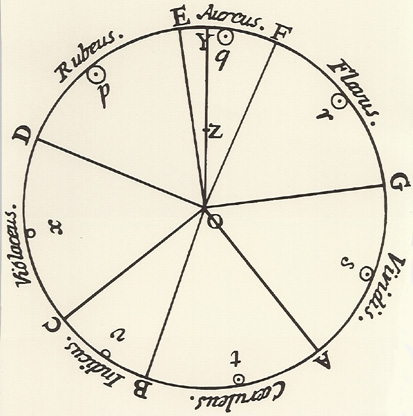
One early opponent famously illustrated his rebuttal. Poet, writer, and scientist Johann Wolfgang von Goethe published Theory of Colors (see here), with its carefully hand-drawn and colored diagrams and wheels, in 1810. From Newton’s time onward, color theorists elaborated prevailing concepts with color wheels, the first attributed to Newton in 1704 (and drawn in black and white, above).
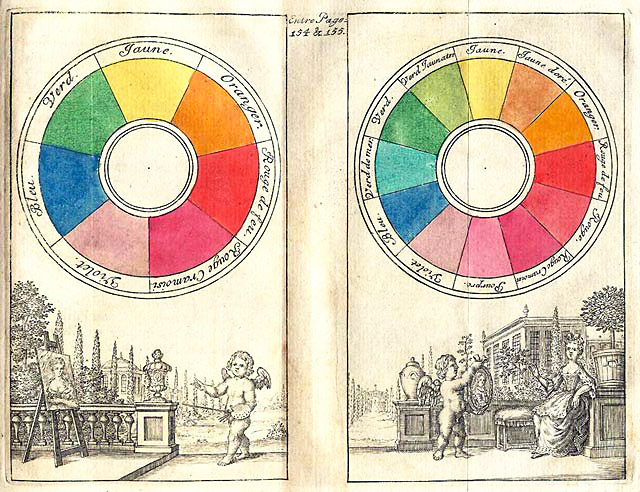
Newton’s wheel “arranged red, orange, yellow, green, blue, indigo, and violet into a natural progression on a rotating disk.” A few years later, two color circles—one with 7 colors and another with 12—appeared in a painting manual attributed to Claude Boutet (top), based on Newton’s theories. Artists, chemists, mapmakers, poets, even entomologists… everyone seemed to have a pet theory of color, generally accompanied by elaborate colored charts and diagrams.
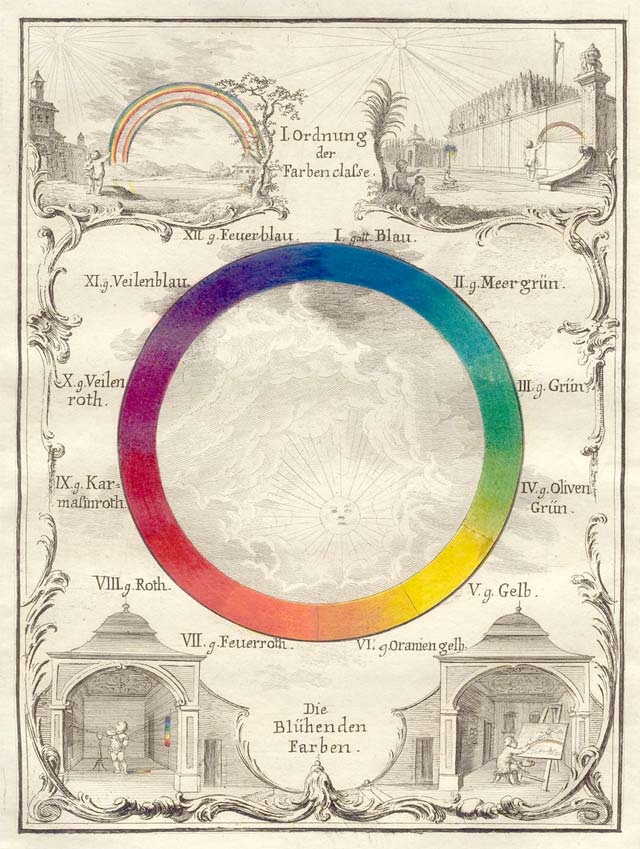
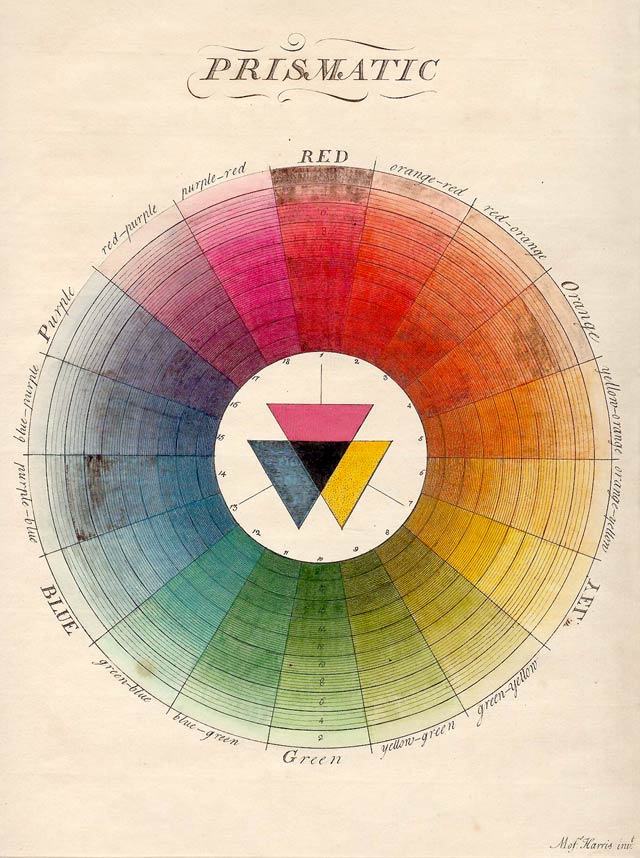
The color wheel was one among many forms—which often presented contrasting theories, like that of Jacques-Fabien Gautier, who argued that black and white were primary colors. But the wheel, and Newton’s basic ideas about it, have endured almost unchanged. The wheel further up (third one from top) by British entomologist Moses Harris from 1766 shows Newton’s 7‑color scheme simplified to the 6 primary and secondary colors we usually see, arranged in the complementary and analogous scheme, with tertiary gradations between them. Another entomologist, Ignaz Schiffermüller, drew the 12-color wheel right above.
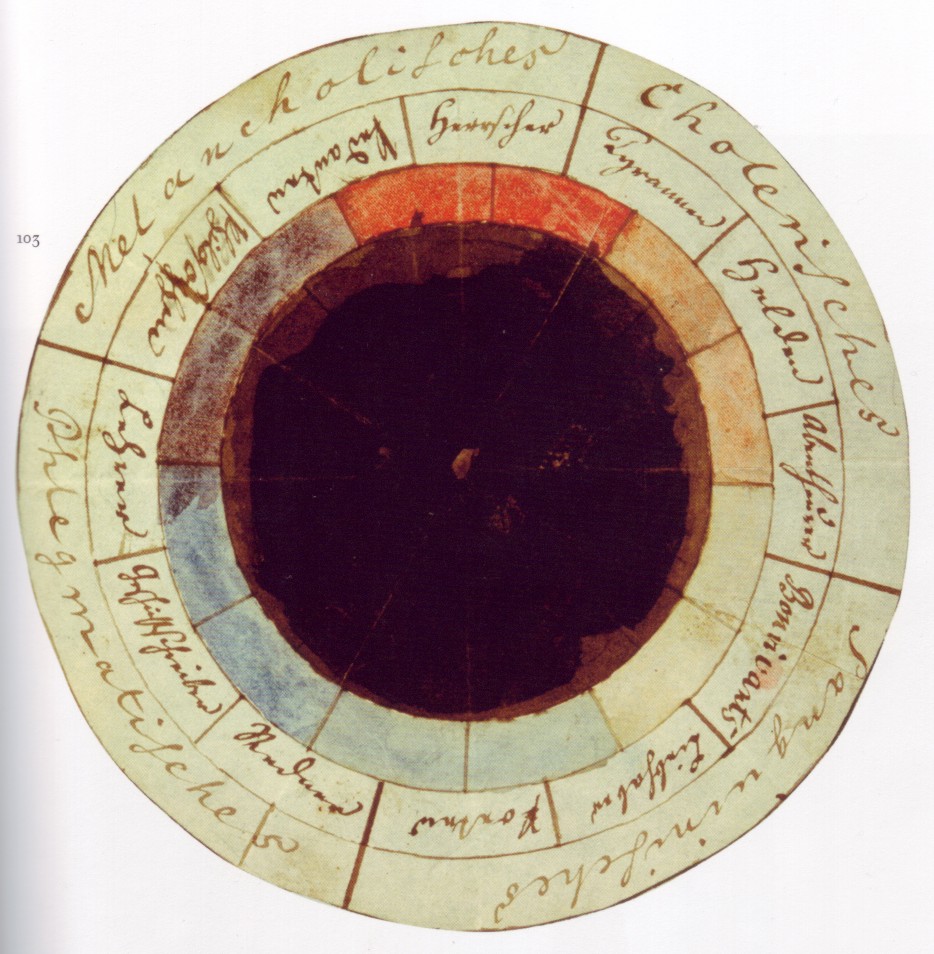
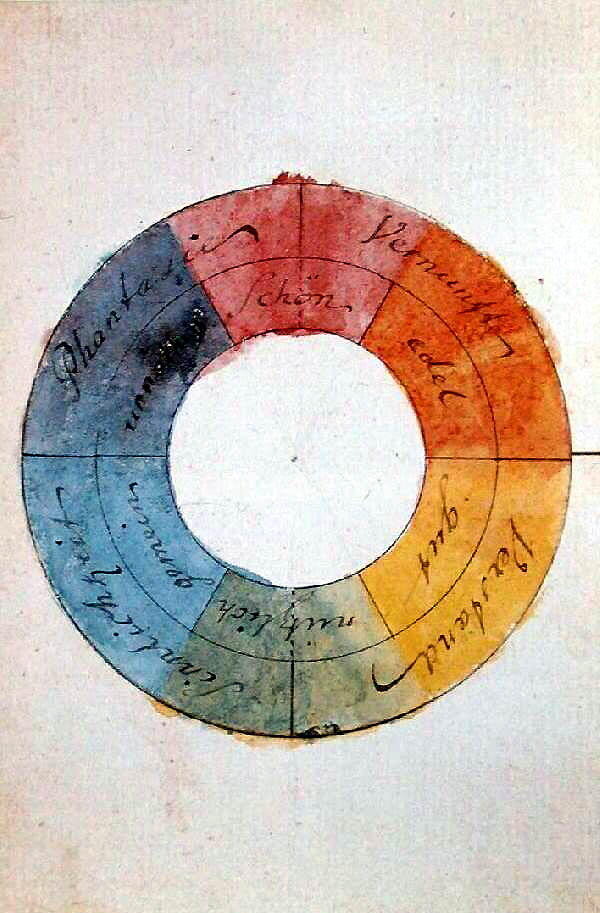
Color is always representative. Newton’s original wheel included “musical notes correlated with color.” By the end of the 18th century, color theory had become increasingly tied to psychological theories and typologies, as in the wheel above, the “rose of temperaments,” made by Goethe and Friedrich Schiller in 1799 to illustrate “human occupations and character traits,” the Public Domain Review notes, including “tyrants, heroes, adventurers, hedonists, lovers, poets, public speakers, historians, teachers, philosophers, pedants, rulers,” grouped into the four temperaments of humoral theory.
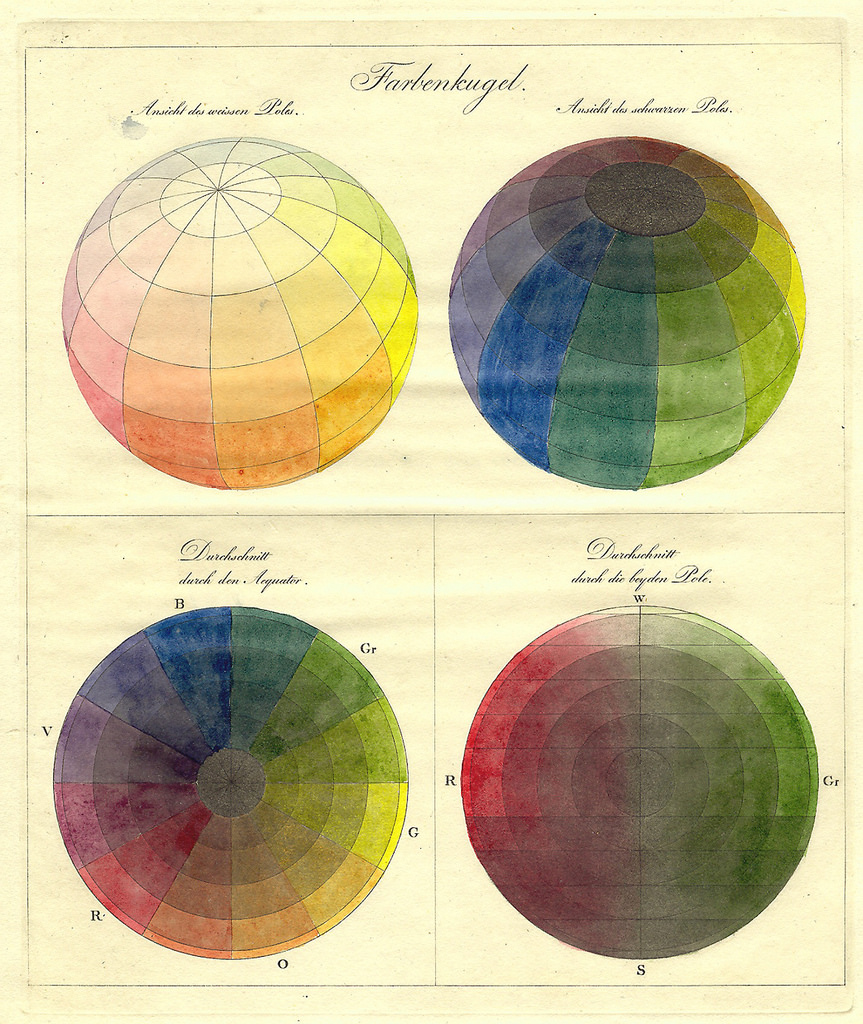
It’s a fairly short leap from these psychologies of color to those used by advertisers and commercial designers in the 20th century—or from the artists and scientists’ color theories to abstract expressionism, the Bauhaus school, and the chemists and photographers who recreated the colors of the world on film. (Goethe’s color wheel, below, from Theory of Colors, illustrates his chapter on “Allegorical, symbolic, and mystical use of colour.”) See more early color wheels, like Philipp Otto Runge’s 1810 Farbenkugel, as well as other conceptual color schemes, at the Public Domain Review.
Note: An earlier version of this post appeared on our site in 2017.
Related Content:
A 900-Page Pre-Pantone Guide to Color from 1692: A Complete High-Resolution Digital Scan
Josh Jones is a writer and musician based in Durham, NC.
Read More...Sears Sold 75,000 DIY Mail Order Homes Between 1908 and 1939, and Transformed American Life
Two of the books that most shaped American culture both happened to bear the nickname “The Big Book.” While the second of these, the A.A. Manual, published in 1939, changed the country with 12-Step recovery groups, the first of these, the Sears Catalog, transformed America with mass consumption, offering customers in every part of the country access to modern conveniences and retail goods of all kinds at unheard of prices. Beginning in 1908, Sears started selling entire houses, in approximately 25-ton kits transported by railroad, consisting of 30,000 pre-cut parts, plumbing and electrical fixtures, and up to 750 pounds of nails.
“In an era before commercial aviation and long-haul trucking,” Curbed marvels, “Sears, Roebuck & Co. set up an operation that would package and ship more than 400 different types of homes and buildings to anybody who had the cash and access to a catalog.”
They started small, and just as they didn’t come up with the concept of the mail order catalog, Sears didn’t invent the kit house, though they suggest as much in their telling of the story. Instead they may have taken the idea from another company called Aladdin. Aladdin houses have been forgotten, however, and even Sears’ main competitor, Montgomery Ward, didn’t catch up until 1921 and only lasted ten years in the kit house business.
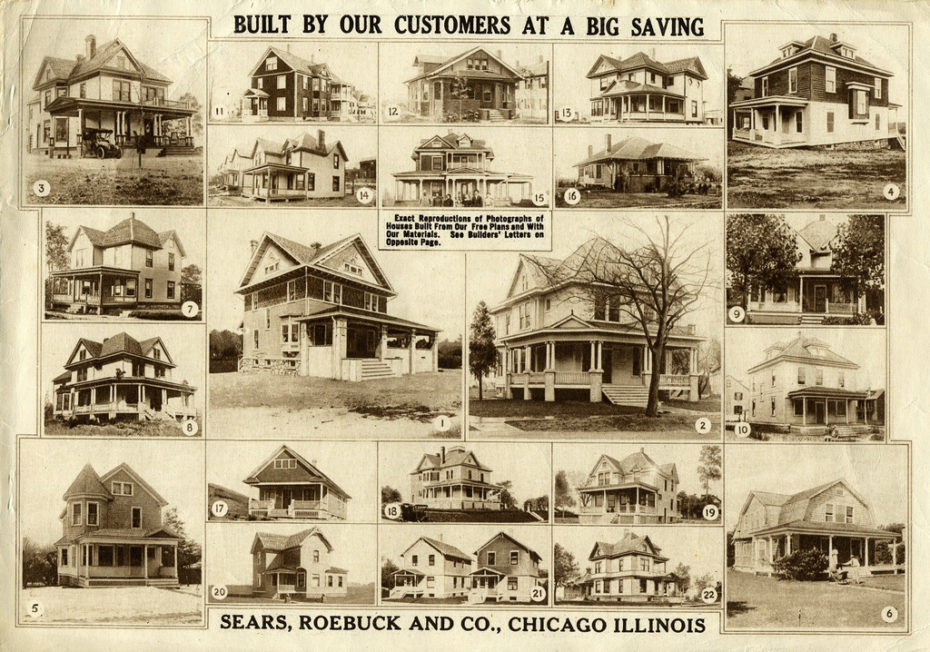
Sears houses, on the other hand, are celebrated and sought out as models of the early 20th century American home, and for good reason. Between 1908 and 1939, Sears sold 70–75,000 houses in 447 different styles all over the country. “From Craftsman to Cape Cods, they offered a custom home at budgets and sizes that could accommodate any size family,” writes Popular Mechanics.
These Sears homes weren’t cheap low-end houses. Many of them were built using the finest quality building materials available during that time. It’s not uncommon to find Sears homes today with oak floors, cypress siding, and cedar shingles.
What’s even more extraordinary is that 50% of these were built by the homeowners themselves, usually, as in a barn-raising, with the generous help of family, friends, and neighbors. The other half sold were built professionally. “Often,” writes Messy Nessy, “local builders and carpentry companies purchased homes from Sears to build as model homes and market their services to potential customers.”
These houses could have a significant effect on the character of a neighborhood. Not only could potential buyers see firsthand, and participate in, the construction. They could also order the same or a similar model, customize it, and even—as the company tells us in its own short history of the “Sears Modern Home”—design their own homes and “submit the blueprints to Sears, which would then ship off the appropriate precut and fitted materials.”
Sears sounds modest about its impact. The company writes it was not “an innovative home designer” but instead “a very able follower of popular home designs but with the added advantage of modifying houses and hardware according to buyer tastes.” Yet Sears houses aren’t beloved for their forward-looking designs, but for their sturdiness and variety, as well as for their impact on “the emotional lives of rural folk,” as Messy Nessy puts it.
“The Sears mail-order catalogues were sitting on kitchen countertops inside millions of American homes, allowing potential homeowners to both visualize their new home and purchase it as easily as they might have bought a new toaster.” Building a house required a little more investment than plugging in a toaster, and required a 75-page instruction book, but that’s another part of why Sears house hunters are such a dedicated bunch, awestruck at each still-standing model they’re able to photograph and match up with its catalog illustrations and floor plans.
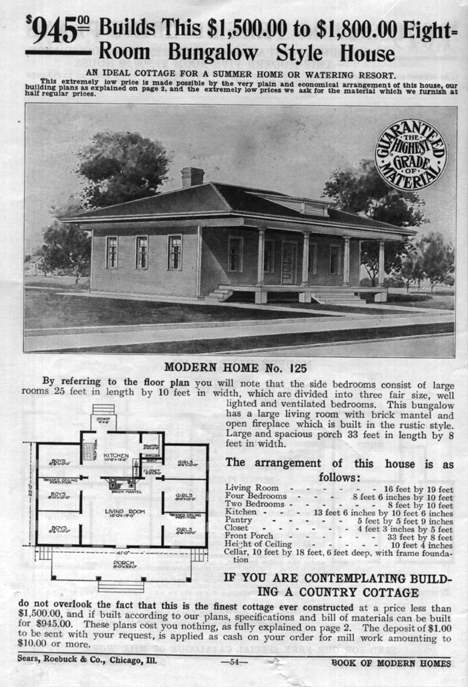
In its first year of production, 1908, Sears sold only one model, number 125, an Eight-Room Bungalow Style House for $945, advertised as “the finest cottage ever constructed at a price less than $1500.” In 1918, the company moved from a numbering system to named models, most of which sound like the names of cozy small towns and bedroom communities: Adeline, Belmont, Maplewood, Avalon, Kilbourne, Del Ray, Stone Ridge…. (See a full list of these models at The Arts & Crafts Society website.)
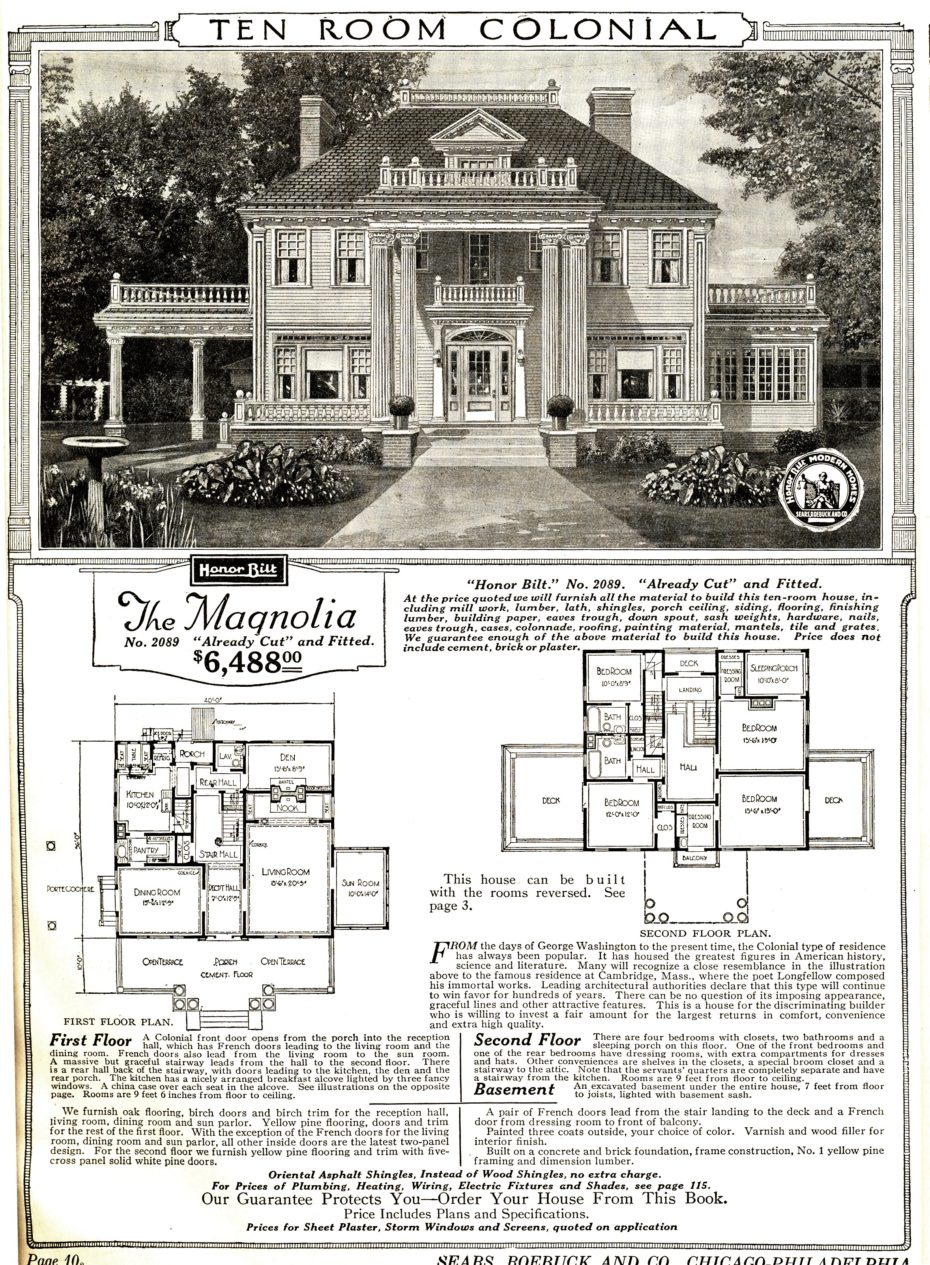
In the years Sears sold houses, between 54 and 44 percent of Americans lived in rural areas, and these constituted Sears’ most loyal customers, given that the catalog allowed them to purchase things they could buy nowhere else, including ten room colonial mansions like The Magnolia, available from 1913 to 1922 for $6,488, or roughly $88,000—a steal if you can put in the work. This was the largest and most expensive model the company offered, “a three-story, eight room neo-Georgian with a two-story columned portico, porte-cochere, and sleeping porches.” (Mint juleps and servants’ quarters not included.)
Sears eventually offered three build qualities, Honor Bilt, Standard Built, and Simplex Sectional. At the lowest end of the price and build spectrum, the company notes, “Simplex houses were frequently only a couple of rooms and were ideal for summer cottages.” Many of its low-end and early models did not include bathrooms, and the company sold outhouses separately. But due to innovative construction methods, even the least expensive houses held up well.
Because the company lost most of the records after its kit house business folded, it can be difficult to identify a Sears house. And because even the “youngest of Sears homes,” Popular Mechanics points out, is now going on nine decades old, they all require a significant amount of care.” The blog Kit House Hunters has found over 18,000 Sears houses still standing across the country, most of them in the Northeast and Midwest, where they sold best. (One community in Elgin, IL has over 200 verified Sears homes.)
In the video at the top, you can see a few of those well-built Sears houses still lived in today. The short How to Architect video above points out that “Sears had a massive impact on the business of home-building, and… the business of pre-fabrication, is alive and well today.” For a look at the variety and intricacy of the Sears Modern Home designs, see this Flickr gallery with over 80 images of catalog pages, illustrated homes, and floor plans. And if you think you might be living in one of these houses, many of which have been granted historic status, find out with this handy 9‑step guide for identifying a Sears Kit Home.
Note: An earlier version of this post appeared on our site in 2018.
Related Content
When Frank Lloyd Wright Designed a Doghouse, His Smallest Architectural Creation (1956)
Read More...Hear How Clare Torry’s Vocals on Pink Floyd’s “The Great Gig in the Sky” Made the Song Go from Pretty Good to Downright Great
Smack in the middle of Pink Floyd’s classic Dark Side of the Moon sits a song many listeners may hear as an extended bridge between the two true centerpieces, “Time” and “Money.” But I’ve always thought of “The Great Gig in the Sky” as the album’s true center, a swirling, swinging, soulful prog-rock masterpiece, carried to stratospheric heights by British singer Clare Torry. The song’s wordless gospel vocal makes it an ecstatic, even hopeful, tent pole supporting Dark Side’s brilliantly cynical songs about the banality and injustice of modern life.
“The Great Gig in the Sky,” that is to say, provides much-needed emotional release in an album that can sound, writes Alexis Petridis, “like one long sigh.” Yet if you know the story of Dark Side of the Moon and of Clare Torry’s defining contribution, you’ll know that her incredible soaring vocal was sheer happenstance, an improvisation by a young singer brought in at the last minute by producer Alan Parsons—and one who wasn’t a particular fan of the band. (“If it had been The Kinks,” she remembered, “I’d have been over the moon.”)
Torry reluctantly stepped into the studio and asked the band, “Well, what do you want?” Basically, she says, “they had no idea.” An isolated track from Alan Parsons’ 1973 mix (above) strips the song down to piano, drums, slide guitar, and Torry’s voice. Early live versions of the song in 1972 had featured Bible readings and recorded speeches by conservative writer Malcolm Muggeridge; in the final version, these gave way to snippets of the band’s crew and friends answering questions about death.
When Torry went into the vocal booth and put on the headphones, she would have heard an even more stripped-down mix. Given no other instruction than “we don’t want any words,” she decided, “I have to pretend to be an instrument.”
Torry’s vocal is so distinctive that she eventually won a settlement in 2005 for a co-songwriting credit with Wright—an outcome some songwriting experts agree was fully justified since she essentially created a new melody for the song. In the interview above, hear Torry describe how she “had a little go” and, after some guidance from David Gilmour and a can of Heineken, casually knocked out one of the most thrilling vocal performances in rock history.
Note: An earlier version of this post appeared on our site in 2017.
Related Content:
Hear Pink Floyd’s “Great Gig in the Sky” Played on the Theremin
Edvard Munch’s Famous Painting “The Scream” Animated to the Sound of Pink Floyd’s Primal Music
Pink Floyd’s “Echoes” Provides a Soundtrack for the Final Scene of Kubrick’s 2001: A Space Odyssey
Josh Jones is a writer and musician based in Durham, NC.
Read More...The Names of Nearly 4 Million Enslaved People in Former British Colonies Are Now Searchable Online, Helping Descendants Find Lost Ancestors
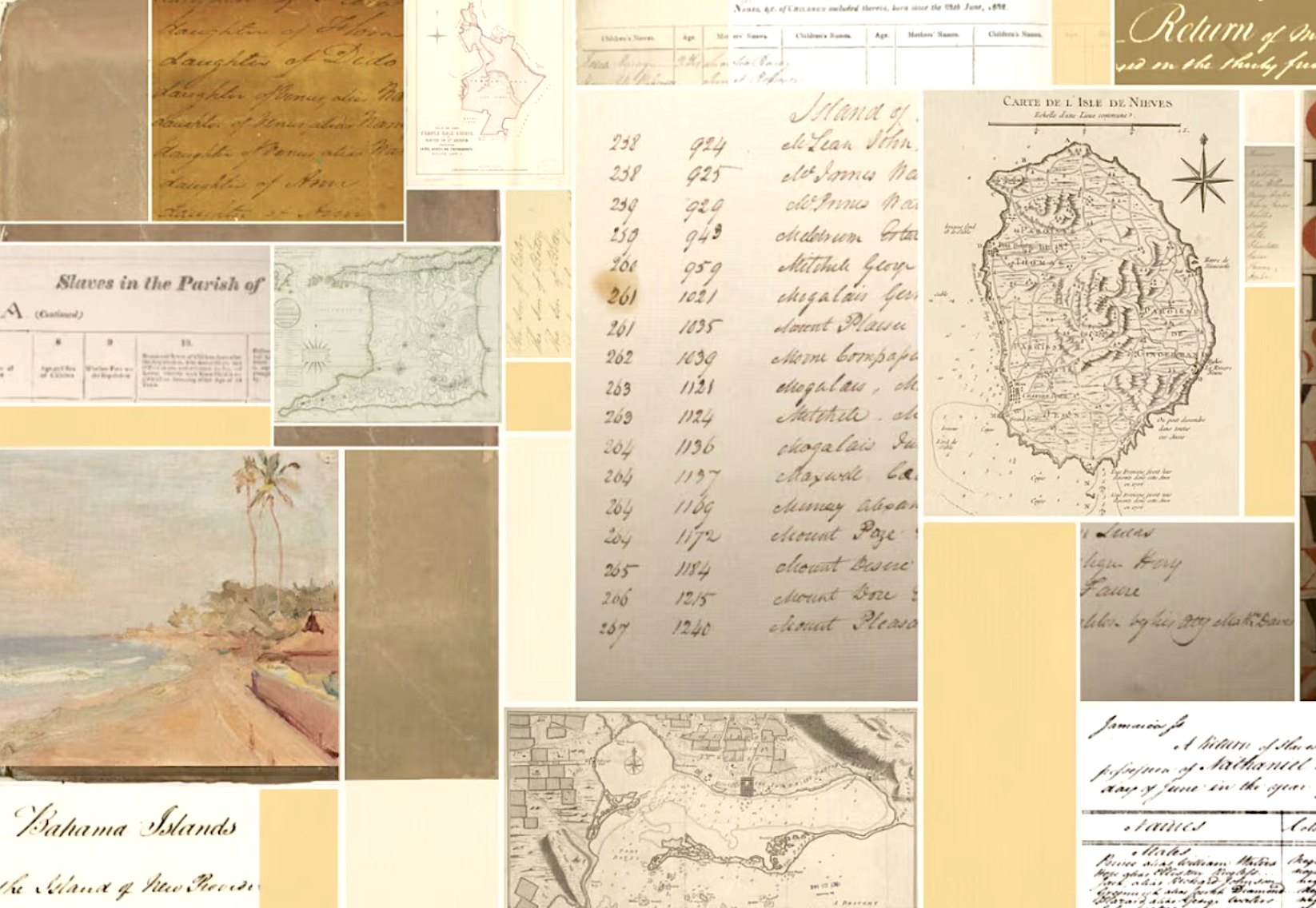
A few years ago, we featured here on Open Culture the Freedmen’s Bureau Project database, which contains searchable information on formerly enslaved people in the United States after its Civil War. With nearly 1.8 million men, women, and children registered there when it first opened to the public, it has remained a valuable resource for many Americans researching their own heritage, not just descendants of former slaves but of other Civil War refugees as well. But of course, the U.S. was hardly the only country where slavery existed. Countless people here in the twenty-first century have ancestors who were enslaved in other former British colonies, and now they’ve got a portal through which to do genealogical searches of their own.
Launched by a partnership between the genealogy company Ancestry and the Centre for the Study of the Legacies of British Slavery at University College London, the online Former British Colonies Enslavement Registers makes available records on nearly four million individuals enslaved between 1813 and 1840 in a host of countries from the Bahamas to Mauritius to South Africa.
First created by the British government during the process of abolishing the transatlantic slave trade in 1807 — much as the Freedmen’s Bureau organized its registry of former slaves during Reconstruction under Abraham Lincoln — the original papers contain not just their names and ages, but also maternal family connections, physical descriptions, and sometimes details about their place of African origin.
In the video above, genealogist and Ancestry Senior Story Producer Nicka Sewell-Smith provides an introduction to the Former British Colonies Enslavement Registers, which you can access here. If you’re curious about whether your own ancestors may appear in its records, you can search by details like name, approximate date, or location to narrow down the potential matches. The modern descendants of people enslaved in the 20 countries covered by the database by no means live exclusively, or even primarily, in those countries or in Great Britain itself. More than two centuries later, their descendants live all over the world, including in Latin America and the United States, leading lives very different from those of their enslaved ancestors — but the reconstruction of their family stories has only just begun. Enter the database here.
Related content:
Based in Seoul, Colin Marshall writes and broadcasts on cities, language, and culture. He’s the author of the newsletter Books on Cities as well as the books 한국 요약 금지 (No Summarizing Korea) and Korean Newtro. Follow him on the social network formerly known as Twitter at @colinmarshall.
Read More...Support Us
We're hoping to rely on loyal readers, rather than erratic ads. Please click the Donate button and support Open Culture. You can use Paypal, Venmo, Patreon, even Crypto! We thank you!

About Us

Open Culture scours the web for the best educational media. We find the free courses and audio books you need, the language lessons & educational videos you want, and plenty of enlightenment in between.
Advertise With Us

FREE UPDATES!
GET OUR DAILY EMAIL
Get the best cultural and educational resources on the web curated for you in a daily email. We never spam. Unsubscribe at any time.
FOLLOW ON SOCIAL MEDIA

Open Culture editor Dan Colman scours the web for the best educational media. He finds the free courses and audio books you need, the language lessons & movies you want, and plenty of enlightenment in between.
Advertise With Us


