Nearly 50 Years Later, WKRP in Cincinnati Becomes a Real Radio Station
It took nearly 50 years. WKRP in Cincinnati is no longer just a TV sitcom. It’s now a real radio station in Cincinnati.
A Cincy-area FM station, known as “The Oasis,” has adopted the WKRP call letters after acquiring them from a nonprofit radio station in North Carolina. The Raleigh-based station put the call letters up for auction as part of a fundraising effort. And then The Oasis snapped them up.
To mark the official launch last week, the station played the TV show’s theme song for six straight hours. Moving forward, the station will continue playing classic rock from the ’60s through the ’80s — much like the music featured on the 1978–82 sitcom. As a bonus, Gary Sandy, who played program director Andy Travis, has recorded promos for the revived WKRP. If the original show was before your time, you can watch some episodes on YouTube. Enjoy…
If you would like to support the mission of Open Culture, consider making a donation to our site. It’s hard to rely 100% on ads, and your contributions will help us continue providing the best free cultural and educational materials to learners everywhere. You can contribute through PayPal, Patreon, and Venmo (@openculture). Thanks!
Related Content
All the Music Played on MTV’s 120 Minutes: A 2,500-Video Youtube Playlist
All of the Songs Played on “WKRP in Cincinnati” in One Playlist: Stream 202 Classic Tracks
MTV Rewind Lets You Revisit 40,000 Music Videos & Commercials from the Golden Age of MTV
Read More...
Why Ancient Egyptian Honey Remains Edible After 3,000 Years
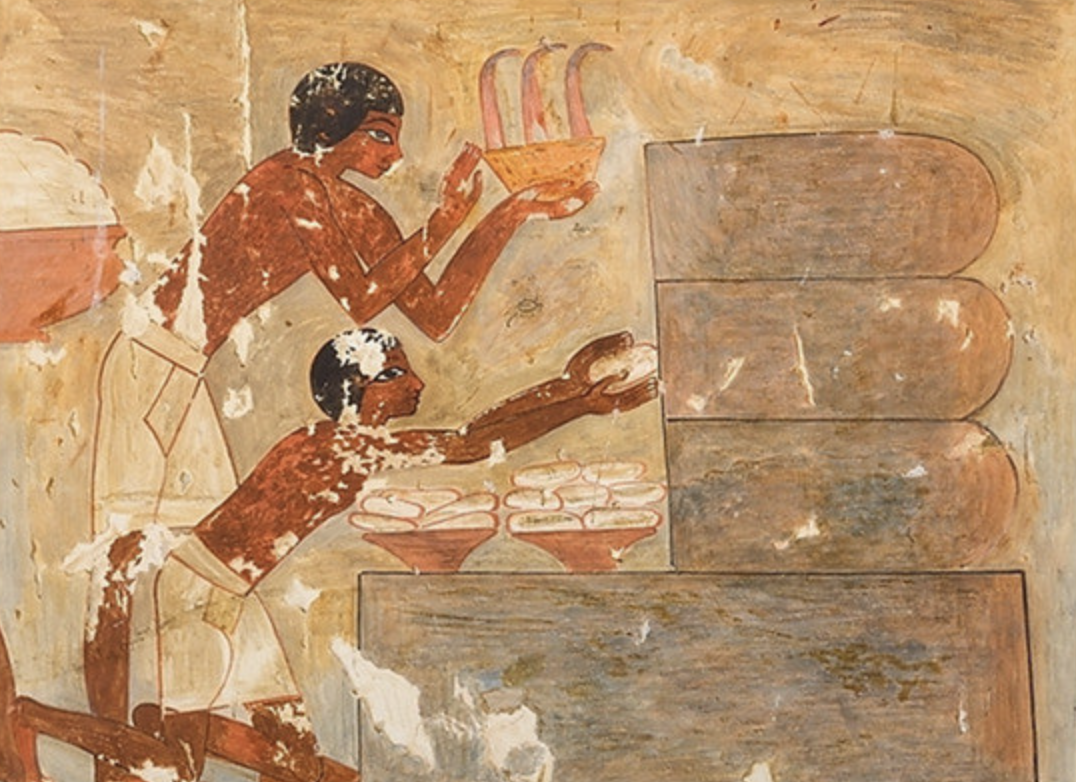
The global bee population comes up in the news every now and again. Sometimes we’re assured that the number is stable or rising; more often, we’re warned about collapsing colonies and the large-scale ecological disaster that could result. As with most high-stakes issues, it can be difficult to know what to believe. But even if you lack the time to invest in an understanding of the science behind the complex connections between apian and human welfare, you can easily come to appreciate the importance of bees if you learn just how long they’ve played a role in our civilization.
As Elana Spivack writes at History.com, “a cave painting in northeastern Spain depicting a human harvesting honey dates back 7,500 years to the Neolithic period, according to research published in 2021 in the journal Trabajos de Prehistoria.” Just last year, a paper in the Journal of the American Chemical Society confirmed that bronze containers discovered in an underground shrine in a sixth-century-BC Greek settlement not far from Pompeii contained a residue of honey. We’ve long known of hieroglyphs from ancient Egypt that depict bees and the keeping thereof; “according to a 2022 paper in the journal Animals, the use of honeybees in the Nile Valley can be traced to the earliest years of the Egyptian kingdom.”
Here in the twenty-first century, most of us regard honey as nothing more than a relatively healthy sweetener. In ancient Egypt, too, it was used to improve the taste of their bread and beer, but it was also put to important medical uses. “Because it’s so thick, rejects any kind of growth and contains hydrogen peroxide, it creates the perfect barrier against infection for wounds,” writes Smithsonian’s Natasha Geiling. “The ancient Egyptians used medicinal honey regularly, making ointments to treat skin and eye diseases.” They may not have been the first to do so, given that the earliest known uses of honey are recorded on Sumerian clay tablets, but they took respect for the stuff to a whole new level, describing honeybees as originating from the tears of their sun god Re (formerly known in the English-speaking world as Ra).
That particular piece of mythology is recorded on some Egyptian papyri; others reveal how much honey was rationed to workers, at least those employed directly by the Pharaoh. In those days, the substance’s golden color reflected its dearness, and it seems that common laborers and their families could go a lifetime without ever tasting a spoonful themselves. Today, of course, we take it for granted that we can go down to the supermarket and cheaply buy an economy-size tub of honey that never goes bad. But then, ancient Egyptian honey has never gone bad either: thanks to the very same chemical and biological properties that made it useful for healing, the sealed jars of it remain theoretically edible even after 3,000 years. Drizzle it on some genuine Greek yogurt, and you’ve got a large swath of the history of civilization in breakfast form.
Related content:
Try the Oldest Known Recipe For Toothpaste: From Ancient Egypt, Circa the 4th Century BC
How Egyptian Papyrus Is Made: Watch Artisans Keep a 5,000-Year-Old Art Alive
How Scientists Recreated Ancient Egypt’s Long-Lost Pigment, “Egyptian Blue”
Based in Seoul, Colin Marshall writes and broadcasts on cities, language, and culture. He’s the author of the newsletter Books on Cities as well as the books 한국 요약 금지 (No Summarizing Korea) and Korean Newtro. Follow him on the social network formerly known as Twitter at @colinmarshall.
Read More...Leo Tolstoy Calls Shakespeare an ‘Insignificant, Inartistic Writer.’ Then George Orwell Fires Back
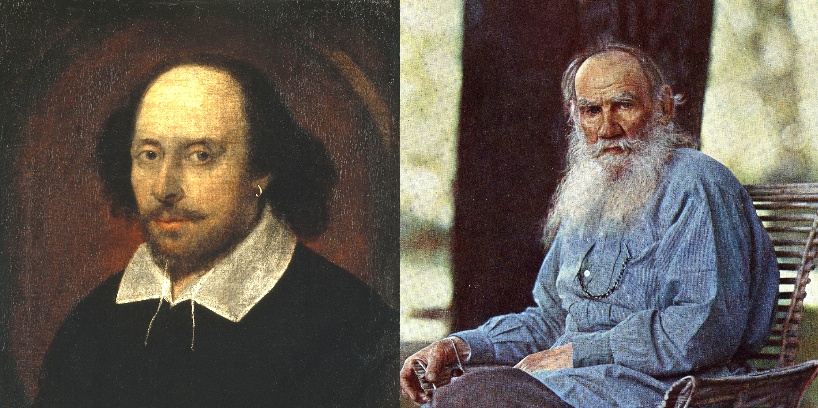
After his radical conversion to Christian anarchism, Leo Tolstoy adopted a deeply contrarian attitude. The vehemence of his attacks on the class and traditions that produced him were so vigorous that certain critics, now mostly obsolete, might call his struggle Oedipal. Tolstoy thoroughly opposed the patriarchal institutions he saw oppressing working people and constraining the spiritual life he embraced. He championed revolution, “a change of a people’s relation towards Power,” as he wrote in a 1907 pamphlet, “The Meaning of the Russian Revolution”: “Such a change is now taking place in Russia, and we, the whole Russian people, are accomplishing it.”
In that “we,” Tolstoy aligns himself with the Russian peasantry, as he does in other pamphlets like the 1909-10 journal, “Three Days in the Village.” These essays and others of the period rough out a political philosophy and cultural criticism, often aimed at affirming the ruddy moral health of the peasantry and pointing up the decadence of the aristocracy and its institutions. In keeping with the theme, one of Tolstoy’s pamphlets, a 1906 essay on Shakespeare, takes on that most hallowed of literary forefathers and expresses “my own long-established opinion about the works of Shakespeare, in direct opposition, as it is, to that established in all the whole European world.”
After a lengthy analysis of King Lear, Tolstoy concludes that the English playwright’s “works do not satisfy the demands of all art, and, besides this, their tendency is of the lowest and most immoral.” But how had all of the Western world been led to universally admire Shakespeare, a writer who “might have been whatever you like, but he was not an artist”? Through what Tolstoy calls an “epidemic suggestion” spread primarily by German professors in the late 18th century. In 21st-century parlance, we might say the Shakespeare-as-genius meme went viral.
Tolstoy also characterizes Shakespeare-veneration as a harmful cultural vaccination administered to everyone without their consent: “free-minded individuals, not inoculated with Shakespeare-worship, are no longer to be found in our Christian society,” he writes, “Every man of our society and time, from the first period of his conscious life, has been inoculated with the idea that Shakespeare is a genius, a poet, and a dramatist, and that all his writings are the height of perfection.”
In truth, Tolstoy proclaims, the venerated Bard is “an insignificant, inartistic writer…. The sooner people free themselves from the false glorification of Shakespeare, the better it will be.”
I have felt with… firm, indubitable conviction that the unquestionable glory of a great genius which Shakespeare enjoys, and which compels writers of our time to imitate him and readers and spectators to discover in him non-existent merits — thereby distorting their aesthetic and ethical understanding — is a great evil, as is every untruth.
What could have possessed the writer of such celebrated classics as War and Peace and Anna Karenina to so forcefully repudiate the author of King Lear? Forty years later, George Orwell responded to Tolstoy’s attack in an essay titled “Lear, Tolstoy and the Fool” (1947). His answer? Tolstoy’s objections “to the raggedness of Shakespeare’s plays, the irrelevancies, the incredible plots, the exaggerated language,” are at bottom an objection to Shakespeare’s earthy humanism, his “exuberance,” or—to use another psychoanalytic term—his jouissance. “Tolstoy,” writes Orwell, “is not simply trying to rob others of a pleasure he does not share. He is doing that, but his quarrel with Shakespeare goes further. It is the quarrel between the religious and the humanist attitudes towards life.”
Orwell grants that “much rubbish has been written about Shakespeare as a philosopher, as a psychologist, as a ‘great moral teacher’, and what-not.” In reality, he says, the playwright, was not “a systematic thinker,” nor do we even know “how much of the work attributed to him was actually written by him.” Nonetheless, he goes on to show the ways in which Tolstoy’s critical summary of Lear relies on highly biased language and misleading methods. Furthermore, Tolstoy “hardly deals with Shakespeare as a poet.”
But why, Orwell asks, does Tolstoy pick on Lear, specifically? Because of the character’s strong resemblance to Tolstoy himself. “Lear renounces his throne,” he writes, “but expects everyone to continue treating him as a king.”
But is it not also curiously similar to the history of Tolstoy himself? There is a general resemblance which one can hardly avoid seeing, because the most impressive event in Tolstoy’s life, as in Lear’s, was a huge and gratuitous act of renunciation. In his old age, he renounced his estate, his title and his copyrights, and made an attempt — a sincere attempt, though it was not successful — to escape from his privileged position and live the life of a peasant. But the deeper resemblance lies in the fact that Tolstoy, like Lear, acted on mistaken motives and failed to get the results he had hoped for. According to Tolstoy, the aim of every human being is happiness, and happiness can only be attained by doing the will of God. But doing the will of God means casting off all earthly pleasures and ambitions, and living only for others. Ultimately, therefore, Tolstoy renounced the world under the expectation that this would make him happier. But if there is one thing certain about his later years, it is that he was NOT happy.
Though Orwell doubts the Russian novelist was aware of it—or would have admitted it had anyone said so—his essay on Shakespeare seems to take the lessons of Lear quite personally. “Tolstoy was not a saint,” Orwell writes, “but he tried very hard to make himself into a saint, and the standards he applied to literature were other-worldly ones.” Thus, he could not stomach Shakespeare’s “considerable streak of worldliness” and “ordinary, belly-to-earth selfishness,” in part because he could not stomach these qualities in himself. It’s a common, sweeping, charge, that a critic’s judgment reflects much of their personal preoccupations and little of the work itself. Such psychologizing of a writer’s motives is often uncalled-for. But in this case, Orwell seems to have laid bare a genuinely personal psychological struggle in Tolstoy’s essay on Shakespeare, and perhaps put his finger on a source of Tolstoy’s violent reaction to King Lear in particular, which “points out the results of practicing self-denial for selfish reasons.”
Orwell draws an even larger point from the philosophical differences Tolstoy has with Shakespeare: “Ultimately it is the Christian attitude which is self-interested and hedonistic,” he writes, “since the aim is always to get away from the painful struggle of earthly life and find eternal peace in some kind of Heaven or Nirvana…. Often there is a seeming truce between the humanist and the religious believer, but in fact their attitudes cannot be reconciled: one must choose between this world and the next.” On this last point, no doubt, Tolstoy and Orwell would agree. In Orwell’s analysis, Tolstoy’s polemic against Shakespeare’s humanism further “sharpens the contradictions,” we might say, between the two attitudes, and between his own former humanism and the fervent, if unhappy, religiosity of his later years.
Note: An earlier version of this post appeared on our site in 2016.
Related Content:
Leo Tolstoy’s 17 “Rules of Life:” Wake at 5am, Help the Poor, & Only Two Brothel Visits Per Month
Leo Tolstoy’s Masochistic Diary: I Am Guilty of “Sloth,” “Cowardice” & “Sissiness” (1851)
Vintage Footage of Leo Tolstoy: Video Captures the Great Novelist During His Final Days
Josh Jones is a writer and musician based in Durham, NC.
Read More...John Cage’s Silent, Avant-Garde Piece 4′33″ Gets Covered by a Death Metal Band
When we think of silence, we think of meditative stretches of calm: hikes through deserted forest paths, an early morning sunset before the world awakes, a staycation at home with a good book. But we know other silences: awkward silences, ominous silences, and—in the case of John Cage’s infamous conceptual piece 4’33”—a mystifying silence that asks us to listen, not to nothing, but to everything. Instead of focusing our aural attention, Cage’s formalized exercise in listening disperses it, to the nervous coughs and squeaking shoes of a restless audience, the ceaseless ebb and flow of traffic and breathing, the ambient white noise of heating and AC…
and the suspended black noise of death metal….
We’re used to seeing 4’33” “performed” as a classical exercise, with a dignified pianist seated at the bench, ostentatiously turning the pages of Cage’s “score.” But there’s no reason at all the exercise—or hoax, some insist—can’t work in any genre, including metal. NPR’s All Songs TV brings us the video above, in which “64 years after its debut performance by pianist David Tudor,” death metal band Dead Territory lines behind their instruments, tunes up, and takes on Cage: “There’s a setup, earplugs go in, a brief guitar chug, a drum-stick count-off and… silence.”
As in every performance of 4’33”, we’re drawn not only to what we hear, in this case the sounds in whatever room we watch the video, but also to what we see. And watching these five metalheads, who are so used to delivering a continuous assault, nod their heads solemnly in silence for over four minutes adds yet another interpretive layer to Cage’s experiment, asking us to consider the performative avant-garde as a domain fit not only for rarified classical and art house audiences but for everyone and anyone.
Also, despite their seriousness, NPR reminds us that Dead Territory’s take is “another in a long line of 4′33″ performances that understand Cage had a sense of humor while expanding our musical universe.” Cage happily gave his experiments to the world to adapt and improvise as it sees fit, and—as we see in his own performance of 4’33” in Harvard Square—he was happy to make his own changes to silence as well.
Note: An earlier version of this post appeared on our site in 2016.
Related Content:
Watch John Cage Play His “Silent” 4′33″ in Harvard Square, Presented by Nam June Paik (1973)
The Curious Score for John Cage’s “Silent” Zen Composition 4′33″
Josh Jones is a writer and musician based in Durham, NC.
Read More...Discover the First Horror & Fantasy Magazine, Der Orchideengarten, and Its Bizarre Artwork (1919–1921)
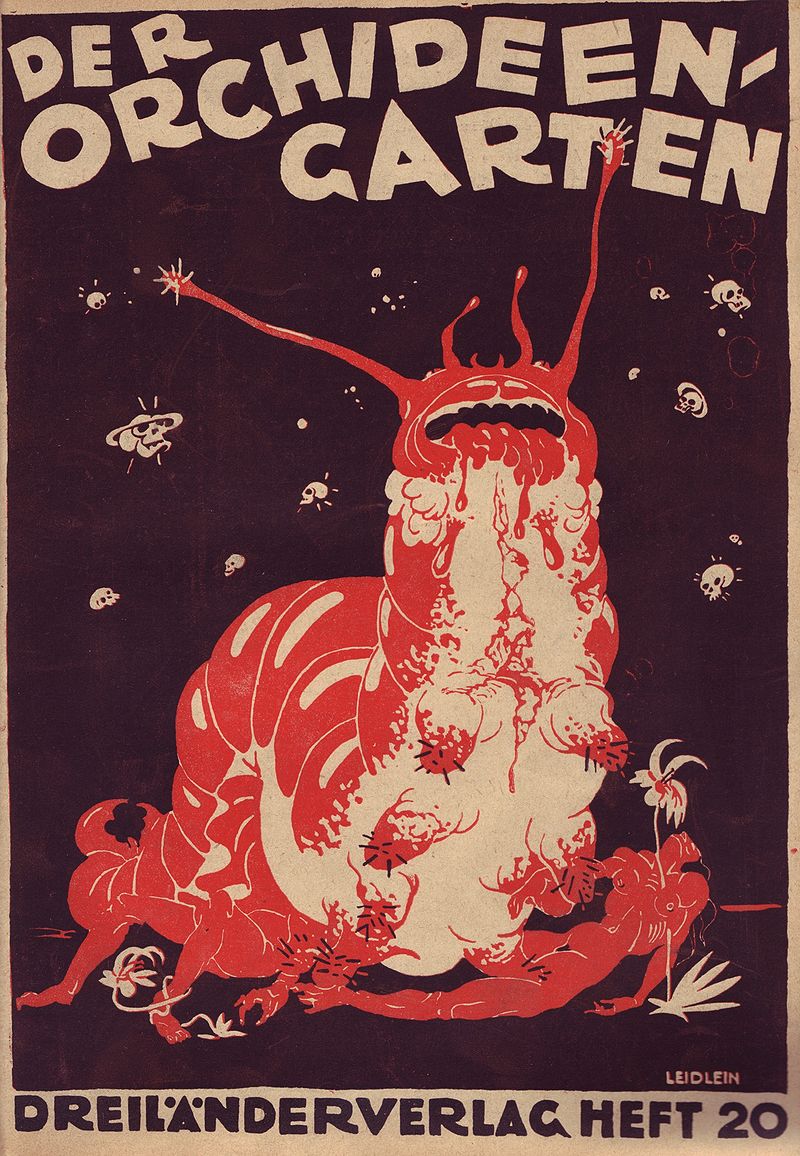
From the 18th century onward, the genres of Gothic horror and fantasy have flourished, and with them the sensually visceral images now commonplace in film, TV, and comic books. These genres perhaps reached their aesthetic peak in the 19th century with writers like Edgar Allan Poe and illustrators like Gustave Dore. But it was in the early twentieth century that a more populist subgenre truly came into its own: “weird fiction,” a term H.P. Lovecraft used to describe the pulpy brand of supernatural horror codified in the pages of American fantasy and horror magazine Weird Tales—first published in 1923. (And still going strong!)
A precursor to EC Comics’ many lurid titles, Weird Tales is often considered the definitive early twentieth century venue for weird fiction and illustration.
But we need only look back a few years and to another continent to find an earlier publication, serving German-speaking fans—Der Orchideengarten (“The Garden of Orchids”), the very first horror and fantasy magazine, which ran 51 issues from January 1919 to November 1921.
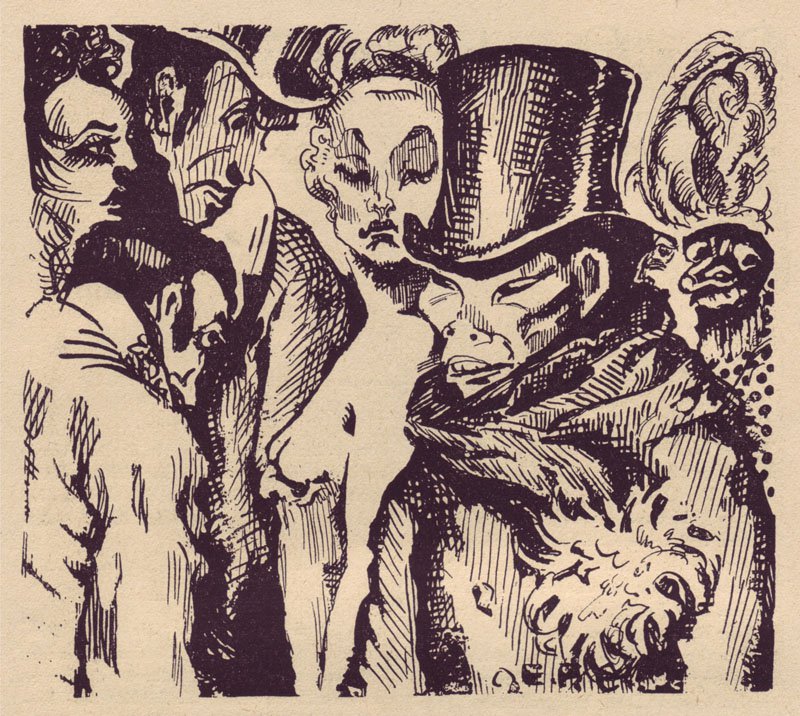
The magazine featured work from its editors Karl Hans Strobl and Alfons von Czibulka, from better-known contemporaries like H.G. Wells and Karel Capek, and from forefathers like Dickens, Pushkin, Guy de Maupassant, Poe, Voltaire, Washington Irving, Nathaniel Hawthorne, and others. “Although two issues of Der Orchideengarten were devoted to detective stories,” writes 50 Watts, “and one to erotic stories about cuckolds, it was a genuine fantasy magazine.” And it was also a gallery of bizarre and unusual artwork.
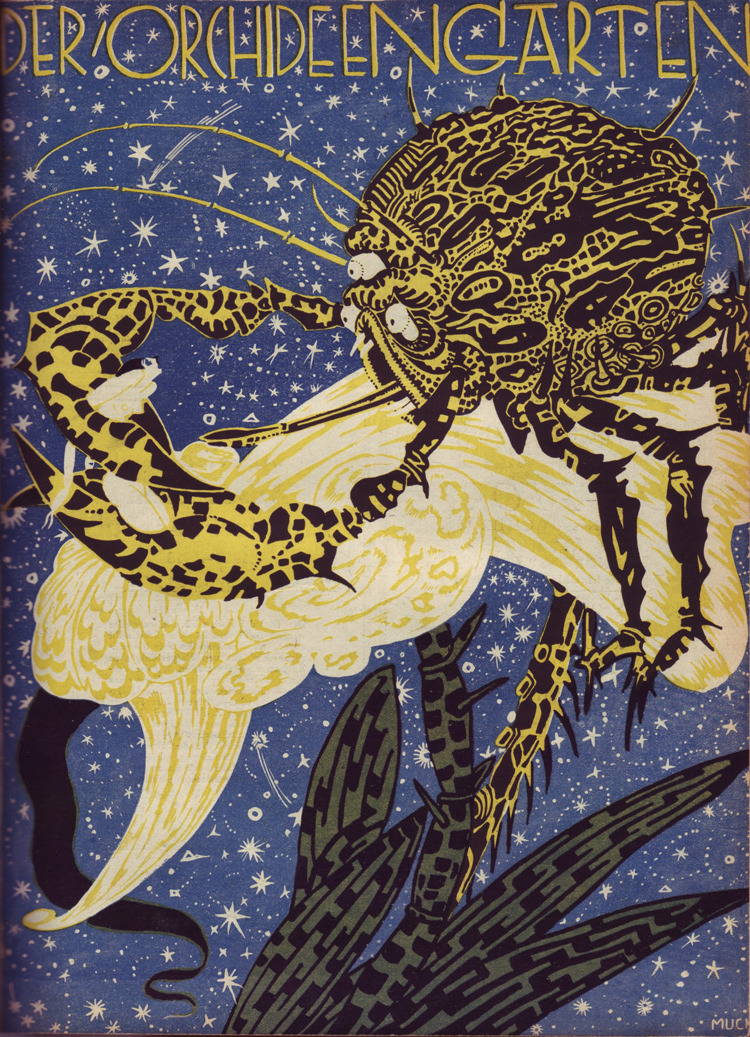
50 Watts quotes from Franz Rottensteiner’s description of the magazine’s art, which ranged “from representations of medieval woodcuts to the work of masters of the macabre such as Gustave Dore or Tony Johannot, to contemporary German artists like Rolf von Hoerschelmann, Otto Lennekogel, Karl Ritter, Heinrich Kley, or Alfred Kubin.” These artists created the covers and illustrations you see here, and many more you can see at 50 Watts, the black sun, and John Coulthart’s {feuilleton}.
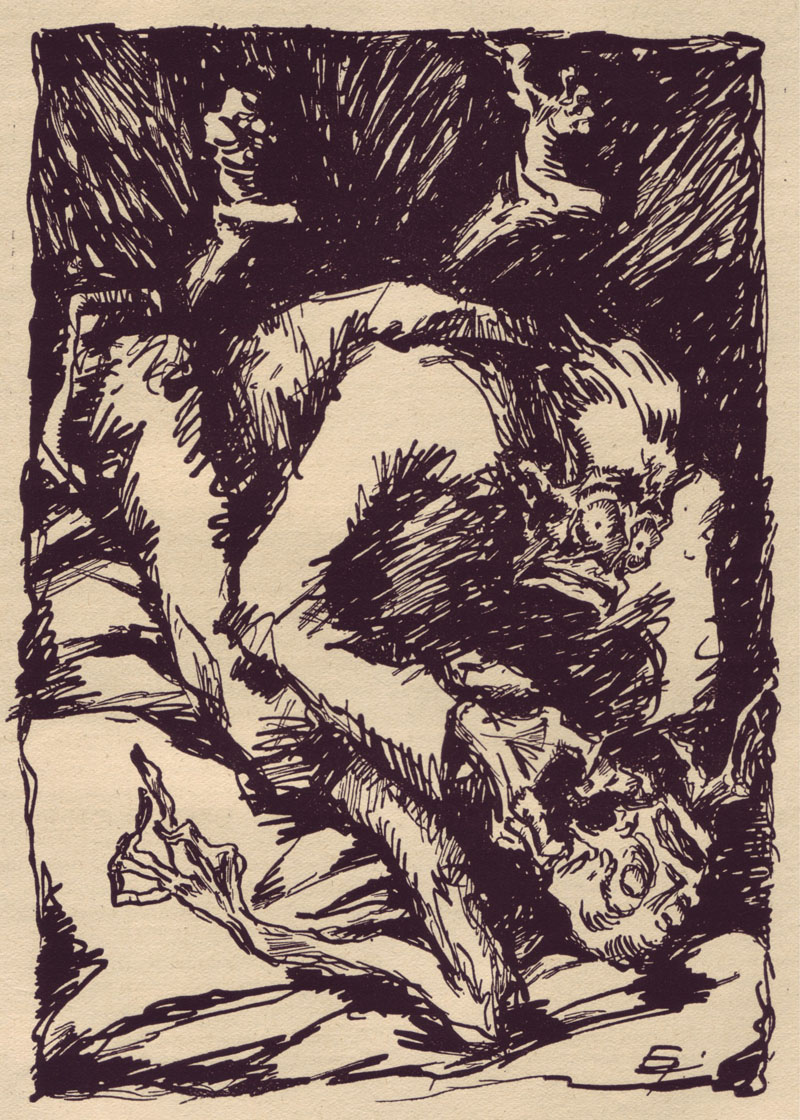
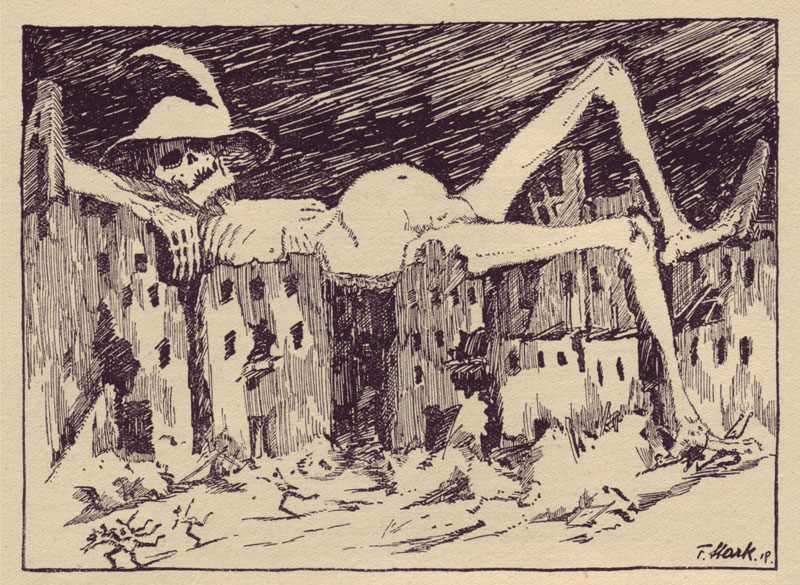
“What strikes me about these black-and-white drawings,” like the dense, frenzied pen-and-ink scene above, Coulthart comments, “is how different they are in tone to the pulp magazines which followed shortly after in America and elsewhere. They’re at once far more adult and frequently more original than the Gothic clichés which padded out Weird Tales and lesser titles for many years.” Indeed, though the format may be similar to its successors, Der Orchideengarten’s covers show the influence of Surrealism, “some are almost Expressionist in style,” and many of the illustrations show “a distinct Goya influence.”
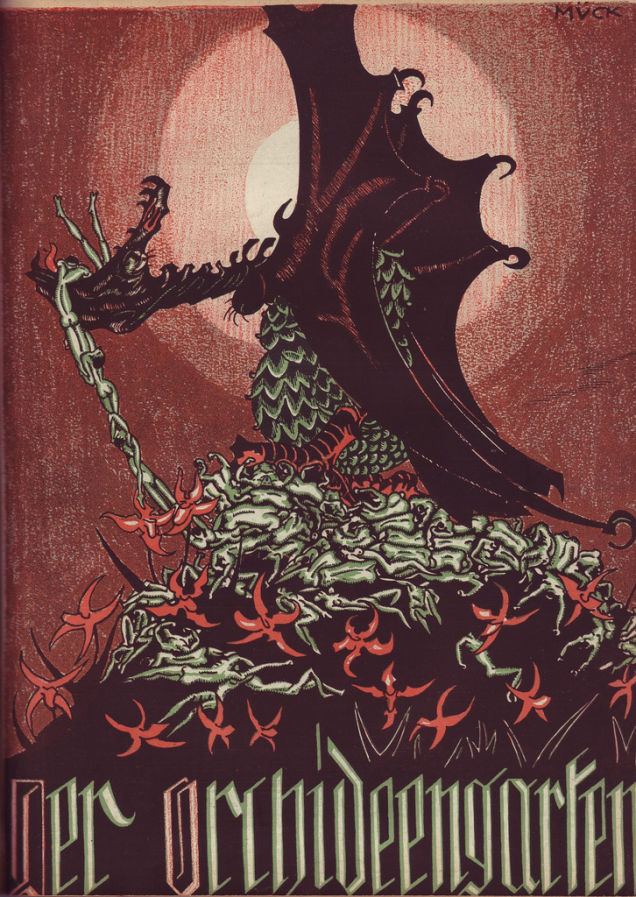
Popular fantasy and horror illustration has often leaned more toward the soft-porn of seventies airbrushed vans, pulp-novel covers, or the grisly kitsch of the comics. Rottensteiner writes in his 1978 Fantasy Book that this “large-format magazine… must surely rank as one of the most beautiful fantasy magazines ever published.” It’s hard to argue with that assessment. View, read (in German), and download original scans of the magazine’s first several issues over on this Princeton site.
Note: An earlier version of this post appeared on our site in 2016.
If you would like to support the mission of Open Culture, consider making a donation to our site. It’s hard to rely 100% on ads, and your contributions will help us continue providing the best free cultural and educational materials to learners everywhere. You can contribute through PayPal, Patreon, and Venmo (@openculture). Thanks!
Related Content:
Read Margaret Cavendish’s The Blazing World: The First Sci-Fi Novel Written By a Woman (1666)
The First Work of Science Fiction: Read Lucian’s 2nd-Century Space Travelogue A True Story
Free: 356 Issues of Galaxy, the Groundbreaking 1950s Science Fiction Magazine
Josh Jones is a writer and musician based in Durham, NC. Follow him at @jdmagness
Read More...Every Known Work by Georgia O’Keeffe Has Been Digitized and Made Available Online

Upon hearing the names of Arthur Dove or Marsden Hartley, the saturated colors and organically askew lines of those painters’ landscapes may appear before your mind’s eye. But unless you have a special interest in American modernists of the early twentieth century, they probably don’t. The name Georgia O’Keeffe, by contrast, can hardly fail to bring a few images even to the mind of the strictly casual art appreciator: New Mexican mesas, animal skulls, and above all flowers in extreme close-up. Apart from the artistic skill and distinctive vision with which she created it, O’Keeffe’s work persists in the wider culture because of how well it happens to reproduce in a variety of contexts, including postcards, mugs, and even apparel, such as that sold at her eponymous museum in Santa Fe.
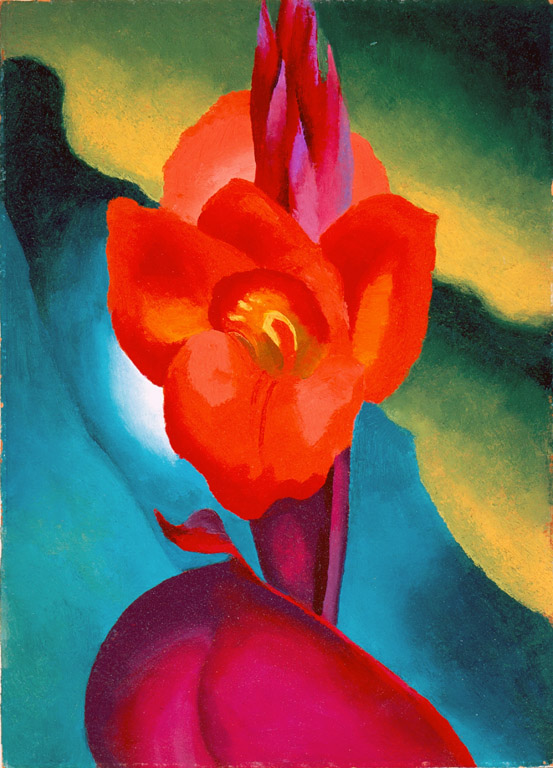
Keeping such products around is, of course, no substitute for seeing the real thing; in their physical reality, O’Keeffe’s paintings have a way of rebuffing all the interpretations with which they’ve been freighted for more than a century now. If you can’t make it out to New Mexico, the Georgia O’Keeffe Museum has been working to make every single one of her pieces (including sculptures and photographs) available for viewing online at a just-launched portal called Access O’Keeffe.
The museum describes it as a “user-friendly, searchable website with high-resolution images, visual descriptions, exhibition histories, archival materials, and research data associated with the artist’s two-volume catalogue raisonné.” The site’s visitors “can browse by color, shape, or medium, explore the context of works created before and after a specific painting, trace historic exhibitions, create lists of favorites, and download images.”
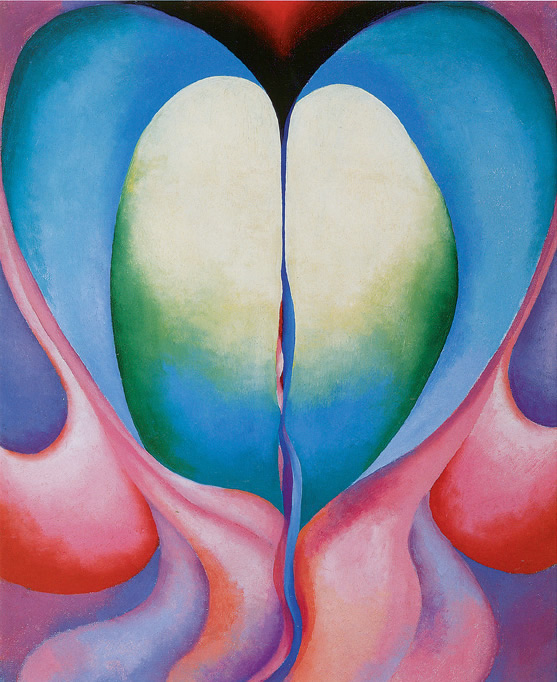
Access O’Keeffe makes it easy to find the artist’s most famous paintings, but also works that may surprise viewers who only know her mesas, skulls, and flowers. Take, for example, such nocturnally themed canvases as her early Starlight Night, from 1917, or her late Untitled (City Night), from the nineteen-seventies. O’Keeffe’s America, we must remember, isn’t limited to the desert: though she did spend most of her nearly century-long life’s second half in New Mexico, it also took her from Wisconsin to Virginia to Texas to New York, with stints in South Carolina and Hawaii. Given the importance of understanding any artist’s contexts both geographical and social, Access O’Keeffe also provides an archive of artifacts and exhibitions related to the people and organizations associated with her — Arthur Dove and Marsden Hartley included.
Related content:
Georgia O’Keeffe: A Life in Art, a Short Documentary on the Painter Narrated by Gene Hackman
How Georgia O’Keeffe Became Georgia O’Keeffe: An Animated Video Tells the Story
The Real Georgia O’Keeffe: The Artist Reveals Herself in Vintage Documentary Clips
Recipes from the Kitchen of Georgia O’Keeffe
Alfred Stieglitz: The Eloquent Eye, a Revealing Look at “The Father of Modern Photography”
Based in Seoul, Colin Marshall writes and broadcasts on cities, language, and culture. He’s the author of the newsletter Books on Cities as well as the books 한국 요약 금지 (No Summarizing Korea) and Korean Newtro. Follow him on the social network formerly known as Twitter at @colinmarshall.
Read More...Enchanting Video Shows How Globes Were Made by Hand in 1955: The End of a 500-Year Tradition
The first globe—a spherical representation of our planet Earth—dates back to the Age of Discovery. Or 1492, to be more precise, when Martin Behaim and painter Georg Glockendon created the “Nürnberg Terrestrial Globe,” otherwise known as the “Erdapfel.” It was made by hand. And that tradition continued straight through the 20th century, until machines largely took over.
Above, you can watch the waning of a 500-year tradition. Somewhere in North London, in 1955, “a woman takes one of the moulds from a shelf and takes it over to a workbench. She fixes it to a device which holds it steady whilst still allowing it to spin.” “Another girl,” notes British Pathe, “is sticking red strips onto a larger sphere.” After that, “coloured printed sections showing the map of the world are cut to shape then pasted onto the surface of the globes.” Through that “skilled operation,” the London-based firm produced some 60,000 globes each year.
Above, you can also find another globe-making mini-documentary, this one in black & white, from 1949. It gives you a glimpse of a process that takes 15 hours, from start to finish. Finally, further down, watch a short feature on Bellerby & Co., which still makes high-quality, handcrafted globes in London. It’s a reminder that, even in the age of mass production, some artisans are keeping a centuries-long craft alive.
If you would like to support the mission of Open Culture, consider making a donation to our site. It’s hard to rely 100% on ads, and your contributions will help us continue providing the best free cultural and educational materials to learners everywhere. You can contribute through PayPal, Patreon, and Venmo (@openculture). Thanks!
Related Content:
Buckminster Fuller’s Map of the World: The Innovation that Revolutionized Map Design (1943)
Japanese Designers May Have Created the Most Accurate Map of Our World: See the AuthaGraph
How Vinyl Records Are Made: A Primer from 1956
How Animated Cartoons Are Made: A Vintage Primer Filmed Way Back in 1919
The Making of Japanese Handmade Paper: A Short Film Documents an 800-Year-Old Tradition
Read More...
Seven Wonders of the Ancient World: From the Walls of Babylon to the Sewers of Rome
You may not be able to name all, or even most, of the seven wonders of the ancient world. But you almost certainly know that there were seven of them. In a way, that aligns well enough with the worldview of the Greeks who first made reference to such a list, given their near-reverence for that number. Seven were the strings of the lyre (unless there happened to be eight or nine), seven were the gates of Thebes, and seven were the “wandering stars” in the night sky (if you count the sun and moon). The identity of the wonders was less important than the length of their list, and indeed, as ancient-history YouTuber Garrett Ryan explains in his Told in Stone video above, additions and changes were proposed since the beginning.
The classic seven-wonders roster includes the Hanging Gardens of Babylon, the Statue of Zeus at Olympia, the Temple of Artemis at Ephesus, the Mausoleum at Halicarnassus, the Colossus of Rhodes, the Lighthouse of Alexandria, and the Great Pyramid of Giza, that last being the only one still in existence today.
Ryan’s alternative list includes the Egyptian labyrinth at Hawara, which Herodotus considered superior even to the Pyramids; the Temple of Zeus at Cyzicus, which Pliny the Elder described as lined by gold tubes to let in the sunlight (surely stripped out as soon as the place fell into disuse); the sewers of Rome, a civilizational achievement unto themselves; and the Theater of Scaurus, which, though constructed out of wood for temporary use, seated an astonishing 80,000 people.
Ryan completes his seven other wonders with the Altar of Horns at Delos, held in myth to have been built by Apollo himself; the Walls of Babylon, which actually appear on the earliest known version of the list; and, finally, the good old Colosseum. As over-familiar (not to mention over-toured) as it may be, the Flavian Amphitheater, as the Colosseum was known in its day, does make for a welcome presence among the ancient wonders, being the only other one apart from the Great Pyramid that we can still visit today. But if you get into the mood to go marvel at thaumata, to borrow the Greek word, by no means limit yourself to selections already curated by others. The world is full of wonders, and your own personal seven may not be far away.
Related content:
A Walking Tour Around the Pyramids of Giza: 2 Hours in Hi Def
Ten Lost Roman Wonders: The World’s Longest Tunnel, Tallest Dam, Widest-Spanning Bridge & More
How the Ancient Greeks Built Their Magnificent Temples: The Art of Ancient Engineering
Take a Virtual Tour of Machu Picchu, One of the New 7 Wonders of the World
Based in Seoul, Colin Marshall writes and broadcasts on cities, language, and culture. He’s the author of the newsletter Books on Cities as well as the books 한국 요약 금지 (No Summarizing Korea) and Korean Newtro. Follow him on the social network formerly known as Twitter at @colinmarshall.
Read More...The First Robot Movie: Watch a Newly Discovered Georges Méliès Film from 1897
Metropolis, Forbidden Planet, 2001: A Space Odyssey, Star Wars, Blade Runner, The Terminator, Short Circuit, RoboCop, Ghost in the Shell, The Iron Giant, WALL‑E, Ex Machina: there is a parallel history of cinema to be told entirely through its robots. That such a history must begin with the work of Georges Méliès may not come as a surprise, given that he invented so many of the techniques of science-fiction filmmaking. But until recently, we didn’t actually know that the cinema pioneer who “invented everything” ever put a robot onscreen. The evidence turned up among a collection of “old and battered” reels of film that were “from before World War I and had been shuttled around from basements to barns to garages and had just been dropped off at the Library.”
So writes the Library of Congress’ Neely Tucker, who goes on to describe the action of one of the films involving “a magician and a robot battling it out in slapstick fashion. It took a bit, but then the gasp of realization: They were looking at ‘Gugusse and the Automaton,’ a long-lost film by the iconic French filmmaker Georges Méliès at his Star Film company.”
Méliès himself plays the magician, who “winds up an automaton dressed like the famous clown Pierrot, which is standing on a pedestal. Once wound up, the clown begins to beat the magician with his walking stick. The magician retaliates by getting a huge sledgehammer and bashing the automaton over the head, with each blow seeming to shrink it in half, until it is just a small doll.”
In just 45 seconds, this simple film would have astonished audiences back in 1897 — and indeed retains the power to impress, provided you consider that none of the techniques to realize its effects were widely known before Méliès attempted them. He did so five years before ‘A Trip to the Moon,’ a hugely ambitious cinematic endeavor by comparison, and by far the single film that best represents his legacy.’ Yet it and Gugusse and the Automaton are clearly the work of the same artist-inventor, one who possessed that rare combination of technical know-how and artistic daring, and who understood the need for an organic relationship between spectacle and narrative. Not that either the spectacle or the narrative are highly evolved at this stage, but, as Méliès may have suspected, the cinema of robots has as long an evolution ahead of it as automata themselves.
Related content:
Watch “The Birth of the Robot,” Len Lye’s Surreal 1935 Stop-Motion Animation
Watch the Sci-Fi Short Film “I’m Not a Robot”: Winner of a 2025 Academy Award
Based in Seoul, Colin Marshall writes and broadcasts on cities, language, and culture. He’s the author of the newsletter Books on Cities as well as the books 한국 요약 금지 (No Summarizing Korea) and Korean Newtro. Follow him on the social network formerly known as Twitter at @colinmarshall.
Read More...Thomas Jefferson’s Handwritten Vanilla Ice Cream Recipe
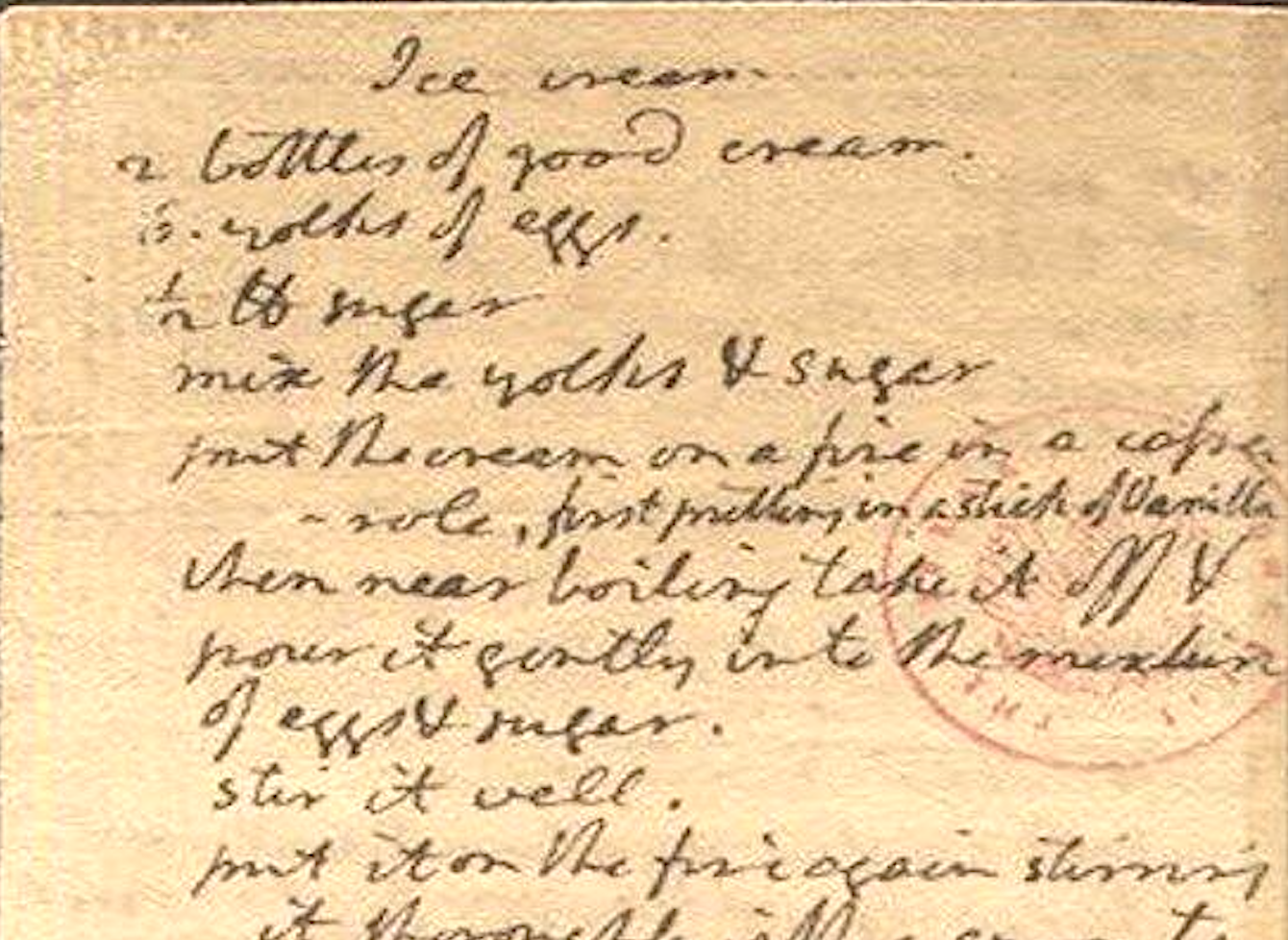
Here’s another thing you can credit Thomas Jefferson with: being the first known American to record an ice cream recipe. It’s one of 10 surviving recipes written by the founding father.
According to Monticello.org, ice cream began appearing “in French cookbooks starting in the late 17th century, and in English-language cookbooks in the early 18th century.” And there “are accounts of ice cream being served in the American colonies as early as 1744.” Jefferson likely tasted his fair share of the dessert while living in France (1784–1789), and it continued to be served at Monticello upon his return to Virginia. By the first decade of the 19th century, ice cream became increasingly common in cookbooks published throughout the U.S.
You can see the entire recipe for Jefferson’s vanilla ice cream here, and read a transcript below.
2. bottles of good cream.
6. yolks of eggs.
1/2 lb. sugarmix the yolks & sugar
put the cream on a fire in a casserole, first putting in a stick of Vanilla.
when near boiling take it off & pour it gently into the mixture of eggs & sugar.
stir it well.
put it on the fire again stirring it thoroughly with a spoon to prevent it’s sticking to the casserole.
when near boiling take it off and strain it thro’ a towel.
put it in the Sabottiere[12]
then set it in ice an hour before it is to be served. put into the ice a handful of salt.
put salt on the coverlid of the Sabotiere & cover the whole with ice.
leave it still half a quarter of an hour.
then turn the Sabottiere in the ice 10 minutes
open it to loosen with a spatula the ice from the inner sides of the Sabotiere.
shut it & replace it in the ice
open it from time to time to detach the ice from the sides
when well taken (prise) stir it well with the Spatula.
put it in moulds, justling it well down on the knee.
then put the mould into the same bucket of ice.
leave it there to the moment of serving it.
to withdraw it, immerse the mould in warm water, turning it well till it will come out & turn it into a plate
Note: An earlier version of this post appeared on our site in 2014.
Related Content:
The First American Cookbook: Sample Recipes from American Cookery (1796)
Leo Tolstoy’s Family Recipe for Mac and Cheese
Ernest Hemingway’s Favorite Hamburger Recipe
The Recipes of Iconic Authors: Jane Austen, Sylvia Plath, Roald Dahl, the Marquis de Sade & More
David Lynch Teaches You to Cook His Quinoa Recipe in a Strange, Surrealist Video
How to Actually Cook Salvador Dali’s Surrealist Recipes: Crayfish, Prawns, and Spitted Eggs
Read More...Support Us
We're hoping to rely on loyal readers, rather than erratic ads. Please click the Donate button and support Open Culture. You can use Paypal, Venmo, Patreon, even Crypto! We thank you!

About Us

Open Culture scours the web for the best educational media. We find the free courses and audio books you need, the language lessons & educational videos you want, and plenty of enlightenment in between.
Advertise With Us

FREE UPDATES!
GET OUR DAILY EMAIL
Get the best cultural and educational resources on the web curated for you in a daily email. We never spam. Unsubscribe at any time.
FOLLOW ON SOCIAL MEDIA

Open Culture editor Dan Colman scours the web for the best educational media. He finds the free courses and audio books you need, the language lessons & movies you want, and plenty of enlightenment in between.
Advertise With Us


