The Dead Sea Scrolls: Discover the Secrets of the Bible’s Oldest and Strangest Texts
The appearance of the Dead Sea Scrolls was the most important document discovery of the twentieth century. Yet, in some sense, they didn’t deliver what many assumed to be promised within: that is, the basis for a complete revision of everything we thought we knew about Christianity. The reality of the Dead Sea Scrolls’ content is less simple, but also stranger — which makes it an ideal subject for the YouTube channel Hochelaga, given its penchant for exploring the obscure byways of religious history. And indeed, as host Tommie Trelawny says in his new video above, they are the “oldest Biblical writings ever found,” a status that, whatever their specifics, certainly justifies the great scrutiny paid to them over the past eight decades.
For it was only in 1946 that the Scrolls were found, by a Bedouin shepherd looking for his lost goat in a series of caves in the vicinity of ancient ruins by the Dead Sea. Or so the story goes, anyway, and Trelawny explains some of the complications that emerge when it’s examined more closely.
But the fact remains that those caves did contain, tightly rolled up and for the most part well-preserved, a set of scrolls adding up to “around 900 individual manuscripts: 40 percent of them “resembled books found in the Bible”; 30 percent, apocryphal writings “banned” from the Bible; and another 30 percent, “writings previously unknown to scholarship.” Those last include “texts that described a secretive religious community and apocalyptic visions of a great heavenly war.”
Most intriguingly, there was also “a scroll made entirely of copper that lists the locations of lost treasure.” None of it has ever been found, much as the content of the other texts hasn’t forced a great rethinking of the religion at the center of so much of Western civilization. In fact, as Biblical scholar Robert Alter writes in the London Review of Books, “the notion that these sectarian writings are actually Christian has no scholarly credibility,” though some researchers argue that “the blueprint for the Gospel narratives,” messiah figure and all, “was laid out in the Scrolls and followed by the first Christian writers.” They do, however, reveal a great deal about the worldview of the particular fringe faithful who took to the desert to keep their unorthodox beliefs safe from the harsh judgment of mainstream society — and, for about twenty centuries, safe they remained.
Related content:
Google Puts The Dead Sea Scrolls Online (in Super High Resolution)
Google Digitizes Ancient Copies of the Ten Commandments and Genesis
The Gnostic Gospels: An Introduction to the Forbidden Teachings of Jesus
Introduction to the Old Testament: A Free Yale Course
Based in Seoul, Colin Marshall writes and broadcasts on cities, language, and culture. He’s the author of the newsletter Books on Cities as well as the books 한국 요약 금지 (No Summarizing Korea) and Korean Newtro. Follow him on the social network formerly known as Twitter at @colinmarshall.
Read More...How the Beatles Wrote Their Songs: From Early Demos to Final Recordings
More than a few of us can claim, with some confidence, to know every Beatles song. And indeed it may be true, in that we’ve heard every track of all their studio albums. But as decade after decade of Beatles scholarship has demonstrated, there’s knowing their songs, and then there’s knowing their songs. Musician and YouTuber David Bennett has made it his project to attain the second kind of knowledge, and on his dedicated series UnBeatled, to share it with the public. In each UnBeatled video he analyzes just one song — “Help!,” “Here Comes the Sun,” “Penny Lane,” and so on — at a level of detail fine enough to necessitate not just breaking it down to its component tracks, but also examining the demos and unreleased takes recorded in the studio.
This process can reveal a great deal about the Beatles’ songwriting process, as Bennett explains in the video at the top of the post. In the course of twenty minutes, he covers eleven songs, a selection not necessarily limited to the group’s universally praised compositions.
Take the first, “Yellow Submarine,” whose early recordings differ both lyrically, melodically, and in time signature from the version we know (and may or may not love), beginning with an idea of John’s and being further shaped by Paul through its iterations. Another of John’s musical seeds is “Everybody Had a Hard Year,” whose fingerpicking pattern (originally learned from Donovan in India) is also heard in “Julia” and “Dear Prudence,” and which evolved, with different chords, into the middle section of “I’ve Got a Feeling.”
Such interconnections come as rewards of close and deep listening to the Beatles canon. And certain songs turn out to be worlds of their own: “Strawberry Fields Forever,” for instance, was assembled out of two completely different recordings, then adjusted in tempo and pitch to match in the middle. One of those takes includes the voice of producer George Martin counting in the orchestra, the pitch of which suggests that its members had originally played in a different key than the one we hear. As Bennett notes, using the then relatively novel technology of “vari-speed” had become practically standard in the Beatles’ studio process, as such technological layering and adjustment itself became a key part of their songwriting process. It contributed much to their signature “vibey, psychedelic, uncanny sound”: sought after by many bands over the past six decades, but never truly replicated.
Related Content:
How John Lennon Wrote the Beatles’ Best Song, “A Day in the Life”
The “Strawberry Fields Forever” Demos: The Making of a Beatles Classic (1966)
How the Beatles Experimented with Indian Music & Pioneered a New Rock and Roll Sound
Based in Seoul, Colin Marshall writes and broadcasts on cities, language, and culture. He’s the author of the newsletter Books on Cities as well as the books 한국 요약 금지 (No Summarizing Korea) and Korean Newtro. Follow him on the social network formerly known as Twitter at @colinmarshall.
Read More...The First American Cookbook: Sample Recipes from American Cookery (1796)
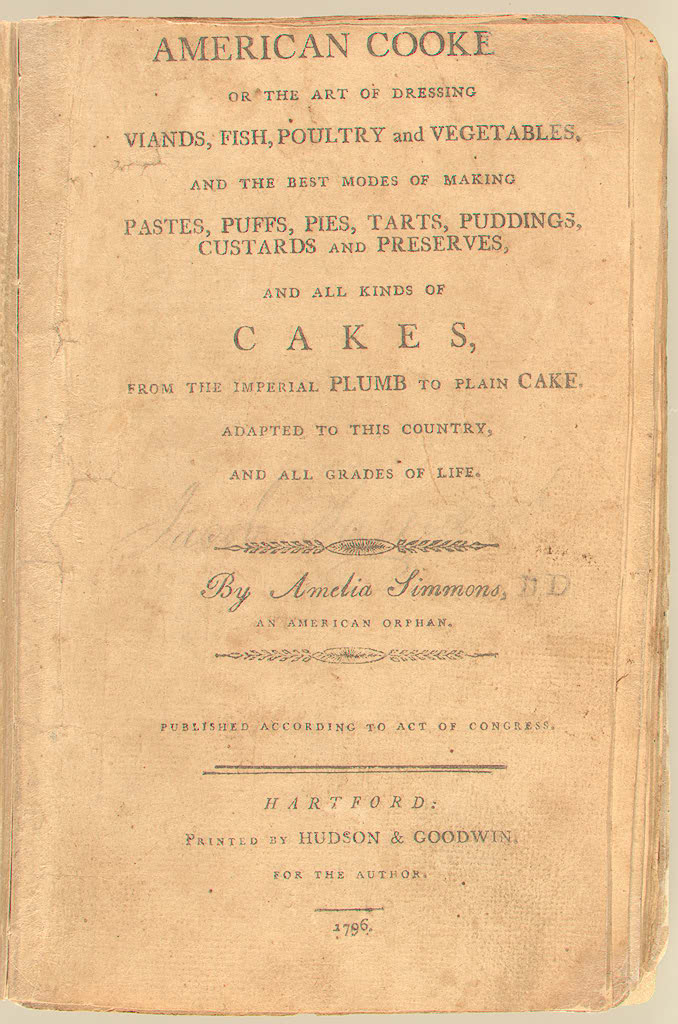
Image via Wikimedia Commons
On the off chance Lin-Manuel Miranda is casting around for source material for his next American history-based blockbuster musical, may we suggest American Cookery by “poor solitary orphan” Amelia Simmons?
First published in 1796, at 47 pages (nearly three of them are dedicated to dressing a turtle), it’s a far quicker read than the fateful Ron Chernow Hamilton biography Miranda impulsively selected for a vacation beach read.
Slender as it is, there’s no shortage of meaty material:
Calves Head dressed Turtle Fashion
Soup of Lamb’s Head and Pluck
Fowl Smothered in Oysters
Tongue Pie
Foot Pie
Modern chefs may find some of the first American cookbook’s methods and measurements take some getting used to.
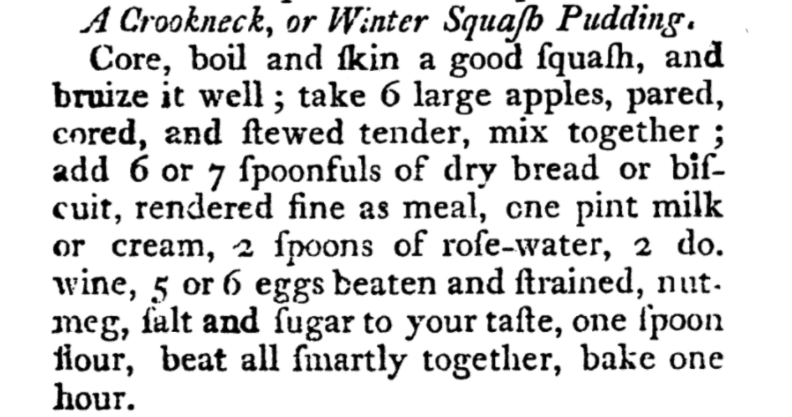
We like to cook, but we’re not sure we possess the wherewithal to tackle a Crookneck or Winter Squash Pudding.
We’ve never been called upon to “perfume” our “whipt cream” with “musk or amber gum tied in a rag.”
And we wouldn’t know a whortleberry if it bit us in the whitpot.
The book’s full title is an indication of its mysterious author’s ambitions for the new country’s culinary future:
American Cookery, or the art of dressing viands, fish, poultry, and vegetables, and the best modes of making pastes, puffs, pies, tarts, puddings, custards, and preserves, and all kinds of cakes, from the imperial plum to plain cake: Adapted to this country, and all grades of life.
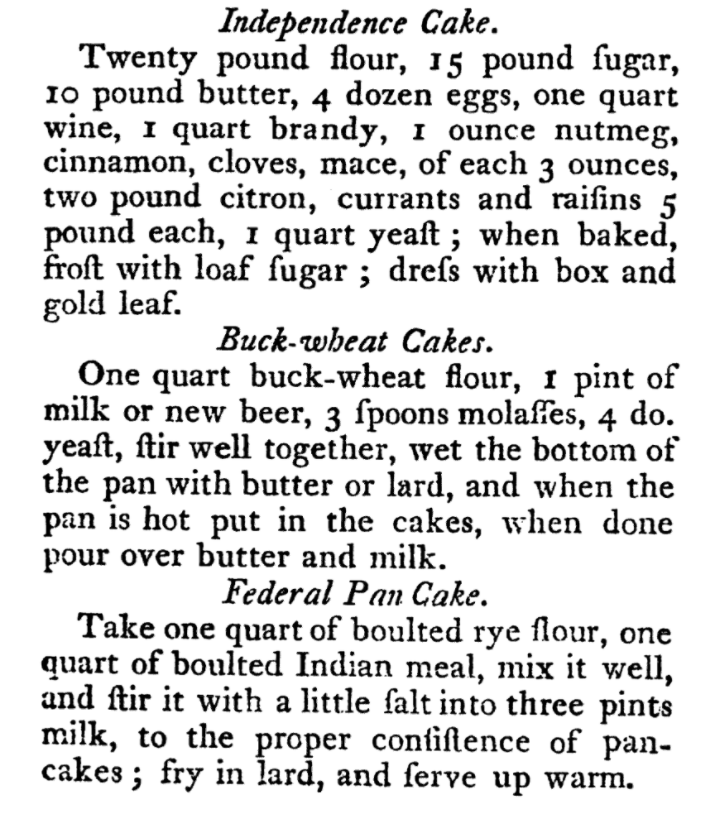
As Keith Stavely and Kathleen Fitzgerald write in an essay for What It Means to Be an American, a “national conversation hosted by the Smithsonian and Arizona State University,” American Cookery managed to straddle the refined tastes of Federalist elites and the Jeffersonians who believed “rustic simplicity would inoculate their fledgling country against the corrupting influence of the luxury to which Britain had succumbed”:
The recipe for “Queen’s Cake” was pure social aspiration, in the British mode, with its butter whipped to a cream, pound of sugar, pound and a quarter of flour, 10 eggs, glass of wine, half-teacup of delicate-flavored rosewater, and spices. And “Plumb Cake” offered the striving housewife a huge 21-egg showstopper, full of expensive dried and candied fruit, nuts, spices, wine, and cream.
Then—mere pages away—sat johnnycake, federal pan cake, buckwheat cake, and Indian slapjack, made of familiar ingredients like cornmeal, flour, milk, water, and a bit of fat, and prepared “before the fire” or on a hot griddle. They symbolized the plain, but well-run and bountiful, American home. A dialogue on how to balance the sumptuous with the simple in American life had begun.
(Hamilton fans will please note that the cake for the 1780 Schuyler-Hamilton wedding leaned more toward the former than anything in the johnnycake / slapjack vein…)
American Cookery is one of nine 18th-century titles to make the Library of Congress’ list of 100 Books That Shaped America:
This cornerstone in American cookery is the first cookbook of American authorship to be printed in the United States. Numerous recipes adapting traditional dishes by substituting native American ingredients, such as corn, squash and pumpkin, are printed here for the first time. Simmons’ “Pompkin Pudding,” baked in a crust, is the basis for the classic American pumpkin pie. Recipes for cake-like gingerbread are the first known to recommend the use of pearl ash, the forerunner of baking powder.
Students of Women’s History will find much to chew on in the second edition of American Cookery as well, though they may find a few spoonfuls of pearl ash dissolved in water necessary to settle upset stomachs after reading Simmons’ introduction.
Stavely and Fitzgerald observe how “she thanks the fashionable ladies,” or “respectable characters,” as she calls them, who have patronized her work, before returning to her main theme: the “egregious blunders” of the first edition, “which were occasioned either by the ignorance, or evil intention of the transcriber for the press.”
Ultimately, all of her problems stem from her unfortunate condition; she is without “an education sufficient to prepare the work for the press.” In an attempt to sidestep any criticism that the second edition might come in for, she writes: “remember, that it is the performance of, and effected under all those disadvantages, which usually attend, an Orphan.”
Read the second edition of American Cookery here. (If the archaic font troubles your eyes, a plainer version is here.) A facsimile edition of American Cookery can be purchased online.
Listen to a LibriVox audio recording of American Cookery here.
Note: An earlier version of this post appeared on our site in 2022.
Related Content:
Explore an Online Archive of 12,700 Vintage Cookbooks
The World’s Oldest Cookbook: Discover 4,000-Year-Old Recipes from Ancient Babylon
Discover the World’s Oldest Surviving Cookbook, De Re Coquinaria, from Ancient Rome
An Archive of 3,000 Vintage Cookbooks Lets You Travel Back Through Culinary Time
Ayun Halliday is an author, illustrator, theater maker and Chief Primatologist in NYC.
David Lynch Remembers Attending the Beatles’ First American Concert in 1964
Though his movies may have benefited greatly from foreign audiences and backers, David Lynch was one of the most thoroughly American of all filmmakers. “Born Missoula, MT,” declared his Twitter bio, yet one never really associates him with a particular place in the United States (at least no extant one). From Montana, the Lynch family moved to Idaho, then Washington, then North Carolina, then Virginia. The timing of that last stint proved culturally fortuitous indeed: living in the city of Alexandria, the eighteen-year-old Lynch was close enough to the nation’s capital to attend the very first concert the Beatles played in North America, at the Washington Coliseum on February 11, 1964.
“I was into rock and roll music, mainly Elvis Presley.” Lynch recalls this unsurprising fact in the clip above (which would have been among the last interviews he gave before his death a year ago) from Beatles ’64, the Martin Scorsese-produced documentary on the Fab Four’s first U.S. tour.
“I didn’t have any idea how big this event was. And it was in a gigantic place where they had boxing matches. The Beatles were in the boxing ring. It was so loud, you can’t believe. Girls shuddering, crying, screaming their heart out. It was phenomenal.” That deafening crowd noise figures into most every account of the group’s Beatlemania-era shows — and played a decisive role in their permanent retreat into the studio a couple of years later.
Lynch surely would have understood the desire for artistic exploration and control that drove the Beatles’ concentration on making records. Even the sensibilities of his work and theirs had something in common, exhibiting as they both did the unlikely combination of popularity and experimentation. Somehow, David Lynch’s films and the Beatles’ albums could venture into bewildering obscurity and sentimental kitsch without losing coherence or critical respect. And dare one imagine that the experience of witnessing the American debut of what would become the most influential rock band of all time has given Lynch his appreciation — evident in his movies, but also his own recordings — for the power of music, which he calls “one of the most fantastic things”? Even if not, it must have been, well… surreal.
Related content:
Angelo Badalamenti Reveals How He and David Lynch Composed the Twin Peaks’ “Love Theme”
When the Beatles Refused to Play Before Segregated Audiences on Their First U.S. Tour (1964)
David Lynch Directs a New Music Video for Donovan
David Lynch Talks Meditation with Paul McCartney
Based in Seoul, Colin Marshall writes and broadcasts on cities, language, and culture. He’s the author of the newsletter Books on Cities as well as the books 한국 요약 금지 (No Summarizing Korea) and Korean Newtro. Follow him on the social network formerly known as Twitter at @colinmarshall.
Read More...Enjoy a Medieval Cover of R.E.M.‘s “Losing My Religion”
?si=2xjPU8WlS7Yk5tRI
During her lifetime, the medieval abbess Hildegard von Bingen (1098–1179) composed roughly 77 songs and hymns. She remains the earliest known woman composer in Western classical music and one of the most important composers of the High Middle Ages.
In her honor, a YouTuber who goes by Hildegard von Blingin’ has developed a penchant for making Bardcore music, “a pastiche genre that takes modern songs and makes them ‘old-timey’ with Medieval and Renaissance inspired instrumentation.” Most of the instrumentals feature a mix of virtual and real instruments, including the Celtic harp, Irish whistle, and recorder.
Hildy’s latest release offers a creative take on R.E.M.’s “Losing My Religion,” complete with some revised lyrics:
I thought that I heard thee laughing
I thought that I heard thee sing
I think I thought I saw thee try
That was but a dream
That was but a dream
That’s me in the corner
‘Tis I in the corner
‘Tis I in the firelight, losing my religion
If you need a short escape from reality, this will serve you well. Enjoy!
Related Content
Hear an Enchanted Medieval Cover of Dolly Parton’s Classic Ode to Jealousy, “Jolene
Read More...The World’s Oldest Cave Art, Discovered in Indonesia, Is at Least 67,800 Years Old
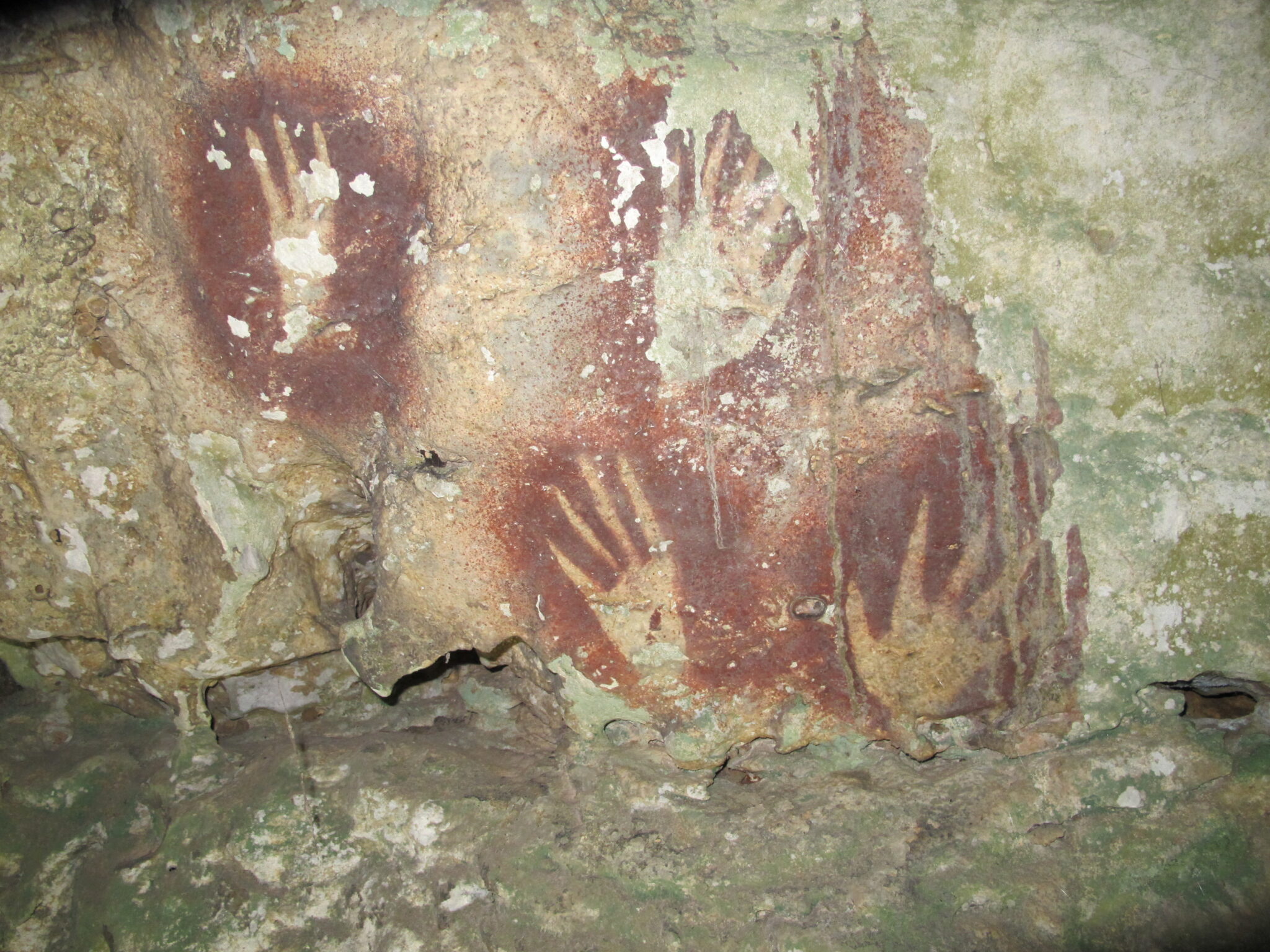
Image by Ahdi Agus Oktaviana
Over the centuries, a variety of places have laid credible claim to being the world’s art center: Constantinople, Florence, Paris, New York. But on the scale of, say, ten millennia, the hot spots become rather less recognizable. Up until about 20,000 years ago, it seems that creators and viewers of art alike spent a good deal in one particular cave: Liang Metanduno, located on Muna Island in Indonesia’s Southeast Sulawesi province. The many paintings on its walls of recognizable humans, animals, and boats have brought it fame in our times as a kind of ancient art gallery. But in recent years, a much older piece of work has been discovered there, one whose creation occurred at least 67,800 years ago.
The creation in question is a handprint, faint but detectable, probably made by blowing a mixture of ochre and water over an actual human hand. To determine its age, researchers performed what’s called uranium-series analysis on the deposits of calcium carbonate that had built up on and around it.
The number of 67,800 years is, of course, not exact, but it’s also just a minimum: in fact, the handprint could well be much older. In a paper published last week in Nature, the researchers point out that its age exceeds both that of the oldest similar rock art found elsewhere in Indonesia and that of a hand stencil in Spain attributed to Neanderthals, “which until now represented the oldest demonstrated minimum-age constraint for cave art worldwide.”
It isn’t impossible that this at least 67,800-year-old handprint could also have been made by Neanderthals. The obvious modification of the hand’s shape, however, an extension and tapering of the fingers that brings to mind animal claws (or the clutches of Nosferatu), suggests to certain scientific eyes the kind of cognition attributable specifically to Homo sapiens. This discovery has great potential relevance not just to art history, but even more so to other fields concerned with the development of our species. While it had previously been thought, for instance, that the first human settlers of Australia made their way there through Indonesia (in a time of much lower sea levels) between 50,000 and 65,000 years ago, the handprint’s existence in Liang Metanduno suggests that the migration took place even earlier. All these millennia later, Australia remains a favored destination for a variety of immigrants — some of whom do their part to keep Sydney’s art scene interesting.
Related Content:
Algerian Cave Paintings Suggest Humans Did Magic Mushrooms 9,000 Years Ago
Was a 32,000-Year-Old Cave Painting the Earliest Form of Cinema?
A Recently Discovered 44,000-Year-Old Cave Painting Tells the Oldest Known Story
40,000-Year-Old Symbols Found in Caves Worldwide May Be the Earliest Written Language
Based in Seoul, Colin Marshall writes and broadcasts on cities, language, and culture. He’s the author of the newsletter Books on Cities as well as the books 한국 요약 금지 (No Summarizing Korea) and Korean Newtro. Follow him on the social network formerly known as Twitter at @colinmarshall.
Read More...
Watch the First Episode of Sesame Street and 140 Other Free Episodes
?si=4AEj95O5wdpShG3I
FYI: Sesame Street has released on YouTube more than 140 full episodes from past seasons. On the Sesame Street Classics channel, you’ll find some iconic episodes, starting with the very first 1969 broadcast. Watch it above. Also on that same channel you can revisit episodes where Big Bird reveals that Snuffy is real, Mr. Rogers visits the show, Maria and Luis get engaged, and the death of Mr. Hooper gets delicately addressed. Beyond these episodes, you can also watch 129 complete episodes on Sesame Street’s main YouTube Channel here. Enjoy!
If you would like to support the mission of Open Culture, consider making a donation to our site. It’s hard to rely 100% on ads, and your contributions will help us continue providing the best free cultural and educational materials to learners everywhere. You can contribute through PayPal, Patreon, and Venmo (@openculture). Thanks!
Related Content
When Mississippi Tried to Ban Sesame Street for Showing a “Highly Integrated Cast” (1970)
Philip Glass Composes Music for a Sesame Street Animation (1979)
Read More...Discover Michelangelo’s First Painting, Created When He Was Only 12 or 13 Years Old
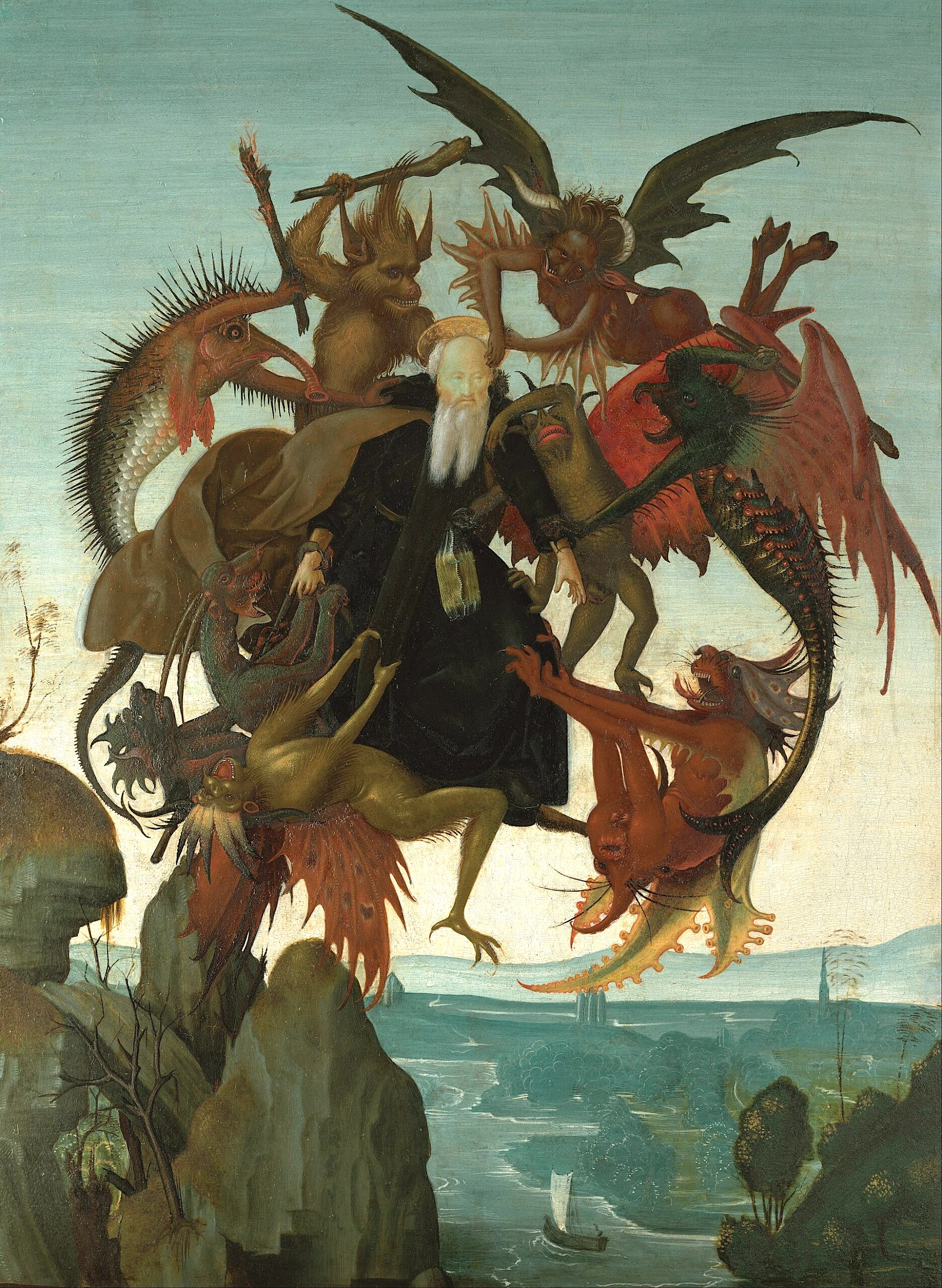
Think back, if you will, to the works of art you created at age twelve or thirteen. For many, perhaps most of us, our output at that stage of adolescence amounted to directionless doodles, chaotic comics, and a few unsteady-at-best school projects. But then, most of us didn’t grow up to be Michelangelo. In the late fourteen-eighties, when that towering Renaissance artist was still what we would now call a “tween,” he painted The Torment of Saint Anthony, a depiction of the titular religious figure beset by demons in the desert. Though based on a widely known engraving, it nevertheless shows evidence of rapidly advancing technique, inspiration, and even creativity — especially when placed under the infrared scanner.
For about half a millennium, The Torment of Saint Anthony wasn’t thought to have been painted by Michelangelo. As explained in the video from Inspiraggio just below, when the painting sold at Sotheby’s in 2008, the buyer took it to the Metropolitan Museum of Art for examination and cleaning.
“Beneath the layers of dirt accumulated over the centuries,” says the narrator, “a very particular color palette appeared. “The tones, the blends, the way the human figure was treated: all of it began to resemble the style Michelangelo would use years later in none other than the Sistine Chapel.” Infrared reflectography subsequently turned up pentimenti, or correction marks, a common indication that “a painting is not a copy, but an original work created with artistic freedom.”
It was the Kimbell Art Museum in Fort Worth, Texas that first bet big on the provenance of The Torment of Saint Anthony. Its newly hired director purchased the painting after turning up “not a single convincing argument against the attribution.” Thus acquired, it became “the only painting by Michelangelo located anywhere in the Americas, and also just one of four easel paintings attributed to him throughout his entire career,” during most of which he disparaged oil painting itself. About a decade later, and after further analysis, the art historian Giorgio Bonsanti put his considerable authority behind a definitive confirmation that it is indeed the work of the young Michelangelo. There remain doubters, of course, and even the notoriously uncompromising artist himself may have considered it an immature work unworthy of his name. But who else could have created an immature work like it?
Related Content:
How Four Masters — Michelangelo, Donatello, Verrocchio & Bernini — Sculpted David
A Secret Room with Drawings Attributed to Michelangelo Opens to Visitors in Florence
Michelangelo’s Illustrated Grocery List
Based in Seoul, Colin Marshall writes and broadcasts on cities, language, and culture. He’s the author of the newsletter Books on Cities as well as the books 한국 요약 금지 (No Summarizing Korea) and Korean Newtro. Follow him on the social network formerly known as Twitter at @colinmarshall.
Read More...Discover Ichi-go Ichi‑e, the Japanese Art of Savoring Every Moment
Each culture has its own sayings about the uniqueness and transience of the present moment. In recent years, the English-speakers have often found themselves reminded, through the expression “YOLO,” that they only live once. (The question of whether that should really be “YLOO,” or “You Live Only Once,” we put aside for the time being.) In Japan, unsurprisingly, one sometimes hears a much more venerable equivalent: “ichi-go ichi‑e,” which some readers acquainted with the Japanese language should be assured has nothing to do with strawberries, ichigo. Rather, the saying’s underlying Chinese characters (一期一会) can be translated as “one time, one meeting.”
The Buddhistically inflected “ichi-go ichi‑e” is just one in the vast library of yojijukugo, highly condensed aphoristic expressions written with just four characters. (Other countries with Chinese-influenced languages have their versions, including sajaseongeo in Korea and chéngyǔ in China itself.) It descends, as the story goes, from a slightly longer saying favored by the sixteenth-century tea master Sen no Rikyū, “ichi-go ni ichi-do” (一期に一度).
One must pay respects to the host of a tea ceremony because the meeting would only ever occur once — which, of course, it would, even if the ceremony was a regularly scheduled event. For we never, to borrow an ancient Greek take on this whole subject, step into the same river twice; no two events, separated in time, can ever truly be identical.
One implication, as noted in the explanatory videos above from the BBC and Einzelgänger, is that we should savor whatever moment we happen to find ourselves in, however imperfect, because we won’t get a second chance to do so. And if it offers little or nothing to enjoy, we can find solace in the fact that its particular displeasure, too, can never revisit us. With the past gone and the future never guaranteed, the present moment, in any case, is the only time that actually exists for us, so we’d better make ourselves comfortable within it. Though these ideas have perhaps found their most elegant and memorable expression in Japan, they’re hardly considered exclusive cultural property there. The Japanese title of Forrest Gump, after all, was Foresuto Ganpu: Ichi-go Ichi‑e.
Related Content:
Wabi-Sabi: A Short Film on the Beauty of Traditional Japan
Memento Mori: How Smiling Skeletons Have Reminded Us to Live Fully Since Ancient Times
Based in Seoul, Colin Marshall writes and broadcasts on cities, language, and culture. He’s the author of the newsletter Books on Cities as well as the books 한국 요약 금지 (No Summarizing Korea) and Korean Newtro. Follow him on the social network formerly known as Twitter at @colinmarshall.
Read More...When Two Filmmakers Make the Same Movie — and One of Them Is Werner Herzog
In 1991, the French husband-and-wife volcanologist-filmmaker team Maurice and Katia Krafft were killed by the flow of ash from the eruption of Mount Unzen in Nagasaki. Inexplicably, Werner Herzog didn’t get around to making a film about them for more than 30 years. These would seem to be ideal subjects for the documentary half of his career, a large portion of which he’s spent on portraits of eccentric, romantic, often foolhardy, and more than occasionally ill-fated individuals who pit themselves, or in any case find themselves pitted, against the raw elements of nature. Their couplehood makes the Kraffts a slight exception in that lineup, but it also makes them even less resistible to a more conventional documentarian — not that a documentarian could get much less conventional than Herzog.
Hence, perhaps, the appearance of two entirely separate documentaries on the Kraffts in the same year, 2022: Herzog’s The Fire Within, and Sara Dosa’s Fire of Love. The Like Stories of Old video above performs a direct comparison of the two films, both of which make heavy use of the volcano footage shot by the Kraffts themselves.
Herzog assembles it into wordless, operatically scored, and sometimes quite long sequences, intensifying their quality of the sublime, which we feel in that aesthetic zone where awe of beauty and fear of existential annihilation overlap completely. These do nothing to advance a narrative, but everything to put forth what Herzog has often referred to in interviews as a sense of “ecstatic truth,” a distillation of reality that cannot be captured by any conventional documentary means.
The video’s host Tom van der Linden describes Fire of Love as “much more fast-paced. Images come and go so quickly that they don’t really have a chance to reveal that strange, secret beauty, to take the spotlight with their own mysterious stardom. Instead, they feel subservient to whatever predetermined emotion the narrative wants you to experience,” as if the director is giving you orders: “Be in awe. Feel the romance. And now the comedy.” That hardly suggests incompetence on the part of Dosa and her collaborators, or any deficiency in her highly acclaimed film. But it does give us a sense of what becomes wearying about the techniques of mainstream cinema in general, fictional, or nonfictional. The truth is that Werner Herzog may be uniquely well placed to appreciate not just the fearsomely enrapturing object of the Kraffts’ obsession, but also the driving passion, and flashes of ridiculousness, in the Kraffts themselves — who were, after all, fellow soldiers of cinema.
Related Content:
An Introduction to the Painting of Caspar David Friedrich, Romanticism & the Sublime
Underwater Volcanic Eruption Witnessed for the First Time
Werner Herzog Discovers the Ecstasy of Skateboarding: “That’s Kind of My People”
Based in Seoul, Colin Marshall writes and broadcasts on cities, language, and culture. He’s the author of the newsletter Books on Cities as well as the books 한국 요약 금지 (No Summarizing Korea) and Korean Newtro. Follow him on the social network formerly known as Twitter at @colinmarshall.
Read More...Support Us
We're hoping to rely on loyal readers, rather than erratic ads. Please click the Donate button and support Open Culture. You can use Paypal, Venmo, Patreon, even Crypto! We thank you!

About Us

Open Culture scours the web for the best educational media. We find the free courses and audio books you need, the language lessons & educational videos you want, and plenty of enlightenment in between.
Advertise With Us

FREE UPDATES!
GET OUR DAILY EMAIL
Get the best cultural and educational resources on the web curated for you in a daily email. We never spam. Unsubscribe at any time.
FOLLOW ON SOCIAL MEDIA

Open Culture editor Dan Colman scours the web for the best educational media. He finds the free courses and audio books you need, the language lessons & movies you want, and plenty of enlightenment in between.
Advertise With Us


