Top 10 Alternative Christmas Movie Lists: Horror, Action, Comedy & More
Die Hard is a Christmas movie. That once-contrarian categorization has increasingly been accepted over the past couple of decades, at least since an editor with whom I’ve often worked first declared it in a Slate roundup. As a result, John McTiernan’s sturdy piece of one-building eighties Hollywood action may have displaced It’s a Wonderful Life as a holiday home-video tradition in certain households. But it’s also stoked a broader desire for ever more alternative Christmas movies with subtle, even subversive holiday elements. If you, too, can’t handle yet another viewing of Miracle on 34th Street, A Christmas Story, or Home Alone this year, have a look at the top ten lists compiled in these four videos, which offer a selection of films beyond — sometimes well beyond — the established seasonal canon.
These selections come from a variety of genres, including the superhero picture: if you haven’t seen Batman Returns in a few decades, you may have forgotten how thoroughly Tim Burton saturates it with Christmas imagery, albeit of a kind suited to the dank, menacing Gotham City. Those who want to crank up the darkness further still would do well to put on the Canadian sorority-house slasher film Black Christmas, which also appears on more than one of these lists.
Joe Dante’s Yuletide-set Gremlins contains much higher-budget spectacles of destruction, albeit comedic ones; the humor of Terry Gilliam’s Brazil, another elaborate mid-eighties auteur project, runs to the dystopian, a sensibility certainly present in the holiday season itself, if seldom treated with such grotesque vividness.
The work of no single professional makes these alternative Christmas movie lists more often than Shane Black, the writer of Lethal Weapon (with Die Hard, the makings of a holiday double bill if ever there was one) and The Long Kiss Goodnight, as well as the writer-director of Kiss Kiss Bang Bang, Iron Man 3, and The Nice Guys. That all of those pictures are set at Christmastime makes them feel — no matter how heightened, fantastical, or visual effects-saturated they may be — palpably connected to our own reality. It also tends to intensify the drama: as Black remarked in one interview, “Christmas represents a little stutter in the march of days, a hush in which we have a chance to assess and retrospect our lives.” Which hardly means, of course, that it can’t be entertaining.
Related Content:
Watch Santa Claus, the Earliest Movie About Santa in Existence (1898)
Watch The Insects’ Christmas from 1913: A Stop Motion Film Starring a Cast of Dead Bugs
An Animated Christmas Fable by Maurice Sendak (1977)
Stanley Kubrick’s Eyes Wide Shut, the Most Troubling Christmas Film Ever Made
Blue Christmas: A Criterion Video Essay
Based in Seoul, Colin Marshall writes and broadcasts on cities, language, and culture. His projects include the Substack newsletter Books on Cities and the book The Stateless City: a Walk through 21st-Century Los Angeles. Follow him on the social network formerly known as Twitter at @colinmarshall.
Read More...How Movies Created Their Special Effects Before CGI: Metropolis, 2001: A Space Odyssey & More
The youngest moviegoers today do not, of course, remember a time before visual effects could be created digitally. What may give us more pause is that, at this point in cinema history, most of their parents don’t remember it either. Consider the fact that Steven Spielberg’s Jurassic Park, with its once impossibly realistic (and still wholly passable) CGI dinosaurs, came out 32 years ago. That may put it, we must acknowledge, into the realm of the “classic,” the kind of picture whose entertainment value holds up despite — or because of — the qualities that fix it in its time. Equally spectacular but longer-canonized classics pose a greater challenge to the imaginations of young viewers, who can hardly guess how they could have been made “before computers.”
After seeing the notable examples provided in the new Primal Space video above, they’ll certainly understand one thing: it wasn’t easy. Even a seemingly simple effect like the pen floating loose through the zero-gravity cabin in 2001: A Space Odyssey required no small degree of ingenuity. We might naturally assume that filmmakers in 1968 would have accomplished it with a couple of pieces of Scotch tape and fishing line, but that would have resulted in unacceptable tangling problems, to say nothing of the trickiness of ensuring, quite literally, that the strings didn’t show. Instead, Kubrick’s team ended up attaching the pen to a sheet of glass — meticulously cleaned, no doubt, to eliminate the possibility of streaks — large enough to occupy the entire frame and thus go unnoticed by the viewer. It was then slowly rotated by a crank-turning assistant.
A few different effects from 2001 come in for explanation throughout the course of the video, including the multiple-exposure photography that made possible shots of spacecraft passing planets as well as the psychedelic “Star Gate” sequence toward the end. Though some of the devices used in these processes were put together just for the production, the underlying techniques had already been evolving for more than 60 years. Indeed, many were pioneered by Georges Méliès, previously featured here on Open Culture for A Trip to the Moon from 1902, the very first science-fiction film. This video goes behind the scenes of a work from the year before: L’Homme à la tête en caoutchouc, or The Man with the Rubber Head, in which Méliès managed a shot in which his own cranium inflates to huge proportions without the use of so much as a zoom lens.
Other examples, drawn from a range of beloved films from Metropolis to Mary Poppins, illustrate the inventiveness born of sheer technical limitation in the days when filmmaking was a wholly analog affair. In some cases, the effects these productions pulled off with miniatures, prisms, and mirrors 60, 80, 100 years ago look as good as anything Hollywood puts on the screen today — or rather better, since the innate physicality behind them makes them feel more “real.” Perhaps unsurprisingly, this video’s artificial-intelligence course sponsor makes reference to the endless range of visual possibilities available to those who master that technology. And it’s not impossible that we now stand on the cusp of a revolution in visual effects for that reason, with at least as much of an upside and downside as CGI. If so, we should prepare ourselves to hear the question, from children born today, of how anyone ever made movies before AI.
Related content:
The Art of Creating Special Effects in Silent Movies: Ingenuity Before the Age of CGI
How Stanley Kubrick Made 2001: A Space Odyssey: A Seven-Part Video Essay
How 2001: A Space Odyssey Became “the Hardest Film Kubrick Ever Made”
Why Movies Don’t Feel Real Anymore: A Close Look at Changing Filmmaking Techniques
Based in Seoul, Colin Marshall writes and broadcasts on cities, language, and culture. His projects include the Substack newsletter Books on Cities and the book The Stateless City: a Walk through 21st-Century Los Angeles. Follow him on the social network formerly known as Twitter at @colinmarshall.
Read More...See What the Original Mona Lisa Likely Looked Like
If you want to see the Mona Lisa in real life, your first thought may not be to head to the Prado. But according to a school of thought that has emerged in recent years, the Mona Lisa in Madrid has a greater claim to artistic faithfulness than the one in Paris. That’s because researchers have discovered compelling evidence suggesting that what was long considered just another copy of the most famous painting in the world wasn’t made after Leonardo had completed the original, but concurrently with the original, probably by one of his students. Over half a millennium, in this view, the Prado’s Mona Lisa has retained the colors and details the Louvre’s has lost, resulting in its preservation of Leonardo’s intentions today.
Infrared photography has even revealed, says the narrator of the new Inspiraggio video above, that both paintings “share the same changes in the original sketch. For years, it has been known that Leonardo made small corrections to the shape of the Mona Lisa’s hands, adjustments to the line of the eyes, and subtle modifications to the curve of the face,” the very same corrections that were found in the newly examined copy.
Unlike other copies, the Prado’s version uses “incredibly expensive pigments” such as lapis lazuli—imported from Afghanistan—for the sky. This only became evident during the 2012 restoration, when the background, long hidden under a thick layer of black, was finally uncovered.

Thereafter, the Prado Mona Lisa was exhibited alongside the Mona Lisa at the Louvre in a temporary exhibition. This gave the public the chance to see both how similar they look, and how different. Though undeniably La Gioconda, the copy doesn’t seem quite “right,” in large part because it hasn’t deteriorated in the manner or to the degree of the original. Leonardo painted it on a poplar wood panel that has given way to countless small cracks, and the layers of yellow varnish added over the centuries have darkened to give the whole image a sepia tone. The result, of course, is the texture and coloring we’ve come to associate with the Mona Lisa by ceaseless exposure to her in popular culture, even if we’ve never seen any version hanging in any museum. If the Prado’s copy really does reflect Leonardo’s original artistic choices, we can put at least one hotly debated matter to rest: the lady really did have eyebrows.
Related content:
What Makes Leonardo’s Mona Lisa a Great Painting?: An Explanation in 15 Minutes
Did Leonardo da Vinci Paint a First Mona Lisa Before the Mona Lisa?
How Did the Mona Lisa Become the World’s Most Famous Painting?: It’s Not What You Think
Original Portrait of the Mona Lisa Found Beneath the Paint Layers of da Vinci’s Masterpiece
Based in Seoul, Colin Marshall writes and broadcasts on cities, language, and culture. His projects include the Substack newsletter Books on Cities and the book The Stateless City: a Walk through 21st-Century Los Angeles. Follow him on the social network formerly known as Twitter at @colinmarshall.
Read More...Did Tintin Creator Hergé Collaborate with the Nazis? A Historical Investigation
The Adventures of Tintin may be a children’s comic series from mid-twentieth-century Europe, but its appeal has long since transcended the boundaries of form, culture, and generation. In fact, many if not most seriously dedicated fans of Tintin are in middle age and beyond, and few of them can have avoided ever considering the question of his creator’s activities during the Second World War. Georges Remi, known by the nom de plume Hergé, was born to a lower-middle-class family in a Brussels suburb in 1907: utterly mundane beginnings, perhaps, but ones that would lead to what the apocryphal ancient Chinese curse calls interesting times, even for a young man whose interests didn’t run far past scouting and drawing.
After serving in the Belgian army, explains history YouTuber Mark Felton in his new video above, Remi was hired by the conservative Catholic paper Le Vingtième Siècle to draw comics for its children’s supplement Le Petit Vingtième. It was there that he became Hergé and created the boy reporter Tintin, whom the paper’s editor asked to be sent to a fictionalized Soviet Union in order to expose the evils of the Bolsheviks. Popularity came immediately, and built up to the degree that an actor was hired to put his hair into a quiff and “return” by train to an appreciative crowd in Brussels upon the story’s conclusion. There followed the further adventures of Tintin in the Congo (at the time, a Belgian colony) and Tintin in America, both of which have since come in for a great deal of criticism for their reliance on stereotypes.
Though very much his own artist, Hergé at this stage let the politics of Tintin stories be dictated by higher-ups. Conceived in response to Japan’s invasion of Manchuria, The Blue Lotus, from 1934, did offer him an opportunity to increase the realism of his art, rendering the look and feel of China as accurately as his research could make possible; he continued to incorporate large amounts of detail from all over the world into The Broken Ear, The Black Island, and King Ottokar’s Sceptre. Though that last deals with fictional European countries, it also clearly satirizes the invasive tendencies of Hitler’s Germany — which would come for Hergé’s homeland in 1940, shutting down Le Petit Vingtième, putting him out of a job, and even requisitioning his home.
Eventually, Hergé landed on his feet and joined Le Soir, Belgium’s largest French-language newspaper. Though he could publish Tintin there, the Nazis had turned it into their ideological mouthpiece, a fact that didn’t reflect well on Hergé after the Allied victory. He found himself blacklisted and categorized with the thousands of Belgian collaborators who could receive the death penalty or life in prison, but an investigation into his case found him to be “a blunderer rather than a traitor” — shades of P. G. Wodehouse making broadcasts about the lighter side of internment for the Gestapo. His good standing as a citizen and artist was eventually restored, though even today, his wartime activities are occasionally called into question. Still, he was able to continue Tintin’s adventures until he died in 1983, engaging in only the kind of collaboration he could do with his staff at Studios Hergé.
Related Content:
Hergé Draws Tintin in Vintage Footage (and What Explains the Character’s Enduring Appeal)
How Andy Warhol and Tintin Creator Hergé Mutually Admired and Influenced One Another
Comics Inspired by Waiting for Godot, Featuring Tintin, Roz Chast, and Beavis & Butthead
How the Nazis Waged War on Modern Art: Inside the “Degenerate Art” Exhibition of 1937
The Nazis’ 10 Control-Freak Rules for Jazz Performers: A Strange List from World War II
Based in Seoul, Colin Marshall writes and broadcasts on cities, language, and culture. His projects include the Substack newsletter Books on Cities and the book The Stateless City: a Walk through 21st-Century Los Angeles. Follow him on the social network formerly known as Twitter at @colinmarshall.
Read More...Why Do Filmmakers Call The Battle of Algiers the Greatest War Movie Ever?: Watch It Free Online
Paul Thomas Anderson’s latest film, the loose Thomas Pynchon adaptation One Battle After Another, serves up many a memorable scene. But for a certain kind of cinephile, nothing — not the terrorist attacks, not the chases, not the swerves into askew comedy — sticks in the mind quite so much as the moment in which Leonardo diCaprio’s stoned protagonist tunes in to a broadcast of Gillo Pontecorvo’s The Battle of Algiers. First released in 1966 (and currently free to watch on YouTube in certain regions), that picture has now been a mainstay of film-studies syllabi long enough that one forgets just how much it would have startled its earliest viewers, more than a few of whom had no idea whether they were watching a war movie or genuine Algerian War newsreel footage.
Some of those viewers included major filmmakers, not least Stanley Kubrick, who later described all films as “false documentaries,” and Pontecorvo’s work as an especially impressive example thereof. Anthony Frewin, who worked as Kubrick’s personal assistant, remembers the director telling him that “I couldn’t really understand what cinema was capable of without seeing The Battle of Algiers. He was still enthusing about it prior to his death.”
The new StudioBinder video at the top of the post also includes testimonials from a host of other auteurs including Werner Herzog, Steven Soderbergh, Oliver Stone, Alfonso Cuarón, Spike Lee, Mira Nair, and Christopher Nolan.
Kathryn Bigelow — who, as the director of pictures like The Hurt Locker and Zero Dark Thirty, knows something about spinning recent military conflicts into compelling, realistic thrillers — pulled The Battle of Algiers from the shelves on her visit to the Criterion Collection’s closet. She calls it “probably my favorite movie of all time,” adding that “the metronome of tension is almost insufferable, but I say that as a compliment.” A young Roger Ebert, in his contemporary review of the film, warned that it “may be a deeper film experience than many audiences can withstand: too cynical, too true, too cruel and too heartbreaking. It is about the Algerian war, but those not interested in Algeria may substitute another war.”
Such a “universal frame of reference” is also common to the other highlights of the Italian neorealist movement, which also include Roberto Rossellini’s Rome, Open City, Vittorio De Sica’s Bicycle Thieves, and Luchino Visconti’s The Earth Trembles, with their stark black-and-white cinematography, their real, often still war-torn locations, and their mostly non-professional actors. Despite their venerability, these films can remind even us twenty-first-century viewers who feel as if we’ve seen it all just how much cinematic potential remains untapped. As Paul Thomas Anderson puts it, “It’s always a good idea to watch The Battle of Algiers again, just as a cinematic exercise to get you excited” — no alteration of consciousness required beforehand.
Related content:
Stanley Kubrick’s List of Top 10 Films: The First and Only List He Ever Created
Fear and Desire: Stanley Kubrick’s First and Least-Seen Feature Film (1953)
How Postwar Italian Cinema Created La Dolce Vita and Then the Paparazzi
Animated Introductions to Edward Said’s Groundbreaking Book Orientalism
Based in Seoul, Colin Marshall writes and broadcasts on cities, language, and culture. His projects include the Substack newsletter Books on Cities and the book The Stateless City: a Walk through 21st-Century Los Angeles. Follow him on the social network formerly known as Twitter at @colinmarshall.
Read More...Talking Heads’ David Byrne Performs a Tiny Desk Concert
If you’ve seen a David Byrne concert in recent years, you know that he performs with a large ensemble of musicians, each carrying their own instruments across the stage, all while moving in intricately choreographed patterns. On his current tour, Byrne and his band stopped by NPR’s studio and played a very different kind of show—a show tightly squeezed behind NPR’s Tiny Desk. As you will see above, they performed two songs (“Everybody Laughs” and “Don’t Be Like That”) from Byrne’s new album, along with two Talking Heads favorites, “(Nothing But) Flowers” and “Life During Wartime.” Enjoy!
Related Content
A Behind-the-Scenes Tour of NPR’s Tiny Desk Concert
Watch a Very Nervous, 23-Year-Old David Byrne and Talking Heads Performing Live in NYC (1976)
224 Books About Music in David Byrne’s Personal Library
Read More...An Immersive, ASMR-Style Look at Japanese Woodblock Printing
While not every Open Culture reader dreams of moving to Japan and becoming a woodblock printmaker, it’s a safe bet that at least a few of you entertain just such a fantasy from time to time. David Bull, a British-Born Canadian who got his first exposure to the art of ukiyo‑e in his late twenties, actually did it. Though he’s been living in Japan and steadily pursuing his art there since 1986, only in recent years has he become known around the world. That’s thanks to his YouTube channel, which we’ve featured here several times before. In the video above, one of his most popular, he lets his viewers experience printmaking from his point of view, seeing what he sees and even hearing what he hears.
Though Bull normally focuses on the early stage carving images into the blocks, here he spends about an hour on the final printing phase, going through a batch of eight sheets. As even a few minutes’ viewing reveals, this is a labor-intensive and thoroughly analog process.
That impression will be heightened if you wear headphones, since, as Bull explains, he shot the video while wearing in-ear microphones that record the sounds of the job just as he hears them. This particular aspect of the production required him to rise considerably earlier than usual, in order to avoid the considerable daytime noise on the streets of Tokyo right outside his workshop — and thus to more fully satisfy the large ASMR crowd.
The term ASMR, or “Autonomous Sensory Meridian Response,” refers to a set of pleasing sensations triggered by certain kinds of sound, often those produced by soft-spoken individuals like Bull or the kind of repetitive, methodical tool work he does. Chances are, many if not most of the almost 950,000 views this video has racked up so far have come from ASMR enthusiasts less interested in Japanese woodblock printing per se than in the general aesthetic experience of watching and listening to Japanese woodblock printing — at least at first. We all know how life can go: one day you’re checking out YouTube, just looking to relax, and the next you’re ensconced in Asakusa, having wholly devoted yourself to a three-and-a-half-millennium-year-old traditional art form.
Related Content:
Enter a Digital Archive of 213,000+ Beautiful Japanese Woodblock Prints
Download 2,500 Beautiful Woodblock Prints and Drawings by Japanese Masters (1600–1915)
Watch a Master Japanese Printmaker at Work: Two Unintentionally Relaxing ASMR Videos
Based in Seoul, Colin Marshall writes and broadcasts on cities, language, and culture. His projects include the Substack newsletter Books on Cities and the book The Stateless City: a Walk through 21st-Century Los Angeles. Follow him on the social network formerly known as Twitter at @colinmarshall.
Read More...How the “Marvelization” of Cinema Accelerates the Decline of Filmmaking
As hard as it may be to believe, some of us have never seen a movie belonging to the Marvel Cinematic Universe. If you’re one of those uninitiated, none of the countless clips incorporated into the Like Stories of Old video essay above will tempt you to get initiated. Nor will the laments aired by host Tom van der Linden, who, despite once enjoying the MCU himself, eventually came to wonder why keeping up with its releases had begun to feel less like a thrill than a chore. As if their CGI-laden sound and fury weren’t trying enough, there’s also “the constant quipping, the annoying self-awareness, the fact that everything has to be a franchise now.”
Van der Linden labels a central factor in the decline of the MCU “storytelling entropy.” Classic films, you may have noticed, concentrate practically all the energy in every facet of their production toward the expression of specific themes, stories, and characters; at their best, their every line, gesture, cut, and invention represents the tip of an artistic iceberg. Take, to use a popular example, the lightsaber introduced in Star Wars, which Van der Linden calls “not just a weapon, but a metaphor” that “symbolically communicates a lot about the philosophy of its wielder, and about the larger world that it exists in,” condensing “a multitude of meanings and ideas into a simple, singular object.”
It does so in the first two or three movies, at any rate. In the decades since, as the Star Wars universe has grown ever vaster, more complex, and conceptually unwieldy, so the proliferation and modification of the once-marvelous lightsaber has turned it into something mundane, even banal. So it goes with storytelling entropy, a phenomenon that afflicts every narrative franchise commercially compelled to grow without end. That process of expansion eventually turns even the most captivating original materials diffuse and uninvolving to all but the hardest-core fans — by which point it has usually become obvious that creators themselves have long since lost their own passion for the stories.
Most MCU viewers will admit that it has produced misses as well as hits. But Marvelization, as Van der Linden calls it, has also inspired other, imitative corporate franchises to pump out globally marketable content fiercely protected by intellectual property lawyers — and has even drained the interest out of realms of film and television that have nothing to do with superheroes, swords, or sci-fi. Hollywood has always been about the bottom line, of course, but only in recent decades have market saturation, cross-platform strategy, and maximum crossover potential come to dominate its priorities so completely. From the MCU or otherwise, a Marvelized movie is one that, at bottom, has no pressing need to be made — and that we, ultimately, feel no pressing need to see.
Related content:
Why Movies Don’t Feel Real Anymore: A Close Look at Changing Filmmaking Techniques
Based in Seoul, Colin Marshall writes and broadcasts on cities, language, and culture. His projects include the Substack newsletter Books on Cities and the book The Stateless City: a Walk through 21st-Century Los Angeles. Follow him on the social network formerly known as Twitter at @colinmarshall.
Read More...The Fascinating History of Tarot Card Decks: From the Renaissance to the Modern Day
Whether or not we believe that the cards of the tarot have supernatural powers, we all think of them primarily as tools for divination. It might seem as if they’ve played that cultural role since time immemorial, but in fact, that particular use only goes back to the eighteenth century. They were, at first, playing cards, used for a game known as tarocchi in Renaissance Italy. That was the original purpose of the oldest tarot cards in possession of the Victoria and Albert Museum, which you can see unboxed by curator Ruth Hibbard in the video above. Throughout its fifteen minutes, Hibbard and two colleagues also “unbox” five other decks produced across the half-millennium of tarot history.
These include the early eighteenth-century Minchiate Deck, whose name refers to a slightly more complex Florentine card game that evolved alongside tarot. The word itself possibly originates from the term sminchiare, “to play your highest card” (though in Sicilian dialect today, it has a rather different meaning).
Later, circa 1807, comes Le Petit Oracle des Dames, “the petite oracle of women,” the earliest deck in the video expressly produced for cartomancy, or prediction of the future through cards — albeit only as a form of light entertainment for gatherings of ladies. A decade or two later, out came the luxurious Tarocco Soprafino, which bears lavish illustrations made with copper-plate engraving and colored stenciling.
The V&A also has an early twentieth-century tarot deck with rich, lively art created by the occultist Pamela Colman-Smith, whose work has previously been featured here on Open Culture. “What makes these cards so great is that they’re just so rich with mythology and symbology and multilayered meaning,” says curator Beckie Billingham, “allowing you to read the cards in many different ways.” That’s even true of the much more thematically deliberate deck that follows, an example from the early two-thousands that brings into our digital century the mission of tarot art to “reveal clandestine knowledge and the hidden powers at work in the world.” Computers, drones, Aldous Huxley, world wars, the World Wide Web: perhaps these cards let us see our future, but they certainly give us a clear view on our present.
Related content:
Meet the Forgotten Female Artist Behind the World’s Most Popular Tarot Deck (1909)
Behold the Sola-Busca Tarot Deck, the Earliest Complete Set of Tarot Cards (1490)
Alejandro Jodorowsky Explains How Tarot Cards Can Give You Creative Inspiration
Based in Seoul, Colin Marshall writes and broadcasts on cities, language, and culture. His projects include the Substack newsletter Books on Cities and the book The Stateless City: a Walk through 21st-Century Los Angeles. Follow him on the social network formerly known as Twitter at @colinmarshall.
Read More...Discover the Oldest Book of the Americas: A Close Look at the Astronomical Maya Codex of Mexico
From the mighty Maya civilization, which dominated Mesoamerica for more than three and a half millennia, we have exactly four books. Only one of them predates the arrival of Spanish conquistadors in the sixteenth century: the Códice Maya de México, or Maya Codex of Mexico, which was created between 1021 and 1152. Though incomplete, and hardly in good shape otherwise, its artwork — colored in places with precious materials — vividly evokes an ancient worldview now all but lost. In the video above from the Getty Museum and Smarthistory, art historians Andrew Turner and Lauren Kilroy-Ewbank tell us what we’re looking at when we behold the remains of this sacred Mayan book, the oldest ever found in the Americas.
“This book has a controversial history,” says Turner. “It was long considered to be a fake due to the strange circumstances in which it surfaced.” After its discovery in a private collection in Mexico City in the nineteen-sixties, it was rumored to have been looted from a cave in Chiapas.
At first pronounced a fake by experts, due to its lack of resemblance to the other extant Mayan texts, it was only verified as the genuine article in 2018. For a non-specialist, the question remains: what is the Códice about? Its purpose, as Kilroy-Ewbank puts it, is astronomical, relaying as it does “information about the cycle of the planet Venus” — which, as Turner adds, “was considered a dangerous planet” by the Mayans.
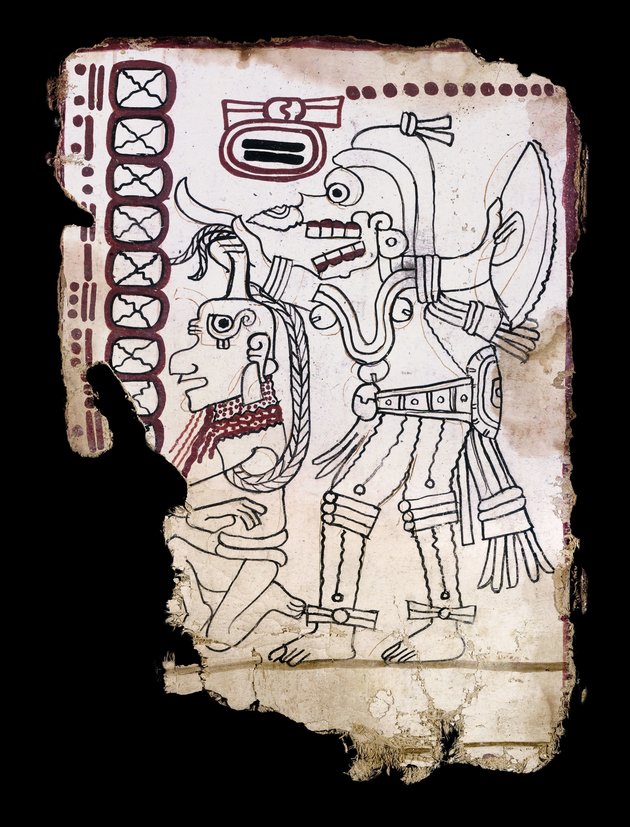
The Códice contains records of Venus’ 584-day cycle over the course of 140 years, testifying to the scrutiny Mayan astronomers gave to its complicated pattern of rising and falling. They thus managed to determine — as many ancient civilizations did not — that it was both the Morning Star and the Evening Star, although they seem to have been more interested in what its movements revealed about the intentions of the deities they saw as controlling it, and thus the likelihood of events like war or famine. Those gods weren’t benevolent: one page shows “a frightful skeletal deity that has a blunt knife sticking out of his nasal cavity,” holding “a giant jagged blade up” with one hand and “the hair of a captive whose head he’s freshly severed” with the other. That’s hardly the sort of image that comes to our modern minds when we gaze up at the night sky, but then, we don’t see things like the Mayans did.
via Aeon
Related content:
A 400-Year-Old Ring that Unfolds to Track the Movements of the Heavens
The Ancient Astronomy of Stonehenge Decoded
How the Ancient Mayans Used Chocolate as Money
Based in Seoul, Colin Marshall writes and broadcasts on cities, language, and culture. His projects include the Substack newsletter Books on Cities and the book The Stateless City: a Walk through 21st-Century Los Angeles. Follow him on the social network formerly known as Twitter at @colinmarshall.
Read More...Support Us
We're hoping to rely on loyal readers, rather than erratic ads. Please click the Donate button and support Open Culture. You can use Paypal, Venmo, Patreon, even Crypto! We thank you!

About Us

Open Culture scours the web for the best educational media. We find the free courses and audio books you need, the language lessons & educational videos you want, and plenty of enlightenment in between.
Advertise With Us

FREE UPDATES!
GET OUR DAILY EMAIL
Get the best cultural and educational resources on the web curated for you in a daily email. We never spam. Unsubscribe at any time.
FOLLOW ON SOCIAL MEDIA

Open Culture editor Dan Colman scours the web for the best educational media. He finds the free courses and audio books you need, the language lessons & movies you want, and plenty of enlightenment in between.
Advertise With Us

