How Marlon Brando Changed Acting: Inside a Scene from On the Waterfront
Marlon Brando has now been gone for more than two decades, and so thoroughgoing was his impact on the art of film acting that younger generations of movie-lovers may have trouble pinning down what, exactly, he did so differently on screen. In the new video above, Evan “Nerdwriter” Puschak shows them — and reminds us — using a single scene from Elia Kazan’s On the Waterfront. No, it’s not the scene you’re thinking of even if you’ve never seen the movie: Puschak selects an earlier one, a conversation between Brando’s prizefighter-turned-longshoreman Terry Malloy and Eva Marie Saint’s young Edie Doyle, the sister of the colleague Terry unknowingly lured to his death.
When Edie asks Terry how he got into boxing, Terry glances at the floor while launching into his answer. “It’s hard to overstate how revolutionary a choice like this was in 1954,” says Puschak. “Actors just didn’t get distracted in this way. Trained in theatrical techniques, they hit their spots, articulated their lines, and performed instantly legible emotions for the audience. They didn’t pause a conversation to look under the table, turning their head away from the microphone in the process, and they certainly didn’t speak while chewing food.” Just a few years earlier, “the famous Brando mumble” would have been unthinkable in a feature film; after On the Waterfront, it became an enduring part of popular culture.
Much of the evolution of the motion picture is the story of its liberation from the tropes of theater. The earliest narrative films amounted to little more than documentations of stage performances, statically framed from the familiar perspective of a spectator’s seat. Just as the development of the technology and techniques for camera movement and editing allowed cinema to come into its own on the visual level, the nature of the actors’ performances also had to change. In the mid-nineteen-forties, the electrified microphone allowed Frank Sinatra to sing with the cadence and subtlety of speech; not long thereafter, Brando took similar advantage of the technological capability of film to capture a range of what would come to be known as his own signature idiosyncrasies.
On the Waterfront opened fairly close on the heels of the Brando-starring A Streetcar Named Desire and The Wild One; still to come were the likes of One-Eyed Jacks, The Godfather, Last Tango in Paris, and Apocalypse Now. While Brando didn’t appear exclusively in acclaimed pictures — especially in the later decades of his career — never did he give a wholly uninteresting performance. Incorporating the tics, hitches, and self-stifling impulses that afflict all our real-life communication, he understood the potential of both realism and oddity to bring a character’s interiority out into the open, usually against that character’s will. But he never could’ve done it without his fellow performers to act and react against, not least the formidable Eva Marie Saint: at 101 years old, one of our few living connections to the vital, deceptively harrowing realm of postwar Hollywood cinema.
Related content:
Marlon Brando Screen Tests for Rebel Without A Cause (1947)
The Godfather Without Brando?: Coppola Explains How It Almost Happened
How Humphrey Bogart Became an Icon: A Video Essay
Based in Seoul, Colin Marshall writes and broadcasts on cities, language, and culture. His projects include the Substack newsletter Books on Cities and the book The Stateless City: a Walk through 21st-Century Los Angeles. Follow him on the social network formerly known as Twitter at @colinmarshall.
Read More...The 1957 “Spaghetti-Grows-on-Trees” Hoax: One of TV’s First April Fools’ Day Pranks
In 1957, the BBC program Panorama aired one of the first televised April Fools’ Day hoaxes. Above, you can watch a faux news report from Switzerland narrated by respected BBC journalist Richard Dimbleby. Here’s the basic premise: After a mild winter and the “virtual disappearance of the spaghetti weevil,” the residents of Ticoni (a Swiss canton on the Italian border) reap a record-breaking spaghetti harvest. Swiss farmers pluck strands of spaghetti from trees and lay them out to dry in the sun. Then we cut to Swiss residents enjoying a fresh pasta meal for dinner—going from farm to table, as it were.
The spoof documentary originated with the BBC cameraman Charles de Jaeger. He remembered one of his childhood schoolteachers in Austria joking, “Boys, you are so stupid, you’d believe me if I told you that spaghetti grew on trees.” Apparently he was right. Years later, David Wheeler, the producer of the BBC segment, recalled: “The following day [the broadcast] there was quite a to-do because there were lots of people who went to work and said to their colleagues ‘did you see that extraordinary thing on Panorama? I never knew that about spaghetti.’ ” An estimated eight million people watched the original program, and, decades later, CNN called the broadcast “the biggest hoax that any reputable news establishment ever pulled.”
If you would like to support the mission of Open Culture, consider making a donation to our site. It’s hard to rely 100% on ads, and your contributions will help us continue providing the best free cultural and educational materials to learners everywhere. You can contribute through PayPal, Patreon, and Venmo (@openculture). Thanks!
Related Content
When Neapolitans Used to Eat Pasta with Their Bare Hands: Watch Footage from 1903
“Moon Hoax Not”: Short Film Explains Why It Was Impossible to Fake the Moon Landing
When Italian Futurists Declared War on Pasta (1930)
Read More...
Edgar Allan Poe’s “The Raven,” Read by Christopher Walken, Christopher Lee & Vincent Price
Of the many readings and adaptations of Edgar Allan Poe’s classic moody-broody poem “The Raven,” none is more fun than The Simpsons’, in which Lisa Simpson’s intro transitions into the reading voice of James Earl Jones and the slapstick interjections of Homer as Poe’s avatar and Bart as the titular bird. Jones’ solo reading of the poem is not to be missed and exists in several versions on YouTube.
But Jones is not the only classically creepy actor to have mastered Poe’s diction. Above, we have Christopher Walken, whose unsettling weirdness is always tinged with a certain wry humor, perhaps an effect of his classical New York accent.
Accompanying Walken’s reading are the standard eerie wind sounds and the unusual addition of some distorted metal guitar: perhaps an intrusion, perhaps a unique dramatic effect. The visual component, a montage of expressive pencil drawings, also may or may not work for you.
You may wish to contrast this production with what may be the locus classicus for televisual interpretations of “The Raven.” Of course I mean the hammy Vincent Price reading (above), which lent so much aesthetically to The Simpsons parody. One of my favorite little in-jokes in the latter occurs during Bart and Lisa’s introduction. Bart whines, “that looks like a school-book!” and Lisa replies, “don’t worry, Bart. You won’t learn anything.”
Lisa’s rejoinder is a sly reference to Poe’s contempt for literature meant to instruct or moralize, a tendency he called “the heresy of the Didactic.” Poe’s theory and practice grew out of his desire that literature have a “unity of effect,” that it produce an aesthetic experience solely through the author’s skillful use of literary form. Poe may have anticipated and directly influenced the French symbolists and other aesthetes like Oscar Wilde, but his assured place in high culture has thankfully not gotten in the way of pop appropriations of his more oddball tales, like “The Raven.” A perennial favorite reading of the poem is classic horror actor Christopher Lee’s (below), which may be the most straightforwardly creepy of them all.
Note: An earlier version of this post appeared on our site in 2013.
Related Content:
Josh Jones is a writer and musician based in Durham, NC.
Read More...Leck Mich Im Arsch (“Kiss My Ass”): Listen to Mozart’s Scatological Canon in B Flat (1782)
We all know the manchild Mozart of Milos Forman’s 1984 biopic Amadeus. As embodied by a manic, braying Thomas Hulce, the precocious and haunted composer supposedly loved nothing more than scandalizing, amusing, or exasperating friends and enemies alike with juvenile pranks and scatological humor. Surely a fiction, eh? Gross exaggeration, no? Undoubtedly Mozart comported himself with more dignity? Those familiar with the composer’s biography know otherwise.
We have, for example, a ridiculously dirty letter that the 21-year-old “poop-loving musical genius” wrote to his 19-year-old cousin Marianne—a missive Letters of Note prefaces with the disclaimer “if you’re easily offended, please do not read any further” (oh, but how can you resist?). This piece of correspondence is but one of many “shockingly crude letters” Mozart wrote to his family. And if these slightly insane documents don’t convince you, we offer as further evidence of Mozart’s exuberantly childish sensibility the above canon in B flat for six voices, Leck Mich Im Arsch, which translates roughly to “Kiss My Ass.”
One of three naughty canons composed in 1782 with lyrics like “Good night, sleep tight, / And stick your ass to your mouth,” this piece was discovered in 1991 at Harvard University. Harvard librarian Michael Ochs, with a clear penchant for understatement, said at the time: “These are minor works. They’re not the Requiem, or ‘Don Giovanni.’ They were written for the amusement of Mozart and his friends, and they show another side of him.” The first edition of Mozart’s complete works, published in 1804, bowdlerized the texts and removed the racy humor, changing the title of Leck Mich Im Arsch to “Let us be glad!”—likely, writes Lucas Reilly at Mental Floss, “the complete opposite of what this tune means.”
Reilly also points out that Mozart’s “potty mouth” was probably not, as some have supposed, evidence of Tourette’s syndrome, but rather of an especially strong current in German humor, shared by Johannes Gutenberg, Martin Luther, and Mozart’s equally brilliant contemporary, Johann Wolfgang von Goethe. In fact, Leck Mich Im Arsch alludes to Goethe’s serious dramatic work, Götz Von Berlichingen. The chorus reads as follows in English:
Kiss my arse!
Goethe, Goethe!
Götz von Berlichingen! Second act;
You know the scene too well!
Let’s sing out now summarily:
Here is Mozart literary!
Hear two additional dirty choral pieces—Bona Nox and Difficile Lectu—at Mental Floss. Some other scatological canons thought to be Mozart’s, such as Leck mir den Arsch fein recht schön sauber (“Lick my ass right well and clean”), have since been attributed to amateur composer and physician Wenzel Trnka, yet it appears that the three featured at Mental Floss are genuine.
Note: An earlier version of this post appeared on our site in 2014.
Related Content:
Hear the Pieces Mozart Composed When He Was Only 5 Years Old
Watch the First Performance of a Mozart Composition That Had Been Lost for Centuries
Josh Jones is a writer and musician based in Durham, NC.
Read More...74 Ways Characters Die in Shakespeare’s Plays Shown in a Handy Infographic: From Snakebites to Lack of Sleep
In the graduate department where I once taught freshmen and sophomores the rudiments of college English, it became common practice to include Shakespeare’s Titus Andronicus on many an Intro to Lit syllabus, along with a viewing of Julie Taymor’s flamboyant film adaptation. The early work is thought to be Shakespeare’s first tragedy, cobbled together from popular Roman histories and Elizabethan revenge plays. And it is a truly bizarre play, swinging wildly in tone from classical tragedy, to satirical dark humor, to comic farce, and back to tragedy again. Critic Harold Bloom called Titus “an exploitative parody” of the very popular revenge tragedies of the time—its murders, maimings, rapes, and mutilations pile up, scene upon scene, and leave characters and readers/audiences reeling in grief and disbelief from the shocking body count.
Part of the fun of teaching Titus is in watching students’ jaws drop as they realize just how bloody-minded the Bard is. While Taymor’s adaptation takes many modern liberties in costuming, music, and set design, its horror-show depiction of Titus’ unrelenting mayhem is faithful to the text. Later, more mature plays rein in the excessive black comedy and shock factor, but the bodies still stack up. As accustomed as we are to thinking of contemporary entertainments like Game of Thrones as especially gratuitous, the whole of Shakespeare’s corpus, writes Alice Vincent at The Telegraph, is “more gory” than even HBO’s squirm-worthy fantasy epic, featuring a total of 74 deaths in 37 plays to Game of Thrones’ 61 in 50 episodes.
All of those various demises came together in a 2016 compendium staged at The Globe (in London) called The Complete Deaths. It included everything “from early rapier thrusts to the more elaborate viper-breast application adopted by Cleopatra.” The only death director Tim Crouch excluded is “that of a fly that meets a sticky end in Titus Andronicus.” In the infographic above, see all of the causes of those deaths, including Antony and Cleopatra’s snakebite and Titus Andronicus’ piece-de-resistance, “baked in a pie.”
Part of the reason so many of my former undergraduate students found Shakespeare’s brutality shocking and unexpected has to do with the way his work was tamed by later 17th and 18th century critics, who “didn’t approve of the on-stage gore.” The Telegraph quotes director of the Shakespeare Institute Michael Dobson, who points out that Elizabethan drama was especially gruesome; “the English drama was notorious for on-stage deaths,” and all of Shakespeare’s contemporaries, including Christopher Marlowe and Ben Jonson, wrote violent scenes that can still turn our stomachs.
More recent productions like a bloody staging of Titus at The Globe have restored the gore in Shakespeare’s work, and The Complete Deaths left audiences with little doubt that Shakespeare’s culture was as permeated with representations of violence as our own—and it was as much, if not more so, plagued by the real thing.
Note: An earlier version of this post appeared on our site in 2016.
Related Content:
Take a Virtual Tour of Shakespeare’s Globe Theatre in London
Hear What Shakespeare Sounded Like in the Original Pronunciation
Josh Jones is a writer and musician based in Durham, NC.
Read More...Explore 1,100 Works of Art by Georgia O’Keeffe: They’re Digitized and Free to View Online

Lake George Reflection (circa 1921) via Wikimedia Commons
What comes to mind when you think of Georgia O’Keeffe?
Bleached skulls in the desert?
Aerial views of clouds, almost cartoonish in their puffiness?
Voluptuous flowers (freighted with an erotic charge the artist may not have intended)?
Probably not Polaroid prints of a dark haired pet chow sprawled on flagstones…
Or watercolor sketches of demurely pretty ladies…
Or a massive cast iron abstraction…
If your knowledge of America’s most celebrated female artist is confined to the gift shop’s greatest hits, you might enjoy a leisurely prowl through the 1100+ works in the Georgia O’Keeffe Museum’s digital collection.
A main objective of this collection is to provide a more complete understanding of the life and work of the iconic artist, who died in 1986 at the age of 98.
Her evolution is evident when you search by materials or date.
You can also view works by other artists in the collection, including two very significant men in her life, photographer Alfred Stieglitz and ceramicist Juan Hamilton.
Each item’s listing is enhanced with information on inscriptions and exhibitions, as well as links to other works produced in the same year.
Visit the Georgia O’Keeffe Museum’s online collection here. And watch a documentary introduction to O’Keeffe, narrated by Gene Hackman, below:
Note: An earlier version of this post appeared on our site in 2020.
Related Content:
The Real Georgia O’Keeffe: The Artist Reveals Herself in Vintage Documentary Clips
Georgia O’Keeffe: A Life in Art, a Short Documentary on the Painter Narrated by Gene Hackman
How Georgia O’Keeffe Became Georgia O’Keeffe: An Animated Video Tells the Story
Recipes from the Kitchen of Georgia O’Keeffe
Ayun Halliday is an author, illustrator, theater maker and Chief Primatologist in NYC.
Read More...
When a Salvador Dalí Sketch Was Stolen from Rikers Island Prison (2003)
In 2003, a Salvador Dalí drawing was stolen from Rikers Island, one of the most formidable prisons in the United States. That the incident has never been used as the basis for a major motion picture seems inexplicable, at least until you learn the details. A screenwriter would have to adapt it as not a standard heist movie but a comedy of errors, beginning with the very conception of the crime. It seems that a few Rikers guards conspired surreptitiously to replace the artwork, which hung on a lobby wall, with a fake. Unfortunately for them, they made a less-than-convincing replacement, and even if it had been detail-perfect, how did they expect to sell a unique work whose criminal provenance would be so obvious?
Yet the job was, in some sense, a success, in that the drawing was never actually found. Dalí created it in 1965, when he was invited by Department of Correction Commissioner Anna Moscowitz Kross to meet with Rikers Island’s inmates. “Kross, the first female commissioner of the jail system, believed in rehabilitating prisoners with art, including painting sessions and theater productions,” writes James Fanelli, telling the story in Esquire. As for the artist, “as long as the city’s newspapers would be there to capture his magnanimous act, he was game” — but in the event, a 101-degree fever kept him from getting on the ferry to the prison that day. Instead, he dashed off an image of Christ on the cross (not an unfamiliar subject for him) and sent it in his stead.
“For nearly two decades, it hung in the prisoners’ mess hall,” writes Fanelli. “In 1981, after an inmate lobbed a coffee cup at the painting, breaking its glass casing and leaving a stain, the Dalí was taken down.” It then went from appraiser to gallery to storage to the trash bin, from which it was saved by a guard. By 2003, it had ended up in the lobby of one of the ten jails that constitute the Rikers Island complex, hung by the Pepsi machine. That no one paid the work much mind, and more so that it has been appraised at one million dollars, was clearly not lost on the employee who masterminded the heist. Yet though they managed to catch his accomplices, the investigators were never able legally to determine who that mastermind was.
Readers of Fanelli’s story, or viewers of the Inside Edition video at the top of the post, may well find themselves suspecting a particular corrections offer, who successfully maintained his innocence despite being named by all his colleagues who did get convictions. Any dramatization of the Rikers Island Dalí heist would have to make its own determination about whether he or someone else was really the ringleader, and it might even have to make a guess as to the ultimate fate of the stolen drawing itself. One isn’t entirely displeased to imagine it hanging today in a hidden room in the outer-borough home of some retired prison guard: made in haste and with scant inspiration, damaged by coffee and poor storage conditions, and possibly ripped apart and put back together again, but a Dalí nonetheless.
Related content:
The Greatest Art Heist in History: How the Mona Lisa Was Stolen from the Louvre (1911)
Take a Virtual Reality Tour of the World’s Stolen Art
Modern Art Was Used As a Torture Technique in Prison Cells During the Spanish Civil War
Based in Seoul, Colin Marshall writes and broadcasts on cities, language, and culture. His projects include the Substack newsletter Books on Cities and the book The Stateless City: a Walk through 21st-Century Los Angeles. Follow him on the social network formerly known as Twitter at @colinmarshall.
Read More...The Night When Bob Dylan Went Electric: Watch Him Play “Maggie’s Farm” at the Newport Folk Festival in 1965
The phrase “when Dylan went electric” once carried as much weight in pop culture history as “the fall of the Berlin Wall” carries in, well, history. Both events have receded into what feels like the distant past, but in the early 1960s, they likely seemed equally unlikely to many a serious Bob Dylan fan in the folk scene. They also seemed equally consequential. To understand the culture of the decade, we must understand the import of Dylan’s appearance at the Newport Folk Festival in 1965, backed by Mike Bloomfield and other members of the Paul Butterfield Blues Band.
The death of rock and roll in the 50s is often told through the lens of tragedy, but there was also anger, disgust, and mass disaffection. The Payola scandal had an impact, as did Elvis joining the army and Little Richard’s return to religion. Rock and roll was broken, tamed, and turned into commercial fodder. Simply put, it wasn’t cool at all, man, and even the Beatles couldn’t save it singlehandedly. Their arrival on U.S. shores is mythologized as music history Normandy—and has been credited with inspiring countless numbers of musicians—but without Dylan and the blues artists he imitated, things would very much have gone otherwise.
In the early 60s, Dylan and the Beatles’ “respective musical constituencies were indeed perceived as inhabiting two separate subcultural worlds,” writes Jonathan Gould in Can’t Buy Me Love: The Beatles, Britain, and America. “Dylan’s core audience was comprised of young people emerging from adolescence—college kids with artistic or intellectual leanings, a dawning political and social idealism, and a mildly bohemian style…. The Beatles’ core audience, by contrast, was comprised of veritable ‘teenyboppers’—kids in high school or grade school whose lives were totally wrapped up in the commercialized popular culture of television, radio, pop records, fan magazines, and teen fashion. They were seen as idolaters, not idealists.”
To evoke anything resembling the commercial pablum of Beatlemania, and at Newport, no less, spoke of treason to folk authenticity. Some called out “Where’s Ringo?” Others called him “Judas.” Dylan’s set “would go down as one of the most divisive concerts ever”—(and that’s saying a lot)—“putting the worlds of both folk and rock in temporary identity crisis,” Michael Madden writes at Consequence of Sound. The former folk hero accomplished this in all of three songs, “Maggie’s Farm,” “Like a Rolling Stone,” and “Phantom Engineer,” an early take on “It Takes a Lot to Laugh, It Takes a Train to Cry.” Pete Seeger famously “threw a furious tantrum” upon hearing the first few bars of “Maggie’s Farm,” above, though he’s since said he was upset at the sound quality.
The moment was defining—and Dylan apparently decided to do it on a whim after hearing Alan Lomax insult the Paul Butterfield Band, who were giving a workshop at the festival. He came back onstage afterward to play two acoustic songs for the appreciative audience who remained, unfazed by the vehemence of half the crowd’s reaction to his earlier set. Yet the revolution to return rock to its folk and blues roots was already underway. Within six months of meeting Dylan in 1964, Gould writes, “John Lennon would be making records on which he openly imitated Dylan’s nasal drone, brittle strum, and introspective vocal persona.” (Dylan also introduced him to cannabis.)
In 1965, “the distinctions between the folk and rock audiences would have nearly evaporated.” The two met in the middle. “The Beatles’ audience, in keeping with the way of the world, would be showing signs of growing up,” while Dylan’s fans showed signs of “growing down, as hundreds of thousands of folkies in their late teens and early twenties” rediscovered “the ethos of their adolescent years.” They also discovered electric blues. Newport shows Dylan accelerating the transition, and also signified the arrival of the great electric blues-rock guitarists, in the form of the inimitable Mike Bloomfield, an invading force all his own, who inspired a generation with his licks on “Like a Rolling Stone” and on the absolute classic Paul Butterfield Blues Band debut album, released in The Year Dylan Went Electric.
Note: An earlier version of this post appeared on our site in 2020.
Related Content:
Watch Bob Dylan Play “Mr. Tambourine Man” in Color at the 1964 Newport Folk Festival
Bob Dylan Explains Why Music Has Been Getting Worse
Tangled Up in Blue: Deciphering a Bob Dylan Masterpiece
How Bob Dylan Kept Reinventing His Songwriting Process, Breathing New Life Into His Music
Josh Jones is a writer and musician based in Durham, NC.
Read More...Why Real Biblical Angels Are Creepy, Beastly, and Hardly Angelic
Nearly 70 percent of Americans believe in angels, at least according to a statistic often cited in recent years. But what, exactly, comes to their minds — or those of any other believers around the world — when they imagine one? Personal conceptions may vary, of course, but we can be fairly certain of one thing: most of them will bear no resemblance to the angels actually described in the Bible. Here to give us a sense of their appearance is Tommie Trelawny, creator of the YouTube channel Hochelaga, whose video above explains “Why Bible Accurate Angels Are So Creepy.”
Far from the winged, white-robed embodiments of gentleness we might know from greeting cards, says Trelawny, the angels of the Bible, and specifically the Old Testament, are “horrifying abominations” who would be more at home in an H. P. Lovecraft novel. Angel, from the Greek angelos, which itself comes from the Hebrew mal’akh, means “messenger.” That implies an innocuous-enough set of duties, but then, you may recall the story of Passover, with its angel who slaughtered the Egyptians’ first-born sons; or the angel who “struck 70,000 Israelites to death”; or the angel who “singlehandedly killed 185,000 Assyrian soldiers in one night.”
The Bible doesn’t say anything about those angels having wings. “In fact, they look like any ordinary person,” as do even the most famous examples like Gabriel, Raphael, and Michael. In the grand heavenly scheme of things, such humanoid angels, or Malakh, don’t rank particularly high. Still, they’re one rung above the Cherubim, who turn out to be less like Cupid and more like “the mythical beasts of ancient Mesopotamia, especially the Babylonian Lamassu, which has the wings of an eagle, the body of a lion, and the head of a king” — with a more-than-passing resemblance to the Egyptian sphinx or the Hittite griffin. Even the popular image of the pudgy, flying cherub, which emerged much later, seems to have been imported from Greek and Roman myths.
Ranked above the Malakh are the six-winged Seraphim, or “burning ones.” The origins of these “caretakers of God’s throne” are suggested by the Hebrew word Saraph, meaning “a venomous serpent in the desert,” much like the cobra whose image adorned the head of the Egyptian pharaoh. As for the Ophanim, it’s anyone’s guess where they come from. Taking the form of a wheel within a wheel floating in the sky, its rims lined with eyes, an Ophan would make for an intimidating sight indeed: perhaps a representation of the wheels of God’s chariot, perhaps the result of “the prophet ingesting a psychedelic plant,” and perhaps — according to a fringe theory — visitation by a spacecraft. Whatever the evidence for those explanations, it’s safe to say they’re not quite as comforting as all those placid celestial harpists.
Related content:
How Our Depiction of Jesus Changed Over 2,000 Years and What He May Have Actually Looked Like
The Origins of Satan: The Evolution of the Devil in Religion
Behold the Codex Gigas (aka “Devil’s Bible”), the Largest Medieval Manuscript in the World
Christianity Through Its Scriptures: A Free Course from Harvard University
Angels & Demons: The Science Revealed
Based in Seoul, Colin Marshall writes and broadcasts on cities, language, and culture. His projects include the Substack newsletter Books on Cities and the book The Stateless City: a Walk through 21st-Century Los Angeles. Follow him on the social network formerly known as Twitter at @colinmarshall.
Read More...Mark Twain Wrote the First Book Ever Written With a Typewriter
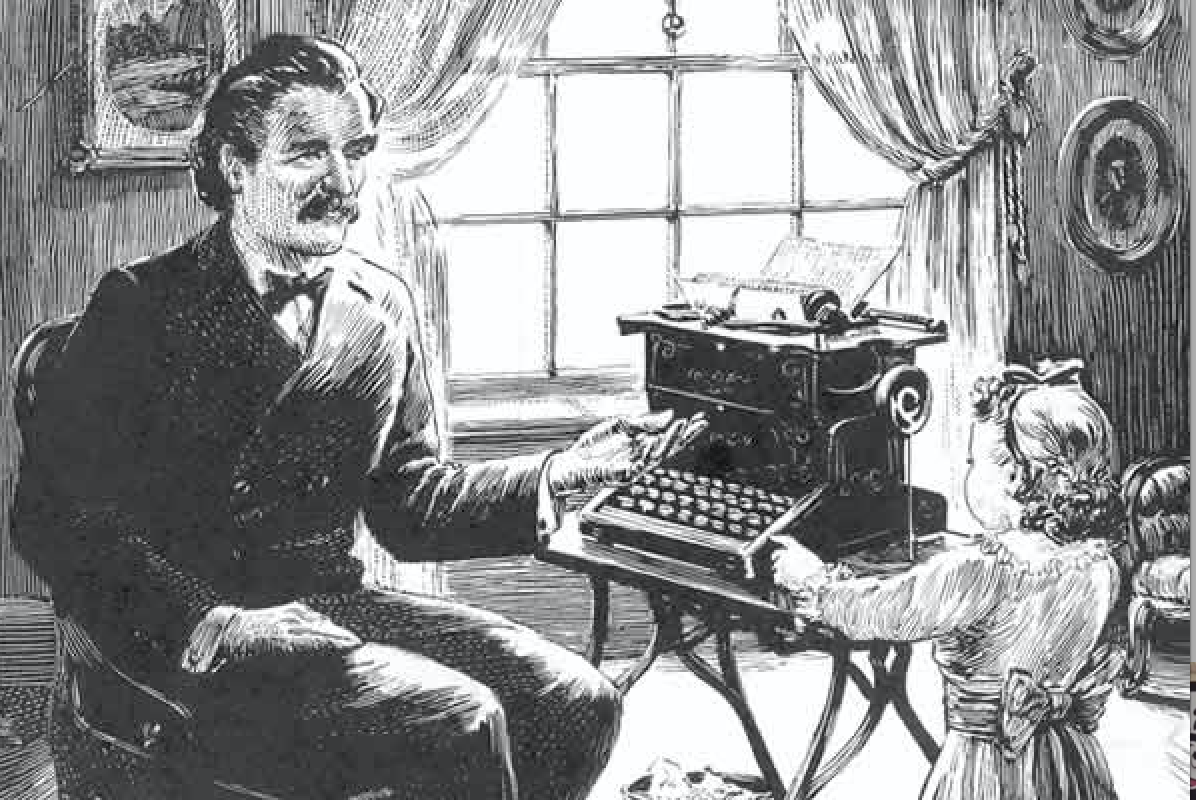
My Penguin Classics copy of Mark Twain’s Life on the Mississippi sits alone atop an overfull shelf. There is a bookmark on page 204, exactly halfway through, torn from an in-flight duty-free catalog—whiskey and fancy pens. It tells me “hey, you forgot to finish this, you [various obscenities].” And I shrug. What can I say? I went to grad school, where I learned to read ten books at once and never finish one. Good thing Mark Twain didn’t write that way, or we might not have Life on the Mississippi.
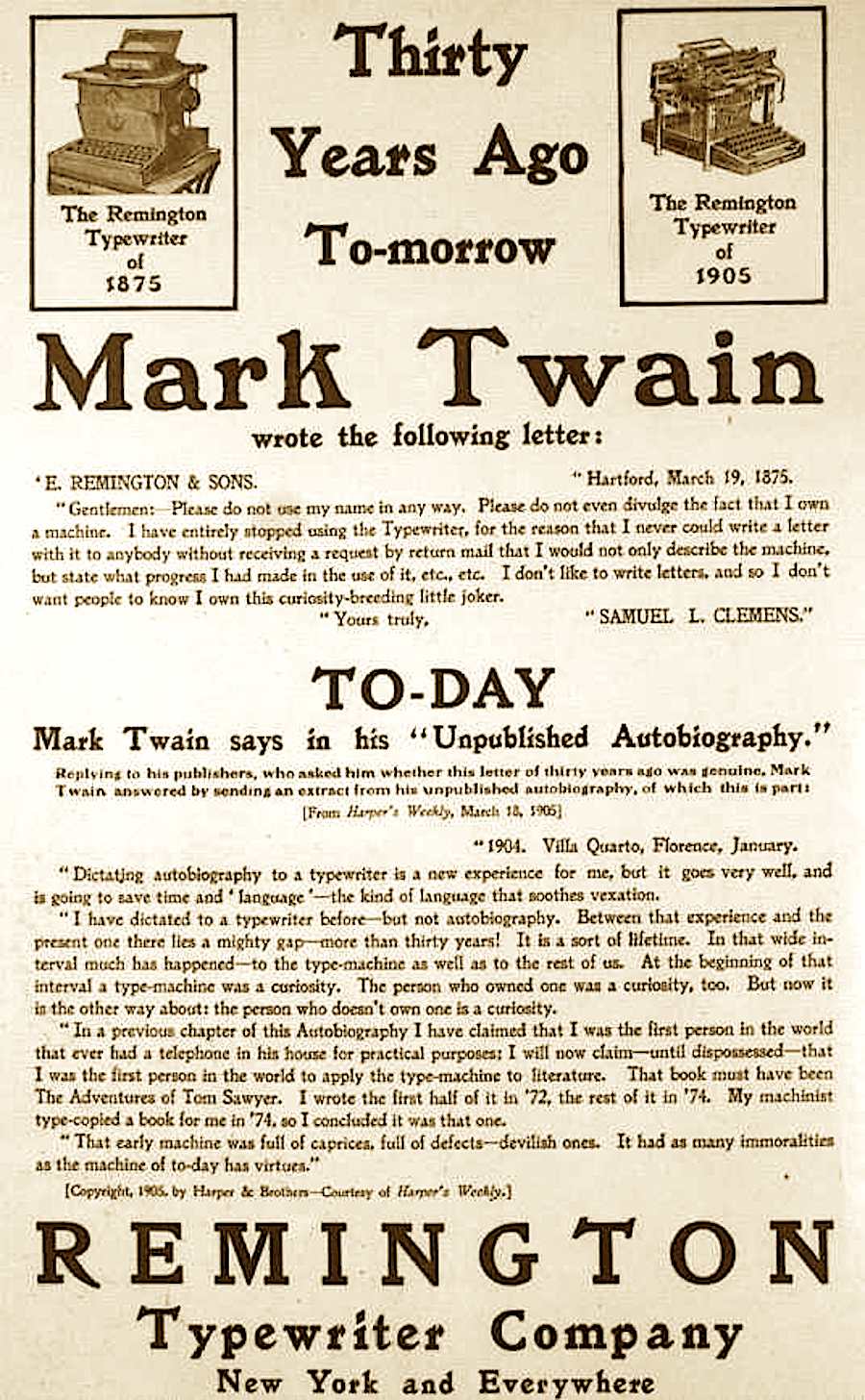
Twain was a diligent and conscientious writer with a memory like a bear trap, or at least that’s what he wanted us to think. But somewhere in his reminiscence he may have been confused. Twain wrote in his 1904 autobiography that his first novel written on a typewriter—the first typewritten novel at all—was Tom Sawyer.
Was this so? Twain purchased his first typewriter (which probably looked like the Sholes and Glidden seen here) in 1874 for $125. In 1875, he writes in a letter to the Remington company that he is no longer using his typewriter; it corrupts his morals because it makes him want to swear. He gives the infernal machine away, twice. It returns to him each time.
The year after Twain’s moral trouble with his Remington, Tom Sawyer is published from handwritten manuscript, not typed. Then, seven years later, Life on the Mississippi (1883) comes to the publisher in typescript. Twain did not type it himself—he had presumably renounced the act—but he dictated the memoir to a typist from a handwritten draft. Now, I can hear you quibbling… Life on the Mississippi isn’t a novel at all! Well, okay, fair enough. Let’s just say it’s the first typewritten book and call it a day, eh? Go read this excellent New Yorker piece on the early life of the typewriter and leave me alone. I’ve got a book to finish.
Note: An earlier version of this post appeared on our site in 2013.
If you would like to support the mission of Open Culture, consider making a donation to our site. It’s hard to rely 100% on ads, and your contributions will help us continue providing the best free cultural and educational materials to learners everywhere. You can contribute through PayPal, Patreon, and Venmo (@openculture). Thanks!
Related Content:
Mark Twain Makes a List of 60 American Comfort Foods He Missed While Traveling Abroad (1880)
The Only Footage of Mark Twain: The Original & Digitally Restored Films Shot by Thomas Edison
Josh Jones is a writer and musician based in Durham, NC.
Read More...Support Us
We're hoping to rely on loyal readers, rather than erratic ads. Please click the Donate button and support Open Culture. You can use Paypal, Venmo, Patreon, even Crypto! We thank you!

About Us

Open Culture scours the web for the best educational media. We find the free courses and audio books you need, the language lessons & educational videos you want, and plenty of enlightenment in between.
Advertise With Us

FREE UPDATES!
GET OUR DAILY EMAIL
Get the best cultural and educational resources on the web curated for you in a daily email. We never spam. Unsubscribe at any time.
FOLLOW ON SOCIAL MEDIA

Open Culture editor Dan Colman scours the web for the best educational media. He finds the free courses and audio books you need, the language lessons & movies you want, and plenty of enlightenment in between.
Advertise With Us


