Every Filmed and Televised Performance by Joy Division (1978–79)
Brian Eno once said of the Velvet Underground that their first album sold only 30,000 copies, but everyone who bought one started a band. Joy Division’s debut Unknown Pleasures sold only 20,000 copies in its initial period of release, but the T‑shirt emblazoned with its cover art — an image of radio waves emanating from a pulsar taken from an astronomy encyclopedia — has long since constituted a commercial-semiotic empire unto itself. That speaks to the vast subcultural influence of the band, despite their only having been active from 1976 to 1980. When we speak of the genre of post-punk, we speak, in large part, of Joy Division and the artists they influenced.
Less than a year after the 1979 release of Unknown Pleasures, Joy Division’s lead singer Ian Curtis committed suicide. The band had already recorded Closer, their second and last album (at least before the subsequent, more successful reformation as New Order). Scant though it may be, their studio discography has only drawn more and more critical acclaim over the decades.
Still, fans who weren’t around to witness the rise of Joy Division first-hand will suspect they’ve missed out on something essential. “Live, Joy Division were heavy,” remembers band historian Jon Savage. “Performers — and David Bowie is a good example – know exactly what to give and what to withhold, but Ian Curtis didn’t have that stagecraft. He just came on and gave everything.”
That sort of intensity, Savage adds, is “not infinitely reproducible”; even at the time, it seems that those who witnessed Joy Division in concert understood that their peculiarly compelling energy was driving toward some kind of final combustion. You can get a taste of it in the collection of the group’s every televised performance, originally aired on BBC2 and Granada TV in 1978 and 1979, at the top of the post; just above, we have a 70-minute compilation of all their filmed live shows. Much of it consists of footage shot over two nights at the Apollo Theatre in 1979, which the uploader describes as of poor quality — but “according to people who were there, the gig’s quality was poor in person too.” As much as generations of fans have done to mythologize the band’s brief existence over the past 45 years, here is evidence that even Joy Division had an off night once in a while.
Related content:
The History of Rock n Roll in 10 Songs: A List Created by Legendary Rock Critic Greil Marcus
Radiohead Covers The Smiths & New Order (2007)
Hear a 9‑Hour Tribute to John Peel: A Collection of His Best “Peel Sessions”
An Animated History of Goth
Based in Seoul, Colin Marshall writes and broadcasts on cities, language, and culture. His projects include the Substack newsletter Books on Cities and the book The Stateless City: a Walk through 21st-Century Los Angeles. Follow him on the social network formerly known as Twitter at @colinmarshall.
Read More...Mark Twain Makes a List of 60 American Comfort Foods He Missed While Traveling Abroad (1880)
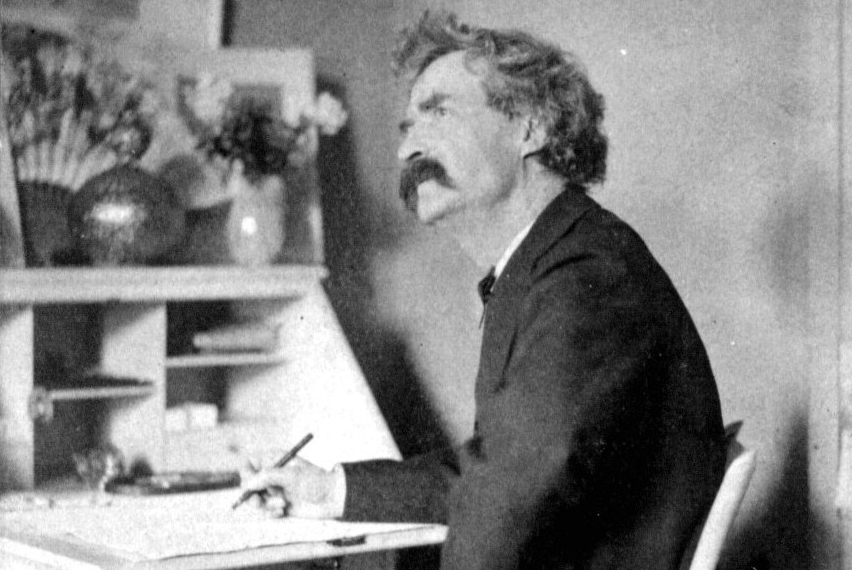
Thinking of taking a trip abroad? Or maybe relocating for good? Americans would do well, even 150 years hence, to attend to Mark Twain’s satirical account of U.S. travelers journeying through Europe and Palestine, The Innocents Abroad. The “Americans who are painted to peculiar advantage by Mr. Clements” (sic), as fellow American satirist William Dean Howells wrote at the time, still roam the Earth—including travelers like one who “told the English officers that a couple of our gunboats could come and knock Gibraltar into the Mediterranean Sea.” The tactlessness and belligerence Twain skewered do not feel historically so far from home.
Twain’s portraits—“somewhat caricatured… or carefully and exactly done”—proved so popular with readers that he followed up with an unofficial sequel, 1880s A Tramp Abroad, a somewhat more serious fictionalized travelogue of Americans journeying through Europe; this time but two, Twain and his friend “Harris.” In the previous book, complained Howells, the reader learns “next to nothing about the population of the cities and the character of the rocks in the different localities.” Here, without his comedy troupe of traveling companions, Twain directs his focus outward with minute descriptions of his surroundings. He is, as usual, supremely curious, often perplexed, but mostly delighted by his experiences. Except when it comes to the food.
Growing “increasingly tired of an abundance of what he described as ‘fair-to-middling’ food,” writes Lists of Note, Twain comments: “The number of dishes is sufficient; but then it is such a monotonous variety of UNSTRIKING dishes […] Three or four months of this weary sameness will kill the robustest appetite.” Having never spent so long a time away, I cannot speak to Twain’s gustatory ennui, but I can relate, as no doubt can you, reader, to missing one or two familiar comfort foods (as well as “sincere and capable” ice water). Twain, perhaps not as adventurous an eater as he was a traveler—and in that sense also very much a modern American—made “an enormous list of the foods he’d missed the most, of which were to be consumed when he arrived home.”
The list, below, is itself a kind of travelogue, through the varieties of 19th century American cuisine, East, West, North, and South, including such delicacies as “’Possum” “Canvas-back-duck from Baltimore,” “Virginia bacon, broiled,” “Prairie hens, from Illinois,” and “Brook trout, from Sierra Nevadas.” While we might pine for a regional delicacy or favorite processed food, Twain conjured up in his mind’s gut a whole continent of food to come home to. What kinds of food do you find yourself missing when you travel? And how long a list might you find yourself making after several months tramping around in foreign lands? Tell us in the comments section below. For now, here’s Twain’s list:
Radishes. Baked apples, with cream
Fried oysters; stewed oysters. Frogs.
American coffee, with real cream.
American butter.
Fried chicken, Southern style.
Porter-house steak.
Saratoga potatoes.
Broiled chicken, American style.
Hot biscuits, Southern style.
Hot wheat-bread, Southern style.
Hot buckwheat cakes.
American toast. Clear maple syrup.
Virginia bacon, broiled.
Blue points, on the half shell.
Cherry-stone clams.
San Francisco mussels, steamed.
Oyster soup. Clam Soup.
Philadelphia Terapin soup.
Oysters roasted in shell-Northern style.
Soft-shell crabs. Connecticut shad.
Baltimore perch.
Brook trout, from Sierra Nevadas.
Lake trout, from Tahoe.
Sheep-head and croakers, from New Orleans.
Black bass from the Mississippi.
American roast beef.
Roast turkey, Thanksgiving style.
Cranberry sauce. Celery.
Roast wild turkey. Woodcock.
Canvas-back-duck, from Baltimore.
Prairie hens, from Illinois.
Missouri partridges, broiled.
‘Possum. Coon.
Boston bacon and beans.
Bacon and greens, Southern style.
Hominy. Boiled onions. Turnips.
Pumpkin. Squash. Asparagus.
Butter beans. Sweet potatoes.
Lettuce. Succotash. String beans.
Mashed potatoes. Catsup.
Boiled potatoes, in their skins.
New potatoes, minus the skins.
Early rose potatoes, roasted in the ashes, Southern style, served hot.
Sliced tomatoes, with sugar or vinegar. Stewed tomatoes.
Green corn, cut from the ear and served with butter and pepper.
Green corn, on the ear.
Hot corn-pone, with chitlings, Southern style.
Hot hoe-cake, Southern style.
Hot egg-bread, Southern style.
Hot light-bread, Southern style.
Buttermilk. Iced sweet milk.
Apple dumplings, with real cream.
Apple pie. Apple fritters.
Apple puffs, Southern style.
Peach cobbler, Southern style
Peach pie. American mince pie.
Pumpkin pie. Squash pie.
All sorts of American pastry.
Fresh American fruits of all sorts, including strawberries which are not to be doled out as if they were jewelry, but in a more liberal way.
Ice-water—not prepared in the ineffectual goblet, but in the sincere and capable refrigerator.
Note: An earlier version of this post appeared on our site in 2016.
Related Content:
Explore an Online Archive of 12,700 Vintage Cookbooks
The Only Footage of Mark Twain: The Original & Digitally Restored Films Shot by Thomas Edison
Mark Twain Drafts the Ultimate Letter of Complaint (1905)
Mark Twain Creates a List of His Favorite Books For Adults & Kids (1887)
Josh Jones is a writer and musician based in Durham, NC.
Read More...What’s the Most Banned Book of the 2024–25 School Year?: A Clockwork Orange
If you happen to be a high school student in Florida who’s eager to read A Clockwork Orange, that urge may turn out to be harder to satisfy than you imagine. Anthony Burgess’ harrowing, linguistically inventive novel of a grim near future has come out on top in PEN America’s latest ranking of banned books: that is, books removed or prevented even from entering public school libraries, most commonly in the state of Florida, with Texas and Tennessee as runners-up. Further down the list appears another widely known dystopian saga, Margaret Atwood’s The Handmaid’s Tale; Toni Morrison’s tale of Depression-era race relations The Bluest Eye; and even such long-popular “young adult” standards as Judy Blume’s Forever… and Stephen Chbosky’s The Perks of Being a Wallflower.
Since its publication in 1962, “A Clockwork Orange has faced multiple book banning attempts due to the sexual violence it depicts,” says Carnegie Mellon University’s Banned Books Project. “In 1973, a bookseller in Orem, Utah, was arrested for selling the novel along with two other ‘obscene’ books.”
Bans followed “in 1976 in Aurora, Colorado, in 1977 in Westport, Connecticut, and in 1982 in Anniston, Alabama. As recently as 2019, members of the Florida Citizens Alliance” — in yet another example of the surprising tendency toward cultural authoritarianism in the Sunshine State — “have lobbied to ban the book along with almost one hundred other ‘pornographic’ novels.”
The notoriety of A Clockwork Orange in this regard probably owes something to the steely luridness of Stanley Kubrick’s film adaptation, which was banned in England by Kubrick himself. It makes, in any case, for an ironic object of a book ban, given its themes. Burgess was inspired to write this novel of juvenile ultra-delinquency, as he explains in the interview clip above, by “talk in the nineteen-sixties of the possibility of getting these young thugs and not putting them in jail, because jail is needed for professional criminals, but rather putting them through a course of conditioning” to make them behave less like organisms than machines: the “clockwork oranges” of the title. The state, it seemed, “was all too ready to take over our brains and turn us into good little citizens without the power of choice” — a process that plausibly begins by restricting the choice of reading material.
Related Content:
The Brooklyn Public Library Gives Every Teenager in the U.S. Free Access to Censored Books
America’s First Banned Book: Discover the 1637 Book That Mocked the Puritans
Based in Seoul, Colin Marshall writes and broadcasts on cities, language, and culture. His projects include the Substack newsletter Books on Cities and the book The Stateless City: a Walk through 21st-Century Los Angeles. Follow him on the social network formerly known as Twitter at @colinmarshall.
Read More...Meryl Streep’s First Film Role Was in an Animated Film on Erik Erikson’s Stages of Life (1976)
Difficult as it may be to remember now, there was a time when Meryl Streep was not yet synonymous with silver-screen stardom — a time, in fact, when she had yet to appear on the silver screen at all. Half a century ago, she was just another young stage actress in New York, albeit one rapidly ascending the rungs of theatrical prestige, doing three Shakespeare plays and then starring in Weill, Hauptmann, and Brecht’s Happy End on Broadway. The Deer Hunter, Kramer vs. Kramer, Out of Africa, Postcards from the Edge, The Bridges of Madison County: all this lay in her future in 1976, the year of her feature debut.
Streep made that debut in Everybody Rides the Carousel, a now-obscure animated film that dramatizes post-Freudian psychologist Erik Erikson’s eight stages of psychosocial development. First published in his book Childhood and Society in 1950, this scheme captured the imagination of the mid-century American public, growing ever hungrier as it was for clear, legible systems of self-understanding.
Erikson conceived of each age of man as a struggle for resolution between two opposing forces: in infancy, for example, trust versus mistrust; in adolescence, identity versus role confusion; and so on.
The young Meryl Streep, or rather her voice, appears in the sixth stage, early adulthood, whose theme is love. She acts out that age’s contest of intimacy and isolation with Charles Levin, another up-and-comer who would go on to achieve wide recognition on television shows like Alice, Hill Street Blues, and (just once, but memorably) Seinfeld. In character as a young couple unsteadily feeling their way through their relationship, the two engage in a remarkably naturalistic conversation, all animated in a seventies watercolor style in the vision of director John Hubley. A prolific animator who’d worked on Disney’s Fantasia, Hubley was known as the creator of Mr. Magoo: a man who provided us all with an example of how to navigate late adulthood’s path between ego integrity and despair, however myopically.
via Messy Nessy
Related content:
Watch Meryl Streep Have Fun with Accents: Bronx, Polish, Irish, Australian, Yiddish & More
Master of Light: A Close Look at the Paintings of Johannes Vermeer Narrated by Meryl Streep
Marcel Marceau Mimes the Progression of Human Life, From Birth to Death, in 4 Minutes
Meryl Streep Gives Graduation Speech at Barnard
Based in Seoul, Colin Marshall writes and broadcasts on cities, language, and culture. His projects include the Substack newsletter Books on Cities and the book The Stateless City: a Walk through 21st-Century Los Angeles. Follow him on the social network formerly known as Twitter at @colinmarshall.
Read More...An Art Conservator Restores a Painting of the Doomed Party Girl Isabella de’ Medici: See the Before and After
Some people talk to plants.
The Carnegie Museum of Art’s chief conservator Ellen Baxter talks to the paintings she’s restoring.
“You have to … tell her she’s going to look lovely,” she says, above, spreading varnish over a 16th-century portrait of Isabella de’ Medici prior to starting the laborious process of restoring years of wear and tear by inpainting with tiny brushes, aided with pipettes of varnish and solvent.
Isabella had been waiting a long time for such tender attention, concealed beneath a 19th-century overpainting depicting a daintier featured woman reputed to be Eleanor of Toledo, wife of Cosimo I de’ Medici, the second Duke of Florence.
Louise Lippincott, the CMA’s former curator of fine arts, ran across the work in the museum’s basement storage. Records named the artist as Bronzino, court painter to Cosimo I, but Lippincott, who thought the painting “awful”, brought it to Ellen Baxter for a second opinion.
As Cristina Rouvalis writes in Carnegie Magazine, Baxter is a “rare mix of left- and right-brained talent”, a painter with a bachelor’s degree in art history, minors in chemistry and physics, and a master’s degree in art conservation:
(She) looks at paintings differently than other people, too—not as flat, static objects, but as three-dimensional compositions layered like lasagna.
The minute she saw the oil painting purported to be of Eleanor of Toledo… Baxter knew something wasn’t quite right. The face was too blandly pretty, “like a Victorian cookie tin box lid,” she says. Upon examining the back of the painting, she identified—thanks to a trusty Google search—the stamp of Francis Leedham, who worked at the National Portrait Gallery in London in the mid-1800s as a “reliner,” transferring paintings from a wood panel to canvas mount. The painstaking process involves scraping and sanding away the panel from back to front and then gluing the painted surface layer to a new canvas.
An x‑ray confirmed her hunch, revealing extra layers of paint in this “lasagna”.
Careful stripping of dirty varnish and Victorian paint in the areas of the portrait’s face and hands began to reveal the much stronger features of the woman who posed for the artist. (The Carnegie is banking on Bronzino’s student, Alessandro Allori, or someone in his circle.)
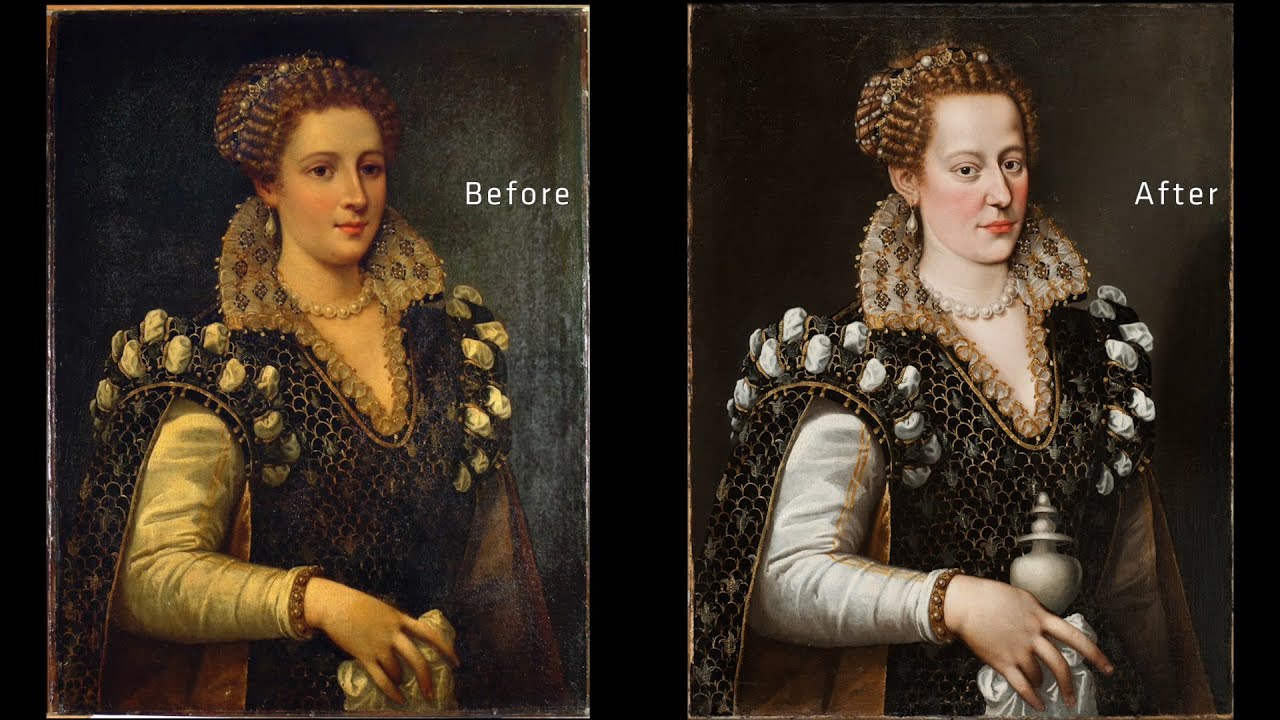
Lippincott was also busily sleuthing, finding a Medici-commissioned copy of the painting in Vienna that matched the dress and hair exactly. Thusly did she learn that the subject was Eleanor of Toledo’s daughter, Isabella de’ Medici, the apple of her father’s eye and a notorious, ultimately ill-fated party girl.
The History Blog paints an irresistible portrait of this maverick princess:
Cosimo gave her an exceptional amount of freedom for a noblewoman of her time. She ran her own household, and after Eleanor’s death in 1562, Isabella ran her father’s too. She threw famously raucous parties and spent lavishly. Her father always covered her debts and protected her from scrutiny even as rumors of her lovers and excesses that would have doomed other society women spread far and wide. Her favorite lover was said to be Troilo Orsini, her husband Paolo’s cousin.
Things went downhill fast for Isabella after her father’s death in 1574. Her brother Francesco was now the Grand Duke, and he had no interest in indulging his sister’s peccadilloes. We don’t know what happened exactly, but in 1576 Isabella died at the Medici Villa of Cerreto Guidi near Empoli. The official story released by Francesco was that his 34-year-old sister dropped dead suddenly while washing her hair. The unofficial story is that she was strangled by her husband out of revenge for her adultery and/or to clear the way for him to marry his own mistress Vittoria Accoramboni.
Baxter noted that the urn Isabella holds was not part of the painting to begin with, though neither was it one of Leedham’s revisions. Its resemblance to the urn that Mary Magdalene is often depicted using as she anoints Jesus’ feet led her and Lippincott to speculate that it was added at Isabella’s request, in an attempt to redeem her image.
“This is literally the bad girl seeing the light,” Lippincott told Rouvalis.
Despite her fondness for the subject of the liberated painting, and her considerable skill as an artist, Baxter resisted the temptation to embellish beyond what she found:
I’m not the artist. I’m the conservator. It’s my job to repair damages and losses, to not put myself in the painting.
Note: An earlier version of this post appeared on our site in 2023.
Related Content
How Art Conservators Restore Old Paintings & Revive Their Original Colors
The Art of Restoring a 400-Year-Old Painting: A Five-Minute Primer
A Restored Vermeer Painting Reveals a Portrait of a Cupid Hidden for Over 350 Years
Free Course: An Introduction to the Art of the Italian Renaissance
– Ayun Halliday is the author of Creative, Not Famous: The Small Potato Manifesto and Creative, Not Famous Activity Book.
Read More...When Michelangelo Created Artistic Designs for Military Fortifications to Protect Florence (1529–1530)

Michelangelo was born in the Republic of Florence, with the talent of… well, Michelangelo. Given those beginnings, it would have been practically impossible for him to avoid entanglement with the House of Medici, the banking family and political dynasty that ruled over Florence for the better part of three centuries. By the time of Michelangelo’s birth, in 1475, the Medici had been in power for four decades. At the age of fourteen, he was taken in by Lorenzo de’ Medici, known as “il Magnifico,” in whose household he received artistic training as well as philosophical knowledge and political connections.
It was with Lorenzo’s death in 1492 that this first streak of Medici dominance ran into choppy waters. When the family was expelled from Florence two years later, Michelangelo took his leave as well, beginning the period of his career in which he would sculpt both the Pietà and the David.
Only in 1512 (after various troubles in Florence that included the four-year theocracy of Savonarola) were the Medici restored to power, but they also had the papacy: the Medici popes Leo X and Clement VII commissioned a great deal of work from Michelangelo, though he seldom saw eye-to-eye with those particular patrons.
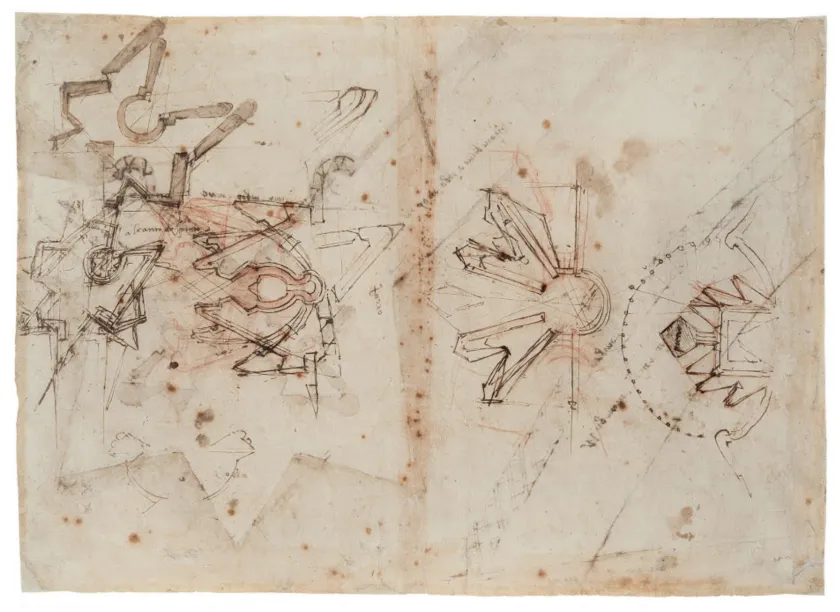
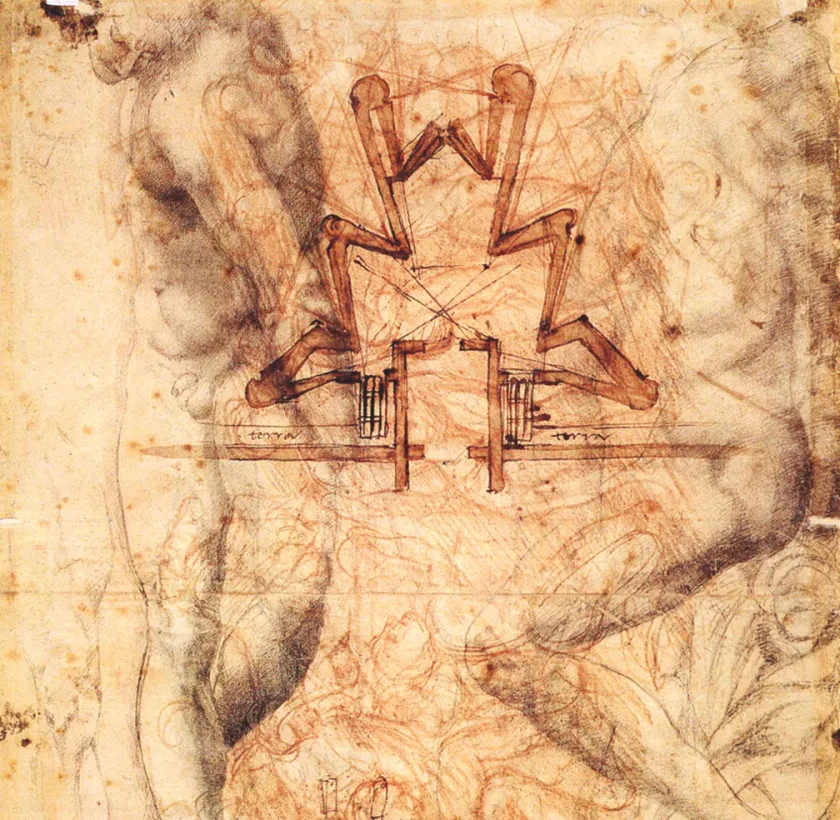
When Florence rebelled against the Medici in the late fifteen-twenties, Michelangelo took the side of the republicans. Their government selected him as one of the “Nine of the Militias” meant to design fortifications for the threatened city (a resumption of earlier, abandoned Medici plans) in 1526, and before long appointed him governatore generale. It was in that capacity that he drew the sketches seen here, which constitute his plans for a set of fortifications against the Medici-backed siege that spanned 1529 and 1530. However artistically striking, their designs were never actually built, at least not in anything like their entirety.
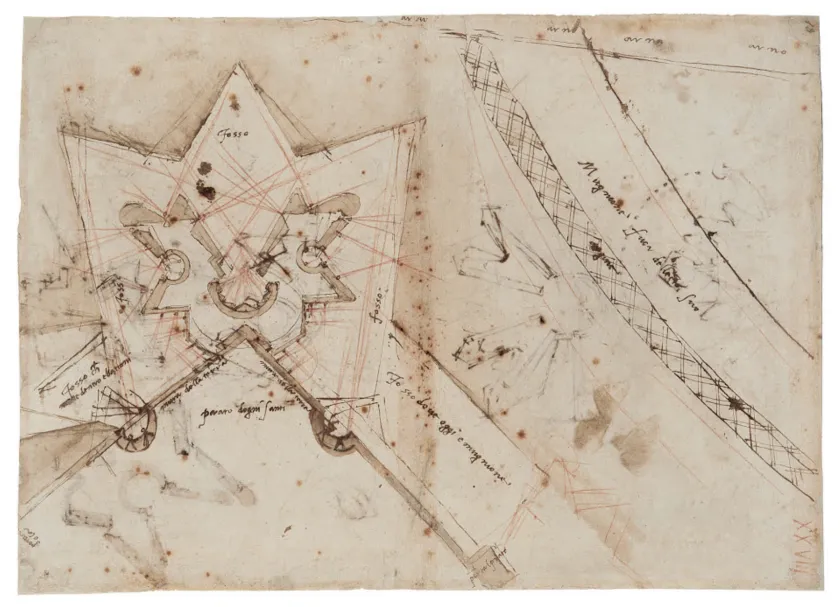
As it happened, Michelangelo had backed the wrong horse: the siege was ultimately successful, and the Medici retook power under the aegis of Holy Roman emperor Charles V. This put the artist in a difficult position, and for a period of months he was forced to go into hiding. With his death sentence in effect, he lay low in a small chamber beneath the Basilica of San Lorenzo, now part of the Medici Chapels Museum, whose walls are covered in drawings, previously featured here on Open Culture, in his unmistakable hand. The artistic skills he’d kept sharp during that period of internal exile would probably have kept serving him well enough in Florence after Clement VII guaranteed his safety there. But it seems he’d had enough Florentine intrigue for one lifetime, the rest of which he wisely opted to spend in Rome.
Related content:
A Secret Room with Drawings Attributed to Michelangelo Opens to Visitors in Florence
How Michelangelo’s David Still Draws Admiration and Controversy Today
New Video Shows What May Be Michelangelo’s Lost & Now Found Bronze Sculptures
Watch the Painstaking and Nerve-Racking Process of Restoring a Drawing by Michelangelo
Michelangelo’s Illustrated Grocery List
Based in Seoul, Colin Marshall writes and broadcasts on cities, language, and culture. His projects include the Substack newsletter Books on Cities and the book The Stateless City: a Walk through 21st-Century Los Angeles. Follow him on the social network formerly known as Twitter at @colinmarshall.
Read More...Leonardo Da Vinci’s To-Do List from 1490: The Plan of a Renaissance Man

Most people’s to-do lists are, almost by definition, pretty dull, filled with those quotidian little tasks that tend to slip out of our minds. Pick up the laundry. Get that thing for the kid. Buy milk, canned yams and kumquats at the local market.
Leonardo Da Vinci was, however, no ordinary person. And his to-do lists were anything but dull.
Da Vinci would carry around a notebook, where he would write and draw anything that moved him. “It is useful,” Leonardo once wrote, to “constantly observe, note, and consider.” Buried in one of these books, dating back to around the 1490s, is a to-do list. And what a to-do list.
NPR’s Robert Krulwich had it directly translated. And while all of the list might not be immediately clear, remember that Da Vinci never intended for it to be read by web surfers 500 years in the future.
[Calculate] the measurement of Milan and Suburbs
[Find] a book that treats of Milan and its churches, which is to be had at the stationer’s on the way to Cordusio
[Discover] the measurement of Corte Vecchio (the courtyard in the duke’s palace).
[Discover] the measurement of the castello (the duke’s palace itself)
Get the master of arithmetic to show you how to square a triangle.
Get Messer Fazio (a professor of medicine and law in Pavia) to show you about proportion.
Get the Brera Friar (at the Benedictine Monastery to Milan) to show you De Ponderibus (a medieval text on mechanics)
[Talk to] Giannino, the Bombardier, re. the means by which the tower of Ferrara is walled without loopholes (no one really knows what Da Vinci meant by this)
Ask Benedetto Potinari (A Florentine Merchant) by what means they go on ice in Flanders
Draw Milan
Ask Maestro Antonio how mortars are positioned on bastions by day or night.
[Examine] the Crossbow of Mastro Giannetto
Find a master of hydraulics and get him to tell you how to repair a lock, canal and mill in the Lombard manner
[Ask about] the measurement of the sun promised me by Maestro Giovanni Francese
Try to get Vitolone (the medieval author of a text on optics), which is in the Library at Pavia, which deals with the mathematic.
You can just feel Da Vinci’s voracious curiosity and intellectual restlessness. Note how many of the entries are about getting an expert to teach him something, be it mathematics, physics or astronomy. Also who casually lists “draw Milan” as an ambition?
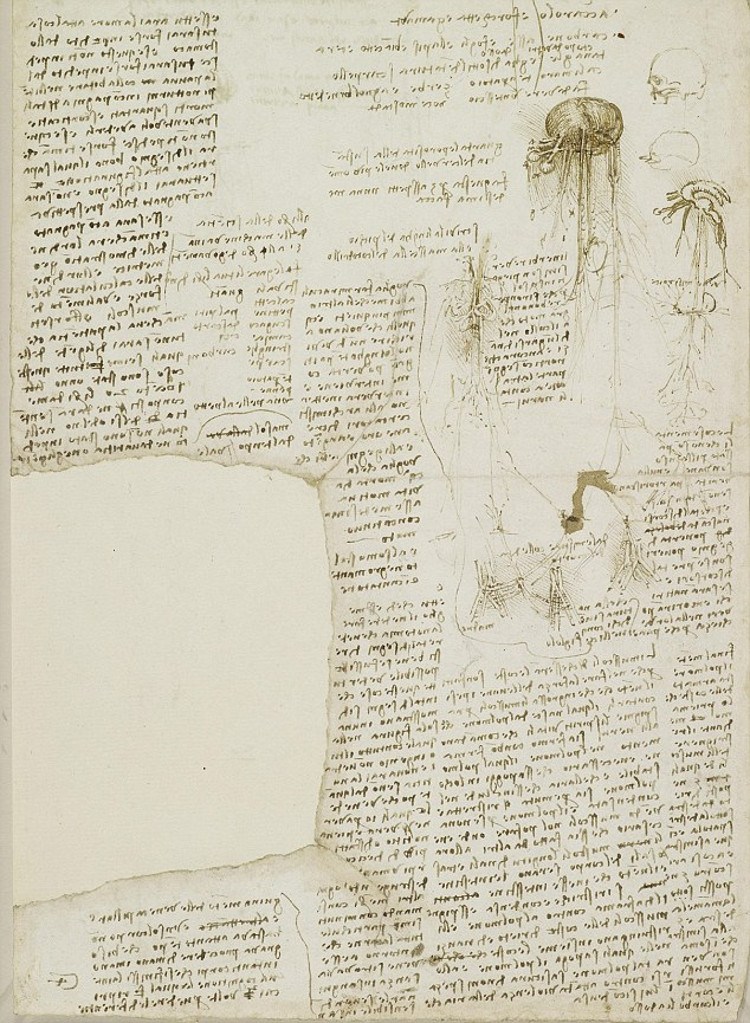
Later to-do lists, dating around 1510, seemed to focus on Da Vinci’s growing fascination with anatomy. In a notebook filled with beautifully rendered drawings of bones and viscera, he rattles off more tasks that need to get done. Things like get a skull, describe the jaw of a crocodile and tongue of a woodpecker, assess a corpse using his finger as a unit of measurement.
On that same page, he lists what he considers to be important qualities of an anatomical draughtsman. A firm command of perspective and a knowledge of the inner workings of the body are key. So is having a strong stomach.
You can see a page of Da Vinci’s notebook above but be warned. Even if you are conversant in 16th century Italian, Da Vinci wrote everything in mirror script.
Note: An earlier version of this post appeared on our site in December, 2014.
If you would like to support the mission of Open Culture, consider making a donation to our site. It’s hard to rely 100% on ads, and your contributions will help us continue providing the best free cultural and educational materials to learners everywhere. You can contribute through PayPal, Patreon, and Venmo (@openculture). Thanks!
Related Content:
Leonardo da Vinci’s Handwritten Resume (Circa 1482)
Thomas Edison’s Hugely Ambitious “To-Do” List from 1888
Umberto Eco Explains Why We Make Lists
Johnny Cash’s Short and Personal To-Do List
Jonathan Crow is a writer and filmmaker whose work has appeared in Yahoo!, The Hollywood Reporter, and other publications.
Read More...The Horrifying Paintings of Francis Bacon
Mention Francis Bacon, and you sometimes have to clarify which one you mean: the twentieth-century painter, or the seventeenth-century philosopher? Despite how much time separated their lives, the two men aren’t without their connections. One may actually have been a descendant of the other, if you credit the artist’s father’s claim of relation to the Elizabethan intellectual’s half-brother. Better documented is how the more recent Francis Bacon made a connection to the time of the more distant one, by painting his own versions of Diego Velázquez’s Portrait of Innocent X. We refer, of course, to his “screaming popes,” the subject of the new Hochelaga video above.
As Hochelaga creator Tommie Trelawny puts it, “no image captured his imagination more” than Velázquez’s depiction of Pope Innocent X, which is “considered to be one of the finest works in Western art.”
Bacon’s version from 1953, after he’d more than established himself in the English art scene, is “a terrible and frightening inversion of the original. The Pope screams as if electrocuted in his golden throne. Violent brushstrokes sweep across the canvas like bars of a cage, stripping away all sense of grandeur and leaving only brutality and pain.” In many ways, this harrowing image came as the natural meeting of existing currents in Bacon’s work, which had already drawn from the history of Christian art and employed a variety of anguished, isolated figures.
Unsurprisingly, Bacon’s Study after Velázquez’s Portrait of Pope Innocent X inspired all manner of controversy. The artist himself denied all interpretations of its supposed implications, insisting that “recreating this papal portrait was simply an aesthetic choice: art for the sake of art.” In any case, he followed it up with about 50 more screaming popes, each of which “embodies a different facet of human darkness.” These and the many other works of art Bacon created prolifically until his death in 1992 reflect what seems to have been his own troubled soul and perpetually disordered life. His style changed over the decades, becoming somewhat softer and less aggressively disturbing, suggesting that his demons may have gone into at least partial retreat. But could anyone capable of painting the screaming popes ever truly have lost touch with the abyss?
Related content:
The Brilliantly Nightmarish Art & Troubled Life of Painter Francis Bacon
Francis Bacon on The South Bank Show: A Singular Profile of the Singular Painter
William Burroughs Meets Francis Bacon: See Never-Broadcast Footage (1982)
The “Dark Relics” of Christianity: Preserved Skulls, Blood & Other Grim Artifacts
The Scream Explained: What’s Really Happening in Edvard Munch’s World-Famous Painting
Based in Seoul, Colin Marshall writes and broadcasts on cities, language, and culture. His projects include the Substack newsletter Books on Cities and the book The Stateless City: a Walk through 21st-Century Los Angeles. Follow him on the social network formerly known as Twitter at @colinmarshall.
Read More...The Earliest Known Appearance of the F‑Word (1310)
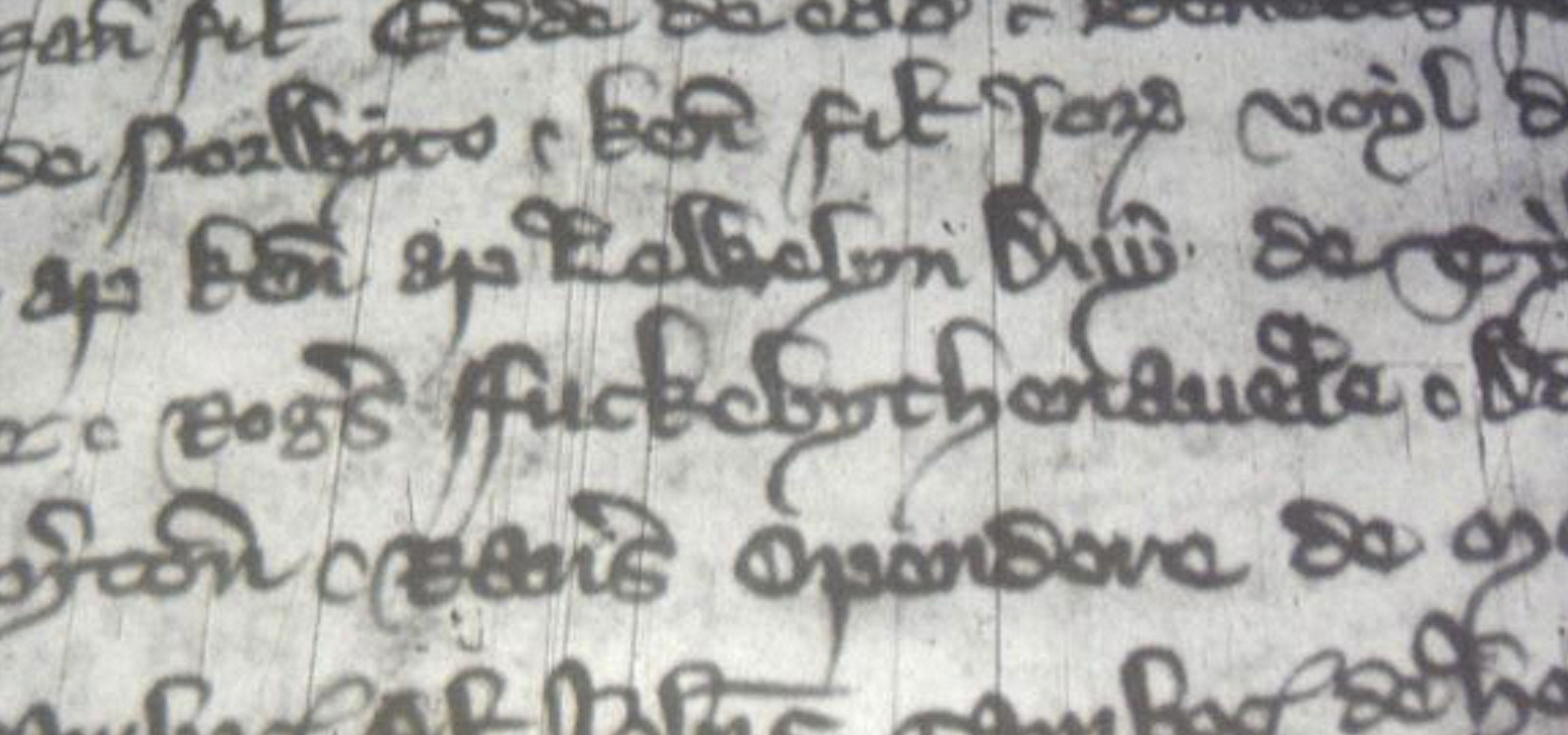
Photo by Paul Booth
You value decorum, propriety, eloquence, you treasure le mot juste and agonize over diction as you compose polite but strongly-worded letters to the editor. But alas, my literate friend, you have the misfortune of living in the age of Twitter, Tumblr, et al., where the favored means of communication consists of readymade mimetic words and phrases, photos, videos, and animated gifs. World leaders trade insults like 5th graders—some of them do not know how to spell. Respected scientists and journalists debate anonymous strangers with cartoon avatars and work-unsafe pseudonyms. Some of them are robots.
What to do?
Embrace it. Insert well-placed profanities into your communiqués. Indulge in bawdiness and ribaldry. You may notice that you are doing no more than writers have done for centuries, from Rabelais to Shakespeare to Voltaire. Profanity has evolved right alongside, not apart from, literary history. T.S. Eliot, for example, knew how to go lowbrow with the best of them, and gets credit for the first recorded use of the word “bullshit.” As for another, even more frequently used epithet in 24-hour online commentary?—well, the word “F*ck” has a far longer history.
Not long ago we alerted you to the first known use of the versatile obscenity in a 1528 marginal note scribbled in Cicero’s De Officiis by a monk cursing his abbot. Not long after this discovery, notes Medievalists.net, another scholar found the word in a 1475 poem called Flen flyys. This was thought to be the earliest appearance of “f*ck” as a purely sexual reference until medieval historian Paul Booth of Keele University discovered an instance dating over a hundred years earlier. Rather than within, or next to, a work of literature, however, the word appears in a set of 1310 English court records. And no, it is decidedly not a legal term.
The documents concern the case of “a man named Roger Fuckebythenavele.” Used three times in the record, the name, says Booth, is probably not a joke made by the scribe but some kind of bizarre nickname, though one hopes not a description of the crime. “Either it refers to an inexperienced copulator, referring to someone trying to have sex with a navel,” says Booth, stating the obvious, “or it’s a rather extravagant explanation for a dimwit, someone so stupid they think that this is the way to have sex.” Our medieval gent had other problems as well. He was called to court three times within a year before being pronounced “outlawed,” which The Independent’s Loulla-Mae Eleftheriou-Smith suggests execution but probably refers to banishment.
For the word to have such casually hilarious or insulting currency in the early 14th century, it must have come from an even earlier time. Indeed, “f*ck is a word of German origin,” notes Jesse Sheidlower, author of an etymological history called The F Word, “related to words in several other Germanic languages, such as Dutch, German, and Swedish, that have sexual meanings as well as meaning such as ‘to strike’ or ‘to move back and forth’” (naturally). So, in other words, it’s just a word. But in this case it might have also been a weapon, Booth speculates, wielded “by a revengeful former girlfriend. Fourteenth-century revenge porn perhaps…” If that’s not evidence for you that the present may not be unlike the past, then maybe take note of the appearance of the word “twerk” in 1820.
Note: An earlier version of this post appeared on our site in 2017.
Related Content:
People Who Swear Are More Honest Than Those Who Don’t, Finds a New University Study
Steven Pinker Explains the Neuroscience of Swearing (NSFW)
Stephen Fry, Language Enthusiast, Defends The “Unnecessary” Art Of Swearing
Josh Jones is a writer and musician based in Durham, NC. Follow him at @jdmagness
Read More...Explore an Online Archive of 12,700 Vintage Cookbooks
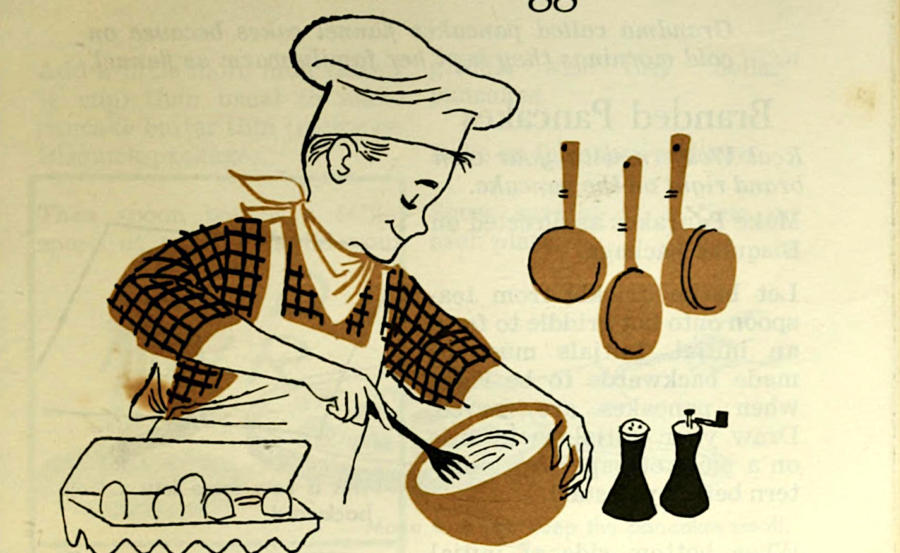
“Early cookbooks were fit for kings,” writes Henry Notaker at The Atlantic. “The oldest published recipe collections” in the 15th and 16th centuries in Western Europe “emanated from the palaces of monarchs, princes, and grand señores.” Cookbooks were more than recipe collections—they were guides to court etiquette and sumptuous records of luxurious living. In ancient Rome, cookbooks functioned similarly, as the extravagant fourth century Cooking and Dining in Imperial Rome demonstrates.
Written by Apicius, “Europe’s oldest [cookbook] and Rome’s only one in existence today”—as its first English translator described it—offers “a better way of knowing old Rome and antique private life.” It also offers keen insight into the development of heavily flavored dishes before the age of refrigeration. Apicius recommends that “cooks who needed to prepare birds with a ‘goatish smell’ should bathe them in a mixture of pepper, lovage, thyme, dry mint, sage, dates, honey, vinegar, broth, oil and mustard,” Melanie Radzicki McManus notes at How Stuff Works.
Early cookbooks communicated in “a folksy, imprecise manner until the Industrial Revolution of the 1800s,” when standard (or metric) measurement became de rigueur. The first cookbook by an American, Amelia Simmons’ 1796 American Cookery, placed British fine dining and lavish “Queen’s Cake” next to “johnny cake, federal pan cake, buckwheat cake, and Indian slapjack,” Keith Stavely and Kathleen Fitzgerald write at Smithsonian, all recipes symbolizing “the plain, but well-run and bountiful American home.” With this book, “a dialogue on how to balance the sumptuous with the simple in American life had begun.”
Cookbooks are windows into history—markers of class and caste, documents of daily life, and snapshots of regional and cultural identity at particular moments in time. In 1950, the first cookbook written by a fictional lifestyle celebrity, Betty Crocker, debuted. It became “a national best-seller,” McManus writes. “It even sold more copies that year than the Bible.” The image of the perfect Stepford housewife may have been bigger than Jesus in the 50s, but Crocker’s career was decades in the making. She debuted in 1921, the year of publication for another, more humble recipe book: the Pilgrim Evangelical Lutheran Church Ladies’ Aid Society of Chicago’s Pilgrim Cook Book.
As Ayun Halliday noted in an earlier post, this charming collection features recipes for “Blitz Torte, Cough Syrup, and Sauerkraut Candy,” and it’s only one of thousands of such examples at the Internet Archive’s Cookbook and Home Economics Collection, drawn from digitized special collections at UCLA, Berkeley, and the Prelinger Library. When we last checked in, the collection featured 3,000 cookbooks. It has grown since 2016 to a library of 12,700 vintage examples of homespun Americana, fine dining, and mass marketing.
Laugh at gag-inducing recipes of old; cringe at the pious advice given to women ostensibly anxious to please their husbands; and marvel at how various international and regional cuisines have been represented to unsuspecting American home cooks. (It’s hard to say whether the cover or the contents of a Chinese Cook Book in Plain English from 1917 seem more offensive.) Cookbooks of recipes from the American South are popular, as are covers featuring stereotypical “mammy” characters. A more respectful international example, 1952’s Luchow’s German Cookbook gives us “the story and the favorite dishes of America’s most famous German restaurant.”
There are guides to mushrooms and “commoner fungi, with special emphasis on the edible varieties”; collections of “things mother used to make” and, most practically, a cookbook for leftovers. And there is every other sort of cookbook and home ec manual you could imagine. The archive is stuffed with helpful hints, rare ingredients, unexpected regional cookeries, and millions of minute details about the habits of these books’ first hungry readers.
If you would like to support the mission of Open Culture, consider making a donation to our site. It’s hard to rely 100% on ads, and your contributions will help us continue providing the best free cultural and educational materials to learners everywhere. You can contribute through PayPal, Patreon, and Venmo (@openculture). Thanks!
Note: An earlier version of this post appeared on our site in 2020.
Related Content:
A Database of 5,000 Historical Cookbooks–Covering 1,000 Years of Food History–Is Now Online
Discover the World’s Oldest Surviving Cookbook, De Re Coquinaria, from Ancient Rome
The World’s Oldest Cookbook: Discover 4,000-Year-Old Recipes from Ancient Babylon
Josh Jones is a writer and musician based in Durham, NC.
Read More...Support Us
We're hoping to rely on loyal readers, rather than erratic ads. Please click the Donate button and support Open Culture. You can use Paypal, Venmo, Patreon, even Crypto! We thank you!

About Us

Open Culture scours the web for the best educational media. We find the free courses and audio books you need, the language lessons & educational videos you want, and plenty of enlightenment in between.
Advertise With Us

FREE UPDATES!
GET OUR DAILY EMAIL
Get the best cultural and educational resources on the web curated for you in a daily email. We never spam. Unsubscribe at any time.
FOLLOW ON SOCIAL MEDIA

Open Culture editor Dan Colman scours the web for the best educational media. He finds the free courses and audio books you need, the language lessons & movies you want, and plenty of enlightenment in between.
Advertise With Us

