Hear the Long-Lost Chants of English Monks, Revived for the First Time in 500 Years
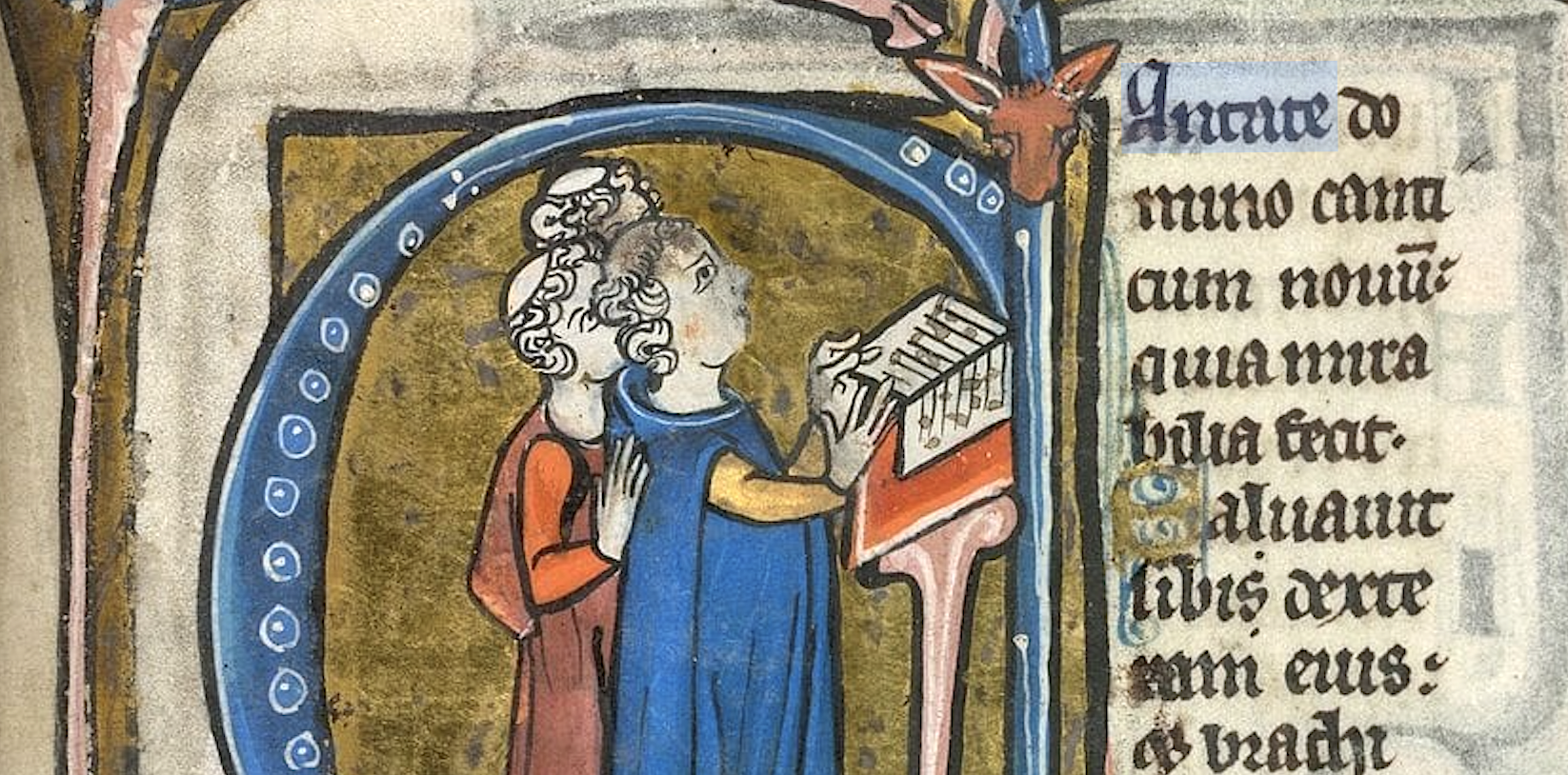
Listening to music, especially live music, can be a religious experience. These days, most of us say that figuratively, but for medieval monks, it was the literal truth. Every aspect of life in a monastery was meant to get you that much closer to God, but especially the times when everyone came together and sang. For English monks accustomed to that way of life, it would have come as quite a shock, to say the very least, when Henry VIII ordered the dissolution of the monasteries between the mid fifteen-thirties and the early fifteen-forties. Not only were the inhabitants of those refuges sent packing, their sacred music was cast to the wind.
Nearly half a millennium later, that music is still being recovered. As reported by the Guardian’s Steven Morris, University of Exeter historian James Clark found the latest example while researching the still-standing Buckland Abbey in Devon for the National Trust.
“Only one book — rather boringly setting out the customs the monks followed — was known to exist, held in the British Library.” But lo and behold, a few leaves of parchment stuck in the back happened to contain pieces of early sixteenth-century music, or rather chant, with both text and notation, a vanishingly rare sort of artifact of medieval monastic life.
Just this month, for the first time in almost five centuries, the music from the “Buckland book” resonated within the walls of Buckland Abbey once again. You can hear a clip from the University of Exeter chapel choir’s performance just above, which may or may not get across the grimness of the original work. “The themes are heavy — the threats from disease and crop failures, not to mention powerful rulers — but the polyphonic style is bright and joyful, a contrast to the sort of mournful chants most associated with monks,” writes Morris. For listeners here in the twenty-first century, these compositions offer the additional transcendental dimension of aesthetic time travel. The only way their rediscovery could be more fortuitous is if it had happened in time to benefit from the nineteen-nineties Gregorian-chant boom.
Related content:
See the Guidonian Hand, the Medieval System for Reading Music, Get Brought Back to Life
The Medieval Ban Against the “Devil’s Tritone”: Debunking a Great Myth in Music Theory
A Beatboxing Buddhist Monk Creates Music for Meditation
Based in Seoul, Colin Marshall writes and broadcasts on cities, language, and culture. His projects include the Substack newsletter Books on Cities and the book The Stateless City: a Walk through 21st-Century Los Angeles. Follow him on the social network formerly known as Twitter at @colinmarshall.
Read More...The 1830s Device That Created the First Animations: The Phenakistiscope

The image just above is an animated GIF, a format by now older than most people on the internet. Those of us who were surfing the World Wide Web in its earliest years will remember all those little digging, jackhammering roadworkers who flanked the permanent announcements that various sites — including, quite possibly, our own — were “under construction.” Charming though they could be at the time, they now look impossibly primitive compared to what we can see on today’s internet, where high-resolution feature films stream instantaneously. But technologically speaking, we can trace it all back to what this particular animated GIF depicts: the phenakistiscope.
Invented simultaneously and independently in late 1832 by Belgian physicist Joseph Plateau and Austrian geometry professor Simon Stampfer, the phenakistiscope was a simple wheel-shaped device that could, for the first time in the history of technology, create the illusion of a smoothly moving picture when spun and viewed in a mirror: hence the derivation of its name from the Greek phenakisticos, “to deceive,” and ops, “eye.”
When it caught on as a commercial novelty, it was also marketed under names like Phantasmascope and Fantascope, which promised buyers a glimpse of horse-riders, twirling dancers, bowing aristocrats, hopping frogs, flying ghouls, and even proto-psychedelic abstract patterns, many of which you can see re-animated as GIFs in this Wikipedia gallery.
Eventually, according to the Public Domain Review, the phenakistiscope was “supplanted in the popular imagination: firstly by the similar Zoetrope, and then — via Eadweard Muybridge’s Zoopraxiscope (which projected the animation) — by film itself.” Muybridge, previously featured here on Open Culture, did pioneering motion-photography work in the eighteen-seventies that’s now considered a precursor to cinema. Understanding what he was up to is an important part of understanding the emergence of movies as we know them. But the most instructive experience to start with is making a phenakistiscope of your own, instructions for which are available from the George Eastman Museum and artist Megan Scott on YouTube. The finished product may not hold anyone’s attention long here in the age of Netflix, but then, the age of Netflix would never have arrived had the phenakistiscope not come first.
Related content:
How Animated Cartoons Are Made: A Vintage Primer Filmed Way Back in 1919
The Trick That Made Animation Realistic: Watch a Short History of Rotoscoping
Was a 32,000-Year-Old Cave Painting the Earliest Form of Cinema?
Based in Seoul, Colin Marshall writes and broadcasts on cities, language, and culture. His projects include the Substack newsletter Books on Cities and the book The Stateless City: a Walk through 21st-Century Los Angeles. Follow him on the social network formerly known as Twitter at @colinmarshall.
Read More...Animated Map Shows How the Five Major Religions Spread Across the World (3000 BC — 2000 AD)
Hinduism, Judaism, Buddhism, Christianity, Islam.… Claims to ancient origin and ultimate authority notwithstanding, the world’s five major religions are all of recent vintage compared to the couple hundred thousand years or more of human existence on the planet. During most of our prehistory, religious beliefs and practices were largely localized, confined to the territorial or tribal boundaries of individual groups.
For people groups in the British Isles a thousand years ago, for example, the Levant may as well have been another planet. How is it that Britain became a few hundred years later one of the most zealously global evangelizers of a religion from Palestine? How is it that an Indian sect, Buddhism, which supposedly began with one man sometime in the 5th Century B.C.E., became the dominant religion in all of Asia just a few hundred years later?
Answering such questions in detail is the business of professional historians. But we know the broad outlines: the world’s major religions spread through imperial conquest and forced conversion; through cultural exchange of ideas and the adaptation of far-off beliefs to local customs, practices, and rituals; through migrant and diaspora communities moving across the globe. We know religions traveled back and forth through trade routes over land and sea and were transmitted by the painstaking translation and copying by hand dense, lengthy scriptures.
All of these movements are also the movements of the modern globalized world, a construct that began taking shape a few thousand years ago. The spread of the “Big 5” religions corresponds with the shifting of masses of humans around the globe as they formed the interconnections that now bind us all tightly together, whether we like it or not.
In the animated map above from Business Insider, you can watch the movement of these five faiths over the course of 5,000 years and see in the span of a little over two minutes how the modern world took shape. And you might find yourself wondering: what will such a map look like in another 5,000 years? Or in 500? Will these global religions all meld into one? Will they wither away? Will they splinter into thousands? Our speculations reveal much about what we think will happen to humanity in the future.
Note: An earlier version of this post appeared on our site in 2018.
Related Content:
A Visual Map of the World’s Major Religions (and Non-Religions)
Free Online Religion Courses
Josh Jones is a writer and musician based in Durham, NC.
Read More...Seven Philosophy Books for Beginners: Where to Start
One especially appealing aspect of philosophy, as a field of study, is that you don’t have to go anywhere to learn it but the library. And these days, you don’t necessarily have to go there, now that so many philosophical texts have become freely available on the internet. In the video above, philosophy YouTuber Jared Henderson recommends seven books through which anyone can get a solid introduction to the subject. They are as follows: Bertrand Russell’s The Problems of Philosophy, Simon Blackburn’s Think, the complete works of Plato, Marcus Aurelius’ Meditations, St. Augustine’s Confessions, René Descartes’ Meditations on First Philosophy, and John Stuart Mill’s On Liberty.
Why these books? Though written for the general public, The Problems of Philosophy has also proven useful to Henderson in teaching introductory courses, not least thanks to Russell’s eloquent defense of philosophical study itself. Think, a more recently written broad survey, “introduces you to some topics that almost everyone is interested in: free will, the problems of knowledge and rationality, the existence of God, the existence of the self, the problems of ethics.” And given the scope of Plato’s writings, if you carefully read through them all, you’ll be “a remarkably different person at the end of that process.”
The name of Marcus Aurelius, who ruled the Roman Empire in the middle of the second century, has lately become an even better-known than it already was thanks to a resurgence of public interest in Stoicism. Henderson recommends his Meditations as an example of “philosophy as a way of life.” In the Confessions, Augustine blends “poetry, theology, and philosophy in a really compelling way,” dealing with such matters as “the nature of time,” “motivation and the will” and “the metaphysics of evil.” Descartes’ Meditations offers not just a primer on skepticism, but also the contest for the famous line “I think, therefore I am.” Mill’s On Liberty opens the path to trace modern, much-thrown-around political notions (including the titular one) back to their sources.
These books, as Henderson stresses, constitute a starting point, not a goal in themselves. Read them, and you’ll get a much clearer sense of what philosophy deals with, but also where your own philosophical interests lie. The field has a long history, after all, and in that time it has grown so vast that no one, no matter how seriously dedicated, can walk all of its intellectual paths. Whatever the particular realm of philosophy to which your inclinations take you, don’t be surprised if you find yourself revisiting these very same books time and again. Nobody ever truly masters Plato, Marcus Aurelius, Descartes, or Mill, and on some level, philosophy itself keeps its practitioners eternal novices. The important thing is to cultivate and maintain what the Zen Buddhists call “beginner’s mind” — but then, that’s a whole other branch of philosophy.
Related content:
Introduction to Philosophy: A Free Course
Introduction to Philosophy: A Free Online Course from the University of Edinburgh
Based in Seoul, Colin Marshall writes and broadcasts on cities, language, and culture. His projects include the Substack newsletter Books on Cities and the book The Stateless City: a Walk through 21st-Century Los Angeles. Follow him on the social network formerly known as Twitter at @colinmarshall.
Read More...Hear Joey Ramone Sing a Piece by John Cage Adapted from James Joyce’s Finnegans Wake
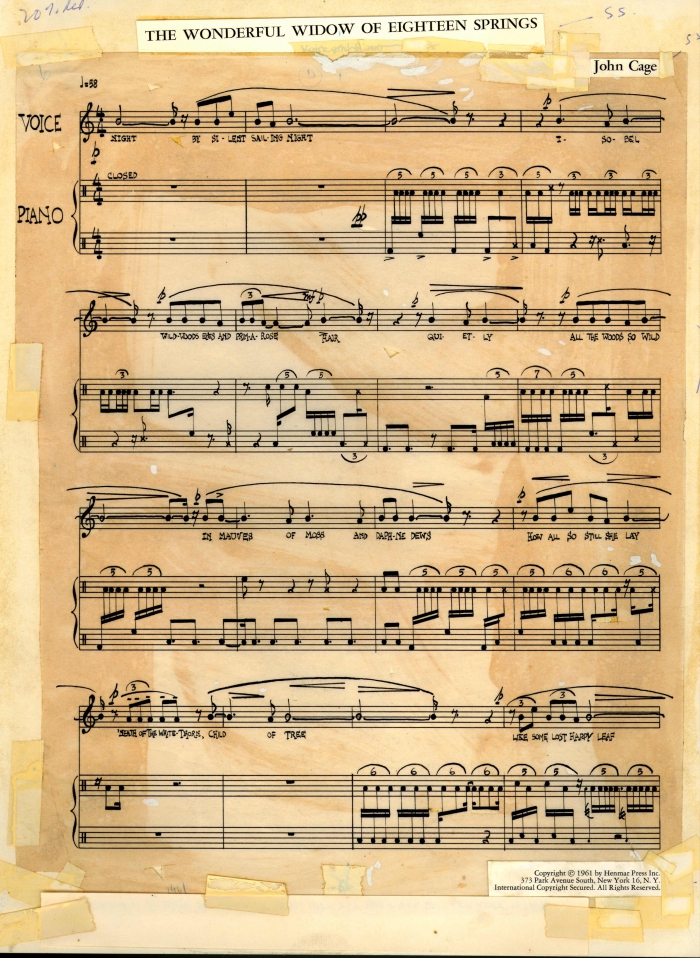
In 1942, John Cage composed a short piece of music adapted from the text of James Joyce’s Finnegans Wake. Titled “The Wonderful Widow of Eighteen Springs,” the piece was originally commissioned and performed by amateur soprano and socialite Justine Fairbank, and while we don’t have a recording of her performance, we do have Cage’s sheet music (see first page above, or view the entire book here). It is—as one might expect—an unusual piece. It sounds like song, yet isn’t. As the Library of Congress description of the piece has it:
This essentially rhythmic speech set against a patterned percussive accompaniment cannot be considered a song in the usual sense. Cage, however, is such an innovator that one often loses sight of the fact that if one does not expect conventional sounds, his music is often very well constructed. Here, for example, the composer weaves a hypnotically compelling pattern of rhythmic tension and relaxation, akin to certain non-Western music, which is very appropriate for Joyce’s moody prose.
Cage’s own instructions “for the singer” state: “sing without vibrato, as in folk-singing. Make any transposition necessary in order to employ a low and comfortable range.”
This flexible arrangement allows anyone to pick up the piece, and so we have, directly below, an unlikely interpreter of Cage’s experimental art, the late Ramones singer Joey Ramone. Ramone’s interpretation of the piece is enthralling simply as a piece of recorded music. But it’s also a fascinating piece of cultural history, representing a confluence of the foremost figures in early twentieth century modernist literature, mid-century avant-garde music, and late century punk rock.
The recording comes from a whole album of Cage interpretations by New York punk and new- and no-wave art-rockers, including David Byrne, Arto Lindsay, John Zorn, Debbie Harry, and Lou Reed. The album, entitled Caged/Uncaged—A Rock/Experimental Homage to John Cage, was recorded in Italy in 1993 and produced by John Cale. You can listen to tracks at Ubuweb.
It’s more than just a tribute record; it’s a serious engagement with the music of a composer whose work—like the fluid prose-poetry of Finnegans Wake—seems infinitely malleable and adaptable to the present. Forty years after composing the song Joey Ramone performs, Cage said, “we live, in a very deep sense, in the time of Finnegans Wake.” Perhaps we still live in the time of Joyce, and also of John Cage.
Note: An earlier version of this post appeared on our site in 2013.
Related Content:
James Joyce Reads From Ulysses and Finnegans Wake In His Only Two Recordings (1924/1929)
James Joyce’s Crayon Covered Manuscript Pages for Ulysses and Finnegans Wake
Hear All of Finnegans Wake Read Aloud: A 35 Hour Reading
Josh Jones is a writer and musician based in Durham, NC.
Read More...Watch Joan Baez Endearingly Imitate Bob Dylan (1972)
Joan Baez was already heralded as the “Queen of Folk” by the time Robert Zimmerman aka Bob Dylan arrived in New York City. Many things brought him to the burgeoning folk scene there, but Baez was the siren who called to a young Dylan through his television set long before he met her. He was smitten. He would write much later in Chronicles, Vol. 1, that she had “A voice that drove out bad spirits… she sang in a voice straight to God… Nothing she did didn’t work.”
And for a couple of years they became collaborators, partners, lovers, and folk royalty. It was Baez who introduced a then-unknown Dylan to the crowds at the 1963 Newport Folk Festival. But soon, fortunes changed: Dylan became an unstoppable cultural force and Baez would be on the receiving end of several betrayals, artistic and otherwise.
An excerpt from an Earl Scruggs documentary, the cute video above, shot by David Hoffman and posted on his YouTube channel, shows Baez imitating Dylan after she sings a verse of “It Ain’t Me Babe”. (She does this while holding her baby and trying to get it to drink from a pitcher, too.) A 16-year-old Ricky Skaggs—not looking anything like a teenager—accompanies her on guitar.
For one thing she does a crackin’ good Dylan impression. The other is watching the emotion behind that impression—there’s a lot of history there, a bit of sadness, a bit of nostalgia, nothing bitter or mean, but evidence of a shared life together that once existed.
By this time in 1972, Dylan’s voice had matured. The crooner on Nashville Skyline was a different person from the man on Blonde on Blonde, all those rough corners sanded off and the register deepened. Yet when anyone imitates Dylan, they head on back to those mid-‘60s albums, the “braying beatnik” as writer Rob Jones calls him. (Jones posits that Dylan has had eight particular voices during his career.)
Remember, as Slate’s Carl Wilson points out, when Dylan first started out, he was commended for his voice, and was considered “one of the most compelling white blues singers ever recorded,” by Robert Shelton, who wrote the copy on the back cover of Dylan’s 1962 debut album. He came from a tradition of both Woody Guthrie and Howlin’ Wolf, and several other idiosyncratic singers who didn’t sound like Frank Sinatra. (Although Dylan’s last few projects have been covers from the Great American Songbook.)
Dylan himself, in a 2015 award acceptance speech, turned his ire towards critics of his voice:
Critics have been giving me a hard time since Day One. Critics say I can’t sing. I croak. Sound like a frog. Why don’t critics say that same thing about Tom Waits? Critics say my voice is shot. That I have no voice. [Why] don’t they say those things about Leonard Cohen? Why do I get special treatment? Critics say I can’t carry a tune and I talk my way through a song. Really? I’ve never heard that said about Lou Reed. Why does he get to go scot-free? … Slur my words, got no diction. Have you people ever listened to Charley Patton or Robert Johnson, Muddy Waters? … “Why me, Lord?” I would say that to myself.
Fast forward to the present and Dylan’s voice shows the wear of years of performing and years of indulgence. It’s gravelly and phlegmatic, smoky and whiskey-soaked, but Wilson points out: “Even the rasp and burr of his late voice, several keen listeners have noticed, is very much like a more genuine copy of the old-bluesman timbre he pretentiously affected as a young man. It’s almost like this is what he’s been aiming toward.”
Note: An earlier version of this post appeared on our site in 2018.
Related Content:
Joan Baez Live in 1965: Full Concert
Bob Dylan Explains Why Music Has Been Getting Worse
17-Year-Old Joan Baez Performs at Famous “Club 47” in Cambridge, MA (1958)
Bob Dylan’s Famous Televised Press Conference After He Went Electric (1965)
Ted Mills is a freelance writer on the arts.
Read More...Behold the Very First Color Photograph (1861): Taken by Scottish Physicist & Poet James Clerk Maxwell
Since its ancient origins as the camera obscura, the photographic camera has always mimicked the human eye, allowing light to enter an aperture, then projecting an image upside down. Renaissance artists relied on the camera obscura to sharpen their own visual perspectives. But it wasn’t until photography—the ability to reproduce the obscura’s images—that the rudimentary artificial eye began evolving the same complex structures we rely on for our own visual acuity: lenses for sharpness, variable apertures, shutter speeds, focus controls…. Only when it began to seem that photography might vie with the other fine arts did the development of camera technology take off. And it moved quickly.
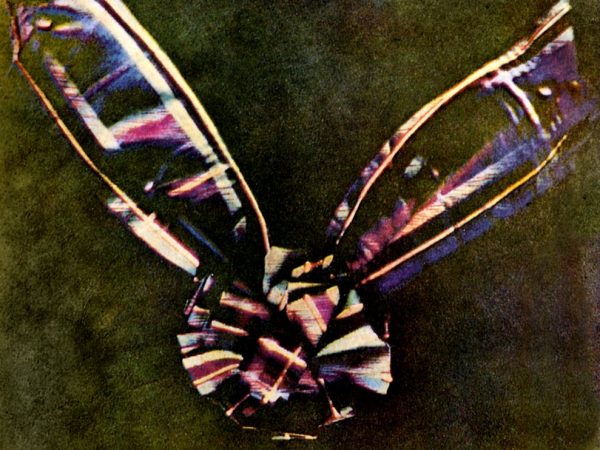
Between the time of the first photograph in 1826 by Joseph Nicéphore Niépce and 1861, photography had advanced sufficiently that physicist James Clerk Maxwell—known for his “Maxwell’s Demon” thought experiment—produced the first color photograph that did not immediately fade or require hand painting (above).
The Scottish scientist chose to take a picture of a tartan ribbon, “created,” writes National Geographic, “by photographing it three times through red, blue, and yellow filters, then recombining the images into one color composite.” Maxwell’s three-color method was intended to mimic the way the eye processes color, based on theories he had elaborated in an 1855 paper.
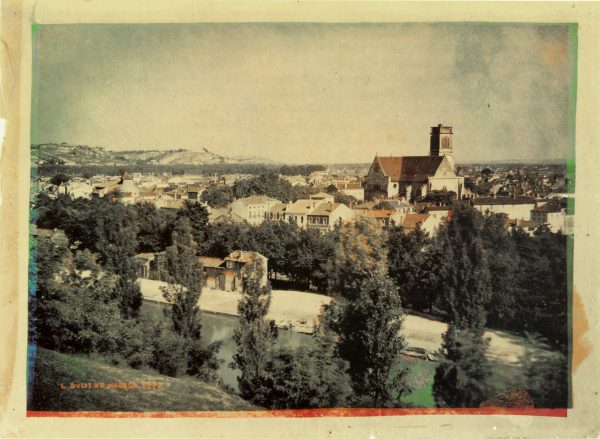
Maxwell’s many other accomplishments tend to overshadow his color photography (and his poetry!). Nonetheless, the polymath thinker ushered in a revolution in photographic reproduction, almost as an aside. “It’s easy to forget,“ writes BBC picture editor, Phil Coomes, “that not long ago news agencies were transmitting their wire photographs as colour separations, usually cyan, magenta, and yellow—a process that relied on Clerk Maxwell’s discovery. Indeed, even the latest digital camera relies on the separation method to capture light.” And yet, compared to the usual speed of photographic advancement, the process took some time to fully refine.
Maxwell created the image with the help of photographer Thomas Sutton, inventor of the single lens reflex camera, but his interest lay principally in its demonstration of his color theory, not its application to photography in general. Sixteen years later, the reproduction of color had not advanced significantly, though a subtractive method allowed more subtlety of light and shade, as you can see in the 1877 example above by Louis Ducos du Hauron. Even so, these nineteenth-century images still cannot compete for vibrancy and lifelikeness with hand-colored photos from the period. Despite appearing artificial, hand-tinted images like these of 1860s Samurai Japan brought a startling immediacy to their subjects in a way that early color photography did not.
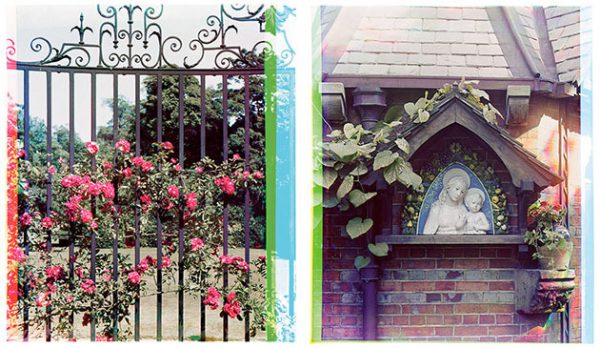
It wasn’t until the early 20th century—with the development of color processes by Gabriel Lippman and the Sanger Shepherd company—that color came into its own. Leo Tolstoy appeared early in the century in brilliant full color photos. Paris came alive in color images during WWI. And Sarah Angelina Acland, a pioneering English photographer, took the image above in 1900 using the Sanger Shepherd method. That process—patented, marketed, and sold—thoroughly improved upon Maxwell’s results, but its basic operation was nearly the same: three images, red, green, and blue, combined into one.
Note: An earlier version of this post appeared on our site in 2016.
Related Content:
The First Photograph Ever Taken (1826)
Hand-Colored 1860s Photographs Reveal the Last Days of Samurai Japan
Josh Jones is a writer and musician based in Durham, NC. Follow him at @jdmagness
Read More...The Only Time Prince & Miles Davis Jammed Together Onstage: Watch the New Year’s Eve, 1987 Concert
A too-precious genre of internet meme depicts departed public figures who did not know each other in life meeting in heaven with hugs, high-fives, and wincingly earnest exchanges. These sentimental vignettes are almost too easy to parody, a kitschy version of the “what if” game, as in: what if two creative geniuses could collaborate in ways they never did before they died?
What if John Lennon had formed a band with Eric Clapton—as Lennon himself had once proposed? Or what if a Jimi Hendrix/Miles Davis collaboration had come off, as Hendrix envisioned the year before his death? More than just fantasy baseball, the exercise lets us speculate about how musicians who influenced each other might evolve if given the chance to jam indefinitely.
When it comes to Miles, there are few who haven’t been influenced by the jazz great, whether they know it or not. Prince Rogers Nelson knew it well. The son of a jazz pianist, Prince grew up with Miles’ music. Although he “gravitated to the worlds of rock, pop, and R&B,” writes pianist Ron Drotos, Prince “seems to have seen jazz as a way to express himself in a broader way than he could through more commercial styles alone.”
Prince was so interested in exploring jazz—and Davis’ particular form of jazz—in the 80s that he formed a band anonymously, called Madhouse (actually just him and horn player Eric Leeds), and released two albums of fusion instrumentals. The influence went both ways. “Miles considered Prince to have the potential to become another Duke Ellington and even modeled his own 1980s music partly on Prince’s style,” with 1986’s Tutu standing out as an example. What if the two musicians had worked together? Can you imagine it?
They did not—to our knowledge, although Prince’s vault is vast—collaborate on an album, but they did create one studio track together, “Can I Play With U?” And the two virtuoso composers and musicians jammed together onstage, once, at Paisley Park, on New Year’s Eve, 1987. The concert was a benefit for the Minnesota Coalition for the Homeless and the last time Prince performed the Sign O’ the Times stage show. At the tail end of the concert, Davis steps onstage for “an ice-cold appearance,” Okayplayer notes. “As a companion to the release of a deluxe edition” of the album, “the late icon’s estate has relinquished the full two-hour-plus set.”
Watch the concert at the top (trust me, don’t just skip ahead to see Davis at 1:43:50). Just above, you can see an hourlong “pre-show” taped with Maya Rudolph, “lifelong Prince devotee,” Emmy-winning comedian, and daughter of Minnie Riperton. Other guests include Prince’s longtime sideman and collaborator on his jazz project, Eric Leeds. “If you’re here, then you’re cool, like me,” Rudolph jokes, “and you know a lot about Prince.” Or maybe you don’t. Let Rudolph and her guests fill you in, and imagine Prince and Davis making celestial jazz-funk forever, between high-fives, in the Great Beyond.
If you would like to support the mission of Open Culture, consider making a donation to our site. It’s hard to rely 100% on ads, and your contributions will help us continue providing the best free cultural and educational materials to learners everywhere. You can contribute through PayPal, Patreon, and Venmo (@openculture). Thanks!
Related Content:
In 1969 Telegram, Jimi Hendrix Invites Paul McCartney to Join a Super Group with Miles Davis
When Miles Davis Discovered and Then Channeled the Musical Spirit of Jimi Hendrix
The Night When Miles Davis Opened for the Grateful Dead (1970)
Josh Jones is a writer and musician based in Durham, NC. Follow him at @jdmagness
Read More...David Lynch’s Weird Espresso Maker Gets Taken for a Test Drive
David Lynch loved his coffee. For decades, the filmmaker let coffee fuel his creativity, drinking five, six, even seven cups per day at Bob’s Big Boy. Famously, Lynch celebrated coffee in Twin Peaks (remember the line, “That’s a damn fine cup of coffee!”), and later directed a whole mini-season of Twin Peaks in the form of Japanese coffee commercials. Then, in 2006, the director launched his own line of organic coffee, sold at Whole Foods.
When the filmmaker died this past January, he left behind no shortage of coffee paraphernalia—ranging from a high-end La Marzocco espresso machine to some run-of-the-mill devices. Take, for example, a fairly ordinary “Mr. Coffee” coffee maker that sold at auction for $4,550. Or a 1970s electric espresso maker made of metal and orange plastic. Above, the coffee connoisseur James Hoffmann takes the orange machine for a test drive. (He paid nearly $2,000 for it, after all.) As for the verdict — no spoilers here. You’ll have to see for yourself.
If you would like to support the mission of Open Culture, consider making a donation to our site. It’s hard to rely 100% on ads, and your contributions will help us continue providing the best free cultural and educational materials to learners everywhere. You can contribute through PayPal, Patreon, and Venmo (@openculture). Thanks!
Related Content
How to Make Coffee in the Bialetti Moka Pot: The “Ultimate Techique”
The Birth of Espresso: How the Coffee Shots The Fuel Our Modern Life Were Invented
Read More...A Page of Madness: The Lost, Avant Garde Masterpiece from Early Japanese Cinema (1926)
It’s a sad fact that the vast majority of silent movies in Japan have been lost thanks to human carelessness, earthquakes and the grim efficiency of the United States Air Force. The first films of hugely important figures like Kenji Mizoguchi, Yasujiro Ozu, and Hiroshi Shimizu have simply vanished. So we should consider ourselves fortunate that Teinosuke Kinugasa’s Kuretta Ippei — a 1926 film known in the States as A Page of Madness – has somehow managed to survive the vagaries of fate. Kinugasa sought to make a European-style experimental movie in Japan and, in the process, he made one of the great landmarks of silent cinema. You can watch it above.
Born in 1896, Kinugasa started his adult life working as an onnagata, an actor who specializes in playing female roles. In 1926, after working for a few years behind the camera under pioneering director Shozo Makino, Kinugasa bought a film camera and set up a lab in his house in order to create his own independently financed movies. He then approached members of the Shinkankaku (new impressionists) literary group to help him come up with a story. Author Yasunari Kawabata wrote a treatment that would eventually become the basis for A Page of Madness.
Though the synopsis of the plot doesn’t really do justice to the movie — a retired sailor who works at an insane asylum to care for his wife who tried to kill their child — the visual audacity of Page is still startling today. The opening sequence rhythmically cuts between shots of a torrential downpour and gushing water before dissolving into a hallucinatorily odd scene of a young woman in a rhomboid headdress dancing in front of a massive spinning ball. The woman is, of course, an inmate at the asylum dressed in rags. As her dance becomes more and more frenzied, the film cuts faster and faster, using superimpositions, spinning cameras and just about every other trick in the book.
While Kinugasa was clearly influenced by The Cabinet of Dr. Caligari, which also visualizes the inner world of the insane, the movie is also reminiscent of the works of French avant-garde filmmakers like Abel Gance, Russian montage masters like Sergei Eisenstein and, in particular, the subjective camerawork of F. W. Murnau in Der Letzte Mann. Kinugasa incorporated all of these influences seamlessly, creating an exhilarating, disturbing and ultimately sad tour de force of filmmaking. The great Japanese film critic Akira Iwasaki called the movie “the first film-like film born in Japan.”
When A Page of Madness was released, it played at a theater in Tokyo that specialized in foreign movies. Page was indeed pretty foreign compared to most other Japanese films at the time. The movie was regarded, film scholar Aaron Gerow notes, as “one of the few Japanese works to be treated as the ‘equal’ of foreign motion pictures in a culture that still looked down on domestic productions.” Yet it didn’t change the course of Japanese cinema, and it was thought of as a curiosity at a time when most films in Japan were kabuki adaptations and samurai stories.
Page disappeared not long after its release and, for over 50 years, was thought lost until Kinugasa found it in his own storehouse in 1971. During that time Kinugasa received a Palme d’Or and an Oscar for his splashy samurai spectacle The Gate of Hell (1953) and Kawabata, who wrote the treatment, got a Nobel Prize in Literature for writing books like Snow Country about a lovelorn geisha.
You can find A Page of Madness on our list of Free Silent Films, which is part of our collection, 4,000+ Free Movies Online: Great Classics, Indies, Noir, Westerns, Documentaries & More.
Note: An earlier version of this post appeared on our site in 2014.
Related Content:
The Golden Age of Japanese Cinema: Kurosawa, Ozu, Mizoguchi & Beyond
Essential Japanese Cinema: A Journey Through 50 of Japan’s Beautiful, Often Bizarre Films
Akira Kurosawa’s List of His 100 Favorite Movies
Jonathan Crow is a writer and filmmaker whose work has appeared in Yahoo!, The Hollywood Reporter, and other publications.
Read More...Support Us
We're hoping to rely on loyal readers, rather than erratic ads. Please click the Donate button and support Open Culture. You can use Paypal, Venmo, Patreon, even Crypto! We thank you!

About Us

Open Culture scours the web for the best educational media. We find the free courses and audio books you need, the language lessons & educational videos you want, and plenty of enlightenment in between.
Advertise With Us

FREE UPDATES!
GET OUR DAILY EMAIL
Get the best cultural and educational resources on the web curated for you in a daily email. We never spam. Unsubscribe at any time.
FOLLOW ON SOCIAL MEDIA

Open Culture editor Dan Colman scours the web for the best educational media. He finds the free courses and audio books you need, the language lessons & movies you want, and plenty of enlightenment in between.
Advertise With Us

