Watch Fantasmagorie, the World’s First Animated Cartoon (1908)
Trying to describe the plot of Fantasmagorie, the world’s first animated cartoon, is a folly akin to putting last night’s dream into words:
I was dressed as a clown and then I was in a theater, except I was also hiding under this lady’s hat, and the guy behind us was plucking out the feathers, and I was maybe also a jack in the box? And I had a fishing pole that turned into a plant that ripped my head off, but only for a few seconds. And then there was a giant champagne bottle and an elephant, and then, suddenly I was on an operating table, and you know how sometimes in a dream, it’s like you’re being crushed to death? Except I escaped by blowing myself up like a balloon and then I hopped onto the back of this horse and then I woke up.
The brainchild of animation pioneer Émile Cohl (1857 – 1938), the trippy silent short from 1908 is composed of 700 drawings, photographed onto negative film and double-exposed.
Clocking in at under two minutes, it’s definitely more diverting than listening to your bed mate bumble through their subconscious’ latest incoherent narrative.
The film’s title is an homage to a mid-19th century variant of the magic lantern, known as the fantasmograph, while its playful, nonsensical content is in the spirit of the Incoherent Movement of the 1880s.
Cohl, who cut his teeth on political caricature and Guignol puppet theatre, went on to create over 250 films over the next 15 years, expanding his explorations to include the realms of live action and stop motion animation.
Above, you can watch a somewhat restored version of the film, featuring music by Fabio Napodano. To get a feel for the original grainier silent film, watch here.
For the definitive biography of Emile Cohl, read Emile Cohl, Caricature, and Film by Donald Crafton (Notre Dame).
Related Content:
Early Japanese Animations: The Origins of Anime (1917 to 1931)
Watch Dziga Vertov’s Soviet Toys: The First Soviet Animated Movie Ever (1924)
Early Japanese Animations: The Origins of Anime (1917 to 1931)
Ayun Halliday is an author, illustrator, theater maker and Chief Primatologist of the East Village Inky zine. Join her in New York City tonight, May 13, for the next installment of her book-based variety show, Necromancers of the Public Domain. Follow her @AyunHalliday.
Read More...
20 Mesmerizing Videos of Japanese Artisans Creating Traditional Handicrafts
In Japanese “tewaza” means “hand technique” or “handcraft” and, in this YouTube playlist of 20 short films, various artisanal techniques are explored and demonstrated by Japanese masters in the field. For those who are both obsessed with Japanese art and watching things get made, these videos are catnip. There’s very little spoken, except a few quotes from the makers themselves, and gentle music plays over shots of delicate, intricate, and confident handiwork.
Watch the video up top, a look at how a small group of men forge a Sakai knife. (Yes, we keep expecting the music to turn into the Laura Palmer’s Theme too.) No words are necessary in this exacting demonstration, and just check out the wood-like grain in the metal.
And the names of these goods denote the towns of origin–Sakai is just outside Osaka, and is one of Japan’s main seaports and, yes, known for its knives.
Other videos show the making of handmade washi paper from Mino; stunning gold leaf production from Kanazawa; paper lantern making from Gifu; decorated wallpaper from Ueno; a Kumano writing brush, and very delicate bamboo weaving from Beppu that looks so precise it’s like it’s made by machine, but no, this is all in the eye.
The YouTube channel that has produced these videos, Aoyama Square, is a literal one-stop shop in Tokyo for all the kinds of crafts seen in the videos, and is a member of the Japanese national association that promotes and keeps these skills and mini-industries alive. So is this one long ad for a large crafts emporium? Well, could be. Do we still want to buy some of that beautiful lacquerware from Echizen? Oh yes, very much so.
Related Content:
How Japanese Things Are Made in 309 Videos: Bamboo Tea Whisks, Hina Dolls, Steel Balls & More
The Beautiful Art of Making Japanese Calligraphy Ink Out of Soot & Glue
Watch a Japanese Craftsman Lovingly Bring a Tattered Old Book Back to Near Mint Condition
Ted Mills is a freelance writer on the arts who currently hosts the FunkZone Podcast. You can also follow him on Twitter at @tedmills, read his other arts writing at tedmills.com and/or watch his films here.
Read More...The World’s First Mobile Phone Shown in 1922 Vintage Film
A number of years ago, British Pathé uncovered some striking footage from 1922 showing two women experimenting with the first mobile phone. A spokesman for the archive said: ”It’s amazing that 90 years ago mobile phone technology and music … was not only being thought of but being trialled.” “The phone even has a lid which makes it the first flip-phone [that] we are aware of, although it is probably not going to win any design awards.” He added, ”We would be delighted to hear from anyone who can tell us anything about the film, from where it is shot to who the women might be or even about the phone itself.” In the Relateds below, you can find more early visions of 21st-century technology. Enjoy.
If you would like to support the mission of Open Culture, consider making a donation to our site. It’s hard to rely 100% on ads, and your contributions will help us continue providing the best free cultural and educational materials to learners everywhere. You can contribute through PayPal, Patreon, and Venmo (@openculture). Thanks!
Related Content
Fritz Lang Invents the Video Phone in Metropolis (1927)
Did Stanley Kubrick Invent the iPad in 2001: A Space Odyssey?
A 1947 French Film Accurately Predicted Our 21st-Century Addiction to Smartphones
Nikola Tesla Accurately Predicted the Rise of the Internet & Smart Phone in 1926
Read More...George Orwell Reviews Mein Kampf: “He Envisages a Horrible Brainless Empire” (1940)
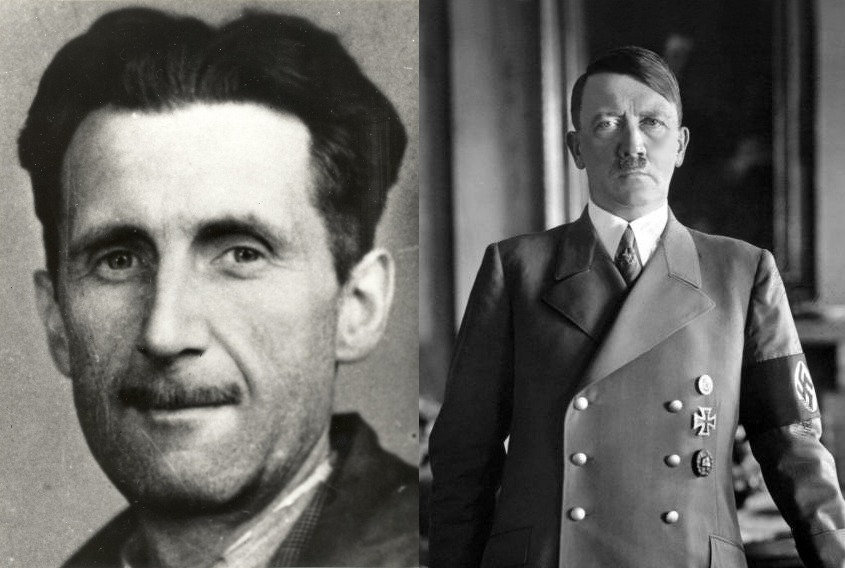
Christopher Hitchens once wrote that there were three major issues of the twentieth century — imperialism, fascism, and Stalinism — and George Orwell proved to be right about all of them.
Orwell displays his remarkable foresight in a fascinating book review, published in March 1940, of Adolf Hitler’s notorious autobiography Mein Kampf. In the review, the author deftly cuts to the root of Hitler’s toxic charisma, and, along the way, anticipates themes to appear in his future masterpieces, Animal Farm and 1984.
The fact is that there is something deeply appealing about him. […] Hitler … knows that human beings don’t only want comfort, safety, short working-hours, hygiene, birth-control and, in general, common sense; they also, at least intermittently, want struggle and self-sacrifice, not to mention drums, flags and loyalty-parades. However they may be as economic theories, Fascism and Nazism are psychologically far sounder than any hedonistic conception of life.
Yet Orwell was certainly no fan of Hitler. At one point in the review, he imagines what a world where the Third Reich succeeds might look like:
What [Hitler] envisages, a hundred years hence, is a continuous state of 250 million Germans with plenty of “living room” (i.e. stretching to Afghanistan or there- abouts), a horrible brainless empire in which, essentially, nothing ever happens except the training of young men for war and the endless breeding of fresh cannon-fodder.
The article was written at a moment when, as Orwell notes, the upper class was backpedaling hard against their previous support of the Third Reich. In fact, a previous edition of Mein Kampf — published in 1939 in England — had a distinctly favorable view of the Führer.
“The obvious intention of the translator’s preface and notes [was] to tone down the book’s ferocity and present Hitler in as kindly a light as possible. For at that date Hitler was still respectable. He had crushed the German labour movement, and for that the property-owning classes were willing to forgive him almost anything. Then suddenly it turned out that Hitler was not respectable after all.”
By March 1940, everything had changed, and a new edition of Mein Kampf, reflecting changing views of Hitler, was published in England. Britain and France had declared war on Germany after its invasion of Poland but real fighting had yet to start in Western Europe. Within months, France would fall and Britain would teeter on the brink. But, in the early spring of that year, all was pretty quiet. The world was collectively holding its breath. And in this moment of terrifying suspense, Orwell predicts much of the future war.
When one compares his utterances of a year or so ago with those made fifteen years earlier, a thing that strikes one is the rigidity of his mind, the way in which his world-view doesn’t develop. It is the fixed vision of a monomaniac and not likely to be much affected by the temporary manoeuvres of power politics. Probably, in Hitler’s own mind, the Russo-German Pact represents no more than an alteration of timetable. The plan laid down in Mein Kampf was to smash Russia first, with the implied intention of smashing England afterwards. Now, as it has turned out, England has got to be dealt with first, because Russia was the more easily bribed of the two. But Russia’s turn will come when England is out of the picture — that, no doubt, is how Hitler sees it. Whether it will turn out that way is of course a different question.
In June of 1941, Hitler invaded Russia, in one of the greatest strategic blunders in the history of modern warfare. Stalin was completely blindsided by the invasion and news of Hitler’s betrayal reportedly caused Stalin to have a nervous breakdown. Clearly, he didn’t read Mein Kampf as closely as Orwell had.
You can read Orwell’s full book review here.
Related Content:
George Orwell’s Political Views, Explained in His Own Words
Aldous Huxley to George Orwell: My Hellish Vision of the Future is Better Than Yours (1949)
Jonathan Crow is a writer and filmmaker whose work has appeared in Yahoo!, The Hollywood Reporter, and other publications. You can follow him at @jonccrow.
Read More...The Alphabet Explained: The Origin of Every Letter
Think back, if you will, to the climactic scenes of Indiana Jones and the Last Crusade, which take place in the hidden temple that contains the Holy Grail. His father having been shot by the dastardly Nazi-sympathizing immortality-seeker Walter Donovan, Indy has no choice but to retrieve the legendary cup to make use of its reputed healing powers. This entails passing through three deadly chambers, one of which has a floor covered in stones, each one labeled with a letter of the alphabet. The way through, according to Jones père’s research, is the name of God. But when Indy steps on “J” for Jehovah, it crumbles away, and he nearly plunges into the enormous pit below.
Of course, true fans will have already quoted the relevant line: “But in the Latin alphabet, Jehova begins with an I!” Those of us who first watched the movie as kids — and, for that matter, many of us who first watched it as adults — simply took that fact as given. But if we watch the RobWords video above, we can learn how and when that “I” became a “J”.
To the ancient Romans, explains host Rob Watts, these letters were one and the same, serving both vowel and consonant duty depending on the context (as in “Iulius” Caesar). Both of them date back to a “rather more complicated character” that looks like a badly contorted F, and which originated as a pictogram representing a human hand and forearm.
The letter J only emerged later, “when scribes wanted to differentiate between these two usages.” (As we’ve seen, it also offered the descendants of the Knights Templar a way to trick interlopers in their caverns.) Throughout the course of the video, Watts covers this and other curious steps in the evolution of the alphabet we use to write English and many other languages today. These produced such features as the plural of knife and wolf being knives and wolves, the seeming superfluity of Q, and — for an Englishman like Watts, an unignorable subject — the transatlantic “zed”/“zee” dividing line. Examined closely, the forms of our letters tells a millennia-spanning story whose cast includes Egyptians, Phoenicians, Canaanites, Etruscans, Greeks, Romans, and others besides. And as the experience of Indiana Jones illustrates, you never know when you’ll need its lessons.
Related content:
How Writing Has Spread Across the World, from 3000 BC to This Year: An Animated Map
The Writing Systems of the World Explained, from the Latin Alphabet to the Abugidas of India
Based in Seoul, Colin Marshall writes and broadcasts on cities, language, and culture. His projects include the Substack newsletter Books on Cities and the book The Stateless City: a Walk through 21st-Century Los Angeles. Follow him on Twitter at @colinmarshall or on Facebook.
Read More...Hear the Very First Adaptation of George Orwell’s 1984 in a Radio Play Starring David Niven (1949)
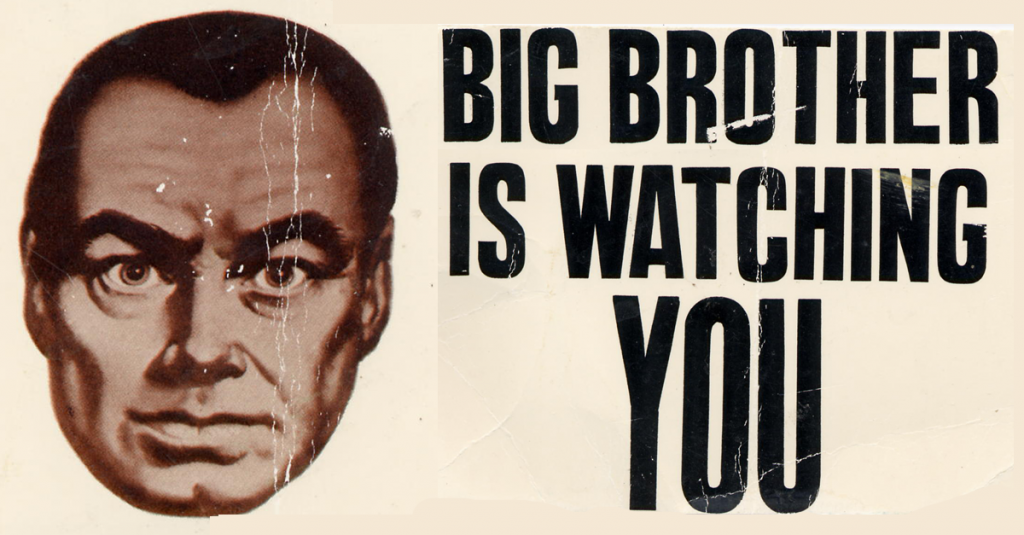
Since George Orwell published his landmark political fable 1984, each generation has found ample reason to make reference to the grim near-future envisioned by the novel. Whether Orwell had some prophetic vision or was simply a very astute reader of the institutions of his day—all still with us in mutated form—hardly matters. His book set the tone for the next 70-plus years of dystopian fiction and film.
Orwell’s own political activities—his stint as a colonial policeman or his denunciation of several colleagues and friends to British intelligence—may render him suspect in some quarters. But his nightmarish fictional projections of totalitarian rule strike a nerve with nearly everyone on the political spectrum because, like the speculative future Aldous Huxley created, no one wants to live in such a world. Or at least no one will admit it if they do.
Even the institutions most likely to thrive in Orwell’s vision have co-opted his work for their own purposes. The C.I.A. rewrote the animated film version of Animal Farm. And if you’re of a certain vintage, you’ll recall Apple’s appropriation of 1984 in Ridley Scott’s Super Bowl ad that very year for the Macintosh computer. But of course not every Orwell adaptation has been made in the service of political or commercial opportunism. Long before the Apple ad, and Michael Radford’s 1984 film version of Nineteen Eighty-Four, there was the 1949 radio drama above. Starring British great David Niven, with intermission commentary by author James Hilton, the show aired on the educational radio series NBC University Theater.
This radio drama, the “first audio production of the most challenging novel of 1949,” opens with a trigger warning, of sorts, that prepares us for a “disturbing broadcast.” To audiences just on the other side of the Nazi atrocities and the nuclear bombings of Japan, then dealing with the threat of Soviet Communism, Orwell’s dystopian fiction must have seemed dire and disturbing indeed.
Every adaptation of a literary work is unavoidably also an interpretation, bound by the ideas and ideologies of its time. The Niven broadcast shares the same historical concerns as Orwell’s novel. More recently, this 70-year-old audio has itself been co-opted by a podcast called “Great Speeches and Interviews,” which edited the broadcast together with a perplexing selection of popular songs and an interview between journalists Glenn Greenwald and Dylan Ratigan. Whatever we make of these developments, one thing seems certain. We won’t be done with Orwell’s 1984 for some time, and it won’t be done with us.
Related Content:
George Orwell Explains in a Revealing 1944 Letter Why He’d Write 1984
The Cover of George Orwell’s 1984 Becomes Less Censored with Wear & Tear
Josh Jones is a writer and musician based in Durham, NC. Follow him at @jdmagness
Read More...What It Takes to Pass “the Knowledge,” the “Insanely Hard” Exam to Become a London Taxicab Driver
Anyone who’s followed the late Michael Apted’s Up documentaries knows that becoming a London cab driver is no mean feat. Tony Walker, one of the series’ most memorable participants, was selected at the age of seven from an East End primary school, already distinguished as a character by his energetic manner, classic cockney accent, and enthusiastically expressed ambition to become a jockey. By 21 Up, however, he’d got off the horse and into a taxicab — or was aiming to do so, having immersed himself in the studies required for the necessary licensing exams. For many non-British viewers, this constituted an introduction to what’s known as “the Knowledge,” the formidable testing process licensed London taxicab drivers have undergone since 1865.
The Great Big Story video at the top of the post provides an introduction to this “insanely hard test,” which demands the memorization of 320 routes around London, involving 25,000 streets and roads, within a six-mile radius of Trafalgar Square. “Its rigors have been likened to those required to earn a degree in law or medicine,” writes Jody Rosen in a 2014 New York Time Style Magazine piece on the Knowledge.
“It is without question a unique intellectual, psychological and physical ordeal, demanding unnumbered thousands of hours of immersive study.” For the Tony Walkers of the world, it has also long offered a route to stable, well-compensated, and even prestigious work: everyone, regardless of social class, acknowledges the expertise of London that the black-taxicab driver possesses.
In recent years, those classic black cabs have faced greatly intensified competition from rideshare and “minicab” services, whose drivers aren’t required to pass the Knowledge. Instead, they rely on the same thing the rest of us do: GPS-enabled devices that automatically compute the route between point A and point B. Though one would imagine this technology having long since rendered the Knowledge redundant, the flow of aspirants to the status of black-cab driver hasn’t dried up entirely. Take Tom the Taxi Driver, a full-fledged London cabbie who’s also millennial enough to have elaborate tattoos and his own Youtube channel, on which he explains not just the experience of driving a taxi in London, but also of taking the tests to do so, which involve plotting Point-A-to-Point‑B routes verbally, on the spot.
The question of whether the Knowledge beats the GPS is settled on the channel of another, similarly named English Youtuber: Tom Scott, who in the video above, drives one route through London using his mobile phone while Tom the Taxi Driver does another of the same length while consulting only his own mental map of the city. This modern-day John Henry showdown is less interesting for its outcome than for what we see along the way: Tom the Taxi Driver’s perception and experience of London differ considerably from that of Tom the non-taxi driver, and as neuroscientific research has suggested, that difference is probably reflected in the physical nature of his brain.
“The posterior hippocampus, the area of the brain known to be important for memory, is bigger in London taxi drivers than in most people, and that a successful Knowledge candidate’s posterior hippocampus enlarges as he progresses through the test,” writes Rosen. The applicants’ having to master fine-grained detail both geographic and historical (over a period of nearly three years on average) also underscores that “the Knowledge stands for, well, knowledge — for the Enlightenment ideal of encyclopedic learning, for the humanist notion that diligent intellectual endeavor is ennobling, an end in itself.” For any of us, habitually offloading the mental work of not just wayfinding but remembering, calculating, and much else besides onto apps may well induce a kind of mental obesity, one we can only fight off by mastering the Knowledge of our own pursuits, whatever those pursuits may be.
Related content:
The Oldest Known Footage of London (1890–1920) Features the City’s Great Landmarks
Take a Virtual Drive through London, Tokyo, Los Angeles & 45 Other World Cities
Robert De Niro’s Taxi Cab License Used to Prepare for Taxi Driver (1976)
Meet Madame Inès Decourcelle, One of the Very First Female Taxi Drivers in Paris (Circa 1908)
Based in Seoul, Colin Marshall writes and broadcasts on cities, language, and culture. His projects include the Substack newsletter Books on Cities and the book The Stateless City: a Walk through 21st-Century Los Angeles. Follow him on Twitter at @colinmarshall or on Facebook.
Read More...An Oscar-Winning Animation of Ernest Hemingway’s “The Old Man and the Sea” Painted on 29,000 Frames of Glass
Ernest Hemingway’s romantic adventure of man and marlin, The Old Man and the Sea, has perhaps spent more time on high school freshman English reading lists than any other work of fiction, which might lead one to think of the novel as young adult fiction. But beyond the book’s ability to communicate broad themes of perseverance, courage, and loss, it has an appeal that also reaches old, wizened men like Hemingway’s Santiago and young, imaginative boyish apprentices like his Manolin. The 1952 novella reinvigorated Hemingway’s career, won him a Pulitzer Prize, and eventually contributed to his Nobel win in 1954. And luckily for all those high school English students, Hemingway’s story has lent itself to some worthy screen adaptations, including the 1958 film starring Spencer Tracy as the indefatigable Spanish-Cuban fisherman and a 1990 version with the mighty Anthony Quinn in the role.
One adaptation that readers of Hemingway might miss is the animation above, a co-production with Canadian, Russian, and Japanese studios created by Russian animator Aleksander Petrov. Winner of a 2000 Academy Award for animated short, the film has as much appeal to a range of viewers young and old as Hemingway’s book, and for some of the same reasons—it’s captivatingly vivid depiction of life on the sea, with its long periods of inactivity and short bursts of extreme physical exertion and considerable risk.
Both states provide ample opportunities for complex character development and rich storytelling as well as exciting white-knuckle suspense. Petrov’s film illustrates them all, opening with images of Santiago’s stories of his seafaring boyhood off the coast of Africa and staging the dramatic contests between Santiago, his “brother” the marlin, and the sharks who devour his prize.
But the production here, unlike Hemingway’s spare prose, makes a dazzling display of its technique. For his The Old Man and the Sea, Petrov—only one of a handful of animators skilled in this art—handpainted over 29,000 frames on glass (with help from his son, Dmitri) using slow-drying oils. Petrov moved the paint with his fingers to capture the movement in the next shot, and while the magical effect resembles a moving painting, the shooting itself was very technologically advanced, involving a specially constructed motion-capture camera. Petrov and son began their painting in 1997 and finished two years later, taking to heart some of the lessons of the book, it seems. The film’s creators, however, fared better than The Old Man’s protagonist, richly rewarded for their struggle. In addition to an Oscar, the short won awards from BAFTA, the San Diego Film Festival, and a handful of other prestigious international bodies.
Related Content:
William Faulkner’s Review of Hemingway’s The Old Man and the Sea (1952)
Watch a Hand-Painted Animation of Dostoevsky’s “The Dream of a Ridiculous Man”
Hemingway, Fitzgerald, Faulkner: A Free Yale Course
The Great Gatsby Is Now in the Public Domain and There’s a New Graphic Novel
Josh Jones is a writer and musician based in Durham, NC. Follow him at @jdmagness
Read More...37 Hitchcock Cameo Appearances Over 50 Years: All in One Video
Early in his career, Alfred Hitchcock began making small appearances in his own films. The cameos sometimes lasted just a few brief seconds, and sometimes a little while longer. Either way, they became a signature of Hitchcock’s filmmaking, and fans made a sport of seeing whether they could spot the elusive director. From 1927 to 1976, Hitchcock made 37 appearances in total, and they’re all nicely catalogued in the clip above. Enjoy!
If you would like to support the mission of Open Culture, consider making a donation to our site. It’s hard to rely 100% on ads, and your contributions will help us continue providing the best free cultural and educational materials to learners everywhere. You can contribute through PayPal, Patreon, and Venmo (@openculture). Thanks!
Related Content
Alfred Hitchcock’s Strict Rules for Watching Psycho in Theaters (1960)
How Edward Hopper’s Paintings Inspired the Creepy Suspense of Alfred Hitchcock’s Rear Window
Alfred Hitchcock Recalls Working with Salvador Dali on Spellbound
Read More...How Rome Began: The History As Told by Ancient Historians
Much attention has been paid to the fall of the Roman Empire, by everyone from august historians like Edward Gibbon to modern-day observers wringing their hands over the fate of the United States of America. But as every Rome enthusiast knows, that long collapse constitutes just one chapter — or rather, a series of chapters at the very least — of a story with much more to it. And as with any story, nobody can hope to understand how it ends unless they understand how it begins: hence the new Voices of the Past video above, “How Did Rome Begin?”
If you’re at all familiar with Roman mythology (or if you, like me, played Centurion: Defender of Rome growing up), you’ll have seen the image of the twins brothers Romulus and Remus being nursed by a giant she-wolf, la Lupa Capitolina, on the banks of the Tiber river. According to one version of events, Rome was founded by Romulus on April 21st in 753 BCE, after he killed Remus and named the Eternal City-to-be after himself.
What relationship this dramatic tale has to historical events is a matter of scholarly interest, but Voices of the Past’s investigation has a wider scope, beginning four and a half centuries earlier with the fall of Troy as told by Homer, one of the many sources cited along the video’s two-hour historical journey.
To make vivid the conditions under which Rome arose, the video closely examines the ruins of the ancient world while quoting the words of historians who lived under the actual Roman Empire, like Livy and Dionysius of Halicarnassus. While they may come with certain embellishments, and even fabrications, these texts together offer a coherent narrative of Rome’s rise, which in this video stretches to eight turbulent centuries. Its final chapter opens in 387 BC, with the storm of Rome’s sack by the Gauls quickly gathering. For Roman citizens at the time, it would have seemed that their long-established city had met its end. Little did they know, it still had — if not an eternity — centuries and centuries still to go.
Related content:
Hear an Ancient Chinese Historian Describe The Roman Empire (and Other Voices of the Past)
The History of Ancient Rome in 20 Quick Minutes: A Primer Narrated by Brian Cox
Based in Seoul, Colin Marshall writes and broadcasts on cities, language, and culture. His projects include the Substack newsletter Books on Cities and the book The Stateless City: a Walk through 21st-Century Los Angeles. Follow him on Twitter at @colinmarshall or on Facebook.
Read More...Support Us
We're hoping to rely on loyal readers, rather than erratic ads. Please click the Donate button and support Open Culture. You can use Paypal, Venmo, Patreon, even Crypto! We thank you!

About Us

Open Culture scours the web for the best educational media. We find the free courses and audio books you need, the language lessons & educational videos you want, and plenty of enlightenment in between.
Advertise With Us

FREE UPDATES!
GET OUR DAILY EMAIL
Get the best cultural and educational resources on the web curated for you in a daily email. We never spam. Unsubscribe at any time.
FOLLOW ON SOCIAL MEDIA

Open Culture editor Dan Colman scours the web for the best educational media. He finds the free courses and audio books you need, the language lessons & movies you want, and plenty of enlightenment in between.
Advertise With Us

