The Wisdom of Alan Watts in 4 Mind-Expanding Animations
Perhaps no single person did more to popularize Zen Buddhism in the West than Alan Watts. In a sense, Watts prepared U.S. culture for more traditionally Zen teachers like Soto priest Suzuki Roshi, whose lineage continues today, but Watts did not consider himself a Zen Buddhist. Or at least that’s what he tells us in the talk above, animated by Trey Parker and Matt Stone, the creators of South Park. “I am not a Zen Buddhist,” he says, “I am not advocating Zen Buddhism, I am not trying to convert anyone to it. I have nothing to sell.” Instead, he calls himself “an entertainer.” Is he pulling our leg?
After all, Watts was the author of such books as The Spirit of Zen (1936—his first), The Way of Zen (1957), and ”This Is It” and Other Essays on Zen and Spiritual Experience (1960). Then again, he also wrote books on Christianity, on “Erotic Spirituality,” and on all manner of mysticism from nearly every major world religion.
And he was ordained an Episcopal priest in 1945 and served as such until 1950. Watts was a tricky character—a strict anti-dogmatist who found all rigid doctrine irritating at best, deeply oppressive and dehumanizing at worst.
While Watts may not have been any sort of doctrinaire Zen priest, he learned—and taught—a great deal from Japanese Buddhist concepts, which he distills in the video at the top. He gleaned very similar insights—about the unity and interconnectedness of all things—from Daoism. Just above, see a very short animation created by Eddie Rosas, from The Simpsons, in which Watts uses a simple parable to illustrate “Daoism in perfection.”
The concepts Watts elucidates from various traditions are instantly applicable to ecological concerns and to our relationship to the natural world. “The whole process of nature,” he says above in a parable animated by Steve Agnos, “is an integrated process of immense complexity.” In this case, however, rather than offering a lesson in unity, he suggests that nature, and reality, is ultimately unknowable, that “it is really impossible to tell whether anything that happens in it is good or bad.” The most reasonable attitude then, it seems, is to refrain from making judgments either way.
It’s that tendency of the human mind to make hasty, erroneous judgments that comes in for critique in the Watts talk above, animated by Tim McCourt and Wesley Louis of Westminster Arts & Film London. Here, he reaches even deeper, investigating ideas of personal identity and the existence of the ego as an entity separate from the rest of reality. Returning to his grand theme of interconnectedness, Watts assures us it’s “impossible to cut ourselves off from the social environment, and also furthermore from the natural environment. We are that; there’s no clear way of drawing the boundary between this organism and everything that surrounds it.” But in order to discover this essential truth, says Watts, we must become “deep listeners” and let go of embarrassment, shyness, and anxiety.
If you enjoy these excerpts from Alan Watts’ lectures, you can find many hours of his talks online. What Watts would have thought of this, I do not know, but I’m certain he’d be glad that so much of his work—hours of lectures, in fact—is available free of charge on YouTube.
Related Content:
The Greatest Hits of Alan Watts: Stream a Carefully-Curated Collection of Alan Watts Wisdom
What If Money Was No Object?: Thoughts on the Art of Living from Eastern Philosopher Alan Watts
Zen Master Alan Watts Discovers the Secrets of Aldous Huxley and His Art of Dying
Alan Watts On Why Our Minds And Technology Can’t Grasp Reality
Josh Jones is a writer and musician based in Durham, NC. Follow him at @jdmagness
Read More...
T. S. Eliot’s Classic Modernist Poem The Waste Land Gets Adapted into Comic-Book Form
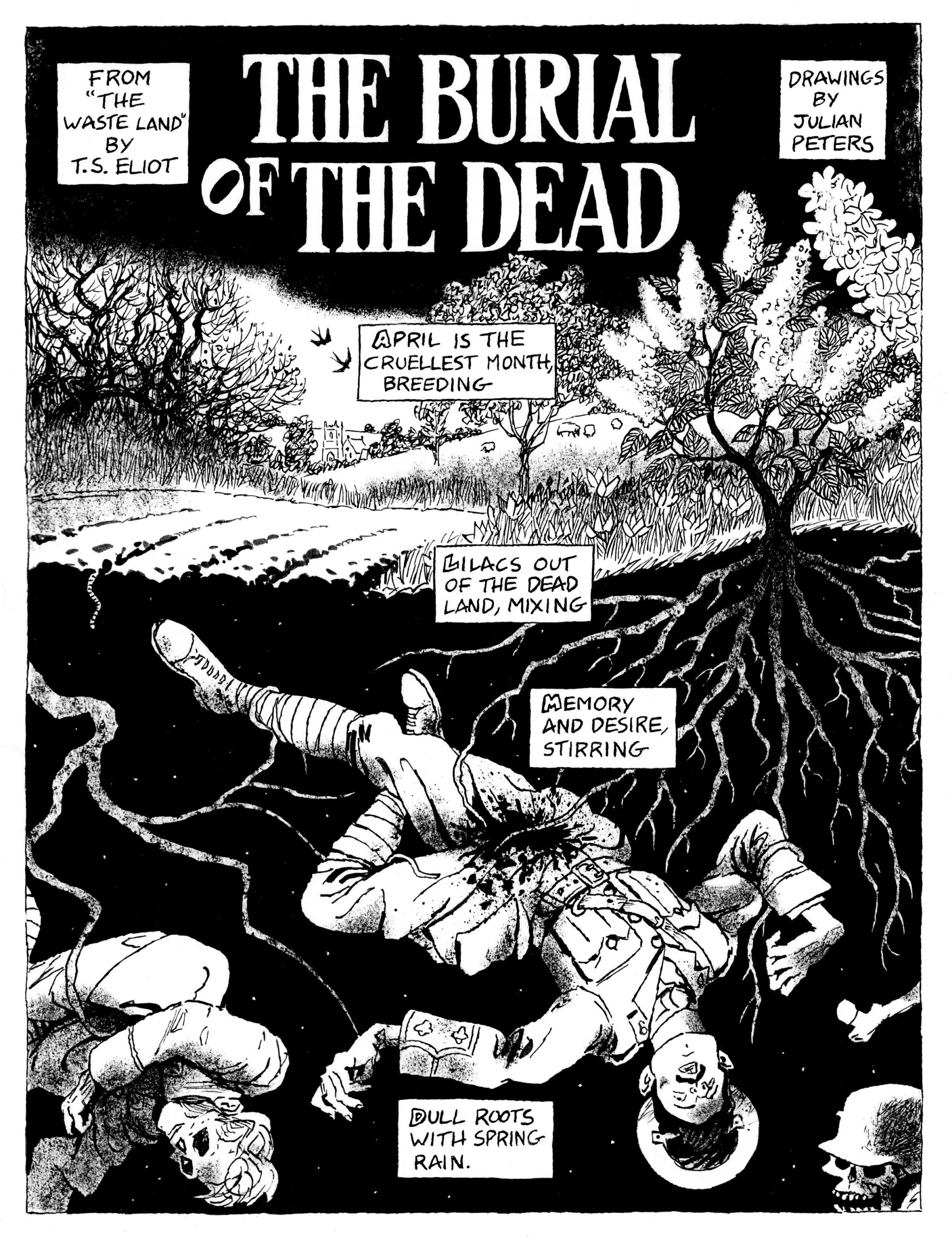
The phrase “April is the cruelest month” was first printed more than 100 years ago, and it’s been in common circulation almost as long. One can easily know it without having the faintest idea of its source, let alone its meaning. This is not, of course, to call T. S. Eliot’s The Waste Land an obscure work. Despite having met with a derisive, even hostile initial reception, it went on to draw acclaim as one of the central English-language poems of the twentieth century, to say nothing of its status as an achievement within the modernist movement. But how, here in the twenty-first century, to read it afresh?
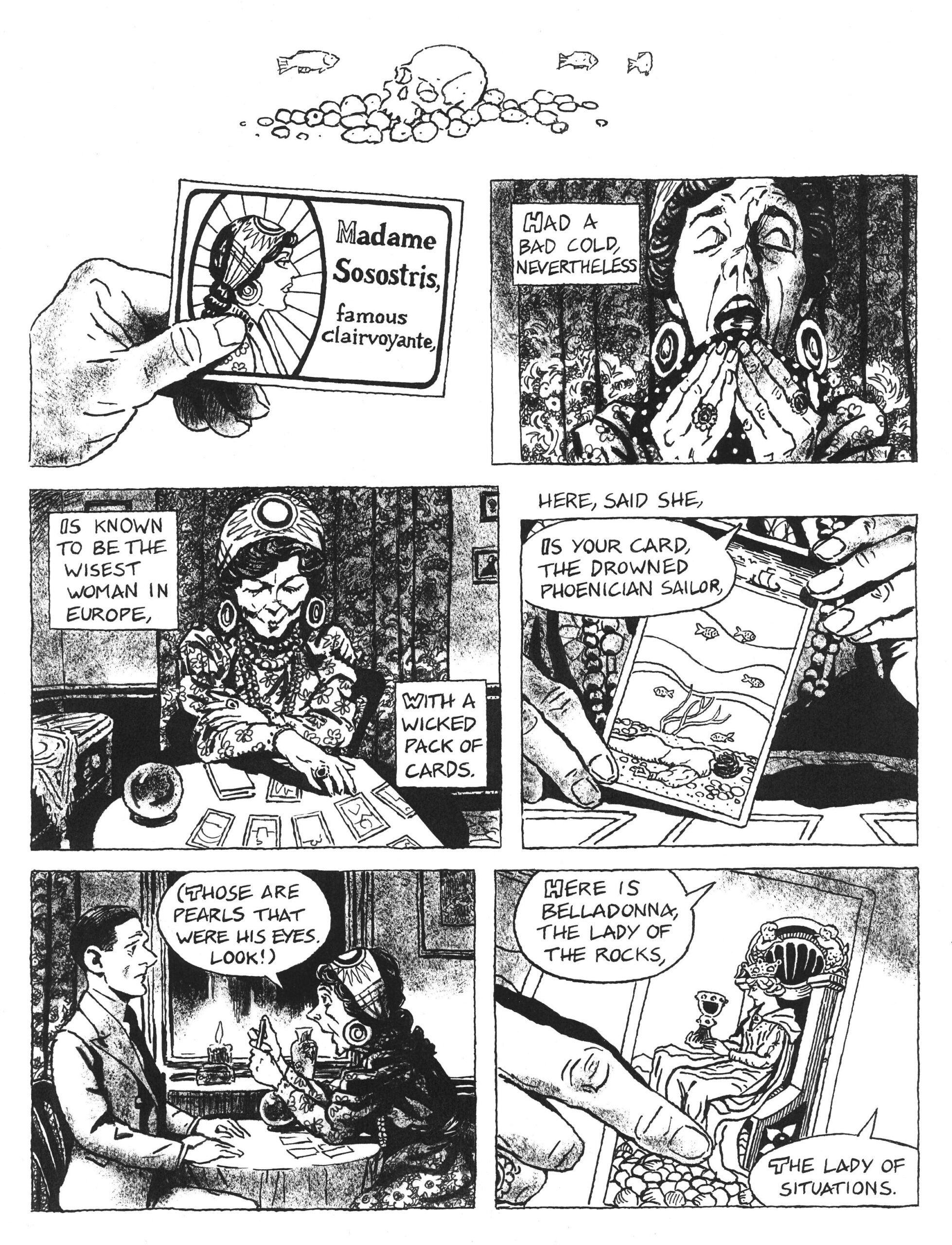
One new avenue to approach The Waste Land is this comic-book adaptation by Julian Peters, previously featured here on Open Culture for his graphic renditions of other such poems as Edgar Allan Poe’s Annabel Lee, W. B. Yeats’ “When You Are Old,” and Eliot’s own “The Love Song of J. Alfred Prufrock.”
It’s an adaptation, to be precise, of the first of The Waste Land’s five sections, “The Burial of the Dead,” which opens on a First World War battlefield — at least in Peters’ adaptation, which puts the first line “April is the cruelest month” into the context of nightmarish imagery of bloodshed and death — and ends in a workaday London likened to Dante’s hell.
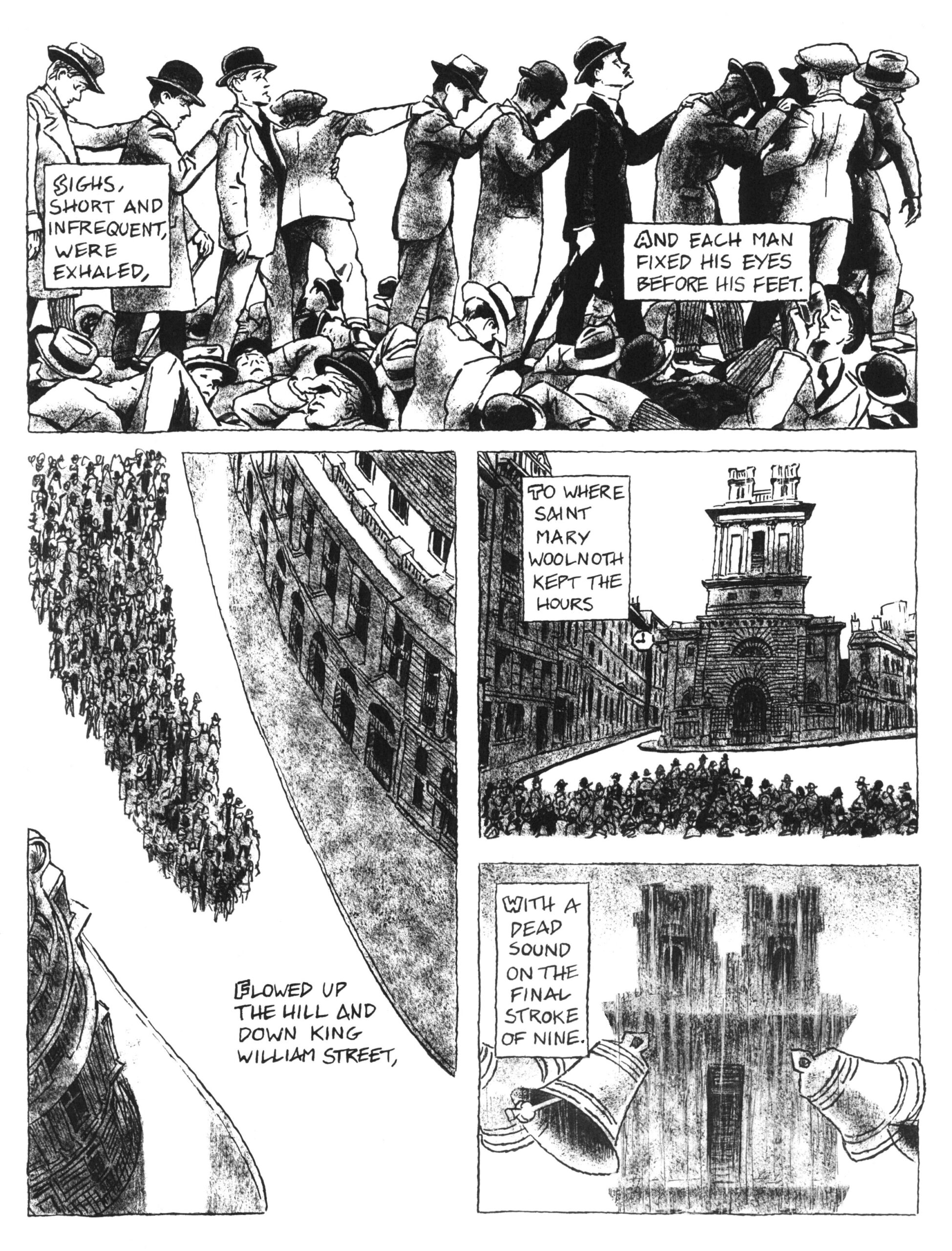
The Waste Land presents a tempting but daunting opportunity to an illustrator, filled as it is with vivid evocations of place and appearances by intriguing characters (including, in this section, “Madame Sosostris, famous clairvoyante”), and characterized as it is by extensive literary quotation and sudden shifts of context. But Peters has made a bold start of it, and anyone who reads his adaptation of “The Burial of the Dead” will be waiting for his adaptations of “A Game of Chess” through “What the Thunder Said.” Though much-scrutinized over the past century, Eliot’s modernist masterpiece (hear Eliot read it here) still tends to confound first-time readers. To them, I always advise considering poetry a visual medium, an idea whose possibilities Peters continues to explore on a much more literal level. Explore it here.
Related content:
Read the Entire Comic Book Adaptation of T.S. Eliot’s “The Love Song of J. Alfred Prufrock”
A Comic Book Adaptation of Edgar Allan Poe’s Poignant Poem Annabel Lee
W. B. Yeats’ Poem “When You Are Old” Adapted into a Japanese Manga Comic
T. S. Eliot Illustrates His Letters and Draws a Cover for Old Possum’s Book of Practical Cats
Based in Seoul, Colin Marshall writes and broadcasts on cities, language, and culture. His projects include the Substack newsletter Books on Cities and the book The Stateless City: a Walk through 21st-Century Los Angeles. Follow him on Twitter at @colinmarshall or on Facebook.
Read More...When Kris Kristofferson (RIP) Stood by Sinéad O’Connor at the Height of Her Controversy
One would have imagined Sinéad O’Connor impervious to any reaction from a hostile audience, no matter how vitriolic. But even for a public figure as outspoken and unapologetic as her, it could all get to be a bit much at times. Take the 1992 concert Columbia Records put on for the 30th anniversary of Bob Dylan’s first album. “Available on pay-per-view,” writes the New York Times’ Marc Tracy, it “featured performances by Dylan along with some of the biggest stars of his era, among them Stevie Wonder, George Harrison, Johnny Cash and Eric Clapton,” as well as the late outlaw-country icon Kris Kristofferson.
The young O’Connor also performed, despite being “at the center of a firestorm. Just two weeks earlier, the Irish singer was the musical guest on Saturday Night Live when, at the conclusion of her second and final performance of the evening, she ripped up a picture of Pope John Paul II and exhorted, ‘Fight the real enemy,’ a defiant act of protest against sexual abuse in the Catholic Church.” It fell to Kristofferson to introduce her, whereupon she “took the stage to a cascade of applause and boos, which did not let up as O’Connor stood silently at the microphone with her hands behind her back.”
As you can see in the video at the top of the post, Kristofferson didn’t stay offstage. After a minute he “re-emerged from stage left, put his arm around O’Connor and whispered something in her ear.” The show then went on, albeit not as planned: instead of doing Dylan’s “I Believe in You,” she did Bob Marley’s “War,” the very same song she’d sung on SNL before the notorious Pope-ripping. Rather than leaving his message as a Lost in Translation moment, Kristofferson later revealed the words he’d summoned to encourage her: “ ‘Don’t let the bastards get you down.’ To which, he said, she responded: ‘I’m not down.’ ”
That response was characteristic of O’Connor, as was her 2021 autobiography’s note that she was thinking, “I don’t need a man to rescue me, thanks.” Whatever her feelings in the moment, her friendship with Kristofferson seems to have lasted until her death last year. “Kristofferson appeared with her in the 1997 music video for the song ‘This Is to Mother You,’ ” writes Tracy. “In 2010, the two performed a duet of Kristofferson’s ‘Help Me Make It Through the Night’ on an Irish talk show. It was a year after Kristofferson had released a song about the 1992 incident, ‘Sister Sinead.’ ” Outwardly, the two could hardly have had less in common, but inwardly, they must have recognized each other as kindred spirits — the likes of which we’ll surely not see again.
Related content:
Sinéad O’Connor’s Raw Isolated Vocals for “Nothing Compares 2 U”
A Choir with 1,000 Singers Pays Tribute to Sinéad O’Connor & Performs “Nothing Compares 2 U”
5 Musical Guests Banned From Saturday Night Live: From Elvis Costello to Frank Zappa
Based in Seoul, Colin Marshall writes and broadcasts on cities, language, and culture. His projects include the Substack newsletter Books on Cities and the book The Stateless City: a Walk through 21st-Century Los Angeles. Follow him on Twitter at @colinmarshall or on Facebook.
Read More...Joan Jett and the Blackhearts Perform a Rollicking Cover of the Mary Tyler Moore Theme Song (1996)
?si=Pblv5Tzpi_F-a6cu
Originally written by Sonny Curtis and released in 1970, “Love Is All Around”–otherwise known as the Mary Tyler Moore theme song–has been covered by many acts: Sammy Davis Jr, Hüsker Dü, and Joan Jett & the Blackhearts, to name a few. After releasing a studio version in 1996, Jett performed the song live on the Late Show with David Letterman that same year. If you’re old enough, this performance will give you a double dose of nostalgia. It lets you recall the spirit of 1970s second-wave-feminist television, and it recaptures the sheer playfulness of Letterman’s freewheeling 90s late night show. Enjoy!
Related Content
How Joan Jett Started the Runaways at 15 and Faced Down Every Barrier for Women in Rock and Roll
Isaac Asimov Predicts the Future on The David Letterman Show (1980)
What Makes a Cover Song Great?: Our Favorites & Yours
Frank Zappa’s 1980s Appearances on The David Letterman Show
Read More...How Kodak Invented the Snapshot in the 1800s, Making It Possible for Everyone to Be a Photographer
We still occasionally speak of “Kodak moments,” making conscious or unconscious reference to the slogan of the Eastman Kodak Company in the nineteen-eighties. Even by that time, Kodak had already been a going concern for nearly a century, furnishing photographers around the world with the film they needed to capture images. Its very first slogan, unveiled in 1888, was “You Press the Button, We Do the Rest,” and it heralded the arrival of a new era: one in which, thanks to the company’s No. 1 box camera (loaded with the new medium of roll film), photographs could be “taken by people with little or no previous knowledge of photography.”
So says Vox’s Coleman Lowndes in the new video above, which explains how this invention changed the nature of photography itself. People began using Kodak cameras “to document their travels and their daily lives at home”; they “took portraits of each other, but also candid street scenes.” Such was the novelty of taking a picture so quickly and easily — and well outside a studio — that it demanded a new word, or rather, the adoption of a word from another domain: snapshot, which up until then had referred to “a quick shot with a gun, without aim, at a fast-moving target.” Before Kodak, a photographer simply had no way to capture the moment.
But it was only with the introduction of the inexpensive Brownie, “a simple box camera made of cardboard encased in faux leather,” that everyone — even a child — could become a photographer. “Take a Kodak with You,” suggested another of the company’s slogans in the early twentieth century, and millions took heed. Its position as both a corporate and cultural institution wasn’t seriously threatened until the end of that century, when Japan’s Fujifilm “had begun to eat away at the American photo giant’s market share,” and then digital photography destroyed wide swaths of the film business at a stroke.
Ironically, the first digital camera was invented in 1975 by a Kodak engineer, “but the company, which from the beginning had built itself on selling and processing film rather than manufacturing cameras, didn’t make the change soon enough.” After finally entering bankruptcy in 2012, Kodak reorganized to “focus on digital printing services rather than film development,” which has by now become “a somewhat niche market of dedicated hobbyists.” Also doing its part to keep the company afloat is its line of logo-emblazoned apparel, which holds out a retro appeal all across the world — even to youngsters quick enough on the draw with their camera phones that every moment might as well be a Kodak moment.
Related content:
The History of Photography in Five Animated Minutes: From Camera Obscura to Camera Phone
How Film Was Made in 1958: A Kodak Nostalgia Moment
Henri Cartier-Bresson and the Decisive Moment
Hunter S. Thompson’s Advice for Aspiring Photographers: Skip the Fancy Equipment & Just Shoot
Based in Seoul, Colin Marshall writes and broadcasts on cities, language, and culture. His projects include the Substack newsletter Books on Cities and the book The Stateless City: a Walk through 21st-Century Los Angeles. Follow him on Twitter at @colinmarshall or on Facebook.
Read More...How Filmmakers Make Cameras Disappear: Mirrors in Movies
If you’ve never tried your hand at filmmaking, you might assume that its hardest visual challenges are the creation of effects-laden spectacles: starships duking it out in space, monsters stomping through major cities, animals speaking and dancing like Broadway stars, that sort of thing. But consider the challenge posed by simply capturing a scene set in a bathroom. Almost all such spaces include a large mirror, meaning that most angles from which you could shoot will violate an important rule cited by Youtuber Paul E.T. in the video above: “Don’t show the camera in the shot.”
Yet we’ve all seen major motion pictures and television series with scenes not just in bathrooms but other mirror-equipped spaces, from rooms used for interrogating suspects to rooms used for preparing to come out on stage. What’s more, the camera often passes blithely before these mirrors with a vampire-like lack of a reflection. The techniques used to achieve such shots are now mature enough that we may not even notice that what we’re seeing doesn’t make visual sense. How they work is the subject of Paul E.T.‘s investigation, beginning with an episode of Criminal: United Kingdom in which a camera somehow floats around a room with a one-way mirror, never appearing in that mirror.
Another more familiar example comes from Contact, directed by the visual-effects maven Robert Zemeckis. In its early flashback sequence, an adolescent version of its astronomer protagonist runs toward the backward-tracking camera and reaches out to open what turns out to be a bathroom medicine cabinet, into whose mirror we must have — yet cannot possibly have — been looking into the whole time. What we’re seeing is actually a seamless fusion of two shots, with the “empty” (that is, blue-screen-filled) frame of the cabinet mirror superimposed on the end of the shot of the young actress running toward it. While not technically easy, it’s at least conceptually straightforward.
Paul E.T. finds another, more complicated mirror shot in no less a masterwork of cinema than Zack Snider’s Sucker Punch, which tracks all the way around from one side of a set of dressing-room mirrors to the other. “What you’re actually seeing when the camera moves is the transitioning from one side of a duplicated set to the other,” he explains, “with an invisible cut spliced in there” — which involves lookalike actresses literally trying to mirror each other’s movements. No such elaborate trickery for Ruben Östlund’s Force Majeure, which shoots straight-on into a bathroom mirror by building the camera into the wall, then digitally erasing it in post-production.
While we do live in an age of “fix it in post” (an instinct with an arguably regrettable effect on cinema), mirror shots, on the whole, still require some degree of foresight and inventiveness. Such was the case with that scene from Criminal: United Kingdom, which Paul E.T. simply couldn’t figure out on his own. His search for answers led him to e‑mail the episode’s B‑camera operator, who explained that the production involved neither a blue screen nor doubles, but “a combination of well-choreographed camera work and VFX.” The result: a shot that may look unremarkable at first, but on closer inspection, attests to the subtle power of movie magic — or TV magic, at any rate.
Related content:
The Art of Creating Special Effects in Silent Movies: Ingenuity Before the Age of CGI
This Is What The Matrix Looks Like Without CGI: A Special Effects Breakdown
Based in Seoul, Colin Marshall writes and broadcasts on cities, language, and culture. His projects include the Substack newsletter Books on Cities and the book The Stateless City: a Walk through 21st-Century Los Angeles. Follow him on Twitter at @colinmarshall or on Facebook.
Read More...The Medieval Masterpiece, the Book of Kells, Is Now Digitized and Available Online
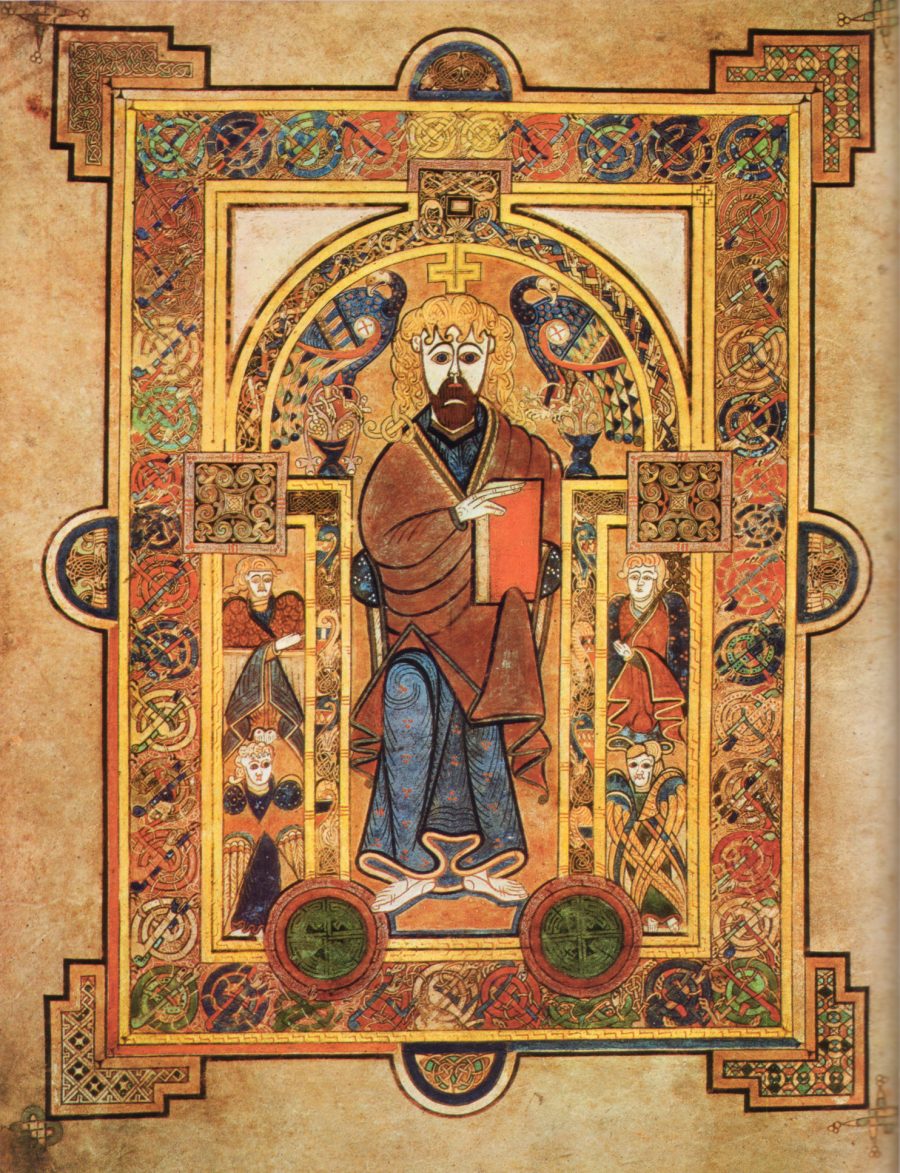
If you know nothing else about medieval European illuminated manuscripts, you surely know the Book of Kells. “One of Ireland’s greatest cultural treasures” comments Medievalists.net, “it is set apart from other manuscripts of the same period by the quality of its artwork and the sheer number of illustrations that run throughout the 680 pages of the book.” The work not only attracts scholars, but almost a million visitors to Dublin every year. “You simply can’t travel to the capital of Ireland,” writes Book Riot’s Erika Harlitz-Kern, “without the Book of Kells being mentioned. And rightfully so.”
The ancient masterpiece is a stunning example of Hiberno-Saxon style, thought to have been composed on the Scottish island of Iona in 806, then transferred to the monastery of Kells in County Meath after a Viking raid (a story told in the marvelous animated film The Secret of Kells). Consisting mainly of copies of the four gospels, as well as indexes called “canon tables,” the manuscript is believed to have been made primarily for display, not reading aloud, which is why “the images are elaborate and detailed while the text is carelessly copied with entire words missing or long passages being repeated.”
Its exquisite illuminations mark it as a ceremonial object, and its “intricacies,” argue Trinity College Dublin professors Rachel Moss and Fáinche Ryan, “lead the mind along pathways of the imagination…. You haven’t been to Ireland unless you’ve seen the Book of Kells.” This may be so, but thankfully, in our digital age, you need not go to Dublin to see this fabulous historical artifact, or a digitization of it at least, entirely viewable at the online collections of the Trinity College Library. (When you click on the previous link, make sure you scroll down the page.) The pages, originally captured in 1990, “have recently been rescanned,” Trinity College Library writes, using state-of-the-art imaging technology. These new digital images offer the most accurate high-resolution images to date, providing an experience second only to viewing the book in person.”
What makes the Book of Kells so special, reproduced “in such varied places as Irish national coinage and tattoos?” asks Professors Moss and Ryan. “There is no one answer to these questions.” In their free online course on the manuscript, these two scholars of art history and theology, respectively, do not attempt to “provide definitive answers to the many questions that surround it.” Instead, they illuminate its history and many meanings to different communities of people, including, of course, the people of Ireland. “For Irish people,” they explain in the course trailer above, “it represents a sense of pride, a tangible link to a positive time in Ireland’s past, reflected through its unique art.”
But while the Book of Kells is still a modern “symbol of Irishness,” it was made with materials and techniques that fell out of use several hundred years ago, and that were once spread far and wide across Europe, the Middle East, and North Africa. In the video above, Trinity College Library conservator John Gillis shows us how the manuscript was made using methods that date back to the “development of the codex, or the book form.” This includes the use of parchment, in this case calf skin, a material that remembers the anatomical features of the animals from which it came, with markings where tails, spines, and legs used to be.
The Book of Kells has weathered the centuries fairly well, thanks to careful preservation, but it’s also had perhaps five rebindings in its lifetime. “In its original form,” notes Harlitz-Kern, the manuscript “was both thicker and larger. Thirty folios of the original manuscript have been lost through the centuries and the edges of the existing manuscript were severely trimmed during a rebinding in the nineteenth century.” It remains, nonetheless, one of the most impressive artifacts to come from the age of the illuminated manuscript, “described by some,” says Moss and Ryan, “as the most famous manuscript in the world.” Find out why by seeing it (virtually) for yourself and learning about it from the experts above.
For anyone interested in getting a copy of The Book of Kells in a nice print format, see The Book of Kells: Reproductions from the manuscript in Trinity College, Dublin.
Related Content:
Take a Free Online Course on the Great Medieval Manuscript, the Book of Kells
Josh Jones is a writer and musician based in Durham, NC. Follow him at @jdmagness
Read More...How Art Gets Stolen: What Happened to Egon Schiele’s Painting Boats Mirrored in the Water After Its Theft by the Nazis
George Clooney may be better regarded as an actor than as a director, but his occasional work in the latter capacity reveals an admirable interest in lesser-dramatized chapters of American history. His films have found their material in everything from the early years of the NFL to the racial strife in Levittown to even The Gong Show creator Chuck Barris’ dubious past as a CIA assassin. A decade ago, he directed The Monuments Men, whose ensemble cast – including Matt Damon, Bill Murray, John Goodman, and Clooney himself — play Allied soldiers tasked with recovering the many works of art stolen by the Nazis during World War II.
The Monuments Men is based, if loosely, on real events; hence the inclusion of a few of its clips in the new Great Art Explained video above. In it, gallerist-Youtuber James Payne gets into the subject of how the Nazis plundered Europe’s cultural treasures through one painting in particular: one of daring Expressionist Egon Schiele’s Boats Mirrored in the Water series, whose whereabouts remain unknown.
Before the war, it had been in the art collection of the Vienna cabaret star Franz Friedrich “Fritz” Grünbaum. Unlike Schiele’s portraits, none of the Boats Mirrored in the Water were sufficiently offensive to be labeled “degenerate art.” They were nonetheless subject to the organized theft that the regime called “Aryanization.”
In 1956, long after the Nazis had sent Grünbaum and his wife to their deaths, 80 percent of their collection came up for auction in Switzerland. How it got there, we don’t know, though it ended up dispersed far and wide, to both institutions and individuals. The Boats Mirrored in the Water in question was recorded as having been sold again, in 1990, to an unidentified private collector, and it hasn’t been seen since. That may not be a Hollywood ending, but the art-repatriating work of the real Monuments Men continues today; not so long ago, a German court even awarded a once-Aryanized portrait by Schiele’s idol Gustav Klimt to the son of its original owner. It’s not impossible that the missing boat Schiele painted in Trieste over a century ago will see the light of day once again.
Related content:
Take a Virtual Reality Tour of the World’s Stolen Art
Based in Seoul, Colin Marshall writes and broadcasts on cities, language, and culture. His projects include the Substack newsletter Books on Cities and the book The Stateless City: a Walk through 21st-Century Los Angeles. Follow him on Twitter at @colinmarshall or on Facebook.
Read More...James Earl Jones (RIP) Reads Edgar Allan Poe’s “The Raven” and Walt Whitman’s “Song of Myself”
Note: With the sad passing of James Earl Jones, at age 93, we’re bringing back a post from our archive–one featuring Jones reading two great American poets, Edgar Allan Poe and Walt Whitman. These readings first appeared on our site in 2014.
For all its many flaws the original Star Wars trilogy never strayed too far afield because of the deep well of gravitas in James Earl Jones’ voice. The ominous breathing, the echo effect, and that arresting baritone—no amount of dancing Ewoks could take away from his vocal performance. And though Jones’ expressive face has also carried many a film, his unmistakable voice can give even the silliest of material the weight of an oil tanker’s anchor. So then imagine the effect when Jones reads from already weighty literature by Edgar Allan Poe and Walt Whitman? “Chills” only begins to describe it. Just above, hear him read Poe’s “The Raven,” a poem whose rhymes and sing-song cadences conjure up the mad obsession that materializes as that most portentous and intelligent of all the winged creatures.
While Vader and Poe seem like natural companions, the reading by Jones above of selections from Whitman’s “Song of Myself” also makes perfect sense. As comfortable on the stage as he is before the cameras, Jones has an excellent ear for the Shakespearean line, clearly good preparation for the Whitmanian, an “operatic line,” writes The Broken Tower, “due to its brea(d)th.” In the truth Whitman sings in his expansive transcendental poem, “the body, the body politic, and the nation’s body, are all literally the stuff of the universe, stardust smattered and strewn from the unifying explosion of our shared origin.” There are few readers, I aver, who could hold such “stuff” together with the strength and depth of voice as James Earl Jones. The recording above, of sections 6–7 and 17–19, comes from a reading Jones gave in October of 1973 at the 92nd St. Y. Below, hear the complete recording, with several more stanzas. Jones begins at the beginning, rumbling and bellowing out those lines that transmute egotism into magisterial, selfless inclusivity:
Related Content:
Darth Vader’s Voice: The Original Voice Versus the Vocals of James Earl Jones
James Earl Jones Reads Othello at White House Poetry Jam
Watch Stars Read Classic Children’s Books: Betty White, James Earl Jones, Rita Moreno & Many More
Josh Jones is a writer and musician based in Durham, NC. Follow him at @jdmagness
Read More...Watch The Idea, the First Animated Film to Deal with Big, Philosophical Ideas (1932)
A vague sense of disquiet settled over Europe in the period between World War I and World War II. As the slow burn of militant ultranationalism mingled with jingoist populism, authoritarian leaders and fascist factions found mounting support among a citizenry hungry for certainty. Europe’s growing trepidation fostered some of the 20th century’s most striking painterly, literary, and cinematic depictions of the totalitarianism that would soon follow. It was almost inevitable that this period would see the birth of the first deeply philosophical animated film, known as The Idea.
The Idea first emerged as a wordless novel in 1920, drawn by Frans Masereel. Masereel, a close friend of Dadaist and New Objectivist artist George Grosz, had created a stark, black-and-white story about the indomitable nature of ideas. Employing thick, aggressive lines obtained through woodcut printing, Masereel depicted a conservative political order’s fight against the birth of a new idea, which eventually flourished in spite of the establishment’s relentless attempts to suppress it.
Setting to work in 1930, a Czech filmmaker named Berthold Bartosch spent two years animating The Idea. Bartosch’s visual style remained true to Masereel’s harsh, vivid lines. His version of the story, however, took a decidedly bleaker turn—one that was more reminiscent of the writings of his compatriot, Franz Kafka. Whereas Masereel believed that the purity of good ideas would overwhelm their opposition, Bartosch, working a decade closer to the Nazis’ ascendancy, was wary of such idealism.
Above, you can watch what film historian William Moritz has called “the first animated film created as an artwork with serious, even tragic, social and philosophical themes.” Paired with a haunting score composed by Arthur Honegger, the 25-minute animation is a powerfully moving meditation on art, struggle, purity of thought, and populist savagery that remains untarnished after eight decades.
You can find other great animations in our collection, 4,000+ Free Movies Online: Great Classics, Indies, Noir, Westerns, Documentaries & More.
Note: This post originally appeared on our site in November, 2013. It was written by Ilia Blinderman. Follow him at @iliablinderman.
Related Content:
4 Franz Kafka Animations: Watch Creative Animated Shorts from Poland, Japan, Russia & Canada
Watch Dziga Vertov’s Soviet Toys: The First Soviet Animated Movie Ever (1924)
Orson Welles Narrates Animation of Plato’s Cave Allegory
Read More...Support Us
We're hoping to rely on loyal readers, rather than erratic ads. Please click the Donate button and support Open Culture. You can use Paypal, Venmo, Patreon, even Crypto! We thank you!

About Us

Open Culture scours the web for the best educational media. We find the free courses and audio books you need, the language lessons & educational videos you want, and plenty of enlightenment in between.
Advertise With Us

FREE UPDATES!
GET OUR DAILY EMAIL
Get the best cultural and educational resources on the web curated for you in a daily email. We never spam. Unsubscribe at any time.
FOLLOW ON SOCIAL MEDIA

Open Culture editor Dan Colman scours the web for the best educational media. He finds the free courses and audio books you need, the language lessons & movies you want, and plenty of enlightenment in between.
Advertise With Us

