Central Park Bird Watcher Christian Cooper Writes DC Comics Graphic Novel: It’s Now Free Online
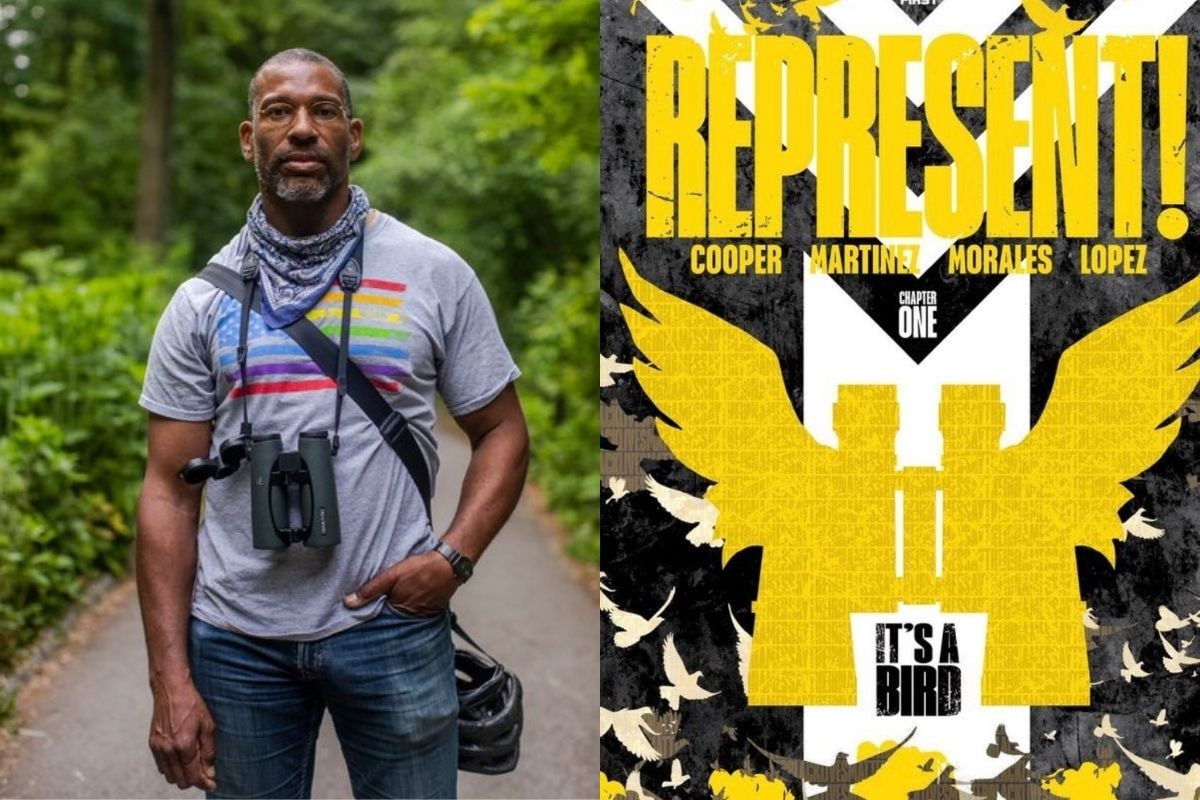
Write what you know.
It’s oft-cited advice for writers both beginning and established.
Thus, Jules, the teenage boy at the center of Christian Cooper’s It’s a Bird, the first entry in DC Comics’ digital-first anthology series Represent!, is a birdwatcher, like the author.
And the binoculars that were a 50th birthday gift from Cooper’s father, a Korean War vet and Civil Rights activist, serve as models for the ones Jules is none too thrilled to receive, despite his grandpa’s belief that they possess special powers.
Cooper, who was was Marvel’s first openly gay writer and editor, introducing a number of queer characters before devoting himself to science writing, also draws on recent personal history that is more fraught.
Although the location has shifted from New York City’s Central Park to a suburban green space bordered with large, well-kept homes, including Jules’, the young man’s encounter with an indignant white woman and her off-leash dog should ring any number of bells.
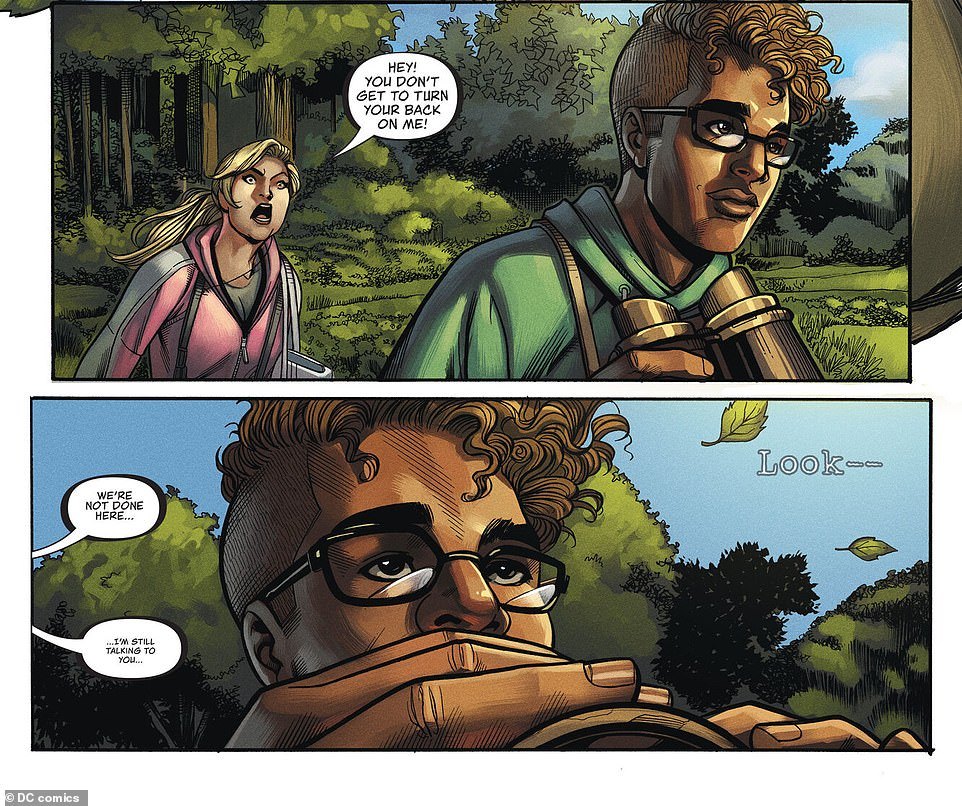
In late May, Cooper became the subject of national news, when he confronted Amy Cooper (no relation) over her violation of park rules, tired of the havoc uncontrolled dogs wreak on birds who call the park home. Ms. Cooper escalated things quickly by calling 911, claiming she was being threatened by an African-American man. Cooper recorded the incident as a matter of protocol, and his sister shared the video on social media later that day.
The same day that George Floyd was killed by police in Minneapolis, Minnesota.
What Jules sees through the lenses of his grandfather’s binoculars contains an element of fantasy, but is also deeply rooted in reality—the faces of Amidou Diallo, Breonna Taylor, Floyd, and other Black people who have died as a result of excessive, unwarranted police force.
When DC first approached him about tapping his experience for his first comic in over two decades, Cooper was reluctant:
I thought, “I don’t know, DC Comics? Superheroes? Not sure how that’s going to work.” We kicked around a couple of ideas. They said they had gotten the title, I’m not sure exactly from who, but somebody pretty high up in the DC food chain: “It’s a Bird.” It took me half a beat. “Oh…I get what you did there.” Once I had the title, the story wrote itself.
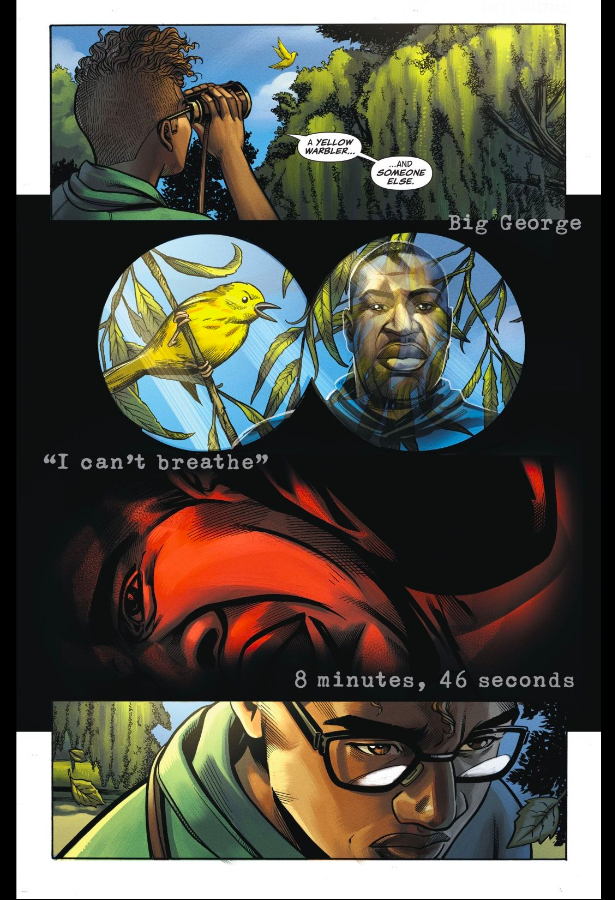
It’s a Bird artist Aletha E. Martinez, a pioneer whose 20-year career has included inking such superhero heavy hitters as the Black Panther, Iron Man, Batgirl, and X‑Men, also pulled from personal experience when rendering Jules’ expression after the binoculars reveal the circumstances of George Floyd’s death:
I saw that look on my son’s face three years ago after we left North Carolina, and we were coming home to New York. We were stopped going into the airport. We travel so often—cons, in and out of the country. These two security guards started to harass us. They wanted to take my purse. “Where are you from?” You hear my voice, there’s no accent in my voice. It ended up with them saying, “You should travel with your passport.” This is after backing us up in the corner, and why? I’m an American citizen born on this soil, so is my son. I don’t need a passport to travel within my country. This is our day and age.
I watched my son’s face change, and he never quite walked up again looking happy going to the airport. Now he has on armor. That face you see? That’s my kid.
It’s a Bird can be read for free on participating digital platforms (see links below), and Cooper is hopeful that it will inspire young people to find out more about some of the real life characters Jules spies through his binoculars. To that end, an appendix touches on some biographical details:
We not only give the bare bones details of how they died, but also a little bit about them, because they were people. They weren’t just want happened to them. I hope young people (are) inspired to keep the focus where it needs to be, which is on those we have lost and how we keep from losing more. There are people who are invested in distracting us right now, and there are people who want to distract us from their failures on so many other things. That’s not what this moment is about. This moment is about the ones we’ve lost, and how we’re going to keep from losing any more. And if you’re not talking about that, I don’t want to hear it.
Read Represent!: It’s a Bird for free on readdc.com, Comixology, Amazon Kindle, Apple Books, and other participating digital platforms.
Read an interview with Cooper and Martinez, from which the quotes in this post are drawn, on DC’s blog.
Related Content:
A New Digital Archive Preserves Black Lives Matter & COVID-19 Street Art
Batman Stars in an Unusual Cartoon Adaptation of Dostoyevsky’s Crime and Punishment
Ayun Halliday is an author, illustrator, theater maker and Chief Primatologist of the East Village Inky zine. Follow her @AyunHalliday.
Read More...Discover the Longest Song in the World: A 639-Year Performance of the John Cage Composition Called “Organ/ASLSP (As Slow As Possible)”
In 2016, Laurie Anderson recreated the experience of Lou Reed’s Metal Machine Music in Saint Mark’s chapel in Brighton. The five-day-long performance piece involved “some eight unmanned guitars leaning on a similar number of vintage amps,” Mark Sheerin writes, all of them cranked up, feeding back, and echoing around the Anglican church’s vaulted ceiling. It was a fitting tribute to Reed, a sustained, dissonant drone that also invokes “the mysteries of faith and the incarnation of rebel angels.”
If five days seems like a long time to hold a single note, however, consider the performance of John Cage’s composition “ORGAN/ASLSP” or “A Slow as Possible” that began in the St. Burchardi church, in the German town of Halberstadt, on September 5th, 2001, what would have been Cage’s 89th birthday. The artists staging this piece intend it to last for 639 years. If the organ doesn’t fall apart and if a new generation of curators continues to take the place of the old, it will play until the year 2640.
Those are some big Ifs, but as long as it lasts, the piece should draw crowds every few years when a chord changes, as just happened recently, despite the pandemic, after the organ had played the same chord for almost 7 years. The change occurred on September 5th, 2020, Cage’s birthday, 19 years after the performance began. Lest we think its length insanely perverse, we should bear in mind that Cage himself never specified a tempo for “As Slow as Possible.” The score itself only “consists of eight pages of music, to be played,” writes Kyle Macdonald at Classic FM, “well, very, very slowly.”
Typically, organists and pianists have interpreted this direction within the space of an hour. Some have stretched single performances “up to, and beyond, 12 hours.” Obviously, no single person, or even team of people, could sustain playing the piece for 233,235 days. Nor, however, has the extreme slowness of the John Cage Organ Project version been made possible by digital means. Instead, a group of artists built a special pipe organ for the task. Each time a chord changes, new pipes are added manually. On Saturday, a masked crowd gathered “to see the G sharp and E notes meticulously installed.”
The organ is automated, by mechanical means. No one needs to sit and hold keys for several years. But can the long-term coordination needed to maintain this solemnly quixotic installation extend over six hundred years for a grand finale in 2640 (IF the organ, the church, and the planet, survive)? The question seems almost irrelevant since no one living can answer it with any degree of certainty. It depends on whether future generations see the St. Buruchardi “As Slow as Possible” as a phenomenon that should continue to exist. But why, we might ask, should it?
Maybe one way of thinking of the John Cage Organ Project is through the lens of the Long Now Project’s 10,000 Year Clock, a device being constructed (“no completion date scheduled”) to radically change humans’ relationship to time, to push us to think beyond—hundreds and thousands of years beyond—our meager lifetimes. Cage, I think, would appreciate the effort to turn his eight page composition into a musical manifestation of the future’s longue durée.
Related Content:
An Impressive Audio Archive of John Cage Lectures & Interviews: Hear Recordings from 1963–1991
John Cage’s Silent, Avant-Garde Piece 4’33” Gets Covered by a Death Metal Band
Josh Jones is a writer and musician based in Durham, NC. Follow him at @jdmagness
Read More...In 1183, a Chinese Poet Describes Being Domesticated by His Own Cats
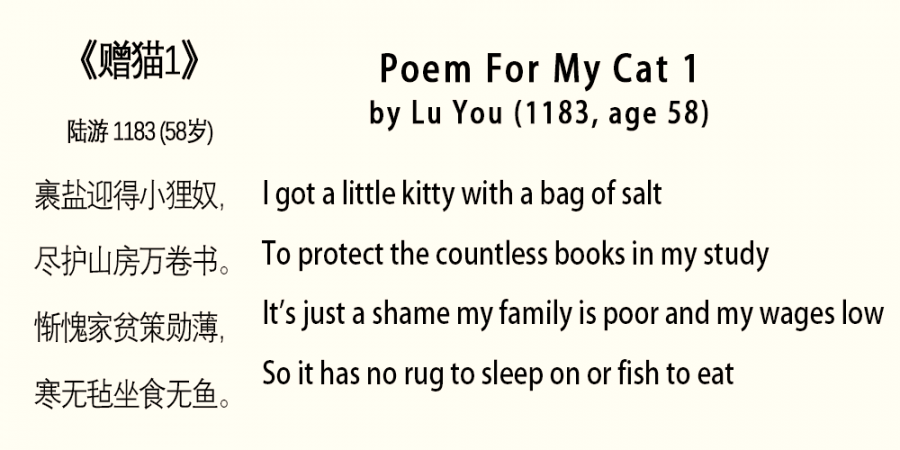
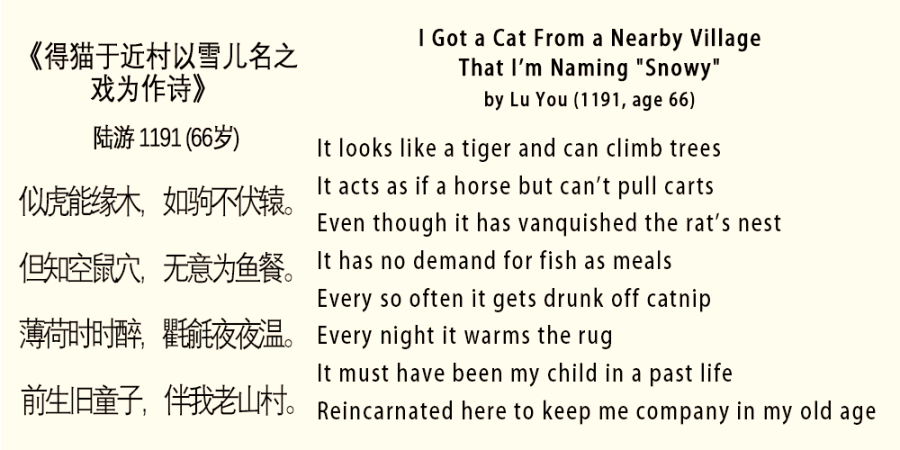
Here in Korea, where I live, cat owners aren’t called cat owners: they’re called goyangi jibsa, literally “cat butlers.” Clearly the idea that felines have flipped the domestic-animal script, not serving humans but being served by humans, transcends cultures. It also goes far back in history: witness the 12th-century verses recently tweeted out in translation by writer Xiran Jay Zhao, in which “Song dynasty poet Lu You” — one of the most prolific literary artists of his time and place — “poem-liveblogged his descent from cat owner to cat slave.”
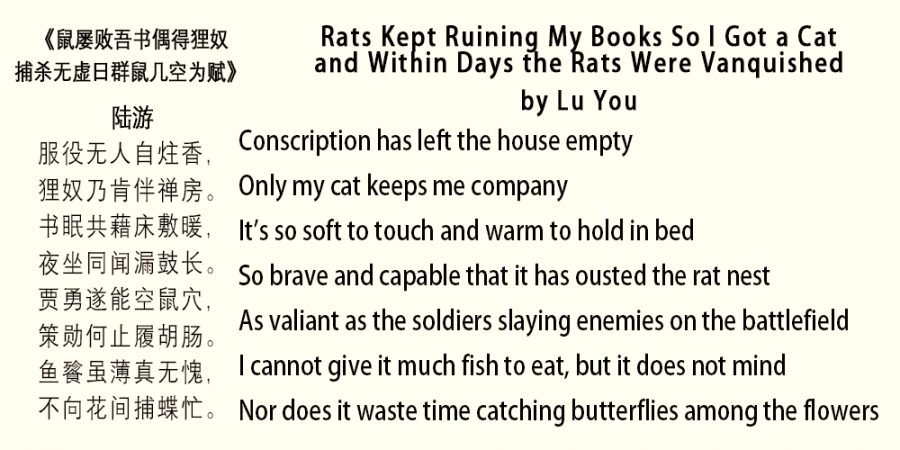
The story begins in 1138, writes Zhao, when “Down On His Luck scholar-official Lu You gets a cat because rats keep munching on his books.” The eight poems in this series begin with praise for the animal — “It’s so soft to touch and warm to hold in bed / So brave and capable that it has ousted the rat nest” — and goes on to describe the cats he subsequently acquires, who selflessly vanquish the household rats while indulging in nothing more than the occasional catnip binge.

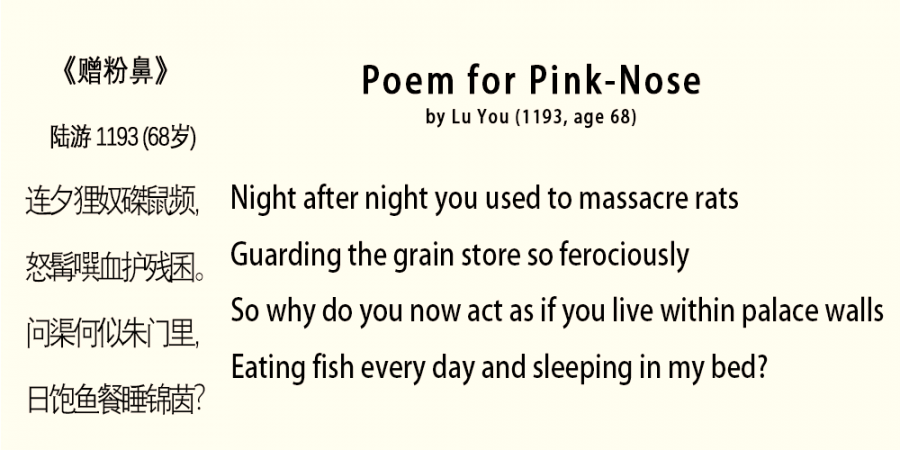
Or at least they do at first. “Night after night you used to massacre rats / Guarding the grain store so ferociously,” Lu asks one in “Poem for Pink-Nose.” “So why do you now act as if you live within palace walls / Eating fish every day and sleeping in my bed?”
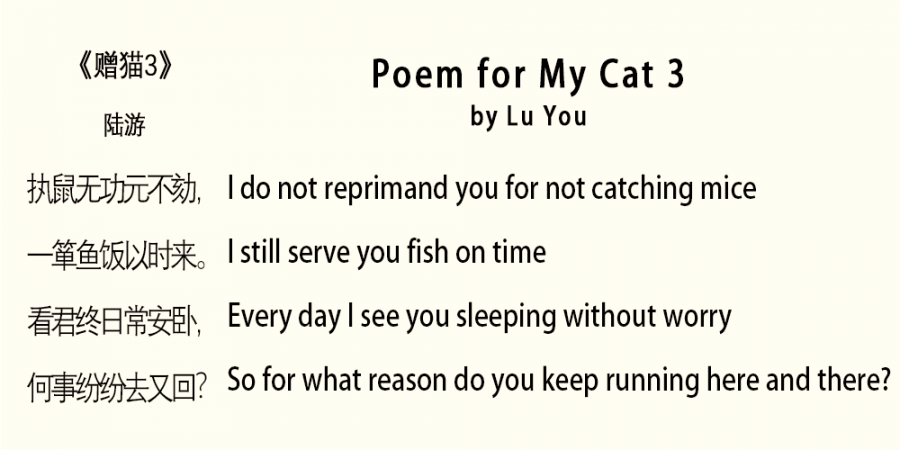
As time goes on, Lu finds himself “serving fish on time” to his cats only to find them “sleeping without worry.” As the rats rampage, he poetically moans, “my books are getting ruined and the birds wake me before dawn.” Has it all been nothing more than “a ruse to get food from me?”
Yet it seems that Lu has no regrets about cat ownership, if ownership be the word. “Wind sweeps the world and rain darkens the village / Rumbles roll off the mountains like ocean waves churning,” he writes in 1192’s “A Rainstorm on the Fourth Day of the Eleventh Month.” Yet “the furnace is soothing and the rug is warm / Me and my cat are not leaving the house.” This is relatable content for the cat butlers of Korea (a culture thoroughly influenced by China in Lu’s day), or indeed anywhere else in the world. The patriotic poet would surely be pleased by the modern-day ascent of China — and perhaps just as much by the high and ever-rising status of the domestic cat.
Related Content:
T.S. Eliot Reads Old Possum’s Book of Practical Cats & Other Classic Poems (75 Minutes, 1955)
Based in Seoul, Colin Marshall writes and broadcasts on cities, language, and culture. His projects include the book The Stateless City: a Walk through 21st-Century Los Angeles and the video series The City in Cinema. Follow him on Twitter at @colinmarshall, on Facebook, or on Instagram.
Read More...Scorsese’s Taxi Driver Reimagined as the 1970s Sitcom, Taxi
And next up, to keep the nostalgia going, watch Samuel Beckett star in the opening credits of an imaginary 70s cop show. Enjoy.…
If you would like to support the mission of Open Culture, consider making a donation to our site. It’s hard to rely 100% on ads, and your contributions will help us continue providing the best free cultural and educational materials to learners everywhere. You can contribute through PayPal, Patreon, and Venmo (@openculture). Thanks!
Related Content:
Martin Scorsese Makes a List of 85 Films Every Aspiring Filmmaker Needs to See
Watch Martin Scorsese’s Brand New Short Film, Made Entirely in His Office Under Quarantine
How Martin Scorsese Directs a Movie: The Techniques Behind Taxi Driver, Raging Bull, and More
Read More...How Charlie Parker Changed Jazz Forever
Jazz has often moved forward in seismic shifts, powered by revolutionary figures who make everything that came before them seem quaint by comparison and radiate their influence beyond the jazz world. Perhaps no figure epitomizes such a leap forward more than Charlie Parker. The legendary inventor of bebop, born a little over a century ago, may be the most universally respected and admired musician in jazz, and far beyond.
Kansas City trumpet player Lonnie McFadden, who grew up hearing stories about hometown hero Parker, was told by everyone he met to learn from the master. “Everybody. It was a consensus. All of them said, ‘You got to listen to Bird. You got to listen to Charlie Parker.’” Furthermore, he says, “every tap dancer I know, every jazz musician I know, every rock and blues musician I know honors Charlie Parker.”
Parker has been called “The Greatest Individual Musician Who Ever Lived.” Not just jazz musician, but musician, period, as the PBS Sound Field short introduction above notes, because there had never been one single musician who influenced “all instruments.” Kansas City saxophone player Bobby Watson and archivist Chuck Haddix explain how Parker made such an impact at such a young age, before dying at 34.
Unlike the swing of Benny Goodman or Louis Armstrong, Parker’s bebop is completely non-danceable. He didn’t care. He was not an entertainer, he insisted, but an artist. Jazz might eventually return to danceability in the late 20th century, but the music—and popular music writ large—would never be the same.
The video’s host, LA Buckner gives a brief summary of the evolution of jazz in four regional centers—New Orleans, Chicago, Kansas City, and New York. Parker made a transit through the last three of these cities, eventually ending up on big apple stages. “By 1944,” Jazzwise writes, “the altoist was… making a huge impact on the young Turks hanging out in Harlem, Dizzy Gillespie and Thelonious Monk in particular… no one had ever played saxophone in this manner before, the harmonic, rhythmic and melodic imagination and the emotional intensity proving an overwhelming experience.”
It’s too bad more musicians didn’t listen to Bird when it came to playing high. “Anyone who said they played better when on drugs or booze ‘are liars. I know,’” he said. Heroin and alcohol abuse ended his career prematurely, but perhaps no single instrumental musician since has cast a longer shadow. Jazz critic Stanley Crouch, author of Parker biography Kansas City Lightning: The Rise and Times of Charlie Parker, explains in an interview how Parker created his own mystique.
Parker sometimes gave the impression that he was largely a natural, an innocent into whom the cosmos poured its knowledge while never bothering his consciousness with explanations.
The facts of his development were quite different. He worked for everything he got, and whenever possible, he did that work in association with a master.
Parker was not appreciated at first, either in his hometown of Kansas City or in New York, where “people didn’t like the way he played” when he first arrived in 1939. He responded to criticism with ceaseless practice, learning, and experimentation, an almost superhuman work ethic that probably wasn’t great for his health but has grown into a legend all its own, giving musicians in every form of music a model of dedication, intensity, and fearlessness to strive toward.
Related Content:
The Night When Charlie Parker Played for Igor Stravinsky (1951)
Josh Jones is a writer and musician based in Durham, NC. Follow him at @jdmagness
Read More...William Blake’s Paintings Come to Life in Two Animations
The poet and painter William Blake toiled in obscurity, for the most part, and died in poverty.
Twenty some years after his death, his rebellious spirit gained traction with the Pre-Raphaelites.
By the dawning of the Age of Aquarius, Blake was ripe to be venerated as a counter-cultural hero, for having flown in the face of convention, while championing gender and racial equality, nature, and free love.
Reclining half-naked on a “a fabulous couch in Harlem,” poet Allen Ginsburg had a hallucinatory encounter wherein Blake recited to him “in earthen measure.”
Ditto poet Michael McClure, though in his case, Bob Dylan’s “Gates of Eden” served as something of a medium:
I had the idea that I was hallucinating, that it was William Blake’s voice coming out of the walls and I stood up and put my hands on the walls and they were vibrating.
Blake’s work (and world view) continues to exert enormous influence on graphic novelists, theatermakers, and creatives of every stripe.
He’s also a dab hand at animation, collaborating from beyond the grave.
The short above, a commission for a late ‘70s Blake exhibition at The Tate, envisions a roundtrip journey from Heaven to Hell. Animator Sheila Graber parked herself in the Sculpture Hall to create it in public view, pairing Blake’s line “Energy is Eternal delight” with a personal observation:
Whether we use it to create or destroy—it’s the same energy. The practice of art can turn a person from a vandal to a builder!
More recently, the Tate gave director Sam Gainsborough access to super high-res imagery of Blake’s original paintings, in order to create a promo for last year’s blockbuster exhibition.
Gainsborough and animator Renaldho Pelle worked together to bring the chosen works to life, frame by frame, against a series of London buildings and streets that were well known to Blake himself.
The film opens with Blake’s Ghost of a Flea emerging from the walls of Broadwick Street, where its creator was born, then stalking off, bowl in hand, ceding the screen to God, The Ancient of Days, whose reach spreads like ink across the gritty facade of a white brick edifice.
Seymour Milton’s original music and Jasmine Blackborow’s narration of excerpts from Blake’s poem “Auguries of Innocence” seem to anticipate the fraught current moment, as does the entire poem:
Auguries of Innocence
To see a World in a Grain of Sand
And a Heaven in a Wild Flower
Hold Infinity in the palm of your hand
And Eternity in an hour
A Robin Red breast in a Cage
Puts all Heaven in a Rage
A Dove house filld with Doves & Pigeons
Shudders Hell thr’ all its regions
A dog starvd at his Masters Gate
Predicts the ruin of the State
A Horse misusd upon the Road
Calls to Heaven for Human blood
Each outcry of the hunted Hare
A fibre from the Brain does tear
A Skylark wounded in the wing
A Cherubim does cease to sing
The Game Cock clipd & armd for fight
Does the Rising Sun affright
Every Wolfs & Lions howl
Raises from Hell a Human Soul
The wild deer, wandring here & there
Keeps the Human Soul from Care
The Lamb misusd breeds Public Strife
And yet forgives the Butchers knife
The Bat that flits at close of Eve
Has left the Brain that wont Believe
The Owl that calls upon the Night
Speaks the Unbelievers fright
He who shall hurt the little Wren
Shall never be belovd by Men
He who the Ox to wrath has movd
Shall never be by Woman lovd
The wanton Boy that kills the Fly
Shall feel the Spiders enmity
He who torments the Chafers Sprite
Weaves a Bower in endless Night
The Catterpiller on the Leaf
Repeats to thee thy Mothers grief
Kill not the Moth nor Butterfly
For the Last Judgment draweth nigh
He who shall train the Horse to War
Shall never pass the Polar Bar
The Beggars Dog & Widows Cat
Feed them & thou wilt grow fat
The Gnat that sings his Summers Song
Poison gets from Slanders tongue
The poison of the Snake & Newt
Is the sweat of Envys Foot
The poison of the Honey Bee
Is the Artists Jealousy
The Princes Robes & Beggars Rags
Are Toadstools on the Misers Bags
A Truth thats told with bad intent
Beats all the Lies you can invent
It is right it should be so
Man was made for Joy & Woe
And when this we rightly know
Thro the World we safely go
Joy & Woe are woven fine
A Clothing for the soul divine
Under every grief & pine
Runs a joy with silken twine
The Babe is more than swadling Bands
Throughout all these Human Lands
Tools were made & Born were hands
Every Farmer Understands
Every Tear from Every Eye
Becomes a Babe in Eternity
This is caught by Females bright
And returnd to its own delight
The Bleat the Bark Bellow & Roar
Are Waves that Beat on Heavens Shore
The Babe that weeps the Rod beneath
Writes Revenge in realms of Death
The Beggars Rags fluttering in Air
Does to Rags the Heavens tear
The Soldier armd with Sword & Gun
Palsied strikes the Summers Sun
The poor Mans Farthing is worth more
Than all the Gold on Africs Shore
One Mite wrung from the Labrers hands
Shall buy & sell the Misers Lands
Or if protected from on high
Does that whole Nation sell & buy
He who mocks the Infants Faith
Shall be mockd in Age & Death
He who shall teach the Child to Doubt
The rotting Grave shall neer get out
He who respects the Infants faith
Triumphs over Hell & Death
The Childs Toys & the Old Mans Reasons
Are the Fruits of the Two seasons
The Questioner who sits so sly
Shall never know how to Reply
He who replies to words of Doubt
Doth put the Light of Knowledge out
The Strongest Poison ever known
Came from Caesars Laurel Crown
Nought can Deform the Human Race
Like to the Armours iron brace
When Gold & Gems adorn the Plow
To peaceful Arts shall Envy Bow
A Riddle or the Crickets Cry
Is to Doubt a fit Reply
The Emmets Inch & Eagles Mile
Make Lame Philosophy to smile
He who Doubts from what he sees
Will neer Believe do what you Please
If the Sun & Moon should Doubt
Theyd immediately Go out
To be in a Passion you Good may Do
But no Good if a Passion is in you
The Whore & Gambler by the State
Licencd build that Nations Fate
The Harlots cry from Street to Street
Shall weave Old Englands winding Sheet
The Winners Shout the Losers Curse
Dance before dead Englands Hearse
Every Night & every Morn
Some to Misery are Born
Every Morn and every Night
Some are Born to sweet delight
Some are Born to sweet delight
Some are Born to Endless Night
We are led to Believe a Lie
When we see not Thro the Eye
Which was Born in a Night to perish in a Night
When the Soul Slept in Beams of Light
God Appears & God is Light
To those poor Souls who dwell in Night
But does a Human Form Display
To those who Dwell in Realms of day
Related Content:
William Blake’s Masterpiece Illustrations of the Book of Job (1793–1827)
Ayun Halliday is an author, illustrator, theater maker and Chief Primatologist of the East Village Inky zine. Follow her @AyunHalliday.
Read More...John Waters Designs a Witty Poster for the New York Film Festival

Yesterday, Film at Lincoln Center unveiled the poster for the 58th New York Film Festival (September 17-October 11, 2020). And it’s created by none other than filmmaker, artist, and “Pope of Trash,” John Waters.
The New York Film Festival writes: The “poster is both a fond tribute and witty parody of the historic festival, poking fun at the long-held stereotypes, valid critiques, and presumed pomp and circumstance of the annual Lincoln Center event. The concept was developed before the current health crisis, in collaboration with and inspired by Globe Poster, the legendary press of Waters’s hometown. Founded in 1929 in Baltimore, Maryland, Globe Poster delivered eye-catching posters to promote concerts, drag races, circuses, carnivals, and more. Fluorescent colors, bold wood type, and lettering that shook and shimmied defined Globe’s iconic style, attracting clients from James Brown and Marvin Gaye to Tina Turner and the Beach Boys.”
For a little laugh, study the poster closely above. And then head to the Relateds below for more.
If you would like to support the mission of Open Culture, consider making a donation to our site. It’s hard to rely 100% on ads, and your contributions will help us continue providing the best free cultural and educational materials to learners everywhere. You can contribute through PayPal, Patreon, and Venmo (@openculture). Thanks!
Related Content:
John Waters’ RISD Graduation Speech: Real Wealth is Never Having to Spend Time with A‑Holes
John Waters Narrates Offbeat Documentary on an Environmental Catastrophe, the Salton Sea
John Waters Makes Handmade Christmas Cards, Says the “Whole Purpose of Life is Christmas”
An Anti, Anti-Smoking Announcement from John Waters
When John Waters Appeared on The Simpsons and Changed America’s LGBTQ Views (1997)
Hear Moby Dick Read in Its Entirety by Tilda Swinton, Stephen Fry, John Waters & Others
Read More...A Database of 5,000 Historical Cookbooks–Covering 1,000 Years of Food History–Is Now Online

As you know if you’re a reader of this site, there are vast, interactive (and free!) scholarly databases online collecting just about every kind of artifact, from Bibles to bird calls, and yes, there are a significant number of cookbooks online, too. But proper searchable, historical databases of cookbooks seem to have appeared only lately. To my mind these might have been some of the first things to become available. How important is eating, after all, to virtually every part of our lives? The fact is, however, that scholars of food have had to invent the discipline largely from scratch.
“Western scholars had a bias against studying sensual experience,” writes Reina Gattuso at Atlas Obscura, “the relic of an Enlightenment-era hierarchy that considered taste, touch, and flavor taboo topics for sober academic inquiry. ‘It’s the baser sense,’ says Cathy Kaufman, a professor of food studies at the New School.” Kaufman sits on the board of The Sifter, a new massive, multi-lingual online database of historical recipe books. Another board member, sculptor Joe Wheaton, puts things more directly: “Food history has been a bit of an embarrassment to a lot of academics, because it involves women in the kitchen.”
Luckily for food scholars, the situation has changed dramatically. There are now over 2,000 historical Mexican cookbooks of all kinds online at the University of Texas San Antonio, for example. (The UTSA is busy curating and translating hundreds of those recipes into English for what they call a “series of mini-cookbooks.”) And scholars of food history may have to be pulled away by force from The Sifter, a vast, ever-expanding Wikipedia-like archive of food research.
The database collects “over 5,000 authors and 5,000 works with details about the authors and about the contents of the works,” the site explains. “The central documents are cookbooks and other writings related to getting, preparing, and consuming food, and the activities associated with them, as well as writings about cultural and moral attitudes.” Like Wikipedia, users are invited to submit their own data, which can be edited by other users. Unlike the public encyclopedia, which we know has serious flaws, The Sifter is overseen by experts, and inspired by none other than the expert Julia Child herself, or at least by her library.
Although the Sifter does not contain actual texts or recipes, it does collect the bibliographic data of thousands of such books, a treasury for scholars, researchers, and historians. The primary force behind the project, Barbara Wheaton, was a neighbor of Julia Childs’ in the early 1960s and used Childs’ library and Harvard University’s Schlesinger Library Culinary Collection (where she is now an honorary curator) to become “one of the best-known scholars of culinary history.” Her story illustrates how a recent wealth of culinary scholarship did not just suddenly appear but has been germinating for decades. The Sifter is the result of “Wheaton’s 50 years of labor.”
Wheaton launched the site in July with the help of a team of scholars and her children, Joe and Catherine. The Sifter contains “more than a thousand years of European and U.S. cookbooks, from the medieval Latin De Re Culinaria, published in 800, to The Romance of Candy, a 1938 treatise on British sweets.” It also collects bibliographic data on cookbooks, in their original languages, from around the world. Wheaton hopes The Sifter will generate new areas of research into the history of what may be at once the most universal of all human activities and the most culturally, regionally, and historically particular. Perhaps a silver lining of so many years of scholarly neglect is that there is now so much work for food historians to do. Get started at The Sifter here.
via Atlas Obscura
Related Content:
An Archive of Handwritten Traditional Mexican Cookbooks Is Now Online
An Archive of 3,000 Vintage Cookbooks Lets You Travel Back Through Culinary Time
Josh Jones is a writer and musician based in Durham, NC. Follow him at @jdmagness
Read More...What Did the Roman Emperors Look Like?: See Photorealistic Portraits Created with Machine Learning

We can spend a lifetime reading histories of ancient Rome without knowing what any of its emperors looked like. Or rather, without knowing exactly what they looked like: being the leaders of the mightiest political entity in the Western world, they had their likenesses stamped onto coins and carved into busts as a matter of course. But such artist’s renderings inevitably come with a certain degree of artistic license, a tendency to mold features into slightly more imperial shapes. Seeing the faces of the Roman Emperors as we would if we were passing them on the street is an experience made possible only by high technology, and high technology developed sixteen centuries after the fall of the Roman Empire at that.
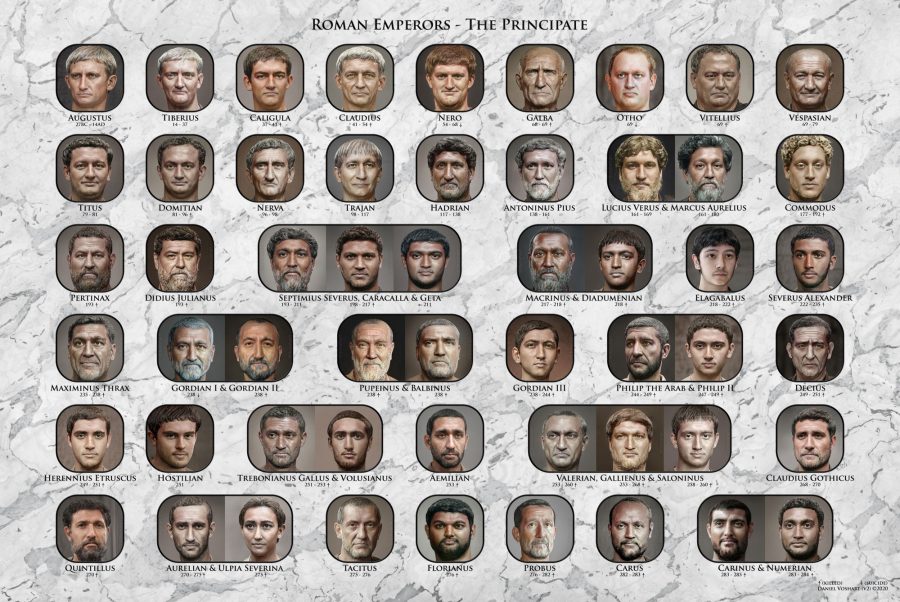
“Using the neural-net tool Artbreeder, Photoshop and historical references, I have created photoreal portraits of Roman Emperors,” writes designer Daniel Voshart. “For this project, I have transformed, or restored (cracks, noses, ears etc.) 800 images of busts to make the 54 emperors of The Principate (27 BC to 285 AD).”
The key technology that enables Artbreeder to convincingly blend images of faces together is what’s called a “generative adversarial network” (GAN). “Some call it Artificial Intelligence,” writes Voshart, “but it is more accurately described as Machine Learning.” The Verge’s James Vincent writes that Voshart fed in “images of emperors he collected from statues, coins, and paintings, and then tweaked the portraits manually based on historical descriptions, feeding them back to the GAN.”

Into the mix also went “high-res images of celebrities”: Daniel Craig into Augustus, André the Giant into Maximinus Thrax (thought to have been given his “a lantern jaw and mountainous frame” by a pituitary gland disorder like that which affected the colossal wrestler). This partially explains why some of these uncannily lifelike emperors — the biggest celebrities of their time and place, after all — look faintly familiar. Though modeled as closely as possible after men who really lived, these exact faces (much like those in the artificial intelligence-generated modern photographs previously featured here on Open Culture) have never actually existed. Still, one can imagine the emperors who inspired Voshart’s Principate recognizing themselves in it. But what would they make of the fact that it’s also selling briskly in poster form on Etsy?
Visit the Roman Emperor Project here. For background on this project, visit here.

Related Content:
Five Hardcore Deaths Suffered By Roman Emperors
Play Caesar: Travel Ancient Rome with Stanford’s Interactive Map
Rome Reborn: Take a Virtual Tour of Ancient Rome, Circa 320 C.E.
The History of Ancient Rome in 20 Quick Minutes: A Primer Narrated by Brian Cox
The History of Rome in 179 Podcasts
Roman Statues Weren’t White; They Were Once Painted in Vivid, Bright Colors
Based in Seoul, Colin Marshall writes and broadcasts on cities, language, and culture. His projects include the book The Stateless City: a Walk through 21st-Century Los Angeles and the video series The City in Cinema. Follow him on Twitter at @colinmarshall, on Facebook, or on Instagram.
Read More...Billie Eilish Performs an NPR Tiny Desk Concert, with a Little Bit of Technology & Magic
Even COVID-19 can’t stop NPR’s series of Tiny Desk Concerts, which has previously featured Yo-Yo Ma, Adele, Wilco, The Pixies, and many, many other talented musicians. As NPR explains below, the performance involved a little bit of technology and some magic. Enjoy:
It didn’t take long for Billie Eilish to become one of the biggest pop stars in the world, sweep the Grammy Awards’ major categories and release the latest James Bond theme. And today, at just 18, she and her brother, Finneas, have accomplished what no one has been able to do for five and a half months: perform a Tiny Desk concert in what certainly appears to be the NPR Music offices.
Of course, due to safety concerns, even the NPR Music staff can’t set foot in the building that houses Bob Boilen’s desk. But if you look over Eilish’s shoulder, there’s no mistaking the signs that she’s appearing at the Tiny Desk in its present-day form: On the last day before staff began working from home, I took home the Green Bay Packers helmet that sat on the top shelf — the one Harry Styles had signed a few weeks earlier — for safe keeping. In this performance, that spot is empty.
So how the heck did they do it?
Honestly, it’s best that you watch the whole video to experience the extent of the technical feat — which, in the spirit of Eilish’s Saturday Night Live performance, they’re willing to share with you. And thankfully, we still have our ways of photographing the desk, even if the room has fallen silent.
So settle in for a welcome jolt of Tiny Desk innovation, not to mention two of the excellent standalone singles Billie Eilish has released in the past year: “my future” and “everything i wanted.” And, seriously, be sure to watch until the very end.
If you would like to support the mission of Open Culture, consider making a donation to our site. It’s hard to rely 100% on ads, and your contributions will help us continue providing the best free cultural and educational materials to learners everywhere. You can contribute through PayPal, Patreon, and Venmo (@openculture). Thanks!
Related Content
Read More...Support Us
We're hoping to rely on loyal readers, rather than erratic ads. Please click the Donate button and support Open Culture. You can use Paypal, Venmo, Patreon, even Crypto! We thank you!

About Us

Open Culture scours the web for the best educational media. We find the free courses and audio books you need, the language lessons & educational videos you want, and plenty of enlightenment in between.
Advertise With Us

FREE UPDATES!
GET OUR DAILY EMAIL
Get the best cultural and educational resources on the web curated for you in a daily email. We never spam. Unsubscribe at any time.
FOLLOW ON SOCIAL MEDIA

Open Culture editor Dan Colman scours the web for the best educational media. He finds the free courses and audio books you need, the language lessons & movies you want, and plenty of enlightenment in between.
Advertise With Us

