Hear Readings of Albert Einstein’s Love Letters (and Chilly Divorce Letters) to His First Wife Mileva
Beware the fake quotation. They have become so ubiquitous they often appear in books and speeches by politicians and their family members, not that anyone seems to care much. But most of us feel a measure of shame at being duped, as Katharine Rose did when she found herself moved by a letter supposedly written by Albert Einstein to his daughter, Lieserl, “regarding the ‘universal force’ of love.” The letter is a “beautiful read,” and it’s a fake. But many admirers of Einstein were eager to believe it.
Why? Like other famous figures to whom spurious words are attributed, Einstein isn’t just well-known, he is revered, a celebrity, and celebrities are people we feel we know intimately. (A common defense for fake-quote-sharing goes: “Well, if he didn’t say it, then it’s exactly the kind of thing he would say.”) Discussing the theft of Einstein’s brain after his death, Ross Anderson at Aeon observes that “an ordinary person can live and die privately, but a genius—and his grey matter—belongs to the world.” We might add, “and so do the intimate details of his private life.”
The details of Einstein’s marriage, and of his very unpleasant separation and divorce, from Mileva Marić have long been public knowledge. “Few public marriages have been subjected to a more unnuanced verdict,” Maria Popova writes at Brain Pickings. Their love letters first came to light in 1986, discovered by Einstein’s granddaughter Evelyn. They were published in 1992 as The Love Letters, “a collection of fifty-four missives exchanged between the beginning of their romance” when they met as students in 1897 to their marriage in 1903. Dozens more are available at Princeton University’s online collection of Einstein’s papers.
The letters are real, and they are “spicy,” as YouTuber Tibees shows us in the video at the top. No awkward private expression is safe: we begin with letters Einstein wrote to his high school girlfriend, Marie Winteler, including a breakup letter at 3:13. The excerpts here are all timestamped on the video’s YouTube page, with helpful summaries like “Einstein’s mom trying to break them up” (them being Albert and Mileva), “Einstein having an affair with his cousin Elsa,” “Breaking up with Elsa,” and “Getting back with Elsa.”
Elsa, you may know, was Einstein’s second wife, in addition to being his cousin, and the cause of his separation and divorce from Mileva, to whom he had professed undying devotion. In the interest of fully invading the genius’s privacy, we have, above, some readings of his harsh “divorce letters” to Mileva, with hits like “Separation,” “Proposing divorce,” and “Court proceedings.” Love may or may not be a “universal force”—we do not, sadly, have Einstein’s thoughts on the matter—but we do know he found it a troublingly chaotic, unpredictable one.
Related Content:
Albert Einstein Imposes on His First Wife a Cruel List of Marital Demands
Hear Albert Einstein Read “The Common Language of Science” (1941)
Albert Einstein Explains Why We Need to Read the Classics
Josh Jones is a writer and musician based in Durham, NC. Follow him at @jdmagness
Read More...Hand-Colored Maps of Wealth & Poverty in Victorian London: Explore a New Interactive Edition of Charles Booth’s Historic Work of Social Cartography (1889)

Mapping has always been contentious, no matter where you look in time. Maps preserve ideological assumptions on paper, rationalizing physical space as they render it in two dimensions. No matter how didactic, they can become political weapons. In the case of Charles Booth’s visually impressive Maps Descriptive of London Poverty, we have a series of maps whose own assumptions can sometimes seem at odds with their ostensible purpose: to improve the living conditions of London’s poor.
Booth’s “colourful poverty maps were created between 1886 and 1903,” Zoe Craig writes at Londonist, as part of a “ground-breaking study into the lives of ordinary Londoners.” A philanthropist born into wealth in the shipping trade, Booth took it upon himself to study poverty in London in order to initiate social reforms.
He succeeded. The study, conducted by Booth and a team of researchers, led to the creation of Old Age pensions, which Booth called “limited socialism,” as well as school meals for hungry children. He was clear about that fact that he saw such reforms as a bulwark against socialist revolution.
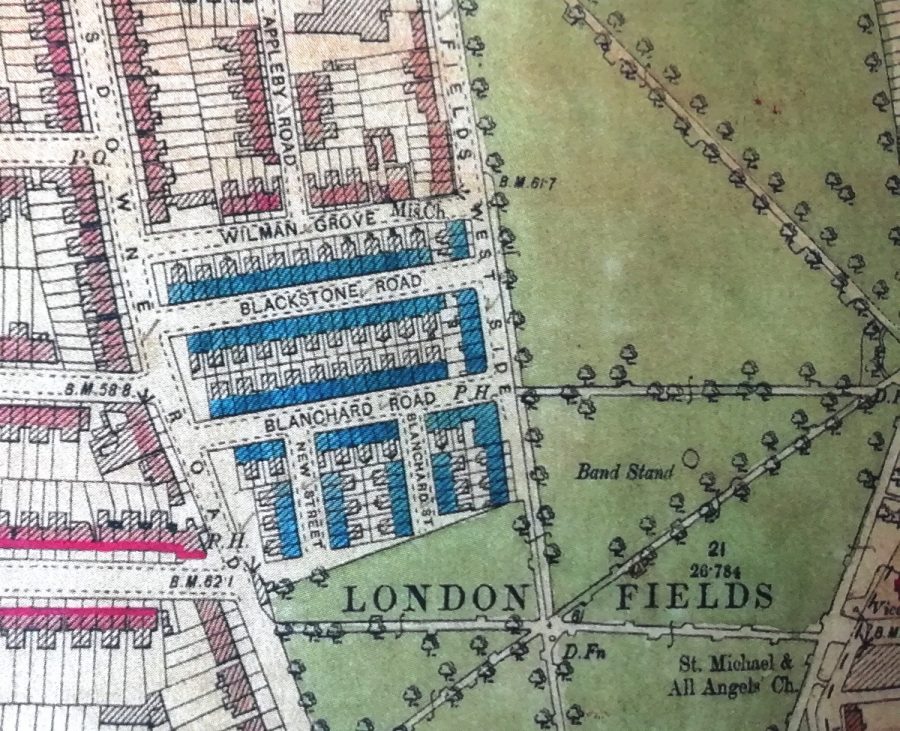
The study’s seventeen volumes are filled with picturesque accounts. “Picking through the tidbits of information from these people’s lives will make you feel a bit like a Victorian costume drama police detective,” Craig remarks. This reference to policing feels pointed, given the role of the police in maintaining class hierarchies in Victorian London. As an American, it can be hard to look at Booth’s map and not also see the 20th redlining practices in U.S. cities. Consider, for example, the categories Booth applied to London’s classes:
Called ‘Inquiry Into the Life and Labour of the People in London’, the epic work studied families and residents living across London, and coloured the streets according to their financial situation: between black for ‘lowest class, vicious, semi-criminal’ through pink for mixed ‘some comfortable, some poor’ to orange for ‘wealthy’.
As in Daniel Patrick Moynihan’s paternalistic 1965 report on the Black underclass in the U.S., the language reinforces Social Darwinist ideas that deem the “lowest class” unfit for full participation in civil society—“vicious, semi-criminal…”
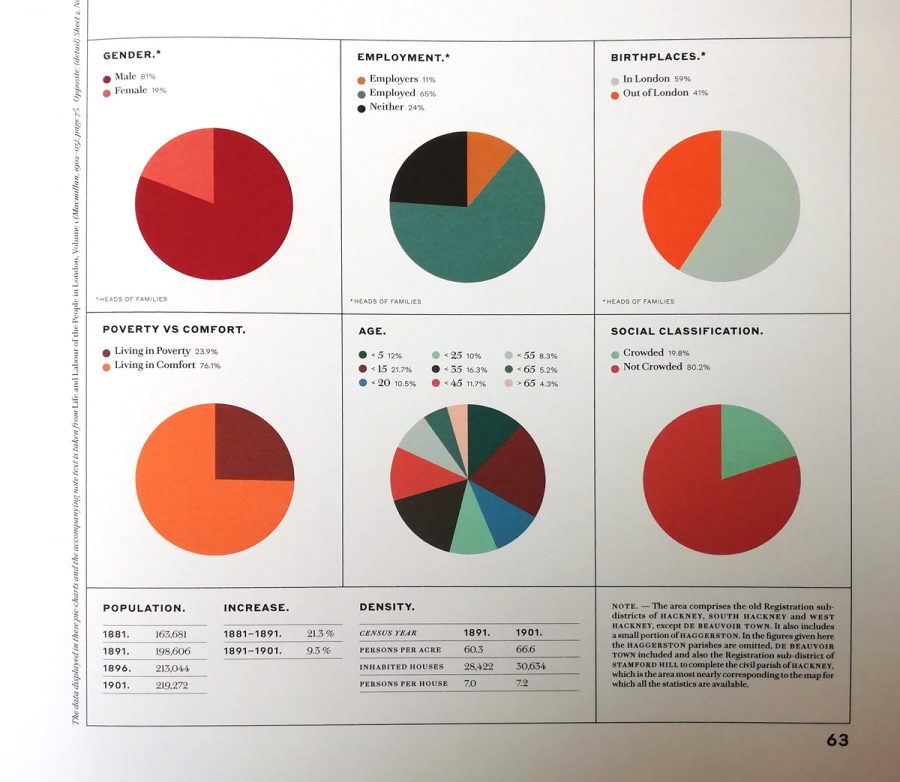
Of course, the social and historical context differs markedly, but we might also consider Feargus O’Sullivan’s observations at Bloomberg CityLab. A new published edition of the map, he writes, “accompanied by compelling if bleak period photos, reveals a city that possesses echoes of London today. It depicts, after all, a densely-packed metropolis with a cosmopolitan population where immensely wealthy people lived just around the corner from neighbors who were struggling to make ends meet.”
Maps may not create the social conditions they describe, but they can help perpetuate them, rendering people visible in ways that allow for even more control over their lives. Criticisms of Booth’s study claimed that not only did the proposed reforms not go far enough but that the report described London’s class structure while offering little to no analysis of the causes of poverty. In language that sounded less objectionable to Victorian ears, the poor are mostly blamed for their own condition.
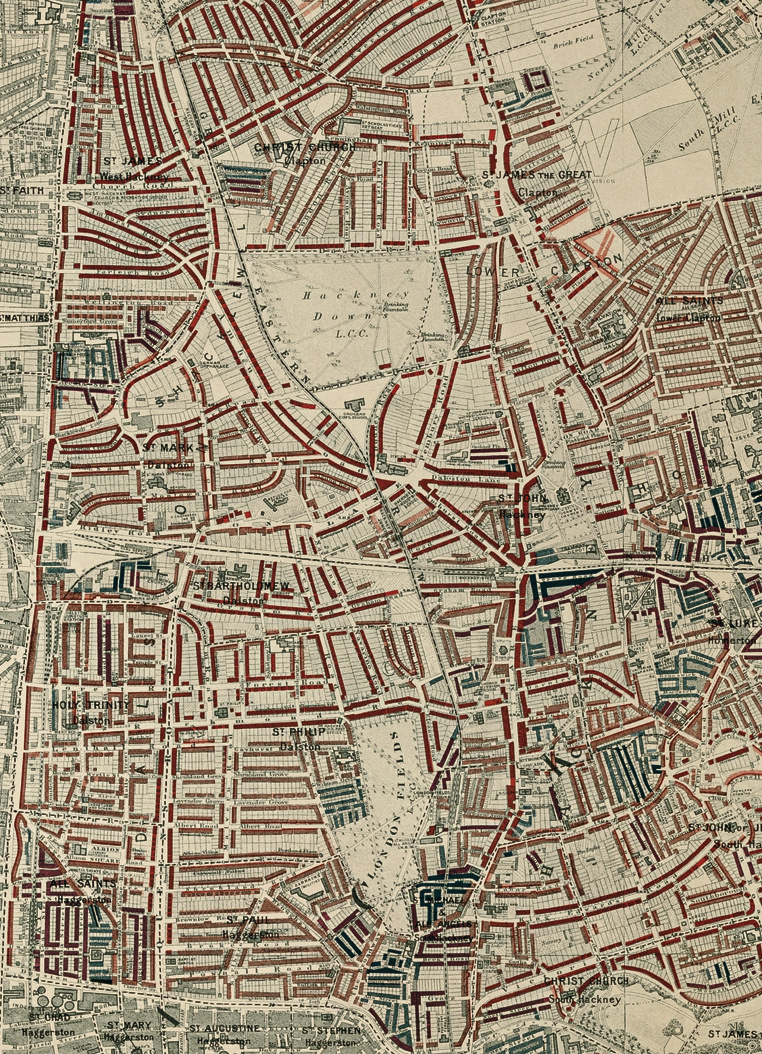
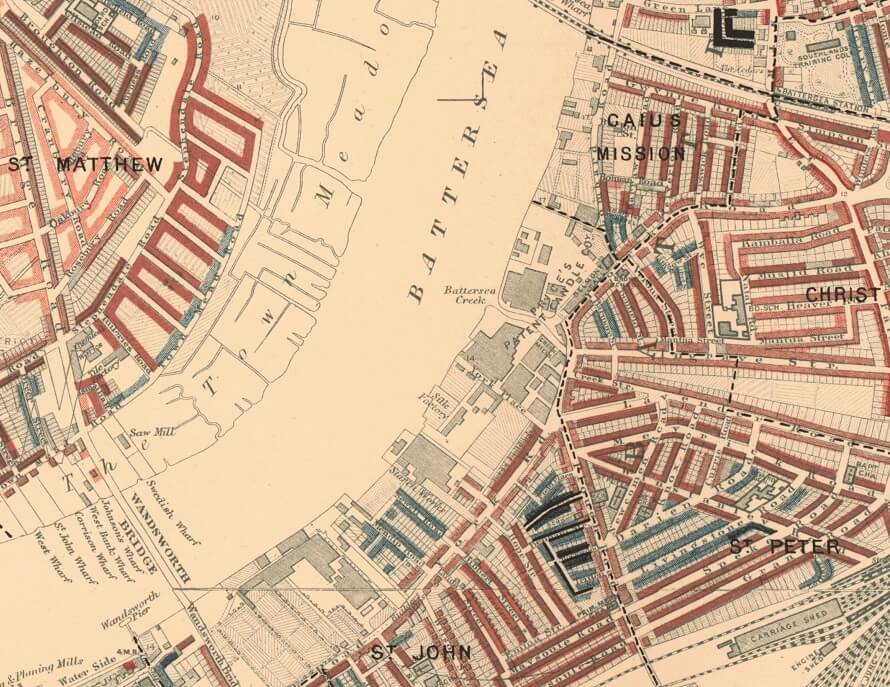
None of the study’s particular limitations take away from the graphic achievements of its maps and explanatory charts. They are, the London School of Economics writes, a striking “early example of social cartography.” The LSE hosts an incredibly detailed, searchable, high-resolution interactive version of the maps, assembled together and overlaid on a modern GPS map of London. They also detail the various editions of the maps as they appeared between 1898 and 1903.
Hand-colored and based on the 1869 Ordnance Survey, the maps seemed “sufficiently important” to Booth to warrant “comprehensive revision.” Here, the police appear in person to guide the process. “Social investigators accompanied policemen on their beats across London,” the LSE writes, “and recorded their own impressions of each street and the comments of the policemen.” You can read the police notebooks from these surveys at the LSE and learn more about the 12 district maps and the demographic data they represent at Mapping London. The LSE printed a hardcover print edition of Booth’s work in 2019, complete with 500 illustrations. You can purchase a copy here. Or visit the interactive edition here.
Related Content:
Josh Jones is a writer and musician based in Durham, NC. Follow him at @jdmagness
Read More...Why James Gandolfini’s Tony Soprano Is “the Greatest Acting Achievement Ever Committed to the Screen”: A Video Essay
The ongoing “golden age” of prestige television drama began more than twenty years ago, but how many shows have truly surpassed The Sopranos, the one that started it all? However many series come and go, raising large and often obsessive fan bases with their varying mixtures of crime, history, politics, science fiction, fantasy, and intrigue, none have shown the cultural staying power of this six-season tale of a mob boss in turn-of-the-21st-century New Jersey. That The Sopranos remains relevant owes in part to the vision of creator David Chase as well as to the tour de force performance of star James Gandolfini.
Evan Puschak, better known as the Nerdwriter, has stronger words of approbation: Gandolfini’s is “probably the greatest acting achievement ever committed to the screen, small or big.” In the video essay “How James Gandolfini Navigates Emotion” he marshals in support of this claim just one scene, but a scene that features Gandolfini at the height of his dramatic powers.
Taken from the fifth-season episode “Unidentified Black Males,” originally aired in 2004 (and co-written by Matthew Weiner, later to create the prestige-TV franchise Mad Men), this selection takes place in the office of Tony’s psychiatrist Dr. Jennifer Melfi, played by Lorraine Bracco. (When The Sopranos debuted, two months before the premiere of Harold Ramis’ Analyze This, a mobster in therapy was very much a novel idea.)
“Tony Soprano is going to have a panic attack in this therapy session,” says Puschak, and “the way James Gandolfini builds to that attack” demonstrates “how he carries us with him through a complex sequence of emotions.” Here Gandolfini rises to the formidable challenge of lying convincingly: not convincingly in the sense that Dr. Melfi believes him, but convincingly in the sense that we believe the grapple with conflicting truths and untruths that characterizes Tony’s life. Tony must pin his recent spate of panic attacks on something other than his cousin Tony B, who committed a hit he shouldn’t have. That Tony doesn’t quite believe his own words Gandolfini transmits with “his tone, his eyes, and the tilt of his head.” He uses the musicality of Tony’s speech, “some combination of leftover Italian rhythms and a New York-inflected North Jersey accent,” to build to “larger and larger crescendoes.”
As it foreshadows the approaching emotional turmoil, his “rhythmic anger, like waves crashing on the shore, is hypnotic, drawing you deeper into his mental and emotional space with each new cycle.” Tony then doubles down on his lie, trying to cover for his cousin by inventing on the spot a story about having been beaten up by a gang of shoe thieves in 1986. Only later in the scene does the truth come out, or at least partially leak out, even as Gandolfini portrays Tony struggling to fight back the panic attack that has emerged as a result of telling these stories. For all the technique it showcases, the scene ends in a classically dramatic fashion, with a kind of catharsis — which, if you know The Sopranos, you know is hardly the word Tony has for it.
Related Content:
How David Chase Breathed Life into the The Sopranos
David Chase Reveals the Philosophical Meaning of The Soprano’s Final Scene
James Gandolfini Reads from Maurice Sendak’s Children’s Story In The Night Kitchen
How Humphrey Bogart Became an Icon: A Video Essay
How David Lynch Manipulates You: A Close Reading of Mulholland Drive
Based in Seoul, Colin Marshall writes and broadcasts on cities, language, and culture. His projects include the Substack newsletter Books on Cities, the book The Stateless City: a Walk through 21st-Century Los Angeles and the video series The City in Cinema. Follow him on Twitter at @colinmarshall, on Facebook, or on Instagram.
Read More...The Beastie Boys’ Final Concert Streaming Free Online This Weekend
Until Monday, the Beastie Boys’ final concert–captured at Bonnaroo on June 12, 2009–will stream free on YouTube. (Watch it above.) Just five weeks after the show, Adam “MCA” Yauch would announce that he had been diagnosed with salivary gland cancer. Originally optimistic, Yauch said “I just need to take a little time to get this in check, and then we’ll release the record and play some shows.” “It’s a pain in the neck (sorry had to say it) because I was really looking forward to playing these shows, but the doctors have made it clear that this is not the kind of thing that can be put aside to deal with later.” Sadly, the cancer proved aggressive and took MCA’s life in May, 2012, leaving the show above as the Beastie Boys’ final live document. Find the setlist for the final show here.
If you would like to support the mission of Open Culture, consider making a donation to our site. It’s hard to rely 100% on ads, and your contributions will help us continue providing the best free cultural and educational materials to learners everywhere. You can contribute through PayPal, Patreon, and Venmo (@openculture). Thanks!
Related Content:
Watch 36 Beastie Boys Videos Now Remastered in HD
The Beastie Boys & Rick Rubin Reunite and Revisit Their Formative Time Together in 1980s NYC
Read More...
Watch Chilling Footage of the Hiroshima & Nagasaki Bombings in Restored Color
“You saw nothing in Hiroshima. Nothing,” says Eiji Okada in the opening of Alain Resnais’ Hiroshima mon amour. “I saw everything,” replies Emmanuelle Riva. “Everything.” The film goes on to show the effects of the American atomic-bomb attack that devastated the titular city nearly fifteen years before. This was the first many viewers had seen of the legacy of that unprecedented act of destruction, and now, six decades later, the cultural image of Hiroshima has conflated Resnais’ stark French New Wave vision with actual wartime documentary materials. By now, we’ve all seen contemporary photographs (and even film clips) of the fate of Hiroshima and subsequently atomic-bombed Nagasaki. Can we regard this world-historic destruction with fresh eyes?
A Youtuber known as Rick88888888 offers one way of potentially doing so: almost half an hour of colorized (as well as motion-stabilized, de-noised, and otherwise enhanced) footage of not just the explosions themselves, but the ruined Japanese cities and their struggling survivors, the airplanes that performed the bombing, and the United States President who ordered it. “The Japanese began the war from the air at Pearl Harbor,” says Harry Truman in a broadcast on August 6, 1945, the day of the attack on Hiroshima. “They have been repaid many fold. And the end is not yet.” From the President, the American public first learned of the development of an atomic bomb, “a harnessing of the basic power of the universe. The force from which the sun draws its power has been loosed against those who brought war to the Far East.”
As we know now, this was the fruit of the Manhattan Project, the secret U.S.-led research-and-development effort that created the first nuclear weapons. Its success, Truman says, prepared the Allies to “obliterate more rapidly and completely every productive enterprise the Japanese have above ground in any city. We shall destroy their docks, their factories, and their communications. Let there be no mistake; we shall completely destroy Japan’s power to make war.” That they did, although military historians argue about about the justifiability of dropping “the bomb” as well as the exact extent it played in the ultimate Allied victory. But nobody can argue with the striking vividness of these “color” motion pictures of the event itself and its aftermath, which reminds us that the era of potential nuclear annihilation doesn’t belong to the distant past — rather, it’s a chapter of history that has only just begun.
Related Content:
Haunting Unedited Footage of the Bombing of Nagasaki (1945)
Hiroshima After the Atomic Bomb in 360 Degrees
Way of Life: Rare Footage of the Hiroshima Aftermath, 1946
Photos of Hiroshima by Hiroshima Mon Amour Star Emmanuelle Riva (1958)
Based in Seoul, Colin Marshall writes and broadcasts on cities, language, and culture. His projects include the Substack newsletter Books on Cities, the book The Stateless City: a Walk through 21st-Century Los Angeles and the video series The City in Cinema. Follow him on Twitter at @colinmarshall, on Facebook, or on Instagram.
Read More...The Internet Archive Will Digitize & Preserve Millions of Academic Articles with Its New Database, “Internet Archive Scholar”
Open access publishing has, indeed, made academic research more accessible, but in “the move from physical academic journals to digitally-accessible papers,” Samantha Cole writes at Vice, it has also become “more precarious to preserve…. If an institution stops paying for web hosting or changes servers, the research within could disappear.” At least a couple hundred open access journals vanished in this way between 2000 and 2019, a new study published on arxiv found. Another 900 journals are in danger of meeting the same fate.
The journals in peril include scholarship in the humanities and sciences, though many publications may only be of interest to historians, given the speed at which scientific research tends to move. In any case, “there shouldn’t really be any decay or loss in scientific publications, particularly those that have been open on the web,” says study co-author Mikael Laasko, information scientist at the Hanken School of Economics in Helsinki. Yet, in digital publishing, there are no printed copies in university libraries, catalogued and maintained by librarians.
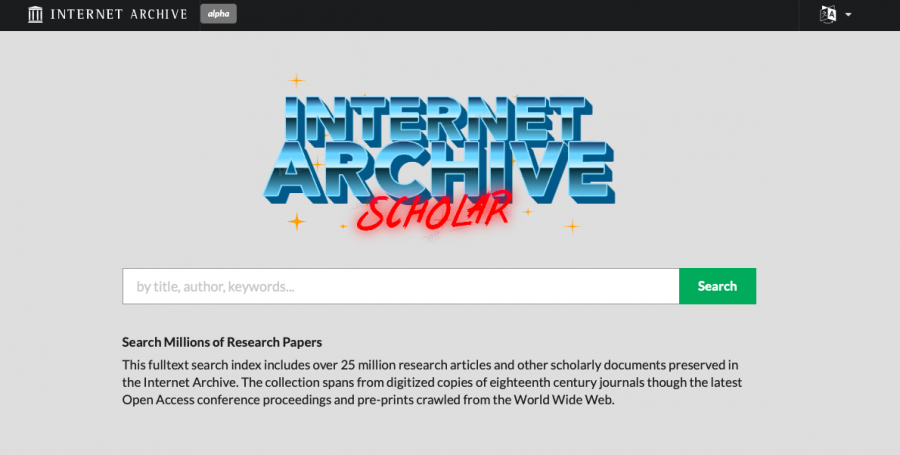
To fill the need, the Internet Archive has created its own scholarly search platform, a “fulltext search index” that includes “over 25 million research articles and other scholarly documents” preserved on its servers. These collections span digitized and original digital articles published from the 18th century to “the latest Open Access conference proceedings and pre-prints crawled from the World Wide Web.” Content in this search index comes in one of three forms:
- public web content in the Wayback Machine web archives (web.archive.org), either identified from historic collecting, crawled specifically to ensure long-term access to scholarly materials, or crawled at the direction of Archive-It partners
- digitized print material from paper and microform collections purchased and scanned by Internet Archive or its partners
- general materials on the archive.org collections, including content from partner organizations, uploads from the general public, and mirrors of other projects
The project is still in “alpha” and “has several bugs,” the site cautions, but it could, when it’s fully up and running, become part of a much-needed revolution in academic research—that is if the major academic publishers don’t find some legal pretext to shut it down.
Academic publishing boasts one of the most rapacious legal business models on the global market, and one of the most exploitative: a double standard in which scholars freely publish and review research for the public benefit (ostensibly) and very often on the public dime; while private intermediaries rake in astronomical sums for themselves with paywalls. The open access model has changed things, but the only way to truly serve the “best interests of researchers and the public,” neuroscientist Shaun Khoo argues, is through public infrastructure and fully non-profit publication.
Maybe Internet Archive Scholar can go some way toward bridging the gap, as a publicly accessible, non-profit search engine, digital catalogue, and library for research that is worth preserving, reading, and building upon even if it doesn’t generate shareholder revenue. For a deeper dive into how the Archive built its formidable, still developing, new database, see the video presentation above from Jefferson Bailey, Director of Web Archiving & Data Services. And have a look at Internet Archive Scholar here. It currently lacks advanced search functions, but plug in any search term and prepare to be amazed by the incredible volume of archived full text articles you turn up.
Related Content:
The Boston Public Library Will Digitize & Put Online 200,000+ Vintage Records
Josh Jones is a writer and musician based in Durham, NC. Follow him at @jdmagness
Read More...Why The Wire is One of the Most Brilliant TV Shows Ever
There were a lot of moments during my first view of The Wire when I realized I wasn’t watching the usual cop procedural. But the one that sticks in my head was when an obviously blitzed and blasted McNulty, the Irish-American detective that you *might* think is the hero of the show, leaves a bar, gets into his car and promptly totals it. In any other show this would have been the turning point for the character, either as a wake-up call, a reason for his boss to throw him off the case, or to gin up some suspense. But no. McNulty walks away from the accident and…it’s never really spoken about. The cops took care of their own.
Life does not follow the contours of a television drama, and neither did David Simon’s groundbreaking HBO series. Beloved characters get killed, or not, or they just transfer out of the show as in life. Nobody really gets what they want. Neither good nor evil wins.
As Simon told an audience at Loyola University, Baltimore in 2007: ““What we were trying to do was take the notion of Greek tragedy, of fated and doomed people, and instead of these Olympian gods, indifferent, venal, selfish, hurling lightning bolts and hitting people in the ass for no reason—instead of those guys whipping it on Oedipus or Achilles, it’s the postmodern institutions … those are the indifferent gods.”
The Wire still feels recent despite premiering in 2002 and in 4:3 ratio, no widescreen HD here. It feels recent because the problems depicted in the show still exist: corruption at all levels of city government and governance, institutionalized racism, failed schools, a collapsing fourth estate, a gutted economy, weakened unions, and a general nihilism and despondency. Simon may not have seen the Black Lives Matter movement coming, but the recipe for it, the warning of it, is there in the show.
So there’s definitely a reason to give it a re-watch to see how we’ve changed. The above essay from 2019 makes the case for The Wire as a subversion of the usual cop show, with Thomas Flight noting it “doesn’t try to grab and keep your attention. It requires it. And if you give it your attention it will reward you.”
It also reminds us of the literary giants in the writers’ room: crime novelists Dennis Lehane, George Pelecanos, and Richard Price were on the team, as was journalist Rafael Alvarez, and William F. Zorzi. That combined with David Simon’s years in journalism covering Baltimore and Ed Burns’ experience on the police force meant the show feels right, and the writers did research and actual Baltimore extras were encouraged to speak up if something didn’t.
If that video essay intrigues you, there’s more in the series, though with many more spoilers, such as this one on Character and Theme.
Not long after The Wire finished its fifth and final season, there were plenty of books published on the show. And now we’re nearly two decades in from its premiere, The Atlantic’s Jemele Hill and The Ringer’s Van Lathan decided to spend quarantine kicking off a podcast where the two black cultural critics give the show a spirited re-watch. Does the show feature too much “copaganda” as my leftist critics now contend? Does it hold up like white liberals (its biggest fans, let’s be honest, despite President Obama’s shout out) think it does? The hosts just wrapped up Season Three, but if you’re ready to start the show again with commentary, here’s their first episode:
Related Content:
President Obama Chats with David Simon About Drugs, The Wire & Omar
Revisiting The Wire During 2020’s Black Lives Matter Movement
“The Wire” @ Harvard
Ted Mills is a freelance writer on the arts who currently hosts the Notes from the Shed podcast and is the producer of KCRW’s Curious Coast. You can also follow him on Twitter at @tedmills, and/or watch his films here.
Read More...Good Movies as Old Books: 100 Films Reimagined as Vintage Book Covers
At one time paperback books were thought of as trash, a term that described their perceived artistic and cultural level, production value, and utter disposability. This changed in the mid-20th century, when certain paperback publishers (Doubleday Anchor, for example, who hired Edward Gorey to design their covers in the 1950s) made a push for respectability. It worked so well that the signature aesthetics they developed still, nearly a lifetime later, pique our interest more readily than those of any other era.
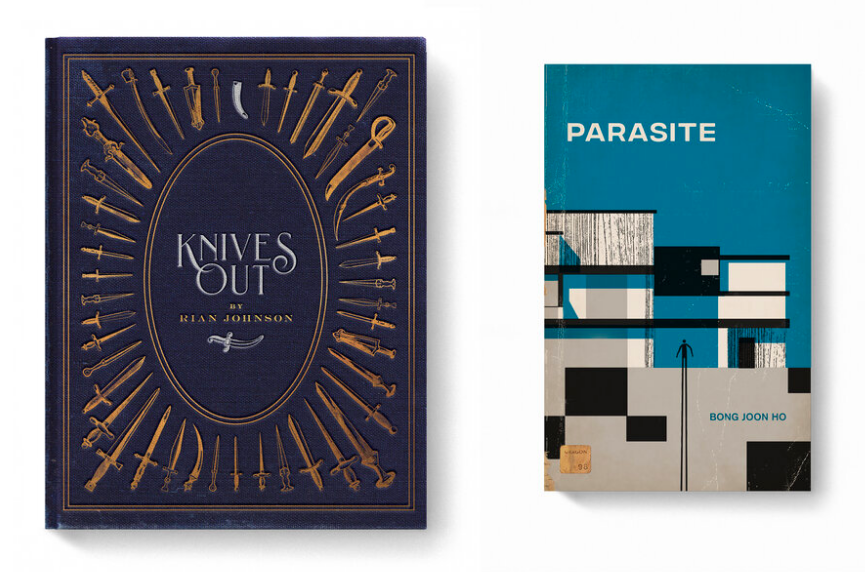
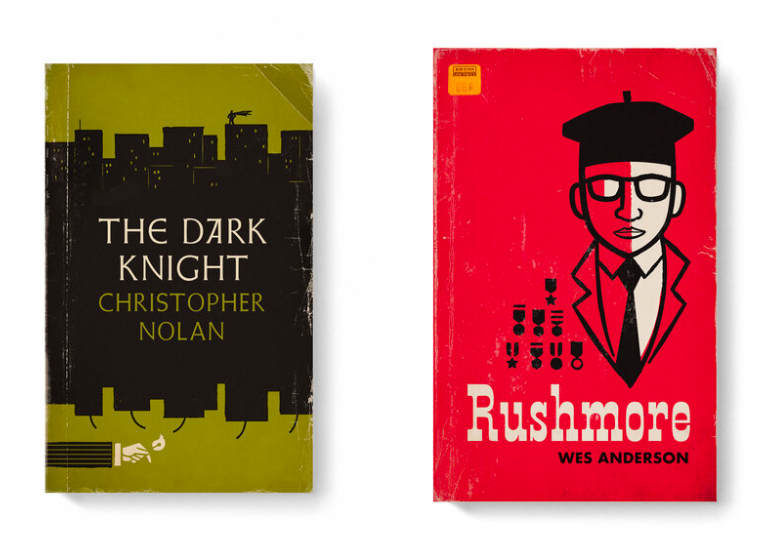
Even today, graphic designers put in the time and effort to master the art of the midcentury paperback cover and transpose it into other cultural realms, as Matt Stevens does in his “Good Movies as Old Books” series. In this “ongoing personal project,” Stevens writes, “I envision some of my favorite films as vintage books. Not a best of list, just movies I love.”
These movies, for the most part, date from more recent times than the mid-20th century. Some, like Jordan Peele’s Us, the Safdie brothers’ Uncut Gems, and Bong Joon-ho’s Parasite, came out just last year. The oldest pictures among them, such as Alfred Hitchcock’s The Birds, date from the early 1960s, when this type of graphic design had reached the peak of its popularity.
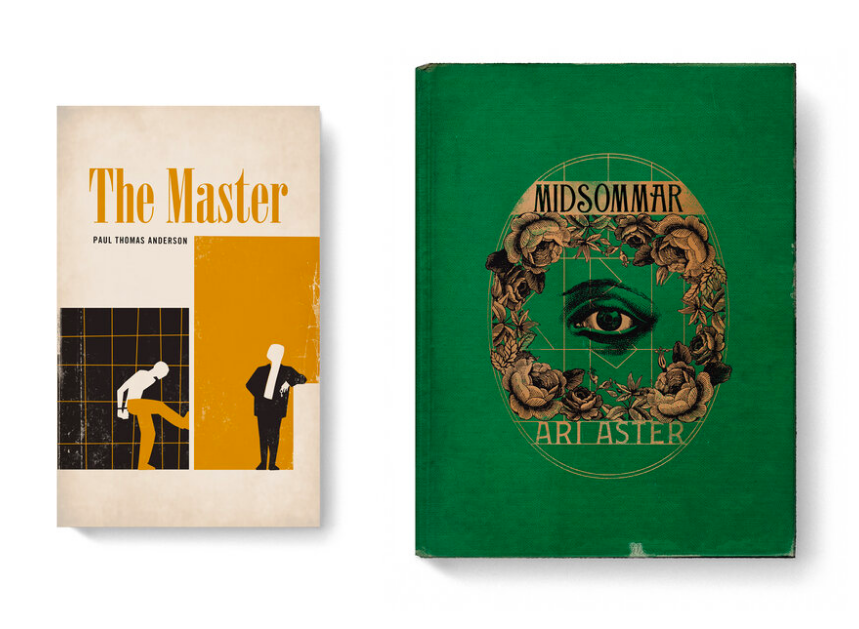
Suitably, Stevens also gives the retro treatment to a few already stylized period pieces like Steven Spielberg’s Raiders of the Lost Ark, Joe Johnston’s The Rocketeer, and Andrew Niccol’s Gattaca, a sci-fi vision of the future itself imbued with the aesthetics of the 1940s. Each and every one of Stevens’ beloved-movies-turned-old-books looks convincing as a work of graphic design from roughly the decade and a half after the Second World War, and some even include realistic creases and price tags. This makes us reflect on the connections certain of these films have to literature, most obviously those, like David Fincher’s Fight Club and Stephen Frears’ High Fidelity, adapted from novels in the first place.
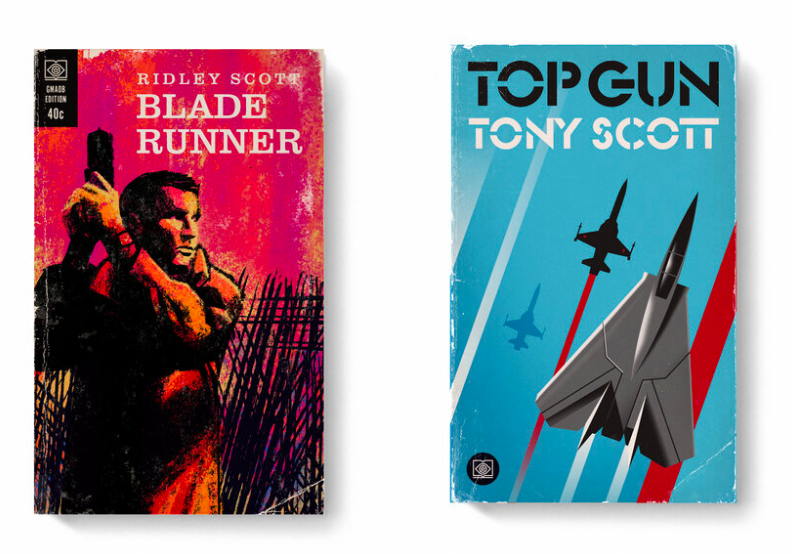
More subtle are Rian Johnson’s recent Knives Out, a thoroughgoing tribute to (if not an adaptation of) the work of Agatha Christie; Ridley Scott’s Blade Runner, which hybridizes a Philip K. Dick novella with pulp detective noir; and Wes Anderson’s Rushmore, a statement of its director’s intent to revive the look and feel of the early 1960s (its books and otherwise) for his own cinematic purposes. Stevens has made these imagined covers available for purchase as prints, but some retro design-inclined, bibliophilic film fans may prefer to own them in 21st-century book form. See all of his adaptations in web format here.
Related Content:
157 Animated Minimalist Mid-Century Book Covers
Vintage Book & Record Covers Brought to Life in a Mesmerizing Animated Video
Based in Seoul, Colin Marshall writes and broadcasts on cities, language, and culture. His projects include the book The Stateless City: a Walk through 21st-Century Los Angeles and the video series The City in Cinema. Follow him on Twitter at @colinmarshall, on Facebook, or on Instagram.
Read More...The Joy of Watching Old, Damaged Things Get Restored: Why the World is Captivated by Restoration Videos
The internet has given us a few new ways to watch things, but many more new things to watch. It’s not just that we now tune in to our favorite shows online rather than on television, but that our “favorite shows” have assumed forms we couldn’t have imagined before. Thirty years ago, if you’d gone to a TV network and pitched a program consisting of nothing but the process of antique restoration — no music, no narration, no story, and certainly no stars — you’d have been told nobody wanted to watch that. In 2020, we know the truth: not only do people want to watch that, but quite a lot of people want to watch that, as evidenced by the enormous view counts of Youtube restoration videos.
At Vice, Mike Dozier profiles the Swiss Youtube restoration channel My Mechanics. Its “videos don’t just appeal to people interested in antique restoration, which they surely do, but many viewers watch because they find the process relaxing.”
Some come for the techniques and stay for the “hypnotic quality — the sounds of clinking metal, the grinding of sandpaper and the whirring of a lathe populate each video. And watching something, like a rusty old coffee grinder, come back to life, shiny and looking brand-new, is uniquely satisfying.” This verges on the newly carved-out territory of “autonomous sensory meridian response,” or ASMR, a genre of video engineered specifically to deliver psychologically pleasing sounds.
In Korea, where I live, ASMR has attained disproportionately massive popularity — though not quite the popularity of mukbang, the style of long-form eating-on-camera video that has gone international in recent years. One theory of the appeal of mukbang holds that it offers vicarious satisfaction to viewers who are dieting, broke, or otherwise unable to consume enormous meals themselves. That may also be true, to a degree, of restoration videos. To bring a 19th-century screwdriver, say, or a World War II military watch back to like-new condition requires not just the right equipment but formidable amounts of knowledge and dexterity as well. Clicking on a Youtube video asks of us much less in the way of time and dedication. And yet, among the billions of views restoration videos have racked up, there are surely fans who have acted on the inspiration and built old-school skills of their own.
In our increasingly digital age — characterized by nothing more acutely than our tendency to spend hours clicking through increasingly specialized Youtube videos — skilled physical work has become an impressive spectacle in itself. As everywhere on the internet, subgenres have produced sub-subgenres: take the vintage toy restoration channel Rescue & Restore or art restorer Julian Baumgartner (who produces both narrated and ASMR version of his videos), both previously featured here on Open Culture. If those don’t absorb you, have a look at Cool Again Restoration, Iron Man Restoration, Hand Tool Rescue, MrRescue (a model-car specialist), Restoration and Metal, Random Hands… and the list goes on, given how much needs restoring in this world.
Related Content:
Watch Battered & Bruised Vintage Toys Get Mesmerizingly Restored to Near Mint Condition
Watch a 17th-Century Portrait Magically Get Restored to Its Brilliant Original Colors
The Art of Restoring a 400-Year-Old Painting: A Five-Minute Primer
The Art of Restoring Classic Films: Criterion Shows You How It Refreshed Two Hitchcock Movies
Based in Seoul, Colin Marshall writes and broadcasts on cities, language, and culture. His projects include the book The Stateless City: a Walk through 21st-Century Los Angeles and the video series The City in Cinema. Follow him on Twitter at @colinmarshall, on Facebook, or on Instagram.
Read More...Monty Python’s Michael Palin Is Also an Art Critic: Watch Him Explore His Favorite Paintings by Andrew Wyeth & Other Artists
Many a parent who caught their kid watching Monty Python’s Flying Circus in the 1970s felt, as one 70s American dad proclaimed, that “it was the singularly dumbest thing ever broadcast on the tube.” Fans of the show know otherwise. The Pythons created some of sharpest satire of conservative authority figures and middle-class mores. But they did it in the broadly silliest of ways. The troupe, who met at Oxford and Cambridge, where they’d been studying for professional careers, decided they preferred to follow in the footsteps of their heroes on The Goon Show. What must their parents have thought?
But the Pythons made good. They grew up to be avuncular authorities themselves, of the kind they might have skewered in their younger days. After several decades of making highly regarded travel documentaries, Michael Palin became president of the Royal Geographical Society, an office one can imagine him occupying in the short-pants uniform of a Bruce. Instead, photographed in academic casual holding a globe, he was dubbed by The Independent as “a man with the world in his hands.”
Unlike fellow accomplished Python John Cleese, who can never resist getting in a joke, Palin has mostly played the straight man in his TV presenter career. He brings to this role an earnestness that endeared viewers for decades. It’s a quality that shines through in his documentaries on art for BBC Scotland, in which he explores the worlds of his favorite painters without a hint of the pretentiousness we would find in a Python caricature. Just above, Palin travels to Maine to learn about the life of Andrew Wyeth and the setting of his most famous work, Christina’s World.
Palin’s passion for art and for travel are of a piece—driven not by ideas about what art or travel should be, but rather by what they were like for him. Palin brings this personal approach to the conversation above with Caroline Campbell, Head of Curatorial at the British National Gallery. Here, he discusses “ten paintings which I cannot avoid when I’m going in the gallery. They always catch my eye, and each one means something to me.” Artists included in his “rather esoteric” collection include the late-Medieval/early-Renaissance pioneer Duccio, Hans Holbein the Younger, William Hogarth, and Joseph Mallord William Turner.
While these may be familiar names to any art lover, the works Palin chooses from each artist may not be. His thoughtful, perceptive responses to these works are not those of the professional critic or of the professional comedian. They are the responses of a frequent traveler who notices something new on every trip.
Related Content:
New Animated Film Tells the Life Story of Monty Python’s Graham Chapman
Josh Jones is a writer and musician based in Durham, NC. Follow him at @jdmagness
Read More...Support Us
We're hoping to rely on loyal readers, rather than erratic ads. Please click the Donate button and support Open Culture. You can use Paypal, Venmo, Patreon, even Crypto! We thank you!

About Us

Open Culture scours the web for the best educational media. We find the free courses and audio books you need, the language lessons & educational videos you want, and plenty of enlightenment in between.
Advertise With Us

FREE UPDATES!
GET OUR DAILY EMAIL
Get the best cultural and educational resources on the web curated for you in a daily email. We never spam. Unsubscribe at any time.
FOLLOW ON SOCIAL MEDIA

Open Culture editor Dan Colman scours the web for the best educational media. He finds the free courses and audio books you need, the language lessons & movies you want, and plenty of enlightenment in between.
Advertise With Us

