How Venice Works: 124 Islands, 183 Canals & 438 Bridges
3,000,000 tourists move through Venice each year. But when the tourists leave the city, 60,000 year-round residents stay behind, continuing their daily lives, which requires navigating an archipelago made up of 124 islands, 183 canals and 438 bridges. How this complicated city works – how the buildings are defended from water, how the buildings stand on unsteady ground, how the Venetians navigate this maze of a city – is a pretty fascinating story. These techniques have been worked out over Venice’s 1500 year history, and now they’re explored in a captivating 17 minute video produced by a Venetian government agency. You can learn more about the inner life of this great city at Venice Backstage.
If you would like to support the mission of Open Culture, consider making a donation to our site. It’s hard to rely 100% on ads, and your contributions will help us continue providing the best free cultural and educational materials to learners everywhere. You can contribute through PayPal, Patreon, and Venmo (@openculture). Thanks!
Related Content:
Watch City Out of Time, A Short Tribute to Venice, Narrated by William Shatner in 1959
Read More...Nick Cave Creates a List of His 10 Favorite Songs–His Favorite “Hiding Songs”
For all of the indispensable purposes music has served over thousands of years of human history, at no time before the age of mass produced recorded music was it ever a collectible commodity—something we could own, believing it was made just for us, even when it reached millions of other people. Music has, of course, continued to play a significant communal role, and in some ways maybe even a stronger one in the age of global mass media.
Yet the experience of listening to music has also become, over the course of the past century, an unprecedentedly private affair. Whether you grew up with LPs, tapes, CDs, or streaming digital, you know what it’s like to have a collection of songs that seem like they were written just for you, summing up your life in some uncanny way: songs that feel like emotional refuges, welcoming some displaced part of yourself.
These are songs Nick Cave calls “hiding songs,” and the leader the Bad Seeds and, formerly, The Birthday Party and Grinderman, has written his share for many of his fans; many of the same fans who write him with deep personal questions, hoping to connect. On his blog The Red Hand Files, Cave posts the letters that most move him and offers candid responses generously threading the conversation through his songwriting and musical influences.
In a post from January, when asked to create a list of his “favourite pieces of music,” Cave revealed ten of his own “hiding songs,” but not before explaining them with a quote from his poem, “The Sick Bag Song.”
Leonard Cohen will sing, and the boy will suddenly breathe as if for the first time, and fall inside the laughing man’s voice and hide.
He will realise that not only are these songs sacred, they are ‘hiding songs’ that deal exclusively in darkness, obfuscation, concealment and secrecy. He will realise that for him the purpose of these songs was to shut off the sun, to draw a long shadow down and protect him from the corrosive glare of the world.
Cohen, unsurprisingly, tops the list. Cave may be an old-fashioned songwriter—preserving some of the best impulses of his literary heroes—but he is also an adept hand at the list, a shorthand form that buries its emotions in parenthetical commentary. When it comes to hiding songs, songs about “concealment and secrecy,” maybe there isn’t much more to say.
Maybe we’d like juicy personal details. What was going on in Cave’s life when Karen Dalton’s “Katie Cruel” gave him a place to hide? What about Neil Young’s downbeat “On the Beach” or Nina Simone’s aching “Plain Gold Ring” (hear him cover it live at the top) or Big Star’s incredibly depressing “Holocaust”? We may never know, and we may never need to. Surely we each have such a list of songs that speak to us alone, of feelings only we can understand.
For an artist like Cave, however, the private experience of recorded music has a very public dimension. The songs he lists, he writes, “are the essential pillars that hold up the structure of my artistic world.” The only question left may be, what songs were all these artists hiding in when they wrote the songs below? Hear all of Cave’s “hiding songs,” with a bonus eleventh, “Mother of Earth,” his favorite Gun Club song, by fan request.
Avalanche, Leonard Cohen
Katie Cruel, Karen Dalton
On the Beach, Neil Young
Tupelo, John Lee Hooker
T.B. Sheets, Van Morrison
It’s All Over Now, Baby Blue, Bob Dylan
Plain Gold Ring, Nina Simone
Holocaust, Big Star
Becalmed, Brian Eno
One Fine Morning, Bill Callahan
Mother of Earth, The Gun Club
Related Content:
Nick Cave Creates a List of His Top 10 Love Songs
Listen to Nick Cave’s Lecture on the Art of Writing Sublime Love Songs (1999)
Josh Jones is a writer and musician based in Durham, NC. Follow him at @jdmagness
Read More...See the Oldest Printed Advertisement in English: An Ad for a Book from 1476
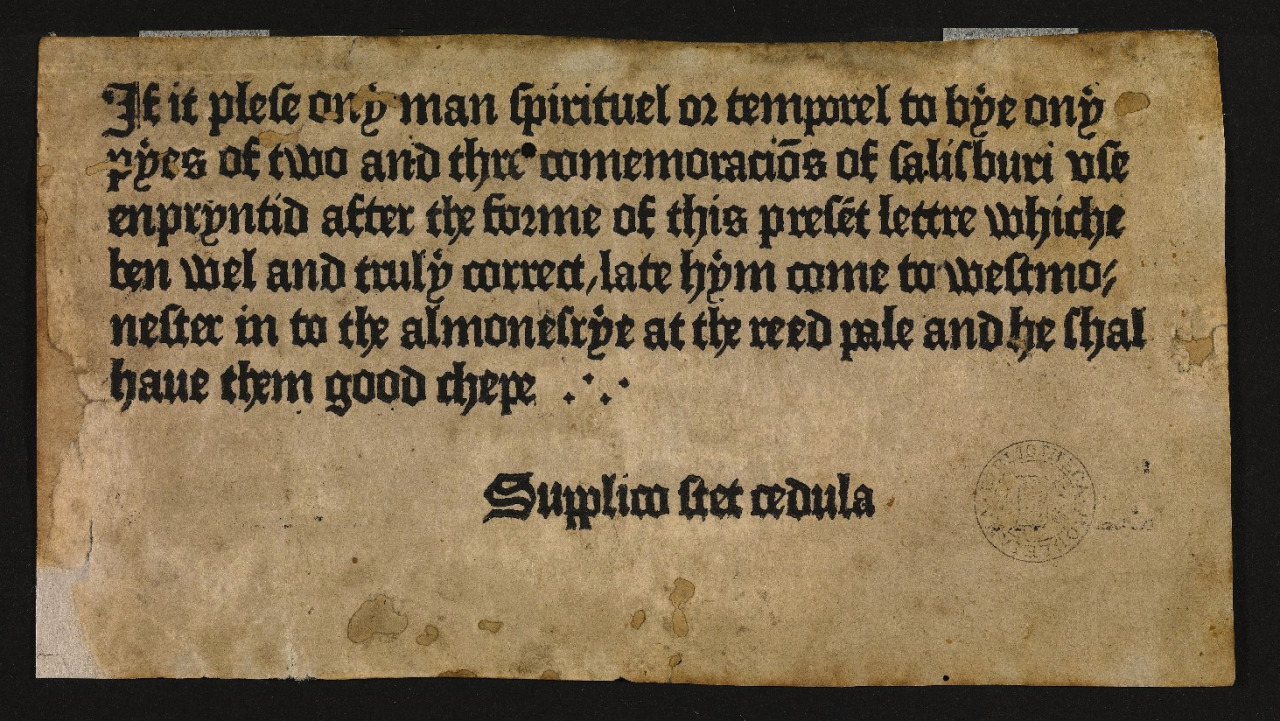
Nobody pays much mind to advertising, at least the haphazard kind of advertising that clutters the space around us. But here in the 21st century, when both that space and the ads that appear throughout it are as likely to be digital as physical, we might take a moment to look back at how the practice of putting up notices to sell things began. In the English language, it goes back to at least to the mid-fifteenth century — specifically, to the year 1476, when Britain’s first printer William Caxton produced not just a manual for priests called Sarum Pie (or the Ordinale ad usum Sarum), but easily postable, playing card-sized advertisements for the book as well.
“This piece of paper, of which two copies survive, is regarded as the earliest surviving printed advertisement in the English language,” writes Erik Kwakkel at medievalbooks. It states that Sarum Pie “is printed in the same letter type as the advertisement (‘enpryntid after the forme of this present lettre,’ line 3). Even without having seen the new book, its key feature, the type, can thus already be assessed.” This pioneering advertisement also “reassures potential clients that the text of the handbook is ‘truly correct’ (line 4) and that it can be acquired cheaply (‘he shal have them good chepe,’ lines 5–6). Both features will have been welcomed by priests, the target audience, who needed their textual tools to be flawless and did not have much money to spend on them.”
Kwakkel also gets into other notable features of this deceptively simple-looking production, including “the precise location of Caxton’s shop,” a warning in Latin urging readers not to remove the notice (“showing that it was put on display somewhere,” perhaps a church porch), and even the type. In both the advertisement and Sarum Pie itself, “the letter shapes lack ‘sharpness:’ frequently ‘blobs’ and small hairlines appear as letters, while an individual letter usually has a variety of appearances when looked at in detail,” possibly an attempt by the printer to create “a more ‘genuine’ – i.e. traditional, ‘manuscript’ – look.”
It would have been important back then to make printed books look hand-copied, since not so long before, all books were hand-copied by definition. With the first Gutenberg Bible still less than half a century old, early printers had to make sure their relatively inexpensive books didn’t look like low-quality substitutes for the “real thing”; hence the assurances about both the type and the price in the text of Caxton’s advertisement. That the origin of advertising turns out to be closely connected with religion may come as a surprise — though given the fact that the print revolution itself began with a Bible, a product that in either physical or digital form now practically sells itself, it may not be that big a surprise.
If you would like to support the mission of Open Culture, consider making a donation to our site. It’s hard to rely 100% on ads, and your contributions will help us continue providing the best free cultural and educational materials to learners everywhere. You can contribute through PayPal, Patreon, and Venmo (@openculture). Thanks!
via medievalbooks
Related Content:
Oxford University Presents the 550-Year-Old Gutenberg Bible in Spectacular, High-Res Detail
One of World’s Oldest Books Printed in Multi-Color Now Opened & Digitized for the First Time
Watch the First Commercial Ever Shown on American TV, 1941
Sell & Spin: The History of Advertising, Narrated by Dick Cavett (1999)
Based in Seoul, Colin Marshall writes and broadcasts on cities, language, and culture. His projects include the book The Stateless City: a Walk through 21st-Century Los Angeles and the video series The City in Cinema. Follow him on Twitter at @colinmarshall or on Facebook.
Read More...Nick Cave Creates a List of His Top 10 Love Songs
This wall I built around you
Is made out of stone-lies
O little girl the truth would be
An axe in thee—Nick Cave, “Say Goodbye to the Little Girl Tree”
Nick Cave has been many things in his long, fascinating career—lewd punk-country crooner for the assaultive Birthday Party, prophetic troubadour and Biblical balladeer, founder of the gritty, sleazy Grinderman, novelist and poet of the darker realms of human experience. He has been many things, but sentimental has rarely been one of them, though he can be quite tender and vulnerable. These qualities stand as some of the many reasons I trust Cave to make a list of love songs worth a damn. Not only has he written some of the finest tunes about heartbreak, betrayal, regret, and desire but he has done so with an attitude of reverence for influences like Leonard Cohen and Nina Simone, artists with their own complicated relationships with love.
Earlier this year, Cave revealed to readers of his blog The Red Hand Files a selection of his “hiding songs”—music that “I can pull over myself,” he wrote, “like a child might pull the bed covers over their head, when the blaze of the world becomes too intense.”
The list includes Dylan’s “It’s All Over Now, Baby Blue,” and Simone’s heartbreakingly somber “Plain Gold Ring.” When Cave is hiding, it ain’t in a happy place, but then sad songs usually give us the greatest comfort. Maybe they also offer the best way we have to understand love, “this strange, inscrutable feeling that tears away at us, all our lives,” Cave writes in answer to two of his fans from Australia and Brazil. He leaves them, and us, his list of top ten love songs below.
01. “To Love Somebody” – Bee Gees
02. “My Father” – Nina Simone
03. “I Threw It All Away” – Bob Dylan
04. “Comfort You” – Van Morrison
05. “Angel of the Morning” – Merrilee Rush & The Turnabouts
06. “Nights in White Satin” – The Moody Blues
07. “Where’s the Playground Susie?” – Glen Campbell
08. “Something on Your Mind” – Karen Dalton
09. “Always on My Mind” – Elvis Presley
10. “Superstar” – Carpenters
“Maybe some songs are the embodiment of love itself and that’s why they move us so deeply.” No one needs to tell us: love is never easy, and hardly ever just a feeling of euphoria. Like every emotion and experience, it has its melancholy shadows, and the best love songs capture this in their lyrics, chord progressions, etc. The ten love songs Cave chose—“simple, plainspoken, incendiary devices that bomb the heart to pieces”—are all classics from the sixties and seventies, decades he draws from liberally in his “hiding songs” playlist.
He favors artists with big personalities, country and folk leanings, and oftentimes a more commercial sound than his own. Nonetheless, those familiar with his music will hear the influence of Elvis, Van Morrison, and maybe even the Bee Gees on his work with the Bad Seeds. He has a new album coming, the follow-up to 2016’s harrowing Skeleton Tree. While we wait to hear what his wife calls “his Fever Songs,” listen to his top ten love songs here.
via Brooklyn Vegan
Related Content:
Listen to Nick Cave’s Lecture on the Art of Writing Sublime Love Songs (1999)
Josh Jones is a writer and musician based in Durham, NC. Follow him at @jdmagness
Read More...When the Nazis Declared War on Expressionist Art (1937)
The 1937 Nazi Degenerate Art Exhibition displayed the art of Paul Klee, Wassily Kandinsky, Georg Grosz, and many more internationally famous modernists with maximum prejudice. Ripped from the walls of German museums, the 740 paintings and sculptures were thrown together in disarray and surrounded by derogatory graffiti and hell-house effects. Right down the street was the respectable Great German Art Exhibition, designed as counterprogramming “to show the works that Hitler approved of—depicting statuesque blonde nudes along with idealized soldiers and landscapes,” writes Lucy Burns at the BBC.
Viewers were supposed to sneer and recoil at the modern art, and most did, but whether they were gawkers, Nazi sympathizers, or art fans in mourning, the exhibit drew massive crowds. Over a million people first attended, three times more than saw the exhibition of state-sanctioned art—or more specifically, art sanctioned by Hitler the failed artist, who had endured watching “the realistic paintings of buildings and landscapes,” of sturdy peasants and suffering poets, “dismissed by the art establishment in favour of abstract and modern styles.” The Degenerate Art Exhibition “was his moment to get his revenge,” and he had it. Over a hundred artists were denounced as Bolsheviks and Jews bent on corrupting German purity.
Afterwards, thousands of works of art were destroyed or disappeared, as did many of their creators. Many artists fled, many could not. Enraged by the eclipse of sentimental academic styles and by his own ignorance, Hitler railed against “works of art which cannot be understood in themselves,” as he put it in a speech that summer. These “will never again find their way to the German people.” Many such quotations surrounded the offending art. The 1993 documentary above, written, produced, and directed by David Grubin, tells the story of the exhibition, which has in time proven Hitler’s greatest culture war folly. It accomplished its immediate purpose, but as Jonathan Petropoulos, professor of European History at Claremont McKenna College points out, “this artwork became more attractive abroad…. I think that over the longer run it was good for modern art to be viewed as something that the Nazis detested and hated.”
Not every anti-Nazi critic saw modern art as subverting fascism. Ten years after the Degenerate Art Exhibition, philosopher Theodor Adorno, himself a refugee from Nazism, called Expressionism “a naïve aspect of liberal trustfulness,” on a continuum between fascist tools like Futurism and “the ideology of the cinema.” Nonetheless, it was Hitler who most bore out Adorno’s general observation: “Taste is the most accurate seismograph of historical experience…. Reacting against itself, it recognizes its own lack of taste.” The hysterical performance of disgust surrounding so-called “degenerate art” turned the exhibit into a sensation, a blockbuster that, if it did not prove the virtues of modernism, showed many around the world that the Nazis were as crude, dim, and vicious as they alleged their supposed enemies to be.
In the documentary, you’ll see actual footage of the theatrical exhibition, juxtaposed with film of a 1992 Berlin exhibition of much of that formerly degenerate art. Restaged Degenerate Art Exhibitions have become very popular in the art word, bringing together artists who need no further exposure, in order to historically reenact, in some fashion, the experience of seeing them all together for the first time. From a recent historical review at New York’s Neue Gallerie to the digital exhibit at MoMA.org, degenerate art retrospectives show, as Adorno wrote, that indeed “taste is the most accurate seismograph of historical experience.”
The original exhibition “went on tour all over Germany,” writes Burns, “where it was seen by a million more people.” Thousands of ordinary Germans who went to jeer at it were exposed to modern art for the first time. Millions more people have learned the names and styles of these artists by learning about the history of Nazism and its cult of pettiness and personal revenge. Learn much more in the excellent documentary above and at our previous post on the Degenerate Art Exhibition.
Degenerate Art — 1993, The Nazis vs. Expressionism will be added to our list of Free Documentaries, a subset of our collection, 4,000+ Free Movies Online: Great Classics, Indies, Noir, Westerns, Documentaries & More
Related Content:
The Nazi’s Philistine Grudge Against Abstract Art and The “Degenerate Art Exhibition” of 1937
Josh Jones is a writer and musician based in Durham, NC. Follow him at @jdmagness
Read More...What Does “Machiavellian” Really Mean?: An Animated Lesson
The word Machiavellian has come to invariably refer to an “unscrupulous schemer for whom the ends justify the means,” notes the animated TED-Ed video above, a description of characters “we love to hate” in fiction past and present. The adjective has even become enshrined in psychological literature as one third of the “dark triad” that also features narcissism and psychopathy, personalities often mistaken for the Machiavellian type.
The term’s “lasting notoriety comes from a brief political essay known as The Prince,” written by Renaissance Italian writer and diplomat Niccolò Machiavelli and “framed as advice to current and future monarchs.” The Prince and its author have acquired such a fearsome reputation that they seem to stand alone, like the work of the Marquis de Sade and Leopold von Sacher-Masoch, who likewise lent their names to the psychology of power. But Machiavelli’s book is part of “an entire tradition of works known as ‘mirrors for princes’ going back to antiquity.”
Machiavelli innovated on the tradition by casting fuzzy abstractions like justice and virtuousness aside to focus solely on virtù, the classical Italian word derived from the Latin virtus (manhood), which had little to do with ethics and everything to do with strength, bravery, and other warlike traits. Though thinkers in the tradition of Aristotle argued for centuries that civic and moral virtue may be synonymous, for Machiavelli they most certainly were not, it seems. “Throughout [The Prince] Machiavelli appears entirely unconcerned with morality except insofar as it’s helpful or harmful to maintaining power.”
The work became infamous after its author’s death. Catholics and Protestants both blamed Machiavelli for the others’ excesses during the bloody European religious wars. Shakespeare coined Machiavel “to denote an amoral opportunist.” The line to contemporary usage is more or less direct. But is The Prince really “a manual for tyranny”? The book, after all, recommends committing atrocities of all kinds, oppressing minorities, and generally terrifying the populace as a means of quelling dissent. Keeping up the appearance of benevolence might smooth things over, Machiavelli advises, unless it doesn’t. Then the ruler must do whatever it takes. The guiding principle here is that “it is much safer to be feared than loved.”
Was Machiavelli an “unsentimental realist”? A Renaissance Kissinger, so to speak, who saw the greater good in political hegemony no matter what the cost? Or was he a neo-classical philosopher hearkening back to antiquity? He “never seems to have considered himself a philosopher,” writes the Stanford Encyclopedia of Philosophy—“indeed, he often overtly rejected philosophical inquiry as beside the point.” Or at least he seemed to have rejected the Christian-influenced humanism of his day. Nonetheless, “Machiavelli deserves a place at the table in any comprehensive survey of philosophy,” not least because “philosophers of the first rank did (and do) feel compelled to engage with his ideas.”
Of the many who engaged with Machiavelli, Isaiah Berlin saw him as reclaiming ancient Greek values of the state over the individual. But there’s more to the story, and it includes Machiavelli’s political biography as a defender of republican government and a political prisoner of those who overthrew it. On one reading, The Prince becomes a “scathing description” of how power actually operates behind its various masks; a guide not for princes but for ordinary citizens to grasp the ruler’s actions for what they are truly designed to do: maintain power, purely for its own sake, by any means necessary.
Related Content:
Salman Rushdie: Machiavelli’s Bad Rap
What “Orwellian” Really Means: An Animated Lesson About the Use & Abuse of the Term
Josh Jones is a writer and musician based in Durham, NC. Follow him at @jdmagness
Read More...The Fantastical Sketchbook of a Medieval Inventor: See Designs for Flamethrowers, Mechanical Camels & More (Circa 1415)
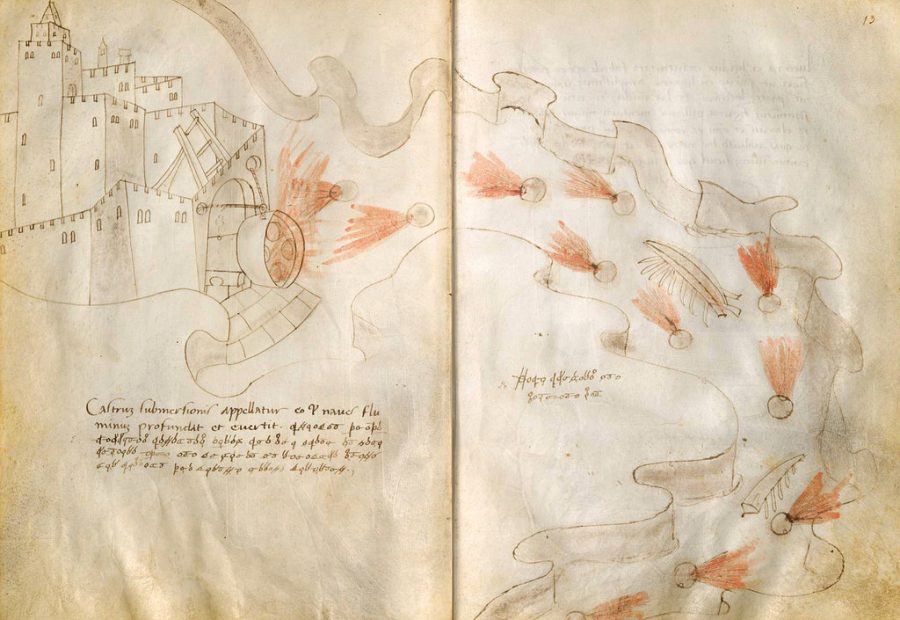
History remembers, and will likely never forget, the name of Renaissance Italian inventor Leonardo da Vinci. But what about the name of Renaissance Italian inventor Johannes de Fontana? Though he came along a couple of generations before Leonardo, Johannes de Fontana, also known as Giovanni Fontana, seems to have had no less fertile an imagination. Where Leonardo came up with everything from musical instruments to hydraulic pumps to war machines to self-supporting bridges, Fontana’s inventions include “fire-breathing automatons, pulley-powered angels, and the earliest surviving drawing of a magic lantern device.”
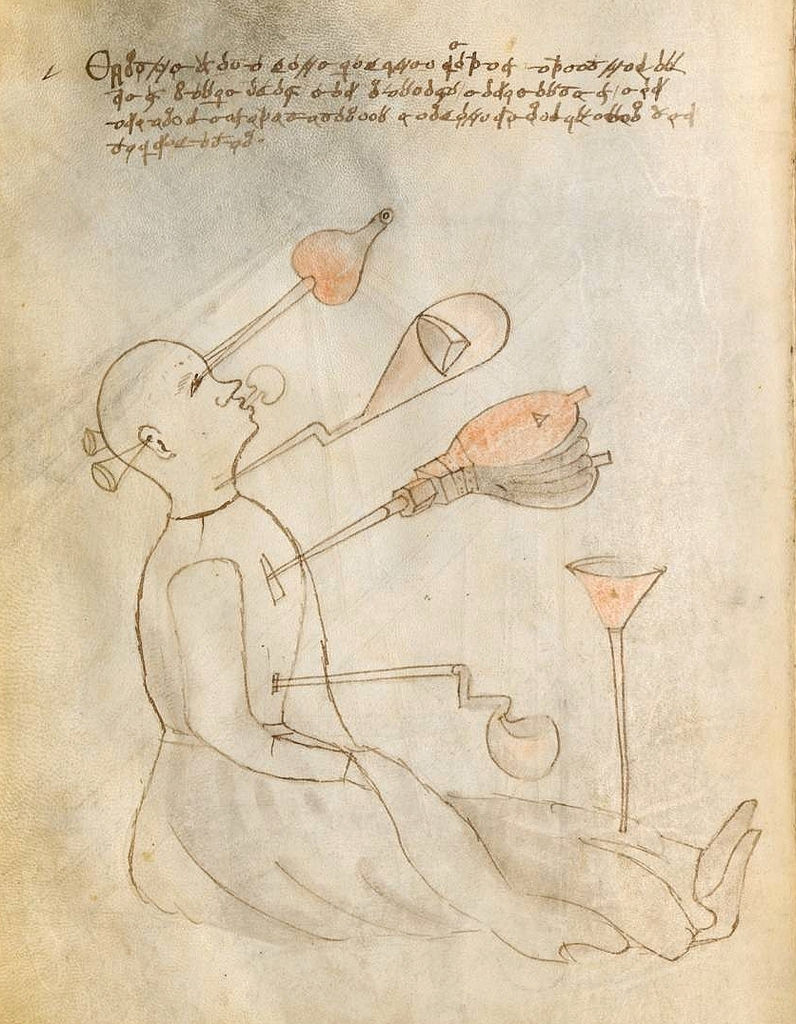
Those words come from Portland State University’s Bennett Gilbert, who takes a dive into Fontana’s notebook of “designs for a variety of fantastic and often impossible inventions” at the Public Domain Review.
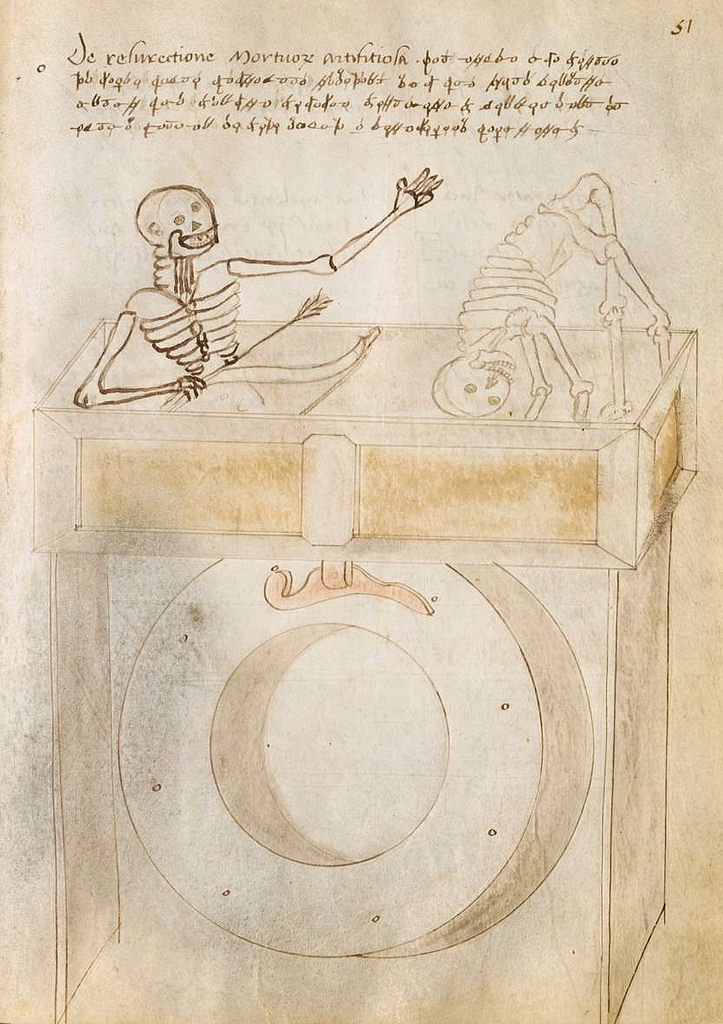
Filled some time between the years 1415 and 1420, its 68 drawings meant to entice potential patrons include plans for “mechanical camels for entertaining children, mysterious locks to guard treasure, flame-throwing contraptions to terrorize the defenders of besieged cities, huge fountains, musical instruments, actors’ masks, and many other wonders.”
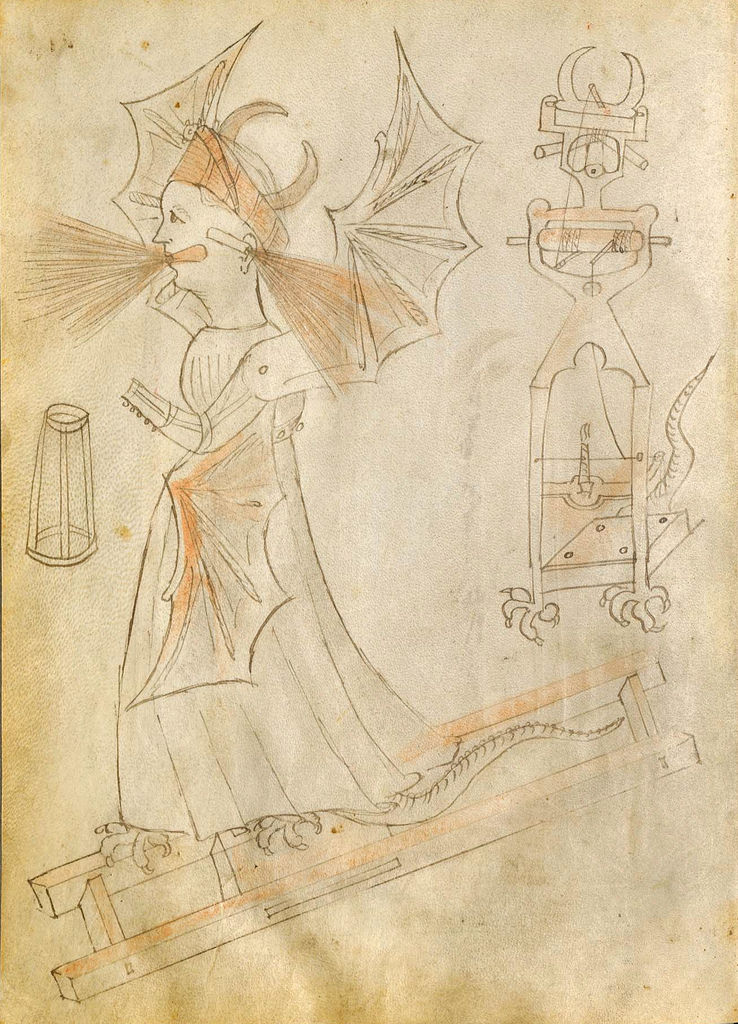
It would seem that Fontana lacked the sense of practicality possessed by his successor Leonardo — and Leonardo dreamed up not just a variety of flying machines but a mechanical knight. That may have to do with the era in which Fontana lived, “more than two hundred years before the discoveries of Newton,” a time “of transition from medieval knowledge of the world to that of the Renaissance, which many now regard as the origin of early modern science.” And so his designs, many of them liberally decorated with unearthly-looking creatures and bursts of flame, strike us today as at most half plausible and at least half fantastical.
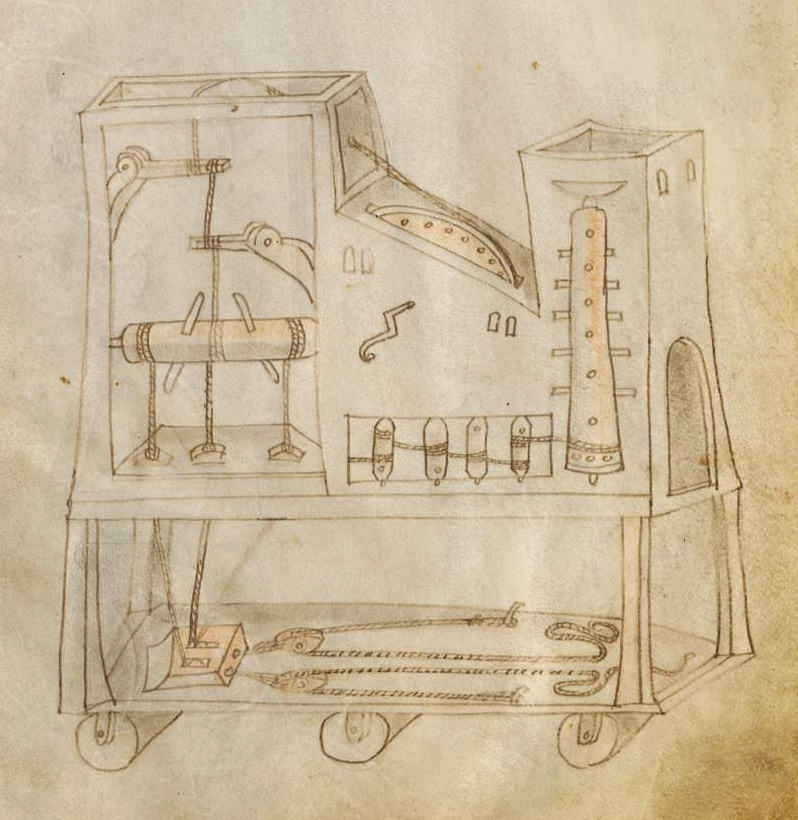
Fontana’s drawing style, too, reflects the state of human knowledge in the early fifteenth century: “The towers and rockets, water and fire, nozzles and pipes, pulleys and ropes, gears and grapples, wheels and beams, and grids and spheres that were an engineer’s occupation at the dawn of the Renaissance fill Fontana’s sketchbook. His way of illustrating his ideas, however, is distinctly medieval, lacking perspective and using a limited array of angles for displaying machine works.” Yet this makes Fontana’s notebook all the more fascinating to 21st-century eyes, and throws into contrast some of his more plausible inventions, such as “a magic lantern device, which transformed the light of fire into emotive display.”
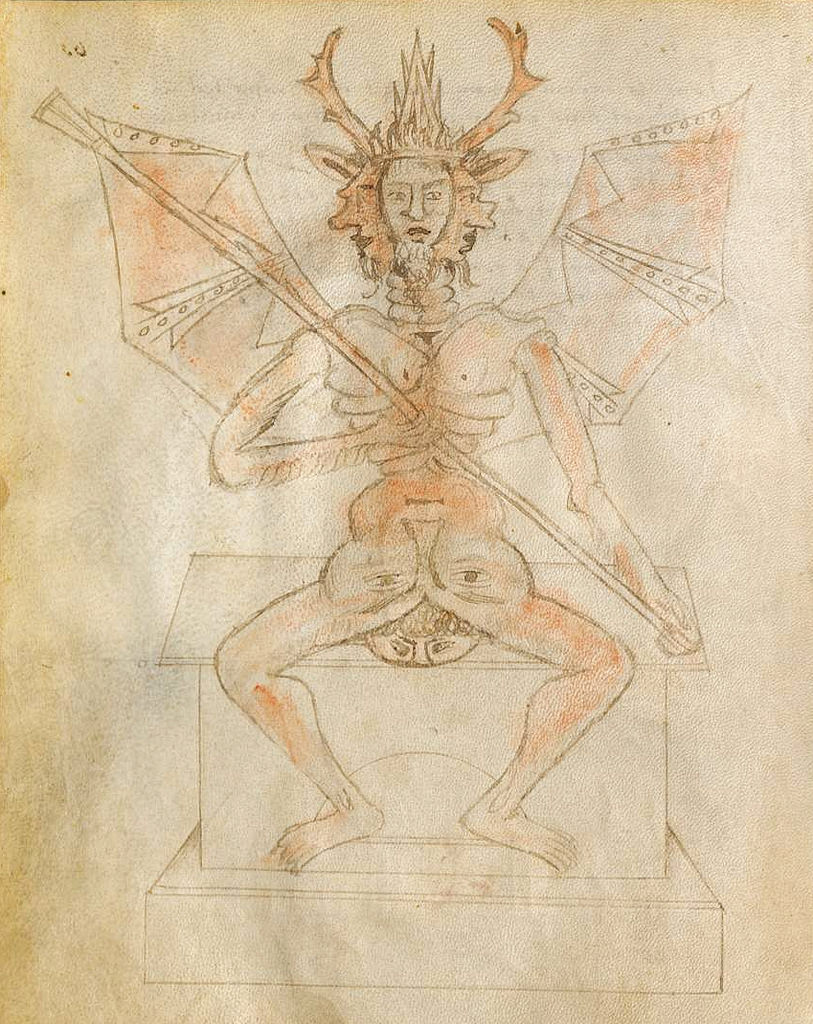
Will some bold scholar of the early Renaissance one day argue that Fontana invented motion pictures? But perhaps the man who designed “an awe-inspiring fire-illuminated spectacle, most likely serving as a propaganda machine, for use in war and in peace” wouldn’t approve of a medium quite so ordinary. We might say that the most valuable legacy of Johannes de Fontana, more so than any of his inventions themselves, is the glimpse his notebook gives us into the the human imagination in his day, when fact and fantasy intermingled as they will never do again. And in the case of some technologies, we should probably feel relieved that they won’t: Fontana’s “life support system for patients undergoing gruesome surgeries” may be fascinating, but I can’t say I’d be eager to make use of it myself.
See his manuscript online here.
Related Content:
Leonardo da Vinci’s Visionary Notebooks Now Online: Browse 570 Digitized Pages
Leonardo da Vinci Draws Designs of Future War Machines: Tanks, Machine Guns & More
Buckminster Fuller Creates Striking Posters of His Own Inventions
Mark Twain’s Patented Inventions for Bra Straps and Other Everyday Items
The 10 Commandments of Chindōgu, the Japanese Art of Creating Unusually Useless Inventions
Based in Seoul, Colin Marshall writes and broadcasts on cities, language, and culture. His projects include the book The Stateless City: a Walk through 21st-Century Los Angeles and the video series The City in Cinema. Follow him on Twitter at @colinmarshall or on Facebook.
Read More...An Animated History of Dogs, Inspired by Keith Haring
That quivering teacup Chihuahua…
The long-suffering Labrador whose child-friendly reputation has led to a lifetime of ear tugging and tail pulling…
The wheezing French bulldog, whose owner has outfitted with a full wardrobe of hoodies, tutus, rain slickers, and pajamas…
All descended from wolves.
As anthropologist and science educator David Ian Howe explains in the animated TED-Ed lesson, A Brief History of Dogs, above, at first glance, canis lupus seemed an unlikely choice for man’s best friend.
For one thing, the two were in direct competition for elk, reindeer, bison, and other tasty prey wandering Eurasia during the Pleistocene Epoch.
Though both hunted in groups, running their prey to the point of exhaustion, only one roasted their kills, creating tantalizing aromas that drew bolder wolves ever-closer to the human camps.
The ones who willingly dialed down their wolfishness, making themselves useful as companions, security guards and hunting buddies, were rewarded come suppertime. Eventually, this mutually beneficial tail wagging became full on domestication, the first such animal to come under the human yoke.
The intense focus on purebreds didn’t really become a thing until the Victorians began hosting dog shows. The push to identify and promote breed-specific characteristics often came at a cost to the animals’ wellbeing, as Neil Pemberton and Michael Worboys point out in BBC History Magazine:
…the improvement of breeds towards ‘perfection’ was controversial. While there was approval for the greater regularity of type, many fanciers complained that standards were being set on arbitrary, largely aesthetic grounds by enthusiasts in specialist clubs, without concern for utility or the health of the animal. This meant that breeds were changing, and not always for the better. For example, the modern St Bernard was said to be a beautiful animal, but would be useless in Alpine rescue work.
Cat-fanciers, rest assured that the opposition received fair and equal coverage in a feline-centric TED-Ed lesson, published earlier this year.
And while we applaud TED-Ed for sparking our curiosity with its “Brief History of” series, covering topics as far ranging as cheese, numerical systems, goths, video games, and tea, surely we are not the only ones wondering why the late artist Keith Haring isn’t thanked or name checked in the credits?
Every canine-shaped image in this animation is clearly descended from his iconic barking dog.
While we can’t explain the omission, we can direct readers toward Jon Nelson’s great analysis of Haring’s relationship with dogs in Get Leashed:
They’re symbolic of unanswered questions, prevalent in the 80s: “Can I do this?” “Is this right?” “What are you doing?” “What is happening?” Dogs stand by people, barking or dancing along, sometimes in precarious scenarios, even involved in some of Haring’s explicitly sexual work. Dogs are neither approving nor disapproving of what people do in the images; their mouth angle is neutral or even happy. In some cases, human bodies wear a dog’s head, possibly stating that we know only our own enjoyment, unaware, like a dog, of life’s next stage or the consequences of our actions.
Visit Ethnocynology, David Ian Howe’s Instagram page about the ancient relationship between humans and dogs.
Related Content:
Photos of Famous Writers (and Rockers) with their Dogs
Ayun Halliday is an author, illustrator, theater maker and Chief Primatologist of the East Village Inky zine. Join her in New York City April 15 for the next installment of her book-based variety show, Necromancers of the Public Domain. Follow her @AyunHalliday.
Read More...Noam Chomsky Makes His First Power Point Presentation
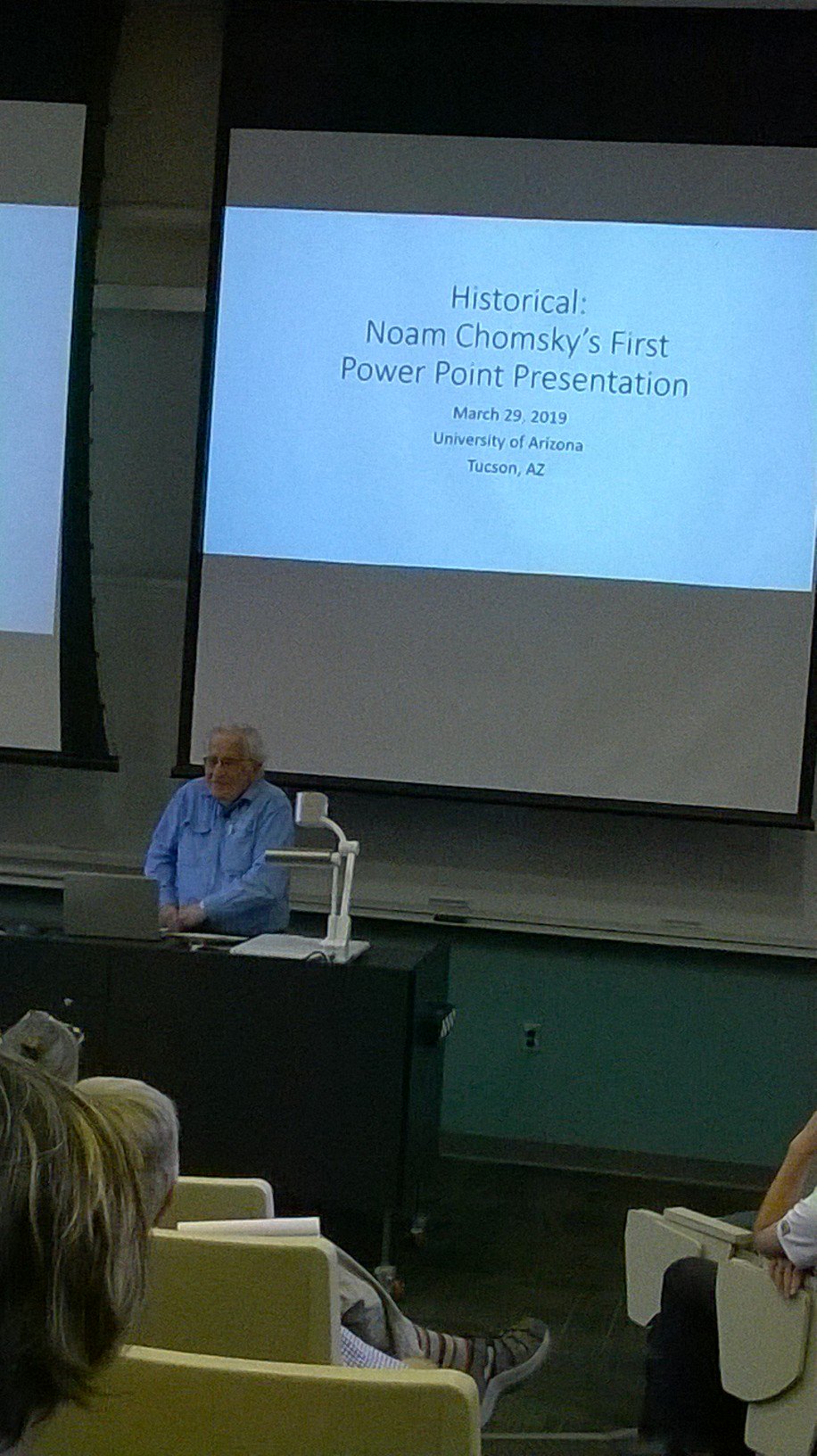
90 years old, and still going strong…
Related Content:
The Ideas of Noam Chomsky: An Introduction to His Theories on Language & Knowledge (1977)
Noam Chomsky Defines What It Means to Be a Truly Educated Person
Read More...See Classic Performances of Joni Mitchell from the Very Early Years–Before She Was Even Named Joni Mitchell (1965/66)
A photograph of two old friends—Joni Mitchell and David Hockney—holding hands at Hockney’s L.A. solo exhibition took over the internet for a moment, for sentimental reasons Guy Trebay laid out in The New York Times. These include the fact that “Ms. Mitchell has seldom been seen in public since she says she was given a diagnosis of Morgellons disease, and suffered a brain aneurysm in 2015,” and “despite the presence of the cane she uses since having learned again to walk, Ms. Mitchell appears radiant and robust.”
Trebay does not include another reason that comes to mind: the two elderly artists, in their sweaters and adorable matching snap-brim hats, look like regular old folks on the way to a weekly chess match in the park. It’s a humanizing portrait of two giants of the art and music world, two people who, despite their wealth and fame, seem imminently down-to-earth and approachable; a warm and cheerful image, says Irish poet Sean Hewitt, who first shared it on Twitter, of “two successful people enjoying their old age.”
Doesn’t everyone especially want that for Joni Mitchell? Of all the beloved septuagenarian stars on the public’s radar these days, Mitchell garners more well-wishes than anyone—rallying generations of stars and musicians for a 75th birthday tribute concert last November. The show appeared in theaters (see a trailer below) and has been released as a superb album of live covers called Joni 75. So much of the love for Mitchell—her undisputed brilliance as a songwriter, guitarist, and performer notwithstanding—has to do with the amount of personal pain she overcame to make it as an artist.
Born Roberta Joan Anderson in Alberta, Canada, her early struggles gave her musical voice so much poignancy and authenticity. As she herself has said, “I wouldn’t have pursued music but for trouble.” A bout with polio at age nine, a push against her parents’ expectations to claim her identity as a visual artist and musician… then, at age 20, Mitchell’s boyfriend left her, “three months pregnant in an attic room with no money and winter coming on,” she later wrote. She gave up the baby for adoption, and the decision haunted her for years. In 1982’s “Chinese Café,” she sang “Your kids are coming up straight / My child’s a stranger / I bore her / But I could not raise her.”
The following year, 1966, she married American folk singer Chuck Mitchell, took the name we know her by, and left Canada for the first time to make musical history. But first, she appeared on a Canadian television program called Let’s Sing Out, hosted by folk singer Oscar Brand and recorded on college campuses across the country between 1963 and 1967. The first ’65 episode at the top captures Mitchell—then Joan Anderson—singing her unreleased “Born to Take the Highway” at the University of Manitoba, a prescient song that “imagined cars and women differently” than the typical road songs of “powerful muscle cars” and “jacked-up masculinity and sexual conquest,” writes the blog Women in Rock.
“I was born to take the highway / I was born to chase a dream,” she sings, certainties that reverberate through her music and her life. Brand introduces Mitchell as an example of the movement in folk music toward the “self-written song.” She appears with him later on that same broadcast to sing “Blow Away the Morning Dew” (a young Dave Van Ronk also appeared on the show). In subsequent broadcasts in the compilation, we see “Joan Anderson” more confidently inhabit the persona that would propel her to fame first in Canada, then the States, then the world. She performs solo and with the Chapins, then, finally as Joni Mitchell, in two 1966 broadcasts. Find a tracklist of each classic performance below, and, if you haven’t already, take some time out to celebrate Mitchell’s 75th by revisiting the beginnings of her career over fifty years ago.
October 4, 1965 — With The Chapins and Dave Van Ronk
00:00 — Opening
01:22 — Born to Take the Highway
04:25 — Blow Away the Morning Dew
October 4, 1965 — With The Chapins and Patrick Sky
07:52 — Opening
09:05 — Favorite Color
12:00 — Me and My Uncle
October 24, 1966 — With Bob Jason and Jimmy Driftwood
15:08 — Opening
17:20 — Just Like Me
20:15 — Urge for Going
October 24, 1966 — With Bob Jason and the Allen-Ward Trio
24:08 — Opening
25:05 — Night in the City
27:55 — Blue on Blue
30:30 — Let’s Get Together (Allen-Ward Trio)
33:37 — Prithee, Pretty Maiden
Related Content:
Josh Jones is a writer and musician based in Durham, NC. Follow him at @jdmagness
Read More...Support Us
We're hoping to rely on loyal readers, rather than erratic ads. Please click the Donate button and support Open Culture. You can use Paypal, Venmo, Patreon, even Crypto! We thank you!

About Us

Open Culture scours the web for the best educational media. We find the free courses and audio books you need, the language lessons & educational videos you want, and plenty of enlightenment in between.
Advertise With Us

FREE UPDATES!
GET OUR DAILY EMAIL
Get the best cultural and educational resources on the web curated for you in a daily email. We never spam. Unsubscribe at any time.
FOLLOW ON SOCIAL MEDIA

Open Culture editor Dan Colman scours the web for the best educational media. He finds the free courses and audio books you need, the language lessons & movies you want, and plenty of enlightenment in between.
Advertise With Us

