Does Democracy Demand the Tolerance of the Intolerant? Karl Popper’s Paradox
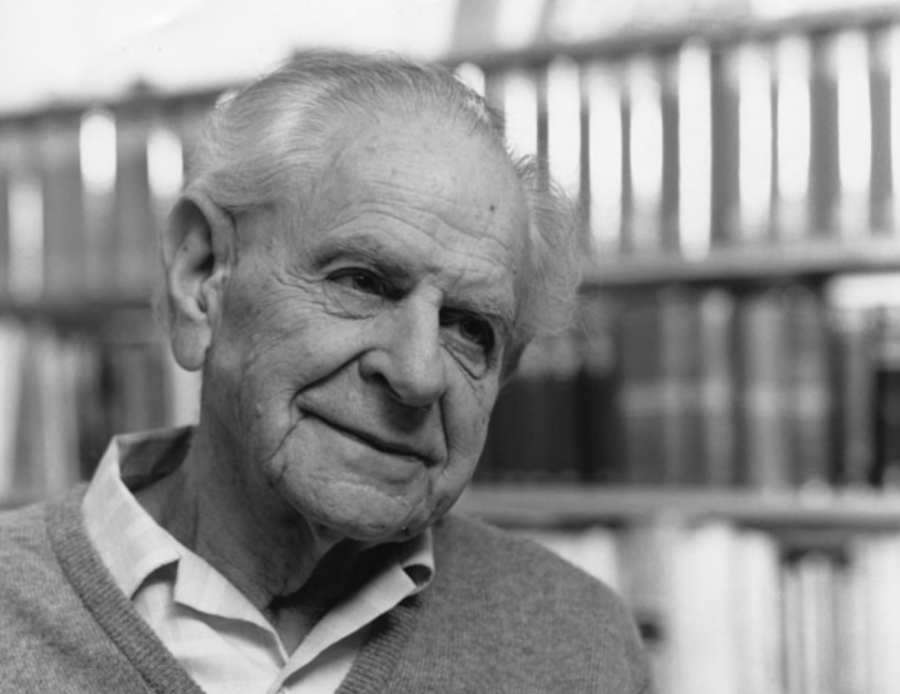
Photo via Wikimedia Commons
In the past few years, when far-right nationalists are banned from social media, violent extremists face boycotts, or institutions refuse to give a platform to racists, a faux-outraged moan has gone up: “So much for the tolerant left!” “So much for liberal tolerance!” The complaint became so hackneyed it turned into an already-hackneyed meme. It’s a wonder anyone thinks this line has any rhetorical force. The equation of tolerance with acquiescence, passivity, or a total lack of boundaries is a reductio ad absurdum that denudes the word of meaning. One can only laugh at unserious characterizations that do such violence to reason.
The concept of toleration has a long and complicated history in moral and political philosophy precisely because of the many problems that arise when the word is used without critical context. In some absurd, 21st century usages, tolerance is even conflated with acceptance, approval, and love. But it has historically meant the opposite—noninterference with something one dislikes or despises. Such noninterference must have limits. As Goethe wrote in 1829, “tolerance should be a temporary attitude only; it must lead to recognition. To tolerate means to insult.” Tolerance by nature exists in a state of social tension.
According to virtually every conception of liberal democracy, a free and open society requires tense debate and verbal conflict. Society, the argument goes, is only strengthened by the oft-contentious interplay of differing, even intolerant, points of view. So, when do such views approach the limits of toleration? One of the most well-known paradoxes of tolerance was outlined by Austrian philosopher Karl Popper in his 1945 book The Open Society and Its Enemies.
Popper was a non-religious Jew who witnessed the rise of Nazism in the 20s in his hometown of Vienna and fled to England, then in 1937, to Christchurch, New Zealand, where he was appointed lecturer at Canterbury College (now the University of Canterbury). There, he wrote The Open Society, where the famous passage appears in a footnote:
Unlimited tolerance must lead to the disappearance of tolerance. If we extend unlimited tolerance even to those who are intolerant, if we are not prepared to defend a tolerant society against the onslaught of the intolerant, then the tolerant will be destroyed, and tolerance with them. — In this formulation, I do not imply, for instance, that we should always suppress the utterance of intolerant philosophies; as long as we can counter them by rational argument and keep them in check by public opinion, suppression would certainly be unwise. But we should claim the right to suppress them if necessary even by force; for it may easily turn out that they are not prepared to meet us on the level of rational argument, but begin by denouncing all argument; they may forbid their followers to listen to rational argument, because it is deceptive, and teach them to answer arguments by the use of their fists or pistols. We should therefore claim, in the name of tolerance, the right not to tolerate the intolerant.
This last sentence has “been printed on thousands of bumper stickers and fridge magnets,” writes Will Harvie at Stuff. The quote might become almost as ubiquitous as Voltaire’s line about “defending to the death” the right of free speech (words actually penned by English writer Beatrice Evelyn Hall). Popper saw how fascism cynically exploited liberal toleration to gain a foothold and incite persecution, violent attacks, and eventually genocide. As he writes in his autobiography, he had seen how “competing parties of the Right were outbidding each other in their hostility towards the Jews.”
Popper’s formulation has been been used across the political spectrum, and sometimes applied in arguments against civil protections for some religious sects who hold intolerant views—a category that includes practitioners of nearly every major faith. But this is misleading. The line for Popper is not the mere existence of exclusionary or intolerant beliefs or philosophies, however reactionary or contemptible, but the open incitement to persecution and violence against others, which should be treated as criminal, he argued, and suppressed, “if necessary,” he continues in the footnote, “even by force” if public disapproval is not enough.
By this line of reasoning, vigorous resistance to those who call for and enact racial violence and ethnic cleansing is a necessary defense of a tolerant society. Ignoring or allowing such acts to continue in the name of tolerance leads to the nightmare events Popper escaped in Europe, or to the horrific mass killings at two mosques in Christchurch this month that deliberately echoed Nazi atrocities. There are too many such echoes, from mass murders at synagogues to concentration camps for kidnapped children, all surrounded by an echo chamber of wildly unchecked incitement by state and non-state actors alike.
Popper recognized the inevitability and healthy necessity of social conflict, but he also affirmed the values of cooperation and mutual recognition, without which a liberal democracy cannot survive. Since the publication of The Open Society and its Enemies, his paradox of tolerance has weathered decades of criticism and revision. As John Horgan wrote in an introduction to a 1992 interview with the thinker, two years before his death, “an old joke about Popper” retitles the book “The Open Society by One of its Enemies.”
With less than good humor, critics have derided Popper’s liberalism as dogmatic and itself a fascist ideology that inevitably tends to intolerance against minorities. Question about who gets to decide which views should be suppressed and how are not easy to answer. Popper liked to say he welcomed the criticism, but he refused to tolerate views that reject reason, fact, and argument in order to incite and perpetrate violence and persecution. It’s difficult to imagine any democratic society surviving for long if it decides that, while maybe objectionable, such tolerance is tolerable. The question, “these days,” writes Harvie, is “can a tolerant society survive the internet?”
Related Content:
Rare 1940 Audio: Thomas Mann Explains the Nazis’ Ulterior Motive for Spreading Anti-Semitism
Josh Jones is a writer and musician based in Durham, NC. Follow him at @jdmagness
Read More...The Venice Time Machine: 1,000 Years of Venice’s History Gets Digitally Preserved with Artificial Intelligence and Big Data
Along with hundreds of other seaside cities, island towns, and entire islands, historic Venice, the floating city, may soon sink beneath the waves if sea levels continue their rapid rise. The city is slowly tilting to the East and has seen historic floods inundate over 70 percent of its palazzo- and basilica-lined streets. But should such tragic losses come to pass, we’ll still have Venice, or a digital version of it, at least—one that aggregates 1,000 years of art, architecture, and “mundane paperwork about shops and businesses” to create a virtual time machine. An “ambitious project to digitize 10 centuries of the Venetian state’s archives,” the Venice Time Machine uses the latest in “deep learning” technology for historical reconstructions that won’t get washed away.
The Venice Time Machine doesn’t only proof against future calamity. It also sets machines to a task no living human has yet to undertake. Most of the huge collection at the State Archives “has never been read by modern historians,” points out the narrator of the Nature video at the top.
This endeavor stands apart from other digital humanities projects, Alison Abbott writes at Nature, “because of its ambitious scale and the new technologies it hopes to use: from state-of-the-art scanners that could even read unopened books, to adaptable algorithms that will turn handwritten documents into digital, searchable text.”
In addition to posterity, the beneficiaries of this effort include historians, economists, and epidemiologists, “eager to access the written records left by tens of thousands of ordinary citizens.” Lorraine Daston, director of the Max Planck Institute for the History of Science in Berlin describes the anticipation scholars feel in particularly vivid terms: “We are in a state of electrified excitement about the possibilities,” she says, “I am practically salivating.” Project head Frédéric Kaplan, a Professor of Digital Humanities at the École polytechnique fédérale de Lausanne (EPFL), compares the archival collection to “’dark matter’—documents that hardly anyone has studied before.”
Using big data and AI to reconstruct the history of Venice in virtual form will not only make the study of that history a far less hermetic affair; it might also “reshape scholars’ understanding of the past,” Abbott points out, by democratizing narratives and enabling “historians to reconstruct the lives of hundreds of thousands of ordinary people—artisans and shopkeepers, envoys and traders.” The Time Machine’s site touts this development as a “social network of the middle ages,” able to “bring back the past as a common resource for the future.” The comparison might be unfortunate in some respects. Social networks, like cable networks, and like most historical narratives, have become dominated by famous names.
By contrast, the Time Machine model—which could soon lead to AI-created virtual Amsterdam and Paris time machines—promises a more street-level view, and one, moreover, that can engage the public in ways sealed and cloistered artifacts cannot. “We historians were baptized with the dust of archives,” says Daston. “The future may be different.” The future of Venice, in real life, might be uncertain. But thanks to the Venice Time Machine, its past is poised take on thriving new life. See previews of the Time Machine in the videos further up, learn more about the project here, and see Kaplan explain the “information time machine” in his TED talk above.
Related Content:
How Venice Works: 124 Islands, 183 Canals & 438 Bridges
Josh Jones is a writer and musician based in Durham, NC. Follow him at @jdmagness
Read More...Salvador Dalí & the Marx Brothers’ 1930s Film Script Gets Released as a Graphic Novel
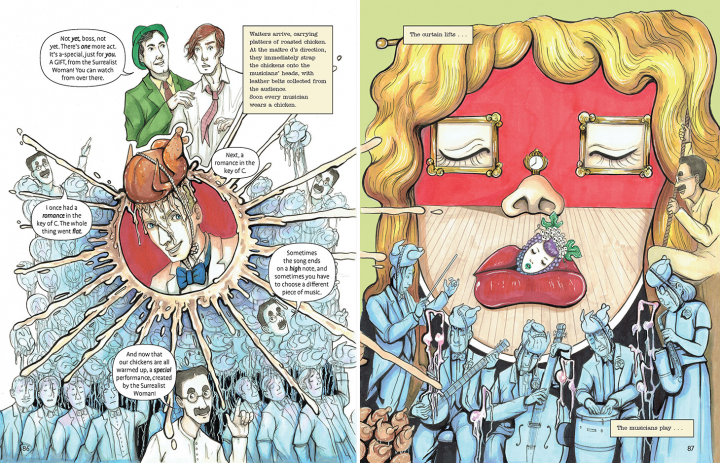
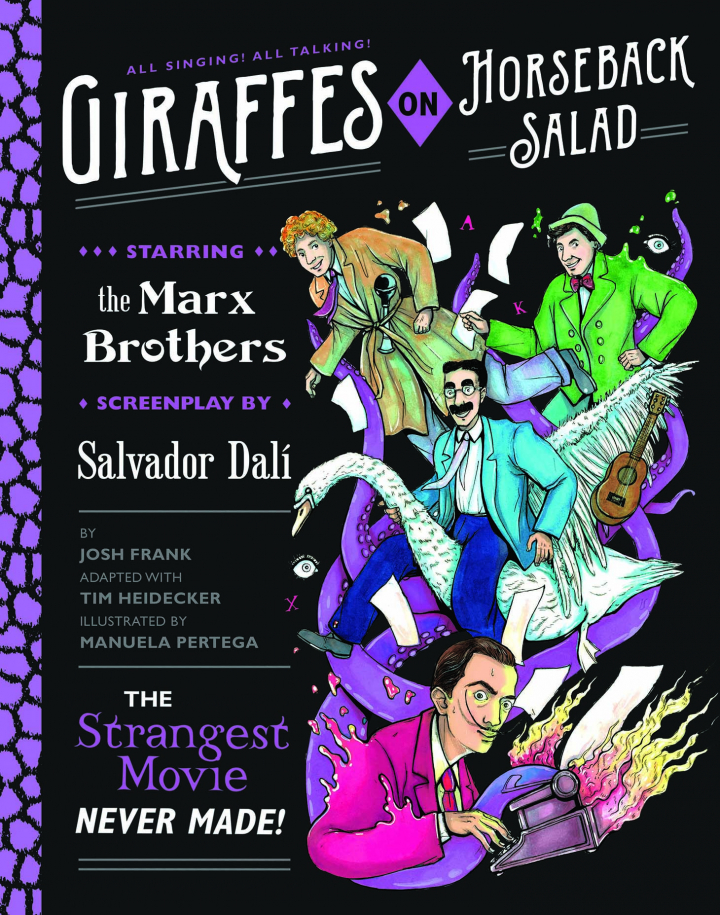
History remembers Salvador Dalí as one of the most individualistic artists ever to live, but he also had a knack for collaboration: with Luis Buñuel, Alfred Hitchcock, Walt Disney, even, in a sense, with Lewis Carroll and William Shakespeare. But would you believe the list also includes one of the Marx Brothers? Though the film on which they collaborated in the 1930s never entered production, its story has been told by Giraffes on Horseback Salad, a hybrid of illustrated text and graphic novel published just this month, itself a collaboration between pop-culture scholar Josh Frank, artist Manuela Pertega, and comedian Tim Heidecker.
When Dalí went to Hollywood, he wrote the following to fellow Surrealist André Breton: “I’ve made contact with the three American surrealists: Harpo Marx, Disney and Cecil B. DeMille.” He seems to have been especially taken with Marx.
“They painted each other, and Dalí sent his new friend a full-size harp strung with barbed wire,” writes NPR’s Etelka Lehoczky. “So overcome was Dalí with Harpo’s genius that he wrote a treatment, and later an abbreviated screenplay, for a Marx Brothers movie to be called Giraffes on Horseback Salad.” (It also had at least one alternate title, The Surrealist Woman.)
The project made it as far as a meeting with MGM head Louis B. Mayer, to whom Frank describes Dalí and Marx as pitching such scenes as “Harpo opens an umbrella and a chicken explodes on all the onlookers. He … puts each piece [of chicken] carefully on a saddle that he uses as a plate, a saddle not for a horse, but for a giraffe!” Unsurprisingly, the business-minded Mayer didn’t go for it, but Giraffes on Horseback Salad has had a long afterlife as one of the most intriguing films never made. In the early 1990s, the New York theater collective Elevator Repair Service put on a production based on the sparse materials then known, just a few years before the entire screenplay turned up among Dalí’s personal papers.
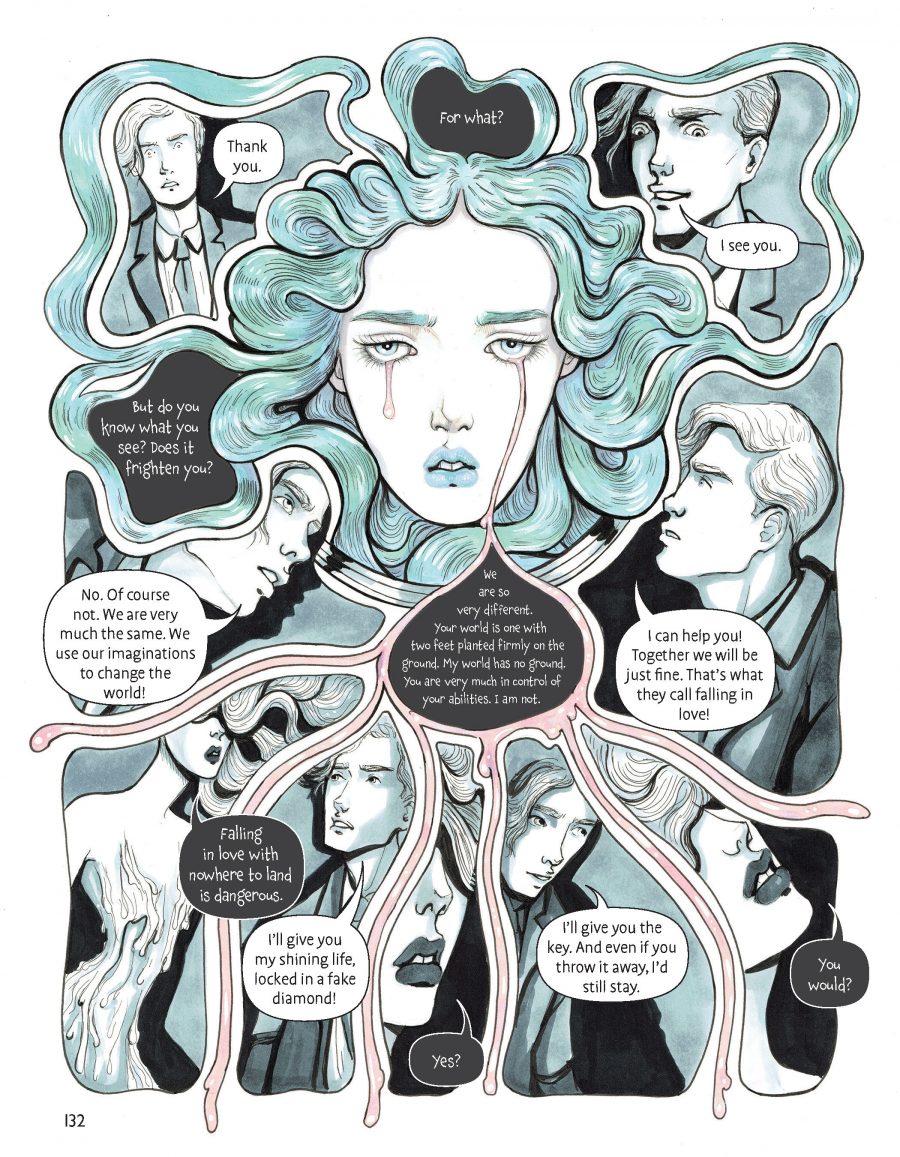
“Harpo will be Jimmy, a young Spanish aristocrat who lives in the U.S. as a consequence of political circumstances in his country,” Dalí wrote. Jimmy was to encounter a “beautiful surrealist woman, whose face is never seen by the audience” in a story dramatizing “the continuous struggle between the imaginative life as depicted in the old myths and the practical and rational life of contemporary society.” Dalí probably used the term “story” loosely: “Even jazzed up with jokes by Tim Heidecker (a modern Marx Brother if there ever was one), Giraffes on Horseback Salad — the movie, not the book — is a baffling mess,” writes Lehoczky. “Neither Dalí nor Harpo seems to have realized that their approaches to humor were vastly different.”
The Marx Brothers, as every one of their fans knows, were “acutely conscious of, and responsive to, established structures: They subverted the social order using its own rules.” Dalí, in film and every other medium in which he tried his hand (and mustache) besides, usually headed off “in a direction orthogonal to accepted reality.” To what extent Dalí and Marx were aware of that clash — and to what extent they deliberately emphasized it — during their work on Giraffes on Horseback Salad remains a mystery, but you can read more about that work, and the work Frank, Pertega, and Heidecker put in to bring it to graphic fruition more than eighty years later, at NPR, Indiewire, and Hyperallergic. The more you learn, the more you’ll wonder how even Dalí and Marx could really imagine their project produced by a studio in the Golden Age of Hollywood. But as Tate Modern curator Matthew Gale plausibly theorizes, actually making the film may have been beside the point.
Pick up a copy of Giraffes on Horseback Salad here.
via Hyperallergic
Related Content:
Two Vintage Films by Salvador Dalí and Luis Buñuel: Un Chien Andalou and L’Age d’Or
Alfred Hitchcock Recalls Working with Salvador Dali on Spellbound
Salvador Dalí & Walt Disney’s Short Animated Film, Destino, Set to the Music of Pink Floyd
The 55 Strangest, Greatest Films Never Made (Chosen by John Green)
Based in Seoul, Colin Marshall writes and broadcasts on cities, language, and culture. His projects include the book The Stateless City: a Walk through 21st-Century Los Angeles and the video series The City in Cinema. Follow him on Twitter at @colinmarshall or on Facebook.
Read More...Watch “Special Delivery,” an Oscar-Winning Animated Short (1978)
From the National Film Board of Canada comes the “Special Delivery.” Here is how they describe it: “In this Oscar®-winning animated short, Ralph’s day gets off to a bad start when he dismisses his wife’s orders to clear the snow from the front walk. When he comes home and finds the mailman dead on his front stairs, Ralph attempts a massive cover-up with disastrous results. One dead mailman leads to a case of mistaken identity, a runaway bride, and a very confused coroner. Life starts looking up for Ralph once he decides to stop worrying about it all.” A copy of the film can be downloaded here. Many more award-winning films from the National Film Board of Canada can be viewed here.
If you would like to support the mission of Open Culture, consider making a donation to our site. It’s hard to rely 100% on ads, and your contributions will help us continue providing the best free cultural and educational materials to learners everywhere. You can contribute through PayPal, Patreon, and Venmo (@openculture). Thanks!
Related Content:
4,000+ Free Movies Online: Great Classics, Indies, Noir, Westerns, Documentaries & More
Read More...Mythos: An Animation Retells Timeless Greek Myths with Abstract Modern Designs
Designer Stephen Kelleher and animator Chris Guyot present “Mythos,” an animation that tells timeless stories–Greek myths–with simple abstract designs. Here’s how they describe this project where the ancient unexpectedly meets the modern:
For centuries the Greek Myths have been used as cautionary tales and teaching tools for people both young and old. These stories convey deep wisdom about the human condition which continue to resonate with us. I wanted to honor these ancient stories by interpreting them in the age of the pixel and gif.
The challenge was to communicate these complex stories in the most minimal way possible while retaining their essence. By having each vignette loop seamlessly, the timeless and perennial nature of these stories are reinforced. Ultimately these animations serve as visual shorthand for ancient truths which are as relevant today as they were when first told.
Sisyphus:
After numerous transgressions, Zeus decided to punish the deceitful king Sisyphus once and for all by forcing him to push a huge enchanted boulder up a steep hill. As soon as he reached the top, the boulder would roll back down to the base of the hill, condemning Sisyphus to an eternity of frustrated labor.
Icarus:
King Minos imprisoned Icarus in a tower alongside his father, the master craftsman Daedalus. As a means of escape Daedalus created a set of wings made of feathers and wax for his son but warned him not to fly too close to the sun. Icarus did not however heed his father’s advice. His wings dissolved and Icarus fell into the sea below and drowned.
Persephone:
The daughter of Zeus and Demeter, Persephone was abducted by the god of the underworld Hades. Although Zeus intervened and brought her back to the land of the living, Persephone was bound to Hades for four months of each year. In her grief, Demeter would make the soils barren thereby creating winter while Persephone’s return would mark the start of the spring.
Narcissus:
As punishment for mortal Narcissus’ cruel treatment of the nymph Echo, he was cursed by Nemesis, the goddess of revenge. She led him to a pool where upon seeing his own reflection, he became besotted with his image and was unable to leave. Fixated, starving and in despair, he fell into the pool and drowned.
Midas:
Having done a great service for the god Dionysus, King Midas was granted one wish of his choosing. He wished that everything he touched would turn to gold. Upon turning food, water and even his own daughter to gold however, he soon realized his foolishness and prayed to Dionysus to undo his wish. Dionysus took pity on King Midas and duly undid the wish.
Theseus:
A Greek hero of many adventures, Theseus is best known for his defeat of the Minotaur. Under the decree of King Minos, every year fourteen young Atheneans were sacrificed to the Minotaur — a monstrous half bull, half man who resided deep within the Labyrinth. Not only was Theseus able to slay the Minotaur but he also successfully escaped the complex Labyrinth, solidifying his legend.
Enjoy…
If you would like to support the mission of Open Culture, consider making a donation to our site. It’s hard to rely 100% on ads, and your contributions will help us continue providing the best free cultural and educational materials to learners everywhere. You can contribute through PayPal, Patreon, and Venmo (@openculture). Thanks!
Related Content:
Free Courses on Design from the Famous California Design Firm IDEO Start This Week
Read More...How Does the Rorschach Inkblot Test Work?: An Animated Primer
A frightening monster?
Two friendly bears?
Say what!?
As anybody with half a brain and the gift of sight knows, the black and red inkblot below resembles nothing so much as a pair of gnomes, gavotting so hard their knees bleed.
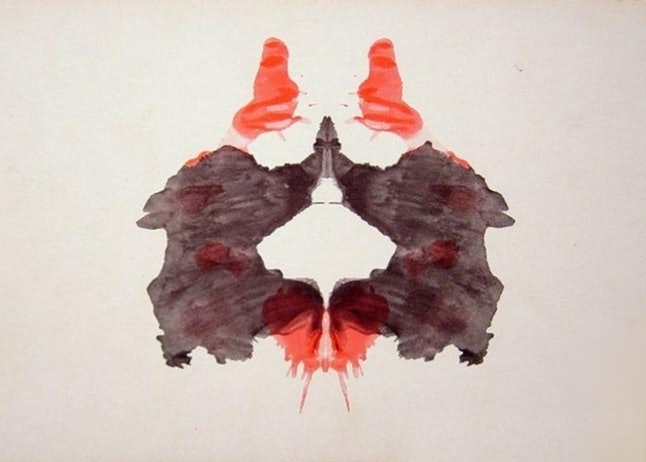
…or perhaps it’s open to interpretation.
Back in 2013, when Open Culture celebrated psychologist Hermann Rorschach’s birthday by posting the ten blots that form the basis of his famous personality test, readers reported seeing all sorts of things in Card 2:
A uterus
Lungs
Kissing puppies
A painted face
Little calfs
Tinkerbell checking her butt out in the mirror
Two ouija board enthusiasts, summoning demons
Angels
And yes, high-fiving bears
As Rorshach biographer Damion Searls explains in an animated Ted-ED lesson on how the Rorschach Test can help us understand the patterns of our perceptions, our answers depend on how we as individuals register and transform sensory input.
Rorshach chose the blots that garnered the most nuanced responses, and developed a classification system to help analyze the resulting data, but for much of the test’s history, this code was a highly guarded professional secret.
And when Rorshach died, a year after publishing the images, others began administering the test in service of their own speculative goals—anthropologists, potential employers, researchers trying to figure out what made Nazis tick, comedians…
The range of interpretative approaches earned the test a reputation as pseudo-science, but a 2013 review of Rorshach’s voluminous research went a long way toward restoring its credibility.
Whether or not you believe there’s something to it, it’s still fun to consider the things we bring to the table when examining these cards.
Do we see the image as fixed or something more akin to a freeze frame?
What part of the image do we focus on?
Our records show that Open Culture readers overwhelmingly focus on the hands, at least as far as Card 2 goes, which is to say the portion of the blot that appears to be high-fiving itself.
Never mind that the high five, as a gesture, is rumored to have come into existence sometime in the late 1970s. (Rorschach died in 1922.) That’s what the majority of Open Culture readers saw six years ago, though there was some variety of perception as to who was slapping that skin:
young elephants
despondent humans
monks
lawn gnomes
Disney dwarves
redheaded women in Japanese attire
chimpanzees with traffic cones on their heads
(In full disclosure, it’s mostly bears.)
Maybe it’s time for a do over?
Readers, what do you see now?
Image 1: Bat, butterfly, moth
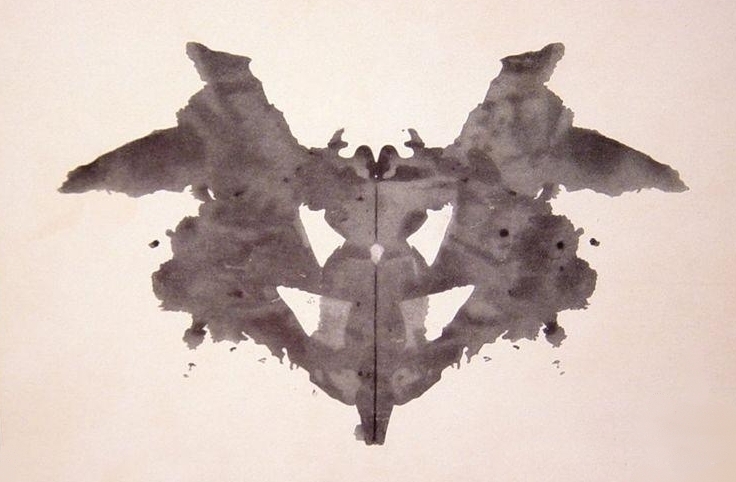
Image 2: Two humans
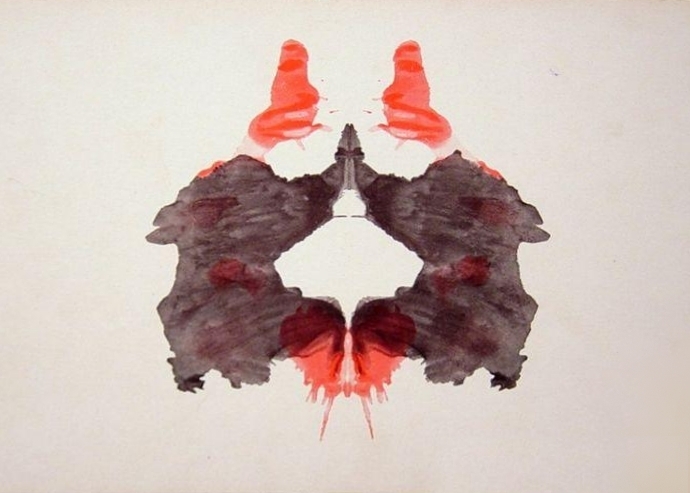
Image 3: Two humans
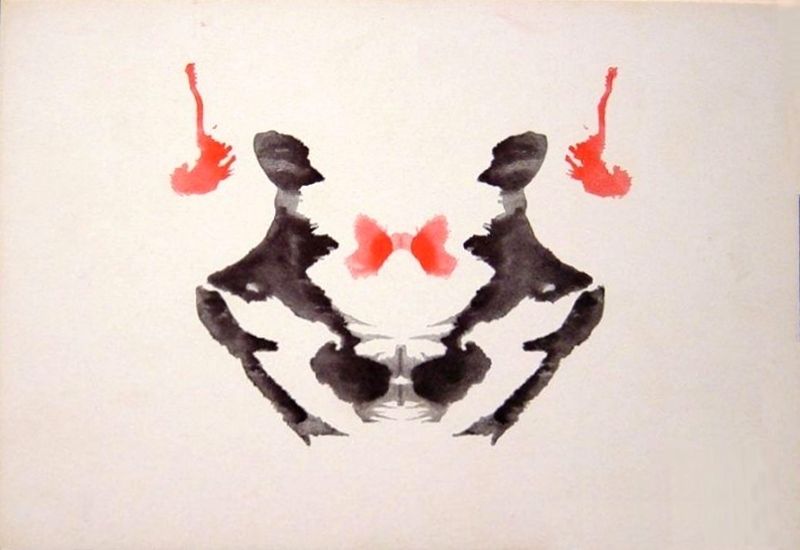
Image 4: Animal hide, skin, rug
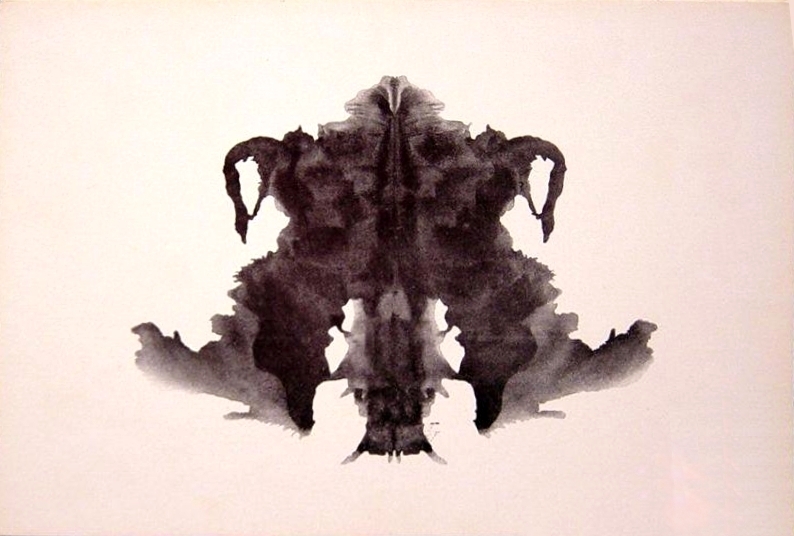
Image 5: Bat, butterfly, moth

Image 6: Animal hide, skin, rug

Image 7: Human heads or faces

Image 8: Animal; not cat or dog
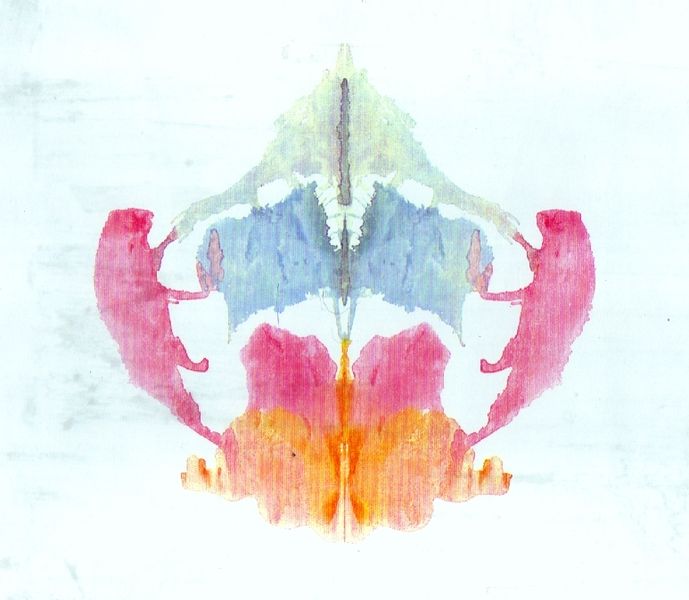
Image 9: Human
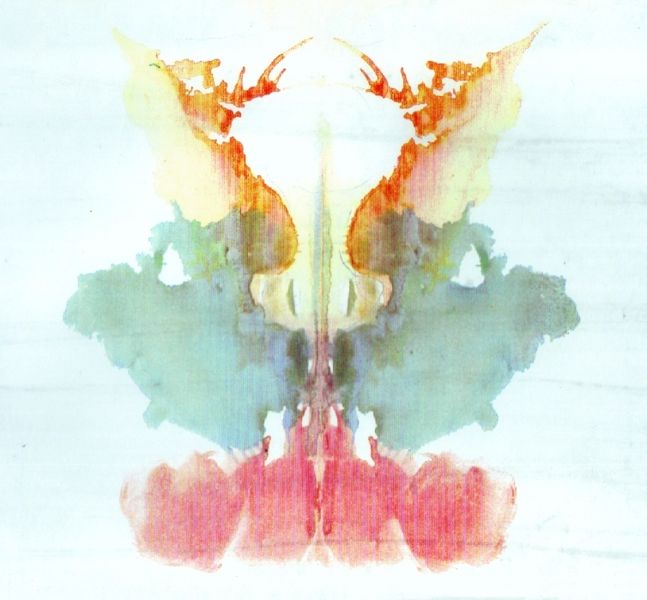
Image 10: Crab, lobster, spider,
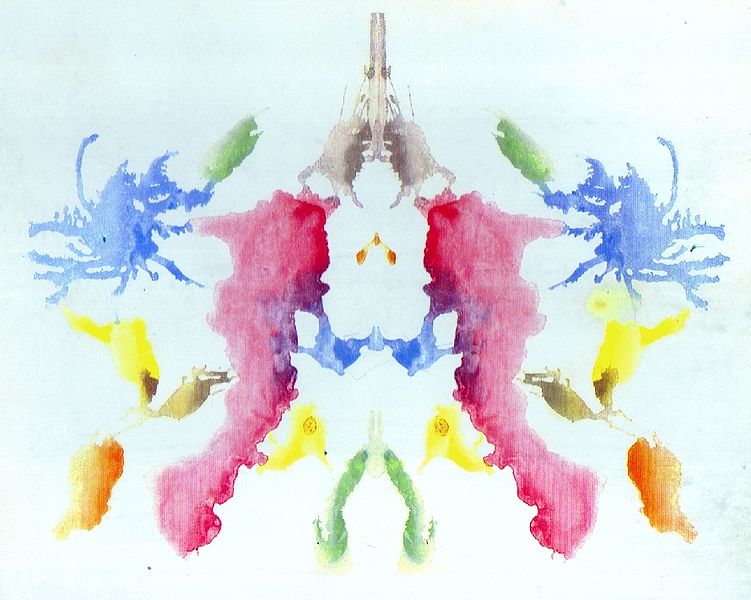
View Searls’ full TED-Ed lesson here.
Related Content:
Hermann Rorschach’s Original Rorschach Test: What Do You See? (1921)
Introduction to Psychology: A Free Course from Yale University
Ayun Halliday is an author, illustrator, theater maker and Chief Primatologist of the East Village Inky zine. Join her in New York City for the next installment of her book-based variety show, Necromancers of the Public Domain, this April. Follow her @AyunHalliday.
Read More...Bohemian Rhapsody’s Bad Editing: A Breakdown
Bohemian Rhapsody may have won the Oscar for Best Editing. But video essayist Thomas Flight isn’t persuaded. In a 13-minute video, Flight deconstructs a 104-second clip from the biopic, revealing the excessive 60 cuts that make up the scene. That translates into a dizzying cut every 1.8 seconds on average.
For Thomas Flight, Bohemian Rhapsody is nothing short of a “masterclass in bad editing.” For you, Flight’s video offers a nice short crash course in film editing.
According to The Washington Post, the pub scene deconstructed in Flight’s video was actually edited by Dexter Fletcher–and not John Ottman, the film editor who helped salvage the film and then won top honors at the Oscars. Asked about the botched scene, Ottman told WaPo: “Whenever I see it, I want to put a bag over my head. Because that’s not my aesthetic. If there’s ever an extended version of the film where I can put a couple scenes back, I will recut that scene!”
If you would like to support the mission of Open Culture, consider making a donation to our site. It’s hard to rely 100% on ads, and your contributions will help us continue providing the best free cultural and educational materials to learners everywhere. You can contribute through PayPal, Patreon, and Venmo (@openculture). Thanks!
Related Content:
Scenes from Bohemian Rhapsody Compared to Real Life: A 21-Minute Compilation
Read More...Natalie Portman Teaches a MasterClass in Acting
This week, MasterClass rolled out its latest course–Natalie Portman teaching a 20-lesson class on acting. The upstart educational venture writes:
One of her generation’s most versatile performers, Academy Award-winning actor Natalie Portman has been captivating audiences for decades. Since her on-screen debut at age 12, she’s worked with some of cinema’s most celebrated directors and showcased her skills through unforgettable roles in Black Swan, Jackie, and the Star Wars franchise.
Having never taken an acting class, Natalie developed her craft over 25 years of observation, collaboration, and countless bold experiments. The consummate dramatic shapeshifter, she has worked across genres and historical periods, imbuing each performance with an authenticity she attributes to intense research, preparation, and an eye for human behavior.
And now, in her first-ever acting class, she “shows how empathy is at the core of every great performance, how to bring real-life details into every role, and how to build your own creative process.”
You can enroll in Portman’s new class (which runs $90) here. You can also pay $180 to get an annual pass to the entirety of MasterClass’ courses–a catalog of about 50 courses, which includes other acting classes by Jodie Foster, Samuel L. Jackson and more.
FYI: If you sign up for a MasterClass course by clicking on the affiliate links in this post, Open Culture will receive a small fee that helps support our operation.
Related Content:
450+ Movie Scenes Where Actors Break the Fourth Wall, Presented in Two Big Supercuts
Read More...Artificial Intelligence Identifies the Six Main Arcs in Storytelling: Welcome to the Brave New World of Literary Criticism
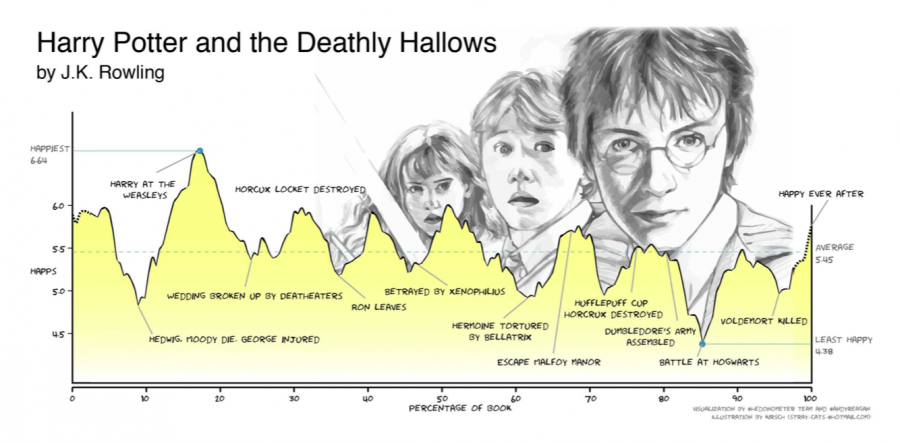
Is the singularity upon us? AI seems poised to replace everyone, even artists whose work can seem like an inviolably human industry. Or maybe not. Nick Cave’s poignant answer to a fan question might persuade you a machine will never write a great song, though it might master all the moves to write a good one. An AI-written novel did almost win a Japanese literary award. A suitably impressive feat, even if much of the authorship should be attributed to the program’s human designers.
But what about literary criticism? Is this an art that a machine can do convincingly? The answer may depend on whether you consider it an art at all. For those who do, no artificial intelligence will ever properly develop the theory of mind needed for subtle, even moving, interpretations. On the other hand, one group of researchers has succeeded in using “sophisticated computing power, natural language processing, and reams of digitized text,” writes Atlantic editor Adrienne LaFrance, “to map the narrative patterns in a huge corpus of literature.” The name of their literary criticism machine? The Hedonometer.
We can treat this as an exercise in compiling data, but it’s arguable that the results are on par with work from the comparative mythology school of James Frazier and Joseph Campbell. A more immediate comparison might be to the very deft, if not particularly subtle, Kurt Vonnegut, who—before he wrote novels like Slaughterhouse Five and Cat’s Cradle—submitted a master’s thesis in anthropology to the University of Chicago. His project did the same thing as the machine, 35 years earlier, though he may not have had the wherewithal to read “1,737 English-language works of fiction between 10,000 and 200,000 words long” while struggling to finish his graduate program. (His thesis, by the way, was rejected.)
Those numbers describe the dataset from Project Gutenberg fed into the The Hedonometer by the computer scientists at the University of Vermont and the University of Adelaide. After the computer finished “reading,” it then plotted “the emotional trajectory” of all of the stories using a “sentiment analysis to generate an emotional arc for each work.” What it found were six broad categories of story, listed below:
- Rags to Riches (rise)
- Riches to Rags (fall)
- Man in a Hole (fall then rise)
- Icarus (rise then fall)
- Cinderella (rise then fall then rise)
- Oedipus (fall then rise then fall)
How does this endeavor compare with Vonnegut’s project? (See him present the theory below.) The novelist used more or less the same methodology, in human form, to come up with eight universal story arcs or “shapes of stories.” Vonnegut himself left out the Rags to Riches category; he called it an anomaly, though he did have a heading for the same rising-only story arc—the Creation Story—which he deemed an uncommon shape for Western fiction. He did include the Cinderella arc, and was pleased by his discovery that its shape mirrored the New Testament arc, which he also included in his schema, an act the AI surely would have judged redundant.
Contra Vonnegut, the AI found that one-fifth of all the works it analyzed were Rags-to-Riches stories. It determined that this arc was far less popular with readers than “Oedipus,” “Man in a Hole,” and “Cinderella.” Its analysis does get much more granular, and to allay our suspicions, the researchers promise they did not control the outcome of the experiment. “We’re not imposing a set of shapes,” says lead author Andy Reagan, Ph.D. candidate in mathematics at the University of Vermont. “Rather: the math and machine learning have identified them.”
But the authors do provide a lot of their own interpretation of the data, from choosing representative texts—like Harry Potter and the Deathly Hallows—to illustrate “nested and complicated” plot arcs, to providing the guiding assumptions of the exercise. One of those assumptions, unsurprisingly given the authors’ fields of interest, is that math and language are interchangeable. “Stories are encoded in art, language, and even in the mathematics of physics,” they write in the introduction to their paper, published on Arxiv.org.
“We use equations,” they go on, “to represent both simple and complicated functions that describe our observations of the real world.” If we accept the premise that sentences and integers and lines of code are telling the same stories, then maybe there isn’t as much difference between humans and machines as we would like to think.
via The Atlantic
Related Content:
Kurt Vonnegut Diagrams the Shape of All Stories in a Master’s Thesis Rejected by U. Chicago
Kurt Vonnegut Maps Out the Universal Shapes of Our Favorite Stories
Josh Jones is a writer and musician based in Durham, NC. Follow him at @jdmagness
Read More...97-Year-Old Philosopher Ponders the Meaning of Life: “What Is the Point of It All?”
If you’ve sat by the bedside of a dying friend or relative, or recovered from a terminal illness yourself, you may know too well: the concerns of yesterday—career anxieties, political high stakes, personal grudges—can slip away into the rear view, becoming smaller and more meaningless as hours pass into final days. What takes their place? Maybe a savoring of the moment, maybe regrets over moments not savored, maybe a growing acknowledgment that gratitude matters more than being right. Maybe a willingness to let go of prior ideas—not to adopt new ones, but to open to the questions again.
Sometimes, this experience is bewildering and frightening, especially when coupled with the pains of illness and old age. Whatever insights one might have at the threshold of death, they cannot easily overcome “lifelong habits,” says Herbert Fingarette in the candid short film Being 97, a documentary made in the last months of the contrarian American philosopher’s life. By the time of his death,” notes Aeon, “Fingarette (1921–2018) had lived what most would consider a full and meaningful life. His marriage to his wife, Leslie, was long and happy. His career as a professor of philosophy at the University of California was both accomplished and controversial.”
By this time, his wife of seventy years had been gone for seven. And at 97, physically frail and his career long over, Fingarette was coming to terms with “loneliness and absence” as well as with his need for help from other people to do simple tasks. After 42 years of teaching—and writing on subjects like self-deception, Confucianism, ethical responsibility, and addiction—he was also grappling with the fact he had been wrong about one particularly pressing matter, at least.
Fingarette became infamous when, without undertaking any scientific research himself, he claimed in the 1988 book Heavy Drinking that alcoholism was a problem of self control, not a disease. But he does not speak of the political furor in this minor controversy. Eleven years later, he took on an even heavier subject in Death: Philosophical Soundings. “What I said was in a nutshell,” he recalls, “is there’s no reason to be afraid or concerned or anything about death because when you die, there’s nothing. You’re not going to suffer, you’re not going to be unhappy… you’re not going to be…. It’s not rational to be afraid of death.”
He admits, “I now think that is not a good statement, because I think it’s important to figure out why it is then that people are afraid of death. Why am I concerned about it?” His best thinking aside, “my sense of realism tells me, well, no good reason or not, it is something that haunts me. I walk around the house and I ask myself, ‘What is the point of it all? There must be something I’m missing in this argument.’” He asks, he says, knowing “that there isn’t any good answer.” But that doesn’t stop him from looking for one. We see Fingarette’s lifelong habits as a thinker push him forward in pursuit of what he calls a “foolish question,” although he intuits that “the answer might be… the silent answer.”
It’s a painful existential realization for a man so devoted to logical argument and pronouncements of certainty. This film of Fingarette in his last months is both a personally moving portrait and a drama in miniature of a universal human dilemma: why is it so hard to accept the inevitable? Why do we have minds that struggle against it? The multitude of possible answers may be far less meaningful than the experience of the question itself, painful and transcendent as it is, whether we are grieving the loss of others, facing our own mortality, or, as in Fingarette’s case, both at once.
Being 97 will be added to our list of Free Online Documentaries, a subset of our collection, 4,000+ Free Movies Online: Great Classics, Indies, Noir, Westerns, Documentaries & More.
via Aeon
Related Content:
Death: A Free Philosophy Course from Yale Helps You Grapple with the Inescapable
Alan Watts Explains Why Death is an Art, Adventure and Creative Act
Josh Jones is a writer and musician based in Durham, NC. Follow him at @jdmagness
Read More...
Support Us
We're hoping to rely on loyal readers, rather than erratic ads. Please click the Donate button and support Open Culture. You can use Paypal, Venmo, Patreon, even Crypto! We thank you!

About Us

Open Culture scours the web for the best educational media. We find the free courses and audio books you need, the language lessons & educational videos you want, and plenty of enlightenment in between.
Advertise With Us

FREE UPDATES!
GET OUR DAILY EMAIL
Get the best cultural and educational resources on the web curated for you in a daily email. We never spam. Unsubscribe at any time.
FOLLOW ON SOCIAL MEDIA

Open Culture editor Dan Colman scours the web for the best educational media. He finds the free courses and audio books you need, the language lessons & movies you want, and plenty of enlightenment in between.
Advertise With Us


