Alan Watts Dispenses Wit & Wisdom on the Meaning of Life in Three Animated Videos
Since his death in 1973, the popular British philosopher, writer, speaker, and onetime-Episcopal-priest-turned-student-of-Zen-and-wildly-eclectic-countercultural-spiritual-thinker Alan Watts has become a cottage industry of sorts. And if you were unfamiliar with his work, you might think—given this description and the mention of the word “industry”—that Watts founded some sort of self-help seminar series, the kind in which people make a considerable investment of time and money.
In a sense, he did: the Alan Watts Organization (previously known as the Alan Watts Electronic University, the Alan Watts Center, or the Alan Watts Project) maintains Watts’ prolific audio and video archives. Founded in the last year of his life by Watts and his son Mark, the Organization charges for access to most of his work. The collections are pricey. Albums of talks on such subjects as Buddhism and Comparative Philosophy and Religion are extensive, but come at a cost.
Though the organization offers free content, you could find yourself spending several hundred dollars to hear the collected Watts lectures. It’s money the Mark Watts suggests covers the “substantial undertaking” of digitizing hundreds of hours of recordings on lacquered disks and magnetic reels. These are noble and necessary efforts, but fans of Watts will know that hundreds of selections from his deeply engaging talks are also freely available on YouTube, many of them with nifty animations and musical accompaniment, like the videos here from After Skool.
Watts would likely have been pleased with this situation—he loved to give out wisdom widely and kept no esoteric trade secrets. But he was also, by his own admission, “a spiritual/philosophical entertainer,” who made a living telling people some of the most unsettling, counterintuitive metaphysical truths there are. He did it with humor, erudition and compassion, with intellectual clarity and rhetorical aplomb.
So what did he have to tell us? That we should join the church of Alan Watts? Attend his next lecture and buy his book? Shape our lives into an emulation of Alan Watts? Though he wore the trappings of a Western expositor of Eastern thought, and embraced all kinds of non-traditional beliefs and practices, Watts was too ironical and detached to be a guru. He couldn’t take himself seriously enough for that.
If there’s any one thread that runs through the incredibly broad range of subjects he covered, it’s that we should never take ourselves too seriously either. We buy into stories and ideas and think of them as concrete entities that form the boundaries of identity and existence: stories like thinking of life as a “journey” on the way to some specific denouement. Not so, as Watts says in the animated video at the top. Life is an art, a form of play: “the whole point of the dancing is the dance.”
But what about the meaning of life? Is Alan Watts going to reveal it in the last course of his ten-week session (payable in installments)? Will we discover it in a series of self-improvement packages? No. The meaning of life he says, is life. “The situation of life is optimal.” But how is anyone supposed to judge what’s good without unchanging external standards? A classic Zen story about a Chinese farmer offers a concise illustration of why we may have no need—and no real ability—to make any judgments at all.
You’ll find many more free excerpts of Watts’ lectures—of varying lengths and with or without animations, on YouTube. To get a further taste of his spiritual and philosophical distillations, see the links below.
Related Content:
The Wisdom of Alan Watts in Four Thought-Provoking Animations
Zen Master Alan Watts Explains What Made Carl Jung Such an Influential Thinker
Take a Break from Your Frantic Day & Let Alan Watts Introduce You to the Calming Ways of Zen
Josh Jones is a writer and musician based in Durham, NC. Follow him at @jdmagness
Read More...Watch the First Film Adaptation of Mary Shelley’s Frankenstein (1910): It’s Newly Restored by the Library of Congress
In his Critique of Judgment Immanuel Kant made every attempt to separate the Sublime—the phenomenon that inspires reverence, awe, and imagination—from terror, horror, and monstrosity. But as Barbara Freeman argues, the distinctions fall apart. Nowhere do we see this better dramatized, Freeman writes, than in Mary Shelley’s Frankenstein, which “can be read almost as a parody of the Critique of Judgment, for in it everything Kant identifies with or as sublime… yield precisely what Kant prohibits: terror, monstrosity, passion, and fanaticism.”
Reason, even that as careful as Kant’s, begets monsters, Shelley suggests. It’s a theme that has become so commonplace in writing about Frankenstein and its numerous progeny that it seems hardly worth repeating. And yet, Shelley’s dark vision, like that of her contemporary Francisco Goya, came at a time when electricity was a new force in the world (one that her husband Percy used to conduct experiments on himself)… a time when Kant’s philosophy had seemingly validated empirical realism and the primacy of abstract reason.
Steeped in the latest science and philosophy, and living on the other side of the French Revolution, Shelley saw the return of what Kant had sought to banish. The monster arrives as an ominous portent of atrocity. As Steven J. Kraftchick points out in a recent anthology of Frankenstein essays published for the novel’s 200th anniversary, “the English term ‘monster’ (by way of French) likely derives from the Latin words montrare ‘to demonstrate’ and monere ‘to warn.’” The monster comes to show “the limits of the ordinary… expanding or contracting.”
As a being intended to show us something, it seems apt that Victor Frankenstein’s creation became ubiquitous in film and television, first arriving on screen in 1910 at the dawning of film as a popular medium. The first Frankenstein adaptation predates the technological horrors of the 20th century (themselves, of course, well documented on film). Rather than taking technology to task directly, this original cinematic adaptation, directed by J. Searle Dawley for Thomas Edison’s studios, vaguely illustrates, as Rich Drees writes, “the dangers of tampering in God’s realm.”
It was a trite message tailored for censorious moral reformers who had taken aim at the moving image’s supposedly corrupting effect on impressionable minds. And yet the film does more than inaugurate a cinematic tradition of better Frankenstein adaptations, both faithful and liberally modernized. The creation of the monster in the 13-minute short is somewhat terrifying—and certainly would have unsettled audiences at the time. Significantly, it takes place in giant black box, with a small window through which Victor peers as the special effects unfold.
The scene is not unlike a film director looking through a colossal camera’s lens, further suggesting the dangerous influence of film, its ability to produce and capture monstrosities. The Library of Congress’s Mike Mashon describes the Edison production of Frankenstein as not “all that revelatory.” Maybe with the benefit of 108 years of hindsight, it is not. But as a critique of the very technology that produced it, we can see it updating Shelley’s anxieties, anticipating the ways in which Frankenstein-like stories have come to telegraph fears of computer intelligence, in films increasingly created by intelligent machines.
This 1910 Frankenstein film has been restored by the Library of Congress, and Mashon’s story of how the only nitrate print was acquired by the library’s Packard Campus for Audio Visual Conservation may be, he writes, “more interesting than the film itself.” Or it may not, depending on your level of interest in the twists and turns of library acquisitions. But the film, which you can see in its restored glory at the top, rewards viewing as more than a cinema-historical artifact. Its effects are crude, its simplified story moralistic, but this truncated version cannily recognizes the horrific creature not as the excluded other but as the monstrous mirror image of its creator.
via Indiewire
Related Content:
Mary Shelley’s Handwritten Manuscripts of Frankenstein Now Online for the First Time
The First Horror Film, George Méliès’ The Manor of the Devil (1896)
Josh Jones is a writer and musician based in Durham, NC. Follow him at @jdmagness
Read More...At Folsom Prison: A Mini-Doc on Johnny Cash’s Historic & Career-Changing Concert
It was the opposite of superstar rock concerts, or even a sweaty, dark stage like that at CBGB’s in New York. But the dining hall at Folsom Prison was the setting for a concert that would give Johnny Cash, on the verge of a career collapse, a second chance on life. And it would become one of the unlikeliest venues in the history of country music.
Nothing was the same after this unlikeliest of turnarounds. After the album recorded at this gig, Cash would be hurtled into superstardom. He’d get his own national TV show. And instead of being a drug and alcohol casualty, he’d take on the mantel of elder statesman with a hint of danger. No, he’d never killed a man in Reno just to watch him die, but when he sang it in that long drawl, you could believe so. None of the original artists that played on Sun Records had a second act quite like Cash.
And that’s all down to the decision to play a concert at California’s Folsom Prison, in which he had set one of his most famous songs from 1953.
In Polyphonic’s nine minute mini-doc above on the making of this classic album, he tries to piece together what makes the Folsom Prison album so special.
You might not think of the album as a radical piece of late ‘60s music similar to The White Album or Beggar’s Banquet, but it is. For it was birthed with the help of producer Bob Johnston, who had a try-anything attitude that was very much in the air in 1968. The recording is raw and very, very live sounding. The audience of prisoners is a part of the mix. Cash’s voice is similarly raw and flubs and mistakes were kept in. (But as the video points out, some of the audience noises were edited for greater impact, like a ‘whoop’ after Cash’s infamous “Reno” line.) June Carter’s sweet voice contrasts with Cash’s, but there’s an air of tension to the duets, as these men probably haven’t seen a young woman in the flesh for a very long time.
There’s also the empathy of the entire project. Cash sings like he’s one of them, and his songs are of isolation and loneliness. He even sings a song written by an inmate called “Greystone Chapel.” While so many acts at this time were stripping away artifice–think of Bob Dylan’s turn away from his psychedelic mid-‘60s height–Cash beat them all to it with unadorned honesty, humor, and in the middle of a prison, a sense of joy.
This year marks the 50th anniversary of the album, and the racial make-up of Folsom has changed–it’s gone from a majority white prison to one populated by African-Americans, Latinos, and Asians.
And while country music would not get the same reception now as it did then, the biggest change is that prisoners make the music themselves. In a Los Angeles Times article about the prison, “the musicians at Folsom have formed hip-hop, hard rock/heavy metal, Latin rock, alt-rock, smooth jazz and progressive rock ensembles within Folsom’s walls.” One recent artist to visit and perform was hip-hop musician Common.
But none of that would have happened without Cash’s historic visit. As he told the Times’ Robert Hilburn about that moment, “I knew this was it. My chance to make up for all the times when I had messed up. I kept hoping my voice wouldn’t give out again. Then I suddenly felt calm. I could see the men looking over at me. There was something in their eyes that made me realize everything was going to be okay. I felt I had something they needed.”
Related Content:
Johnny Cash Sings “Man in Black” for the First Time, 1971
Johnny Cash’s Short and Personal To-Do List
Ted Mills is a freelance writer on the arts who currently hosts the artist interview-based FunkZone Podcast and is the producer of KCRW’s Curious Coast. You can also follow him on Twitter at @tedmills, read his other arts writing at tedmills.com and/or watch his films here.
Read More...7 Tips From Ernest Hemingway on How to Write Fiction
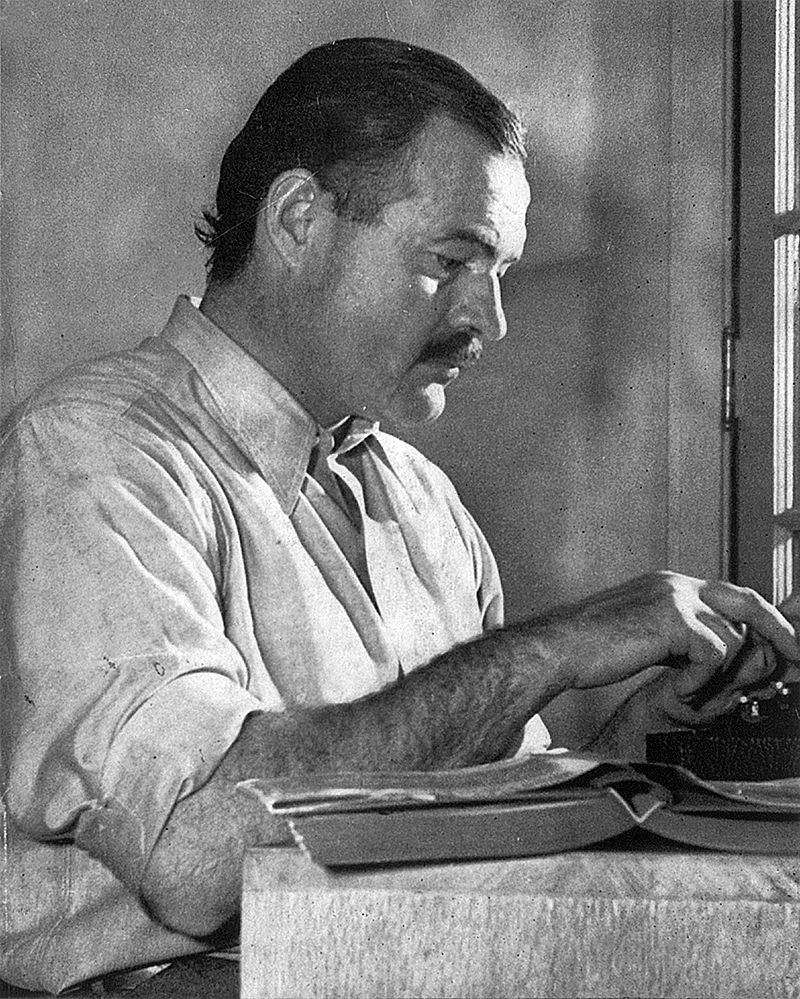
Image by Lloyd Arnold via Wikimedia Commons
Before he was a big game hunter, before he was a deep-sea fisherman, Ernest Hemingway was a craftsman who would rise very early in the morning and write. His best stories are masterpieces of the modern era, and his prose style is one of the most influential of the 20th century.
Hemingway never wrote a treatise on the art of writing fiction. He did, however, leave behind a great many passages in letters, articles and books with opinions and advice on writing. Some of the best of those were assembled in 1984 by Larry W. Phillips into a book, Ernest Hemingway on Writing.
We’ve selected seven of our favorite quotations from the book and placed them, along with our own commentary, on this page. We hope you will all–writers and readers alike–find them fascinating.
1: To get started, write one true sentence.
Hemingway had a simple trick for overcoming writer’s block. In a memorable passage in A Moveable Feast, he writes:
Sometimes when I was starting a new story and I could not get it going, I would sit in front of the fire and squeeze the peel of the little oranges into the edge of the flame and watch the sputter of blue that they made. I would stand and look out over the roofs of Paris and think, “Do not worry. You have always written before and you will write now. All you have to do is write one true sentence. Write the truest sentence that you know.” So finally I would write one true sentence, and then go on from there. It was easy then because there was always one true sentence that I knew or had seen or had heard someone say. If I started to write elaborately, or like someone introducing or presenting something, I found that I could cut that scrollwork or ornament out and throw it away and start with the first true simple declarative sentence I had written.
2: Always stop for the day while you still know what will happen next.
There is a difference between stopping and foundering. To make steady progress, having a daily word-count quota was far less important to Hemingway than making sure he never emptied the well of his imagination. In an October 1935 article in Esquire ( “Monologue to the Maestro: A High Seas Letter”) Hemingway offers this advice to a young writer:
The best way is always to stop when you are going good and when you know what will happen next. If you do that every day when you are writing a novel you will never be stuck. That is the most valuable thing I can tell you so try to remember it.
3: Never think about the story when you’re not working.
Building on his previous advice, Hemingway says never to think about a story you are working on before you begin again the next day. “That way your subconscious will work on it all the time,” he writes in the Esquire piece. “But if you think about it consciously or worry about it you will kill it and your brain will be tired before you start.” He goes into more detail in A Moveable Feast:
When I was writing, it was necessary for me to read after I had written. If you kept thinking about it, you would lose the thing you were writing before you could go on with it the next day. It was necessary to get exercise, to be tired in the body, and it was very good to make love with whom you loved. That was better than anything. But afterwards, when you were empty, it was necessary to read in order not to think or worry about your work until you could do it again. I had learned already never to empty the well of my writing, but always to stop when there was still something there in the deep part of the well, and let it refill at night from the springs that fed it.
4: When it’s time to work again, always start by reading what you’ve written so far.
T0 maintain continuity, Hemingway made a habit of reading over what he had already written before going further. In the 1935 Esquire article, he writes:
The best way is to read it all every day from the start, correcting as you go along, then go on from where you stopped the day before. When it gets so long that you can’t do this every day read back two or three chapters each day; then each week read it all from the start. That’s how you make it all of one piece.
5: Don’t describe an emotion–make it.
Close observation of life is critical to good writing, said Hemingway. The key is to not only watch and listen closely to external events, but to also notice any emotion stirred in you by the events and then trace back and identify precisely what it was that caused the emotion. If you can identify the concrete action or sensation that caused the emotion and present it accurately and fully rounded in your story, your readers should feel the same emotion. In Death in the Afternoon, Hemingway writes about his early struggle to master this:
I was trying to write then and I found the greatest difficulty, aside from knowing truly what you really felt, rather than what you were supposed to feel, and had been taught to feel, was to put down what really happened in action; what the actual things were which produced the emotion that you experienced. In writing for a newspaper you told what happened and, with one trick and another, you communicated the emotion aided by the element of timeliness which gives a certain emotion to any account of something that has happened on that day; but the real thing, the sequence of motion and fact which made the emotion and which would be as valid in a year or in ten years or, with luck and if you stated it purely enough, always, was beyond me and I was working very hard to get it.
6: Use a pencil.
Hemingway often used a typewriter when composing letters or magazine pieces, but for serious work he preferred a pencil. In the Esquire article (which shows signs of having been written on a typewriter) Hemingway says:
When you start to write you get all the kick and the reader gets none. So you might as well use a typewriter because it is that much easier and you enjoy it that much more. After you learn to write your whole object is to convey everything, every sensation, sight, feeling, place and emotion to the reader. To do this you have to work over what you write. If you write with a pencil you get three different sights at it to see if the reader is getting what you want him to. First when you read it over; then when it is typed you get another chance to improve it, and again in the proof. Writing it first in pencil gives you one-third more chance to improve it. That is .333 which is a damned good average for a hitter. It also keeps it fluid longer so you can better it easier.
7: Be Brief.
Hemingway was contemptuous of writers who, as he put it, “never learned how to say no to a typewriter.” In a 1945 letter to his editor, Maxwell Perkins, Hemingway writes:
It wasn’t by accident that the Gettysburg address was so short. The laws of prose writing are as immutable as those of flight, of mathematics, of physics.
If you would like to support the mission of Open Culture, consider making a donation to our site. It’s hard to rely 100% on ads, and your contributions will help us continue providing the best free cultural and educational materials to learners everywhere. You can contribute through PayPal, Patreon, and Venmo (@openculture). Thanks!
Note: An earlier version of this post appeared on our site in February 2013.
Related content:
Writing Tips by Henry Miller, Elmore Leonard, Margaret Atwood, Neil Gaiman & George Orwell
Ernest Hemingway Creates a Reading List for a Young Writer (1934)
18 (Free) Books Ernest Hemingway Wished He Could Read Again for the First Time
James Joyce Picked Drunken Fights, Then Hid Behind Ernest Hemingway
Find Courses on Hemingway and Other Authors in our big list of Free Online Courses
Read More...Living Paintings: 13 Caravaggio Works of Art Performed by Real-Life Actors
Michelangelo Merisi da Caravaggio, the father of Baroque painting, shocked the upper class aesthetes of his day by drafting prostitutes and proletariats as models for his primarily Biblical subjects.
Ten years ago, under the direction of founder Ludovica Rambelli, eight members of the Italian company, Malatheatre, discovered first hand the insanely rigorous poses Caravaggio demanded of his models, creating 23 tableaux vivants inspired by the master’s oeuvre.
The company sought less to reproduce the paintings than the scene Caravaggio would have gazed on from behind his easel.
The 13 stagings in the video above make one aware of the intense physicality evident in Caravaggio’s work.
All those extended arms and inversions are agony for a model. After 30 seconds or so, even a sharply inclined neck or bent back can serve up a small taste of what it’s like to be crucified.
The result is exquisite. The eight players are not just extraordinarily fit specimens, they have clearly devoted much thought to the emotional life of each character they embody, sustaining the moment with great focus and determination.
The action unfolds in the suitably ancient setting of Naples’ Church of Santa Maria Donnaregina Nuova.
When not called upon to model, the performers become stage hands, helping each other to arrange the simple, well chosen props and flowing mantles.
(I enjoyed the small joke of a female Bacchus.)
Performed live to selections from Mozart, Bach, and Vivaldi, this company has settled on the Lux Aeterna section of Mozart’s Requiem to accompany their archival footage.
The next opportunity to see the show performed live will be in Naples on December 28.
Have a look at the video below, for some comparisons between the original paintings and the 13 tableaux vivants seen in the video:
The Entombment of Christ
Mary Magdalene in Ecstasy,
Crucifixion of Saint Peter
The Beheading of St John the Baptist
Judith Beheading Holofernes
Flagellation of Christ
The Martyrdom of Saint Matthew
Annunciation
Rest on the Flight into Egypt
Narcissus,
The Raising of Lazarus
Saint Francis of Assisi in Ecstasy
Bacchus
Related Content:
Flashmob Recreates Rembrandt’s “The Night Watch” in a Dutch Shopping Mall
Batman & Other Super Friends Sit for 17th Century Flemish Style Portraits
Why Babies in Medieval Paintings Look Like Middle-Aged Men: An Investigative Video
Ayun Halliday is a former artist’s model turned author, illustrator, theater maker and Chief Primatologist of the East Village Inky zine. Join her in NYC on Monday, November 12 for another monthly installment of her book-based variety show, Necromancers of the Public Domain. Follow her @AyunHalliday.
Read More...
“A Great Day in Harlem,” Art Kane’s Iconic Photo of 57 Jazz Legends (with a Detailed Listing of Who Appears in the Photo)
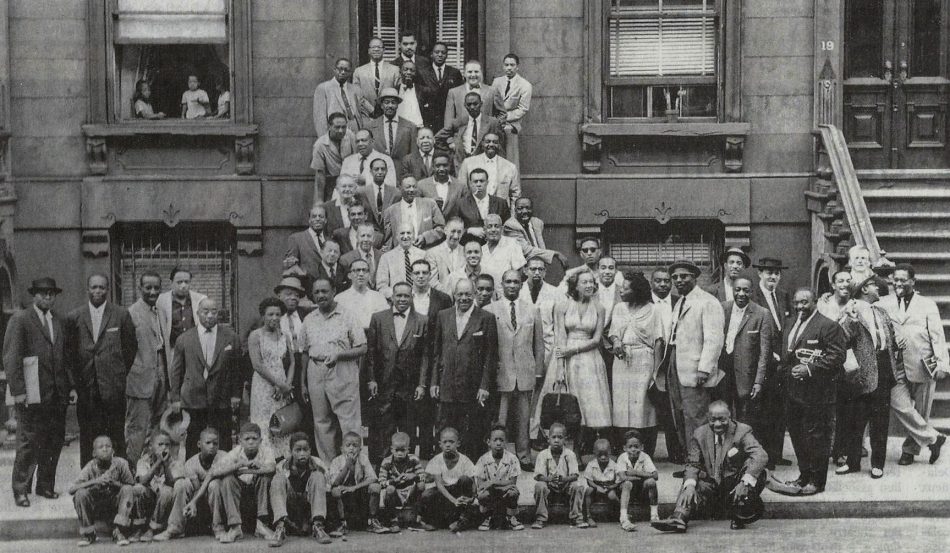
Image by Art Kane, via Wikimedia Commons
Sixty years ago, Art Kane assembled one of the largest groups of jazz greats in history. No, it wasn’t an all-star big band, but a meeting of veteran legends and young upstarts for the iconic photograph known as “A Great Day in Harlem.” Fifty-seven musicians gathered outside a brownstone at 17 East 126th St.—accompanied by twelve neighborhood kids—from “big rollers,” notes Jazzwise magazine, like “Thelonious Monk, Charles Mingus, Count Basie, Sonny Rollins, Lester Young, Art Blakey, Horace Silver, Dizzy Gillespie, Coleman Hawkins and Pee Wee Russell to then up-and-coming names, Benny Golson, Marion MacPartland, Mary Lou Williams and Art Farmer.”
Sonny Rollins was there, one of only two musicians in the photo still alive. The other, Benny Golson, who turns 90 next year, remembers getting a call from Village Voice critic Nat Hentoff, telling him to get over there. Golson lived in the same building as Quincy Jones, “but somehow he wasn’t called or he didn’t make it.”
Other people who might have been in the photograph but weren’t, Golson says, because they were working (and the 10 a.m. call time was a stretch for a working musician): “John Coltrane, Miles, Duke Ellington, Woody Herman.” And Buddy Rich, whom Golson calls the “greatest drummer I ever heard in my life” (adding, “but his personality was horrible.”)
The next year, everything changed—or so the story goes—when revolutionary albums hit the scene from the likes of Miles Davis, Dave Brubeck, Ornette Coleman, and Charles Mingus. These records pushed experimental forms, leaving behind the confines of both swing and bebop. But Kane’s jazz class photo shows us, Matthew Kessel writes at Vulture, “a portrait of harmony, old and new guard alike peaceably intermingling. The photo suggests that jazz is as much about continuity and tradition as it is about radical change.” The photo has since become a tradition itself, hanging on the walls of thousands of homes, bookshops, record stores, barbershops, and restaurants. (Get your copy here.)
Originally titled “Harlem 1958,” Kane’s image has inspired some notable homages in black culture. In 1998, XXL magazine tapped Gordon Parks to shoot “A Great Day in Hip Hop” for a now-historic cover. And this past summer, Netflix gathered 47 black creatives behind more than 20 original Netflix shows for the redux “A Great Day in Hollywood.” The photo also inspired a documentary of the same title in 1994 (at whose website you can click on each musician for a short bio). At the Daily News, Sarah Goodyear tells the story of how Kane conceived and executed the ambitious project for a special jazz edition of Esquire.
It was his “first professional shooting assignment and, with it, he ended up making history by almost by accident.” Goodyear quotes Kane’s son Jonathan, himself a New York musician, who remarks, “certain things end up being bigger than the original intention. The photograph has become part of our cultural fabric.” For longtime residents of Harlem, the so-called Capital of Black America, and a spiritual home of jazz, it’s just like an old family portrait. See a fully annotated version of “A Great Day in Harlem” at Harlem.org, and at the Daily News, an interactive version with links to YouTube recordings and performances from every one of the 57 musicians in the picture.
This month, to commemorate the 60th anniversary of the photo, Wall of Sound Gallery will publish the book Art Kane: Harlem 1958, a retrospective with outtakes from the photo session and text from Quincy Jones, Benny Golson, Jonathan Kane, and Art himself. “The importance of this photo transcends time and location,” writes Jones in his forward, “leaving it to become not only a symbolic piece of art, but a piece of history. During a time in which segregation was very much still a part of our everyday lives, and in a world that often pointed out our differences instead of celebrating our similarities, there was something so special and pure about gathering 57 individuals together, in the name of jazz.”
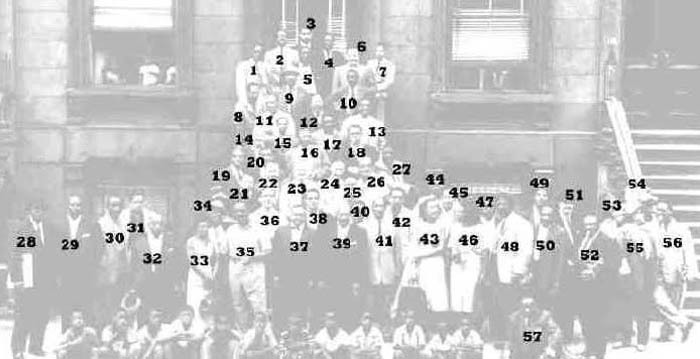
- Hilton Jefferson (1903–1968)
- Benny Golson (1929-)
- Art Farmer (1928–2003)
- Wilbur Ware (1923–1979)
- Art Blakey (1919–1990)
- Chubby Jackson (1918–2003)
- Johnny Griffin (1928–2008)
- Dickie Wells (1909–1985)
- Buck Clayton (1911–1993)
- Taft Jordan (1915–1981)
- Zutty Singleton (1898–1975)
- Henry “Red” Allen (1908–1967)
- Tyree Glenn (1912–1972)
- Miff Mole (1898–1961)
- Sonny Greer (1903–1982)
- J.C. Higginbotham (1906–1973)
- Jimmy Jones (1918–1982)
- Charles Mingus (1922–1979)
- Jo Jones (1911–1985)
- Gene Krupa (1909–1973)
- Max Kaminsky (1908–1994)
- George Wettling (1907–1968)
- Bud Freeman (1906–1988)
- Pee Wee Russell (1906–1969)
- Ernie Wilkins (1922–1999)
- Buster Bailey (1902–1967)
- Osie Johnson (1923–1968)
- Gigi Gryce (1927–1983)
- Hank Jones (1918–2010)
- Eddie Locke (1930–2009)
- Horace Silver (1928–2014)
- Luckey Roberts (1887–1968)
- Maxine Sullivan (1911–1987)
- Jimmy Rushing (1902–1972)
- Joes Thomas (1909–1984)
- Scoville Browne (1915–1994)
- Stuff Smith (1909–1967)
- Bill Crump (1919–1980s)
- Coleman Hawkins (1904–1969)
- Rudy Powell (1907–1976)
- Oscar Pettiford (1922–1960)
- Sahib Shihab (1925–1993)
- Marian McPartland (1920–2013)
- Sonny Rollins (1929-)
- Lawrence Brown (1905–1988)
- Mary Lou Williams (1910–1981)
- Emmett Berry (1915–1993)
- Thelonious Monk (1917–1982)
- Vic Dickenson (1906–1984)
- Milt Hinton (1910–2000)
- Lester “Pres” Young (1909–1959)
- Rex Stewart (1907–1972)
- J.C. Heard (1917–1988)
- Gerry Mulligan (1927–1995)
- Roy Eldridge (1911–1989)
- Dizzy Gillespie (1917–1993)
- William “Count” Basie (1904–1984)
Related Content:
1959: The Year That Changed Jazz
Hear 2,000 Recordings of the Most Essential Jazz Songs: A Huge Playlist for Your Jazz Education
Josh Jones is a writer and musician based in Durham, NC. Follow him at @jdmagness.
Read More...The Exhilarating Filmmaking of Robert Bresson Explored in Eight Video Essays
“Who’s afraid of Robert Bresson?” New Yorker film critic Anthony Lane once asked. “Me, for a start.” But he didn’t mean that he dreaded screenings of Au hasard Balthazar, Diary of a Country Priest, A Man Escaped, The Devil, Probably, or any other acclaimed work in the auteur’s filmography. “It’s not that I don’t look forward to a Bresson picture,” Lane clarified. “It’s just that as I shuffle into the theatre I feel like a pupil approaching the principal’s door, wondering what crimes I may have committed and how I must answer for them.”
Even now, 35 years after his final picture, Bresson intimidates with his rigor — rigor of the moral variety, certainly, but even more so of the aesthetic variety — often described (not least by the likes of Andrei Tarkovsky) in the terms of asceticism. Nevertheless, Indiewire offers a brief and friendly introduction to his cinema in the three-minute video essay at the top of the post.
Just above, in “Robert Bresson: The Essence of Cinema,” A‑BitterSweet-Life gets deeper into the Bressonian sensibility by showing clips of his films alongside clips of him working and speaking, all narrated with his own words.
“I always like to see and hear the film before I shoot it, to come up with things by working on my own, things from my memory or imagination, even if I don’t end up filming them,” Bresson says in one piece of interview footage. “These are often things I can’t come up with on the set, so I believe it’s important to create a solid groundwork, a set of constraints within which the film will take shape. Because I’m aware of these constraints, I can ask my actors, nonprofessional actors, to surprise me. Unlimited surprises but within a limited context.”
Those worlds will sound familiar to anyone who has read Notes sur le cinématographe (variously translated as Notes on Cinematography or Notes on the Cinematographer), Bresson’s collection of maxims laying out his view of his art. If observations like “To set up a film is to bind persons to each other and to objects by looks,” “Empty the pond to get the fish,” and “Be sure of having used to the full all that is communicated by immobility and silence” seem abstract on the page, Filmscalpel’s “Notes on Pickpocket” illustrates their enormous relevance to the effectiveness of Bresson’s work by weaving them directly into scenes of one of his best-known works.
Film scholar David Bordwell examines the same movie, but takes a much less aphoristic and much more technical tack, in “Constructive Editing in Robert Bresson’s Pickpocket,” which contextualizes Bresson’s technique of constructive editing, or building a space while showing only small pieces of it at a time, as opposed to “analytical editing” that first establishes the entire space and then moves within it. Just above, critic and well-known Bresson enthusiast James Quant breaks down the much later L’Argent — or at least its use of reflections and repetition, just the R in the longer “L’Argent, A to Z” video essay Quandt created for the Criterion Collection’s release of the film.
The video essayist Kogonada, now a respected filmmaker in his own right, has so far put out two tributes to Bresson: “Hands of Bresson” just above, which concentrates on the director’s use of those body parts, and “Once There Was Everything,” about the great cinematic effect to which he put doors all throughout his career. “Why shouldn’t I put ten times more doors in my films if I feel like it?” the essay quotes him as saying. But then, the true fan knows that Bresson could hardly have countenanced using even one more door than absolutely necessary — or one more of anything else, for that matter.
In Bresson’s world, to put it in drastically reduced terms, less is more: Julian Palmer’s short video essay above even takes that phrase as its title. Bresson’s work has many virtues, few as nameable as their simplicity, but for the man himself it always had to be just the right kind of simplicity. In Notes sur le cinématographe he identifies two types: “The bad: simplicity as starting-point, sought too soon. The good: simplicity as end-product, recompense for years of effort.” Or, as he he writes elsewhere, “It is with something clean and precise that you will force the attention of inattentive eyes and ears.” A cinema that has forgotten these lessons of Bresson’s — now there’s a truly frightening proposition.
Related Content:
Andrei Tarkovsky Reveals His Favorite Filmmakers: Bresson, Antonioni, Fellini, and Others
An Introduction to Jean-Luc Godard’s Innovative Filmmaking Through Five Video Essays
The Surreal Filmmaking of David Lynch Explained in 9 Video Essays
Based in Seoul, Colin Marshall writes and broadcasts on cities, language, and culture. His projects include the book The Stateless City: a Walk through 21st-Century Los Angeles and the video series The City in Cinema. Follow him on Twitter at @colinmarshall or on Facebook.
Read More...How to Make and Wear Medieval Armor: An In-Depth Primer
Look at a medieval knight in armor and you can’t help but wonder how he got the stuff on. Then follows a question with an even more complicated answer: how did the armor get made in the first place? Luckily, we in the 21st century have medievalists who have dedicated their lives to learning and explaining just such pieces of now-obscure knowledge (as well as the ever-growing legion of medieval battle enthusiasts doing their utmost to both demand that knowledge and hold the scholars who possess it to account). You can see what went into the making of a knight’s armor — and still goes into it, for those inclined to learn the craft — in the video above, a live presentation of the real tools and techniques by armorer Jeffrey D. Wasson at The Metropolitan Museum of Art.
With narration by Dirk Breiding, Assistant Curator of its Arms and Armor Department, the video reveals every step of Wasson’s process, beginning with research into how 500-year-old components of armor looked and work, and ending with pieces that, while newly made, could easily have fit into the suit worn by a knight of those days.
Wasson’s next demonstration, in the second video just above, shows the process of getting dressed in armor, one a knight could hardly execute by himself. Much like the videos about how women got dressed in the 14th and 18th centuries previously featured here on Open Culture, it required an assistant, but in both cases the result is supposed to have been less restrictive and cumbersome than we today might expect — or somewhat less restrictive and cumbersome, anyway.
Though we associate this kind of plate armor with the Middle Ages, it actually developed fairly late in that era, around the Hundred Years’ War that lasted from the mid-14th to the mid-15th century. As a form, it peaked in the late 15th and early 16th centuries, spanning the end of the Middle Ages and the early Renaissance; the image of the knight we all have in our heads is probably wearing a suit of 16th-century armor made for jousting. That practice continued even as the use of armor declined on the battlefield, the development of firearms having greatly lessened its protective value and put a high premium on agility. Yet armor remains an impressive historical artifact and, at its best, an achievement in craftsmanship as well. But now that we know how to make it and put it on, how best to keep it shining?
Related Content:
What’s It Like to Fight in 15th Century Armor?: A Surprising Demonstration
A Free Yale Course on Medieval History: 700 Years in 22 Lectures
Based in Seoul, Colin Marshall writes and broadcasts on cities, language, and culture. His projects include the book The Stateless City: a Walk through 21st-Century Los Angeles and the video series The City in Cinema. Follow him on Twitter at @colinmarshall or on Facebook.
Read More...Watch/Hear Led Zeppelin’s Earliest Performances from 1968–69 & Celebrate the 50th Anniversary of the Band’s Birth
For metalheads and lovers of guitar rock dark, heavy, and chock full of references to sex, demons, tarot cards, and fantasy novels, the birth of Led Zeppelin should be celebrated like Christmas. The 50th anniversary of the band should be a nonstop global cacophony of awkward “Stairway to Heaven” covers. Yes, there are other things going on in the world, terrible things—things that would be that much harder to bear without music as fiery and bombastic as that concocted by the combo of Page/Plant/Jones/Bonham.
In 1968, the band seemed to rocket out of nowhere—erroneously billed as “Len Zefflin” in its earliest taped gig at a Gonzaga University Gymnasium as an opening act for “The Vanilla Fudge” (hear the bootleg above).
But kids in the know knew them as recently-ex-Yardbird Jimmy Page’s new project, originally intended to be a supergroup starring Jeff Beck and The Who’s Keith Moon and John Entwistle. This “dry run,” notes music journalist Keith Shadwick, was Page’s “first attempt to put something together that was really heavyweight.”
Page’s friend from his session days, John Paul Jones, ended up on bass for the only recording session, the project fell apart, and instead Page recruited two not-yet-superstars, Plant and Bonham from Band of Joy, to form what was first known as the New Yardbirds before a cease and desist letter. Accounts of who came up with the replacement name—first “Led Balloon,” a variation on the phrase for a big flop—vary. “But it was said afterwards that that’s what it could have been called,” remembers Page. “Because Moony wanted to get out of The Who, and so did John Entwistle…. Instead, it didn’t happen.”
Yet, it happened. Less determined musicians might have scrapped the idea and joined another band. Page, known as “Mister Cool” for his professionalism, had a distinct vision for what he wanted and was hellbent on manifesting it. “Page said he had Led Zeppelin’s sound, and first songs, fully formed in his mind before the Yardbirds were even done,” Andrew Dalton writes at The Chicago Tribune.“I just knew what way to go,” said Page. “It was in my instinct.”
He conjured the magic with a ceremonial instrument—a 1959 Fender Telecaster he got from Jeff Beck, on which he painted a psychedelic dragon. He called the guitar “the Excalibur” (now a signature guitar that you can buy in replica next year).
After tours of Scandinavia and England as the New Yardbirds, Led Zeppelin made their formal debut at the University of Surrey on October 25th, 1968, then they toured the U.S. and released their debut album in January. Here, you can hear and see some of the band’s first introductions to the world, in the bootleg Gonzaga concert recording at the top, a filmed 1968 performance of “Dazed and Confused,” further up, and, just above, a killer live set from March of ’69 at the Gladsaxe Teen Club in Denmark.
It’s no great surprise that they sounded as good as they did from the start, nor that they had such savvy and poise. Zeppelin was “typical,” writes Shadwick, “of this third wave [of British bands] in that… all were experienced and thoroughly professional even though they were still very young, and they had more than a passing knowledge of how the industry worked before they even signed their first deal as a unit.” But what continues to astonish about Led Zeppelin’s debut is just how heavy it still sounds, 50 years later. Their distant progeny may have taken the template to absurd extremes, but even in the bleakest, most blistering black metal we hear Zeppelin’s musical DNA.
As one early fan who caught them at that early Gonzaga show later remarked, “It was like, after that, psychedelia was dead and heavy metal was born, all in a three-hour show.”
Related Content:
Hear Led Zeppelin’s First Recorded Concert Ever (1968)
Josh Jones is a writer and musician based in Durham, NC. Follow him at @jdmagness.
Read More...Martin Scorsese Creates a List of the 11 Scariest Horror Films
“When it comes to ripe old frighteners — or to any other overheated genre — Scorsese is the most ardent of proselytizers,” writes the New Yorker’s Anthony Lane in a review of that respected director’s ripe-old-frightener-flavored Shutter Island, “so much so that I would prefer to hear him enthuse about Hammer Horror films, say, than to watch a Hammer Horror film.” And though no Hammer productions appear on it, Scorsese, who often seems as much film enthusiast as filmmaker, has put together a solid list of his personal eleven scariest horror movies for The Daily Beast. At its very top we have Robert Wise’s The Haunting, whose trailer you can watch above. Scorsese promisingly describes the story of the film, originally ballyhooed with the tagline “You may not believe in ghosts but you cannot deny terror!,” as “about the investigation of a house plagued by violently assaultive spirits.” His full and frightening list–perfect for Halloween–runs as follows:
- The Haunting (Robert Wise, 1963)
- Isle of the Dead (Val Lewton, 1945)
- The Uninvited (Lewis Allen, 1944)
- The Entity (Frank de Felitta, 1983)
- Dead of Night (Alberto Cavalcanti, Charles Crichton, Basil Dearden and Robert Hamer, 1945)
- The Changeling (Peter Medak, 1980)
- The Shining (Stanley Kubrick, 1980)
- The Exorcist (William Friedkin, 1973)
- Night of the Demon (Jacques Tourneur, 1957)
- The Innocents (Jack Clayton, 1961)
- Psycho (Alfred Hitchcock, 1960)
You can watch clips of all these movies over at The Daily Beast. (And if you simply can’t get enough of the things, see also Time Out London’s list of the 100 best horror films.) Such tastes make it no surprise to see a Hitchcock film make Scorsese’s list; so much does Scorsese love Hitchcock’s work — “one of my guiding lights,” he calls the maker of Psycho — that he once spoofed his own fanboyism in a commercial for Freixenet sparkling wine. For those who’d prefer a more conventional Scorsese-inspired binge watch, we’ve also featured his list of twelve favorite films overall and his list of 39 Essential Foreign Films. Whatever genre you favor, you could do much worse than taking his recommendations.
Note: An earlier version of this post appeared on our site in November, 2014.
Related Content:
Martin Scorsese Reveals His 12 Favorite Movies (and Writes a New Essay on Film Preservation)
Martin Scorsese’s Very First Films: Three Imaginative Short Works
Martin Scorsese Brings “Lost” Hitchcock Film to Screen in Short Faux Documentary
Where Horror Film Began: The Cabinet of Dr. Caligari
Colin Marshall hosts and produces Notebook on Cities and Culture and writes essays on cities, language, Asia, and men’s style. He’s at work on a book about Los Angeles, A Los Angeles Primer. Follow him on Twitter at @colinmarshall or on Facebook.
Read More...Support Us
We're hoping to rely on loyal readers, rather than erratic ads. Please click the Donate button and support Open Culture. You can use Paypal, Venmo, Patreon, even Crypto! We thank you!

About Us

Open Culture scours the web for the best educational media. We find the free courses and audio books you need, the language lessons & educational videos you want, and plenty of enlightenment in between.
Advertise With Us

FREE UPDATES!
GET OUR DAILY EMAIL
Get the best cultural and educational resources on the web curated for you in a daily email. We never spam. Unsubscribe at any time.
FOLLOW ON SOCIAL MEDIA

Open Culture editor Dan Colman scours the web for the best educational media. He finds the free courses and audio books you need, the language lessons & movies you want, and plenty of enlightenment in between.
Advertise With Us


