How Japanese Things Are Made in 309 Videos: Bamboo Tea Whisks, Hina Dolls, Steel Balls & More
The Japanese term kaizen, which just means something like “good change,” has come to signify in global management culture a process of continuous small-scale improvement — an element of the “Japanese business philosophy” so enviously scrutinized during that country’s postwar economic boom. Toyota has done the most to associate themselves with the idea of kaizen-as-continuous-improvement, but it has made its way to countless other businesses, including foreign ones selling completely different products; even the American grocery store Trader Joe’s has worked the word into their internal customer-service lexicon.
But the nature of kaizen comes most clearly into view in the systems of Japanese manufacturing. Japan has long possessed a strong culture of hand-craftsmanship, and, for almost as long, a strong culture of automation as well. You can see both at work in The Making, a series of videos from the Japan Science and Technology Agency’s Science Channel on Youtube. “There are from 2 to 150, and 151 to 309 videos to choose from,” writes Metafilter user aroweofshale, who highlights the episodes on mayonnaise, “the making of steel balls (available in English), the construction and testing of sewing machines, how rice crackers are made, a thermos factory, the recycling of PET bottles, a matcha tea factory and the creation of bamboo whisks.”
These mini-documentaries take in-depth looks at the nuts and bolts (sometimes literally) of production systems that have evolved, small improvement after small improvement, over decades or indeed centuries. You can see in action every stage of these hybrid processes of advanced and highly specialized technology with skilled and sometimes even artisanal human labor, somehow at once elaborate and elegant. This goes for every product featured, no matter how important or trivial it may seem. (I got hooked myself after watching one on chicken-shaped sweets.)
Even non-Japanese-speakers can enjoy all of The Making’s clear and almost completely visual-driven episodes, but the JST has also made select ones available with English subtitles (see top playlist) in order to tell the world all about what it takes to make what it has come to see as quintessentially Japanese, like urban railroad cars, steel balls (of many uses, including but not limited to pachinko machines), and Hina dolls.
Any American old-timer will tell you that, back in their day — a time when the United States’ former enemy had yet to fully rebuild its economy, let alone to become a technological leader — the “made in Japan” stamp signified a piece of junk. These videos show us, in detail, what it took to refute that notion for good.
Related Content:
Discover Japan’s Earthquake Proof Underground Bike Storage System: The Future is Now
Watch a Japanese Craftsman Lovingly Bring a Tattered Old Book Back to Near Mint Condition
Cookpad, the Largest Recipe Site in Japan, Launches New Site in English
Let’s Learn Japanese: Two Classic Video Series to Get You Started in the Language
Based in Seoul, Colin Marshall writes and broadcasts on cities, language, and style. He’s at work on a book about Los Angeles, A Los Angeles Primer, the video series The City in Cinema, the crowdfunded journalism project Where Is the City of the Future?, and the Los Angeles Review of Books’ Korea Blog. Follow him on Twitter at @colinmarshall or on Facebook.
Read More...What Happens When a Japanese Woodblock Artist Depicts Life in London in 1866, Despite Never Having Set Foot There
The affinities between England and Japan go far beyond the fact that both are tea-loving nations with a devotion to gardens; far beyond the fact that both drive on the left, are the world’s leading overseas investors, and are rainy islands studded with green villages. They go even beyond the fact that both have an astringent sense of hierarchy, subscribe to a code of social reticence, and are, in some respects, proud, isolated monarchies with more than a touch of xenophobia. The very qualities that seem so foreign, even menacing, to many Americans in Japan — the fact that people do not invariably mean what they say, that uncertain distances separate politeness from true feelings, and that everything is couched in a kind of code in which nuances are everything — will hardly seem strange to a certain kind of Englishman.
That astute comparison comes from an essay called “For Japan, See Oscar Wilde” by Pico Iyer, a writer uniquely well-placed to sense this sort of thing by virtue of his childhood in England and longtime residence as an adult in Japan. His Indian heritage and penchant for world travel have also equipped him to write with clarity about the ways — sometimes grotesque, sometimes delusional, sometimes aspirational, sometimes fantastical — in which one country can perceive another.
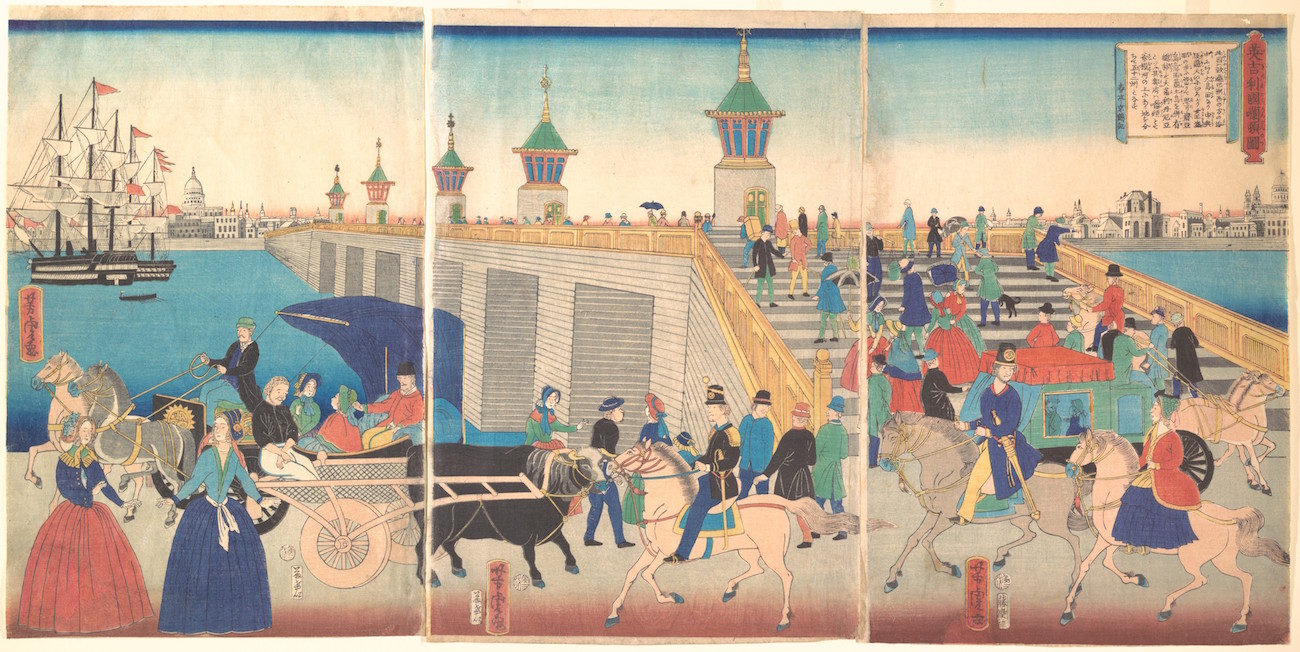
In the case of the somehow separated-at-birth nations of England and Japan, we have some direct documentation of the former as dreamed of by the latter in Utagawa Yoshitora’s 1866 triptych Igirisukoku Rondon no zu.
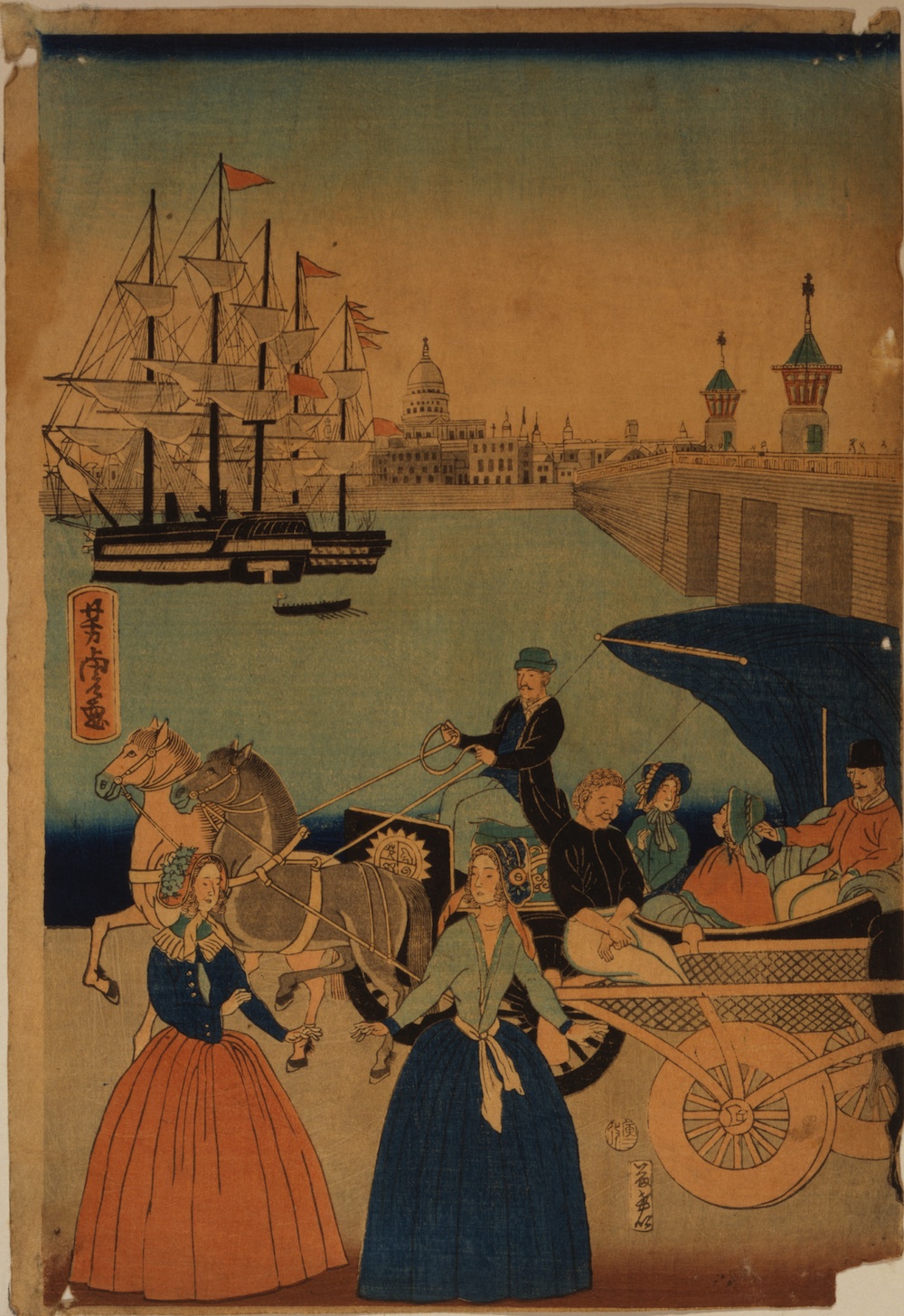
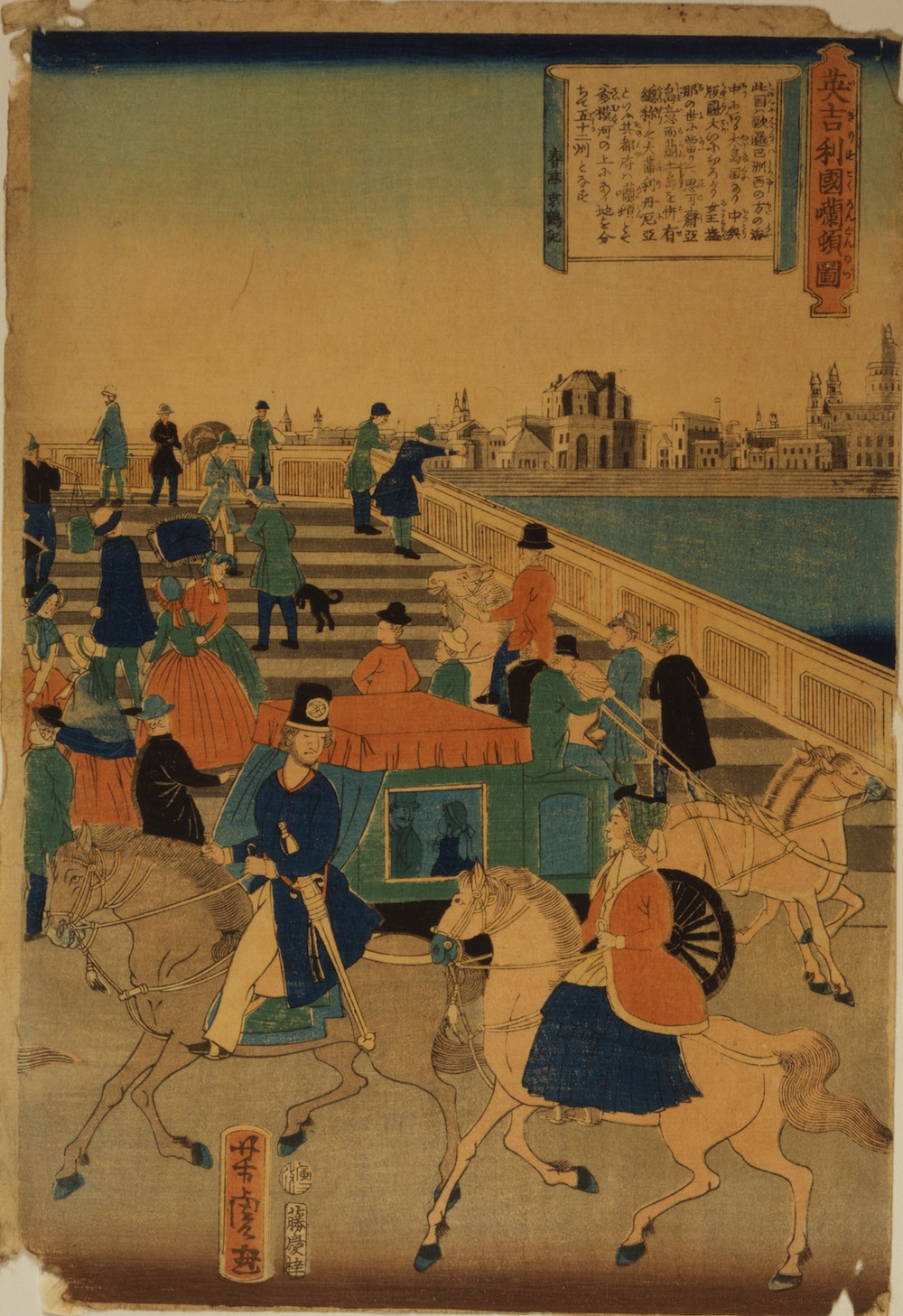
“Together, the three images depict a street scene near the River Thames, complete with thronging English pedestrians, two sailing ships, horses, oxen, and carriages,” writes Slate’s Rebecca Onion: “The images would have sold fairly cheaply, in the thriving market in woodblock (ukiyo‑e) prints in 19th-century Japan. Utagawa, a relatively minor artist from an extensive lineage of woodblock printers, also produced portraits of Kabuki actors, triptychs of historical battle scenes, and images of foreigners in Yokohama—one of the only places in Japan where they were allowed to trade at the time. (Here’s an 1861 print titled ‘Two Americans.’) Utagawa probably did not visit London, and was instead working from secondhand reports.”
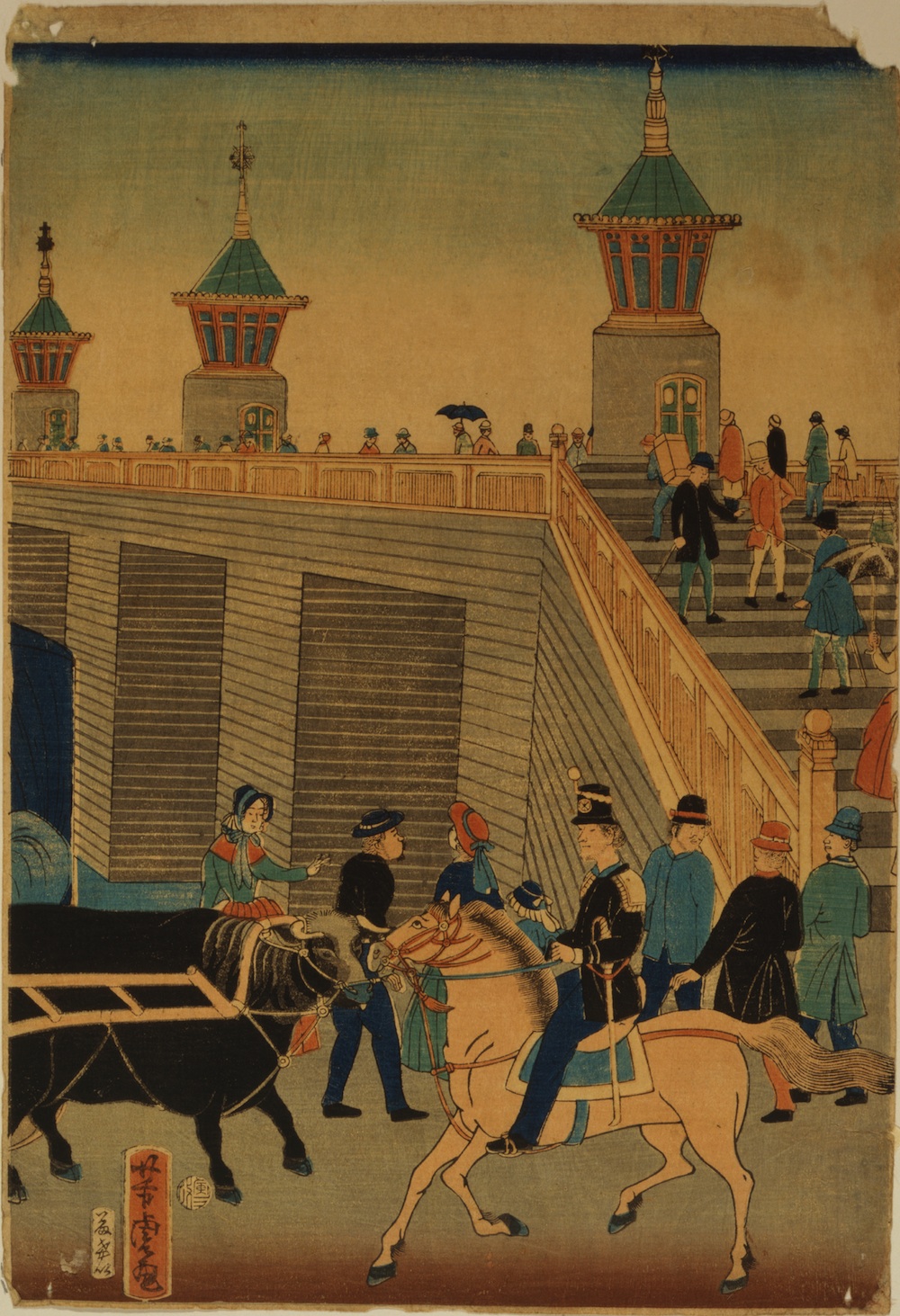
That would make him a perfect subject for Iyer, who has tended to specialize in writing not just about the places of the world but the places of the mind. While the people of Utagawa’s London of the mind display a simplified typical English style of dress, and do so before a proud domed building and a mighty-looking, elaborately rigged sailing ship, their composition remains somehow quintessentially Japanese. But then, how much separates the quintessentially Japanese from the quintessentially English? “The actual people who live in Japan,” said Oscar Wilde as quoted in Iyer’s essay, “are not unlike the general run of English people.”
And the affinity goes both ways. When Prince Fushimi Sadanaru made a state visit to England forty years after Utagawa made his prints, he hoped to catch a performance of The Mikado, Gilbert and Sullivan’s hit comic opera set very much in the Japan of the English mind (and one that faces accusations of cultural imperialism to this day). Alas, the British government had preemptively canceled all performances during the Prince’s stay for fear of offending him. This prompted a Japanese journalist in London to later see the show himself. He went on to write of his disappointment: he’d gone in expecting “real insults” to his homeland, only to find “bright music and much fun.”
via Slate’s The Vault/Two Nerdy History Girls
Related Content:
London Mashed Up: Footage of the City from 1924 Layered Onto Footage from 2013
2,000 Years of London’s Historical Development, Animated in 7 Minutes
Prize-Winning Animation Lets You Fly Through 17th Century London
1927 London Shown in Moving Color
Download Hundreds of 19th-Century Japanese Woodblock Prints by Masters of the Tradition
The Best Writing Advice Pico Iyer Ever Received
Based in Seoul, Colin Marshall writes and broadcasts on cities, language, and style. He’s at work on a book about Los Angeles, A Los Angeles Primer, the video series The City in Cinema, the crowdfunded journalism project Where Is the City of the Future?, and the Los Angeles Review of Books’ Korea Blog. Follow him on Twitter at @colinmarshall or on Facebook.
Read More...Walter Benjamin Jots in His Notebook Every Book He’s Read Since He Was 18
If you’re in Berlin, stop by the Galerie Max Hetzler, which is currently staging an exhibition where the Jewish mystic philosopher Walter Benjamin plays a prominent role. Here’s how the gallery sets the scene:
[British artist British artist Edmund] De Waal first came to know the city of Berlin through the writings of Walter Benjamin, particularly his autobiographical fragments in A Berlin Childhood around 1900. The exhibition title, Irrkunst, has been taken from Benjamin’s concept of the art of getting lost, the art of noticing what has been disregarded.
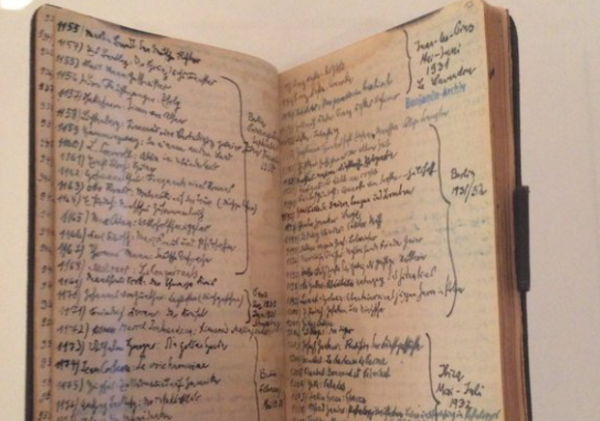
In the Bleibtreustrasse gallery, offering a room with a view on Walter Benjamin’s former school, [De Waal] will show works that reflect Benjamin’s childhood, his passion for gathering objects and the idea of collecting as memory work. Here, amongst others, de Waal will present a major new series of vitrines. Furthermore, a selection of original notes and manuscripts from the Walter Benjamin archive in Berlin will be on view at Bleibtreustrasse and illustrate Benjamin’s own way of working as well as de Waal’s deep fascination with the œuvre of this thinker.
One such item on display, we discovered through Julia Michalska’s Twitter stream, is “Walter Benjamin’s notebook in which he noted all the books he read since he was 18”–a picture of which you can find above. When I zoomed into the image, I couldn’t make out the books on the list. But I did get this detail: By 1931/32, the 40-year-old Benjamin had amassed 1200 books on his list, which means he was reading, on average, 54 books per year. No doubt, they weren’t light ones. If anyone stops by Galerie Max Hetzler and identifies actual titles in the notebook, we’d love it if you could note some in the comments section below.
Update: Some titles were added to the comments below–books by Cocteau, Hemingway, Malraux and more. Check them out.
Looking for free, professionally-read audio books from Audible.com? Here’s a great, no-strings-attached deal. If you start a 30 day free trial with Audible.com, you can download two free audio books of your choice. Get more details on the offer here.
If you would like to support the mission of Open Culture, consider making a donation to our site. It’s hard to rely 100% on ads, and your contributions will help us continue providing the best free cultural and educational materials to learners everywhere. You can contribute through PayPal, Patreon, and Venmo (@openculture). Thanks!
Related Content:
Walter Benjamin’s 13 Oracular Writing Tips
Walter Benjamin’s Radio Plays for Kids (1929–1932)
Walter Benjamin’s Philosophical Thought Presented by Two Experimental Films
Read More...Hear “Starlight,” Michael Jackson’s Early Demo of “Thriller”: A Version Before the Lyrics Were Radically Changed
The definitive blockbuster albums of an 80s childhood… maybe you weren’t there, but the Internet has made it so you might as well have been. Prince’s 1999 and Purple Rain, Van Halen’s 1984, Michael Jackson’s Midnight Man, the best-selling album of all time and biggest thing to happen to pop music since Off the Wall. Surely you remember the hit single “Starlight.” Its smooth grooves have burrowed into the brain of anyone who has ever seen a radio. Hit play above and tell me you don’t immediately start singing the chorus:
We need some starlight starlight sun
There ain’t no second chance we got to make it while we can
You need the starlight some starlight sun
I need you by my side you give me starlight starlight tonight yeah
But this sounds an awful lot like that other song, the one you actually remember singing—and dancing—along to every Halloween. In fact, it sounds exactly like “Thriller.” But what’s with these lyrics?
“Starlight” is the song writer Rod Temperton originally penned. And the album title? Temperton tells The Telegraph that after Quincy Jones gave him the assignment, he went back to his hotel room, “wrote two or three hundred titles, and came up with the title ‘Midnight Man.’” It didn’t last long. The next morning, Temperton had an epiphany:
I woke up, and I just said this word… Something in my head just said, this is the title. You could visualize it on the top of the Billboard charts. You could see the merchandising for this one word, how it jumped off the page as “Thriller.”
The rest is a history so thoroughly embedded in the pop culture matrix that it’s nearly impossible to think things could have been otherwise. “Imagining ‘Thriller’ as anything else,” writes Patrick Rivers at American Music Review, “can be puzzling, even unfathomable.” In his short, but comprehensive survey of Thriller’s creation, Rivers wonders “whether unpolished products of popular artists should be made available.” Do such demos compromise or enhance our appreciation of the final, commercial product? “ ‘Starlight’ can really disturb prior understandings of Jackson’s career and image,” Rivers concludes; it “does not fit the product or artist that is Michael Jackson.”
And yet, such recordings almost invariably become public eventually: “While years of popular music creation remain behind the blissful curtain, the presence of ‘Starlight’ on social and peer-to-peer networks demonstrates an appetite for this content.” While no similar appetite may exist in the case of great literary works, the shock and surprise at hearing “Starlight” (readily available on YouTube) is akin to that feeling many students of T.S. Eliot’s poetry experience when they discover that his masterpiece The Waste Land was originally titled “He Do the Police in Different Voices” and was a very different work of art before it was heavily edited and even rewritten by Ezra Pound.
The comparison illuminates an important point about all art, commercial or otherwise: that it is very often the product of many hands and the result of many prior versions, and its success depends upon an often ungainly, trial-and-error process that might have led to very different results. “Starlight,” Rivers writes, “elucidates the calculated decisions made in the creation of commercial popular music.” Surely we knew this, yet when it comes to an artist like Michael Jackson at the height of his creative powers, we assume a kind of instant pop perfection, rather than the hit-by-committee process Rivers describes in his article.
In the case of “Thriller,” the committee mostly consisted of Temperton—whose “Starlight” demo had been chosen from hundreds submitted by others—and Quincy Jones, who gently pushed the songwriter toward an edgier theme and secured the great Vincent Price for the song’s outro (written by Temperton in a taxi on the way to the studio; Hear a studio outtake of Price’s voiceover above.) Album engineer Bruce Swedian remembers “the words ‘Edgar Allan Poe’ going between Quincy and Rod. Quincy saying it should be more Edgar Allan Poe. And that ‘Starlight’ isn’t, ‘Thriller’ is.”
Temperton recalled later in his commentary for the 2001 Thriller: Special Edition that as “Thriller” took shape along with “Billie Jean” and “Wanna be Starting Something,” the production team “were kind of giving the whole thing an edge and a direction that some of the other tracks didn’t have.” It was an edge, Rivers notes, “intended to represent Jackson’s unveiling as an adult recording artist,” jumpstarting his transition from child star and the boyish twenty-year-old of Off the Wall.
Delivering to the world a grown-up Michael Jackson in the artist’s next massive hit record was certainly Jones’ intent, though it was Jackson who penned most of album’s edgier songs. Hits like “Billie Jean” and “Beat It” arrived nearly fully formed. (Hear “Billie Jean” in a home demo above and an a cappella demo of “Beat It” below.) But it took the brilliance of Quincy Jones and his production “A‑Team” to bring these songs to the pop music marketplace, supplying just the right embellishments—like Eddie Van Halen’s “Beat It” solo—to etch these tunes into our collective consciousness forever.
via Kottke
Related Content:
Miles Davis Covers Michael Jackson’s “Human Nature” (1983)
Josh Jones is a writer and musician based in Durham, NC. Follow him at @jdmagness
Read More...Sir Ian McKellen Releases New Apps to Make Shakespeare’s Plays More Enjoyable & Accessible
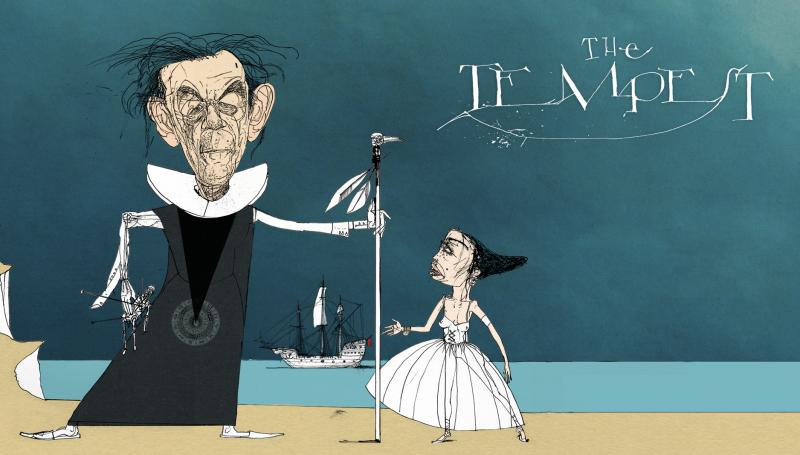
FYI: Ian McKellen, who first made his reputation performing at the Royal Shakespeare Company in the 1970s and 80s, has just released the first of a series of iPad apps meant to make Shakespeare’s plays more accessible, especially for high school and college students.
As McKellen explains above, Shakespeare’s plays were originally meant to be seen performed live in a theatre, not read as books. And so these apps feature actors performing dramatic scenes from the plays, while text scrolls by. They’ve just launched the first of 37 apps. It’s devoted to The Tempest, runs $5.99 on iTunes, and frankly seems well worth the price. Benedict Cumberbatch likes it. See below.
The app also includes these features:
- The full text of The Tempest as published in the First Folio.
- A full digital version of Arden Shakespeare The Tempest.
- The ability to switch between three different levels of notes depending on the level of reader’s needs.
- A full breakdown and explanation of every character and all of their lines across every scene.
- A linked historical time line of Shakespeare’s life, his plays, his theatres, and contemporary context to put it all into perspective.
- Video explanations and discussions by both Sir Ian McKellen and Professor Sir Jonathan Bate on characters, themes, and the meaning of the play.
- A full “play at a glance” with illustrations and summaries to explain the play’s plot with key quotes and events.
- A history of all the major productions of The Tempest from the 17th century to the present day.
- The option to make notes, copy and highlight text that can be collected, correlated and exported for later use.
- The option to search the play’s full text and essays.
Keep your eye on Heuristic Shakespeare’s iTunes site for new Shakespeare apps down the line.
Related Content:
Ian McKellen Stars in King Lear
Sir Ian McKellen Puts on a Dazzling One-Man Shakespeare Show
Read More...The Poetic Harmony of Andrei Tarkovsky’s Filmmaking: A Video Essay
“What words would best describe a Tarkovsky film?” asks Lewis Bond, creator of the cinephile video-essay Youtube channel Channel Criswell. He offers a few right away: “Haunting, ethereal, hypnotic, serene.” But appreciators, scholars, and even critics of the work of Andrei Tarkovsky, the Soviet director of such austere yet visually rich, serious-minded yet dreamlike, and long artistically scrutinized pictures as Andrei Rublev, Solaris, Stalker, and The Mirror (watch them all free online here), could come up with many more. And though the man himself may have denied drawing any inspiration from similarly respected filmmakers — Bresson, Antonioni, Bergman, Kurosawa, Mizoguchi, “I have no desire to imitate any of them” — few could avoid exposure to his own widespread and lasting influence on cinema.
Why has Tarkovsky’s work made such an impact? One might argue that the answer has do to with his commitment to “pure cinema,” or in Bond’s words, “to do with film that which couldn’t be done with other art forms.” Solaris may have emerged, extensively rethought, out of the source material of Stanislaw Lem’s eponymous science fiction novel, and Stalker may have more recently provided the elements of a video game (which went on to become a series of novels itself), but none of Tarkovsky’s works can truly exist outside the medium, with all its emotional and experiential power, in which he and his collaborators made them.
In this video essay called “Poetic Harmony,” Bond identifies the purely cinematic qualities of Tarkovsky’s films: from the textures of their visual composition to their selective use of sound (and quietness as well) to build moods and the resistance of their abstraction and ambiguity to intellectual analysis (despite how much viewers continue to fling at them); from their lack of symbolism to their building of characters through not words but action, the connection of scenes through metaphor (as in Nostalghia, which cuts from a man who lights himself on fire to a man who struggles to light a candle), and their use of long takes to build the “pressure of time.” Tarkovsky enthusiasts could hardly disagree, though the time soon comes to put away what The Sacrifice’s central character calls “words, words, words” and simply watch.
When you’re done watching Bond’s video, you can watch many of Tarkovsky’s major films free online, thanks to Russian film studio Mosfilm.
Related Content:
A Poet in Cinema: Andrei Tarkovsky Reveals the Director’s Deep Thoughts on Filmmaking and Life
“Auteur in Space”: A Video Essay on How Andrei Tarkovsky’s Solaris Transcends Science Fiction
Andrei Tarkovsky’s Solaris Shot by Shot: A 22-Minute Breakdown of the Director’s Filmmaking
Based in Seoul, Colin Marshall writes and broadcasts on cities, language, and style. He’s at work on a book about Los Angeles, A Los Angeles Primer, the video series The City in Cinema, the crowdfunded journalism project Where Is the City of the Future?, and the Los Angeles Review of Books’ Korea Blog. Follow him on Twitter at @colinmarshall or on Facebook.
Read More...Hear Oscar Wilde’s “The Happy Prince,” Performed by Orson Welles & Bing Crosby on Christmas Eve 1944
The most beloved fables have survived for ages, passed down from generation to generation in one form or another since time immemorial. It speaks to the genius of Oscar Wilde that his children’s story “The Happy Prince” has attained that status despite having existed for less than 130 years. In that time it has captivated readers, listeners, and viewers (including the likes of Patti Smith) in the original text as well as in a variety of adaptations, including an orchestral performance, an animated film, a reading by Stephen Fry, and a rock opera. It also provided material for a number of radio broadcasts in the 1930s and 40s, including the one above, a reading by Orson Welles, Bing Crosby, and Lurene Tuttle.
Welles takes the Wildean role of the narrator. Crosby plays the titular prince immortalized in statue form without having ever, ironically, experienced happiness in life. Tuttle, a prolific actress of not just radio but vaudeville, film, and television, gives voice to the swallow who, left behind when his flock migrates to Egypt for the winter, alights on the prince’s shoulder. In their shared lonesomeness, the bird and the statue become friends, and the prince asks the sparrow to distribute his decorations to the people of the impoverished town around them. What comes of these selfless deeds? The answer resides, with the rest of the story, in the hallowed realm of myth.
Welles, Crosby, and Tuttle’s performance of “The Happy Prince” debuted on the Philco Radio Hall of Fame on Christmas Eve 1944. It proved popular enough that two years later, Decca commissioned the actors for another performance of the story and put it out as a record album. In becoming something of a holiday tradition, Wilde’s immaculately crafted tale of companionship, sacrifice, and redemption has surely turned a few generations on to the work of one of the sharpest wits in western history. The prince and the swallow may come to an unfortunate end on Earth, but they enjoy the recognition their deeds have earned them in the kingdom of heaven. Wilde’s own short life closed with a series of difficult chapters, but now we all recognize the preciousness of what he left behind.
Find more readings of Oscar Wilde classics in our collection, 1,000 Free Audio Books: Download Great Books for Free.
Related Content:
Stephen Fry Reads Oscar Wilde’s Children’s Story “The Happy Prince”
Watch Animations of Oscar Wilde’s Children’s Stories “The Happy Prince” and “The Selfish Giant”
Patti Smith’s List of Favorite Books: From Rimbaud to Susan Sontag
Based in Seoul, Colin Marshall writes and broadcasts on cities, language, and style. He’s at work on a book about Los Angeles, A Los Angeles Primer, the video series The City in Cinema, the crowdfunded journalism project Where Is the City of the Future?, and the Los Angeles Review of Books’ Korea Blog. Follow him on Twitter at @colinmarshall or on Facebook.
Read More...Frida!
In a pretty great gif. That’s all.
If you would like to support the mission of Open Culture, consider making a donation to our site. It’s hard to rely 100% on ads, and your contributions will help us continue providing the best free cultural and educational materials to learners everywhere. You can contribute through PayPal, Patreon, and Venmo (@openculture). Thanks!
Related Content:
Frida Kahlo and Diego Rivera Visit Leon Trotsky in Mexico, 1938
Read More...Sell & Spin: The History of Advertising, Narrated by Dick Cavett (1999)
“According to a study published Monday by researchers at Duke University’s Center for Cognitive Neuroscience, humans experience the most intense feelings of happiness when pressing the ‘skip ad’ button before watching a video on the internet.” That comes from The Onion, whose satirical reporting hits the mark as usual. If we know one thing about advertising for sure, we know that we don’t like it — or at least we don’t like many of its current manifestations, so much so that we willingly engage in the arms race of downloading special programs to block them, which advertisers soon find a way to defeat, requiring us to find new evasive tactics, which forces advertises to cut another path to us, and so on.
How has it come to this? You can learn exactly how from Sell & Spin, the 1999 television documentary above. “From ancient phrases etched in stone to today’s cutting-edge multimedia commercials, selling has always meant grabbing attention,” says its narrator, the respected talk-show host Dick Cavett. “The point? Moving the product. The means? Tapping into desire — creating need.” From the first known advertisement, a wine shop’s sign from ancient Babylon, to the eve of the high-tech 21st century, Cavett and a host of advertising experts tell the story of not just how advertising became an industry in the first place, but how it became the huge, shape-shifting industry we regard today as both wildly creative yet somehow sinister.
Even the most ad-loathing viewer will recognize many of the iconic examples of this ultra-commercial art form of the thousands this documentary includes: Burma-Shave roadsigns, the smoke-blowing Camel cigarettes billboard in Times Square, the Volkswagen Beetle touting itself as a “lemon” on a whole magazine page, “I can’t believe I ate the whole thing”; mascots from Tony the Tiger to the Marlboro Man (a symbol of freedom, we hear, for postwar office workers shackled to their desks) to the Taco Bell chihuahua; and of course Coca-Cola’s “I’d like to teach the world to sing,” whose conception the final episode of Mad Men fictionalized by putting into the mind of its protagonist, 1960s Madison Avenue “creative” Don Draper.
That acclaimed recent television drama both glamorized and criticized the culture of the 20th-century advertising industry, which may have operated as cynically and opportunistically as the businesses it worked for, but which nevertheless crafted some of the most enduring words and images in our modern culture. But what of the “mad men” of today, charged with the thankless (if often remunerative) task of coming up with those videos we get such a kick out of clicking past? Sell & Spin shows us the very beginning of their work, taking place on a now-quaint-looking cyberspace that had only just moved beyond Burma Shave-simple banner ads.
“Nobody quite knows how to use it effectively,” says Jay Chiat of the internet toward the documentary’s end. As the co-founder of Los Angeles’ formidable Chiat/Day advertising industry, he knew the mechanics of the craft well indeed, more than thoroughly enough to recognize both the medium’s potential and the extent to which nobody had yet tapped it. How we all use the internet has changed dramatically since Chiat died in 2002, but his words still ring true. It’s still early days for internet advertising, and its maddest men (and women) — the ones who fully reject the old industry commandment to “irritate your way into peoples’ consciousness — have yet to arrive on the scene.
Sell & Spin will be added to our list of Free Documentaries, a subset of our collection 4,000+ Free Movies Online: Great Classics, Indies, Noir, Westerns, Documentaries & More.
Related Content:
Watch the First Commercial Ever Shown on American TV, 1941
Eisenhower Answers America: The First Political Advertisements on American TV (1952)
Before Mad Men: Familiar and Forgotten Ads from 1950s to 1980s Now Online
The Mad Men Reading List: 25 Revealing Books Read by the Characters on the Show
Digital Archive of Vintage Television Commercials
David Ogilvy’s 1982 Memo “How to Write” Offers 10 Pieces of Timeless Advice
A Gallery of Mad Magazine’s Rollicking Fake Advertisements from the 1960s
Based in Seoul, Colin Marshall writes and broadcasts on cities, language, and style. He’s at work on a book about Los Angeles, A Los Angeles Primer, the video series The City in Cinema, the crowdfunded journalism project Where Is the City of the Future?, and the Los Angeles Review of Books’ Korea Blog. Follow him on Twitter at @colinmarshall or on Facebook.
Read More...Delight in Prince’s Extraordinarily Poignant Cover of Radiohead’s “Creep
Prince didn’t cover a song, he possessed it. He took over its limbs and made it do things it had never done before—dance wildly down the aisles, scream, shout, and fall to the ground. When he covered a song, it got religion the way people only do in the movies. And if you had the privilege to see it happen, you too became a believer in every word and note. As the producer Fafu, a onetime member of his army of players and techs, testified yesterday: “I never saw Prince make a mistake—in anything.” It may sound like a musician who fits that description would have to be some kind of robot; Prince was precisely the opposite, the apotheosis of what a human being could do with voice, guitar, and virtually every other instrument.
Unsurprisingly, Prince’s all-powerful control over his musicianship extended to most other areas of his life. He “was hard on people,” Fafu remembered, “I don’t want to paint an ugly picture, but he was tough. You wanted to please daddy.” He was equally hard on people who disseminated his recordings and performances in unauthorized ways. But in at least one case, Radiohead’s Thom Yorke fought back, forcing Prince to unblock access to Youtube footage of his 2008 Coachella version of “Creep.” And wow, are we glad he did. See it above (especially poignant is his gospel delivery of the line, “you just want to have controoool.”), and be reborn.
Prince reminds us that every hard rock ballad since the early ‘80s owes him a royalty check, and that just one of his screams, one of his explosive guitar fills, even one of his pregnant pauses, had more power and beauty in it than some entire albums. Prince didn’t have to want to be special. He just was.
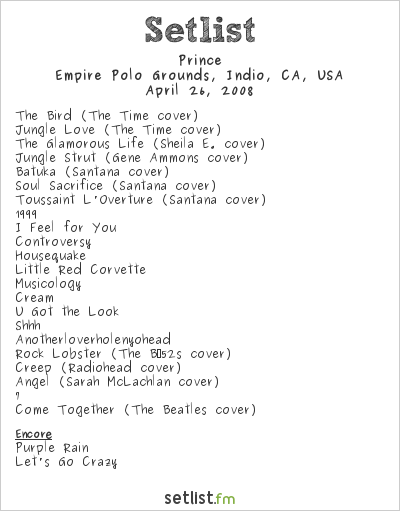
As I shared yesterday, he was without a doubt the most incredible live performer I have ever experienced, so much so that I generally prefer his live recordings—bootlegged or otherwise—to his studio stuff. Millions of people feel likewise, and thanks to one fan, we have the full audio of that headlining Coachella show. Hear it all here (and see the setlist further down)—the ridiculously catchy funk/soul hits, the between-song inspirational patter, the soaring, snarling guitar solos, and the covers: including “Creep,” “Come Together,” Sarah Mclachlan’s “Angel,” songs by Santana, The Time, Sheila E., and, no kidding, The B‑52’s “Rock Lobster.”
Related Content:
Josh Jones is a writer and musician based in Durham, NC. Follow him at @jdmagness
Read More...Support Us
We're hoping to rely on loyal readers, rather than erratic ads. Please click the Donate button and support Open Culture. You can use Paypal, Venmo, Patreon, even Crypto! We thank you!

About Us

Open Culture scours the web for the best educational media. We find the free courses and audio books you need, the language lessons & educational videos you want, and plenty of enlightenment in between.
Advertise With Us

FREE UPDATES!
GET OUR DAILY EMAIL
Get the best cultural and educational resources on the web curated for you in a daily email. We never spam. Unsubscribe at any time.
FOLLOW ON SOCIAL MEDIA

Open Culture editor Dan Colman scours the web for the best educational media. He finds the free courses and audio books you need, the language lessons & movies you want, and plenty of enlightenment in between.
Advertise With Us

