Mad Magazine’s Al Jaffee & Other Cartoonists Create Animations to End Distracted Driving
Model Ts were the average American’s car of choice in 1921, when cartoonist Al Jaffee was born.
The father of MAD Magazine’s fold-ins was but seven when the T’s successor, the Model A, was introduced.
It would be a long time before such innovations as seat belts, baby seats, and airbags were introduced. These safety measures do a fine job of minimizing human damage in motor vehicle accidents, but they can’t prevent the collisions themselves.
To remedy this, Ford, the company responsible for the Model T and hundreds of motor vehicles since, recently enlisted Jaffee and his fellow cartoonists, MK Brown and Bill Plympton, to educate the public on the dangers of distracted driving. Turns out this preventable scourge rivals intoxication and hazardous road conditions as a leading cause of accidents.
Jaffee’s take, animated by J.J. Sedelmaier, above, will never be mistaken for filmmaker Werner Herzog’s harrowing anti-texting documentary PSA, From One Second to the Next, or even Jaffee’s own anti-drunk driving fold-in from MAD’s March 1975 issue.
Instead, he offers a gentle, child-friendly metaphor in which an uncaged bird becomes a havoc-wreaking distraction. (Fortunately, everyone’s wearing his seatbelt, and the little boy is riding in back, in compliance with CDC recommendations.)
National Lampoon alum, Brown, tiptoes closer to the true causes of distraction, with the alien-themed segment, above, also animated by Sedelmaier. If it seems likelier that the alien’s earthling wife might do her henpecking via text rather than actual call these days—well, sometimes dramatic liberties are warranted to get the message across.
Unsurprisingly, Plympton’s self-animated contribution is the most graphic, a direct descendent of his fabulously grotesque cartoon primers 25 Ways To Quit Smoking and How To Kiss. Moral? Assuming you want to keep your teeth in your head, the vegetable matter wedged in between can wait ’til you reach your destination.
Related Content:
Werner Herzog’s Eye-Opening New Film Reveals the Dangers of Texting While Driving
Reading While Driving, Seriously?
Ayun Halliday is an author, illustrator, and Chief Primatologist of the East Village Inky. Her plan for avoiding accidents is to refrain from driving whenever possible. Follow her @AyunHalliday
Read More...Ta-Nehisi Coates’ List of 13 Recommended Books
Ta-Nehisi Coates has been riding a wave so high these past few years that most honest writers would confess to at least some small degree of envy. And yet anyone—writer or reader—who appreciates Coates’ rigorous scholarship, stylistic mastery, and enthralling personal voice must also admit that the accolades are well-earned. Winner of the National Book Award for his second autobiographical work, Between the World and Me and recipient of a MacArthur “Genius Grant,” Coates is frequently called on to discuss the seemingly intractable racism in the U.S., both its long, gritty history and continuation into the present. (On top of these credentials, Coates, an unabashed comic book nerd, is now penning the revived Black Panther title for Marvel, currently the year’s best-selling comic.)
As a senior editor at The Atlantic, Coates became a national voice for black America with articles on the paradoxes of Barack Obama’s presidency and the bootstraps conservatism of Bill Cosby (published before the comedian’s prosecution). His article “The Case for Reparations,” a lengthy, historical examination of Redlining, brought him further into national prominence. So high was Coates’ profile after his second book that Toni Morrison declared him the heir to James Baldwin’s legacy, a mantle that has weighed heavily and sparked some backlash, though Coates courted the comparison himself by styling Between the World and Me after Baldwin’s The Fire Next Time. In doing so, writes Michael Eric Dyson, “Coates did a daring thing… waged a bet that the American public could absorb even more of the epistolary device, and wrote a book-length essay to his son.”
Not only did America “absorb” the device; the nation’s readers marveled at Coates’ deft mixture of existential toughness and emotional vulnerability; his intense, unsentimental take on U.S. racist animus and his moving, loving portraits of his close friends and family. As a letter from a father to his son, the book also works as a teaching tool, and Coates liberally salts his personal narrative with the sources of his own education in African American history and politics from his father and his years at Howard University. In the wake of the fame the book has brought him, he has continued what he seems to view as a public mission to educate, and interviews and discussions with the writer frequently involve digressions on his sources of information, as well as the books that move and motivate him.
So it was when Coates sat down with New York Times Magazine and ProPublica reporter Nikole Hannah-Jones at New York’s Schomburg Center for Research in Black Culture last year. You can watch the full interview at the top of the post. During the course of the hour-long talk, Coates mentioned the books below, in the hopes, he says, that “folks who read” Between the World and Me “will read this book, and then go read a ton of other books.” He both began and ended his recommendations with Baldwin.
1. “The Fire Next Time” in Collected Essays by James Baldwin.
2. The Night of the Gun: A Reporter Investigates the Darkest Story of His Life, His Own by David Carr
3. The Half Has Never Been Told: Slavery and the Making of American Capitalism by Edward E. Baptist
4. Battle Cry of Freedom: The Era of the Civil War by James McPherson
5. Making the Second Ghetto: Race and Housing in Chicago, 1940–1960 by Arnold R. Hirsch
6. Family Properties: Race, Real Estate, and the Exploitation of Black Urban America by Beryl Satter
7. Confederate States of America — Declaration of the Immediate Causes Which Induce and Justify the Secession of South Carolina from the Federal Union from Avalon Project, Lillian Goldman Law Library, Yale Law School
8. Showdown: Thurgood Marshall and the Supreme Court nomination That Changed America by Wil Haygood
9. American Slavery, American Freedom: The Ordeal of Colonial Virginia by Edmund S. Morgan
10. Racecraft: The Soul of Inequality in American Life by Karen E. Fields and Barbara J. Fields
11. When and Where I Enter: The Impact of Black Women on Race and Sex in America by Paula Giddings
12. Ida: A Sword Among Lions: Ida B. Wells and the Campaign against Lynching by Paula J. Giddings
13. Out of the House of Bondage: The Transformation of the Plantation Household by Thavolia Glymph
Finally, Coates references the famous debate between James Baldwin and William F. Buckley at Cambridge University in 1965, which you can read about and watch in full here.
via The New York Public Library
Related Content:
Toni Morrison Dispenses Writing Wisdom in 1993 Paris Review Interview
James Baldwin Bests William F. Buckley in 1965 Debate at Cambridge University
Stephen King Creates a List of 96 Books for Aspiring Writers to Read
Ernest Hemingway Creates a Reading List for a Young Writer, 1934
Michael Stipe Recommends 10 Books for Anyone Marooned on a Desert Island
Josh Jones is a writer and musician based in Durham, NC. Follow him at @jdmagness
Read More...Martin Scorsese Names His Top 10 Films in the Criterion Collection
“What do you do when you change how the world thinks of cinema? What’s next? Do you keep making the same kind of film? If you’re a person like Rossellini, you try something experimental. You push further. Not experimental for experiment’s sake, but you push the boundaries further.” With these words, Martin Scorsese describes the situation of Roberto Rossellini, one of his predecessors in filmmaking he most admires, after completing Paisan in 1946. Where to take the movement “Italian neorealism” from there?
Scorsese discusses Rossellini’s next three major films, Stromboli, Europe ’51, and Journey to Italy in this Conversations Inside the Criterion Collection interview clip from Vice. Given his possession of an enthusiasm for cinema as strong as his mastery of the craft of cinema (making him a predecessor of such younger American indie-rooted cinephile-auteurs as Quentin Tarantino and Wes Anderson), it makes sense that Scorsese would want to engage with the Criterion Collection, whose painstakingly-produced video releases of respected films have for decades constituted a kind of film school, informal yet rich and rigorous.
When Criterion, whose catalog includes Scorsese’s own The Last Temptation of Christ, asked the director to name his ten favorite films in the Collection, he began with a paean to Paisan. (Note: You can watch Paisan for free if you start a free trial with Hulu. Also watch Fellini’s 8 1/2–listed below–free on Hulu here.) “I saw it for the first time on television with my grandparents, and their overwhelming reaction to what had happened to their homeland since they left at the turn of the century was just as present and vivid for me as the images and the characters,” he said. “I was experiencing the power of cinema itself, in this case made far beyond Hollywood, under extremely tough conditions and with inferior equipment. And I was also seeing that cinema wasn’t just about the movie itself but the relationship between the movie and its audience.”
Here are Scorsese’s nine other Criterion selections:
- The Red Shoes (Michael Powell and Emeric Pressburger) “There’s no other picture that dramatizes and visualizes the overwhelming obsession of art, the way it can take over your life. But on a deeper level, in the movement and energy of the filmmaking itself, is a deep and abiding love of art, a belief in art as a genuinely transcendent state.”
- The River (Jean Renoir) “This was Jean Renoir’s first picture after his American period, his first in color, and he used Rumer Godden’s autobiographical novel to create a film that is, really, about life, a film without a real story that is all about the rhythm of existence, the cycles of birth and death and regeneration, and the transitory beauty of the world.”
- Ugetsu (Kenji Mizoguchi) “The boat slowly materializing from out of the mist and coming toward us… Genjuro collapsing on the grass in ecstasy and being smothered by Lady Wakasa… the final crane up from the son making an offering at his mother’s grave to the fields beyond. Just to think of these moments now fills me with awe and wonder.”
- Ashes and Diamonds (Andrzej Wada) “I saw Ashes and Diamonds for the first time in 1961. And even back then, during that period when we expected to be astonished at the movies, when things were happening all over the world, it shocked me. It had to do with the look, both immediate and haunted, like a nightmare that won’t stop unfolding.”
- L’avventura (Michelangelo Antonioni) “It’s difficult to think of a film that has a more powerful understanding of the way that people are bound to the world around them, by what they see and touch and taste and hear. I realize that L’avventura is supposed to be about characters who are ‘alienated’ from their surroundings, but that word has been used so often to describe this film and Antonioni’s films in general that it more or less shuts down thought.”
- Salvatore Giuliano (Francesco Rosi) “On one level, it’s an extremely complex film: there’s no central protagonist (Giuliano himself is not a character but a figure around which the action pivots), and it shifts between time frames and points of view. But it’s also a picture made from the inside, from a profound and lasting love and understanding of Sicily and its people and the treachery and corruption they’ve had to endure.”
- 8 1/2 (Federico Fellini) “8½ has always been a touchstone for me, in so many ways—the freedom, the sense of invention, the underlying rigor and the deep core of longing, the bewitching, physical pull of the camera movements and the compositions (another great black-and-white film: every image gleams like a pearl — again, shot by Gianni Di Venanzo). But it also offers an uncanny portrait of being the artist of the moment, trying to tune out all the pressure and the criticism and the adulation and the requests and the advice, and find the space and the calm to simply listen to oneself.”
- Contempt (Jean-Luc Godard) “It’s a shattering portrait of a marriage going wrong, and it cuts very deep, especially during the lengthy and justifiably famous scene between Piccoli and Bardot in their apartment: even if you don’t know that Godard’s own marriage to Anna Karina was coming apart at the time, you can feel it in the action, the movement of the scenes, the interactions that stretch out so painfully but majestically, like a piece of tragic music.”
- The Leopard (Luchino Visconti) “Time itself is the protagonist of The Leopard: the cosmic scale of time, of centuries and epochs, on which the prince muses; Sicilian time, in which days and nights stretch to infinity; and aristocratic time, in which nothing is ever rushed and everything happens just as it should happen, as it has always happened.”
For Scorsese’s full commentary on all ten of these pictures, see the article on Criterion’s site. The directors of his favorite Criterion Collection films all changed how the world thinks of cinema in one way or another, at different times, in different places, and in different ways. Scorsese, too, has changed how the world thinks of cinema, arguably more than once in his career — and given his penchant for trying new things, avoiding that treadmill where you “keep making the same film,” he may well make another movie that changes it again. And if he does, here’s another important question: what special features will Criterion include when they put out their deluxe edition?
Related Content:
Free on Hulu: Stream Fellini’s 8 1/2, La Strada & Other Classic & Contemporary Films
Martin Scorsese Reveals His 12 Favorite Movies (and Writes a New Essay on Film Preservation)
Martin Scorsese Makes a List of 85 Films Every Aspiring Filmmaker Needs to See
Martin Scorsese Introduces Filmmaker Hong Sangsoo, “The Woody Allen of Korea”
Martin Scorsese Creates a List of 39 Essential Foreign Films for a Young Filmmaker
Martin Scorsese Names the 11 Scariest Horror Films: Kubrick, Hitchcock, Tourneur & More
Based in Seoul, Colin Marshall writes and broadcasts on cities, language, and style. He’s at work on a book about Los Angeles, A Los Angeles Primer, the video series The City in Cinema, the crowdfunded journalism project Where Is the City of the Future?, and the Los Angeles Review of Books’ Korea Blog. Follow him on Twitter at @colinmarshall or on Facebook.
Read More...Alejandro Jodorowsky’s 82 Commandments For Living
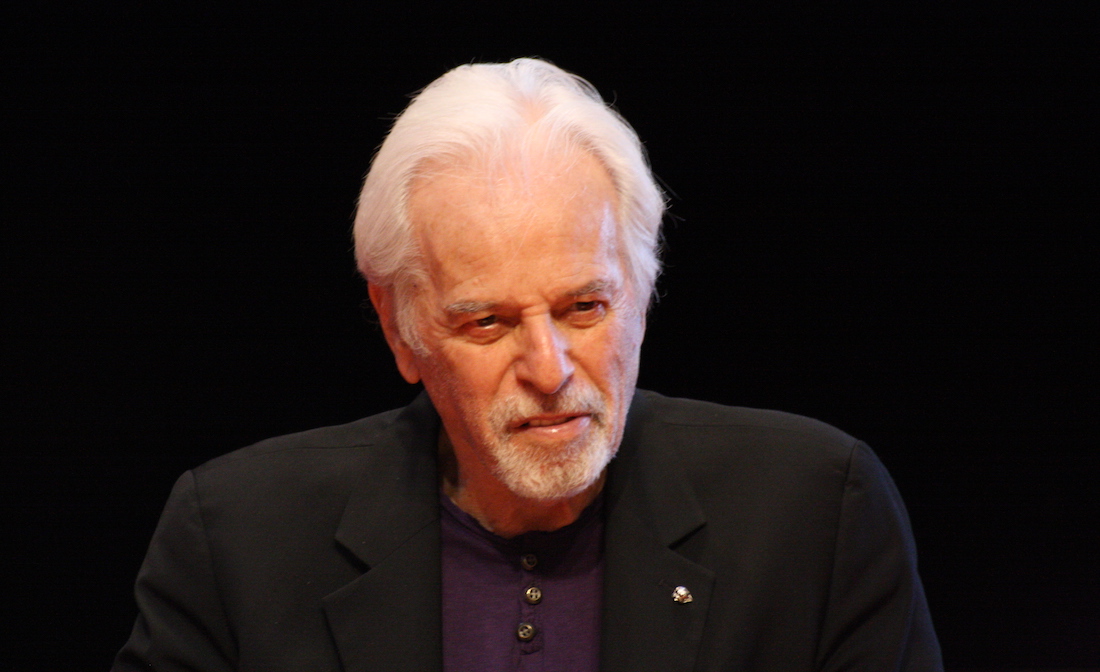
Creative Commons photo by Lionel Allorge
If you’re a fan of science fiction or the films of David Lynch, you’ve surely seen the 1984 film adaptation of Frank Herbert’s cult classic sci-fi novel, Dune (though Lynch himself may prefer that you didn’t). And indeed, it’s very likely that, by now, you’ve heard the incredible story of what Dune might have been, had it been directed ten years earlier by psychedelic Chilean filmmaker, writer, composer, and psychotherapist Alejandro Jodorowsky. Perhaps you even caught Jonathan Crow’s post on this site featuring Jodorowsky’s proposed storyboards—drawn by French artist Moebius—for what would most certainly would have been “a mind-bogglingly grand epic” of a movie. Alas, Jodorowsky’s Dune never came about, though it did later lead to the documentary Jodorowsky’s Dune, which Matt Zoller Seitz pronounced “a call to arms for dreamers everywhere.”
That description applies not only to the film about a film that could have been, but also to the entirety of Jodorowsky’s work, including his—thoroughly bizarre and captivating—early features, El Topo and The Holy Mountain, and the creation of a comic book universe like no other. Called “The Jodoverse,” the world of his comic books is, as writer Warren Ellis says, “astonishingly beautiful and totally mad”—again, a succinct description of Jodorowsky’s every artistic endeavor. Witness below, for example, the stunning trailer for his most recent feature film, 2014’s The Dance of Reality. You may find the visual excesses so overwhelming that you only half-hear the narration.
Listen (or read) carefully, however. Jodorowsky has as much to tell us with his cryptically poetic pronouncements as he does with his visionary imagery. Do you find his epigrams platitudinous, sententious, Pollyannaish, or naïve? Jodorowsky doesn’t mind. He calls, remember, to the dreamers, not the hard-bitten, cynical realists. And if you’re one of the dreamers who hears that call, you’ll find much to love in the list below of Jodorowsky’s 82 Commandments for living. But so too, I think, will the realists. These come from Jodorowsky’s memoir The Spiritual Journey of Alejandro Jodorowsky, and the list comes via Dangerous Minds, who adapted it from “the better part of three pages” of text.
As Jodorowsky frames these maxims in his book, they originated with influential Russian mystic George Gurdjieff, and were told to him by Gurdjieff’s daughter, Reyna d’Assia. Perhaps that’s so. But you’ll note, if you know Jodorowsky’s writing—or simply took a couple minutes time to watch the trailer above—that they sound enough like the author’s own words to have been brought forth from his personal storehouse of accumulated wisdom. In any case, Jodorowsky has always been quick to acknowledge his spiritual teachers, and whether these are his second-hand accounts of Gurdjieff or his own inventions has no bearing on the substance therein.
Often sounding very much like Biblical proverbs or Buddhist precepts, the commandments are intended, d’Assia says in Jodorowsky’s account, to help us “change [our] habits, conquer laziness, and become… morally sound human being[s].” As she remarks in the book, before she delivers the below in a lengthy monologue, “to be strong in the great things, we must also be strong in the small ones.” Therefore…
- Ground your attention on yourself. Be conscious at every moment of what you are thinking, sensing, feeling, desiring, and doing.
- Always finish what you have begun.
- Whatever you are doing, do it as well as possible.
- Do not become attached to anything that can destroy you in the course of time.
- Develop your generosity ‒ but secretly.
- Treat everyone as if he or she was a close relative.
- Organize what you have disorganized.
- Learn to receive and give thanks for every gift.
- Stop defining yourself.
- Do not lie or steal, for you lie to yourself and steal from yourself.
- Help your neighbor, but do not make him dependent.
- Do not encourage others to imitate you.
- Make work plans and accomplish them.
- Do not take up too much space.
- Make no useless movements or sounds.
- If you lack faith, pretend to have it.
- Do not allow yourself to be impressed by strong personalities.
- Do not regard anyone or anything as your possession.
- Share fairly.
- Do not seduce.
- Sleep and eat only as much as necessary.
- Do not speak of your personal problems.
- Do not express judgment or criticism when you are ignorant of most of the factors involved.
- Do not establish useless friendships.
- Do not follow fashions.
- Do not sell yourself.
- Respect contracts you have signed.
- Be on time.
- Never envy the luck or success of anyone.
- Say no more than necessary.
- Do not think of the profits your work will engender.
- Never threaten anyone.
- Keep your promises.
- In any discussion, put yourself in the other person’s place.
- Admit that someone else may be superior to you.
- Do not eliminate, but transmute.
- Conquer your fears, for each of them represents a camouflaged desire.
- Help others to help themselves.
- Conquer your aversions and come closer to those who inspire rejection in you.
- Do not react to what others say about you, whether praise or blame.
- Transform your pride into dignity.
- Transform your anger into creativity.
- Transform your greed into respect for beauty.
- Transform your envy into admiration for the values of the other.
- Transform your hate into charity.
- Neither praise nor insult yourself.
- Regard what does not belong to you as if it did belong to you.
- Do not complain.
- Develop your imagination.
- Never give orders to gain the satisfaction of being obeyed.
- Pay for services performed for you.
- Do not proselytize your work or ideas.
- Do not try to make others feel for you emotions such as pity, admiration, sympathy, or complicity.
- Do not try to distinguish yourself by your appearance.
- Never contradict; instead, be silent.
- Do not contract debts; acquire and pay immediately.
- If you offend someone, ask his or her pardon; if you have offended a person publicly, apologize publicly.
- When you realize you have said something that is mistaken, do not persist in error through pride; instead, immediately retract it.
- Never defend your old ideas simply because you are the one who expressed them.
- Do not keep useless objects.
- Do not adorn yourself with exotic ideas.
- Do not have your photograph taken with famous people.
- Justify yourself to no one, and keep your own counsel.
- Never define yourself by what you possess.
- Never speak of yourself without considering that you might change.
- Accept that nothing belongs to you.
- When someone asks your opinion about something or someone, speak only of his or her qualities.
- When you become ill, regard your illness as your teacher, not as something to be hated.
- Look directly, and do not hide yourself.
- Do not forget your dead, but accord them a limited place and do not allow them to invade your life.
- Wherever you live, always find a space that you devote to the sacred.
- When you perform a service, make your effort inconspicuous.
- If you decide to work to help others, do it with pleasure.
- If you are hesitating between doing and not doing, take the risk of doing.
- Do not try to be everything to your spouse; accept that there are things that you cannot give him or her but which others can.
- When someone is speaking to an interested audience, do not contradict that person and steal his or her audience.
- Live on money you have earned.
- Never brag about amorous adventures.
- Never glorify your weaknesses.
- Never visit someone only to pass the time.
- Obtain things in order to share them.
- If you are meditating and a devil appears, make the devil meditate too.
Related Content:
Moebius’ Storyboards & Concept Art for Jodorowsky’s Dune
Moebius Gives 18 Wisdom-Filled Tips to Aspiring Artists (1996)
Josh Jones is a writer and musician based in Durham, NC. Follow him at @jdmagness
Read More...The Alchemy of Film Editing, Explored in a New Video Essay That Breaks Down Hannah and Her Sisters, The Empire Strikes Back & Other Films
Writing, casting, shooting — all important parts of the filmmaking process, but the real making of a movie happens, so they say, in the editing room. Though often film editors themselves, “they” have a point: even moviegoers unfamiliar with the mechanics of editing can sense that, when something feels right onscreen, and even more so when something feels wrong, it has to do less with the pieces themselves than how those pieces have been put together.
“There’s an inbuilt relationship between the story itself, how to tell the story, and the rhythm with which you tell it,” says famed editor Walter Murch, known for his work with Francis Ford Coppola on the Godfather trilogy and Apocalypse Now, “and editing is seventy percent about rhythm.” Twenty years ago, in his book In the Blink of an Eye, Murch shed light on how an editor works. Now, cinema video essayist Tony Zhou has continued that mission with a new episode of his series Every Frame a Painting, “How Does an Editor Think and Feel?”
Zhou’s chosen medium places him well to address the question, since each video essay must require at least as much time spent editing as thinking about film in the first place. Still, asked by a friend how he knows where to cut, he can come up with only this unsatisfying answer: “Like a lot of editors, I cut based on instinct.” As to what exactly constitutes that editor’s instinct, Zhou spends the bulk of this ten-minute essay searching for answers himself, examining the cuts in pictures like Hannah and Her Sisters, In the Mood for Love, The Empire Strikes Back, Tampopo, Only Angels Have Wings, Pierrot le Fou, and All That Jazz.
He also turns to the words of editors with decades of experience in the game, including frequent Steven Spielberg collaborator Michael Kahn, frequent Martin Scorsese collaborator Thelma Schoonmaker, and even Murch himself. But ultimately, no matter how much wisdom about timing, emotions, tension, and rhythm you collect, you’ve got to sit down in the editing suite and go it alone. “If you watch anything over and over again,” Zhou says, “you eventually feel the moment when the shot wants you to cut.” If this seems like an overwhelming task, especially given hundreds of thousands of hours of footage an editor will work through in a career, do keep Kahn’s simple words in mind: “I see all that film up there — it doesn’t matter. I’m doing one piece at a time. One scene at a time. One cut at a time.”
Related Content:
Alfred Hitchcock’s 7‑Minute Master Class on Film Editing
The Dark Knight: Anatomy of a Flawed Action Scene
The Wizard of Oz Broken Apart and Put Back Together in Alphabetical Order
Based in Seoul, Colin Marshall writes and broadcasts on cities, language, and style. He’s at work on a book about Los Angeles, A Los Angeles Primer, the video series The City in Cinema, the crowdfunded journalism project Where Is the City of the Future?, and the Los Angeles Review of Books’ Korea Blog. Follow him on Twitter at @colinmarshall or on Facebook.
Read More...Monty Python’s Philosopher’s Football Match: The Epic Showdown Between the Greeks & Germans (1972)
Last year, we witnessed a very tense, unpleasant showdown between Germany and Greece as the topmost nation in the European Union drove its most indebted country to make painful, perhaps punishing compromises. In one analysis of this hard-to-watch economic humiliation—for Greece, that is—The Washington Post made use of a much more lighthearted contest between the two countries, one in which Greece emerged the victor after scoring the only goal of the match.
The soccer match, that is, or, if you must, football—played between German and Greek philosophers in 1972 and staged by Monty Python. On one side, Hegel, Leibniz, Kant, Marx, Nietzsche, Wittgenstein, and more (including actual footballer Franz Beckenbauer, a “surprise inclusion”)… on the other, Socrates, Archimedes, Heraclitus, Plato, Democritus, Epictetus, etc…. On the sidelines of this showdown between Western schools of thought, Confucius served as the referee. Even after that single goal, scored after two full halves of meandering, the two teams came into conflict—in heated arguments about the nature of existence….
I won’t continue to bore you by explaining the gags—watch the sketch above. It’s great fun, if by some chance you haven’t seen it, and great fun to watch again if you have.
Filmed at the Grünwalder Stadion in Munich (presumably giving the Germans home field advantage), the sketch, Terry Jones recalled many years later, is about the “clash of opposites.” No, not the two European countries, but the opposites of sports and intellectual exercise. “You can’t think about football too much,” said Jones, “you just have to do it.” This proves challenging for our deep thinkers.
Why football? Because it’s “a team activity,” Jones answered, “which philosophy, as a general rule, isn’t.” Well, mostly. The Pythons weren’t the first to make the “incongruous” connection. Albert Camus played the game, as a goalkeeper, and played it quite well by all accounts. He once wrote, “all I know most surely about morality and obligations, I owe to football.”
The injunction to “just do it” wouldn’t present too much of a challenge for an existentialist, one would think. Philosopher Julian Baggini puts the Pythons firmly in that school of thought, their take on it a “coherent, Anglo-Saxon” one. Indeed, like Camus, the British comedians recognized the absurdity of life, and showed us that “the right response is to laugh at it.” They also showed us that philosophy could be hilarious, and made a classic sketch academics could use to refute charges they’re a dour, humorless lot.
It should come as no surprise that the Python “most interested in the subject” of philosophy and comedy was John Cleese—whom we’ve featured here many times for his talents in combining the two. Cleese, writes Baggini, is “on record as saying that comedy and deep thought can go hand in hand. ‘You and I could talk about the meaning of life, or education, or marriage,’ Cleese once told a journalist, ‘and we could be laughing a lot, and it doesn’t mean that what we’re talking about isn’t serious.’”
Inspired by the Pythons’ serio-comic love of learning, Baggini, and other philosophers like A.C. Grayling and Nigel Warburton, along with comedians, historians, and journalists, decided to restage the Germany-Greek match in 2010. Where the Pythons indirectly boosted intellectual pursuits in the course of mocking them, the participants in this “game”—such as it was—explicitly sought to promote “Reasoning,” the “fourth R” in “Reading, W®iting, and A®ithmetic.”
See them bumble around on the pitch here and generally have a good time making philosophical fools of themselves to the strains of Monty Python’s rowdy anthem “The Philosopher’s Song.”
Related Content:
Monty Python and the Holy Grail Re-Imagined as an Epic, Mainstream Hollywood Film
Josh Jones is a writer and musician based in Durham, NC. Follow him at @jdmagness
Read More...Al Jaffee, the Longest Working Cartoonist in History, Shows How He Invented the Iconic “Folds-Ins” for Mad Magazine
Keep copying those Sunday funnies, kids, and one day you may beat Al Jaffee’s record to become the Longest Working Cartoonist in History.
You’ll need to take extra good care of your health, given that the Guinness Book of World Records notified Jaffee, above, of his honorific on his 95th birthday.
Much of his legendary career has been spent at Mad Magazine, where he is best known as the father of Fold-ins.
Conceived of as the satirical inverse of the expensive-to-produce, 4‑color centerfolds that were a staple of glossier mags, the first Fold-In spoofed public perception of actress Elizabeth Taylor as a man-eater. Jaffe had figured it as a one-issue gag, but editor Al Feldstein had other ideas, demanding an immediate follow up for the June 1964 issue.
Jaffe obliged with the Richard Nixon Fold-in, which set the tone for the other 450 he has hand rendered in subsequent issues.
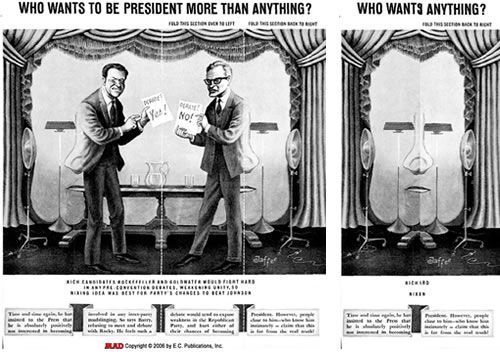
For those who made it to adulthood without the singular pleasure of creasing Mad’s back cover, you can digitally fold-in a few samples using this nifty interactive feature, courtesy of The New York Times.
With all due respect, it’s not the same, just enough to give a feel for the thrill of drawing the outermost panel in to reveal the visual punchline lurking within the larger picture. The print edition demands precision folding on the reader’s part, if one is to get a satisfactory answer to the rhetorical text posed at the outset.
Jaffe must be even more precise in his calculations. In an interview with Sean Edgar of Paste Magazine, he described how he turned a Republican primary stage shared by Nelson Rockefeller and Barry Goldwater into a surprise portrait of the man who would become president five years hence:
The first thing I did was draw Richard Nixon’s face, not in great detail, just a very rough establishment of where the eyes, nose and mouth would be, and the general shape. I did an exaggerated caricature of Nixon and then I cut it in half, and moved it apart. Once the face was cut in half, it didn’t have the integrity of a face anymore — it was sort of a half of face. Then I looked at what the eyes were like, and I said, ‘what can I make out of the eyes?’ He had these heavy eyebrows. I played around with many things, but I had to keep in mind all the time what the big picture was. So there they (Goldwater and Rockefeller) were up on a stage somewhere, doing a debate, and I thought, ‘What kind of stage prop can I put alongside these guys that would seem natural there?’ I decided that I could make eyes out of the lamps, and as far as the nose was concerned, that could come out of the figures — their clothing. Then I figured the mouth; I could use some sort of table that could give me those two sides. That’s how it all came about. You have to have some kind of visual imagination to see the possibilities. I had to concentrate on stuff that looked natural on a stage.
Each Fold-In is a reflection of the zeitgeist. Past preoccupations have included Vietnam, feminism, illegal drug use and, more recently, the Jersey Shore.
via Gothamist
Related Content:
A Gallery of Mad Magazine’s Rollicking Fake Advertisements from the 1960s
Watch Mad Magazine’s Edgy, Never-Aired TV Special (1974)
A Look Inside Charlie Hebdo, Their Creative Process & the Making of a Fateful Cartoon
Cartoonists Draw Their Famous Cartoon Characters While Blindfolded (1947)
Ayun Halliday is an author, illustrator, and Chief Primatologist of the East Village Inky zine. Follow her @AyunHalliday
Read More...Edward Snowden & Jean-Michel Jarre Record a Techno Protest Song, “Exit”
For his new album, Electronica Volume II: The Heart Of Noise, Jean-Michel Jarre, a pioneer in electronic and ambient music, collaborated on a recording with Edward Snowden, the former CIA computer analyst-turned-whistleblower. Cue up their song, “Exit,” above.
At first glance, it perhaps seems like an unlikely pairing. But if you give Jarre, the son of a French resistance fighter, a chance to explain, it all makes perfect sense. Recently, he told The Guardian:
The whole Electronica project is about the ambiguous relationship we have with technology: on the one side we have the world in our pocket, on on the other, we are spied on constantly. There are tracks about the erotic relationship we have with technology, the way we touch our smartphones more than our partners, about CCTV surveillance, about love in the age of Tindr. It seemed quite appropriate to collaborate not with a musician but someone who literally symbolises this crazy relationship we have with technology.
A lot of what Jarre and Snowden were trying to accomplish with the song–musically, conceptually, ideologically, etc.–gets explained in the video below. Listening to Snowden talk about the meaning of the song’s title (“Exit” means “things have to change,” “it’s time to leave, it’s time to do something else, it’s time to find a better way”), you’ll get the sense that “Exit” is an electronic protest song befitting our digital age. Out with the folk music, in with the techno.
Electronica Volume II: The Heart Of Noise also features songs with the Pet Shop Boys, Gary Numan and the rapper Peaches.
Related Content:
Recalling Albert Camus’ Fashion Advice, Noam Chomsky Pans Glenn Greenwald’s Shiny, Purple Tie
The History of Electronic Music in 476 Tracks (1937–2001)
Hear Seven Hours of Women Making Electronic Music (1938- 2014)
How the Moog Synthesizer Changed the Sound of Music
Read More...7 Tips for Reading More Books in a Year
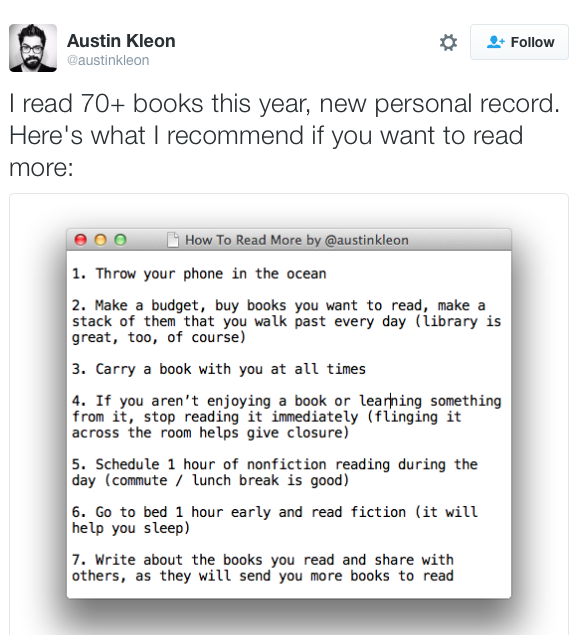
On Twitter, Austin Kleon, author of Steal Like an Artist: 10 Things Nobody Told You About Being Creative has served up 7 tips for achieving the seemingly impossible–getting more books read in this age of constant distraction. The tips are simple and effective–effective enough to help Austin read 70+ books during a year, a new personal record.
No doubt, you have your own strategies for spending more time with books (and not just watching them pile up, unread, on your shelves. There’s a word for that in Japanese folks. It’s called “Tsundoku.”) If you care to share them, please put your best tips in the comments section below. We, and your fellow readers, thank you in advance.
Looking for free, professionally-read audio books from Audible.com? (Speaking of an easy way to spend more time with books.) Here’s a great, no-strings-attached deal. If you start a 30 day free trial with Audible.com, you can download two free audio books of your choice. Get more details on the offer here. Also note that Audibooks.com has a very similar offer that you can explore here.
Related Content:
Spike Jonze Presents a Stop Motion Film for Book Lovers
Books Savored in Stop Motion Film
Read More...Artificial Intelligence Creativity Machine Learns to Play Beethoven in the Style of The Beatles’ “Penny Lane”
It is the end of term this week and my film production students asked me to name my favorite part of filmmaking. I told them it’s directing, as it’s something I so rarely get to do (compared to writing) yet so involving that an entire day goes by in a flash. Regardless, I always pop out the other side knowing I was at my absolute creative best. I was in the “zone” or as Mihaly Csikszentmihalyi called it in 1990, “the flow state.” And in a wonderful bit of synchronicity, not a little while later, I have been charged with presenting to you this example of artificial intelligence (AI) creativity. It similarly uses this understanding of the flow state to create.
In the above video, the Flow Machine developed by François Pachet at Sony CSL-Paris has been fed Beethoven’s “Ode to Joy”, and then asked to orchestrate “cover versions” following the rules set down by a genre–say bossa nova or electronic chill music–or a song itself, in this case being the Beatles’ “Penny Lane.”
Previous attempts to create random computer music have resulted in exactly that–random notes, drawn from a selection determined by a programmer. But that isn’t how creativity works. When we create, we understand our parameters already, subconsciously, and not only that, we know what we and others have done before, what “pushes the envelope” compared to using a completely wrong element, and what makes our own creativity unique. (If we discover it and emphasize the latter over and over, it’s called style.)
The Flow Machine project aims to understand style and treat it as a computational object through which other information can pass. That’s what we’re seeing in the above video. For a more thorough explanation of Flow Machine, watch this video.
Supposedly, this will help us poor human beings in the end, as it might (it’s never explained how) help us get into our own flow state more readily.
But really, that’s not what I’m thinking about. I’m more imagining a night club sometime in the future where Beatles androids play not just their hits, but the hits of others as if John, Paul, George and Ringo wrote them instead. (Yes, I know that has already been done. By humans.) And your local used record shop will have a lot of LPs full of classical versions of Beatles hits.
It’s an interesting video, but I wouldn’t pack up your guitars yet folks!
Related Content:
Slavoj Žižek: What Fulfils You Creatively Isn’t What Makes You Happy
Slavoj Žižek Examines the Perverse Ideology of Beethoven’s Ode to Joy
Ted Mills is a freelance writer on the arts who currently hosts the artist interview-based FunkZone Podcast. You can also follow him on Twitter at @tedmills, read his other arts writing at tedmills.com and/or watch his films here.
Read More...Support Us
We're hoping to rely on loyal readers, rather than erratic ads. Please click the Donate button and support Open Culture. You can use Paypal, Venmo, Patreon, even Crypto! We thank you!

About Us

Open Culture scours the web for the best educational media. We find the free courses and audio books you need, the language lessons & educational videos you want, and plenty of enlightenment in between.
Advertise With Us

FREE UPDATES!
GET OUR DAILY EMAIL
Get the best cultural and educational resources on the web curated for you in a daily email. We never spam. Unsubscribe at any time.
FOLLOW ON SOCIAL MEDIA

Open Culture editor Dan Colman scours the web for the best educational media. He finds the free courses and audio books you need, the language lessons & movies you want, and plenty of enlightenment in between.
Advertise With Us


