Hear 100 Amazing Cover Versions of Beatles Songs
If you’ve ever learned to play an instrument, especially the guitar or piano, odds are you’ve spent countless hours trying to master the rhythms and melodies of your favorite songs. And odds are at least one of those songs was written by Messrs. Lennon & McCartney. If you’re anything like me, you probably realized early in the exercise that The Beatles weren’t only praised as great songwriters because of their lyricism and social and romantic insights. Their songs are also packed with ingenious chord changes, unexpected time shifts, unusual hooks, etc.
What may seem at first listen like a simple tune reveals itself as highly challenging for the amateur musician. I well remember sweating over two of my favorites—“Julia” and “Martha My Dear”—for many days.
Even in modified versions that simplify difficult voicings, I struggled to master the letter of the songs while still conveying the spirit. Surely, that’s a testament to my own lack of skill, and yet the trouble I’ve had pulling off my favorite Beatles’ songs has given me all the more respect for musicians who make it look easy.
Even a straight-ahead blues like “Why Don’t We Do It In the Road” ain’t easy to sell—far from it. But I’ve never heard anyone do it better than Tulsa, Oklahoma-born bluesman Lowell Fulsom (top). Further down, St. Vincent does a stellar live rendition of another of my favorites, “Dig a Pony.” A great song can take all kinds of bending, stretching, and pulling and still retain its essence. In Paolo Nutini’s smooth, stripped-down, organ, voice, and drums take on Lennon’s “Don’t Let Me Down,” above, the passion remains, even if the impassioned shouts have been tamed.
There are hundreds more great Beatles’ covers out there, and probably hundreds of terrible ones, too—and many an oddball interpretation that sharply divides opinion in either direction (such as Marc Ribot’s machine-shop “While My Guitar Gently Weeps,” which I happen to love). Just above, we’ve put together a Spotify playlist of over 80 great cover versions of Beatles’ songs, culled from suggestions made by @openculture followers/fans on Twitter. (You can download Spotify’s software here.) And in the list below, find links to 20 fabulous cover versions on Youtube. (Those weren’t available on Spotify, but they’re definitely worth hearing). In total, you’ll find 100 tracks, by artists ranging from Ray Charles, to Joe Cocker and Sarah McLachlan, to Patti Smith, David Bowie, and Johnny Cash. It makes for 6 hours of Beatles bliss.
If we’ve missed an essential cover, let us know in the comments below, and drop in a link if you can.
Jimi Hendrix — Sgt. Pepper
The Pixies — Wild Honey Pie
David Gilmour — Here, There and Everywhere
Alice Cooper and the Bee Gees — Because
Kris Kristofferson — Paperback Writer
Bryan Ferry — She’s Leaving Home
Paolo Nutini — Don’t Let Me Down
The Fall — A Day in the Life
Elliot Smith — Because
Elvis Costello — Penny Lane
Marc Ribot — While My Guitar Gently Weeps
Ben E. King — Don’t Let Me Down
Ike & Tina Turner – She Came in Through the Bathroom Window
St Vincent — Dig a Pony
Peer Frampton and the Bee Gees — Sgt. Pepper’s Lonely Hearts Club Band (soundtrack)
Ray Charles — The Beatles Covers
Booker T. & the MGS — McLemore Avenue (Covers of Abbey Road)
George Benson — The Other Side of Abbey Road
Related Content:
Peter Sellers Covers the Beatles’ “A Hard Day’s Night,” “She Loves You” & “Help!”
Josh Jones is a writer and musician based in Durham, NC. Follow him at @jdmagness
Read More...The 100 Most Memorable Shots in Cinema Over the Past 100 Years
Harold Lloyd hanging high above the city on the hands of a skyscraper’s clock. A shot through the eye on the Odessa steps. Another eye, this one readied for the razor blade. King Kong roaring atop a skyscraper of his own. Snow White offering a perch to the bluebird. Dorothy, the Cowardly Lion, the Tin Man, and the Scarecrow skipping off toward the distant Emerald City. Charles Foster Kane orating before his own enormous portrait. Norma Desmond’s unsettling approach through ever-softer focus.
Roger Thornhill pursued by the biplane. Patton saluting before the enormous American flag. Alex DeLarge staring, in his bowler and past his prosthetic eyelashes, straight into the camera. Rocky jogging up the Philadelphia Museum of Art steps. A camouflage-painted Willard rising out of the swamp. The slow-motion march of Messrs. Blonde, Blue, Brown, Orange, Pink, and White. The opening-night reception dance after Max Fischer’s Heaven and Earth. Leonidas kicking the messenger into the hole. The young Mason Evans, Jr. flat on the grass, staring up at the skies.
Oh, and Charlie Chaplin using Scraps the dog as a pillow. I could have described more of the most memorable shots of the past century of cinema history, but in the video above, which presents one hundred years of film with one shot selected from each year, they all speak for themselves. “While many of these shots are the most recognizable in film history, others are equally iconic in their own right,” writes the video’s creator Jacob T. Swinney, “For example, some shots pioneered a style or defined a genre, while others tested the boundaries of censorship and filmgoer expectations.”
While the earliest pictures here, a group starting in 1915 with D.W. Griffith’s The Birth of a Nation, have had plenty of time to establish themselves in our visual lexicon — even for those of us who’ve never actually sat down and watched the movies in full — the more recent selections clearly require some guesswork: Swinney’s memorable shots from the past decade come from sources as varied as There Will Be Blood and The Tree of Life, Avatar, and The Avengers.
And some cinema purists, as opposed to structural purists, will regret that, with these strictly single shots, the famous cuts (in both senses, when it comes to Un Chien Andalou’s eyeball) don’t come across. Me, I’d have bent the rules to pay proper tribute to Lawrence blowing out the match, but that’s just one cinephile’s opinion. Besides, you’ve got to see it in context, projected in 70-millimeter, to really feel why it can stand for all of 1962 in film — and then some.
Related Content:
A Mesmerizing Supercut of the First and Final Frames of 55 Movies, Played Side by Side
Signature Shots from the Films of Stanley Kubrick: One-Point Perspective
The Perfect Symmetry of Wes Anderson’s Movies
Based in Seoul, Colin Marshall writes and broadcasts on cities, language, and style. He’s at work on a book about Los Angeles, A Los Angeles Primer, the video series The City in Cinema, the crowdfunded journalism project Where Is the City of the Future?, and the Los Angeles Review of Books’ Korea Blog. Follow him on Twitter at @colinmarshall or on Facebook.
Read More...Vincent Price Reads the Poetry of Shelley; Ralph Richardson Reads the Poetry of Coleridge
Many of us today think of Vincent Price as the face, and an even more so the voice, of modestly budgeted midcentury horror movies. But over his long and prolific career, he showed just what multitudes he could contain. Price could elevate schlock, of course, but he could also rise to the challenge of masterpieces: here on Open Culture, we’ve previously featured his readings, on record and on camera, of the work of Edgar Allan Poe, the original master of the psychologically troubling tale. Today, we have for you a set of recitations well outside the realm of the scary: Price reading the poetry of Percy Bysshe Shelley, free on Spotify (whose software you can download here).
Shelley, as anyone interested in 19th-century English poetry knows, didn’t have a long career, but the candle that burns quickly, as they say, burns bright. Before his death at the age of 29 in a storm on the Gulf of Spezia, he managed to write such immortal works as Music, When Soft Voices Die, Ozymandias, To a Skylark, Ode to the West Wind, and the drama Prometheus Unbound, all of which we hear Price read whole, or in part, in this playlist. And for its final four tracks, we hear famed English stage actor Ralph Richardson deliver four poems from the equally enduring legacy of Shelley’s rough contemporary Samuel Taylor Coleridge, including Kubla Khan and The Rime of the Ancient Mariner.
The vividness of the imagery and the timeless resonance of the themes in both poets’ work hold up well on the page, but no matter how many times you’ve read it, hearing it interpreted by performers like Price and Richardson can let you experience it in a new way. Their dramatic backgrounds empower them to bring out levels of emotion you might never have felt in your own reading; certainly Price’s world-weary yet faintly arch tone does well with Ozymandias’ gaze-into-the-abyss evocation of hubris, impermanence, and the ultimate fate in oblivion of all things great and small. Maybe the man who starred in The Pit and the Pendulum never really strayed far from horror after all.
The Price/Richardson reading will be added to our collection, 1,000 Free Audio Books: Download Great Books for Free.
Related Content:
5 Hours of Edgar Allan Poe Stories Read by Vincent Price & Basil Rathbone
Watch Vincent, Tim Burton’s Animated Tribute to Vincent Price & Edgar Allan Poe (1982)
Watch Vincent Price Turn Into Edgar Allan Poe & Read Four Classic Poe Stories (1970)
Learn to Write Through a Video Game Inspired by the Romantic Poets: Shelley, Byron, Keats
Based in Seoul, Colin Marshall writes and broadcasts on cities, language, and style. He’s at work on a book about Los Angeles, A Los Angeles Primer, the video series The City in Cinema, the crowdfunded journalism project Where Is the City of the Future?, and the Los Angeles Review of Books’ Korea Blog. Follow him on Twitter at @colinmarshall or on Facebook.
Read More...New LSD Research Provides the First Images of the Brain on Acid, and Hints at Its Potential to Promote Creativity
Talk to nearly any veteran of sixties counterculture, and you’re bound to hear a story or three about an acid trip. Some of those trips were bad, man, full of nightmare hallucinations and severe anxiety. In other accounts, however, LSD gets credit for opening up the mind, releasing old patterns of thought, and freeing up latent creative energy. From Ken Kesey to R. Crumb, these stories abound. Are they credible? Now that scientists have once again begun to study the drug—first synthesized in 1938 and used in experiments in the 50s and 60s until it was banned nearly everywhere—they are finding concrete answers using the latest in brain imaging technology.

And it appears that LSD—-in a controlled laboratory setting at least—“can be seen as reversing the more restricted thinking we develop from infancy to adulthood.” So reports The Guardian in regard to experiments recently conducted by neuropharmacologist David Nutt, former “drugs advisor” for the British government. Nutt gave volunteer subjects an injection of LSD, then captured the first images ever recorded of the brain on acid. You can see dramatic animations of those scans in the video at the top of the post, comparing the brains of test subjects on the drug and those on placebo, and see some static images above. The study, says Nutt, “is to neuroscience what the Higgs boson was to particle physics.” In an interview with Nature, he describes LSD research as a “way to study the biological phenomenon that is consciousness.”
What the subjects experienced won’t necessarily surprise anyone who has been on one of those legendary, mind-altering trips: researchers found, writes The Guardian, that “under the drug, regions [of the brain] once segregated spoke to one another,” producing hallucinations, “feelings of oneness with the world,” and “a loss of personal identity called ‘ego dissolution.’” However, prior to this study, Nutt says, “we didn’t know how these profound effects were produced.” There has been precious little data, because “scientists were either scared or couldn’t be bothered to overcome the enormous hurdles to get this done.”
Working with the Beckley Foundation, which studies psychoactive drugs and promotes policy reform, Nutt and his colleague Robert Carhart-Harris crowdfunded their study; in the video above, you can hear them both describe the goals and rationale of their research. What they eventually found, The Guardian reports, was that “under the influence, brain networks that deal with vision, attention, movement and hearing became far more connected, leading to what looked like a ‘more unified brain.’”
But at the same time, other networks broke down. Scans revealed a loss of connections between part of the brain called the parahippocampus and another region known as the retrosplenial cortex.
Nutt and his colleagues have more specific experiments planned, he tells Nature, “to look at how LSD can influence creativity, and how the LSD state mimics the dream state.” And just as the drug was tested decades ago as a therapy for addictions and psychiatric disorders, Nutt hopes he can conduct similar trials. But his research has an even larger scope: As Amanda Feilding, director of the Beckley Foundation, puts it, “We are finally unveiling the brain mechanisms underlying the potential of LSD, not only to heal, but also to deepen our understanding of consciousness itself.” We look forward to Nutt’s further research findings. Perhaps someday, LSD will be available with a prescription. Until then, it’s probably wise not to try these experiments at home.
Related Content:
Artist Draws Nine Portraits on LSD During 1950s Research Experiment
Ken Kesey Talks About the Meaning of the Acid Tests in a Classic Interview
R. Crumb Describes How He Dropped LSD in the 60s & Instantly Discovered His Artistic Style
Josh Jones is a writer and musician based in Durham, NC. Follow him at @jdmagness
Read More...Carl Sagan Presents His “Baloney Detection Kit”: 8 Tools for Skeptical Thinking

Photo by NASA via Wikimedia Commons
It is sometimes said that science and philosophy have grown so far apart that they no longer recognize each other. Perhaps they no longer need each other. And yet some of the most thoughtful scientists of modernity—those who most dedicated their lives not only to discovering nature’s mysteries, but to communicating those discoveries with the rest of us—have been fully steeped in a philosophical tradition. This especially goes for Carl Sagan, perhaps the greatest science communicator of the past century or so.
Sagan wrote a number of popular books for layfolk in which he indulged not only his tendencies as a “hopeless romantic,” writes Maria Popova, but also as a “brilliant philosopher.” He did not fear to venture into the realms of spiritual desire, and did not mock those who did likewise; and yet Sagan also did not hesitate to defend reason against “society’s most shameless untruths and outrageous propaganda.” These undertakings best come together in Sagan’s The Demon-Haunted World, a book in which he very patiently explains how and why to think scientifically, against the very human compulsion to do anything but.
In one chapter of his book, “The Fine Art of Baloney Detection,” Sagan laid out his method, proposing what he called “A Baloney Detection Kit,” a set of intellectual tools that scientists use to separate wishful thinking from genuine probability. Sagan presents the contents of his kit as “tools for skeptical thinking,” which he defines as “the means to construct, and to understand, a reasoned argument and—especially important—to recognize a fallacious or fraudulent argument.” You can see his list of all eight tools, slightly abridged, below. These are all in Sagan’s words:
- Wherever possible there must be independent confirmation of the “facts.”
- Encourage substantive debate on the evidence by knowledgeable proponents of all points of view.
- Arguments from authority carry little weight — “authorities” have made mistakes in the past. They will do so again in the future. Perhaps a better way to say it is that in science there are no authorities; at most, there are experts.
- Spin more than one hypothesis. If there’s something to be explained, think of all the different ways in which it could be explained. Then think of tests by which you might systematically disprove each of the alternatives.
- Try not to get overly attached to a hypothesis just because it’s yours. It’s only a way station in the pursuit of knowledge. Ask yourself why you like the idea. Compare it fairly with the alternatives. See if you can find reasons for rejecting it. If you don’t, others will.
- If whatever it is you’re explaining has some measure, some numerical quantity attached to it, you’ll be much better able to discriminate among competing hypotheses. What is vague and qualitative is open to many explanations.
- If there’s a chain of argument, every link in the chain must work (including the premise) — not just most of them.
- Occam’s Razor. This convenient rule-of-thumb urges us when faced with two hypotheses that explain the data equally well to choose the simpler. Always ask whether the hypothesis can be, at least in principle, falsified…. You must be able to check assertions out. Inveterate skeptics must be given the chance to follow your reasoning, to duplicate your experiments and see if they get the same result.
See the unabridged list at Brain Pickings, or read Sagan’s full chapter, ideally by getting a copy of The Demon-Haunted World. As Popova notes, Sagan not only gives us succinct instructions for critical thinking, but he also makes a thorough list, with definitions, of the ways reason fails us through “the most common and perilous fallacies of logic and rhetoric.” Sagan’s chapter on “Baloney Detection” is, like the rest of the book, a highly literary, personal, engagement with the most pressing scientific considerations in our everyday life. And it is also an informal yet rigorous restatement of Aristotle’s classical logic and rhetoric and Francis Bacon’s natural philosophy.
Related Content:
The Wisdom of Carl Sagan Animated
Richard Feynman Creates a Simple Method for Telling Science From Pseudoscience (1966)
Noam Chomsky Calls Postmodern Critiques of Science Over-Inflated “Polysyllabic Truisms”
Josh Jones is a writer and musician based in Durham, NC. Follow him at @jdmagness
Read More...Tom Waits Names 14 of His Favorite Art Films
Tom Waits is that rare breed of artist who has equal amounts of credibility in the art house theaters and on the punk rock street. His depression-era everyman blues and drunken skid row laments ring just as true as his high-concept vaudeville theater act and cocktail lounge performance art. Having the ability to convincingly set his brow high or low makes Waits an excellent ambassador for film, a medium sadly riven by brow height. While cable TV and Netflix may be the art houses of the 21st century, let’s not give up on the cultural reach of legacy archives like the Criterion Collection just yet. Not before we hear Waits weigh in on his favorite art films.
Waits’ filmography as an actor is itself a testament to his brow-spanning abilities—from such wide-release fare as Dracula and Seven Psychopaths to the scrappy, intimate films of Jim Jarmusch, and more or less everything in-between. The threads that run through all of his film choices as an actor are a certain surreal sense of humor and the off-kilter humanity and formal anarchy we know so well from his musical choices.
We see similar proclivities in Waits’ film favorites, as compiled by Chris Ambrosio at Criterion. Most of the choices are of the, “Ah, of course” variety in that these films so perfectly explain, or illustrate, the Tom Waits universe. We might imagine many of them with alternate soundtracks of songs from Real Gone, Swordfishtrombones, Bone Machine, etc.
First, up, of course, Fellini’s neorealist La Strada, a film about the saddest, sweetest, gruffest traveling circus act ever. Waits also confesses a passion for all of the beautifully overwrought films of Carl Theodor Dreyer, including the profound and disturbing 1928 The Passion of Joan of Arc and 1932 horror classic Vampyr (both above). You can see the full list of Waits’ favs below. Let your passion for art film be rekindled, and when watching the silent films, consider putting on some Mule Variations or Blood Money. You’ll probably find it fits perfectly.
- La Strada, Federico Fellini (U.S. readers: watch Fellini’s films free on Hulu)
- Zatoichi: The Blind Swordsman
- Putney Swope, Robert Downey, Sr.
- Everything by Carl Theodor Dreyer
- Amarcord, Federico Fellini
- 8 1/2, Federico Fellini
- The Night of the Hunter, Charles Laughton
- Wise Blood, John Huston
- Two-Lane Blacktop, Monte Hellman
- Eraserhead, David Lynch
- Pickup on South Street, Samuel Fuller
- Ikiru, Akira Kurosawa
- Vernon, Florida, Errol Morris
- In a Lonely Place, Nicholas Ray
Related Content:
Free on Hulu: Stream Fellini’s 8 1/2, La Strada & Other Classic & Contemporary Films
Tom Waits, Playing the Down-and-Out Barfly, Appears in Classic 1978 TV Performance
The Tom Waits Map: A Mapping of Every Place Waits Has Sung About, From L.A. to Africa’s Jungles
Jim Jarmusch: The Art of the Music in His Films
Josh Jones is a writer and musician based in Durham, NC. Follow him at @jdmagness
Read More...330 Years of Female Printmakers (1570–1900) : Download Free Prints, Visit the Exhibit
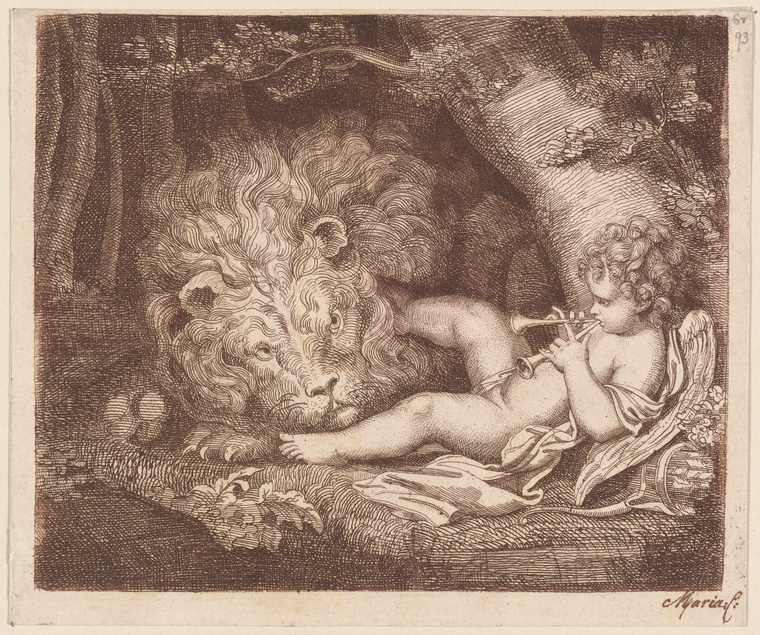
Henrietta Louisa Koenen was born a century before the Guerrilla Girls, but her collecting habits are a strong argument for honorary, posthumous membership in the activist group.
The wife of the Rijksmuseum’s Print Room’s first director, Koenen spent over three decades acquiring prints by female artists, though discouragingly few of the 827 women in her collection achieved much in the way of recognition for their work.
Renaissance aristocratic painter, Sofonisba Anguissola, and portraitist (and founding member of London’s Royal Academy of Arts) Angelica Kauffman, have the distinction of being namechecked in the Guerrilla Girl’s 1989 provocation, below.

Neither can be said to enjoy the museum tote bag celebrity of a Kahlo or O’Keeffe.
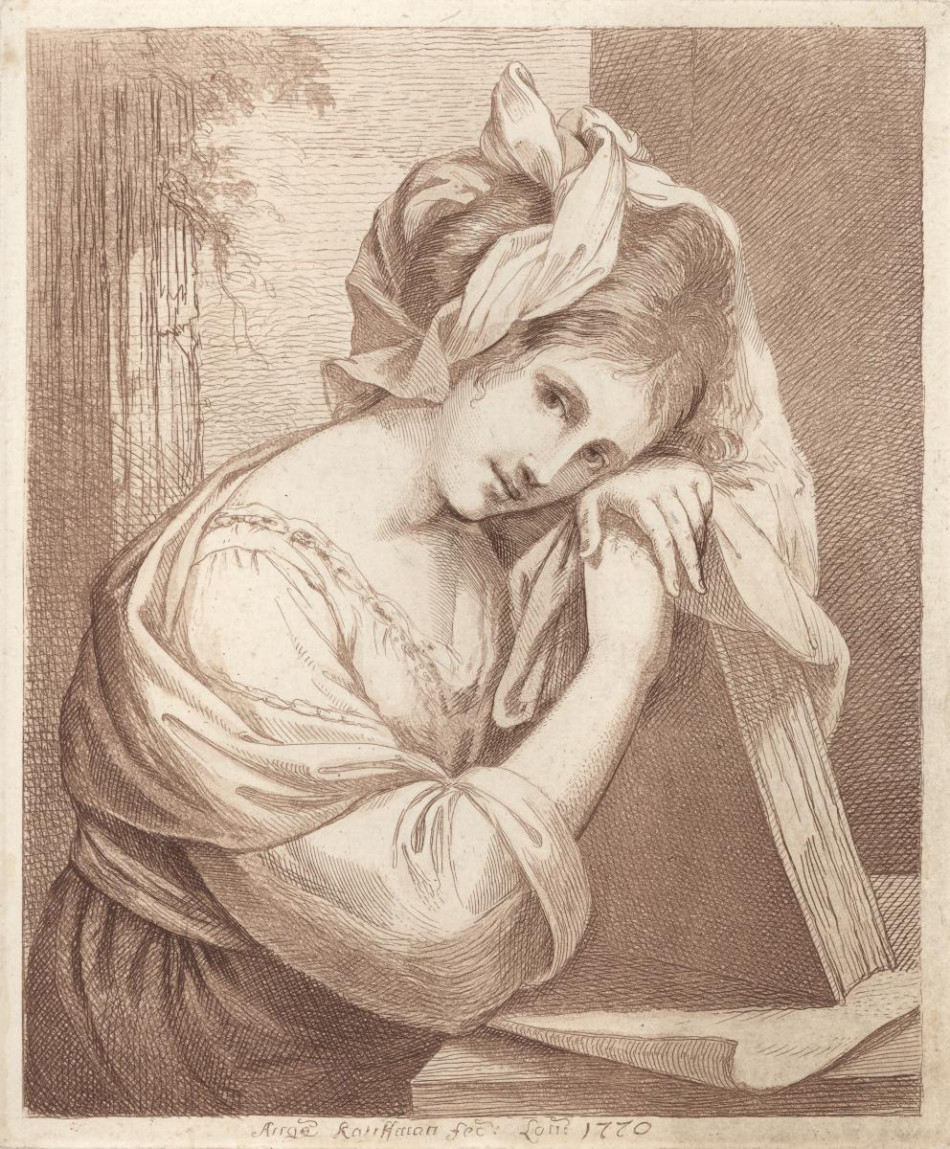
Self portait, Angelica Kauffman
Their work can be expected to attract some new fans, now that 80 some pieces from Koenen’s collection are on display as part of the New York Public Library’s exhibit, Printing Women: Three Centuries of Female Printmakers, 1570–1900.
(And it would be unseemly not to credit American art dealer Samuel Putnam Avery, for donating Koenen’s collection to the library at the turn of the last century, twenty years after her death.)
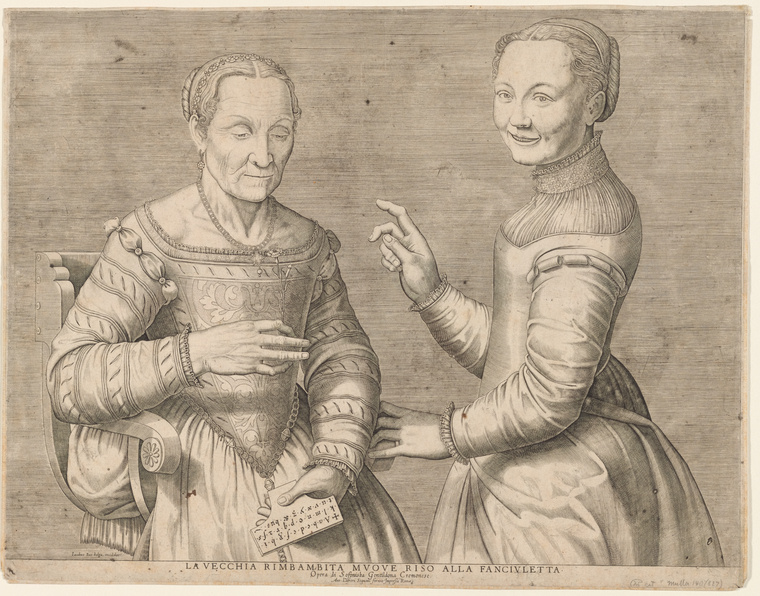
Printmaking is a frequently collaborative art. The droll Young Girl Laughing at the Old Woman, above, was drawn by Anguissola and engraved by Jacob Bos.
And Maria Cosway’s Music Has Charms, at the top of this post, was a family affair, with Cosway printing husband Richard’s celestial rendering of daughter Louisa Paolina Angelica. (Mrs. Cosway was also an accomplished composer and painter of miniatures and mythological scenes, though history has decreed her most enduring claim to fame should be her hold over a besotted Thomas Jefferson.)
The library highlights the continuum with an online gallery showcasing the work of contemporary female printmakers, some of whom are contributing guest posts to curator Madeleine Viljoen’s Printing Women blog.
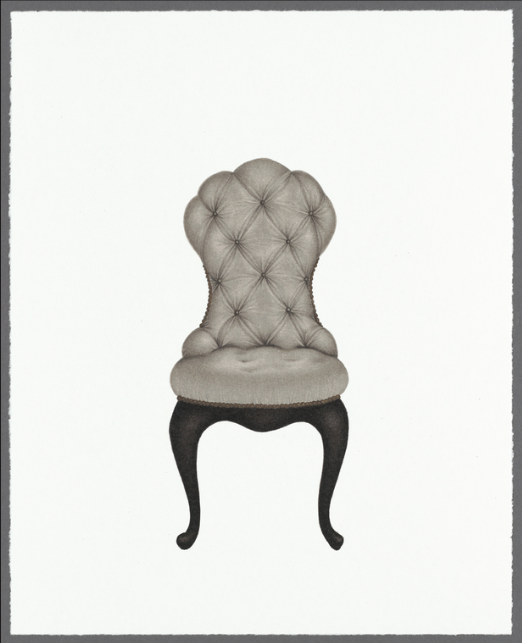
Sara Sanders, whose 2010 Lithograph, Untitled Chair #5, above, is part of a larger series, writes:
I believe that the domestic objects with which we spend our lives retain traces of our histories and tell stories about our pasts. These prints are part of an ongoing series of portraits of chairs drawn in the way we imagine them to be. Two of the chairs in this series were drawn from existing objects with a rich history, while the rest are imagined character studies.
Her thoughts seem particularly germane, when the “lesser genres” of ornament, still-life, and landscape were by default frequent subjects for the female artists in Koenen’s collection. Propriety deemed the fairer sex should not be party to the nude figure studies that significant religious and historical scenes so often demanded.
(Channel your inner Guerrilla Girl by performing an image search on Rape of the Sabine Women, and imagining the models as aspirant artists themselves, confined to such subject matter as violets and laundry day.)
That’s not to say domestic subjects can’t prove divine.
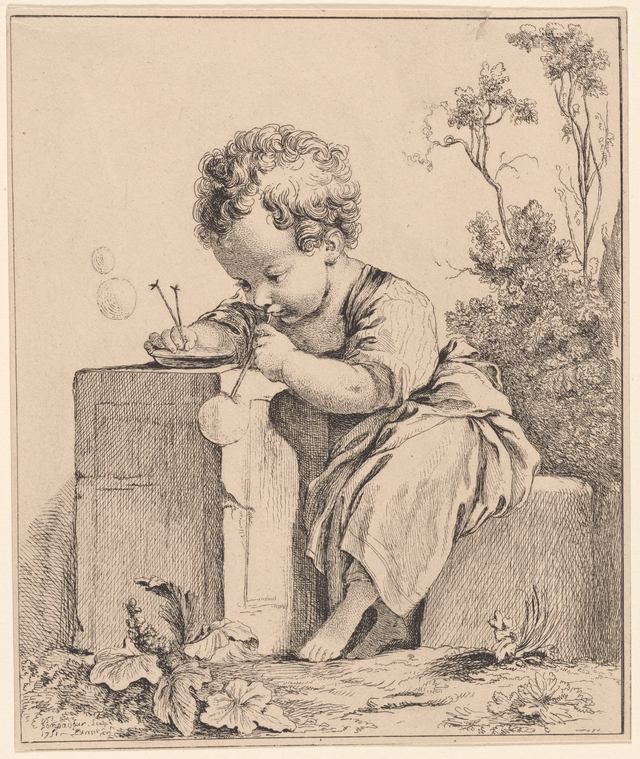
Witness 1751’s A Child Seated, Blowing Bubbles by Madame de Pompadour, an amateur artist and frequently painted beauty, who, the National Gallery’s website informs us, was “groomed from childhood to become a plaything for the King.”
View the online brochure for New York Public Library’s Printing Women: Three Centuries of Female Printmakers, 1570–1900 exhibition here. The exhibition at The New York Public Library ends May 27th, 2016.
Related Content:
11 Essential Feminist Books: A New Reading List by The New York Public Library
Ayun Halliday is an author, illustrator, and Chief Primatologist of the East Village Inky zine. Follow her @AyunHalliday
Read More...Patti Smith on Virginia Woolf’s Cane, Charles Dickens’ Pen & Other Cherished Literary Talismans
Oh to be eulogized by Patti Smith, Godmother of Punk, poet, best-selling author.
Her memoir, Just Kids, was born of a sacred deathbed vow to her first boyfriend, photographer Robert Mapplethorpe.
Its follow up, M Train, started out as an exercise in writing about “nothing at all,” only to wind up as an elegy to her late husband, guitarist Fred “Sonic” Smith. (Their daughter suggested that her dad “was probably annoyed that Robert got so much attention in the other book.”)
She and husband Smith celebrated their first anniversary by collecting stones from the French Guiana penal colony, Saint-Laurent-du-Maroni, in an effort to feel closer to Jean Genet, one of her most revered authors.
She believes in the transmutation of objects, unabashedly lobbying to liberate the walking stick that accompanied Virginia Woolf to her death from the NYPL’s collection in order to commune with it further. She may turn into a gibbering fangirl in face to face meetings with the authors she admires, but interacting with relics of those who have gone before has a centering effect.
Needless to say, her fame grants her access to items the rest of us are lucky to view though the walls of a vitrine.
She has paged through Sylvia Plath’s childhood notebooks and gripped Charles Dickens’ surprisingly modest pen. She has ““perpetuated remembrance” by coming into close contact with Bobby Fischer’s chess table, Frida Kahlo’s leg braces, and a hotel room favored by Maria Callas. Her recollection of these events is both reverential and impish, the stuff of a dozen anecdotes.
“I would faint to use (sculptor Constantin) Brâncuși’s toothbrush,“ she quips. “I wouldn’t use it though.”
Where tangible souvenirs prove elusive, Smith takes photographs.
Interviewer Holdengräber is uniquely equipped to share in Smith’s literary passions, egging her on with quotes recited from memory, including this beauty by Rainer Maria Rilke:
Now loss, however cruel, is powerless against possession, which it completes, or even, affirms: loss is, in fact, nothing else than a second acquisition–but now completely interiorized–and just as intense.
(The sentiment is so lovely, who can blame him for invoking it in previous conversation with NYPL guests, artist Edmund de Waal and pianist Van Cliburn.)
The topic can get heavy, but Smith is a consummate entertainer whose clownish brinkmanship leads her to cite Jimi Hendrix: “Hooray, I wake from yesterday.”
The complete transcript of the conversation is available for download here, as is an audio podcast.
Note: You can download Just Kids or M Train as free audio books if you join Audible.com’s 30-day free trial.
Related Content:
Patti Smith’s List of Favorite Books: From Rimbaud to Susan Sontag
Patti Smith and David Lynch Talk About the Source of Their Ideas & Creative Inspiration
Ayun Halliday is an author, illustrator, and Chief Primatologist of the East Village Inky zine. Follow her @AyunHalliday
Read More...Carol Kaye, 81-Year-Old Pioneer of Rock, Gives Kiss’ Gene Simmons a Bass Lesson
If you asked me to name the best representative of rock and roll as a boy’s club, KISS would be high on my list. Despite their commitment to a gender-bending glam style, Frontmen Gene Simmons and Paul Stanley’s chest hair rugs, wagging tongues, and studded codpieces are exaggerated examples of seventies virility—a rock era known for progressive music, but not progressive gender politics.
If you asked me to name a musician who had challenged and defied gender stereotypes in rock and roll, Carol Kaye— bassist and member of L.A.’s top flight session musicians the Wrecking Crew—would be high on my list. Kaye and her crew helped create the sound of Phil Spector records, the Beach Boys, the Mamas and the Papas, and so many other classic sixties artists.
Kaye never particularly saw herself as a pioneer or pathbreaker, but her smooth, unpretentious professionalism carried her through a career most musicians, male and female, would envy, even if she never stood in the spotlight herself. Her attitude, approach, and playing are pretty much the opposite of the bombastic, mercenary Simmons, who has on more than one occasion weathered charges of sexism in his pursuit of bigger, louder, dumber music and more tawdry reality TV.
In the short clip above, the two legends meet, and Kaye sits Simmons down and shows him how it’s done.
She has taught hundreds of students to imitate, though never duplicate, her chops, and earned the clout to take Simmons to school (though she seems surprised to be doing so); Kaye largely helped invent the sound of rock bass and elevated the instrument from a supporting player to an indispensable lead one as well.
The clip comes from an unfinished documentary that features over an hour of interview footage in which Kaye discusses her start in music and longtime success, and demonstrates more of her phenomenal, understated playing.
Related Content:
Meet Carol Kaye, the Unsung Bassist Behind Your Favorite 60s Hits
7 Female Bass Players Who Helped Shape Modern Music: Kim Gordon, Tina Weymouth, Kim Deal & More
Paul McCartney Offers a Short Tutorial on How to Play the Bass Guitar
Josh Jones is a writer and musician based in Durham, NC. Follow him at @jdmagness
Read More...Google Makes Its $149 Photo Editing Software Now Completely Free to Download

Google’s Nik Collection, a photo editing software package designed for professional photographers, once retailed for $149. Today it’s absolutely free to download, for both Windows and Mac users.
Here you can read Google’s announcement, which includes more information on the software package and its capabilities.
Today we’re making the Nik Collection available to everyone, for free.
Photo enthusiasts all over the world use the Nik Collection to get the best out of their images every day. As we continue to focus our long-term investments in building incredible photo editing tools for mobile, including Google Photos and Snapseed, we’ve decided to make the Nik Collection desktop suite available for free, so that now anyone can use it.
The Nik Collection is comprised of seven desktop plug-ins that provide a powerful range of photo editing capabilities — from filter applications that improve color correction, to retouching and creative effects, to image sharpening that brings out all the hidden details, to the ability to make adjustments to the color and tonality of images.
Starting March 24, 2016, the latest Nik Collection will be freely available to download: Analog Efex Pro, Color Efex Pro, Silver Efex Pro, Viveza, HDR Efex Pro, Sharpener Pro and Dfine. If you purchased the Nik Collection in 2016, you will receive a full refund, which we’ll automatically issue back to you in the coming days.
We’re excited to bring the powerful photo editing tools once only used by professionals to even more people now.
Once you’ve downloaded the software, head over to the Nik Collection channel on YouTube where you’ll find video tutorials, including the one below called “Introduction to the Nik Complete Collection.” It’s a good place to start.
PS: Some readers have asked whether this software can work as a standalone program, or whether it needs to run with a program like Photoshop. Here’s what PC Magazine has to say about that: “Though you can run the seven different plugins in the collection as standalone products, they tend to work better when you integrate them into an existing image editing program, like Adobe’s PhotoShop. ‘(On Windows) You can make shortcuts to the individual .exe files on your desktop and then just drag stacks of images onto them,’ suggested one Google+ user.” In short, you have some options.
If you would like to support the mission of Open Culture, consider making a donation to our site. It’s hard to rely 100% on ads, and your contributions will help us continue providing the best free cultural and educational materials to learners everywhere. You can contribute through PayPal, Patreon, and Venmo (@openculture). Thanks!
Related Content:
Museum of Modern Art (MoMA) Launches Free Course on Looking at Photographs as Art
Software Used by Hayao Miyazaki’s Animation Studio Becomes Open Source & Free to Download
Download Free NASA Software and Help Protect the Earth from Asteroids!
Read More...Support Us
We're hoping to rely on loyal readers, rather than erratic ads. Please click the Donate button and support Open Culture. You can use Paypal, Venmo, Patreon, even Crypto! We thank you!

About Us

Open Culture scours the web for the best educational media. We find the free courses and audio books you need, the language lessons & educational videos you want, and plenty of enlightenment in between.
Advertise With Us

FREE UPDATES!
GET OUR DAILY EMAIL
Get the best cultural and educational resources on the web curated for you in a daily email. We never spam. Unsubscribe at any time.
FOLLOW ON SOCIAL MEDIA

Open Culture editor Dan Colman scours the web for the best educational media. He finds the free courses and audio books you need, the language lessons & movies you want, and plenty of enlightenment in between.
Advertise With Us


