Joe Cocker Sings “With A Little Help From My Friends,” Live in 2013 and At Woodstock in 1969
Today as we say goodbye to British singer Joe Cocker, who died at 70 after a struggle with lung cancer, we’ll remember him most for that 1969 Woodstock performance of The Beatles’ “With a Little Help From My Friends.” It was without a doubt a career-defining moment. He never stopped performing the song in his inimitably gruff style, his raspy voice partly a product of too many cigarettes and some pretty hard living over the decades. Known also for his air guitar proficiency, Cocker successfully covered other famous bands like Traffic and The Box Tops, and made many songs—like Billy Preston’s “You Are So Beautiful to Me”—uniquely his.
But yes, it’s that 1969 debut album, also titled With a Little Help from My Friends, with its mix of originals and big-name covers from The Beatles and Bob Dylan, that first brought us the Joe Cocker we fondly pay tribute to this holiday week. I overheard someone describe Cocker as the only person who could do The Beatles better than they could, which is going a bit too far. But he may be the only artist whose covers of the band are as well-known and well-loved as their originals. Paul McCartney, who will lead memorials this week with Ringo Starr, said of Cocker’s “A Little Help,” “it was just mind-blowing, [he] totally turned the song into a soul anthem and I was forever grateful to him for doing that.” Indeed. At the top of the post, see Cocker and band above play “With a Little Help” in Cologne, Germany in 2013, and just above, watch again that gripping Woodstock performance.
Related Content:
Jimi Hendrix at Woodstock: The Complete Performance in Video & Audio (1969)
Dick Cavett’s Epic Woodstock Festival Show (August, 1969)
Josh Jones is a writer and musician based in Durham, NC. Follow him at @jdmagness
Read More...12 Interminable Days of Xmas: Hear the Longest, Trippiest Holiday Carol
“The Twelve Days of Christmas” is, of course, already long and repetitive, such that when in recent years I’ve sung even the first few notes of it at “Ave Maria” speed, I’ve been greeted with satisfying moans of agony. This year I decided that the thing must be put to tape, with each verse slower than the last. The whole thing now runs to around 75 minutes.
To make this pleasingly bearable, even if an exercise in Zen-like patience, I crowd-sourced the backing arrangements for the verses among musician-fans of The Partially Examined Life podcast, plus a few special guests, including Camper van Beethoven’s Jonathan Segel (who arranged and performed verse 11 and plays solos on guitar, lap steel, and violin in the verse 12 group jam) and New York comedian Adam Sank (who adds a naughty monologue to verse 12).
Here’s a quick guide to help you keep your bearings during this strange trip:
-Verses 1 and 2 are my effort, to establish the concept for the album: ignore the melody to set any beat at any tempo you want and throw down a bunch of tracks without second-guessing yourself or redoing anything.
-Verse 3 is Swedish prog-keyboardist/guitarist Daniel Gustafsson, sporting a baroque ensemble.
-Verse 4 is Jason Durso and Shannon Farrell providing some staid beauty while a narrator spouts some epigrams about our experience of time.
-Verse 5 is a disco monstrosity by a being who wants to be known only as Wilson.
-Verses 6 and 7 are electronic, textured pieces by Maxx Bartko and Belgian musician Timo Carlier respectively. Comedian Alex Fossella (@afossella) provides some brief narration in the vein of True Detective.
-Verse 8 is a collage of atmospheric sounds and acoustic instruments by Kenn Busch and Jenny Green, while Verse 9 turns into a tuneful acoustic folk song featuring UK singer Al Baker.
-On returning in verse 10, Daniel Gustafsson establishes a death-metal purgatory, which morphs in Jonathan Segel’s verse 11 into an endless nightmare landscape.
-Verse 12 is over 25 minutes alone, with a jazz fusion vibe a la Miles Davis’s Bitches Brew and contributions from Kylae Jordan (sax), Rei Tangko (piano), Gustafsson, Segel, Wilson, Carlier, Greg Thornburg, and Sank, over my bass and drums.
An early commenter on the Partially Examined Life site where the “song” was posted (as an exemplar in support of a discussion on Edmund Burke’s ideas about aesethetic judgments of the sublime), said that it’s “kind of what I would expect a Pink Floyd Christmas album to sound like.”
Can you live through the 12 days? What will your mind look like on the other side?
A free, audio-only mp3 version of the song can be found here.
Mark Linsenmayer is a musician who releases his work free to the public. He also hosts the Partially Examined Life philosophy podcast and blog, which you can access via iTunes or the PEL web site.
Read More...Ayn Rand’s Reviews of Children’s Movies: From Bambi to Frozen

Warm and fuzzy, she wasn’t. But that’s partly why it’s fun to imagine the acerbic Ayn Rand taking a crack at reviewing children’s movies. And that’s why it’s fun to read Mallory Ortberg’s parody in The New Yorker, which features 17 Randian reviews of classic kids films, beginning with Snow White and the Seven Dwarfs:
An industrious young woman neglects to charge for her housekeeping services and is rightly exploited for her naïveté. She dies without ever having sought her own happiness as the highest moral aim. I did not finish watching this movie, finding it impossible to sympathize with the main character. —No stars.
Get the remaining movie reviews — and a few more laughs — right here.
Related Content:
Flannery O’Connor: Friends Don’t Let Friends Read Ayn Rand (1960)
Ayn Rand Adamantly Defends Her Atheism on The Phil Donahue Show (Circa 1979)
Ayn Rand Trashes C.S. Lewis in Her Marginalia: He’s an “Abysmal Bastard”
Read More...F for Fake: Orson Welles’ Short Film & Trailer That Was Never Released in America
Ask Orson Welles enthusiasts to name the filmmaker’s masterpiece, and most will, of course, name Citizen Kane. While Welles’ very first feature film may lay credible claim to the title of not just the finest in his oeuvre but the finest film ever made, a growing minority of dissenters have, in recent years, plumped for his last: 1974’s F for Fake. Too truthful to call a fiction film and too filled with lies to call a documentary, it brings together such seemingly disparate themes as authorship, authenticity, art forgery, architecture, and girl-watching into what Welles himself thought of as “a new kind of film,” but which cinephiles might now consider an “essay film,” a form exemplified by the works of, to name a well-known proponent, La jetee and Sans soleil director Chris Marker.
Alas, Welles revealed F for Fake in 1974 to an unready world: audiences didn’t quite understand it, and what distributors showed interest in buying it didn’t quite offer enough money. The feature finally came out in America in 1976, and for the occasion Welles put together the nine-minute “trailer,” never actually screened in a theater, at the top of the post, a short essay film in and of itself possessed of a similar style to but consisting of no footage from the full-length F for Fake. As with the picture to which it ostensibly offers a preview, Welles made it in collaboration with B‑movie cinematographer Gary Graver and his girlfriend Oja Kodar — the one you see posing with the tiger — hoping to tantalize with a suggestion of the dance of truth and falsity the film does around such storied figures as Pablo Picasso, Howard Hughes, and infamous art forger Elmyr de Hory.
In the clip after that, you can hear filmmaker (and something of a Boswell for Welles) Peter Bogdanovich briefly discuss the origin of F for Fake as well as the film’s sheer unusualness. “My favorite moment is when he talks about Chartres, this extraordinary cathedral of Chartres which nobody knows who designed, how its authorship is anonymous and he connects that to the whole idea of authorship and fakery.” That sequence from the full movie appears just above; just below, have another taste in the form of one of its passages on Picasso, featuring Kojar as the artist’s ostensible former mistress. Seem strange? Take Bogdanovich’s words to heart: “If you get on the film’s wavelength and listen to what he’s saying and what what he’s doing, it’s riveting. It takes you along through the rhythm of the cutting, and of Orson’s personality. If you fight it, and you expect it to be a linear kind of thing, then you’re not going to enjoy it.”
You can find more short films by Orson Welles in our collection, 4,000+ Free Movies Online: Great Classics, Indies, Noir, Westerns, Documentaries & More.
Related Content:
Listen to Eight Interviews of Orson Welles by Filmmaker Peter Bogdanovich (1969–1972)
Orson Welles Explains Why Ignorance Was His Major “Gift” to Citizen Kane
Discover the Lost Films of Orson Welles
Orson Welles Tells Some Damn Good Stories in the Orson Welles’ Sketch Book (1955)
Colin Marshall hosts and produces Notebook on Cities and Culture and writes essays on cities, language, Asia, and men’s style. He’s at work on a book about Los Angeles, A Los Angeles Primer. Follow him on Twitter at @colinmarshall or on Facebook.
Read More...Ideasthesia: An Animated Look at How Ideas Feel
Danko Nikolic, a researcher at the Max-Planck Institute for Brain Research, has come up with a theory called “ideasthesia,” which questions the reality of two philosophical dualities: 1.) the mind and body, and 2.) sense perception and ideas. Nikolic’s research suggests that these dualities may not exist at all, and particularly that sense perception and ideas are inextricably bound up in one another. If you want to better understand “ideasthesia,” I can’t recommend reading the term’s Wikipedia page. It’s tough sledding. But you can make it through Nikolic’s TED-Ed video released last month. It still requires you to wear a thinking cap. But if you’re reading this site, you’re probably willing to put one on for five minutes.
Related Content:
Free Online Philosophy Courses
Playing an Instrument Is a Great Workout For Your Brain: New Animation Explains Why
This is Your Brain on Jazz Improvisation: The Neuroscience of Creativity
Free Online Psychology and Neuroscience Courses
Read More...Eastern Philosophy Explained with Three Animated Videos by Alain de Botton’s School of Life
“Among the founders of religions,” writes Walpola Rahula in his book What the Buddha Taught, “the Buddha…was the only teacher who did not claim to be other than a human being, pure and simple. […] He attributed all his realization, attainment and achievements to human endeavor and human intelligence.” Rahula’s interpretation of Buddhism is only one of a great many, of course. In some traditions, the Buddha is miraculous and more or less divine. But this quote sums up why the generally non-theistic system of Eastern thought is often called a psychology or philosophy rather than a religion. With the video above, Alain de Botton—whose School of Life has recently brought us a survey of Western philosophers—begins his introduction to Eastern thought with Buddhism. The Buddha’s story, de Botton says, “is a story about confronting suffering.”
Born the son of a wealthy Indian king and destined for greatness by a prophecy—or so the story goes—Siddhartha Gautama, the future Buddha, discovered human suffering during brief excursions from his palace. Appalled and disturbed by sickness, aging, and death, the Buddha left his luxurious life (and his wife and son) and practiced many rituals and austerities before finding his own path to enlightenment and Nirvana—the extinguishing of desire.
One fruit of his realization is the doctrine of “the Middle Way,” a mediation between extremes that one source compares to Aristotle’s golden mean, “whereby ‘every virtue is a mean between two extremes, each of which is a vice.’” The Buddha’s enlightened understanding of the essential continuity of life gave him compassion for all living beings; of the thousands of sutras, or sayings, attributed to him, his teaching can be concisely summed up in what he called “the Four Noble Truths,” the acknowledgement, cause, and remedy of inevitable pain and discontent.
Most of what de Botton does in his introduction to the Buddha will be familiar to anyone who has taken a comparative religions class. But true to his task of approaching Buddhism philosophically, he avoids Buddhist metaphysics, cosmology, and questions of rebirth, instead interpreting the Buddha’s teachings as a kind of Eastern Aristotelian ethics: “We must change our outlook (not our circumstances). We are unhappy not because we don’t have enough money, love, or status, but because we’re greedy, vain, and insecure. By reorienting our minds we can become content. By reorienting our behavior, and adopting what we now term a ‘mindful’ attitude, we can also become better people.”
While Buddhist scholars and sages would argue that enlightenment entails a great deal more than self-improvement, the summation suits the purposes of de Botton’s School of Life—to help people “live wisely and well.” These videos—like his others, animated by Mad Adam films with Monty Pythonesque whimsy—distill Eastern thought into fun, bite-sized nuggets. Just above, we have a short introduction to the Chinese sage Lao Tzu, purported author of the Tao Te Ching, the founding text of Daoism. Whereas de Botton seems to take the Buddha’s story more or less for granted, he admits above that Lao Tzu may well be a mythical character, “like Homer,” and that the Tao is likely the work “of many authors over time.”
Daoism is often intertwined with Buddhism and Confucianism, but its own particular philosophy is distinct from either tradition. At the heart of Daoism is wu wei, which translates to “non-action” or “non-doing,” a mode of being that seeks harmony with the rhythms of nature and a ceasing of preoccupation and ambition. Another “key point” of Lao Tzu’s instructions for realizing the “Tao,” or “the way,” is getting “in touch with our real selves,” something we can only accomplish through receptivity to nature—our own and that outside us—and through freedom from distraction, a most difficult demand for technology-obsessed 21st century people.
The third video in de Botton’s series surveys a Japanese Zen Buddhist sage and contrasts him with Western philosophers, who generally write long, obscure books and cloister themselves in lecture halls and offices. In the Zen tradition, de Botton says, “philosophers write poems, rake gravel, go on pilgrimages, practice archery, write aphorisms on scrolls, chant, and in the case of one of the very greatest Zen thinkers, Sen no Rikyu, teach people how to drink tea in consoling and therapeutic ways.” Born in 1522 near Osaka, Rikyu reformed and refined the chanoyu, the Japanese tea ceremony, into a rigorous but elegant meditative practice. Rikyu coined the term wabi-sabi, a compound of words for “satisfaction with simplicity and austerity” and “appreciation for the imperfect.” Wabi-sabi offers not only the foundation for a way of life, but also for a way of design and architecture, and its practice informs a great deal of traditional Japanese aesthetics.
Like Lao Tzu, Rikyu intended his practices to help people reconnect with the simplicity and harmony of nature, as well as with each other, inspiring mutual respect free of status-consciousness and competition. Rikyu’s wabi-sabi philosophy is premised on Zen’s understanding of the impermanence, imperfection, and incompleteness of everything. Therefore he eschewed the trappings of luxury and preferred worn and humble objects in his ceremonial instructions. Whether we call Rikyu’s practices religious or philosophical seems to make little difference. In the case of the three thinkers profiled here, the distinction may be meaningless and introduce Western conceptual divisions that only obscure the meaning of Buddhism, Daoism, and Japanese Zen. When it comes to the latter, another Western interpreter, Alan Watts, once delivered an excellent talk called “The Religion of No Religion” that helps to explain practices like Rikyu’s chanoyu.
All of the videos here are part of the School of Life’s “Curriculum.” Visit de Botton’s Youtube channel for more, and for short videos offering advice on everything from anxiety to relationships to “the dangers of the internet.”
Related Content:
A Guide to Happiness: Alain de Botton Shows How Six Great Philosophers Can Change Your Life
Alain de Botton Shows How Art Can Answer Life’s Big Questions in Art as Therapy
Josh Jones is a writer and musician based in Durham, NC. Follow him at @jdmagness
Read More...The Swing Wing: From the Annals of Bad Toys for Kids (1965)
During the 1950s, when a hula hoop craze swept across America, the Carlon Products Corp. (a company that specialized in making lightweight plastic pipes), managed to produce some 50,000 hula hoops per day. That got other companies thinking. How could they capitalize on this mania, if not directly, then indirectly? When a second hula hooping craze gripped the country during the mid-1960s, Transogram Games introduced the “Swing Wing,” possibly the worst idea for a kids’ toy until Bag O’ Glass (who here remembers that classic SNL skit?). It’s a dizzying toy, backed by a dizzying — but you have to admit catchy — commercial. Buyer beware, there’s a Swing Wing on ebay. Never opened and ready to go for 53 clams.
Related Content:
On Christmas, Browse A Historical Archive of More Than 50,000 Toys
Friedrich Nietzsche & Existentialism Explained to Five-Year-Olds
Famous Philosophers Imagined as Action Figures: Plunderous Plato, Dangerous Descartes & More
Read More...Salvador Dalí’s Avant-Garde Christmas Cards
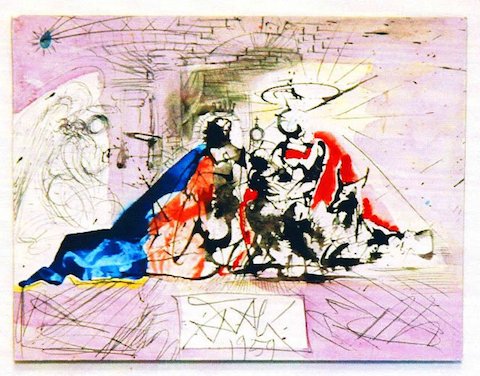
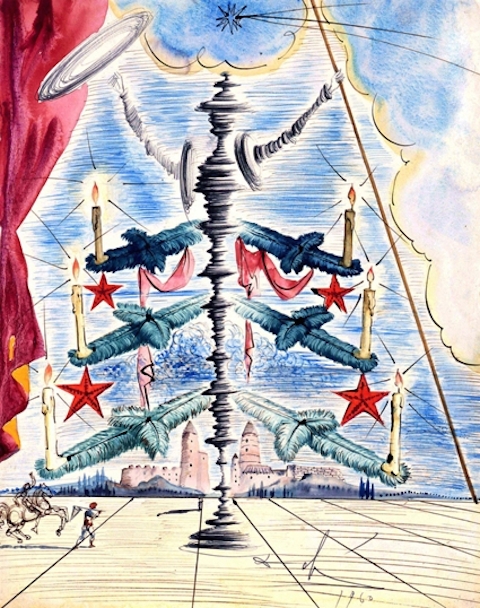
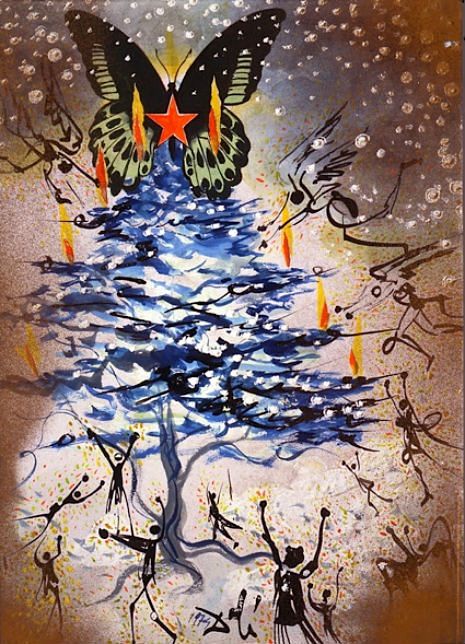
If ever you find yourself looking down on the Christmas card as a bland, mainstream art form, remember that John Waters makes them. So did Andy Warhol. But we’ve told you about those two countercultural creators’ appreciation for the imagery of Christmas before. This holiday season, we submit for your approval a series of Christmas cards from the hand of none other than Salvador Dalí. They came our way via Spanish literature professor Rebecca M. Bender, who writes that the surrealist painter “designed 19 unique Christmas cards between 1958–1976 for the Barcelona-based company Hoechst Ibérica,” a chapter in a commercial career that also included “artwork for advertisements (Bryan’s Hosiery) and magazine covers during the mid-20th century.”
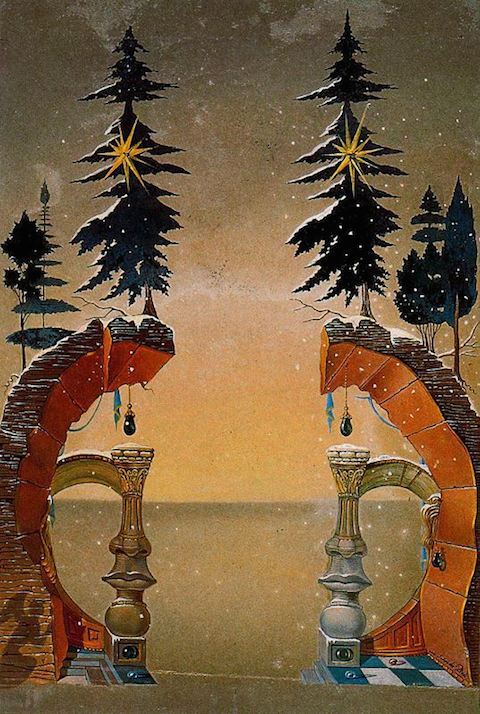
Bender, a Dalí enthusiast who teaches at Grinnell, has assembled an impressive collection of images that give Christmas the surreal touch that I think we can all agree the holiday has always needed. The sketch for a 1948 Vogue magazine cover just above “exhibits tell-tale characteristics of Dalí’s surrealist style, including the barren, expansive landscape and the incorporation of double-images (which also characterize his depiction of the Spanish Civil War).” While that image has today become a specialty Christmas card, the art he created specifically for cards “did not incorporate traditional Mediterranean, Catholic Christmas imagery such as the Nativity scene or the Reyes magos (Wise men), but rather they appropriated more American and Central European elements, such as the Christmas Tree,” which he sometimes used as “an allegorical depiction of the year’s events” or infused “with distinctive elements of Spanish culture.”
When Dalí did try his hand at more traditional Christmas iconography, he did it for American greeting-card titan Hallmark. You can see one fruit of this commission in the 1959 nativity scene at the top of the post. Bender cites Patrick Regan’s book Hallmark: A Century of Caring as describing Dalí’s “take on Christmas [being] a bit too avant garde for the average greeting card buyer.” But tastes, even mainstream tastes, seem to have broadened quite a bit over the past 55 years. The time may have come where every man, woman, and child in America could do with a little surrealism stirred into their Christmas spirit. If you agree, make sure to read and see everything else Bender has gathered from Dalí’s Christmas-card career, all of which will inspire you to make the Yuletide more aesthetically daring.
Related Content:
John Waters Makes Handmade Christmas Cards, Says the “Whole Purpose of Life is Christmas”
Watch Terry Gilliam’s Animated Short, The Christmas Card (1968)
Colin Marshall hosts and produces Notebook on Cities and Culture and writes essays on cities, language, Asia, and men’s style. He’s at work on a book about Los Angeles, A Los Angeles Primer. Follow him on Twitter at @colinmarshall or on Facebook.
Read More...Patti Smith’s Passionate Covers of Jimi Hendrix, Nirvana, Jefferson Airplane & Prince
In 1966, Jimi Hendrix released his first single, “Hey Joe,” a cover song, and, in a certain sense, reclaimed American rock ‘n’ roll from the British invasion. Eight years later in ‘74, it may have seemed like rock ‘n’ roll was dead and gone. Nostalgia set in; Bill Haley’s “Rock Around the Clock” hit the charts again thanks to American Graffiti and Happy Days. And then, a skinny poet from New Jersey and four kids from Queens more or less invented punk and resurrected the moldering corpse of rock. The Ramones appeared at CBGB’s for the first time in August. (See one of their earliest recorded performances here.) That same month saw the release of Patti Smith’s first single—“Hey Joe”—arguably the first punk release in history, though she sings it like a torch song. (The B‑side, the spoken word “Piss Factory,” set the tone for punk rock naming practices for decades to come).
At the top, hear Smith’s version of “Hey Joe,” which she introduces with an original piece of transgressive poetry about Patty Hearst, then still a captive member of the Symbionese Liberation Army. In the still image, Smith wears a t‑shirt that seems to answer the echo of Bill Haley’s ghost: “F*ck the Clock. “ Just above, see Smith and band play “Hey Joe” live on The Old Grey Whistle Test in 1976, just after an abridged version of “Horses.”
One of Smith’s biggest hits, “Gloria,” was also a cover, of a song by Van Morrison’s former band Them. She memorably made that song her own as well with the opening line “Jesus died for somebody’s sins, but not mine.” She went on to cover a host of artists—Dylan, The Beatles, Stevie Wonder, U2. In fact her 10th studio album, 2007’s Twelve, consists entirely of covers. Just above from that record, hear her folky take on Nirvana’s “Smells Like Teen Spirit,” recorded with stand-up bass and banjo. And below, she delivers a spooky rendition of Jefferson Airplane’s “White Rabbit.”
While her stage persona may have mellowed with age, Smith’s voice has remained as powerful and captivating as ever. Below she belts out the Stones’ “Gimme Shelter” live on the BBC’s Later… with Jool Holland, a song she also covers on Twelve.
Her tastes are eclectic, her range wide, and though she’ll always get the credit as the “Godmother of Punk,” she’s able to work in almost any style, even a kind of adult contemporary that doesn’t seem very Patti Smith at all. But she owns it in her cover of Prince’s “When Doves Cry” below, from her two-disc compilation album Land (1975–2002). It’s a long way from “Piss Factory,” but it’s still Smith doing what she’s always done—paying homage to the artists who inspire her. Whether it’s Smokey Robinson, Bruce Springsteen, or Virginia Woolf, she’s able to channel the genius of her influences while infusing their work with her own passionate sexual energy and poetic intensity.
Related Content:
Hear Patti Smith Read 12 Poems From Seventh Heaven, Her First Collection (1972)
See Patti Smith Give Two Dramatic Readings of Allen Ginsberg’s “Footnote to Howl”
Patti Smith’s Cover of Nirvana’s “Smells Like Teen Spirit” Strips the Song Down to its Heart
Josh Jones is a writer and musician based in Durham, NC. Follow him at @jdmagness
Read More...Robert Sapolsky Explains the Biological Basis of Religiosity, and What It Shares in Common with OCD, Schizophrenia & Epilepsy
Since the 19th century, thinkers like Ludwig Feuerbach, Friedrich Nietzsche, and Sigmund Freud have theorized religion as a strictly psychological and anthropological phenomenon born of the tendency of the human mind to project its contents out into the heavens. The Darwinian revolution provided another framework—one grounded in experimental science—to explain religion. Social scientists like Pascal Boyer have integrated these paradigms in comprehensive accounts of the origins of religious belief, and in theories like E.O. Wilson’s Sociobiology, evolutionary biology provides an explanation for all social phenomena, of which religion is but one among many human adaptations. Advances in neurobiology have furthered scientists’ understanding of religion as a product not only of human consciousness, but also of the physical structure of the brain. In experiments like the “God helmet,” for example, scientists can induce religious experiences by prodding certain areas of subjects’ brains.
It is in this context of psychology, anthropology, and evolutionary and neurobiology that we need to situate the lecture above from Stanford professor Robert Sapolsky. Where many critics of religion explicitly reject religious authority and belief, Sapolsky, though himself “stridently atheistic,” has no such agenda. As an article in the Colorado Springs Independent puts it, “he’s no Christopher Hitchens.” Sapolsky freely admits, as do many scientists—religious and non—that religion has many benefits: “It makes you feel better. It tends to decrease anxiety, and it gets you a community.” However, he claims, these positives are the result of evolutionary adaptations, not proofs of any supernatural realm. In fact, religiosity, Professor Sapolsky argues above, is biologically based and related to seemingly much less adaptive traits like obsessive compulsive disorder, schizophrenia, and epilepsy.
Part of a lecture course on “Human Behavioral Biology” at Stanford, the religion lecture is one Sapolsky admits he is “most nervous for, simply because this one people wind up having strong opinions about.” As he moves ahead, he presents his case (with occasional interruptions from his students) for religiosity as a result of natural selection, connecting belief to the selection of genes for diseases like Tay-Sachs, the existence of which can help to explain dispiriting historical cases like the European Pogroms against the Jews in the Middle Ages. Throughout his lecture, Sapolsky makes connections between religiosity and biology, theorizing, for example, that St. Paul had temporal-lobe epilepsy.
At the end of his lecture, around the 1:19:30 mark, Sapolsky issues a disclaimer about what he’s “not saying”: “I’m not saying ‘you gotta be crazy to be religious.’ That would be nonsense. Nor am I saying, even, that most people who are, are psychiatrically suspect.” What he is saying, he continues, is that “the same exact traits which in a secular context are life-destroying” and “separate you from the community” are, “at the core of what is protected, what is sanctioned, what is rewarded, what is valued in religious settings.” What fascinates Sapolsky is the “underlying biology” of these traits. Sapolsky even confesses that he “most regrets” his own break with the Orthodox religion of his upbringing, but that his atheism is something he “appears to be unable to change.” The questions Sapolsky asks broadly cover the physical determinism of gaining faith, and of losing it, which he says, is “just as biological.” What we are to make of all this is a question he leaves open.
You can watch Sapolsky’s full series of lectures on Behavioral Biology here, and for a fully annotated summary of his religiosity lecture above, see this site.
Related Content:
Stanford’s Robert Sapolsky Demystifies Depression
Biology That Makes Us Tick: Free Stanford Course by Robert Sapolsky
Dopamine Jackpot! Robert Sapolsky on the Science of Pleasure
Josh Jones is a writer and musician based in Durham, NC. Follow him at @jdmagness
Read More...Support Us
We're hoping to rely on loyal readers, rather than erratic ads. Please click the Donate button and support Open Culture. You can use Paypal, Venmo, Patreon, even Crypto! We thank you!

About Us

Open Culture scours the web for the best educational media. We find the free courses and audio books you need, the language lessons & educational videos you want, and plenty of enlightenment in between.
Advertise With Us

FREE UPDATES!
GET OUR DAILY EMAIL
Get the best cultural and educational resources on the web curated for you in a daily email. We never spam. Unsubscribe at any time.
FOLLOW ON SOCIAL MEDIA

Open Culture editor Dan Colman scours the web for the best educational media. He finds the free courses and audio books you need, the language lessons & movies you want, and plenty of enlightenment in between.
Advertise With Us

