50 Years of Changing David Bowie Hair Styles in One Animated GIF
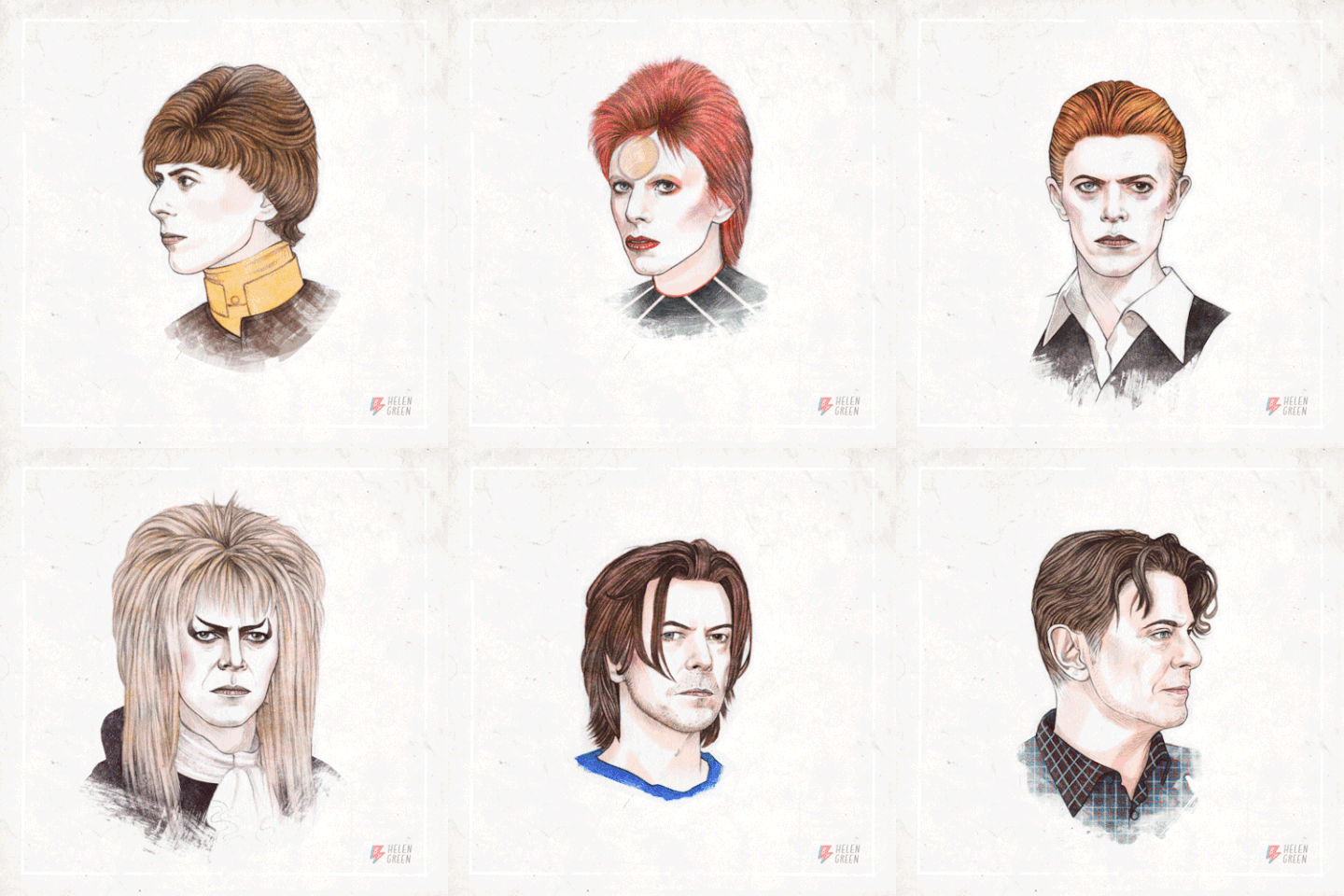
Last summer we time traveled back to 1964 and showed you the very first TV appearance of David Bowie. Here, we found Bowie, only 17 years old, presenting himself as the spokesman for “The Society for the Prevention of Cruelty to Long-Haired Men.” Long hair wasn’t widely accepted in the England of 1964, and, with a touch of humor, Bowie was taking a stand. “I think we’re all fairly tolerant, but for the last two years we’ve had comments like ‘Darling!’ and ‘Can I carry your handbag?’ thrown at us, and I think it just has to stop now.”
Bowie’s obsession with hair never went away. Creative hairstyles would come and go throughout the years. And they’re all on display in an animated gif, which Helen Green published on her Tumblr last week to celebrate the musician’s 68th birthday.
If you would like to support the mission of Open Culture, consider making a donation to our site. It’s hard to rely 100% on ads, and your contributions will help us continue providing the best free cultural and educational materials to learners everywhere. You can contribute through PayPal, Patreon, and Venmo (@openculture). Thanks!
Related Content:
A 17-Year-Old David Bowie Defends “Long-Haired Men” in His First TV Interview (1964)
David Bowie and Cher Sing Duet of “Young Americans” and Other Songs on 1975 Variety Show
Read More...7 Tips from Edgar Allan Poe on How to Write Vivid Stories and Poems
There may be no more a macabrely misogynistic sentence in English literature than Edgar Allan Poe’s contention that “the death… of a beautiful woman” is “unquestionably the most poetical topic in the world.” (His perhaps ironic observation prompted Sylvia Plath to write, over a hundred years later, “The woman is perfected / Her dead / Body wears the smile of accomplishment.”) The sentence comes from Poe’s 1846 essay “The Philosophy of Composition,” and if this work were only known for its literary fetishization of what Elisabeth Bronfen calls “an aesthetically pleasing corpse”—marking deep anxieties about both “female sexuality and decay”—then it would indeed still be of interest to feminists and academics, though not perhaps to the average reader.
But Poe has much more to say that does not involve a romance with dead women. The essay delivers on its title’s promise. It is here that we find Poe’s famous theory of what good literature is and does, achieving what he calls “unity of effect.” This literary “totality” results from a collection of essential elements that the author deems indispensable in “constructing a story,” whether in poetry or prose, that produces a “vivid effect.”
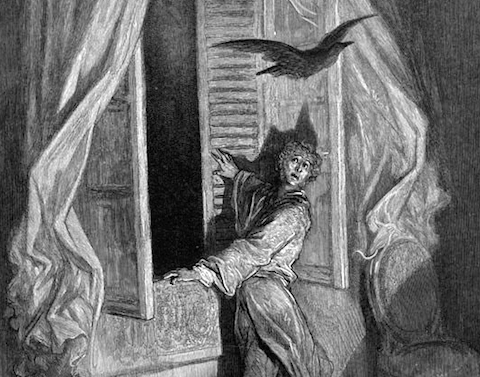
To illustrate what he means, Poe walks us through an analysis of his own work, “The Raven.” We are to take for granted as readers that “The Raven” achieves its desired effect. Poe has no misgivings about that. But how does it do so? Against commonplace ideas that writers “compose by a species of fine frenzy—an ecstatic intuition,” Poe has not “the least difficulty in recalling to mind the progressive steps of any of my compositions”—steps he considers almost “mathematical.” Nor does he consider it a “breach of decorum” to pull aside the curtain and reveal his tricks. Below, in condensed form, we have listed the major points of Poe’s essay, covering the elements he considers most necessary to “effective” literary composition.
- Know the ending in advance, before you begin writing.
“Nothing is more clear,” writes Poe, “than that every plot, worth the name, must be elaborated to its dénouement before any thing be attempted with the pen.” Once writing commences, the author must keep the ending “constantly in view” in order to “give a plot its indispensable air of consequence” and inevitability.
- Keep it short—the “single sitting” rule.
Poe contends that “if any literary work is too long to be read at one sitting, we must be content to dispense with the immensely important effect derivable from unity of impression.” Force the reader to take a break, and “the affairs of the world interfere” and break the spell. This “limit of a single sitting” admits of exceptions, of course. It must—or the novel would be disqualified as literature. Poe cites Robinson Crusoe as one example of a work of art “demanding of no unity.” But the single sitting rule applies to all poems, and for this reason, he writes, Milton’s Paradise Lost fails to achieve a sustained effect.
- Decide on the desired effect.
The author must decide in advance “the choice of impression” he or she wishes to leave on the reader. Poe assumes here a tremendous amount about the ability of authors to manipulate readers’ emotions. He even has the audacity to claim that the design of the “The Raven” rendered the work “universally appreciable.” It may be so, but perhaps it does not universally inspire an appreciation of Beauty that “excites the sensitive soul to tears”—Poe’s desired effect for the poem.
- Choose the tone of the work.
Poe claims the highest ground for his work, though it is debatable whether he was entirely serious. As “Beauty is the sole legitimate province of the poem” in general, and “The Raven” in particular, “Melancholy is thus the most legitimate of all poetical tones.” Whatever tone one chooses, however, the technique Poe employs, and recommends, likely applies. It is that of the “refrain”—a repeated “key-note” in word, phrase, or image that sustains the mood. In “The Raven,” the word “Nevermore” performs this function, a word Poe chose for its phonetic as much as for its conceptual qualities.
Poe claims that his choice of the Raven to deliver this refrain arose from a desire to reconcile the unthinking “monotony of the exercise” with the reasoning capabilities of a human character. He at first considered putting the word in the beak of a parrot, then settled on a Raven—“the bird of ill omen”—in keeping with the melancholy tone.
- Determine the theme and characterization of the work.
Here Poe makes his claim about “the death of a beautiful woman,” and adds, “the lips best suited for such topic are those of a bereaved lover.” He chooses these particulars to represent his theme—“the most melancholy,” Death. Contrary to the methods of many a writer, Poe moves from the abstract to the concrete, choosing characters as mouthpieces of ideas.
- Establish the climax.
In “The Raven,” Poe says, he “had now to combine the two ideas, of a lover lamenting his deceased mistress and a Raven continuously repeating the word ‘Nevermore.’” In bringing them together, he composed the third-to-last stanza first, allowing it to determine the “rhythm, the metre, and the length and general arrangement” of the remainder of the poem. As in the planning stage, Poe recommends that the writing “have its beginning—at the end.”
- Determine the setting.
Though this aspect of any work seems the obvious place to start, Poe holds it to the end, after he has already decided why he wants to place certain characters in place, saying certain things. Only when he has clarified his purpose and broadly sketched in advance how he intends to acheive it does he decide “to place the lover in his chamber… richly furnished.” Arriving at these details last does not mean, however, that they are afterthoughts, but that they are suggested—or inevitably follow from—the work that comes before. In the case of “The Raven,” Poe tells us that in order to carry out his literary scheme, “a close circumscription of space is absolutely necessary to the effect of insulated incident.”
Throughout his analysis, Poe continues to stress—with the high degree of repetition he favors in all of his writing—that he keeps “originality always in view.” But originality, for Poe, is not “a matter, as some suppose, of impulse or intuition.” Instead, he writes, it “demands in its attainment less of invention than negation.” In other words, Poe recommends that the writer make full use of familiar conventions and forms, but varying, combining, and adapting them to suit the purpose of the work and make them his or her own.
Though some of Poe’s discussion of technique relates specifically to poetry, as his own prose fiction testifies, these steps can equally apply to the art of the short story. And though he insists that depictions of Beauty and Death—or the melancholy beauty of death—mark the highest of literary aims, one could certainly adapt his formula to less obsessively morbid themes as well.
Related Contents:
Gustave Doré’s Splendid Illustrations of Edgar Allan Poe’s “The Raven” (1884)
Edgar Allan Poe’s “The Raven,” Read by Christopher Walken, Vincent Price, and Christopher Lee
H.P. Lovecraft Gives Five Tips for Writing a Horror Story, or Any Piece of “Weird Fiction”
Josh Jones is a writer and musician based in Durham, NC. Follow him at @jdmagness
Read More...The Big Ideas of Stephen Hawking Explained with Simple Animation
Full disclosure: On my 7th grade report card, a sympathetic science teacher tempered a shockingly low grade with a handwritten note to my parents. Something to the effect of it being her opinion that my interest in theater would, ultimately, serve me far better than any information she was attempting to ram through my skull.
Thank you, Miss Cooper, for your compassion and exceptional foresight.
There are times, though, when I do wish I was just a teensy bit better informed about certain buzzy scientific theories. Hank Green’s information-packed science Crash Courses are helpful to a degree, but he talks so damn fast, I often have the sensation of stumbling stupidly behind…
Which I am, but still…
Alok Jha, the author and ITV Science Correspondent who narrates the brief animated guide to some of Stephen Hawking’s big ideas, takes things at a more encouraging pace. His delivery reminds me of Alain de Botton’s, and that alone is enough to sooth me into believing I stand a chance of somewhat grasping such quantum concepts as black holes, gravitational singularities, and Hawking radiation.
As long as I don’t lose myself in non-scientific flourishes like the cat in a box anchoring some of Hawking’s equations or a sweet homage to ET, I may be able to keep hold of this tiger’s tail. Or at least nod with something resembling interest, the next time a science-obsessed teen is sharing his or her passion…
The video above come from The Guardian’s Animations and Explainers video series. And it was created by Scriberia, a London animation studio.
via Brain Pickings
Related Content:
Stephen Hawking’s Universe: A Visualization of His Lectures with Stars & Sound
Watch A Brief History of Time, Errol Morris’ Film About the Life & Work of Stephen Hawking
Carl Sagan, Stephen Hawking & Arthur C. Clarke Discuss God, the Universe, and Everything Else
Free Online Astronomy Courses
Ayun Halliday is an author, homeschooler, and Chief Primatologist of the East Village Inky zine. Follow her @AyunHalliday
Read More...Andrei Tarkovsky’s Masterpiece Stalker Gets Adapted into a Video Game
Of all the movies out there, Andrei Tarkovsky’s maddeningly oblique masterpiece Stalker (1979) doesn’t seem like a likely choice to be adapted into a video game. Yet it was.
The movie, Tarkovsky’s last in the USSR, is dense and enigmatic with none of the narrative pay-offs that you see in most films. The story centers on a region called the Zone, which after some unnamed disaster, has the power to fulfill your greatest wish. Naturally, the area has been ringed off by the authorities with razor wire and armed guards. At the film’s opening, a guide, called a Stalker, takes two clients, a writer and a scientist, into the Zone. And yet after nearly three hours of meandering and philosophical monologues, none of the characters make a wish nor are any wishes granted. The end. But the reason the movie has such a fervent, cultish following is not for its dramatics. Instead, the film’s power is found in the cumulative effect of its hypnotically slow pacing, its spiritual longing and its gorgeous imagery. You can watch the film online here. Find more Tarkovsky films here.
And there’s the uncanny fact that Stalker seemed to prefigure a global disaster that struck seven years after the movie premiered. It is just about impossible to look at those eerie photos of irradiated ghost towns within Chernobyl’s 30 square kilometer exclusion zone and not think about Stalker.
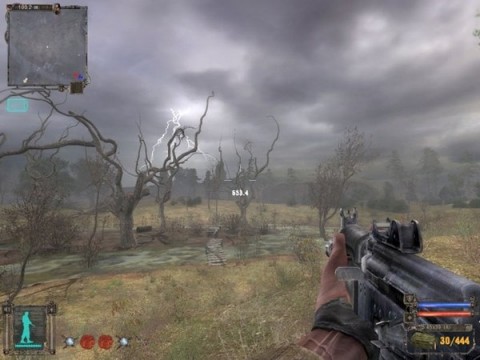
Enter Ukrainian game developer GSC Game World, which explicitly connected the disaster with Tarkovsky’s movie when, in 2007, it released S.T.A.L.K.E.R.: Shadow of Chernobyl, the first in a whole series of games. (The title might just feature the most tortured acronym this side of the USAPATRIOT Act, standing for Scavenger, Trespasser, Adventurer, Loner, Killer, Explorer, Robber.) On first blush, the game and the movie seem to have little in common aside from the name. There are relatively few machine gun battles or zombified mutants in the film. Yet Gabriel Winslow-Yost argues in The New York Review of Books that there are more similarities than might be first apparent.
As games, the S.T.A.L.K.E.R. series are remarkable.… While they all have the elements of a standard action game—guns, monsters, missions, traps, loot—much of the player’s activity is oddly in keeping with Stalker’s spirit, sometimes even managing to expand upon it. […] Watching Stalker, one is occasionally brought up short by remembering that it was not filmed in Chernobyl, so perfect an analogue does that event seem for the film’s images of technology and nature, beauty and danger in strange alliance. The games, at their best, can seem like a sort of miracle: a dead man’s masterpiece, come home at last.
Stalker was based on a novella called Roadside Picnic by Arkady and Boris Strugatsky. Winslow-Yost points out the games are actually more in keeping with the source material than Tarkovsky’s film. “The stalkers are numerous and mercenary. The elements of the Zone are many, and named, if not quite explained—there’s ‘Mosquito Mange’ and ‘Burning Fluff,’ ‘Full Empties’ and ‘Black Sprays.’ In the film most of these are not present—Tarkovsky leaves in only one, the ‘meatgrinder,’ though his Stalker is clearly terrified of many more.”
The games proved to be so successful, especially in Russia, that they were turned into novels. No word if anyone has bothered to buy the film rights to those books. If you want to see what the game looks like, there’s a video of it above.
But the real question is what other art house landmarks are going to get remade into video games? A version of Second Life inspired by Yasujiro Ozu’s Tokyo Story? A mash up of Grand Theft Auto and Jean-Luc Godard’s Weekend? Last Year at Marienbad as a first-person shooter?
Related Content:
Tarkovsky Films Now Free Online
Watch Stalker, Andrei Tarkovsky’s Mind-Bending Masterpiece Free Online
The Masterful Polaroid Pictures Taken by Filmmaker Andrei Tarkovsky
Tarkovsky’s Advice to Young Filmmakers: Sacrifice Yourself for Cinema
A Poet in Cinema: Andrei Tarkovsky Reveals the Director’s Deep Thoughts on Filmmaking and Life
Jonathan Crow is a Los Angeles-based writer and filmmaker whose work has appeared in Yahoo!, The Hollywood Reporter, and other publications. You can follow him at @jonccrow. And check out his blog Veeptopus, featuring lots of pictures of badgers and even more pictures of vice presidents with octopuses on their heads. The Veeptopus store is here.
Read More...Steven Soderbergh Creates a Big List of What He Watched, Read & Listened to in 2014
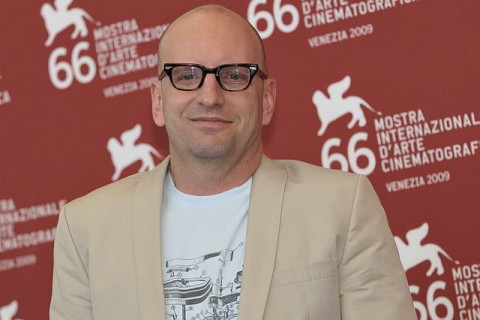
Image by Nicolas Genin
Our vast media landscape feels grossly oversaturated with advertising, propaganda, and all manner of redundant noise. But the discerning eye, and ear, perceives just as much quality out there as crap. “Retired” auteur Steven Soderbergh, as fans of his will know, is just such a discerning customer — and an exacting, highly organized one at that. Soderbergh has sworn off directing film, turning his attention to television by directing the Cinemax series The Knick as well as—reports Indiewire—“producing, editing, and lensing Magic Mike XXL,” the second installment of the Channing Tatum-starring male stripper saga.
One might think all this work would keep Soderbergh busy from dawn to dusk, but he’s a man who “gets more done in a day than most do in a week.” A consummate consumer of culture high and low, Soderbergh assiduously documented his watching, reading, and listening experiences for the entire year previous. His list includes TV shows like Veep and Louie, and heavier fare like True Detective and House of Cards. He read Donna Tartt’s The Goldfinch and Karl Ove Gnausgaard’s laborious Proustian novel My Struggle (books one through three—in two months). In addition to recent films like Gone Girl, Soderbergh watched Kubrick’s 2001: A Space Odyssey three times and Jaws twice. He even found the time for Die Hard With a Vengeance.
The above represents but the tiniest sampling of Soderbergh’s voracious diet. You can see the full list, including his album purchases here. As Indiewire rightly observes, the list is “a lot to wade through.” Even more so the incredible range and diversity of creative works contained within. Soderbergh maintained a similar log for 2013, which you can see here. Scanning these may inspire you to step up your input, or maybe just to pull a manageable number of selections for future reading/viewing/listening of your own.
via Indiewire
Related Content:
Steven Soderbergh Posts a List of Everything He Watched and Read in 2009
Watch Steven Soderbergh’s Creative Mashup of Hitchcock and Gus Van Sant’s Psycho Films
Steven Soderbergh Writes Twitter Novella After His Retirement From Filmmaking
Josh Jones is a writer and musician based in Durham, NC. Follow him at @jdmagness
Read More...Jimmy Page Tells the Story of “Stairway to Heaven”: How the Most Played Rock Song Came To Be
Walk into any guitar store, anywhere in the world, and you’re likely to hear the strains of one, or both, of two songs: Guns n’ Roses’ “Sweet Child O’ Mine” and Led Zeppelin’s “Stairway to Heaven.” (Some guitar shops supposedly banned the latter several years ago.) Why are these so popular with budding players? Perhaps it’s because they have two of the most memorable guitar intros in rock history.
But only one of those intros might be lifted almost wholesale from another song, at least if you ask the estate of Randy California. Heirs of the late guitarist and co-founder of the band Spirit have claimed for years that the delicate acoustic melody that opens Zeppelin’s song came directly from California’s tune “Taurus.” The lawsuit is ongoing, and maybe not without some merit.
But all that aside (and what song, after all, doesn’t at least reference another?), “Stairway” is a phenomenal piece of songwriting, with its Celtic folk undertones and orchestral crescendos. So how, apart from some borrowing, did Zeppelin guitarist Jimmy Page come to write it? You can hear the story from the man himself above. Page talks about the use of recorders in the song’s “exposed acoustic” intro to give it a “slightly medieval feel.” Given the number of Lord of the Rings references in Robert Plant’s lyrics, this seems only fitting. Multi-instrumentalist bass player John Paul Jones came up with the idea for the recorders, Page tells us, and played them himself. (Page would have gone with “the texture of electric piano”).
Page offers many other fascinating tidbits on the moody, layered “Stairway.” To hear what it sounded like at first, before the storied album version’s cavernous production, listen to the early acoustic demo above. Page and Plant composed the rudiments while vacationing in Wales at a cottage called Bron Yr Aur (now a famous pilgrimage site for fans). Recording sessions took place in 1970 and 71 at Basing Street Studios in London and Headley Grange in Hampshire, where the band lived at the time. Zeppelin debuted “Stairway” live at Belfast’s Ulster Hall on March 5, 1971, with Page playing his many parts on a Gibson double-necked guitar. You can hear that first performance, and the somewhat tepid audience response, in the muffled recording below.
According to John Paul Jones, the crowd was “all bored to tears waiting to hear something they knew.” Nonetheless, “Stairway to Heaven” became the band’s “most requested song ever played on American radio” and was “included at every subsequent Zeppelin show.” Though it may be the most overplayed song of all time, “Stairway” has certainly earned it status as a rock ‘n’ roll milestone. As Page says at the top, the recording captures the band in their most inspired moment, a time when they did “nothing but eat, sleep, and make music.”
Related Content:
‘Stairway to Heaven’: Watch a Moving Tribute to Led Zeppelin at The Kennedy Center
Zeppelin Took My Blues Away: An Illustrated History of Zeppelin’s “Copyright Indiscretions”
Josh Jones is a writer and musician based in Durham, NC. Follow him at @jdmagness
Read More...Isaac Asimov Wrote “Gross” Limericks — Lots of Them
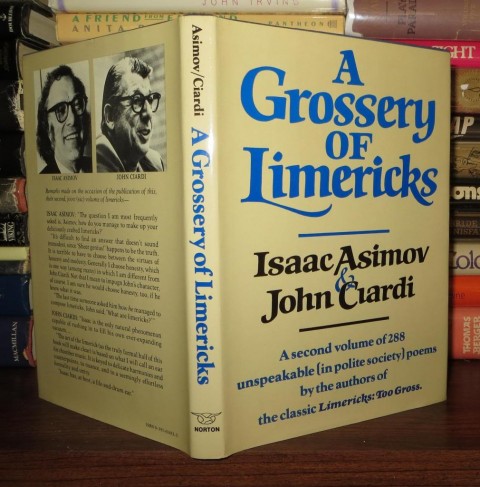
Isaac Asimov — he’s best known for his masterful works of science fiction. He was also a professor of biochemistry at Boston University. A committed humanist. And someone who enjoyed writing lots of dirty limericks. Somewhere on his list of 500+ books, you will find Lecherous Limericks (1976), Limericks: Too Gross (1978), A Grossery of Limericks (1981), and Asimov Laughs Again: More Than 700 Jokes, Limericks, and Anecdotes (1993). In two of these volumes, Asimov sparred with popular poet and Dante translator John Ciardi, each writing dirty poems, and trying to master a rather strict poetic form that began in early 18th century England.
Most of the limericks are indeed a “gross.” Many are crude. Some would be considered downright offensive by 2015 standards. But, if you want a taste of what Asimov served up, you can try out these tamer ones from Limericks: Too Gross.
The haughty philosopher, Plato
Would unbend to a sweet young tomato.
Though she might be naive
Like you wouldn’t believe
He would patiently show her the way to.A certain young fellow named Scott
Once jumped his young bride on their cot.
He intended no shirking.
But from sheer overworking
A dry run is all that she got.
If you want to see Asimov at his tamest, you can also check out his book Limericks for Children.
Related Content:
Isaac Asimov Predicts in 1964 What the World Will Look Like Today — in 2014
Free: Isaac Asimov’s Epic Foundation Trilogy Dramatized in Classic Audio
Isaac Asimov Imagines Learning in the Electronic Age … and Gets It Quite Right (1989)
Read More...Steven Spielberg & Alfred Hitchcock Face Off in an Epic Rap Battle (NSFW)
In a throw down between directors Steven Spielberg and Alfred Hitchcock, who do you think would win?
The pioneering crowd pleaser?
Or the master of suspense?
If Peter Shukoff and Lloyd Ahlquist, the makers of Epic Rap Battles of History refuse to say, I will: neither of them.
Instead, it is action director Michael Bay (as embodied by a bewigged Shukoff), who emerges victorious, dropping into the proceedings via helicopter, to spit that moviemaking is all about the “motherfuc&in’ money”! Artistically, he may not have much currency, but there’s no arguing that the Transformers franchise has indeed endowed him with the “socks made of silk money.”
Other unannounced competitors include Stanley Kubrick, pedaling down a long hallway on an ersatz Big Wheel, and Quentin Tarantino, summoned, no doubt, by a Hitchcock taunt that no one will ever pick Samuel L. Jackson’s turn in Jurassic Park as their favorite Samuel L. Jackson role.
It’s vulgar, and NSFW sans headphones, but as legions of adolescent boys will passionately attest, it has its moments. Watching the behind the scenes, below, reminded me of all the planning that went into this episode, from special effects make up to research and green screen. If the end result is not quite to your taste, at least you can rest assured that it’s by design.
Related Content:
23 Free Hitchcock Movies Online
Alfred Hitchcock’s Seven-Minute Editing Master Class
Thomas Edison and Nikola Tesla Face Off in “Epic Rap Battles of History”
4,000+ Free Movies Online: Great Classics, Indies, Noir, Westerns, Documentaries & MoreAyun Halliday is an author, homeschooler, and Chief Primatologist of the East Village Inky zine. Follow her @AyunHalliday
Read More...Werner Herzog Plays Himself in Cartoon That Satirizes Obama’s 2008 Election & Race in America
The United States has two important cultural means of self-examination—the work of foreign observers and of domestic satirists. In the former category, we have the longstanding example of political theorist Alexis de Tocqueville and the much bleaker, contemporary vision of Werner Herzog. As for the latter, we have venerable literary heroes like Mark Twain and more populist, contemporary voices like Chris Rock, Stephen Colbert, and cartoonist Aaron McGruder, creator of the comic strip-turned-animated series The Boondocks. In 2010, the Season 3 debut episode of the biting Adult Swim show brought these two traditions together, as McGruder took on the election of America’s first black president by imagining a German documentarian—Herzog—who examines the nation’s response through interviews with the show’s characters.
The clip above will give you an idea of the general tone. Herzog plays an exaggerated version of himself, complete with stereotypically German expressions of existential despair. The Freeman family, the show’s center, represents an also-exaggerated range of responses from black Americans to Obama’s election. Huey, the young black radical (“retired”), expresses a deep, cynical skepticism. His brother Riley has a total disregard for the social and political import of the election, confident instead that a black president will give him a license to do what he wants. And the brothers’ grandfather Robert, a Civil Rights veteran, displays an unqualified optimism and nostalgic pride for his activist days. The full episode also satirizes a certain ill-informed rapper with a character called Thugnificent and certain superficial white progressives (“Obama Guy” and “Obama Girl”). And, of course, belligerent reactionary Uncle Ruckus gets his say.
If you would like to support the mission of Open Culture, consider making a donation to our site. It’s hard to rely 100% on ads, and your contributions will help us continue providing the best free cultural and educational materials to learners everywhere. You can contribute through PayPal, Patreon, and Venmo (@openculture). Thanks!
By the time of its airing, the episode was already nearly two years late in its comment on the events, making it feel, wrote the A.V. Club’s Todd VanDerWerff, “like an instant period piece.” Perhaps now it seems downright paleolithic in the timescale of political commentary. Making this kind of cultural critique seem relevant outside of the immediate moment is a challenge writers on The Daily Show confront, well, daily. But here, the content holds up, not only because Herzog has a way of making everything timeless, but also because “the episode takes us back to… the way [Barack Obama] managed to make almost every single one of his supporters believe that he was going to do what THEY most wanted him to do and not what he had actually promised to do.” In many ways, the country is still recovering from a brutal hangover after this post-2008 election high.
Whether the president is fully to blame for encouraging false hopes—and fears—is highly debatable. In any case, the characters’ outsized expectations or expressions of apathy or virulent outrage mirror many of the responses of both liberals and conservatives. But it seems that both the left and right shared at least one hope: that the election of the country’s first black president would put an end to its oldest, deepest, most persistent ill. “At the end of the episode,” writes VanDerWerff, “most of the characters seem disappointed that Obama didn’t completely rewrite the space-time continuum, that America still struggles with race.” An understatement perhaps even in 2010, the phrase “still struggles with race” is even more so today, for reasons both obvious and less so.
That the United States—despite the continued efforts of a great many activists and some few legislators—is still riven with deep racial divides, and that these represent the persistence of a historical legacy, should not be matters in much dispute. A multitude of academic analyses on “staggering disparities” in policing practices, imbalances in the justice system, and profound wealth inequality and discrimination in housing and employment bear out the claim. How we talk about these issues, who is authorized to do so, and what can be done about it, on the other hand, are matters of considerable, seemingly unending debate. It has always seemed particularly ironic that many comedians—from Richard Pryor to Chris Rock and Louis CK—have achieved much of their mainstream success by telling hard truths about the state of race in America, truths few people seem to want to hear. When those messages come from non-entertainers, for example, the backlash can be swift and vicious.
But this is nothing new. From the candor of Shakespeare’s jesters to Swift’s poison pen to, yes, The Boondocks, humor and satire have served as vehicles for what we would otherwise suppress or repress. (No need to be a Freudian to acknowledge the point). In this episode, the satirical target isn’t only Obama’s supporters and detractors at home—though they get their due. Herzog’s editorial intrusions also satirize some woefully naïve, ahistorical expectations of a global, or at least European, community. As the Herzog character puts it in his second question to Huey, “now that it looks like Obama is going to win, as a black African American Negro, are you merely excited, or are you extremely excited that everything is going to change forever.” VanDerWerff reads Huey’s apathetic response to such grandiosity as an expression of McGruder’s view that idealism is “both an unsustainable tragedy and the only rational response to a world that’s hopelessly screwed.” But in the face of unbridled idealism, Huey’s hard-bitten realism is tonic: “Hope,” he says, “is irrational.” So also, perhaps, is despair.
Watch the full episode here and read a complete summary here.
Related Content:
Werner Herzog’s Eye-Opening New Film Reveals the Dangers of Texting While Driving
Steven Spielberg’s Obama, Starring Daniel Day Lewis as the President
Josh Jones is a writer and musician based in Durham, NC. Follow him at @jdmagness
Read More...The Tate Digitizes 70,000 Works of Art: Photos, Sketchbooks, Letters & More
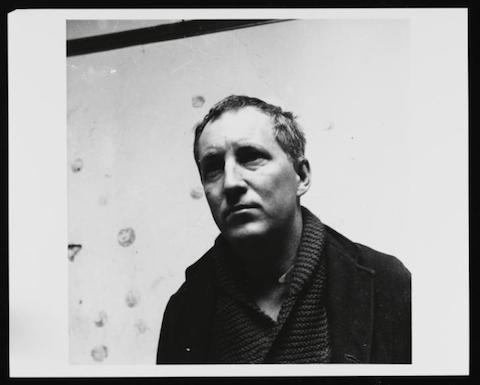
Photograph of Nigel Henderson via Nigel Henderson Estate
If you’re like me, one of the first items on your itinerary when you hit a new city is the art museums. Of course one, two, even three or four visits to the world’s major collections can’t begin to exhaust the wealth of painting, sculpture, photography, and more contained within. Rotating and special exhibits make taking it all in even less feasible. That’s why we’re so grateful for the digital archives that institutions like the Getty, LA County Museum of Art, the Metropolitan Museum of Art, the National Gallery, and the British Library make available free online. Now another museum, Britain’s Tate Modern, gets into the digital archive arena with around 70,000 digitized works of art in their online gallery.
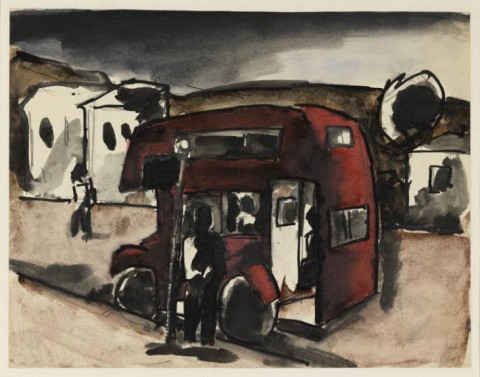
“Sketch of the bus stop” from the estate of Josef Herman
But wait, there’s more. Much more. A separate digital archive—the Tate’s Archives & Access project—offers up a trove of materials you’re unlikely to encounter much, if at all, in their physical spaces. That’s because this collection digitizes little-seen “artists’ materials, including photographs, sketchbooks, diaries, letters and objects, documenting the lives and working processes of British born and émigré artists, from 1900 to the present.” These include, writes The Guardian, “the love letters of painter Paul Nash, the detailed sculpture records of Barbra Hepworth, and 3,000 photographs by Nigel Henderson, providing a behind-the-scenes backstage look at London’s 1950s jazz scene.” Thus far, the Tate has uploaded about 6,000 items, “including 52 collections relating to 79 artists.” At the Tate archive, you’ll find photographs like that of painter and photographer Nigel Henderson (see top of the post) and also paintings by the highly regarded Polish-British realist, Josef Herman (right above).

“Squared-up drawings of soldiers” via The estate of David Jones
You’ll find preliminary sketches like the 1920–21 Squared-up drawings of soldiers by painter and poet David Jones, above, one of 109 sketches and two sketchbooks available by the same artist. You’ll find letters like that below, written by sculptor Kenneth Armitage to his wife Joan Moore in 1951—one of hundreds. These are but the tiniest sampling of what is now “but a drop in the ocean,” The Guardian writes, “given the more than 1 million items in the [physical] archive.” Archive head Adrian Glew calls the collection “a national archival treasure” that is also “for the enrichment of the whole world.”

Letter from Kenneth Armitage to Joan Moore via the The Kenneth Armitage Foundation
The remainder of the digitized Archives & Access collection—52, 000 items in total—should be available by the summer of 2015. While viewing art and artifacts online is certainly no substitute for seeing them in person, it’s better than never seeing them at all. In any case, millions of pieces are only viewable by curators and specialists and never make their way to gallery floors. But with the appearance and expansion of free online archives like the Tate’s, that situation will shift dramatically, opening up national treasures to independent scholars and ordinary art lovers the world over.
Related Content:
The Metropolitan Museum of Art Puts 400,000 High-Res Images Online & Makes Them Free to Use
The National Gallery Makes 25,000 Images of Artwork Freely Available Online
LA County Museum Makes 20,000 Artistic Images Available for Free Download
Josh Jones is a writer and musician based in Durham, NC. Follow him at @jdmagness
Read More...Support Us
We're hoping to rely on loyal readers, rather than erratic ads. Please click the Donate button and support Open Culture. You can use Paypal, Venmo, Patreon, even Crypto! We thank you!

About Us

Open Culture scours the web for the best educational media. We find the free courses and audio books you need, the language lessons & educational videos you want, and plenty of enlightenment in between.
Advertise With Us

FREE UPDATES!
GET OUR DAILY EMAIL
Get the best cultural and educational resources on the web curated for you in a daily email. We never spam. Unsubscribe at any time.
FOLLOW ON SOCIAL MEDIA

Open Culture editor Dan Colman scours the web for the best educational media. He finds the free courses and audio books you need, the language lessons & movies you want, and plenty of enlightenment in between.
Advertise With Us

