What We Heard on the Night John Lennon Was Shot: Radio & TV Broadcasts (December 8, 1980)
On December 8, 1980, the New England Patriots-Miami Dolphins game was winding down, the end of another Monday Night Football game. Then, Howard Cosell, America’s legendary sportscaster, broke the news to unsuspecting viewers: “An unspeakable tragedy confirmed to us by ABC News in New York City: John Lennon, outside of his apartment building on the West Side of New York City, the most famous, perhaps, of all of The Beatles, shot twice in the back, rushed to Roosevelt Hospital, dead on arrival.” Soon enough, more formal news reports followed on the BBC and ABC’s Nightline, and you can still hear what New Yorkers heard on the radio that night (below). The sound file was originally posted by WFMU’s Beware of the Blog, and like Howard says, it puts a lot of things in perspective for us.
A longer montage can be heard here:
If you would like to support the mission of Open Culture, consider making a donation to our site. It’s hard to rely 100% on ads, and your contributions will help us continue providing the best free cultural and educational materials to learners everywhere. You can contribute through PayPal, Patreon, and Venmo (@openculture). Thanks!
Related Content:
John Lennon’s Raw, Soul-Baring Vocals From the Beatles’ ‘Don’t Let Me Down’ (1969)
John Lennon & Yoko Ono’s Two Appearances on The Dick Cavett Show in 1971 and 72
Read More...Jeff Bridges Narrates a Brief History of Bob Dylan’s and The Band’s Basement Tapes

It’s not hard to guess what Bob Dylan will fans will be putting on their Christmas lists this year — either the new hardcover book, The Lyrics: Since 1962, the 14-pound, 960-page book containing all the lyrics Dylan wrote, recorded, and performed throughout the years. Or the definitive edition of The Basement Tapes, the new collection featuring 6‑discs and 138 tracks.
Above, actor Jeff Bridges (you know him as “The Dude” in The Big Lebowski) narrates the story behind The Basement Tapes, tracing Dylan’s journey from Greenwich Village to the basement of “Big Pink,” the unassuming home in West Saugerties, New York where Dylan and The Band recorded those famous tapes. We don’t need to rehearse the story. Bridges does a fine job of doing that. Below, you can watch him show off some of his musical talents, playing a cover of a Dylan song, “Ring Them Bells,” at the El Rey Theatre in LA in April 2013. He’s obviously a fan.
H/T Mike
Related Content:
Bob Dylan and The Grateful Dead Rehearse Together in Summer 1987. Listen to 74 Tracks.
The 1969 Bob Dylan-Johnny Cash Sessions: 12 Rare Recordings
Bob Dylan and George Harrison Play Tennis, 1969
Read More...Chrissie Hynde’s 10 Pieces of Advice for “Chick Rockers” (1994)
 Chrissie Hynde knows a few things about being a female rocker. When at the tender age of 14 she saw Mitch Ryder and the Detroit Wheels play at a fairground in her hometown of Akron, Ohio, the band got into a fistfight with each other during the performance. She was hooked. “I thought,” she said to The Guardian ‘That’s got to be the life!’ ”
Not long after college at Kent State, where she was in a band with Devo’s Mark Mothersbaugh, she ended up in London. There she worked at Malcolm McLaren’s notorious store SEX alongside the future members of The Sex Pistols. She even asked Sid Vicious and Johnny Rotten to marry her for the work visa. She tried to start a band with Mick Jones of The Clash, but that didn’t take. She was kicked out of the band Masters of the Backside before they changed their name to The Damned and became famous. Then in 1978, she formed the band The Pretenders and quickly became a rock icon with hit tunes like “Don’t Get Me Wrong” and “Message of Love.”
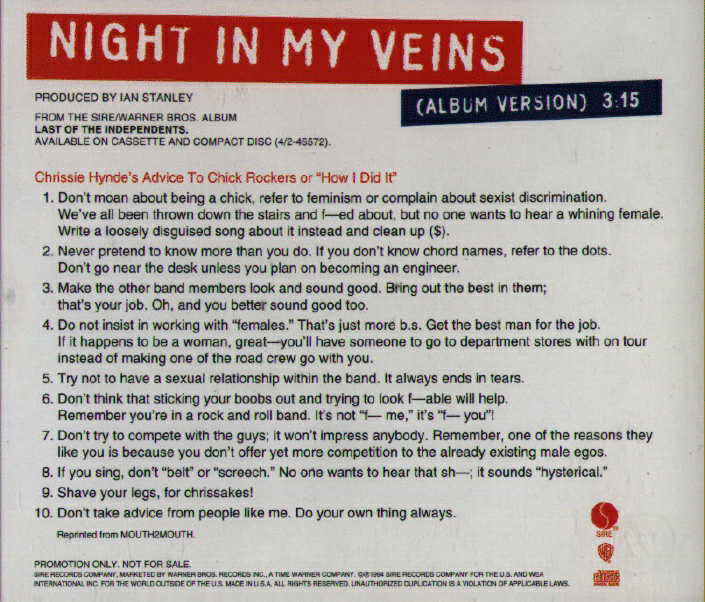
In short, Hynde has been rocking for over 40 years now and she has some advice for aspiring lady rockers, which was originally printed as a promo for her 1994 release “Night in my Veins.”
1. Don’t moan about being a chick, refer to feminism or complain about sexist discrimination. We’ve all been thrown down the stairs, and f—ed about, but no one wants to hear a whining female. Write a loosely disguised song about it instead and clean up. ($)
2. Never pretend to know more than you do. If you don’t know chord names, refer to the dots. Don’t go near the desk unless you plan on becoming an engineer.
3. Make the other band members look and sound good. Bring out the best in them; that’s your job. Oh, and you better sound good too.
4. Do not insist in [sic] working with “females.” That’s just more b.s. Get the best man for the job. If it happens to a woman, great – you’ll have someone to go to department stores with on tour instead of making one of the road crew go with you.
5. Try not to have a sexual relationship with the band. It always ends in tears.
6. Don’t think that sticking your boobs out and trying to look f—able will help. Remember you’re in a rock and roll band. It’s not “f—me,” it’s “f—you”!
7. Don’t try to compete with the guys; it won’t impress anybody. Remember, one of the reasons they like you is because you don’t offer yet more competition to the already existing male egos.
8. If you sing, don’t “belt” or “screech.” No one wants to hear that sh–; it sounds “hysterical.”
9. Shave your legs, for chrissakes!
10. Don’t take advice from people like me. Do your own thing always.
A lot of this is just sound advice for getting along at the workplace – don’t act like you know more than you do, don’t complain, make your workmates look good but don’t doink them. But probably the key points for Hynde is number one and number seven.
In that interview with the Guardian, she indeed proved to be reluctant to “moan” about sexual discrimination in the rockdom. “There’s always been women doing this, just not that many,” she said. “I don’t know what the feminists have to say about it. Over the years, you’d hear, ‘We weren’t encouraged.’ Well, I don’t think Jeff Beck’s mother was saying, ‘Jeffrey! What are you doing up in your room? Are you rehearsing up there?’ No one was ever encouraged to play guitar in a band. But I never found it harder because I’m a woman. If anything I’ve been treated better. Guys will carry my guitars and stuff – who’s going to say no? Guys always tune my guitars, too.”
Check out the video for “Night in my Veins” below:
Related Content:
Four Female Punk Bands That Changed Women’s Role in Rock
The Art of Punk Presents a New Documentary on The Dead Kennedys and Their Gritty Aesthetics
Jonathan Crow is a Los Angeles-based writer and filmmaker whose work has appeared in Yahoo!, The Hollywood Reporter, and other publications. You can follow him at @jonccrow. And check out his blog Veeptopus, featuring lots of pictures of badgers and even more pictures of vice presidents with octopuses on their heads. The Veeptopus store is here.
Read More...
George Harrison’s Mystical, Fisheye Self-Portraits Taken in India (1966)
The Beatles’ sojourn in India can seem like a bit of a stunt, as much a rock n’ roll cliché as Led Zeppelin’s trashed hotel rooms or Fleetwood Mac’s coke binges. Easily parodied in, for example, Walk Hard: The Dewey Cox Story, the band’s turn Eastward looks in hindsight like faddish spiritual tourism. That impression may not be so far off. As one writer puts it:
By the late 1960s, The Beatles had engineered another pop culture revolution (at least in Europe and North America) by wearing Indian-style clothing, spouting religious and philosophical aphorisms that seemed to borrow from ‘Eastern’ thought, and later even visiting India for a highly-publicized training session to learn Transcendental Meditation with the fraudulent ‘mystic’ Maharishi Mahesh Yogi.
But while for John, Paul, and Ringo, “interest in Indian/Hindu culture was rather fleeting and temporal […] for George, India completely overhauled and changed his life permanently.” As Harrison himself would later recount of his first journey in 1966, “it was the first feeling I’d ever had of being liberated from being a Beatle or a number.” The rest of the band wouldn’t make the trip until two years later.
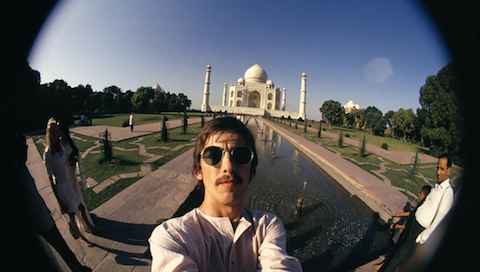
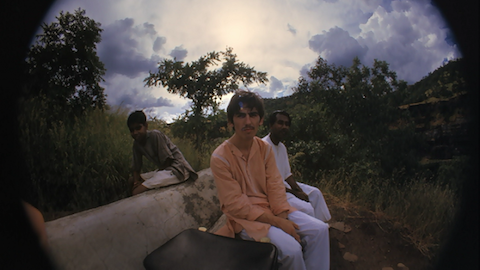
Harrison had principally embarked to study sitar under Ravi Shankar and learn yoga, but this was also a period of self-discovery and escape from, as he says, the “mania.” Traveling, as he always did, with a camera, he documented his journey. His pictures are far from ordinary tourist images.
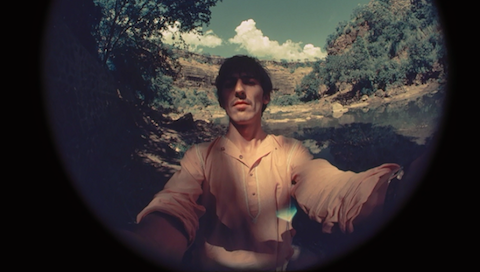
While he describes in writing the “mixture of unbelievable things” he saw, he just as often turned the camera on himself, his photographic introspection made even more pronounced by his use of a fisheye lens.
Interestingly, in his recollection of the trip, Harrison references the surreal cult, sci-fi show The Prisoner as a prime illustration of life as “a number.” One of the show’s most memorable devices involves a huge, mysterious white bubble that captures or kills anyone trying to escape the sinister organization that holds the main character captive. In Harrison’s photos, the bubble becomes a paradoxical representation of his way out of fame’s fishbowl, of the prison of Beatlemania and an identity that felt contrived and alienating.
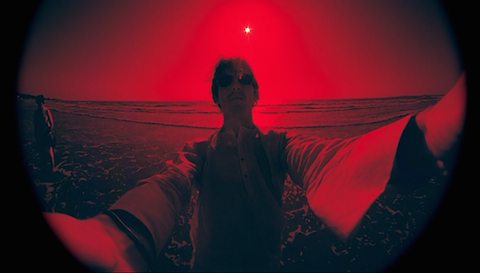
Behind his steady, serious gaze open up vistas that presage the breadth and depth of his immersion in Indian spiritual practices. Whatever one thinks of his conversion, there’s no doubt it was sincere, and lifelong. Not long after this first trip, at the age of 24, he wrote to his mother, “I want to be self-realized. I want to find God. I’m not interested in material things, this world, fame.” Harrison expressed the very same mystical aspirations in his final, 1997 interview, still playing and singing with his mentor Ravi Shankar.
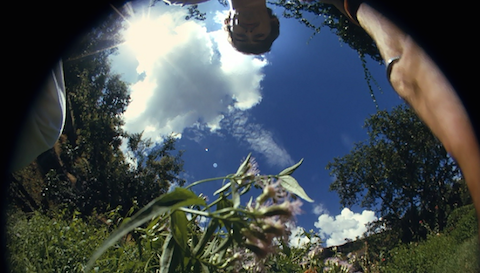
via Shooting Film/Dangerous Minds
Related Content:
Ravi Shankar Gives George Harrison a Sitar Lesson … and Other Vintage Footage
Watch George Harrison’s Final Interview and Performance (1997)
Josh Jones is a writer and musician based in Durham, NC. Follow him at @jdmagness.
Read More...All of Lionel Messi’s 253 Record-Setting Goals in La Liga, Shown in One Video
Earlier this month, when Lionel Messi scored a hat-trick against Sevilla, he reached a milestone. He had scored his 253rd goal in La Liga, making him the all-time top scorer in the elite Spanish soccer league. His first goal came on May 1, 2005, and it took him just 289 matches to break the record previously held by Telmo Zarra. If you’re late to appreciating the artistry of Messi, not to worry. Above, we have a video that runs 31 minutes and brings together footage of every Messi goal in La Liga — all 253 in a row. To see the goals presented in another fashion, check out this infographic.
Read More...Neil Gaiman Reads Bad, Fake Neil Gaiman Stories
The American Public Media show, “Wits,” asked its listeners to write their “poorest imitations of Neil Gaiman’s writing.” And then they got Gaiman himself to read the best/worst submissions. You can watch the results above, and hear the complete radio show here.
To watch/listen to Gaiman reading stories that he actually wrote, see this collection where Neil reads eight works, including the entirety of The Graveyard Book.
If you would like to support the mission of Open Culture, consider making a donation to our site. It’s hard to rely 100% on ads, and your contributions will help us continue providing the best free cultural and educational materials to learners everywhere. You can contribute through PayPal, Patreon, and Venmo (@openculture). Thanks!
Related Content:
Neil Gaiman’s Free Short Stories
Neil Gaiman Gives Graduates 10 Essential Tips for Working in the Arts
Where Do Great Ideas Come From? Neil Gaiman Explains
1,000 Free Audio Books: Download Great Books for Free
Read More...120 Artists Pick Their Top 10 Films in the Criterion Collection
Some of us get our education at film school. More of us get it from The Criterion Collection, that formidably cinephilic restorer, curator, and packager of classic motion pictures from every era. In addition to their elegant, supplementary material-rich home video releases — they’ve put them out on Laserdisc, on DVD, on Blu-ray, streaming over the internet, and will presumably continue to do so on whichever formats come next — they also do intriguing collaborations with the various cultural figures with whom they’ve worked, such as asking them to name their ten favorite Criterion releases. You may recall that, back in June, we featured actor, director, and 1990s “Indiewood” icon Steve Buscemi’s Criterion top ten list, which included such choice pieces of film history as Gus Van Sant’s My Own Private Idaho, Franco-Dutch horror classic The Vanishing, and long-unreleased “faux-documentary” Symbiopsychotaxiplasm.
Of the many more lists criterion.com offers, you can find this surprisingly classic-oriented one from Richard Linklater, maker of films like Slacker, the Before Sunrise/Before Sunset/Before Midnight trilogy, and this year’s Boyhood (and another architect of Indiewood):
- Andrei Rublev (Andrei Tarkovsky)
- Au hasard Balthazar (Robert Bresson)
- The Flowers of St. Francis (Roberto Rossellini)
- Day of Wrath (Carl Theodor Dreyer)
- Tokyo Story (Yasujiro Ozu)
- The Last Temptation of Christ (Martin Scorsese)
- Unfaithfully Yours (Preston Sturges)
- Fanny and Alexander — The Television Version (Ingmar Bergman)
- Pickpocket (Robert Bresson)
- I Know Where I’m Going! (Michael Powell and Emeric Pressburger)
Or this one by four members of the New York no-wave rock band Sonic Youth, who turned the whole top-ten list concept up to twelve, giving their props to Ozu like Linkater and The Vanishing like Buscemi (“It gets veeerrry weird,” adds guitarist Thurston Moore):
- Floating Weeds (Yasujiro Ozu)
- Jeanne Dielman, 23, quai du Commerce, 1080 Bruxelles (Chantal Akerman)
- Ali: Fear Eats the Soul (Rainier Werner Fassbinder)
- Masculin féminin (Jean-Luc Godard)
- Double Suicide (Masahiro Shinoda)
- The Vanishing (George Sluizer)
- Mamma Roma (Pier Paolo Pasolini)
- Black Orpheus (Marcel Camus)
- Ace in the Hole (Billy Wilder)
- Night on Earth (Jim Jarmusch)
- Fat Girl (Catherine Breillat)
- Days of Heaven (Terrence Malick)
Or lists from vital creators who have more recently arrived on the scene, such as this one from Tiny Furniture director and Girls creator Lena Dunham, an inveterate fan of Agnès Varda (who “manages to be both deeply emotional and utterly in control of the technical elements of filmmaking [ … ] that had seemed to me to be an impossible line to straddle, and she does it so beautifully”). She also makes room for Malick’s Days of Heaven, (also a pick of Sonic Youth’s Kim Gordon), two from Fassbinder (also a director of choice for Sonic Youth’s Lee Ranaldo), and one from Bergman (who should make everyone’s favorite-films lists, but also made Linklater’s):
- Fish Tank (Andrea Arnold)
- Days of Heaven (Terrence Malick)
- Broadcast News (James L. Brooks)
- Weekend (Andrew Haigh)
- La Pointe Courte, Cléo from 5 to 7, Le bonheur, and Vagabond (Agnès Varda)
- The Marriage of Maria Braun and Ali: Fear Eats the Soul (Rainier Werner Fassbinder)
- Picnic at Hanging Rock (Peter Weir)
- Straw Dogs (Sam Peckinpah) and Dead Ringers (David Cronenberg)
- Through a Glass Darkly (Ingmar Bergman)
- The War Room (Chris Hegedus and D. A. Pennebaker)
D.A. Pennebaker, by the way, has his own Criterion top ten list, as do other filmmakers named here, like Andrew Haigh and Martin Scorsese. But this leaves me with one burning question: if directors like Ozu and Fassbinder had lived to see The Criterion Collection, which volumes would they have put on their own DVD shelves?
Enter the complete collection of Criterion Top Tens here.
Related Content:
4,000+ Free Movies Online: Great Classics, Indies, Noir, Westerns, Documentaries & MoreSteve Buscemi’s Top 10 Film Picks (from The Criterion Collection)
A Young Jean-Luc Godard Picks the 10 Best American Films Ever Made (1963)
Martin Scorsese Reveals His 12 Favorite Movies (and Writes a New Essay on Film Preservation)
Colin Marshall hosts and produces Notebook on Cities and Culture and writes essays on cities, language, Asia, and men’s style. He’s at work on a book about Los Angeles, A Los Angeles Primer. Follow him on Twitter at @colinmarshall or on Facebook.
Read More...Bob Dylan’s Thanksgiving Radio Show: A Playlist of 18 Delectable Songs
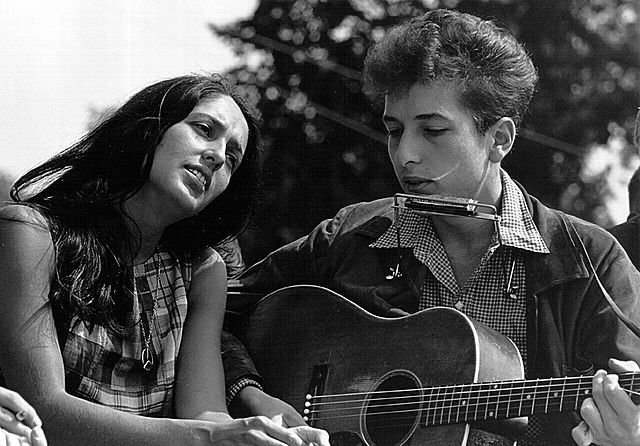
Image by Rowland Scherman, via Wikimedia Commons
If you’re looking for a soundtrack for Thanksgiving, you could do worse than to let Bob Dylan create it for you.
From May 2006 until April 2009, Dylan hosted the Theme Time Radio Hour, a weekly radio show on XM Satellite Radio. Each show revolved around a different theme (e.g., “Weather,” “Drinking” or “Baseball”). But the episodes all had one thing in common — they presented listeners with an eclectic mix of music, everything from LL Cool J and Chuck Berry, to They Might Be Giants, Billie Holiday, and Johnny Cash. Trying to describe the radio show, theater critic Terry Teachout wrote in The Wall Street Journal: “To listen to Theme Time Radio Hour is to rediscover the sense of musical adventure that old-fashioned disc jockeys with strongly individual personalities offered in the days before big-money stations pinned their fiscal hopes to the rigid Top 40-style playlists that took the fun out of radio.”
Today we bring you Episode 30 of Season 1, “Thanksgiving Leftovers,” which originally aired on November 22, 2006. The show features 18 songs, selected and introduced by Dylan. The songs (find a list below) aren’t dishes cooked fresh. No, they’re “leftovers” — tunes that Dylan had hoped to squeeze into previous radio shows but never quite managed to do. Yet, together, they make for a pretty good meal. You can stream them all above. And if you like what you hear, head over to the Theme Time Radio Hour Archive, where they’ve apparently archived all 100 episodes, audio included.
- “Turkey In The Straw” — Liberace (1952)
- “Hallelujah, I’m A Bum” — Harry McClintock (1926)
- “Let Me Play With Your Poodle” — Tampa Red & Big Maceo (1942)
- “Yard Dog” — Al Ferrier (1972)
- “The Turkey Hop” — The Robins with Johnny Otis Orchestra (1950)
- “Honeysuckle Rose” — Fats Waller (1934)
- “Twelve Red Roses” — Betty Harris (1966)
- “Don’t Let The Stars Get In Your Eyes” — Skeets McDonald (1952)
- “Them There Eyes” — Billie Holiday (1939)
- “Angel Eyes” — Jesse Belvin (1959)
- “Gunslingers” — Mighty Sparrow (1963)
- “Let’s Be Friends” — Billy Wright (1955)
- “Whiskey Is The Devil (In Liquid Form)” — The Bailes Brothers (1947)
- “Teach Me Tonight” — Dinah Washington (1954)
- “Teacher Teacher” — Rockpile (1980)
- “Iodine In My Coffee” — Muddy Waters (1952)
- “You Eat Too Much” — Harold Burrage (1956)
- “Pie In The Sky” — Cisco Houston (1960)
Related Content:
Bob Dylan Reads From T.S. Eliot’s Great Modernist Poem The Waste Land
Marilyn Monroe’s Handwritten Turkey-and-Stuffing Recipe
Bob Dylan and The Grateful Dead Rehearse Together in Summer 1987. Listen to 74 Tracks.
Read More...The Digital Nietzsche: Download Nietzsche’s Major Works as Free eBooks
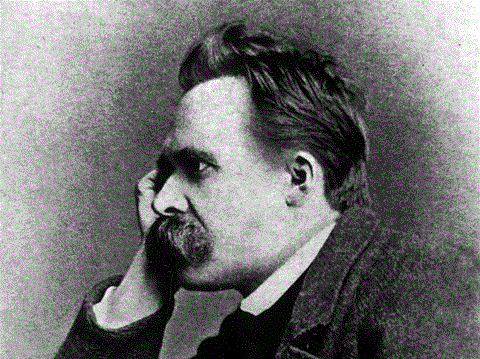
In times of deep distress I’ve often found the brutal, unsparing candor of Friedrich Nietzsche a strange comfort. While wholly enamored of the aristocratic, Hellenistic past of literary invention, the often bilious German philosopher nonetheless had no illusions about the nature of power, which does as it will and is not held in check by what we take for common values. In Nietzsche’s diagnosis, no set of values—or what he calls in The Genealogy of Morals “moral prejudices”—is ever disinterested, transcendent or “disconnected.” Instead, wrote Nietzsche, the language of traditional morality is generally synonymous with the language of power, thus:
The master’s right of giving names goes so far that it is permissible to look upon language itself as the expression of the power of the masters: they say “this is that, and that,” they seal finally every object and every event with a sound, and thereby at the same time take possession of it.
It is “because of this origin,” writes the contrarian Nietzsche, “that the word ‘good’ is far from having any necessary connection with altruistic acts, in accordance with the superstitious belief of these moral philosophers.” Nietzsche described Christianity as “hostile to life” and called for a “revaluation of all values,” excoriating Judeo-Christian beliefs as “slave morality.” The radical iconoclasm expressed in works like The Genealogy of Morals sits side by side with what can seem like the most reactionary valorizations of “nobility” and hierarchy. Nietzsche may have had nothing but contempt for liberal, bourgeois society, but he did not seek to replace it with egalitarian socialism or anything of the kind. It is this sometimes jarring contrast between his seemingly rightist politics and his unsystematic dismantling of the ideological mechanisms by which state power justifies itself that make Nietzsche such a confusing philosopher, one so easily misinterpreted and misread.
The most famous misreading of Nietzsche was a deliberate one, orchestrated by his anti-Semitic sister Elisabeth, friend and admirer of Hitler, who corrupted her brother’s late work and adapted it to Nazi ideology. And yet, despite Nietzsche’s seeming disdain for what he vaguely termed, among other things, an “under race” of common people, he also loathed anti-Semitism and nationalism and would have been infuriated to see his work used as it was by German and Italian fascists. Later readings of Nietzsche, like those of the late Walter Kaufmann or Nietzsche scholar and philosopher Babette Babich, place him in dialogue with Hegel, Kant, and Aristotle, and with the Existentialists. Nietzsche has been called an existentialist thinker himself, as well as a pragmatist, naturalist, and pre-postmodernist—all designations that get at important aspects of his thought, e.g. his stress on contingency, on the physical basis of thought, and on the relative, perspectival nature of truth.
This very broad overview doesn’t pretend to do justice to the depth and variety of Nietzschean thought. If you wish to understand his work, you should, of course, read it for yourself. And so you can, nearly all of it, online. Below, find links to almost all of the philosopher’s major works, in Kindle, PDF, HTML, ePub, and other formats. For some excellent guides through Nietzsche’s thinking, consider listening to Walter Kaufmann’s 1960 lectures and watching the Nietzsche segment in Human, All Too Human, a 3‑part documentary series that also profiles Martin Heidegger and Jean-Paul Sartre. Professor Babich’s site has links to many of her articles online and the site Nietzsche Circle has a large links section with many helpful resources. But of course, there’s no substitute for the original. Below, in chronological order, find most of the complete works of Friedrich Nietzsche. Ironic, pessimistic, joyous, creative, and scathing, they make for intriguing, frustrating, enlightening, and ultimately life-affirming reading.
-
- The Birth of Tragedy (1872) — Kindle + Other Formats — Read Online Now
- Human, All Too Human (1878) — Kindle + Other Formats – Read Online Now
- The Dawn of Day (1881) — Kindle + Other Formats — Read Online Now
- The Gay Science (1882) — Read Online Now
- Thus Spake Zarathustra (1883) — iPad/iPhone – Kindle + Other Formats
- Beyond Good and Evil (1886) — iPad/iPhone – Kindle + Other Formats – Read Online Now
- On the Genealogy of Morals (1887) — Read Online Now
- The Case of Wagner/Nietzsche Contra Wagner/Selected Aphorisms (1888) — iPad/iPhone – Kindle + Other Formats
- Twilight of the Idols (1888) — Kindle + Other Formats — Read Online Now
- The Anti Christ (1888) — iPad/iPhone – Kindle + Other Formats
- Ecce Homo (1888) — Kindle + Other Formats — Read Online Now
All of these texts appear in our collection of Free Philosophy eBooks as well as in our larger collection, 800 Free eBooks for iPad, Kindle & Other Devices.
Related Content:
Download Walter Kaufmann’s Lectures on Nietzsche, Kierkegaard, Sartre & Modern Thought (1960)
Human, All Too Human: 3‑Part Documentary Profiles Nietzsche, Heidegger & Sartre
Free Online Philosophy Courses
Josh Jones is a writer and musician based in Durham, NC. Follow him at @jdmagness
Read More...David Lynch Takes Aspiring Filmmakers Inside the Art & Craft of Making Indie Films
As a couple of generations of film students have shown us, you shouldn’t try to imitate David Lynch. You should, however, learn from David Lynch. At his best, the director of Eraserhead, Blue Velvet, and Mulholland Drive has managed, in the words of David Foster Wallace, to “single-handedly broker a new marriage between art and commerce in U.S. movies, opening formula-frozen Hollywood to some of the eccentricity and vigor of art film.” How has Lynch brought his enduringly strange and richly evocative visions to the screen, and to a surprising extent into the mainstream, without much apparent compromise?
You can get an idea of his method in Room to Dream: David Lynch and the Independent Filmmaker, the twenty-minute documentary above. Since Lynch hasn’t released a feature film since 2006’s Inland Empire — an especially uncompromising work, admittedly — some fans have wondered whether he’s put the movies, per se, behind him.
But Room to Dream shows the director in recent years, very much engaged in both the theory and process of filmmaking — or rather, his distinctive interpretations of the theory and process of filmmaking.
This touches on his childhood obsession with drawing weapons, his discovery of “moving paintings,” his endorsement of learning by doing, how he uses digital video, his enjoyment of 40-minute takes, why people fear the “very dark,” conveying meaning without explaining meaning (especially to actors), the process of “rehearsing-and-talking, rehearsing-and-talking,” how Avid (the short’s sponsor, as it would happen) facilitates the “heavy lifting” of editing his footage, how he finesses “happy accidents,” how he composes differently for different screens, and the way that “sometimes things take strange routes that end up being correct.” Take Lynch’s words to heart, and you, too, can enjoy his experience of crafting what he calls “sound and picture moving along in time” — with or without an Avid of your own.
Room to Dream will be added to our collection, 285 Free Documentaries Online.
Related Content:
Akira Kurosawa’s 80-Minute Master Class on Making “Beautiful Movies” (2000)
David Lynch Presents the History of Surrealist Film (1987)
10 Tips From Billy Wilder on How to Write a Good Screenplay
Tarkovsky’s Advice to Young Filmmakers: Sacrifice Yourself for Cinema
Filmmaking Advice from Quentin Tarantino and Sam Raimi (NSFW)
Colin Marshall hosts and produces Notebook on Cities and Culture and writes essays on cities, language, Asia, and men’s style. He’s at work on a book about Los Angeles, A Los Angeles Primer. Follow him on Twitter at @colinmarshall or on Facebook.
Read More...Support Us
We're hoping to rely on loyal readers, rather than erratic ads. Please click the Donate button and support Open Culture. You can use Paypal, Venmo, Patreon, even Crypto! We thank you!

About Us

Open Culture scours the web for the best educational media. We find the free courses and audio books you need, the language lessons & educational videos you want, and plenty of enlightenment in between.
Advertise With Us

FREE UPDATES!
GET OUR DAILY EMAIL
Get the best cultural and educational resources on the web curated for you in a daily email. We never spam. Unsubscribe at any time.
FOLLOW ON SOCIAL MEDIA

Open Culture editor Dan Colman scours the web for the best educational media. He finds the free courses and audio books you need, the language lessons & movies you want, and plenty of enlightenment in between.
Advertise With Us


