Lewis Carroll’s Photographs of Alice Liddell, the Inspiration for Alice in Wonderland

One of the great polymaths of the 19th century, Lewis Carroll (pen name of Charles Lutwidge Dodgson) —mathematician, logician, author, poet, Anglican cleric—took to the new medium of photography with the same alacrity he applied to all of his pursuits. Though he may be described as a hobbyist in the sense that he never pursued the art professionally, he nonetheless “became a master of the medium, boasting a portfolio of roughly 3,000 images and his very own studio.”
So says a recent article by Gannon Burgett on Carroll’s “24-year career as a photographer,” during which he made a number of portraits, including one of then-poet laureate of England Alfred, Lord Tennyson. His subjects also included “landscapes, dolls, dogs, statues, paintings, trees and even skeletons.”
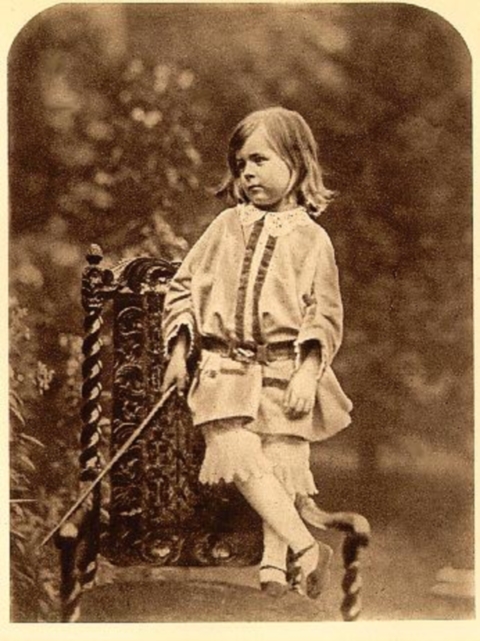
Carroll excelled at a developing method called the wet collodion process, which replaced the daguerreotype as the primary means of photographic image-making. This process seems to have been something like painting in oils, requiring a great deal of dexterity and chemical know-how, and similarly subject to decay when done improperly. Carroll particularly valued this method for its difficulty (he described it in detail in some lines added to a poem called “Hiawatha’s Photographing”)—so much so that once a dry developing process came into being, he abandoned the medium altogether, complaining that it became so easy anyone could do it. Carroll’s obsessive focus on process mirrored an obsession with his favorite photographic subjects, young children, including Tennyson’s son Hallam (above). Most famously, Carroll obsessively photographed the young Alice Liddell (top and below as “The Queen of May”), daughter of family friend Henry George Liddell and inspiration for Carroll’s most famous fictional character.

Many of Carroll’s photographs of Alice and other children can seem downright prurient to our eyes. As Carroll’s biographer Jenny Woolf writes in a 2010 essay for the Smithsonian, “of the approximately 3,000 photographs Dodgson made in his life, just over half are of children—30 of whom are depicted nude or semi-nude.”
Some of his portraits—even those in which the model is clothed—might shock 2010 sensibilities, but by Victorian standards they were… well, rather conventional. Photographs of nude children sometimes appeared on postcards or birthday cards, and nude portraits—skillfully done—were praised as art studies […]. Victorians saw childhood as a state of grace; even nude photographs of children were considered pictures of innocence itself.
Woolf admits that Carroll’s interest, as scholars have speculated for decades, may have been less than innocent, prompting Vladimir Nabokov to propose “a pathetic affinity” between Carroll and the narrator of Lolita. The evidence for Carroll’s possible pedophilia is highly suggestive but hardly conclusive. Burgett summarizes the claims as only speculative at best: “The entire controversy is an almost century-long debate, and one that doesn’t seem to be making any major progress in either direction.” In a Slate review of Woolf’s Lewis Carroll biography, Seth Lerer also acknowledges the controversy, but reads the photographs of Alice, her sisters, and friends as representative of larger trends, as “brilliant testimonies to the taste, the sentiment, and perhaps the sexuality of mid-Victorian England.”
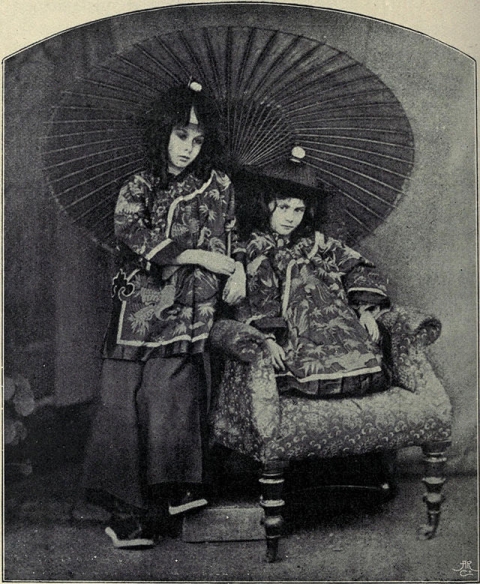
A great part of this Victorian sensibility consists of the “recognition that all life involves role-playing,” hence the recurring photos of the girls in dress-up—as figures from myth and literature and exotic Orientalist characters, such as the photo above of Alice and her sister Lorina as “Chinamen.” “These are the tableaux of Victorian melodrama,” writes Lerer, “images on stage-sets of the imagination.” We see another of Carroll’s favorite photographic subjects, Alexandra “Xie” Kitchin, daughter of a colleague, also given the Orientalist treatment below, posed as an off-duty tea merchant.
Carroll’s carefully staged child photographs are very much like those of other photographers of the period like Mary Cowden Clarke and Julia Margaret Cameron, who also photographed Alice Liddell, even into her adulthood. Cameron’s photographs also included child nudes, to a similar effect as Carroll’s—the depiction of a “state of grace” in which children appear as nymphs, “gypsies” or other such types supposedly belonging to Edenic worlds untouched by adult cares. Given the context Woolf, Lerer and others provide, it’s reasonable to view Carroll’s child photography as consistent with the tastes of the day. (Though no one suggests this as an alibi for Carroll’s possibly troubling proclivities.)

As it stands, the photographs of Alice and other children open a fascinating, if sometimes discomfiting, window on an age that viewed childhood very differently than our own. They also give us a view of Carroll’s strange inner world, one not unlike the unsettling fantasy realm of 20th century folk artist Henry Darger. Unlike Darger, Carroll’s work brought him widespread fame in his lifetime, but like that reclusive figure, the author of Alice’s Adventures in Wonderland and Through the Looking Glass was a shy, introspective man whose imaginative landscape possessed a logic all its own, charged with magic, threat, and longing for lost childhood innocence.
See a galleries of Carroll’s photographs of Alice and other children here and here, and see this site for more general info on Carroll’s photography.
Related Content:
See Salvador Dali’s Illustrations for the 1969 Edition of Alice’s Adventures in Wonderland
Free Audio: Alice In Wonderland Read by Cory Doctorow
Josh Jones is a writer and musician based in Durham, NC. Follow him at @jdmagness.
Read More...Ralph Waldo Emerson Writes a Job Recommendation for Walt Whitman (1863)
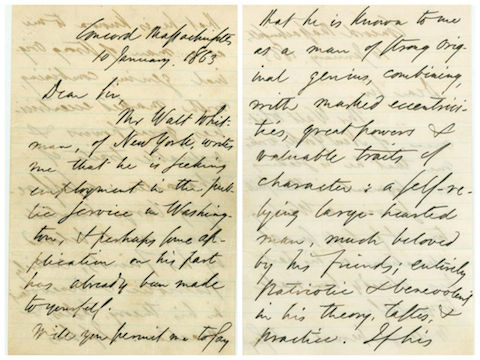
While we often recommend Letters of Note for the hits of history’s most illuminating pieces of incidental correspondence, do consider also making a regular visits to Slate’s history blog The Vault. There you’ll find such written artifacts as the one pictured in part above, astutely written up by occasional Open Culture contributor Rebecca Onion: “In 1863, as he considered seeking a government clerkship, Walt Whitman asked his friend and advocate Ralph Waldo Emerson for a letter of recommendation. Emerson, for decades a respected name in American letters, knew the secretaries of state and treasury personally, and Whitman hoped that a note from him would help the younger poet secure steady employment in Washington.” This note runs, in a transcript from the Walt Whitman archive, as follows:
Concord Massachusetts
10 January 2, 1863Dear Sir,
Mr Walt Whitman, of New York, writes me that he is seeking employment in the public service in Washington, & perhaps some application on his part has already been made to yourself. Will you permit me to say that he is known to me as a man of strong original genius, combining, with marked eccentricities, great powers & valuable traits of character: a self-relying large-hearted man, much beloved by his friends; entirely patriotic & benevolent in his theory, tastes, & practice. If his writings are in certain points open to criticism, they show extraordinary power, & are more deeply American, democratic, & in the interest of political liberty, than those of any other poet.
A man of his talents & dispositions will quickly make himself useful, and, if the government has work that he can do, I think it may easily find that it has called to its side more valuable aid than it bargained for.
With entire respect,
Your obedient servant,
R. W. Emerson.
Hon Salmon P. Chase, | Secretary of the Treasury.
Any of us, I feel certain, would love having such an eloquently praise-filled letter of recommendation sent on our behalf by a friend, a teacher, a former employer, or a pillar of American Transcendentalism. But even with that, the author of Leaves of Grass didn’t find the road to a day gig particularly smooth — in large part, of course, because of having written Leaves of Grass. Whitman, whose “reputation preceded him in job interviews, reported that Salmon Chase, the secretary of the treasury and addressee of this letter, was vehemently against the idea of employing the author of Leaves, a book that celebrated open sexuality in a way that Chase found distasteful.” He would even get fired from another job specifically “because of objections to his poetry.” Well, they can’t say Emerson didn’t warn them about Whitman’s “marked eccentricities” — such as his tendency to write some of the most enduring verse in American history.
via The Vault
Related Content:
Mark Twain Writes a Rapturous Letter to Walt Whitman on the Poet’s 70th Birthday (1889)
Hear Walt Whitman (Maybe) Reading the First Four Lines of His Poem, “America” (1890)
Find works by Whitman and Emerson in our twin collections: 1,000 Free Audio Books: Download Great Books for Free and 800 Free eBooks for iPad, Kindle & Other Devices
Colin Marshall hosts and produces Notebook on Cities and Culture and writes essays on cities, language, Asia, and men’s style. He’s at work on a book about Los Angeles, A Los Angeles Primer. Follow him on Twitter at @colinmarshall or on Facebook.
Read More...Chicken Infinite: A 532 Page Avant-Garde Chicken Recipe

Earlier this year, Gregor Weichbrodt, a German college student, took all of the geographic stops mentioned in Jack Kerouac’s On the Road, plugged them into Google Maps, and ended up with a 45-page manual of driving directions, divided into chapters paralleling those of Kerouac’s original book. Now he’s back with a culinary mashup. Not mashed potatoes, but mashed up recipes for cooking chicken.
“Cooking recipes from the web have been collected and mixed randomly together,” and the result is Chicken Infinite, an avant-garde recipe for making chicken that spans some 532 pages. According to Weichbrodt, Chicken Infinite – available as a free PDF or paperback – “plays with the concept of instructions itself” that you regularly see on websites or in manuals. It’s a concept that cut-up artist William S. Burroughs could love. As for how Chicken Infinite actually tastes, someone (with a little time and a sense of adventure) will have to let us know.
Related Content:
Ernest Hemingway’s Favorite Hamburger Recipe
David Lynch Teaches You to Cook His Quinoa Recipe in a Weird, Surrealist Video
Marilyn Monroe’s Personal, Handwritten Turkey-and-Stuffing Recipe
MIT Teaches You How to Speak Italian & Cook Italian Cuisine All at Once (Free Online Course)
Read More...Six Animations of Stories and Poems by Shel Silverstein
Shel Silverstein, beloved poet, songwriter, children’s author, and illustrator, perfected an instantly recognizable visual and literary style that has imprinted itself on several generations. We remember the heartfelt whimsy of stories like The Giving Tree (1964) and poetry collections like Where the Sidewalk Ends (1974) and A Light in the Attic (1981) as we remember childhood best friends, first crushes, and summer camp exploits. Many of us raised on his work have gone on to have kids of our own, so we get to revisit those books we loved, with their weird, irreverent twists and turns and wild imaginative flights. Our kids get a bonus, though, thanks to the web, since they can also see several Silverstein poems and stories in animated form on Youtube. Today, we bring you six of those animations. Sate your nostalgia, share with your kids, and rediscover the utterly distinctive voice of the pre-eminent children’s poet.
We don’t get to hear Silverstein’s actual voice in the animations of “Runny’s Hind Keart”and “Runny on Rount Mushmore,” above, two of many poems made almost entirely of spoonerisms from the book and audio CD Runny Babbit: A Billy Sook, posthumously published in 2005.
Instead, Silverstein sound-alike Dennis Locorriere—former lead singer of the band Dr. Hook—narrates. (Silverstein wrote a number of songs for the band.) The poems are as fun for kids to read aloud as they are to untangle. Read full text here.
Just above, we get vintage Silverstein, read/singing “Ickle Me, Pickle Me, Tickle Me Too” from Where the Sidewalk Ends. Accompanied by an acoustic guitar, Silverstein turns the poem into a folk ballad, his voice rising and cracking off-key. You may know that Silverstein wrote the Johnny Cash hit “A Boy Named Sue”—you may not know that he recorded his own version and several dozen more songs besides. The video above offers a fair representation of his musical style.
Silverstein published his award-winning collection of poetry Falling Up in 1996, three years before his death and many years after my childhood, so I didn’t have the pleasure of reading poems like “The Toy Eater” as a kid. The poem is an excellent example of what Poets.org calls Silverstein’s “deft mixing of the sly and the serious, the macabre, and the just plain silly.”
Hear Silverstein above read “Backwards Bill,” a poem I remember quite well as one of my favorites from A Light in the Attic. His raspy sing-song narration turns the poem into a funny little melody kids will remember and love singing along to.
Finally, we bring you an animated excerpt from Silverstein’s beloved 1963 fable Lafcadio: The Lion Who Shot Back, Silverstein’s first book written exclusively for children. He is so well known as a writer and illustrator for kids that it’s easy to forget that Silverstein first made a career in the fifties and sixties as a cartoonist for adults, publishing most of his work in Playboy. Silverstein never formally studied poetry and hadn’t considered writing it until his editor at Harper & Row, Ursula Nordstrom, urged him to. Without her intervention, he’d surely still be remembered for his iconic visual style and songwriting, but millions of kids would have missed out on the weirdness of his warped imagination. Silverstein showed us we didn’t have to be sentimental or schmaltzy to be open-hearted, caring, and curious. His work endures because he had the unique ability to speak to children in a language they understand without condescending or dumbing things down. See several more short animations at Silverstein’s official website.
Related Content:
Studs Terkel Interviews Bob Dylan, Shel Silverstein, Maya Angelou & More in New Audio Trove
Johnny Cash: Singer, Outlaw, and, Briefly, Television Host
Josh Jones is a writer and musician based in Durham, NC. Follow him at @jdmagness.
Read More...Thomas Dolby Explains How a Synthesizer Works on a Jim Henson Kids Show (1989)
We’ve all heard the musical fruits of audio synthesis, especially if we regularly listen to the pop of the 1980s. But how, exactly, does a synthesizer work? Ask a modern electronic-music enthusiast and the answer may come out too technical, and at too much length, to bear. But pioneeringly technology-minded singer-songwriter Thomas Dolby, he of “She Blinded Me with Science” (though I’ve always prefer his more elegiac numbers like “Airwaves”), can give you a clearer, more concise explanation.
In fact, he gets it simple to the point of child-friendliness — so simple that he gives it on a children’s television program. The Ghost of Faffner Hall, which ran in late 1989 in England and America, taught lessons about music with a gallery of famous performers — Bobby McFerrin, Joni Mitchell, James Taylor, Mark Knopfler — in a puppet-rich setting. Those puppets, the denizens (living and dead) of the titular Faffner Hall, came built by Jim Henson’s Creature Shop, known for their mastery of Muppet craft.
Dolby’s illustration of a synthesizer’s operation involves an unusual work of Muppetry: a fly in a matchbox. “A synthesizer consists of two things,” he says, “an oscillator and a filter. The oscillator controls the pitch of the sound, and the filter controls the tone.” Out, then, comes the box and its slightly unwilling (Muppet) inhabitant. “I want you to imagine the fly is an oscillator, and this box is a filter.” Dolby shakes the box, representing electrical current through an oscillator, which makes the frightened fly buzz. “The harder I shake the box, the higher the pitch!” To demonstrate filtration, he opens and closes the matchbox, harshening the fly’s wail (until, indeed, it turns into a cry of “Help!”). If you’d like to hear Dolby talk more about the intersection of his art and his technology at a higher, albeit Muppetless level, have a listen to his appearance last year on the Nerdist podcast. He long ago, in another context, stated his goal of teaching people that synthesizers “don’t have to sound like a crate of moribund wasps” — an interesting thing to accomplish with a matchbox and a superintelligent fly.
via That Eric Alper
Related Content:
Buzz Aldrin and Thomas Dolby Geek Out and Sing “She Blinded Me With Science”
All Hail the Beat: How the 1980 Roland TR-808 Drum Machine Changed Pop Music
Colin Marshall hosts and produces Notebook on Cities and Culture and writes essays on cities, language, Asia, and men’s style. He’s at work on a book about Los Angeles, A Los Angeles Primer. Follow him on Twitter at @colinmarshall or on Facebook.
Read More...Andy Warhol Interviews Alfred Hitchcock (1974)
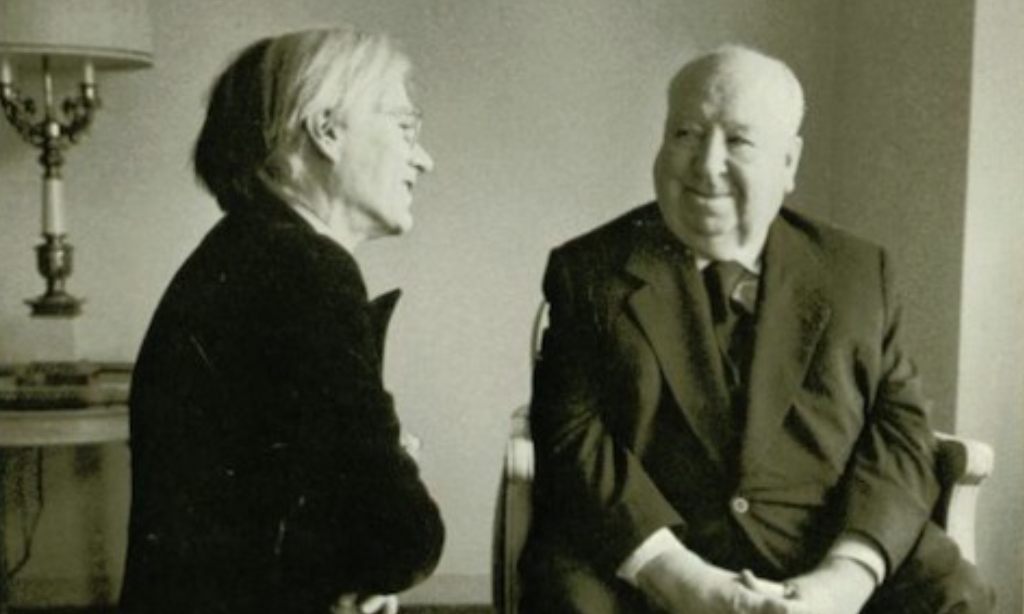
Few midcentury cultural figures would at first seem to have as little in common as Andy Warhol and Alfred Hitchcock. Sure, they both made films, but how straight a line can even the farthest-reaching cinema theorists draw between, say, Hitchcock’s Psycho (1960) and Warhol’s Vinyl (1965)? Hitchcock’s The Birds (1963) and Warhol’s Empire (1964)? Yet not only did both of them direct many motion pictures, each began as a visual artist: “Warhol had started his career working as a commercial illustrator, Hitchcock had started out creating illustrations for title cards in silent movies,” says Filmmaker IQ’s post on their encounter in the September 1974 issue of Warhol’s Interview magazine. Yet in the brief conversation printed, they discuss not drawing, and not filmmaking, but murder:
Andy Warhol: Since you know all these cases, did you ever figure out why people really murder? It’s always bothered me. Why.
Alfred Hitchcock: Well I’ll tell you. Years ago, it was economic, really. Especially in England. First of all, divorce was very hard to get, and it cost a lot of money.
[ … ]
Andy Warhol: But what about a mass murderer.
Alfred Hitchcock: Well, they are psychotics, you see. They’re absolutely psychotic. They’re very often impotent. As I showed in “Frenzy.” The man was completely impotent until he murdered and that’s how he got his kicks. But today of course, with the Age of the Revolver, as one might call it, I think there is more use of guns in the home than there is in the streets. You know? And men lose their heads?
Andy Warhol: Well I was shot by a gun, and it just seems like a movie. I can’t see it as being anything real. The whole thing is still like a movie to me. It happened to me, but it’s like watching TV. If you’re watching TV, it’s the same thing as having it done to yourself.
“Warhol openly proclaimed that he was nervous upon meeting the legendary director,” adds Filmmaker IQ, “and posed with Hitchcock by kneeling at his feet,” resulting in the photo you see at the top of the post. They also include three portraits Warhol made of Hitchcock, the best known of which Christie’s Auction House describes as “a variation on the doubled self-image that Hitchcock played with in his title sequence, layering his own expressive line-drawing over the director’s silhouette, suggesting the mischievous defacement of graffiti as much as the canonization of a hero through the timelessness of the inscribed profile.” These images and the brief interview excerpt leave us wondering: can one call a work — on film, in a frame, in a magazine — both Hitchcockian and Warholian? A question, perhaps, best left to the theorists.
Related Content:
Watch Andy Warhol’s 1965 Film, Vinyl, Adapted from Anthony Burgess’ A Clockwork Orange
Three “Anti-Films” by Andy Warhol: Sleep, Eat & Kiss
Listen to François Truffaut’s Big, 12-Hour Interview with Alfred Hitchcock (1962)
36 Hitchcock Murder Scenes Climaxing in Unison
Alfred Hitchcock’s 50 Ways to Kill a Character (and Our Favorite Hitch Resources on the Web)
Colin Marshall hosts and produces Notebook on Cities and Culture and writes essays on cities, language, Asia, and men’s style. He’s at work on a book about Los Angeles, A Los Angeles Primer. Follow him on Twitter at @colinmarshall or on Facebook.
Read More...62 Psychedelic Classics: A Free Playlist Created by Sean Lennon

Last week, Rolling Stone published Sean Lennon’s list of 10 Lost Psychedelic Classics. A connoisseur of Sixties psychedelic music, Lennon told the magazine. “There are a hundred songs I could pick.” “It’s really my favorite period in rock & roll history. Revolver and Pepper are my favorite Beatles records – that’s when everyone was trying hardest to blow people’s minds.” He’s not kidding around when he says that his list could be much longer.
Over at Spotify, we’ve found (courtesy of one of our Twitter followers) a playlist of 62 psychedelic songs. Featuring 3 hours and 32 minutes of free music, the playlist lets you tap into songs by bands that had some pretty trippy names. I cite as examples, The Peanut Butter Conspiracy and The Electric Prunes. You’ll also find some more recognizable names: Pink Floyd, The Beach Boys, and Alice Cooper. Access the playlist on the web here, or start streaming it below. If you need to download Spotify, grab the software here.
Bonus: At the bottom of the page, you can stream the new album by The Ghost Of A Saber Tooth Tiger, the band created by Sean Lennon and Charlotte Kemp Muhl. The album, Midnight Sun, has been called an experiment in “psychedelic blitzkrieg”.
Midnight Sun by The Ghost Of A Saber Tooth Tiger.
Read More...Rare Video Shows FDR Walking: Filmed at the 1937 All-Star Game
In 1921, Franklin D. Roosevelt was sailing in the Bay of Fundy when he fell overboard into the cold waters. The next day, he felt weakness in his legs. The sensation intensified, and, soon enough, he could no longer walk. Once doctors sorted things out, F.D.R. discovered that he had contracted polio, a disease that typically afflicted children, not adults. A long and grueling period of rehabilitation followed, mostly in Warm Springs, Georgia. You can see footage of his rehab right below.
With a lot of hard work, F.D.R. learned to walk short distances, aided by leg braces, a cane, and someone’s shoulder to lean on. When he re-entered politics, the F.D.R. Presidential Library notes, he “requested that the press avoid photographing him walking, maneuvering, or being transferred from his car. The stipulation was accepted by most reporters and photographers but periodically someone would not comply. The Secret Service was assigned to purposely interfere with anyone who tried to snap a photo of FDR in a ‘disabled or weak’ state.” Above, you can see (according to CNN) only the second known clip that shows F.D.R. walking. (Watch around the 40 second mark.) Recorded in Washington, D.C., at the 1937 All-Star Game, the video was recently donated to the Pennsylvania Historical and Museum Commission. The other extant video appears right below.
via CNN
Related Content:
Rare Footage: Home Movie of FDR’s 1941 Inauguration
Read More...Neil Gaiman Reads The Graveyard Book, His Award-Winning Kids Fantasy Novel, Chapter by Chapter
In 2009, Neil Gaiman won the Newbery Medal for The Graveyard Book, a prestigious prize given to “the author of the most distinguished contribution to American literature for children.” The American Library Association, the organization that bestows the award, called The Graveyard Book a “delicious mix of murder, fantasy, humor and human longing,” and cited its “magical, haunting prose.” You can savor that prose by watching the playlist of videos embedded above. During the book tour for The Graveyard Book, Gaiman read a different chapter at every stop, and his publisher, HarperCollins, recorded the readings and made them available online. If you have roughly eight hours of free time, you can watch the reading from start to finish.
We have more Gaiman readings in our collection of Neil Gaiman’s Free Short Stories. You can also find the reading on our list 1,000 Free Audio Books: Download Great Books for Free.
Related Content:
Free Audio: Download the Complete Chronicles of Narnia by C.S. Lewis
200 Free Kids Educational Resources: Video Lessons, Apps, Books, Websites & More
The International Children’s Digital Library Offers Free eBooks for Kids in Over 40 Languages
Neil Gaiman Reads Dr. Seuss’ Green Eggs and Ham
Read More...
Slavoj Žižek Tells Jokes (NSFW)
For Sigmund Freud, a joke was never just a joke, but a window into the unconscious, laughter an anxious symptom of recognition that something lost has resurfaced, distorted into humor. For Slovenian psychoanalytic philosopher Slavoj Žižek, jokes function similarly. And yet, in keeping with his commitment to leftist politics, he uses jokes not to expose the hidden terrain of individual psyches but “to evoke binds of historical circumstances hard to indicate by other means.” So writes Kenneth Baker in a brief SFGate review of the recent Žižek’s Jokes, a book-length compilation of Žižekisms published by MIT Press. Baker also points out a defining feature of Žižek’s humor: “Many of Žižek’s jokes preserve or even amplify the vulgarity of their demotic or pop cultural origins.” Take the NSFW joke he tells above at the expense of a Montenegrin friend. Žižek explains the joke as part of his maybe dubious strategy of countering racism with “progressive racism” or the “solidarity” of “shared obscenity”—the use of potentially uncomfortable ethnic humor to expose uncomfortable political truths that get repressed or papered over by politeness.
Some of Žižek’s humor is more trigger-warning worthy, such as his retelling of this old Soviet dissident joke or this “very dirty joke” he reportedly heard from a Palestinian Christian acquaintance. On the other hand, some of his “dirty jokes” replace vulgarity with theory. For example, Žižek likes to tell a “truly obscene” version of the famously filthy joke “The Aristocrats,” which you’ll know if you’ve seen, or only read about, the film of the same name. And yet in his take, instead of a series of increasingly disgusting acts, the family performs “a short course in Hegelian thought, debating the true meaning of the negativity, of sublation, of absolute knowing, etc.” This is perhaps an example of what Baker refers to as Žižekian jokes that are “baffling to readers not conversant with the gnarly dialectics of his thought, which does not lend itself easily to sampling.” Be that as it may, much of Žižek’s humor works without the theoretical context, and some of it is even tame enough for water cooler interludes. Below are four examples of “safe” jokes, culled from website Critical Theory’s list of “The 10 Best Žižek Jokes to Get You Through Finals” (which itself culls from Žižek’s Jokes). “Some of the jokes [in Žižek’s book] provide hilarious insights into Hegelian dialectics, Lacanian psychoanalysis or ideology,” writes Critical Theory, “Others are just funny, and most are somewhat offensive—a characteristic Žižek admittedly doesn’t care to correct.”
#1 There is an old Jewish joke, loved by Derrida…
about a group of Jews in a synagogue publicly admitting their nullity in the eyes of God. First, a rabbi stands up and says: “O God, I know I am worthless. I am nothing!” After he has finished, a rich businessman stands up and says, beating himself on the chest: “O God, I am also worthless, obsessed with material wealth. I am nothing!” After this spectacle, a poor ordinary Jew also stands up and also proclaims: “O God, I am nothing.” The rich businessman kicks the rabbi and whispers in his ear with scorn: “What insolence! Who is that guy who dares to claim that he is nothing too!”
#4 When the Turkish Communist writer Panait Istrati visited the Soviet Union in the mid- 1930s, the time of the big purges…
and show trials, a Soviet apologist trying to convince him about the need for violence against the enemies evoked the proverb “You can’t make an omelet without breaking eggs,” to which Istrati tersely replied: “All right. I can see the broken eggs. Where’s this omelet of yours?”
We should say the same about the austerity measures imposed by IMF: the Greeks would have the full right to say, “OK, we are breaking our eggs for all of Europe, but where’s the omelet you are promising us?”
#7 This also makes meaningless the Christian joke…
according to which, when, in John 8:1–11, Christ says to those who want to stone the woman taken in adultery, “Let him who is without sin among you be the first to throw a stone!” he is immediately hit by a stone, and then shouts back: “Mother! I asked you to stay at home!”
#8 In an old joke from the defunct German Democratic Republic,…
a German worker gets a job in Siberia; aware of how all mail will be read by censors, he tells his friends: “Let’s establish a code: if a letter you will get from me is written in ordinary blue ink, it is true; if it is written in red ink, it is false.” After a month, his friends get the first letter, written in blue ink: “Everything is wonderful here: stores are full, food is abundant, apartments are large and properly heated, movie theaters show films from the West, there are many beautiful girls ready for an affair—the only thing unavailable is red ink.”
And is this not our situation till now? We have all the freedoms one wants—the only thing missing is the “red ink”: we “feel free” because we lack the very language to articulate our unfreedom. What this lack of red ink means is that, today, all the main terms we use to designate the present conflict —“war on terror,” “democracy and freedom,” “human rights,” etc.—are false terms, mystifying our perception of the situation instead of allowing us to think it. The task today is to give the protesters red ink.
For more of Slavoj Žižek’s witticism, vulgarity, and humorous critiques of ideological formations, political history, and Hegelian and Lacanian thought, pick up a copy of Žižek’s Jokes, and see this Youtube compilation of the politically incorrect leftist philosopher’s humor caught on tape.
Related Content:
Slavoj Žižek: What Fullfils You Creatively Isn’t What Makes You Happy
Žižek!: 2005 Documentary Reveals the “Academic Rock Star” and “Monster” of a Man
In His Latest Film, Slavoj Žižek Claims “The Only Way to Be an Atheist is Through Christianity”
Josh Jones is a writer and musician based in Durham, NC. Follow him at @jdmagness.
Read More...Support Us
We're hoping to rely on loyal readers, rather than erratic ads. Please click the Donate button and support Open Culture. You can use Paypal, Venmo, Patreon, even Crypto! We thank you!

About Us

Open Culture scours the web for the best educational media. We find the free courses and audio books you need, the language lessons & educational videos you want, and plenty of enlightenment in between.
Advertise With Us

FREE UPDATES!
GET OUR DAILY EMAIL
Get the best cultural and educational resources on the web curated for you in a daily email. We never spam. Unsubscribe at any time.
FOLLOW ON SOCIAL MEDIA

Open Culture editor Dan Colman scours the web for the best educational media. He finds the free courses and audio books you need, the language lessons & movies you want, and plenty of enlightenment in between.
Advertise With Us

