Salvador Dalí’s Melting Clocks Painted on a Latte
 In 1931, Salvador Dalí painted The Persistence of Memory, a landmark piece of surrealist art that used melting pocket watches to symbolize the relativity of space and time in dreamscapes. (More on that below.)
If you haven’t seen the painting at the MoMA in NYC, you’ve almost certainly seen those melting watches on posters and all sorts of kitschy products. Those poor watches have been abused over the years. But somehow I don’t mind seeing them on my favorite ephemeral canvas — the frothy milk surface of a latte. The latte above was decorated by Kazuki Yamamoto, a Japanese artist who uses nothing but a toothpick for a paint brush. You can find an online gallery of his work here, which includes some 3D creations. Or follow pictures of his latest works on Twitter.
The 6‑minute introduction to Dalí’s 1931 painting (below) comes courtesy of Smart History.
Related Content:
Salvador Dalí’s 100 Illustrations of Dante’s The Divine Comedy
Destino: The Salvador Dalí – Disney Collaboration 57 Years in the Making
The (Beautiful) Physics of Adding Cream to Your Coffee
Read More...101 Free Silent Films: The Great Classics
Watch over 100 free silent films. Including some of the most important films ever made. Watch films by Luis Buñuel and Salvador Dali, Charlie Chaplin, Dziga Vertov, D.W. Griffith, Alfred Hitchcock, Sergei Eisenstein, Fritz Lang, F.W. Murnau and many more. For more great films, please visit our complete collection of Free Movies Online.
- Abraham Lincoln — Free - D.W. Griffith’s biography of the beloved United States president.
- A Burlesque On Carmen – Free – Original two-reel parody of Bizet’s Carmen by Charlie Chaplin. Also stars Leo White & Edna Purviance. (1915)
- A Christmas Carol - Free — Marc McDermott stars as Ebenezer Scrooge in this 1910 version of Dickens’ classic ghost story.
- A Dog’s Life — Free – This endearing short film tells the story of underdogs, hunan and canine, succeeding despite the odds. (1918)
- A Fair Exchange — Free — Originally released as Getting Acquainted, the film’s plot has been summarized as follows: “Charlie and his wife are walking in the park when they encounter Ambrose and his wife. The partners become fond of their counterparts and begin chasing each other around. A policeman looking for a professional Don Juan becomes involved, as does a Turk.” (1914)
- A Man with a Camera – Free – Dziga Vertov’s experimental film about life as it is lived. A Sight and Sound magazine poll named it the 8th best movie ever made. (1929)
- Aelita — Free — A silent film directed by Soviet filmmaker Yakov Protazanov. One of the earliest full-length films about space travel, the most notable part of the film remains its remarkable constructivist Martian sets and costumes designed by Aleksandra Ekster. (1924)
- After the Ball – Free — One of the first “adult” films in cinema history. By the pioneering director Georges Méliès.
- Alice in Wonderland - Free – The first-ever film version of Lewis Carroll’s tale. Based on Sir John Tenniel’s original illustrations. (1903)
- Anémic Cinéma - Free – Marcel Duchamp’s avant-garde film combines whirling optical illusions, known as Rotoreliefs, with spiraling puns and complex word play. (1926)
- Battleship Potemkin – Free – Directed by the great Russian director, Sergei Eisenstein. One of the most influential propaganda films of all time. Alternative version here. (1925)
- Behind the Screen – Free – A short film written and directed by Charlie Chaplin, the film is long on slapstick, but it also gets into themes dealing with gender bending and homosexuality. (1916)
- Between Showers - Free — A short Keystone film from 1914 starring Charlie Chaplin, Ford Sterling, and Emma Bell Clifton.
- Broken Blossoms – Free – Silent film directed by D.W. Griffith and starring Lillian Gish. (1919)
- Champagne - Free — A silent comedy film based on an original story by English writer and critic Walter C. Mycroft. (1928)
- Charlie Shanghaied – Free — Charlie Chaplin and his Tramp character gets shanghaied by crooks. (1915)
- Charlie’s Recreation — Free — Out of costume, Charlie is a clean-shaven dandy who, somewhat drunk, visits a dance hall. There the wardrobe girl has three rival admirers: the band leader, one of the musicians, and now Charlie. (1914)
- Cinderella – Free – This film by George Méliès is the oldest known film adaptation of the 1697 fairy tale. It was also apparently the first movie to use a “dissolve transition” between scenes. (1899)
- Der Golum – Free – Paul Wegener’s German expressionist classic, says Roger Ebert, “is a vivid piece of darkly toned fantasy that exerted a powerful influence over both European cinema and Hollywood.” (1920)
- Die Nibelungen – Free – A series of two silent fantasy films created by Fritz Lang in 1924. Runs 5 hours.
- Don Quixote — Free — Classic adaptation of the Miguel de Cervantes’ novel (find in our collection of Free eBooks), directed by Georg Wilhelm Pabst, and starring the famous operatic bass Feodor Chaliapin. (1933)
- Downhill – Free – In this silent Hitchcock film, a public schoolboy takes the blame for a friend’s theft and his life falls apart in a series of misadventures. Also released under the title, When Boys Leave Home. (1927)
- Dr. Jekyll And Mr. Hyde - Free – Horror film based on Robert Louis Stevenson’s novella Strange Case of Dr Jekyll and Mr Hyde. (1912)
- Dr. Jekyll And Mr. Hyde — Free – John Barrymore stars in the renowned silent adaptation of the Robert Louis Stevenson classic. (1920)
- Easy Street - Free – Charlie Chaplin steps forward and keeps the peace. (1917)
- Easy Virtue - Free – Early silent film directed by Alfred Hitchcock. Loosely based on a play by Noël Coward. (1928)
- Emak-Bakia – Free – Features filming techniques used by Man Ray, including rayographs, double exposures, soft focus and ambiguous features. (1926)
- Entr’Acte - Free — René Clair’s Dadaist masterpiece. Great early avant-garde film. Features scenes with Marcel Duchamp and Man Ray. (1924)
- Faust — Free - German expressionist filmmaker F.W. Murnau directs film version of Goethe’s classic tale. This was Murnau’s last German movie. (1926)
- Frankenstein — Free - The first time Mary Shelley’s literary was brought to the big screen. (1910)
- Ghosts Before Breakfast (Vormittagsspuk) - Free – Silent avant-garde film by Hans Richter. The nazis destroyed the sound version of the film, deeming it “degenerate art.” (1928)
- Greed – Free — Erich von Stroheim’s silent drama originally ran 10 hours, but was eventually hacked down to two. It follows a dentist whose wife wins a lottery ticket, only to become obsessed with money. (1924)
- Harakiri — Free — Early silent film by Fritz Lang. (1919)
- Häxan — Free — Swedish/Danish silent horror film written and directed by Benjamin Christensen. (1922)
- Hell W10 – Free – The Clash stars in 1980s gangster parody. Written and directed by Joe Strummer. (1983)
- Intolerance — Free — D.W. Griffith’s most ambitious silent film is one of the landmarks in cinematic history. (1916)
- La Souriante Madame Beudet – Free – Early feminist film by Germaine Dulac. Features a woman trapped in a loveless marriage. (1922)
- Joyless Street – Free – Greta Garbo stars in her second major role. One of the first films of the “New Objectivity” movement. (1925)
- Kid Auto Races at Venice – Free – It’s the first film in which Charlie Chaplin’s iconic “Little Tramp” character makes his appearance. (1914)
- L’Arrivée D’un Train En Gare De La Ciotat - Free – One of the most famous early silent films shot by Auguste and Louis Lumière. (1895)
- La Passion de Jeanne d’Arc – Free – Directed by Carl Theodor Dreyer and starring Renée Jeanne Falconetti, this film is considered a masterpiece from the silent era. (1928)
- Laughing Gas - Free — Film starring Chaplin is sometimes known as ”Busy Little Dentist”, “Down and Out”, “Laffing Gas”, “The Dentist”, and “Tuning His Ivories”.
- Le Ballet Mécanique - Free — Historic cinematic collaboration between Fernand Legér and George Antheil. (1924)
- Le Retour à la Raison – Free – A film from the avant-garde Cinéma Pur movement shot by Man Ray in 1923.
- Mabel’s Strange Predicament — Free — Watch lots of lots of high jinks go down in a hotel. (1914)
- Making a Living - Free – Premiering on February 2, 1914, Making a Living marks the first film appearance by Charlie Chaplin.
- Menilmontant – Free – When Pauline Kael, longtime New Yorker film critic, was asked to name her favorite film, this was it. French silent film. (1925)
- Metropolis – Free – Fritz Lang’s fable of good and evil fighting it out in a futuristic urban dystopia. An important classic. (1927)
- Nosferatu – Free – German Expressionist horror film directed by F. W. Murnau. An unauthorized adaptation of Bram Stoker’s Dracula. (1922)
- October: Ten Days That Shook the World — Free – Originally called Oktyabr, Sergei Eisenstein’s film documents the Russian Revolution of 1917. A masterpiece by a pioneering filmmaker. (1928)
- Old and New - Free – Also called The General Line, Sergei Eisenstein’s film has been called a “bucolic epic about the Soviet struggle to collectivize agricultural production.” Find alternate version at the Internet Archive here. (1929)
- One A.M. — Free — The first silent film Charlie Chaplin starred in alone. (1916)
- Pandora’s Box – Free – G.W. Pabst’s tragic melodrama about the fate of a carefree seductress, memorably played by Louise Brooks. (1929)
- Romance Sentimentale – Free – Directed by Sergei Eisenstein. (1930) Alternate version here.
- Sherlock Jr. – Free – A comic masterpiece from the silent era. Stars Buster Keaton (1924)
- Sherlock Holmes and the Secret Weapon – Free – Sherlock Holmes rescues an inventor of an new bomb site before the Nazis can get him. (1943)
- Sunrise: A Song of Two Humans — Free — Made by the German expressionist director F.W. Murnau. Voted in 2012, the 5th greatest film of all time. (1927)
- The Adventurer — Free – Charlie Chaplin plays an escaped convict who falls into favor with a wealthy family after he saves a young lady. (1917)
- The Birth of a Nation — Free — Directed by DW Griffith. A landmark work in film history (1915) with racist undertones. (1915)
- The Bond — Free — A propaganda film created and funded by Charlie Chaplin for theatrical release to help sell U.S. Liberty Bonds during World War I. (1918)
- The Cabinet of Dr. Caligari – Free – This silent film directed by Robert Wiene is considered one of the most influential German Expressionist films and perhaps one of the greatest horror movies of all time. Watch the restored version. (1920)
- The Count — Free — The Count was Charlie Chaplin’s 5th film for Mutual Films. Co-starring Eric Campbell and Edna Purviance, it is a story about Charlie and his boss finding an invitation to a party from a real Count. (1916)
- The Cure – Free — Chaplin plays a drunk who checks into a health spa to dry out and comedy ensues. (1917)
- The Devilish Tenant – Free — In this Georges Méliès, a new tenant moves in and fills the room with furniture taken from his suitcase. (1909)
- The Dreyfus Affair — Free — Georges Méliès’ created a short docudrama on The Dreyfus Affair, as it unfolded in France. The film was banned and not seen until the 1970s. (1899)
- The Fireman — Free — Charlie Chaplin’s second short for Mutual continued his focus on gags and situations—as the title suggests, Chaplin plays the role of an inept firefighter. (1916)
- The Floorwalker — Free – Filmed for the Mutual Film Corporation, the film featured the first “running staircase” in cinema history. (1916)
- The Four Horsemen of the Apocalypse – Free – Hugely popular silent film that made Rudolph Valentino a star. (1921)
- The General – Free — Orson Welles said that Buster Keaton’s The General is “the greatest comedy ever made, the greatest Civil War film ever made, and perhaps the greatest film ever made. Alternate version here (1926)
- The Goddess — Free — A classic from the Golden Age of Chinese Cinema, starring the silent film icon Ruan Lingyu. (1934)
- The Gold Rush – Free – Charlie Chaplin wrote, produced, directed and starred in The Gold Rush. Chaplin repeatedly said that this is the film he most wanted to be remembered for. (1925)
- The Golem: How He Came Into the World – Free – A follow-up to Paul Wegener’s earlier film, “The Golem,” about a monstrous creature brought to life by a learned rabbi to protect the Jews from persecution in medieval Prague. Based on the classic folk tale, and co-directed by Carl Boese. (1920)
- The Golem: How He Came Into the World — Free – The same film as the one listed immediately above, but this one has a score created by Pixies frontman Black Francis. (2008)
- The Good for Nothing — Free — Made at the Keystone Studios, the film involves Chaplin taking care of a man in a wheelchair. (1914)
- The Great Train Robbery — Free — Early western film by Edwin S. Porter. A landmark in narrative filmmaking. (1903)
- The Hearts of Age — Free — The first film/short film shot by Orson Welles. It’s a play on Jean Cocteau’s movie, The Blood of a Poet. (1934)
- The Hunchback of Notre Dame – Free – With Lon Chaney. (1923)
- The Immigrant – Free – Charlie Chaplin plays an immigrant coming to the United States who gets accused of theft along the way. (1917)
- The Impossible Voyage – Free ‑Directed by Georges Méliès, this 1904 film, based on a Jules Verne’s play, is a satire of scientific exploration in which a group of geographers attempt a journey into the interior of the sun. (1904)
- The Kid – Free – This was Charlie Chaplin’s first full-length film as a director, and it is still considered one of his best. (1921)
- The Lady and the Hooligan — Free — Russian silent film directed by Vladimir Mayakovsky and Yevgeni Slavinsky. (1918)
- The Last Laugh - Free – F.W. Murnau’s classic chamber drama about a hotel doorman who falls on hard times. A masterpiece of the silent era, the story is told almost entirely in pictures. (1924)
- The Little Match Girl - Free — a 40-minute silent film by Jean Renoir based on a story by Hans Christian Andersen. (1928)
- The Lodger: A Story of the London Fog — Free — One of Hitchcock’s silent classics. A landlady suspects her lodger is a murderer killing women around London. (1927)
- The Lost World — Free — The “grandaddy of monster movies,” the film adaptation of Sir Arthur Conan Doyle’s classic novel about a land where prehistoric creatures still roam. (1925)
- The Manxman – Free – This was Hitchcock’s last silent film. (1929)
- The Pawnshop – Free – Rich in slapstick, The Pawnshop was one of Chaplin’s more popular movies for Mutual Film, the producer of some of the greatest Chaplin comedies. (1916)
- The Phantom Carriage – Free – One of the central works in the history of Swedish cinema. Notable for its influence on Ingmar Bergman. Directed by Victor Sjöström, (1921)
- The Phantom of the Opera – Free – A classic silent film featuring Lon Chaney as the Phantom. (1925)
- The Pleasure Garden — Free — After several collaborative efforts, Hitchcock made his solo directorial debut in the German-British co-production based on a novel by Oliver Sandys.
- The Ring – Free – This silent film focuses on a love triangle between two men and a woman. One of Hitchcock’s minor works. (1927)
- The Rink – Free – The Rink, Chaplin’s 8th film for Mutual Films, showcases the actor’s roller skating skills. (1916)
- The Sealed Room – Free – Directed by DW Griffith, the film is based on based upon Edgar Allan Poe’s “A Cask of Amontillado”, with appearances by Mary Pickford and Mack Sennett.
- The Seashell and the Clergyman – Free – The first surrealist film ever. Directed by Germaine Dulac. (1928)
- The Sheik – Free – Silent film with Rudolph Valentino. (1921)
- The Toll of the Sea – Free — The first general release film in technicolor. 1922.
- The Tramp - Free — The film made Chaplin’s great Tramp character famous. (1915)
- The Vagabond – Free – A silent film by Charlie Chaplin that co-starred Edna Purviance, Eric Campbell, Leo White and Lloyd Bacon. Chaplin appears as The Tramp. (1916)
- The Wizard of Oz – Free – The earliest surviving film version of L. Frank Baum’s 1900 novel. (1910)
- The Wizard of Oz – Free – The first major film adaptation of the classic novel. Features Oliver Hardy as the Tin Woodsmen. (1925)
- Tillie’s Punctured Romance – Free – Among other things, the film is notable for being the last Chaplin film didn’t write or direct by himself. (1914)
- Trip to the Moon / Le Voyage dans la lune – Free – French black & white silent sci-fi film loosely based on two novels: From the Earth to the Moon by Jules Verne and The First Men in the Moon by H. G. Wells. (1902)
- Un Chien Andalou – Free – Salvador Dali and Luis Buñuel’s short, silent surrealist film. (1929)
For a full lineup of great movies, please visit our complete collection of Free Movies Online.
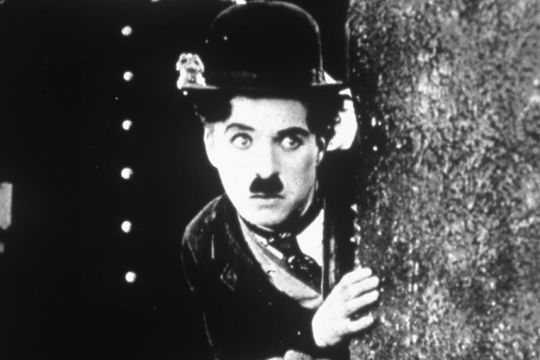
Boston’s Great Molasses Flood of 1919: How One of America’s Strangest Tragedies Happened
It fits perfectly into early 20th-century American lore, this all-too-real disaster: on January 15, 1919, a fifteen-foot wall of molasses rushed through Boston’s North End, killing 21, injuring 150, doing $100 million in today’s dollars worth of damage, and requiring 80,000 man-hours to clean up. Those figures come from a post on the subject at Mental Floss, which investigates what loosed the Great Molasses Flood in the first place. The United States Industrial Alcohol Company, owners of the brown, sticky substance in question and the exploding tank that contained it, pinned it on bomb-chuckers, claiming that, “since its alcohol was an ingredient in government munitions, anarchists must have sabotaged the tank.” Investigations later revealed the cause as none other than seat-of-the-pants capitalistic hubris, another standby of early 20th-century America.
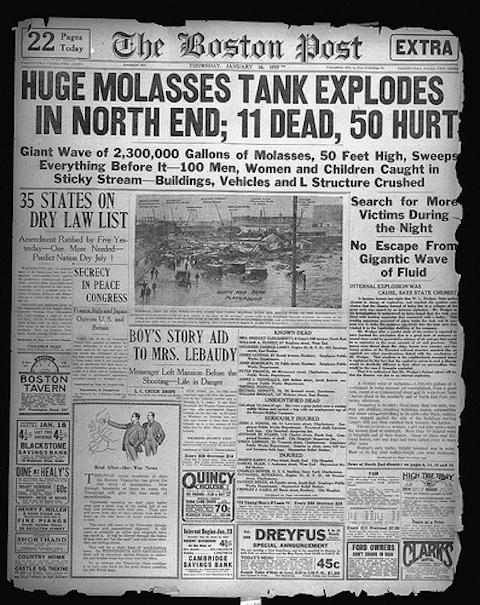
The tank’s “absurdly shoddy construction work,” led by a man who “couldn’t even read a blueprint,” came down to this: they “threw up a gigantic tank as quickly and cheaply as possible, skimped on inspections and safety tests, and hoped for the best.” You can learn more about what happened in the video above, a dramatization of the events leading up to the Great Molasses Flood from the pilot episode of The Folklorist.
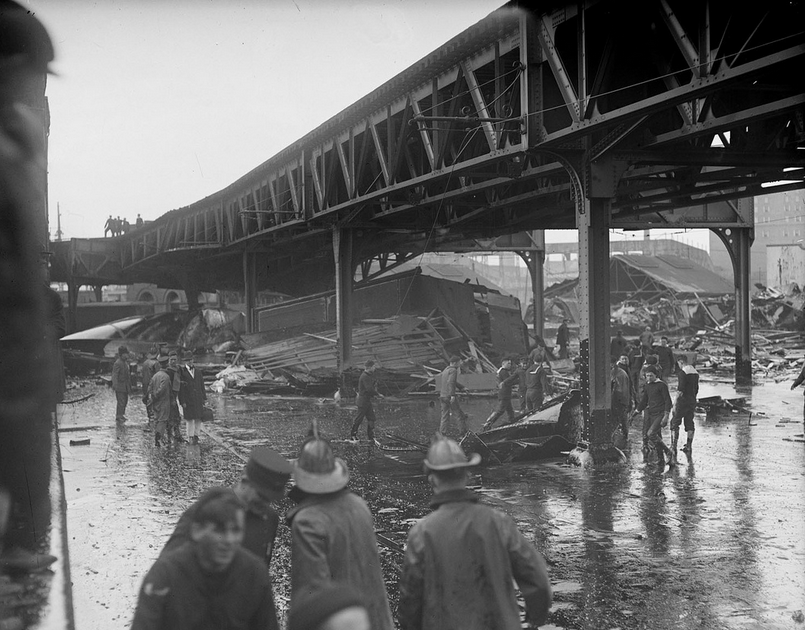
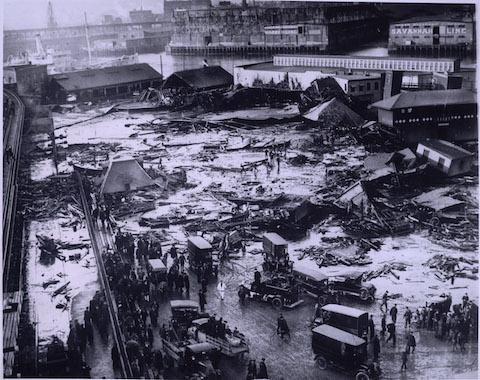
The contemporary images above and below come from the Boston Public Library’s Flickr set. For the most definitive study of this gooey calamity, you’ll want to seek out Dark Tide: The Great Boston Molasses Flood of 1919 by Stephen Puleo, who speaks in some detail about the event and its aftermath in this Real History video. All these well-documented facts aside, legend has it that, on a particularly hot day on Commercial Street, you can still smell the stuff.
Related Content:
Voltaire & the Lisbon Earthquake of 1755
The Titanic: Rare Footage Before Disaster Strikes
How the Titanic Sank: James Cameron’s New CGI Animation
Colin Marshall hosts and produces Notebook on Cities and Culture and writes essays on cities, Asia, film, literature, and aesthetics. He’s at work on a book about Los Angeles, A Los Angeles Primer. Follow him on Twitter at @colinmarshall or on his brand new Facebook page.
Read More...What Did Charles Darwin Read? See His Handwritten Reading List & Read Books from His Library Online

Click to enlarge
Today marks the 215th anniversary of pioneering English naturalist Charles Darwin’s birth — a suitable occasion, perhaps, to finally take that copy of On the Origin of Species down off your shelf (or from our collection of Free eBooks). Though Darwin’s best-known publication lays out his observations on evolution by natural selection, culminating in the theory often and unhesitatingly called the most important in biology, the book remains more respected than read. Still, any scientist’s legacy, even that of one with a name so widely known as Darwin’s, comes down to what they understood, and thus what they allowed the rest of humanity to understand, not what they wrote. But you still have to wonder: what did Darwin read?
We have two answers to that question, the first of which comes in the form of Darwin’s 1838 “to read” list above, which runs as follows:
Humboldt’s New Spain — — —
Fauna Borealis
Richardson’s
Entomological Magazine — — —
Study Buffon on varieties of Domesticated animals — — — —
Find out from Statistical Soc. where M. Quetelet has published his laws about sexes relative to the age of marriage
Brown at end of Flinders & at the end of Congo voyage (Hooker 923) read
Decandolle Philosophie
Decandolle on Geograph distrib:—
F. Cuvier on Instinct read
L. Jenyns paper in Annals of Nat. Hist.
Prichard; a 3d vol Lawrence read
Bory St Vincent Vol 3. p 164 on unfixed form: Dr Royle on Himmalaya types (read)
Smellie Philosophy of Zoology.
Fleming Ditto
Falconers remark on the influence of climate
You can find more on the list’s context at Endpaper, whose post describes it as found in Darwin’s “series of notebooks for theoretical work now known as Notebooks A, B, C, D, etc.,” specifically Notebook C. (The famous Tree of Life sketch, they add, came from Notebook B.) For our second answer to the question of which books equipped the celebrated biologist’s mind, we offer the books that furnished his home: back in 2011, we featured Cambridge University’s Biodiversity Heritage Library and its project to digitize and make freely available 330 texts from Darwin’s library. All come annotated by the man himself, so you can learn not just from what he read, but about how he read. The next, much more difficult step, then presents itself: to think how he thought.
Related Content:
Watch Darwin, a 1993 Film by Peter Greenaway
Read the Original Letters Where Charles Darwin Worked Out His Theory of Evolution
The Genius of Charles Darwin Revealed in Three-Part Series by Richard Dawkins
Darwin’s Personal Library Goes Digital: 330 Books Online
Darwin’s Legacy, a Stanford course in our collection of 750 Free Online Courses
Colin Marshall hosts and produces Notebook on Cities and Culture and writes essays on cities, Asia, film, literature, and aesthetics. He’s at work on a book about Los Angeles, A Los Angeles Primer. Follow him on Twitter at @colinmarshall or on his brand new Facebook page.
Read More...David Foster Wallace’s Sharp Letter to His Editor: “Don’t F with the Mechanics of My Piece”
Click for expanded version
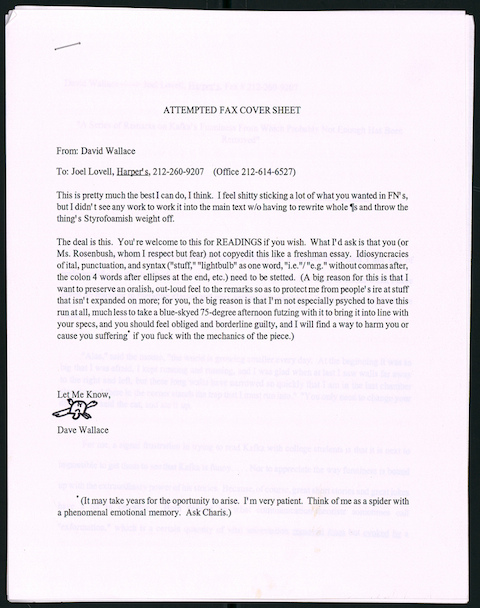
We might imagine that David Foster Wallace worked out his neuroses primarily in his voluminous fictional and critical output, but as we see from a fax above to Harper’s editor Joel Lovell, the painful self-consciousness that drove his writing manifested in even the most mundane of documents. Wallace submitted the faxed letter with a short essay on Kafka that appeared in Harper’s in 1998. The essay itself—an account of the difficulties of teaching the arch Czech author to American undergraduates—slices through commonplaces, arriving at the conclusion that “the horrific struggle to establish a human self results in a self whose humanity is inseparable from that horrific struggle. That our endless and impossible journey toward home is in fact our home.” Reassuring stuff this ain’t, but then, neither is Kafka. Even amidst all of its elaborate defensive strategies, Wallace’s writing also exposes the unheimlichkeit of human embodiment, and in the Kafka essay, it’s a point he wanted to make in a very particular way, unmediated by any editorial intervention.
His faxed letter to Lovell anticipates and resists criticism and alternates between dismissive, self-effacing, and mock-threatening in his expressed desire that the Harper’s staff “not copyedit this like a freshman essay.” He explains the conversational style of the piece as an effort to “protect me from people’s ire.” The body of the letter finishes with Wallace’s footnoted promise to “find a way to harm you or cause you suffering* if you fuck with the mechanics of this piece.” It’s classic DFW: completely idiosyncratic, a prose style induced by his “horrific struggle” to establish an authentic self. Read a transcript below, courtesy of Letters of Note. All, of course, sic.
ATTEMPTED FAX COVER SHEET
From: David Wallace
To: Joel Lovell, Harper’s [redacted] (Office [redacted])
This is pretty much the best I can do, I think. I feel shitty sticking a lot of what you wanted in FN’s, but I didn’t see any work to work it into the main text w/o having to rewrite whole ¶s and throw the thing’s Styrofoamish weight off.
The deal is this. You’re welcome to this for READINGS if you wish. What I’d ask is that you (or Ms. Rosenbush, whom I respect but fear) not copyedit this like a freshman essay. Idiosyncracies of ital, punctuation, and syntax (“stuff,” “lightbulb” as one word, “i.e.”/“e.g.” without commas after, the colon 4 words after ellipses at the end, etc.) need to be stetted. (A big reason for this is that I want to preserve an oralish, out-loud feel to the remarks so as to protect me from people’s ire at stuff that isn’t expanded on more; for you, the big reason is that I’m not especially psyched to have this run at all, much less to take a blue-skyed 75-degree afternoon futzing with it to bring it into line with your specs, and you should feel obliged and borderline guilty, and I will find a way to harm you or cause you suffering* if you fuck with the mechanics of this piece.
Let Me Know,
Dave Wallace
* (It may take years for the oportunity to arise. I’m very patient. Think of me as a spider with a phenomenal emotional memory. Ask Charis.)
Related Content:
30 Free Essays & Stories by David Foster Wallace on the Web
David Foster Wallace’s 1994 Syllabus: How to Teach Serious Literature with Lightweight Books
Josh Jones is a writer and musician based in Durham, NC. Follow him at @jdmagness
Read More...An Artistic Portrait of Stephen Fry Made From His Own Bacteria
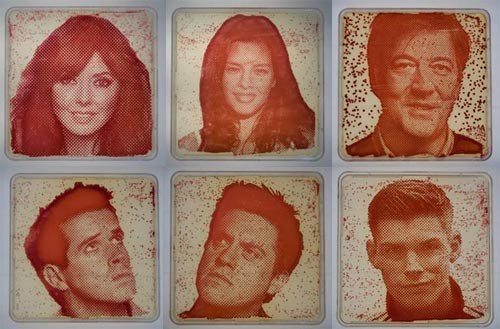
Stephen Fry is taking part in a curious science experiment. It involves creating a portrait of the writer/comedian/science enthusiast, using nothing but his own bacteria and cells. According to the web site of The Big Bang UK Young Scientists & Engineers Fair, the “bacteriographs” — as the portraits are called — are “made from the subjects’ own cells – and have been grown by Zachary Copfer, an American microbiologist and photographer.” “To make the Pop Art style images, Zachary cleverly exposes areas of a petri dish to radiation in order to stimulate the bacteria’s growth. This creates a photograph grown entirely from the bacteria itself.” Find more of Copfer’s work below, and other scientific work featuring Stephen Fry further down the page.
Related Content
Stephen Fry Explains Cloud Computing in a Short Animated Video
Stephen Fry Introduces the Strange New World of Nanoscience
Free Online Biology Courses
Read More...Jimi Hendrix’s Final Interview Animated (1970)
We’ve previously featured Jimi Hendrix’s final interview, preserved as an audio recording by NME’s Keith Altham, who sat down to talk with him on September 11, 1970, one week before Hendrix’s death. Now, we bring you multimedia org Blank on Blank’s animation of that interview—breezy, surreal, funny, and profound. As I wrote in our previous post, Hendrix’s “offhand lyricism and fractal imagination” are on full display here. It’s rare that a musician is as interesting to hear speaking as playing, but Hendrix was one of them. Take, for example, Hendrix’s response when Altham suggests that he invented psychedelic music:
Jimi Hendrix: [chuckles] A mad scientist approach. The way I write things, I just write them with a clash between reality and fantasy mostly. You have to use fantasy to show different sides of reality; it’s how it can bend. As a word reality is nothing, but each individual’s own way of thinking. Then the establishment grabs a big piece of that.
Then there’s Hendrix on destroying guitars onstage:
Jimi Hendrix: One time I said: maybe I should burn a guitar tonight. You know [laughs] smash a guitar or something like that. And they said: yeah, yeah! I said: you really think I should? They said: yeah, that’d be cool. I said: well, ok. So like I just worked up enough anger where I could do it, you know. But like I didn’t know it was anger until they told me that it was, like with destruction and all that. But I believe everybody should have like a room where they can get rid of all their releases, where they can do their releases at. So my room is a stage. [laughs]
There are many more of these gems in the full interview that didn’t make the cut above, but the abridged Blank on Blank version appropriately captures the whimsy and good humor of the late lamented genius.
Related Content:
Jimi Hendrix’s Final Interview on September 11, 1970: Listen to the Complete Audio
Watch Jimi Hendrix’s ‘Voodoo Chile’ Performed on a Gayageum, a Traditional Korean Instrument
Josh Jones is a writer and musician based in Durham, NC. Follow him at @jdmagness
Read More...Two Animations of Plato’s Allegory of the Cave: One Narrated by Orson Welles, Another Made with Clay
The ever-flickering lights, the ever-present screen, the stupefied spectators immune to a larger reality and in need of sudden enlightenment—Plato’s allegory of the cave from Book VII of The Republic is a marketing department’s dream: it sums up an entire brand in a stock-simple parable that almost anyone can follow, one that lends itself to compellingly brief visual interpretations like those above and below. In the top video, Orson Welles narrates while the camera pans over some colorfully stylized illustrations of the fable by artist Dick Oden. This preserves the didactic tone of the text, but it is a little dry. In contrast, the award-winning three-dimensional renderings of the prisoners and their nonstop nickelodeon in the Claymation Cave Allegory below offers dramatic close-ups of the chained prisoner’s faces and the hypnotic movement of firelight over the cave’s rock walls.
Plato’s “brand” is a doctrine of idealism that posits a realm of ideal forms, of which everything we know by our senses is but an inferior copy. The ironically poetic Socrates relates the story to illustrate “the effect of education and the lack of it on our nature.”
And yet it does much more than this—Plato illustrates an epistemology that supports notions of the soul and immortality, and hence his ideas survived in theology long after they was supposedly vanquished by analytic philosophy.
Plato’s idea of reason as a perfect, unchanging realm of which we’re only dimly aware is intuitively compelling. Most of us are at some time conscious of how limited our perceptions truly are. But just because the allegory of the cave is fairly easy to communicate to philosophy 101 students doesn’t mean it’s easy to adapt to the screen like the two examples above. Mark Linsenmayer of The Partially Examined Life points us toward these 20 YouTube takes on Plato’s cave, “many of them,” he writes, “frightfully amateurish and some of them presenting a warped and/or incomprehensible version of the story.” I am particularly intrigued by the silent film version below. As always, your comments on the soundness of these various interpretations are most welcome.
Courses on Plato can be found on our list of 100 Free Philosophy Courses, a subset of our larger Free Online Course collection.
Related Content:
The Drinking Party, 1965 Film Adapts Plato’s Symposium to Modern Times
Philosophy Bites: Podcasting Ideas From Plato to Singularity Since 2007
Famous Philosophers Imagined as Action Figures: Plunderous Plato, Dangerous Descartes & More
Josh Jones is a writer and musician based in Durham, NC. Follow him at @jdmagness
Read More...James Taylor and Joni Mitchell, Live and Together (1970)
“I’m ready when you are, James.”
“… I know.”
Something extremely sweet was going on between James Taylor and Joni Mitchell when they played together at London’s Paris Theatre in 1970. You can hear it in these recordings, taped by the BBC and broadcast as one of John Peel’s Sunday Shows.
Mm, just listen to Sweet Baby James’ “magic fingers boogie up and down those golden frets.” Is it any wonder he became the subject of so many songs, two of them Joni’s?
(For the record, here are critic David B. Wilson’s Top 5 Songs About James Taylor:
- Joni Mitchell, “See You Sometime”
- Carly Simon, “We Have No Secrets”
- Joni Mitchell, “Just Like This Train”
- Carly Simon, “Jesse”
- James Taylor, “That’s Why I’m Here”)
According to Joni’s own website, James’ “You Can Close Your Eyes,” above, is about her. (That would explain the little giggle at the top.)
He performed it solo on his 1971 release, Mud Slide Slim and the Blue Horizon. Joni contributed backing vocals elsewhere on the album. In return, he played guitar on her Blue.
The general public had to wait another year to hear “See You Sometime,” David Wilson’s pick for the number one song about James Taylor, but Joni must’ve made sure that James got a preview.
As she later told Bill Flanagan of Musician Magazine, “I wrote a song for James Taylor that mentioned his suspenders. And then on his next album he went and wore his bloody suspenders on the cover! Well, then the cat was completely out of the bag!”
Oh, Joni, I’m not so sure the suspenders were the giveaway.
As for the young man she talks about after “For Free”—the guy who felt he was over the hill at the ripe old age of 21—it’s not James. It’s Neil Young, and the song his gloomy mood inspired was “Circle Game.” (Good luck finding that cut. Once a ubiquitous bootleg, with the exception of the songs posted here, the concert has all but disappeared, though those who still listen to cds can put it in their baskets on Amazon’s UK site.)
Related Content:
James Taylor Performs Live in 1970, Thanks to a Little Help from His Friends, The Beatles
Watch Joni Mitchell Perform “Both Sides Now” on the First Episode of The Johnny Cash Show (1969)
Ayun Halliday was introduced to this concert as a WBEZ Unconcert in the early 80’s and worries that her homemade cassette may one day cease to exist. Follow her @AyunHalliday
Read More...The Drawings of Franz Kafka (1907–1917)
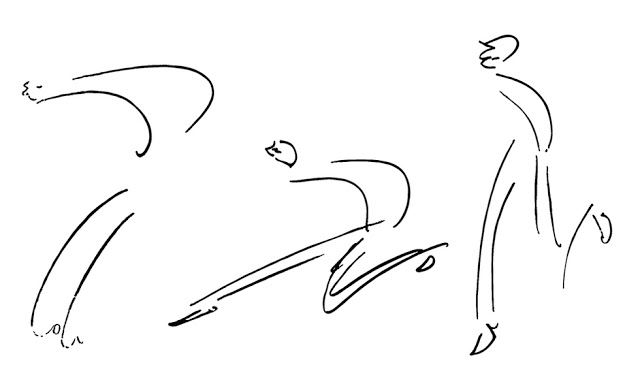
Runner 1907–1908
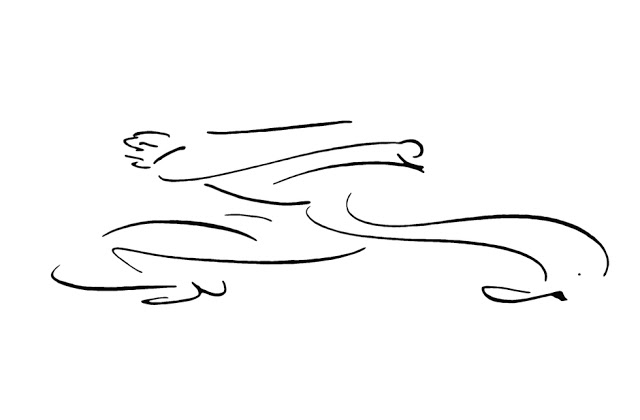
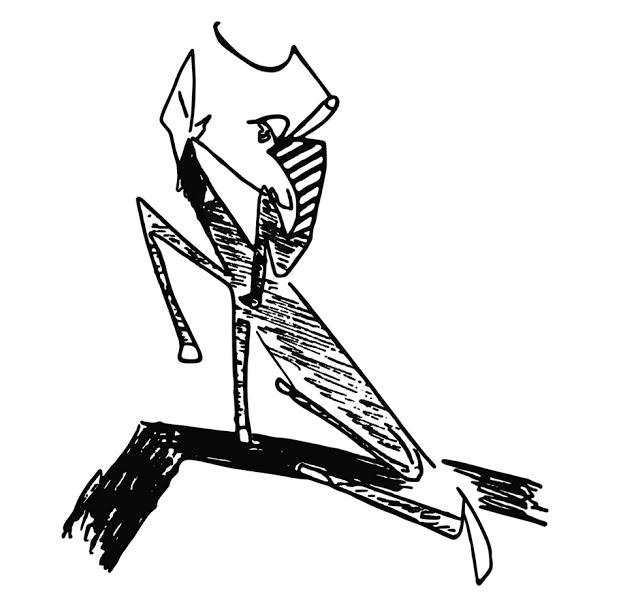
UK-born, Chicago-based artist Philip Hartigan has posted a brief video piece about Franz Kafka’s drawings. Kafka, of course, wrote a body of work, mostly never published during his lifetime, that captured the absurdity and the loneliness of the newly emerging modern world: In The Metamorphosis, Gregor transforms overnight into a giant cockroach; in The Trial, Josef K. is charged with an undefined crime by a maddeningly inaccessible court. In story after story, Kafka showed his protagonists getting crushed between the pincers of a faceless bureaucratic authority on the one hand and a deep sense of shame and guilt on the other.
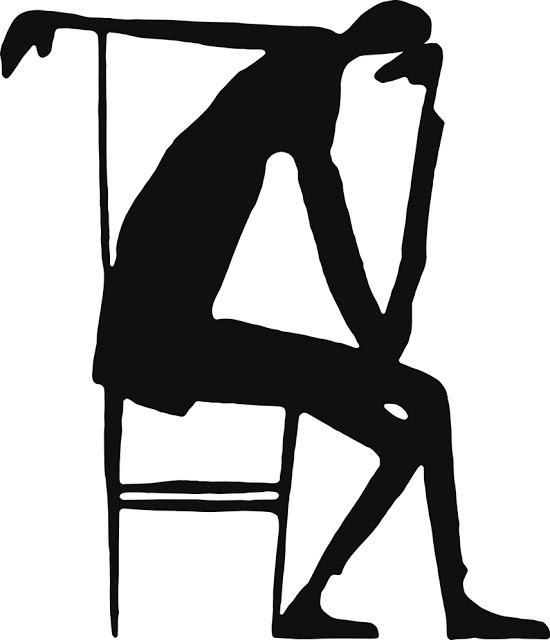
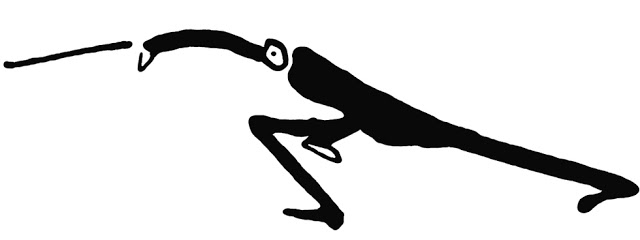
On his deathbed, the famously tortured writer implored his friend Max Brod to burn his unpublished work. Brod ignored his friend’s plea and instead published them – novels, short stories and even his diaries. In those diaries, Kafka doodled incessantly – stark, graphic drawings infused with the same angst as his writing. In fact, many of these drawings have ended up gracing the covers of Kafka’s books.
“Quick, minimal movements that convey the typical despairing mood of his fiction” says Hartigan of Kafka’s art. “I am struck by how these simple gestures, these zigzags of the wrist, contain an economy of mark making that even the most experienced artist can learn something from.”
In his book Conversations with Kafka, Gustav Janouch describes what happened when he came upon Kafka in mid-doodle: the writer immediately ripped the drawing into little pieces rather than have it be seen by anyone. After this happened a couple times, Kafka relented and let him see his work. Janouch was astonished. “You really didn’t need to hide them from me,” he complained. “They’re perfectly harmless sketches.”
“Kafka slowly wagged his head to and fro – ‘Oh no! They are not as harmless as they look. These drawing are the remains of an old, deep-rooted passion. That’s why I tried to hide them from you…. It’s not on the paper. The passion is in me. I always wanted to be able to draw. I wanted to see, and to hold fast to what was seen. That was my passion.”
Check out some of Kafka’s drawings below:
Horse and Rider 1909–1910
Three Runners 1912–1913
The Thinker 1913
Fencing 1917
via ArtsCentre
Related Content:
Find Works by Kafka in our Free eBooks collection
Watch Franz Kafka, the Wonderful Animated Film by Piotr Dumala
The Art of William Faulkner: Drawings from 1916–1925
Vladimir Nabokov Makes Editorial Tweaks to Franz Kafka’s Novella
Vladimir Nabokov’s Delightful Butterfly Drawings
Jonathan Crow is a Los Angeles-based writer and filmmaker whose work has appeared in Yahoo!, The Hollywood Reporter, and other publications. You can follow him at @jonccrow.
Read More...Support Us
We're hoping to rely on loyal readers, rather than erratic ads. Please click the Donate button and support Open Culture. You can use Paypal, Venmo, Patreon, even Crypto! We thank you!

About Us

Open Culture scours the web for the best educational media. We find the free courses and audio books you need, the language lessons & educational videos you want, and plenty of enlightenment in between.
Advertise With Us

FREE UPDATES!
GET OUR DAILY EMAIL
Get the best cultural and educational resources on the web curated for you in a daily email. We never spam. Unsubscribe at any time.
FOLLOW ON SOCIAL MEDIA

Open Culture editor Dan Colman scours the web for the best educational media. He finds the free courses and audio books you need, the language lessons & movies you want, and plenty of enlightenment in between.
Advertise With Us


