Opening Sentences From Great Novels, Diagrammed: Lolita, 1984 & More

I admit it: I still don’t understand sentence diagramming. Though as a middle schooler I dutifully, if grudgingly, submitted to that classic English classroom exercise, the practice didn’t stick, nor did whatever habit of composition it meant to convey. Some of my teachers tried to make sentence diagramming interesting, but they could only do so much. They could only do so much, that is, without Pop Chart Lab’s “A Diagrammatical Dissertation on Opening Lines of Notable Novels,” a poster that “diagrams 25 famous opening lines from revered works of fiction according to the dictates of the classic Reed-Kellogg system,” with each and every graphic “parsing classical prose by parts of speech and offering a partitioned, color-coded picto-grammatical representation of some of the most famous first words in literary history.”
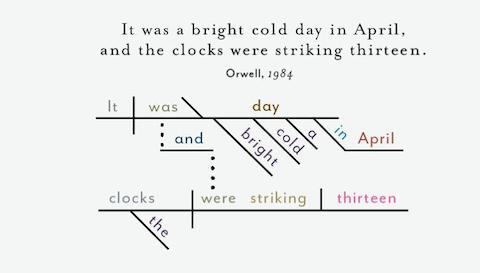
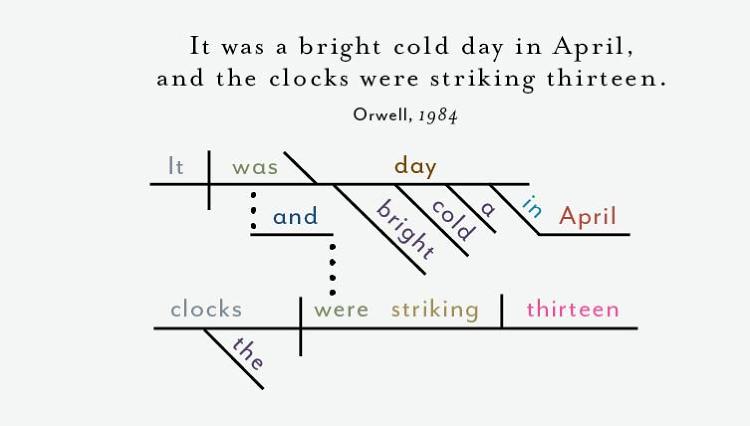
At the top of the post, we have the poster’s diagram of Humbert Humbert’s famous first words, by way of Vladimir Nabokov, in Lolita: “Lolita, light of my life, fire of my loins.” That immortal sentence may always have struck you as incomplete — doesn’t it need a verb? — but hey, it diagrams, at least with the addition of the implicit (is) and a couple implicit (the)s. Follow the branches and you find the words’ concealed complexity visually revealed. Just above, you’ll see diagrammed a more traditional opening sentence from George Orwell, a much more plainspoken writer. “It was a bright cold day in April,” goes the first line of 1984, “and the clocks were striking thirteen” — a more linguistically involved description, as you can see, than it may at first seem. Fifteen years after the specter of Reed-Kellogg darkened my desk — in which time I’ve made writing my career — I still can’t claim the ability to produce properly diagrammed sentences for myself. But I like to think that I can appreciate them, especially when they show me the workings of a sufficiently great sentence.
See more famous opening sentences from Pop Chart Lab’s poster (and purchase your own copy) here.
Related Content:
George Orwell’s 1984: Free eBook, Audio Book & Study Resources
The History of the English Language in Ten Animated Minutes
Learn Languages for Free: Spanish, English, Chinese & 37 Other Languages
David Foster Wallace Breaks Down Five Common Word Usage Mistakes in English
Nabokov Reads Lolita, Names the Great Books of the 20th Century
Colin Marshall hosts and produces Notebook on Cities and Culture and writes essays on cities, aesthetics, Asia, and men’s style. He’s at work on a book about Los Angeles, A Los Angeles Primer. Follow him on Twitter at @colinmarshall or on Facebook.
Read More...Hattie McDaniel, Star of Gone with the Wind, Gives a Moving Academy Award Acceptance Speech (1940)
In 1940, Hattie McDaniel became the first African American to win an Academy Award, taking home the Best Supporting Actress Oscar for her turn as Mammy in Gone with the Wind. To quote a friend, there’s a lot happening in the 1:40 minutes that document her acceptance speech.
1939’s stately Best Supporting Actress Fay Bainter introduced the historic moment by noting, “It opens the doors of this room, moves back the walls, and enables us to embrace the whole of America….”
At which point, co-star Olivia de Havilland and fellow nominees Geraldine Fitzgerald, Edna May Oliver, and Maria Ouspenskaya no doubt loosened their girdles and began contemplating their next martinis.
McDaniel’s emotional, and inspiringly brief, remarks above don’t allude to the fact that she and her escort were seated at a table near the kitchen, far from the podium and her fellow Gone with the Wind cast members’ table. Two months prior, Georgia’s segregationist laws prevented her from attending the Atlanta premiere. Protesters outside the Coconut Grove awards ceremony decried Gone with the Wind’s depiction of people of color, McDaniel’s successful efforts to get the “n” word stricken from the script notwithstanding.
It would take the Academy over two decades to single out another African-American actor’s performance—Sidney Poitier, 1963’s Best Actor for his performance in Lilies of the Field.
Related Content:
Screen Tests for Gone with the Wind: What Could Have Been
Spielberg Reacts to the 1975 Oscar Nominations: ‘Commercial Backlash!’
33 Free Oscar Winning Films Available on the Web
80 Years of Academy Award Winning Films in Posters
Ayun Halliday is spending the weekend at the NYC Feminist Zinefest. Follow her @AyunHalliday
Read More...The Lyrics of Johnny Cash’s “I’ve Been Everywhere” Charted on a Dynamic Google Map

The country music classic “I’ve Been Everywhere” was first recorded by Lucky Starr in Australia in 1962, then later adapted by Hank Snow, various other artists, and eventually the great Johnny Cash. The lyrics begin:
I was toting my pack along the dusty Winnemucca road
When along came a semi with a high an’ canvas-covered load
“If you’re goin’ to Winnemucca, Mack, with me you can ride.”
And so I climbed into the cab and then I settled down inside
He asked me if I’d seen a road with so much dust and sand
And I said, “Listen, I’ve traveled every road in this here land!”I’ve been everywhere, man
I’ve been everywhere, man
Crossed the desert’s bare, man
I’ve breathed the mountain air, man
Of travel I’ve had my share, man
I’ve been everywhereI’ve been to:
Reno, Chicago, Fargo, Minnesota
Buffalo, Toronto, Winslow, Sarasota
Wichita, Tulsa, Ottawa, Oklahoma
Tampa, Panama, Mattawa, La Paloma
Bangor, Baltimore, Salvador, Amarillo
Tocopilla, Barranquilla, and Padilla, I’m a killerI’ve been to:
Boston, Charleston, Dayton, Louisiana
Washington, Houston, Kingston, Texarkana
Monterey, Faraday, Santa Fe, Tallapoosa
Glen Rock, Black Rock, Little Rock, Oskaloosa
Tennessee, Tennessee, Chicopee, Spirit Lake
Grand Lake, Devil’s Lake, Crater Lake, for Pete’s sake
And that’s not all of the locations the narrator travels to. If you chart and connect all of the destinations mentioned in the song — as Iain Mullan has done in this handy, dynamic map — you’ll find that the singer covers some 112,515 miles (or 181,075 kilometers). Even better, you can watch the travels take place in real-time on a Google map. Just click play, and you will be on your way.
For more travels on a Google map, don’t miss our recent post:
Jack Kerouac’s On The Road Turned Into Google Driving Directions & Published as a Free eBook
Read More...Raymond Chandler’s Ten Commandments for Writing a Detective Novel

Promo portrait photo of author Raymond Chandler, via Wikimedia Commons
Raymond Chandler – along with his hardboiled brethren like Dashiell Hammett and James M. Cain – sandblasted the detective novel of its decorousness and instilled it with a sweaty vitality. Chandler, through the eyes of his most famous character Philip Marlowe, navigated a thinly veiled Los Angeles through the desperation of those on the low end of society’s totem pole and through the greed and venality of those at the top.
Instead of creating self-contained locked room mysteries, Chandler created stories that looked outward, struggling to make sense of a morally ambiguous world. He dedicated his career to the genre, influencing generations of writers after him. His very name became synonymous with his terse, pungent style.
So it isn’t terribly surprising that Chandler had some very strong opinions about crime fiction. Below are his ten commandments for writing a detective novel:
1) It must be credibly motivated, both as to the original situation and the dénouement.
2) It must be technically sound as to the methods of murder and detection.
3) It must be realistic in character, setting and atmosphere. It must be about real people in a real world.
4) It must have a sound story value apart from the mystery element: i.e., the investigation itself must be an adventure worth reading.
5) It must have enough essential simplicity to be explained easily when the time comes.
6) It must baffle a reasonably intelligent reader.
7) The solution must seem inevitable once revealed.
8) It must not try to do everything at once. If it is a puzzle story operating in a rather cool, reasonable atmosphere, it cannot also be a violent adventure or a passionate romance.
9) It must punish the criminal in one way or another, not necessarily by operation of the law.… If the detective fails to resolve the consequences of the crime, the story is an unresolved chord and leaves irritation behind it.
10) It must be honest with the reader.
These commandments are oblique jabs at the locked room whodunits popular during the Golden Age of the detective novel during the 1920s and 30s. Chandler delivers a much more pointed criticism of these works in his seminal essay about crime fiction, The Simple Art of Murder.
After taking thoroughly apart the murder mystery The Red House by A. A. Milne (yes, the writer of Winnie the Pooh), Chandler rails against detective stories where the machinations of plot outstrip any semblance of reality. “If the situation is false, you cannot even accept it as a light novel, for there is no story for the light novel to be about.”
He goes on to trash other British mystery writers like Agatha Christie and particularly Dorothy L. Sayers, who Chandler paints not only as a hypocritical snob but also as boring. “The English may not always be the best writers in the world, but they are incomparably the best dull writers,” he quips.
Chandler then offers praise to his hardboiled colleague Dashiell Hammett who infuses his stories with a sense of realism. “Hammett gave murder back to the kind of people that commit it for reasons, not just to provide a corpse; and with the means at hand, not with hand-wrought duelling pistols, curare, and tropical fish….He was spare, frugal, hardboiled, but he did over and over again what only the best writers can ever do at all. He wrote scenes that seemed never to have been written before.”
Whether conscious or not, this passage is a fair description of Chandler as well.
Related Content:
Watch Raymond Chandler’s Long-Unnoticed Cameo in Double Indemnity
Jonathan Crow is a writer and filmmaker whose work has appeared in Yahoo!, The Hollywood Reporter, and other publications. You can follow him at @jonccrow.
Read More...Hear Italo Calvino Read Selections From Invisible Cities, Mr. Palomar & Other Enchanting Fictions
The Travels of Marco Polo—tales told by the Venetian explorer to Italian romance writer Rustichello da Pisa—purportedly describes in great detail Polo’s encounter with “The East,” a place in the medieval European mind as alien and fantastical as the interstellar realms of science fiction. Like other travel narratives of the period (notably the spurious Travels of Sir John Mandeville), Polo’s stories mixed accurate geographical and cultural information with folklore, myth, and Orientalist misapprehension. While the appearance of monsters and marvels seems capricious to the modern reader, these elements may have felt almost mundane to Polo’s contemporaries. Or maybe not. After all, the Italian title of Polo’s travelogue—Il Milione—may refer to Polo’s reputation as the teller of “a million” lies.
But let us leave the puzzles of authenticity to historians. As readers, we get lost in these fascinating romances because the worlds they describe are both so strange yet so unsettlingly familiar. Medieval travelogues like Polo’s open up the possibility of fairy kingdoms with outlandish customs thriving almost within reach. These tales of strange and unknown lands were, after all, prominent inspiration for C.S. Lewis’s Narnia books. (Listen to the Chronicles of Narnia in a free audio format here).
For grown-up readers, no author better evokes the uncanny geopolitics of the medieval imagination than Italo Calvino, whose Invisible Cities imagines Polo’s supposed journey to the imperial seat of Mongol ruler Kublai Khan. In Calvino’s novel—more a collection of prose-poems—Polo regales Khan with his accounts of 55 exotic cities, while the busy emperor’s functionaries come and go. “At some point,” says author Eric Weiner, “you realize that Calvino is not talking about cities at all, not in the way we normally think of the word. Calvino’s cities—like all cities, really—are constructed not of steel and concrete but of ideas. Each city represents a thought experiment.”
Similar observations can be made of any of the author’s oddly enchanting allegorical fictions—Seamus Heaney called Calvino’s stories “fantastic displays” inspired by “symmetries and arithmetics.” In the audio above, you can hear the author read selections from several of his works, including Invisible Cities and Mr. Palomar, a work of “even more archness and architectural invention.” Do not be daunted by Calvino’s Italian. I find it very pleasing to listen to, even if I do not understand it all. But if you’d rather skip ahead to the English portion of his reading—recorded at the 92nd St. Y on March 31st, 1983—it begins at 8:40 where Calvino reads from a section of Invisible Cities called “Thin Cities.” In this excerpt, Polo tells Khan of a place called “Armilla”:
Whether Armilla is like this because it is unfinished or because it has been demolished, whether the cause is some enchantment or only a whim, I do not know. The fact remains that it has no walls, no ceilings, no floors: it has nothing that makes it seem a city except the water pipes that rise vertically where the houses should be and spread out horizontally where the floors should be: a forest of pipes that end in taps, showers, spouts, overflows […]
You can read the remainder of the “Armilla” section here, along with other selections from Invisible Cities. A portion of the text of Mr. Palomar is available here. Calvino’s reading is long—nearly an hour and a half—and very rewarding, both for the rich musicality of his accented English and the spellbinding charms of his philosophical fictions. And if you are so inspired, you may wish to read Calvino’s short essay “Why Read the Classics?” to which I often turn for a fuller grasp his wide-ranging literary inheritance.
via The Paris Review
Related Content:
Watch a Whimsical Animation of Italo Calvino’s Short Story “The Distance of the Moon”
John Turturro Reads Italo Calvino’s Animated Fairy Tale
550 Free Audio Books: Download Great Books for Free
Josh Jones is a writer and musician based in Durham, NC. Follow him at @jdmagness
Read More...Watch Boy and Bicycle: Ridley Scott’s Very First Film (1965)
Alien, Blade Runner, Gladiator, Prometheus, the Apple Macintosh 1984 Super Bowl ad, the upcoming Biblically-based (and Biblically-sized) Exodus: if you want a thoroughly through-and-through vision, executed at full scale and tinted with more than a touch of dystopian grimness, you go to Ridley Scott. But no director commences his career making pictures like these; most of them have to begin in humbler places, pulling together whatever grant money, film-school resources, and helpful acquaintances they can to realize, and in the process often compromise, their long-incubated cinematic dreams. So it went with Scott himself, who made the short film above, 1965’s Boy and Bicycle, while a student at London’s Royal College of Art. But even this comparatively tiny project, with its rich 16-millimeter images, adept camera movement, and utterly hopeless setting, shows signs of what sort of filmmaker the twentysomething Scott would become a decade or two later.
Though he received his photographic education in London, Scott took his camera out for the Boy and Bicycle shoot to West Hartlepool, where he’d attended art school several years earlier. That bit of the soon-to-be-deindustrialized north of England provided, especially in the British Steel North Works cooling tower and blast furnace, just the sort of background we’d expect to see in the mature director’s work. And through this bleak landscape (which reminds me of nothing so much as the inhospitable Osaka he would portray more than twenty years later in Black Rain) we have the titular boy on the titular bicycle, played by — classic first-time filmmaker’s strategy — the director’s younger brother. In this case, that brother would grow up to become Tony Scott, a celebrated if aesthetically polarizing director (Top Gun, True Romance, Domino) in his own right. Not one to waste a resonant image, Ridley Scott would a decade later revisit Boy and Bicycle in the beloved advertisement for Hovis bread just above.
Other early short films by great directors can be found below, and in our collection of 635 Free Movies Online.
Related Content:
Martin Scorsese’s Very First Films: Three Imaginative Short Works
Stanley Kubrick’s Very First Films: Three Short Documentaries
Andrei Tarkovsky’s Very First Films: Three Student Films, 1956–1960
The Hearts of Age: Orson Welles’ Surrealist First Film (1934)
Colin Marshall hosts and produces Notebook on Cities and Culture and writes essays on cities, Asia, film, literature, and aesthetics. He’s at work on a book about Los Angeles, A Los Angeles Primer. Follow him on Twitter at @colinmarshall or on his brand new Facebook page.
Read More...The Doors Play Live in Denmark & LA in 1968: See Jim Morrison Near His Charismatic Peak
Do they look a bit scruffy, the Doors on live Danish TV in 1968? My image of the Doors is forever colored by Oliver Stone’s The Doors. But the real Jim Morrison had even better hair than his doppelgänger Val Kilmer (“not a case of casting,” quoth Ebert, “but of possession”), even if the above performance is less Lizard King than lounge lizard. John Densmore lays back on the beat, gets out the way of Morrison’s free associative poetry. Guitarist Robbie Krieger riffs intently, looks subdued. Always the one to watch, the recently departed Ray Manzarek plays hypnotic baselines with his left hand while his right dances around melodic blue note phrases. It’s a very cool show, but the lack of an audience is palpable.
Morrison was at his best, and probably also worst, before crowds of admirers. He has no lack of them in another ’68 performance, this time at the Hollywood Bowl. Where the Danish gig is cabaret, this is a shamanistic happening: Morrison wears something like a sleeveless toreador’s jacket and the band plays loud, especially Densmore, who bashes his drums like John Bonham. Jim Morrison seems entranced, and really stoned. Densmore later said he’d just dropped acid: “I could tell once we hit the stage because his movements, his performance, was a little deliberate; a little like he was holding it together. But he was fantastic.”
The Hollywood Bowl is the show to see. It was a magical night. It was a big deal to play the Hollywood Bowl. We were all so excited. We’d had dinner with Mick Jagger just before the show and he was right in the front. For any fan of The Doors — young or old — this is really the way it was; this is the way to see what it was all about.
In neither of these concerts is Morrison quite the unhinged maniac of legend, but things, as they say, had already begun to unravel. Two years later the band would play its last show with Morrison at The Warehouse in December of 1970. Some believe the Doors peaked in 1967 and never topped their debut (a “stoned, immaculate classic” and the dark underbelly of Sgt. Pepper’s sunny psychedelia). I don’t buy that at all. But even if these shows catch them on the start of a decline, it was a long slow burn, and beautiful to watch.
Related Content:
“The Lost Paris Tapes” Preserves Jim Morrison’s Final Poetry Recordings from 1971
A Young, Clean Cut Jim Morrison Appears in a 1962 Florida State University Promo Film
Josh Jones is a writer and musician based in Durham, NC. Follow him at @jdmagness
Read More...Roger Ebert Lists the 10 Essential Characteristics of Noir Films
A Criterion Collection list of Roger Ebert’s 141 “Great Movies” includes only two films noir—The Third Man and The Killing—yet the late great critic had quite a lot to say about the genre. In an interview with radio show To the Best of Our Knowledge, for example, Ebert described noir films as teaching their characters a lesson: “that they’re weaker than they thought they were and they’re capable of evil that they didn’t think they could commit.” His deeply philosophical discussion will draw you into the nihilistic abyss at the heart of noir. And yet many of his reviews of such films comment as much on surfaces as depths. For all their psychological brutality, noir films were nothing if not stylish.
Ebert’s enthusiastic review of 2005 neo-noir Sin City, for example, calls it a movie “not about narrative but about style… a comic book brought to life and pumped with steroids.” Ten years earlier, he wrote on the noir explosion of the mid-90s: “Not since its heyday (roughly from 1940 to 1955) has film noir been more popular than it is right now.” Ebert’s examples are such hyper-stylized films as Pulp Fiction, Exotica, Seven, and even Batman Forever, all of which gesture toward classical noir locations and costuming fetishes. And in our post yesterday on 25 timeless noir films, we quoted from another 1995 Ebert piece. This time he writes on classic noir characteristics, and brings together much of his thinking on the grim themes and louche stylistic mannerisms of the genre. Below, we have Ebert’s ten essential comments, slightly abridged, on what “Film noir is…”
1. A French term meaning “black film,” or film of the night.
2. A movie which at no time misleads you into thinking there is going to be a happy ending.
3. Locations that reek of the night, of shadows, of alleys, of the back doors of fancy places, of apartment buildings with a high turnover rate, of taxi drivers and bartenders who have seen it all.
4. Cigarettes. Everybody in film noir is always smoking, as if to say, “On top of everything else, I’ve been assigned to get through three packs today.”
5. Women who would just as soon kill you as love you, and vice versa.
6. For women: low necklines, floppy hats, mascara, lipstick, dressing rooms, boudoirs… high heels, red dresses, elbow length gloves, mixing drinks […]
7. For men: fedoras, suits and ties, shabby residential hotels with a neon sign blinking through the window, buying yourself a drink out of the office bottle, cars with running boards, all-night diners […]
8. Movies either shot in black and white, or feeling like they were.
9. Relationships in which love is only the final flop card in the poker game of death.
10. The most American film genre, because no society could have created a world so filled with doom, fate, fear and betrayal, unless it were essentially naive and optimistic.
Be sure to see Ebert’s full piece here. Ebert loved all things noir, including comic book films like Sin City and Batman Begins. One of his favorite neo-noirs was Leaving Las Vegas (perhaps in part due to his own acknowledged alcoholism). But as he avers in his radio interview and in book The Great Movies, perhaps his favorite classic noir film was Detour, “a movie so filled with imperfections that it would not earn the director a passing grade in film school.” All the same, he writes, the film “lives on, haunting and creepy, an embodiment of the guilty soul of film noir.” Watch Edgar G. Ulmer’s “ham-handed” yet unforgettable 1945 Detour above and learn more about the film in this previous post from Colin Marshall.
Related Content:
25 Noir Films That Will Stand the Test of Time: A List by “Noirchaelogist” Eddie Muller
The Third Man: Film Noir Classic on YouTube
Roger Ebert Talks Movingly About Losing and Re-Finding His Voice (TED 2011)
The Two Roger Eberts: Emphatic Critic on TV; Incisive Reviewer in Print
Josh Jones is a writer and musician based in Durham, NC. Follow him at @jdmagness
Read More...Scenes from Star Wars, The Godfather, Scarface and Other Classic Movies Adapted Into Ottoman-Style Paintings
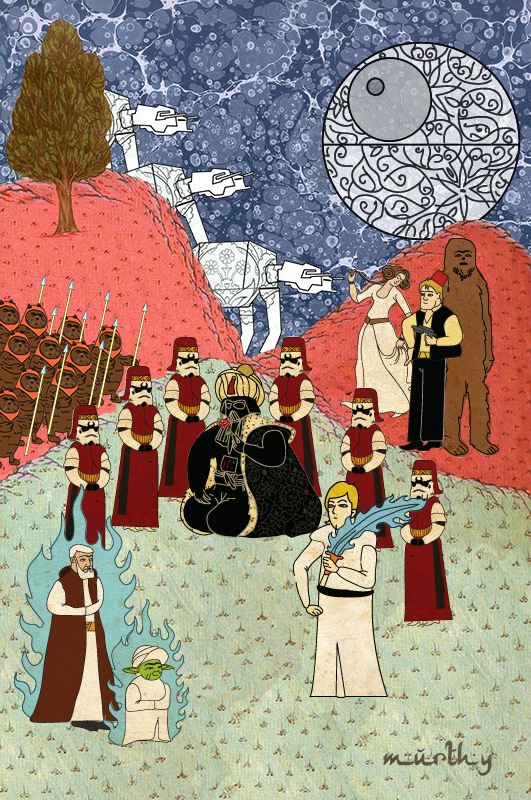
Every now and again, we like to bring you a reimagining of an old classic. Some time ago, for example, we posted about a reinvention of Star Wars: A New Hope, shot by scores of ardent fans, and spliced together from 15-second fragments. Today, we’re writing about another project that grew out of a twist on Star Wars, called Classic Movies in Miniature Style. Murat Palta, a Turkish illustrator, decided to combine a western film with the intricate two-dimensional motifs found in Ottoman miniature paintings, and got the surreal result that you see above. Pay particular attention to Han Solo’s smug grin, and Darth Vader dallying to smell the roses.
With Ottoman Star Wars having garnered high marks from his professors, and having enjoyed the project, Palta decided to keep with his theme and illustrate other iconic movies in the same style. Here are a couple of other movie posters he’s produced since:


As you probably guessed, the first depicts the final moments of Scarface (1983), where a coked-out Tony Montana rains bullets on a team of assassins who have infiltrated his lavish compound. In the second, a compendium of Godfather scenes, a regal Don Corleone listens to supplicants, as Jack Woltz, in the bottom left-hand corner, finds his prized stallion’s severed head in his bed. While the concept is clever, what really stands out in Palta’s illustrations is the level of detail, from Brando’s sour facial expression, to Tony Montana’s fez. The remainder of the posters on his website, which include The Shining, Alien, and a terrific version of A Clockwork Orange, are no less impressive.
For more of Murat Palta’s Ottoman movie posters, visit his page at Behance.net.
Ilia Blinderman is a Montreal-based culture and science writer. Follow him at @iliablinderman, or read more of his writing at the Huffington Post.
Related content:
Star Wars Retold with Paper Animation
Read More...Animated Video: Dock Ellis Throws a No-Hitter Against the Padres While Tripping on LSD (1970)
For a sport obsessed with statistical averages, baseball seems to thrive like no other on outrageous anecdotes and singular characters. One of those characters, pitcher Dock Ellis, had a drug-fueled run in the 70s with the Pittsburgh Pirates, claiming that he almost never pitched a game sober, including several National League East Championships and a 1971 World Series win. The drugs eventually became too much and he got help, but they gave Ellis his career best anecdote, the story he tells in the short film above, “Dock Ellis and the LSD No-No.” It’s animated by James Blagdon from an interview Ellis gave to Donnell Alexander and Neille Ilel that aired on NPR in March of 2008.
In June 1970, Ellis took a day off, dropped acid at the airport and, “high as a Georgia pine,” checked into a friend’s girlfriend’s house to enjoy the rest of his trip. He woke up two days later, still tripping, went to the stadium, took some stimulants—which “over 90% of the league was using,” he says—and got to work, pitching a no-hitter against the San Diego Padres. “I didn’t see the hitters,” Ellis says, “all I could tell was whether they were on the right side or left side.” Above, his colorful narration gets a full compliment of sound effects and day-glo exclamations. (We also see allusions to Ellis’ other storied antics, like appearing on the mound in curlers and beaning opposing players with fastballs.) “It was easier,” he says, “to pitch with the LSD because I was used to medicating myself.” In this instance at least, the meds were magic.
The short film premiered at Sundance and film festivals worldwide in 2010, and the Dock Ellis legend has only grown since. The same interview become part of Beyond Ellis D, a “multimedia book” for iPads developed in 2012 by Donnell Alexander and animated by Heidi Perry. (See Part 1, “Superfly Spitball,” above.) In an essay for Deadspin, Alexander laments that Ellis—an outspoken critic of racism in baseball—has been largely reduced to the LSD no-hitter, which he calls “a short take on a big life.” While it’s a hell of a good story, Alexander also sees Ellis “on a continuum with Jackie Robinson” (who advised him to tone it down), “a black ballplayer straddling the reserve-clause era and the arrival of free agency, a man who brought many of the old ways with him into baseball’s new, Day-Glo epoch.” Ellis—who died in 2008 of liver failure at age 63 after years as a drug counselor—certainly lived up to the hype. His wild life and career get a full treatment in the documentary No No, which just screened at Sundance this past month. Watch the film’s trailer below.
via The Paris Review
Related Content:
Ken Kesey’s First LSD Trip Animated
Errol Morris’ New Short Film, Team Spirit, Finds Sports Fans Loving Their Teams, Even in Death
This is What Oliver Sacks Learned on LSD and Amphetamines
Josh Jones is a writer and musician based in Durham, NC. Follow him at @jdmagness
Read More...Support Us
We're hoping to rely on loyal readers, rather than erratic ads. Please click the Donate button and support Open Culture. You can use Paypal, Venmo, Patreon, even Crypto! We thank you!

About Us

Open Culture scours the web for the best educational media. We find the free courses and audio books you need, the language lessons & educational videos you want, and plenty of enlightenment in between.
Advertise With Us

FREE UPDATES!
GET OUR DAILY EMAIL
Get the best cultural and educational resources on the web curated for you in a daily email. We never spam. Unsubscribe at any time.
FOLLOW ON SOCIAL MEDIA

Open Culture editor Dan Colman scours the web for the best educational media. He finds the free courses and audio books you need, the language lessons & movies you want, and plenty of enlightenment in between.
Advertise With Us