Patti Smith’s Cover of Nirvana’s “Smells Like Teen Spirit” Strips the Song Down to its Heart
In 2007, Kurt Cobain’s 1991 anti-anthem “Smells Like Teen Spirit” was long etched into the consciousness of every music fan, but the musical landscape had changed considerably since its release. The inevitable mass appropriation of Nirvana’s thunderous dynamics and shaggy rebellion had turned out so much bland, overproduced grunge that the sound sank into unlistenable decadence. With indie artists doing Gang of Four-like dance punk, eighties electro, and anything at all that sounded nothing like Nirvana, some—like Iron and Wine and the Decembrists—picked up banjos and fiddles and reached back even further to moody Appalachian folk.
So when punk foremother Patti Smith re-interpreted Nirvana’s era-defining classic for her ’07 covers album Twelve, she choose the latter sound, a spare country arrangement with bass, acoustic guitar, violin, banjo, and Smith’s timeless voice. No need for drums, it’s been done; what we hear instead is the essence of the song’s lyrical and melodic power.
As most songwriters will tell you, a good song should strip down to voice and guitar without losing its heart. Smith’s version of “Smells Like Teen Spirit” proves that Kurt Cobain’s songwriting stands up to the test, and the black and white video recalls Smith’s own photography. It’s a particularly Patti Smith memorial.
Loss defines so much of Smith’s late period work—of Cobain, her brother, late husband Fred “Sonic” Smith, and close friend Robert Mapplethorpe—but her commemoration of those losses has also renewed her creatively. In a way, her career revival began with a memorial to Cobain, with the song “About a Boy” from her 1996 “comeback” record Gone Again, a partial collaboration with her husband not long before his death. Watch Smith below deliver a spellbinding live performance of “About a Boy” from a June 23, 2000 concert in Seattle.
If you would like to support the mission of Open Culture, consider making a donation to our site. It’s hard to rely 100% on ads, and your contributions will help us continue providing the best free cultural and educational materials to learners everywhere. You can contribute through PayPal, Patreon, and Venmo (@openculture). Thanks!
Related Content:
Patti Smith Remembers Robert Mapplethorpe
The First Live Performance of Nirvana’s “Smells Like Teen Spirit” (1991)
Josh Jones is a writer, editor, and musician based in Washington, DC. Follow him @jdmagness
Read More...Watch The Twilight Zone’s Pilot Episode, Pitched by Rod Serling Himself (1959)
?si=HLkGT0R6EOmzwCen
Sure, creators of television’s disposable sitcoms and game shows have to sell their wares, and strenuously, to network executives. But The Twilight Zone? How could such an innovative, influential televisual institution have ever needed to push its way past gatekeepers? Yet watch the series’ 1959 pilot above, and, before that even starts, you’ll see creator Rod Serling himself make his pitch: “You gentlemen, of course, know how to push a product. My presence here is for much the same purpose: simply to push a product. To acquaint you with an entertainment product which we hope, and which we rather expect, would make your product-pushing that much easier. What you’re about to see, gentlemen, is a series called The Twilight Zone. We think it’s a rather special kind of series.” And how.
As the quintessential late-night, black-and-white plunge into the speculative, the bizarre, the moralistic, and the simply eerie, The Twilight Zone continues to captivate viewers—nowadays often, no doubt, YouTube viewers—born generations after the end of its run. The pilot episode, “Where is Everybody?” sets the tone by following a lone, bewildered man through a mysteriously empty town, seemingly abandoned moments ago. But before that rolls, Serling tantalizes the bosses with descriptions of other tales then in production: a man stuck on an asteroid with a robot, an immortal sentenced to life imprisonment, and a milquetoast mistaken for the fastest gun in the old west. Not for nothing did Serling build a reputation as an auteur of human loneliness. But that would come later. “Mr. Serling should not have much trouble in making his mark,” wrote the New York Times’ critic when the show first aired. “At least his series promises to be different.”
If you would like to support the mission of Open Culture, consider making a donation to our site. It’s hard to rely 100% on ads, and your contributions will help us continue providing the best free cultural and educational materials to learners everywhere. You can contribute through PayPal, Patreon, and Venmo (@openculture). Thanks!
Related content:
Rod Serling: Where Do Ideas Come From?
Colin Marshall hosts and produces Notebook on Cities and Culture and writes essays on literature, film, cities, Asia, and aesthetics. He’s at work on a book about Los Angeles, A Los Angeles Primer. Follow him on Twitter at @colinmarshall.
Read More...The Poetry of Abraham Lincoln
It should surprise few to learn that Abraham Lincoln wrote poetry. But this fact about his life is dwarfed by those events that defined his political legacy, and this is also no surprise. Nevertheless, in the midst of the current Lincoln revival, the man and the statesman, I think it’s fitting to attend to Abraham Lincoln the poet. Certainly scholars have read his poetry in relation to his skillful prose and oratory. But, on its own, this writing gives us insight into the sensitivity of Lincoln’s less public modes of expression.
Was he a great poet? Well, it appears that he had at least three phases—the first, a youthful one in his teens and early twenties when he produced some silly juvenelia, “a number of crude and satirical verses.” The most popular of these is called “Chronicles of Reuben,” a local satire Lincoln scholar Robert Bray describes as “a series of pseudo-biblical prose and verse pieces that are, out of their local Indiana context, so topical as to be neither funny nor comprehensible.” The piece, written in 1828 to avenge himself upon a rival Indiana family, apparently had great effect on the neighbors, however. One of them, Joseph C. Richardson, claimed that the poem was “remembered here in Indiana in scraps better than the Bible.”
We have to credit frontier oral tradition for our knowledge of some of Lincoln’s more serious poems in his second phase, after he joined “a Kind of Poetical Society” in Illinois sometime between 1837–39. One neighbor, James Matheny, remembered the following worldly lines from a Lincoln poem called “On Seduction”:
Whatever Spiteful fools may Say—
Each jealous, ranting yelper—
No woman ever played the whore
Unless She had a man to help her.
If this is truly a stanza from Lincoln’s pen, the satirist is still very much in evidence—Swift could have written these lines—but the self-described “prairie lawyer” has grown philosophical and left the adolescent boundaries of local feuds and pranks.
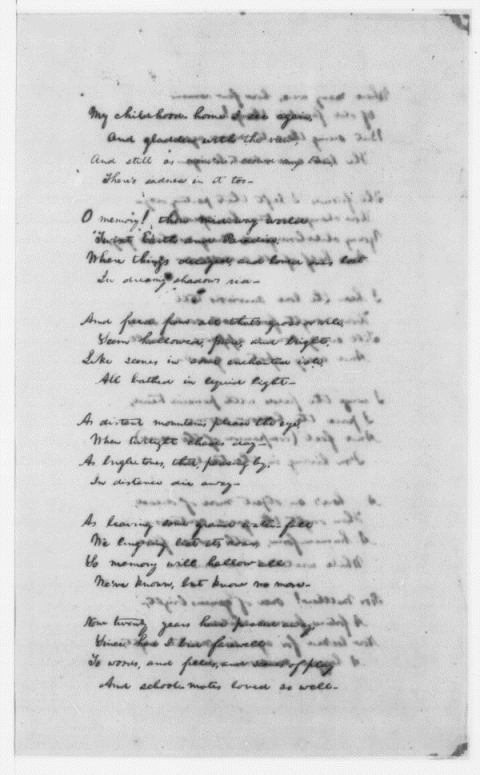
His third, most serious phase begins when Lincoln returned to Indiana, after leaving Illinois briefly in an attempt to help Henry Clay’s failed presidential bid against James Polk. Lincoln called Indiana “as unpoetical as any spot of the earth,” and yet it serves as a subject for a poem completed in 1846 called “My Childhood Home I See Again.” (The image above is of the first six stanzas of this long poem in Lincoln’s handwriting. Click here to see the remaining pages). Here in the first two stanzas (below), you can see the cutting wit of the younger, more confident man give way to a kind of wistful nostalgia worthy of Wordsworth:
My child-hood home I see again,
And gladden with the view;
And still as mem’ries crowd my brain,
There’s sadness in it too–
O memory! thou mid-way world
‘Twixt Earth and Paradise;
Where things decayed, and loved ones lost
In dreamy shadows rise–
You can read a complete transcript of the poem here, and the Library of Congress has a detailed description of the poem’s stages of composition.
Lincoln-as-poet continued in this thoughtful, mature voice in the remaining years of his life, though never equaling the poetic output of 1846. Somewhat out of character, the final documented piece of poetry from Lincoln comes from July 19, 1863. Written in response to the North’s victory in Gettysburg, “Verse on Lee’s Invasion of the North” is a short piece of doggerel that sees him returning to satire, writing in the voice of “Gen. Lee”:
Gen. Lee’s invasion of the North written by himself—
In eighteen sixty three, with pomp,
and mighty swell,
Me and Jeff’s Confederacy, went
forth to sack Phil-del,
The Yankees they got arter us, and
giv us particular hell,
And we skedaddled back again,
And didn’t sack Phil-del.
Surely the poem was written in a hurry, and with jubilant, triumphal glee, but if this is the last we heard from Lincoln the poet, it might be a shame, though it would not blot out the literary skill of poems like “My Childhood Home I See Again” and others like “The Bear Hunt” and “To Rosa,” which you can read here.
But there’s more to this story; in 2004, a historian discovered an unsigned poem called “The Suicide’s Soliloquy”—published in the August 25, 1838 issue of the Sangamo Journal, a Springfield newspaper—and believed the former president to be the poet. In the video above, listen to a moody, dramatic reading of the poem:
It is not known with certainty if Lincoln wrote this poem, but scholarly consensus inclines heavily in that direction, given its stylistic similarity to his other work from this period. “The Suicide’s Soliloquy” is as passionate and morbid as any of Edgar Allen Poe’s verse, and betrays Lincoln’s characteristic melancholy in its stormiest and most Romantic guise. NPR has the full poem and the story of its discovery.
Related Content:
Resurrecting the Sounds of Abraham Lincoln in Steven Spielberg’s New Biopic
The Last Surviving Witness of the Lincoln Assassination
Louis CK Plays Abraham Lincoln, America’s 16th President and (Yes) Stand-Up Comedian Too
Josh Jones is a writer, editor, and musician based in Washington, DC. Follow him @jdmagness
Read More...The Only Known Footage of George Orwell (Circa 1921)
?t=49s
Although he died in 1950, George Orwell seemingly escaped the reach of modern media. Orwell’s voice was never captured on audio. And his image never appeared on film. Historians and literature scholars lamented this for decades.
But then, in 2003, on the hundredth anniversary of Orwell’s birth, two researchers stumbled upon a tantalizing piece of footage in the The Pathay Film Library in London. The very brief footage — watch in full here, or at the 50 second mark in the video above — shows an 18-year-old Orwell, then named Eric Blair, marching across a sports field at Eton College, where he spent his formative years and studied French with Aldous Huxley. In the line of marching students, Orwell is the fourth student from the left.
Note: the video above comes from a British Pathe clip that features celebrities before they became famous. If you’re curious who appears in the film, see the list below the jump.
Read More...Physical Attraction: Marriage Proposal Comes in the Form of a Physics Paper
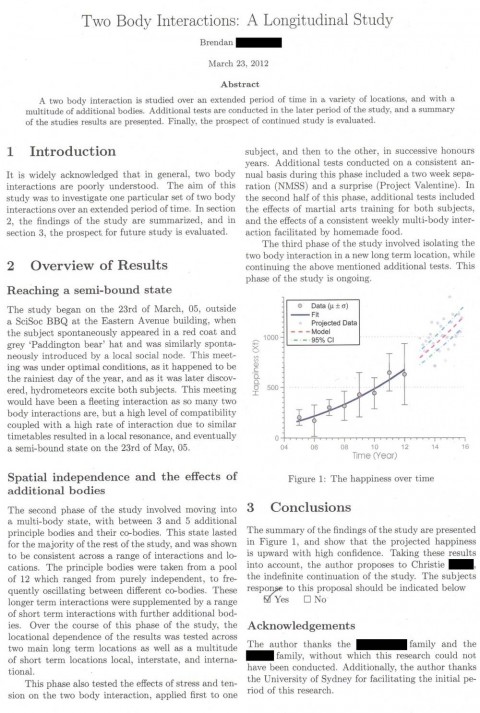
On reddit, a user wrote yesterday, “My boyfriend of 7 years and I are both physicists. Here’s how he proposed to me.” Yes, the marriage proposal is a physics paper of sorts, called “Two Body Interactions: A Longitudinal Study,” that concludes:
The summary of the findings of the study are presented in Figure 1 and that that the project happiness is upward with high confidence. Taking these results into account, the author proposes to Christie the indefinite continuation of the study. The subjects response to their proposal should be indicated below [by checking the “Yes” or “No” box].
Brendan McMonigal and Christie Nelan (pictured here) met at the University of Sydney seven years ago. They will tie the knot this coming May, and we hope you’ll wish them the best.…
via BoingBoing and @stevesilberman
Read More...Seven Tips From F. Scott Fitzgerald on How to Write Fiction
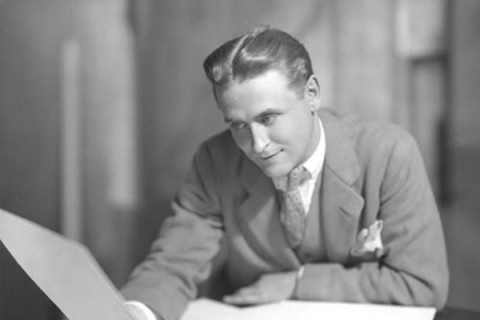
F. Scott Fitzgerald is often portrayed as a natural-born writer. “His talent,” says Ernest Hemingway in A Moveable Feast, “was as natural as the pattern that was made by the dust on a butterfly’s wings.” But Fitzgerald saw himself in a different light. “What little I’ve accomplished,” he said, “has been by the most laborious and uphill work.”
Last week we brought you Seven Tips From Ernest Hemingway on How to Write Fiction. Today we’re back with a similar list of advice from Hemingway’s friend and rival Fitzgerald. We’ve selected seven quotations from F. Scott Fitzgerald on Writing, which was edited by Larry W. Phillips and published in 1985 as a companion to the Hemingway book. As in the previous post, we’ve organized the advice under our own headings and added some brief commentary.
1: Start by taking notes.
Fitzgerald made a habit of recording his stray thoughts and observations in notebooks. He organized the entries into categories like “Feelings and emotions,” “Conversations and things overheard” and “Descriptions of girls.” When Fitzgerald was giving writing advice to his mistress Sheilah Graham in the late 1930s, he advised her to do the same. In her 1940 memoir, Beloved Infidel, Graham quotes Fitzgerald as saying:
You must begin by making notes. You may have to make notes for years.… When you think of something, when you recall something, put it where it belongs. Put it down when you think of it. You may never recapture it quite as vividly the second time.
2: Make a detailed outline of your story.
When Fitzgerald was working on a novel, he would surround himself with charts outlining the various movements and histories of his characters. In a 1936 letter to novelist John O’Hara, he advises the younger novelist to start with a big outline:
Invent a system Zolaesque…but buy a file. On the first page of the file put down an outline of a novel of your times enormous in scale (don’t worry, it will contract by itself) and work on the plan for two months. Take the central point of the file as your big climax and follow your plan backward and forward from that for another three months. Then draw up something as complicated as a continuity from what you have and set yourself a schedule.
3: Don’t describe your work-in-progress to anyone.
Fitzgerald’s policy was never to talk with other people about the book he was working on. In a 1940 letter to his daughter Scottie, he says:
I think it’s a pretty good rule not to tell what a thing is about until it’s finished. If you do you always seem to lose some of it. It never quite belongs to you so much again.
4: Create people, not types.
Fitzgerald was known for creating emblematic characters, but he said it was accidental. “I had no idea of originating an American flapper when I first began to write,” he said in a 1923 interview for Metropolitan magazine. “I simply took girls who I knew very well and, because they interested me as unique human beings, I used them for my heroines.” In the opening sentence of his 1926 short story, “The Rich Boy,” Fitzgerald explains the principle:
Begin with an individual, and before you know it you find that you have created a type; begin with a type, and you find that you have created–nothing.
5: Use familiar words.
In a 1929 letter to his college friend and fellow writer John Peale Bishop, Fitzgerald says:
You ought never to use an unfamiliar word unless you’ve had to search for it to express a delicate shade–where in effect you have recreated it. This is a damn good prose rule I think.… Exceptions: (a) need to avoid repetition (b) need of rhythm © etc.
6: Use verbs, not adjectives, to keep your sentences moving.
In a 1938 letter to his daughter, Fitzgerald writes:
About adjectives: all fine prose is based on the verbs carrying the sentences. They make sentences move. Probably the finest technical poem in English is Keats’ “Eve of Saint Agnes.” A line like “The hare limped trembling through the frozen grass,” is so alive that you race through it, scarcely noticing it, yet it has colored the whole poem with its movement–the limping, trembling and freezing is going on before your own eyes.
7: Be ruthless.
A writer has to make some hard choices. Fitzgerald warns about the danger of becoming too attached to something you’ve written. Keep an objective eye on the whole piece, he says, and if something isn’t working get rid of it. In a 1933 Saturday Evening Post article titled “One Hundred False Starts,” he writes:
I am alone in the privacy of my faded blue room with my sick cat, the bare February branches waving at the window, an ironic paper weight that says Business is Good, a New England conscience–developed in Minnesota–and my greatest problem:
“Shall I run it out? Or shall I turn back?”
Shall I say:
“I know I had something to prove, and it may develop farther along in the story?”
Or:
“This is just bullheadedness. Better throw it away and start over.”
The latter is one of the most difficult decisions that an author must make. To make it philosophically, before he has exhausted himself in a hundred-hour effort to resuscitate a corpse or disentangle innumerable wet snarls, is a test of whether or not he is really a professional. There are often occasions when such a decision is doubly difficult. In the last stages of a novel, for instance, where there is no question of junking the whole, but when an entire favorite character has to be hauled out by the heels, screeching, and dragging half a dozen good scenes with him.
Related content:
Seven Tips From Ernest Hemingway on How to Write Fiction
Rare Footage of Scott and Zelda Fitzgerald From the 1920s
Winter Dreams: F.Scott Fitzgerald’s Life Remembered in a Fine Film
F. Scott Fitzgerald Reads From Shakespeare’s Othello and John Masefield’s ‘On Growing Old’ (c.1940)
Read More...Édith Piaf’s Moving Performance of ‘La Vie en Rose’ on French TV, 1954
Édith Piaf’s life was anything but rosy. Born in a Parisian slum, she was abandoned by her mother and lived for awhile in a brothel run by her grandmother. As a teenager she sang on the streets for money. She was addicted to alcohol and drugs for much of her life, and her later years were marred by chronic pain. Through it all, Piaf managed to hold onto a basically optimistic view of life. She sang with a lyrical abandon that seemed to transcend the pain and sorrow of living.
On April 3, 1954 Piaf was the guest of honor on the French TV show La Joie de Vivre. She was 38 years old but looked much older. She had recently undergone a grueling series of “aversion therapy” treatments for alcoholism, and was by that time in the habit of taking morphine before going onstage. Cortisone treatments for arthritis made the usually wire-thin singer look puffy. But when Piaf launches into her signature song, “La Vie en Rose” (see above), all of that is left behind.
Nine years after this performance, when Piaf died, her friend Jean Cocteau said of her: “Like all those who live on courage, she didn’t think about death–she defied it. Only her voice remains, that splendid voice like black velvet.”
Follow Open Culture on Facebook and Twitter and share intelligent media with your friends. Or better yet, sign up for our daily email and get a daily dose of Open Culture in your inbox. And if you want to make sure that our posts definitely appear in your Facebook newsfeed, just follow these simple steps.
Read More...33 Oscar-Winning Films Online
http://youtu.be/euh0kEU20V4?t=10s
Personally, I’d rather watch a good movie than an awards show about good movies. If you’re like me, then consider spending tonight watching a long list of Oscar-winning films on the web. 33 films, to be precise. The list includes many great short films, animated films, documentaries, and a few feature-length movies. We start you off above with Why Man Creates, the classic animated film by Saul Bass and his wife/collaborator Elaine, which won the 1968 Academy Award for Documentary Short Subject. You can get the full list of Academy Award winners on the web here. And don’t forget to peruse our ever-growing list of 500 Free Movies Online. It’ll keep you busy for weeks, if not months.
Please follow us on Facebook, Twitter and Google Plus and share intelligent media with your friends! They’ll thank you for it.
Read More...Richard Dawkins Dies (Not Really) and Meets His Maker in a New NSFW Animation
When Christopher Hitchens died, it didn’t take long for humorists to imagine the comic scenario: what happens when the surly atheist comes face to face with God? It’s amusing to consider. And when it comes to Richard Dawkins, the humorists aren’t waiting for the biologist’s demise to play things out. In Kevin Breen’s South Park-style tribute, Dawkins arrives at the Gates of Heaven, only to discover that God exists after all. When the “Man in the Sky Who Saves America, Blesses the Queen” asks Dawkins for his reaction, the author of The God Delusion gives him an earful. The strident language is pure Dawkins. Actually, his lines are sound bites taken from recent Dawkins speeches. In 2006, a student famously asked Dawkins “What If You’re Wrong [About the Existence of God], and the Oxford biologist replied with lines that sound familiar.
In this clip, critics will find another reason not to like Dawkins; fans will find another reason to adore him. But, what did Richard Dawkins think? “Fun!,” he wrote, as he posted it to his Facebook page.
Note: This video contains some strong language. It’s basically NSFW.
Related Content:
Alan Watts and His Zen Wisdom Animated by Creators of South Park
Christopher Hitchens: No Deathbed Conversion for Me, Thanks, But it was Good of You to Ask
Read More...Bertolt Brecht Sings ‘Mack the Knife’ From The Threepenny Opera, 1929
Bertolt Brecht wasn’t much of a singer, but he could really roll his “r“s. This rare recording of the socialist playwright singing “Mack the Knife” was made in May of 1929, less than a year after the smash-hit premiere of The Threepenny Opera.
The song, called in German “Die Moritat von Mackie Messer,” was written in a rush only a few days before the August 31, 1928 Berlin premiere, after the actor who played Macheath complained that his entrance wasn’t grand enough. Brecht wrote the words overnight and asked his collaborator, the composer Kurt Weill, to set them to music. The song is modeled after the Moritat (from “mord” meaning murder and “tat” meaning deed), a kind of medieval ballad traditionally sung by traveling minstrels recounting the crimes of notorious murderers. An English translation begins:
See the shark with teeth like razors.
All can read his open face.
And Macheath has got a knife, but
Not in such an obvious place.
See the shark, how red his fins are
As he slashes at his prey.
Mack the Knife wears white kid gloves which
Give the minimum away.
Brecht’s gritty 1929 recording of the song is consistent with the ragged aesthetic of the original production of The Threepenny Opera, with its intentionally threadbare sets and its cast of actors who were not accomplished singers. Although Weill was the one who wrote the score, Brecht personally enjoyed playing music. The actress Lotte Lenya, who played Jenny in the original production, remembered how Brecht would strum his guitar and sing ballads “amateurishly but with an odd magnetism.” Besides “Mack the Knife,” there is also a recording from the same 1929 session of Brecht singing a lesser-known piece from The Threepenny Opera, “Song of the Insufficiency of Human Endeavor.” You can listen to that one by clicking here.
Related content:
Bertolt Brecht Testifies Before the House Un-American Activities Committee (1947)
Read More...Support Us
We're hoping to rely on loyal readers, rather than erratic ads. Please click the Donate button and support Open Culture. You can use Paypal, Venmo, Patreon, even Crypto! We thank you!

About Us

Open Culture scours the web for the best educational media. We find the free courses and audio books you need, the language lessons & educational videos you want, and plenty of enlightenment in between.
Advertise With Us

FREE UPDATES!
GET OUR DAILY EMAIL
Get the best cultural and educational resources on the web curated for you in a daily email. We never spam. Unsubscribe at any time.
FOLLOW ON SOCIAL MEDIA

Open Culture editor Dan Colman scours the web for the best educational media. He finds the free courses and audio books you need, the language lessons & movies you want, and plenty of enlightenment in between.
Advertise With Us

