Seven Tips From Ernest Hemingway on How to Write Fiction
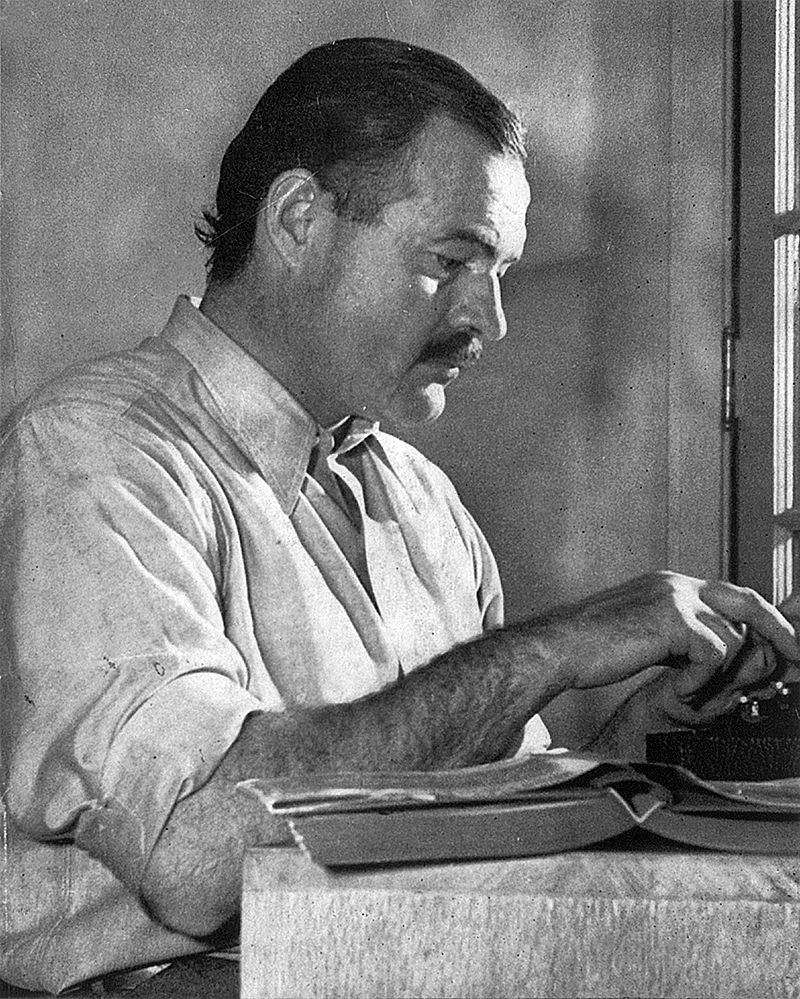
Image by Lloyd Arnold via Wikimedia Commons
Before he was a big game hunter, before he was a deep-sea fisherman, Ernest Hemingway was a craftsman who would rise very early in the morning and write. His best stories are masterpieces of the modern era, and his prose style is one of the most influential of the 20th century.
Hemingway never wrote a treatise on the art of writing fiction. He did, however, leave behind a great many passages in letters, articles and books with opinions and advice on writing. Some of the best of those were assembled in 1984 by Larry W. Phillips into a book, Ernest Hemingway on Writing. We’ve selected seven of our favorite quotations from the book and placed them, along with our own commentary, on this page. We hope you will all–writers and readers alike–find them fascinating.
1: To get started, write one true sentence.
Hemingway had a simple trick for overcoming writer’s block. In a memorable passage in A Moveable Feast, he writes:
Sometimes when I was starting a new story and I could not get it going, I would sit in front of the fire and squeeze the peel of the little oranges into the edge of the flame and watch the sputter of blue that they made. I would stand and look out over the roofs of Paris and think, “Do not worry. You have always written before and you will write now. All you have to do is write one true sentence. Write the truest sentence that you know.” So finally I would write one true sentence, and then go on from there. It was easy then because there was always one true sentence that I knew or had seen or had heard someone say. If I started to write elaborately, or like someone introducing or presenting something, I found that I could cut that scrollwork or ornament out and throw it away and start with the first true simple declarative sentence I had written.
2: Always stop for the day while you still know what will happen next.
There is a difference between stopping and foundering. To make steady progress, having a daily word-count quota was far less important to Hemingway than making sure he never emptied the well of his imagination. In an October 1935 article in Esquire ( “Monologue to the Maestro: A High Seas Letter”) Hemingway offers this advice to a young writer:
The best way is always to stop when you are going good and when you know what will happen next. If you do that every day when you are writing a novel you will never be stuck. That is the most valuable thing I can tell you so try to remember it.
3: Never think about the story when you’re not working.
Building on his previous advice, Hemingway says never to think about a story you are working on before you begin again the next day. “That way your subconscious will work on it all the time,” he writes in the Esquire piece. “But if you think about it consciously or worry about it you will kill it and your brain will be tired before you start.” He goes into more detail in A Moveable Feast:
When I was writing, it was necessary for me to read after I had written. If you kept thinking about it, you would lose the thing you were writing before you could go on with it the next day. It was necessary to get exercise, to be tired in the body, and it was very good to make love with whom you loved. That was better than anything. But afterwards, when you were empty, it was necessary to read in order not to think or worry about your work until you could do it again. I had learned already never to empty the well of my writing, but always to stop when there was still something there in the deep part of the well, and let it refill at night from the springs that fed it.
4: When it’s time to work again, always start by reading what you’ve written so far.
T0 maintain continuity, Hemingway made a habit of reading over what he had already written before going further. In the 1935 Esquire article, he writes:
The best way is to read it all every day from the start, correcting as you go along, then go on from where you stopped the day before. When it gets so long that you can’t do this every day read back two or three chapters each day; then each week read it all from the start. That’s how you make it all of one piece.
5: Don’t describe an emotion–make it.
Close observation of life is critical to good writing, said Hemingway. The key is to not only watch and listen closely to external events, but to also notice any emotion stirred in you by the events and then trace back and identify precisely what it was that caused the emotion. If you can identify the concrete action or sensation that caused the emotion and present it accurately and fully rounded in your story, your readers should feel the same emotion. In Death in the Afternoon, Hemingway writes about his early struggle to master this:
I was trying to write then and I found the greatest difficulty, aside from knowing truly what you really felt, rather than what you were supposed to feel, and had been taught to feel, was to put down what really happened in action; what the actual things were which produced the emotion that you experienced. In writing for a newspaper you told what happened and, with one trick and another, you communicated the emotion aided by the element of timeliness which gives a certain emotion to any account of something that has happened on that day; but the real thing, the sequence of motion and fact which made the emotion and which would be as valid in a year or in ten years or, with luck and if you stated it purely enough, always, was beyond me and I was working very hard to get it.
6: Use a pencil.
Hemingway often used a typewriter when composing letters or magazine pieces, but for serious work he preferred a pencil. In the Esquire article (which shows signs of having been written on a typewriter) Hemingway says:
When you start to write you get all the kick and the reader gets none. So you might as well use a typewriter because it is that much easier and you enjoy it that much more. After you learn to write your whole object is to convey everything, every sensation, sight, feeling, place and emotion to the reader. To do this you have to work over what you write. If you write with a pencil you get three different sights at it to see if the reader is getting what you want him to. First when you read it over; then when it is typed you get another chance to improve it, and again in the proof. Writing it first in pencil gives you one-third more chance to improve it. That is .333 which is a damned good average for a hitter. It also keeps it fluid longer so you can better it easier.
7: Be Brief.
Hemingway was contemptuous of writers who, as he put it, “never learned how to say no to a typewriter.” In a 1945 letter to his editor, Maxwell Perkins, Hemingway writes:
It wasn’t by accident that the Gettysburg address was so short. The laws of prose writing are as immutable as those of flight, of mathematics, of physics.
If you would like to support the mission of Open Culture, consider making a donation to our site. It’s hard to rely 100% on ads, and your contributions will help us continue providing the best free cultural and educational materials to learners everywhere. You can contribute through PayPal, Patreon, and Venmo (@openculture). Thanks!
Related content:
Writing Tips by Henry Miller, Elmore Leonard, Margaret Atwood, Neil Gaiman & George Orwell
The Big Ernest Hemingway Photo Gallery: The Novelist in Cuba, Spain, Africa and Beyond
The Spanish Earth, Written and Narrated by Ernest Hemingway
Archive of Hemingway’s Newspaper Reporting Reveals Novelist in the Making
Find Courses on Hemingway and Other Authors in our big list of Free Online Courses
Read More...Mark Twain Shirtless in 1883 Photo
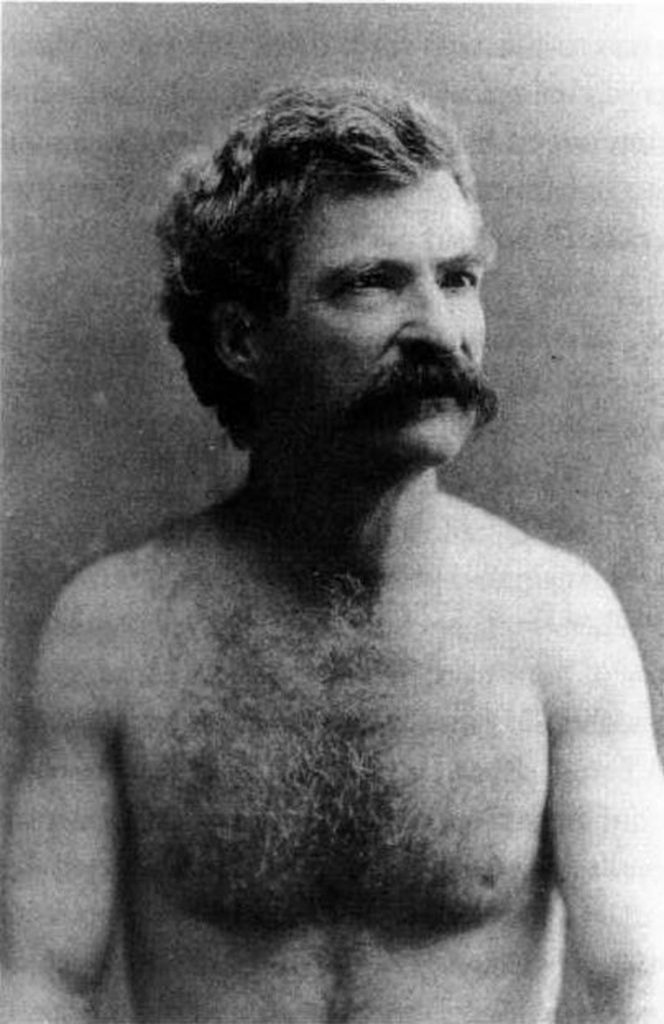
Last year, Edwin Turner, the mastermind behind the Biblioklept blog, assembled a fine photo gallery that captured Ernest Hemingway posing shirtless. Big, burly and barrel-chested, Papa projects the masculine image that he carefully cultivated for himself and for the world to see.
Hemingway’s photos seem right in keeping with his public persona (we’ll have more on him later today). But this 1883 portrait of Mark Twain will perhaps give you pause. To be sure, Twain cared deeply about his public image. The writer carefully crafted his public identity, giving more than 300 interviews to journalists where he reinforced the traits he wanted to be known for — his wit, irreverent sense of humor, and thoughtfulness. Twain also loved having his picture taken, posing for photographers whenever he had a chance. The camera offered yet another way to fashion his own personal myth.
Of course, the author is best remembered for one set of iconic images — the one where he dons a white suit in 1906, upon traveling to Washington D.C. to lobby for the protection of authors’ copyrights. But, as The Routledge Encyclopedia of Mark Twain explains, the novelist also let his image be used in countless advertisements — in ads for restaurants, pharmacies, dry goods and cigars too. The encyclopedia gives the impression that the shirtless photo was perhaps taken within this commercial context. It’s not clear what product the portrait helped market (care to take a guess?), or precisely how Twain saw it contributing to his public image. The details are murky. But one thing is for certain: The 1880s image is authentic. It’s the real shirtless Mark Twain.
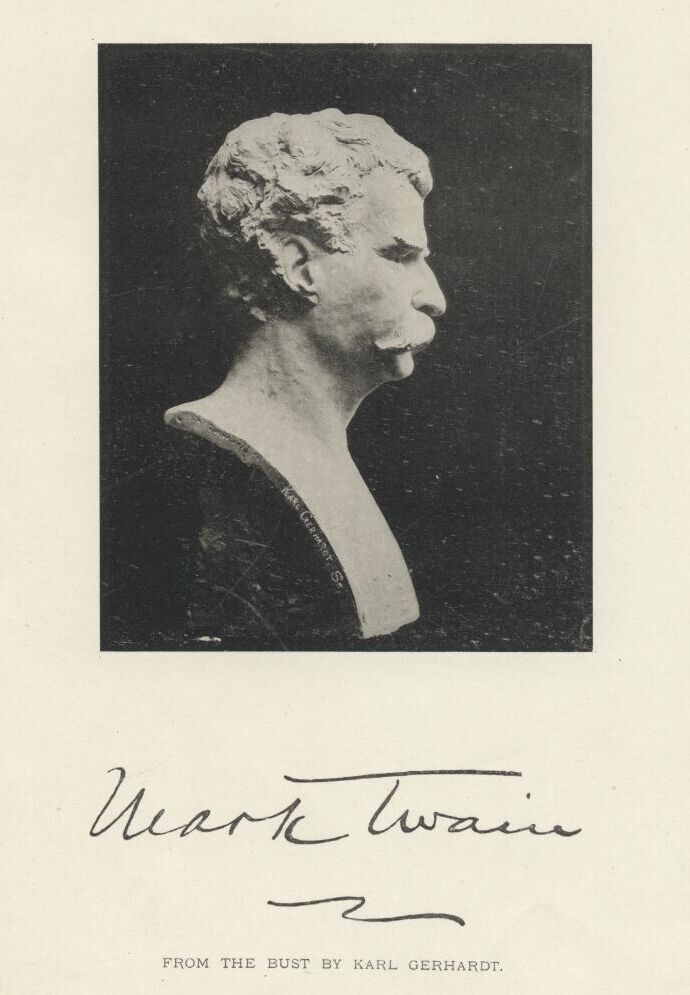
Update: One of our readers suggests that the shirtless photo was a byproduct of a bust that was sculpted by Karl Gerhardt for the frontispiece of Adventures of Huckleberry Finn. Seems quite plausible. See it here.
This vintage pic comes to us via Wired writer Steve Silberman. Follow him on Twitter at @stevesilberman.
Read More...“Nothing Good Gets Away”: John Steinbeck Offers Love Advice in a Letter to His Son (1958)
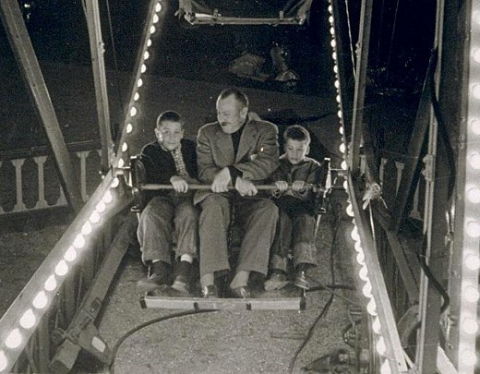
Certain readers may turn, for general solace, to the novels of John Steinbeck. But how many, in particular need of romantic advice, open up Of Mice and Men, East of Eden, or The Grapes of Wrath? Yet on matters of the heart, Steinbeck knew of what he spoke, as his son Thom found out after mentioning a new school sweetheart in a note home. In what must surely count as the most eloquent, relevant piece of unsolicited parental love advice ever given—not, admittedly, a high bar to cross—the formidable man of American letters explained how best to navigate this richest of all experiences:
First—if you are in love—that’s a good thing—that’s about the best thing that can happen to anyone. Don’t let anyone make it small or light to you.
Second—There are several kinds of love. One is a selfish, mean, grasping, egotistical thing which uses love for self-importance. This is the ugly and crippling kind. The other is an outpouring of everything good in you—of kindness and consideration and respect—not only the social respect of manners but the greater respect which is recognition of another person as unique and valuable. The first kind can make you sick and small and weak but the second can release in you strength, and courage and goodness and even wisdom you didn’t know you had.
This excerpt comes from a full text available at a favorite site of ours, Letters of Note. One of the internet’s finest repositories of man’s wisdom and folly, Letters of Note has offered William Faulkner’s take-this-job-and-shove-it, a young Kurt Vonnegut’s wartime report home after his release from a Dresden work camp, the first American fan letter sent to David Bowie, and Aldous Huxley’s death as described by his widow. My personal favorite remains the simultaneously astute and unhinged lament Ted Turner received from his father after changing his college major to classics. Turner père wrote, in his askew fashion, in the same spirit of fatherly support as Steinbeck. But Ted didn’t get to read any lines half as reassuring as those Thom Steinbeck did: “Don’t worry about losing,” his father advised. “If it is right, it happens—The main thing is not to hurry. Nothing good gets away.”
Related content:
John Steinbeck’s Six Tips for the Aspiring Writer and His Nobel Prize Speech
This is Your Brain in Love: Scenes from the Stanford Love Competition
Face to Face with Bertrand Russell: ‘Love is Wise, Hatred is Foolish’
Colin Marshall hosts and produces Notebook on Cities and Culture and writes essays on literature, film, cities, Asia, and aesthetics. He’s at work on a book about Los Angeles, A Los Angeles Primer. Follow him on Twitter at @colinmarshall.
Read More...The BBC Presents a New Dramatization of Orwell’s 1984, with Christopher Eccleston as Winston Smith
Like the idea of totalitarianism, perhaps best articulated by Hannah Arendt in her post-war Origins of Totalitarianism, George Orwell’s post-war scrutiny of repressive governments has become a staple, catch-all reference for pundits on either side of the political spectrum, particularly the concepts of doublespeak, doublethink, historical revisionism, and the hyper-intrusive Big Brother, all from the 1949 novel 1984. In fact, few adjectives seem to get deployed with more frequency in urgent political discourse of all kinds than “Orwellian.” But the name George Orwell, pen name of journalist Eric Blair, hides an enigma: Orwell identified himself explicitly as a Democratic Socialist of a particularly English bent (most notably in his essay “The Lion and the Unicorn”), but his scathing critiques of nearly every existing institution sometimes make it hard to pin him down as a partisan of anything but the kind of freedom and openness that everyone vaguely wants to advocate. That ambiguity is a strength; despite his steadfast leftist roots, Orwell would not be a partisan hack—where he saw stupidity, avarice, and brutal inhumanity, he called it out, no matter the source.
The seeming contradictions and ironies that permeate Orwell’s thought and fiction are also what keep his work perennially interesting and worth rereading and revisiting. He was a probing and unsentimental critic of the motives of propagandists of all stripes, both left and right. Beginning in late January, BBC Radio 4 launched a month-long series on Orwell, with the avowedly ironic name, “The Real George Orwell.” Part of the irony comes from the fact that Orwell (or Blair) once worked as a propagandist for the BBC during WWII, and later based the torture area in 1984, Room 101, on a meeting room he recalled from his time there. His experiences with the state broadcasting network were not pleasant in his memory. Nonetheless, his former employer honors him this month with an extensive retrospective, including readings and dramatizations of his essays and journalism, his semi-autobiographical accounts Down and Out in Paris and London and Homage to Catalonia, and his novels Animal Farm and 1984.
In this latest dramatization of Orwell’s most famous novel, protagonist Winston Smith is voiced by actor Christopher Eccleston, who has inhabited another key post-war character in English fiction, Dr. Who (Pippa Nixon voices Julia). In a brief discussion of what he takes away from the novel, Eccleston (above) draws out some of the reasons that 1984 appeals to so many people who might agree on almost nothing else. At the heart of the novel is the kind of humanist individualism that Orwell never abandoned and that he championed against Soviet-style state communism and hard-right imperialist authoritarianism both. Winston Smith is an embodiment of human dignity, celebrated for his struggle to “love, remember, and enjoy life,” as Eccleston says. “It’s the human story that means that we keep coming back to it and that keeps it relevant.” Listen to a brief clip of the 1984 dramatization at the top of this post, and visit BBC Radio 4’s site to hear parts one and two of the full broadcast, which is available online for the next year. When Europe and America both seem rent in two by competing and incompatible social and political visions, it’s at least some comfort to know that no one wants to live in the world Orwell foresaw. Despite his novel’s deeply pessimistic ending, Orwell’s own career of fierce resistance to oppressive regimes offers a model for action against the dystopian future he imagined.
For other free, online readings of Orwell’s work, you can visit our archives of Free Audio Books, where you’ll find
- 1984 – Free MP3 Zip File – Multiple Versions
- Free eBook available here.
- Animal Farm – Free MP3 Zip File – Free iTunes
- Free eBook available here.
- Homage to Catalonia – Chapter 1 here – Remaining Chapters here
Related Content:
Aldous Huxley Reads Dramatized Version of Brave New World
Free: Isaac Asimov’s Epic Foundation Trilogy Dramatized in Classic Audio
Also find major works by Orwell in our collection of Free eBooks
Josh Jones is a writer, editor, and musician based in Washington, DC. Follow him @jdmagness
Read More...“PoemTalk” Podcast, Where Impresario Al Filreis Hosts Lively Chats on Modern Poetry
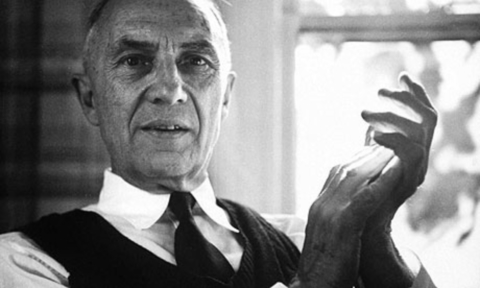
Want to know what’s going on the poetry world? Ask University of Pennsylvania professor Al Filreis. A national treasure for modern American poetry, Filreis serves as Faculty Director of the Kelly Writers House, Director of UPenn’s Center for Programs in Contemporary Writing, and Co-Director of the excellent poetry recording series and archive PennSound. He also teaches a Coursera massive open online course, “ModPo,” which has reached over 36,000 students, bringing his thirty years of seminar-style teaching experience to the masses. On top of all that, Filreis is the publisher of contemporary poetry webzine Jacket 2, which hosts a podcast called “PoemTalk.”
“PoemTalk” brings together poets, writers, and teachers to informally discuss a single poem. Like Filreis’ classes—in which he prefers lively discussions over long lectures—these seminar-like sessions involve a lot of friendly disagreement and serendipitous insights, with many pearls of poetic wisdom scattered throughout. The first episode of “PoemTalk” (above), from December 2007, took on William Carlos Williams’ fragmentary modernist provocation “Between Walls”:
Between Walls
the back wings
of the
hospital where
nothing
will grow lie
cinders
in which shine
the broken
pieces of a green
bottle
If you don’t see much in this little imagist exercise, you might just want to read it again, several times, after listening to Filreis, Saigon-born poet Linh Dinh, teacher and poet Randall Couch, and poet Jessica Lowenthal unpack the poem’s many resonances and reflections. (Or you might have had your fill by then). Williams’ approach was completely innovative, stripping all of the rhetorical excesses from American poetry, which suffered from a kind of Victorian hangover into the first decades of the twentieth century until those nasty modernists finished roughing it up. As the episode’s page points out, “‘Between Walls’ has had a huge influence on poetry and photography since its first publication in 1934.” Listen to the discussion above to find out why such a seemingly straightforwardly unsentimental, un-“poetic” piece of writing had such an impact.
Since this inaugural episode, “PoemTalk” has covered several dozen contemporary, living poets, as well as such notables as Ezra Pound, John Ashbery, Adrienne Rich, Allen Ginsberg, and Wallace Stevens. By the way, as an added bonus, all of the poems discussed on “PoemTalk” are available as audio recordings on PennSound, read by the poets themselves. Here’s Williams reading “Between Walls.”
“PoemTalk”’s most recent episode takes as its text Charles Alexander’s “Near or Random Acts.” You can listen through the website or subscribe on iTunes.
Related Content:
William Carlos Williams Reads His Poetry (1954)
Listening to Famous Poets Reading Their Own Work
Josh Jones is a writer, editor, and musician based in Washington, DC. Follow him @jdmagness
Read More...How a Baltimore Hairdresser Became a World-Renowned “Hair Archaeologist” of Ancient Rome
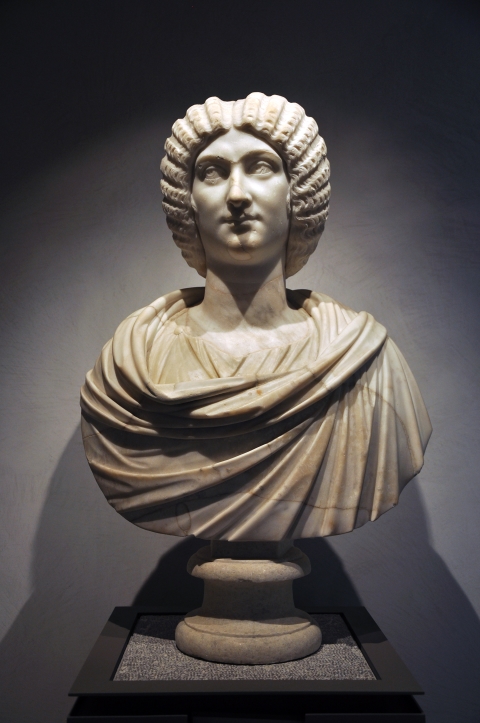
In 2001, Janet Stephens, a Baltimore hairdresser, caught sight of a bust of Roman empress Julia Domna at the Walters Art Museum (the image above is of a bust in the Louvre). Captivated by the philosopher empress’s hairdo, she thought “holy cow, that is so cool… like a loaf of bread sitting on her head.” Thus began Stephens’ quest to recreate the coiffures of ladies of antiquity.
Stephens first set about trying the empress’s hairstyle on a mannequin, with no success. She undertook some research and found that scholars generally assumed that the elaborate, sculpted hairstyles of Roman ladies could only be wigs. This set off Stephens’ skeptic detector, and—armed with no more than her free time, some dogged research methods, and a few volunteer models—she ventured to disprove the scholarly consensus. As The Wall Street Journal tells it:
In 2005, she had a breakthrough. Studying translations of Roman literature, Ms. Stephens says, she realized the Latin term “acus” was probably being misunderstood in the context of hairdressing. Acus has several meanings including a “single-prong hairpin” or “needle and thread,” she says. Translators generally went with “hairpin.”
The single-prong pins couldn’t have held the intricate styles in place. But a needle and thread could. It backed up her hair hypothesis.
Her persistence paid off. In 2008, she published an article in the Journal of Roman Archaeology detailing her findings on Roman hair. Stephens is now a recognized authority on ancient hairstyles and a “hair archaeologist.”
See Stephens at work and hear WSJ reporter Abigail Pesta tell the story in the video below.
Josh Jones is a writer, editor, and musician based in Washington, DC. Follow him @jdmagness
Read More...Listen to a Brief History of Papal Abdication
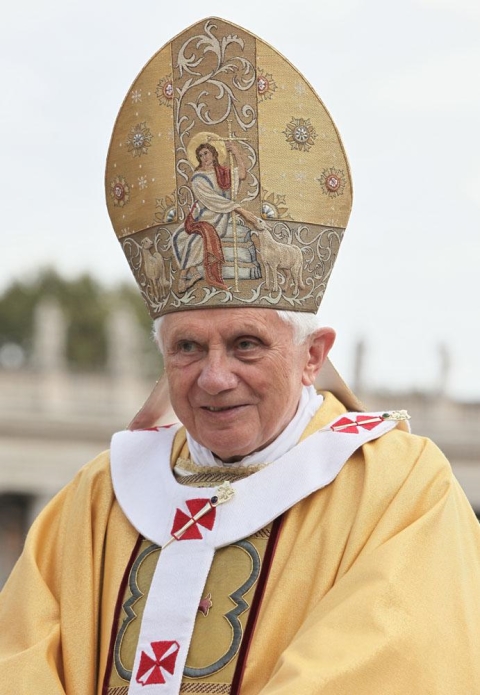
Pope Benedict XVI’s announcement of his retirement yesterday morning sent the internet into a tizzy, not to mention the thousands of Catholic institutions across the world. The first question on everyone’s lips seemed to be “can he do that?” And since no pope has in 600 years, there doesn’t seem to be much precedent for it. Well, in a special and timely edition, the new podcast Footnoting History presents the “admittedly very sparse” history of papal abdication. It has indeed happened before, but “almost never without scandal.”
Listen to the brief history above and visit Footnoting History’s homepage for more fascinating historical footnotes.
Josh Jones is a writer, editor, and musician based in Washington, DC. Follow him @jdmagness
Read More...The Scared Is Scared: A Child’s Wisdom for Starting New Chapters (Creative or Otherwise) in Life
The future’s uncertainty has paralyzed many an artist. How to begin?
Were you to take the advice of 6‑year-old Asa Baker-Rouse, you might show the word “start” in a box, add an equals sign, frame it with a box, make the word orange, then green, then white in a green box….
Asa is both narrator and muse of The Scared is Scared, the final project of recent Middlebury College grad, Bianca Giaever’s independently designed Narrative Studies major. Rather than hand the boy a script, she allowed him to determine the course of her film, literally visualizing his spontaneous monologue with the help of several game friends, a trick implemented earlier in Holy Cow Lisa, which built on an interview with her college advisor.
The result should appeal to anyone who had a soft spot for PeeWee’s Playhouse’s Penny cartoons. It’s cute all right, but The Scared is Scared also boasts an effortless-seeming profundity. Asa may be of the age where piano-shaped cookies and secret sleepovers represent the pinnacle of anarchy, but he’s got an ancient master’s take on things coming to their inevitable end. By committing to roll with whatever unknowns this child might supply, Giaver taps into a rich vein of creativity. Along the way, she makes peace with a very familiar-feeling unknown, the fate of the young artist leaving college’s cozy embrace.
It turns out to be a perfect place to start.
Related Content:
One of the Biggest Risks is Being Too Cautious…
Paulo Coelho on The Fear of Failure
J.K. Rowling Tells Harvard Grads Why Success Begins with Failure
Read More...
How Spike Lee Got His First Big Break: From She’s Gotta Have It to That Iconic Air Jordan Ad
“Film found me,” says Spike Lee in the clip above from mediabistro’s “My First Big Break” series. We may now know him as one of his generation’s most outspoken, conviction-driven American filmmakers, but he says he only got into the game because he couldn’t land a job. Entering the long, hot, unemployed summer of 1977, the young Lee spied a Super‑8 movie camera in a friend’s house. Borrowing it, he roamed the streets of an unusually down-at-heel New York City, shooting the exuberant emergence of disco, the anxiety over the Son of Sam killings, the unrest that bubbled up during blackouts, and the countless other facets of urban life he’s continued to explore throughout his career. Encouraged by a film professor at Morehouse College, he then put in the hours to edit all this footage he’d simply grabbed for fun into a documentary called Last Hustle in Brooklyn. Nearly a decade later, he made his first feature, She’s Gotta Have It, an early entry in what would become the American indie film boom of the nineties.
Lee not only directed She’s Gotta Have It, but played one of its most memorable characters, a smooth-talking hustler of a b‑boy named Mars Blackmon. Mars cares about having the freshest gear, a trait he shares with the man who created him. This did not escape the notice of famous advertising agency Wieden+Kennedy; when a couple of their employees saw Lee’s performance as Mars, they knew they’d found the ideal pitchman for one of their client’s products. The company: Nike. The product: the Air Jordan. As surprised as anyone that such a major firm and the iconic athlete Michael Jordan would take a chance on a young director, Lee went ahead and shot the commercial above, which announced him as a new force in the late-1980s zeitgeist. To learn much more about this period of Lee’s career and its subsequent development, watch his episode of Inside the Actors Studio. Though considerably less of a motormouth than Mars Blackmon, Lee tells a compelling story, especially his own.
Related content:
40 Great Filmmakers Go Old School, Shoot Short Films with 100 Year Old Camera
Colin Marshall hosts and produces Notebook on Cities and Culture and writes essays on literature, film, cities, Asia, and aesthetics. He’s at work on a book about Los Angeles, A Los Angeles Primer. Follow him on Twitter at @colinmarshall.
Read More...Destination Earth: The Greatness of American Civilization Revealed in 1950s Sci-Fi Cartoon
Many sci-fi tales go something like this: The human race travels into the great unknown, deep outer space, and encounters beings with forces greater than its own. Greater fire power. Greater intelligence. Greater technological ability. But, in Destination Earth, the standard narrative gets flipped on its head. Here, Martians come to Earth — the United States actually — and discover a vastly superior civilization. A civilization superior because it enjoys an endless supply of petroleum (used to make gas, tires, toothbrushes, cosmetics and insecticides) and the capitalist spirt of competition. Now, Sherlock, if you’re thinking this isn’t your average Saturday morning cartoon, I’d say you’re onto something. Destination Earth was the creation of The American Petroleum Institute, still the biggest lobby for the U.S. oil and gas industry. And the film was shot in 1956, smack dab in the middle of the Cold War. If you think Mars, the red planet, might be a proxy for the Soviet Union (and Ogg looks like Stalin), you might be the new James Bond.
Destination Earth appears in the Animation section of our collection of 500 Free Movies Online. For more vintage propaganda cartoons, check out: Donald Duck’s Bad Nazi Dream and Four Other Disney Propaganda Cartoons from World War II.
Read More...Support Us
We're hoping to rely on loyal readers, rather than erratic ads. Please click the Donate button and support Open Culture. You can use Paypal, Venmo, Patreon, even Crypto! We thank you!

About Us

Open Culture scours the web for the best educational media. We find the free courses and audio books you need, the language lessons & educational videos you want, and plenty of enlightenment in between.
Advertise With Us

FREE UPDATES!
GET OUR DAILY EMAIL
Get the best cultural and educational resources on the web curated for you in a daily email. We never spam. Unsubscribe at any time.
FOLLOW ON SOCIAL MEDIA

Open Culture editor Dan Colman scours the web for the best educational media. He finds the free courses and audio books you need, the language lessons & movies you want, and plenty of enlightenment in between.
Advertise With Us