“Moon Hoax Not”: Short Film Explains Why It Was Impossible to Fake the Moon Landing
S.G. Collins doesn’t trust the United States government. They “lie all the time, about all kinds of things,” he insists, “and if they haven’t lied to you today, maybe they haven’t had coffee yet.” Like some of those who express a similar distrust, he claims he has no way to verify that NASA landed on the moon in 1969. But unlike most of that subset, he doesn’t think the government could have pulled off a convincing hoax about it. In other words, America “did have the technical ability, not to mention the requisite madness, to send three guys to the moon and back. They did not have the technology to fake it on video.” Calmly, methodically, with a deadpan wit, Collins uses the thirteen minutes of Moon Hoax Not to explain exactly why, as improbable as the real moon landing sounds, a fake moon landing would have been downright impossible.
“The later you were born,” Collins says, “the more all-powerful movie magic seems.” Hollywood could now fake dozens of moon landings every day, but they didn’t always have that ability. Marshaling knowledge accrued over thirty years as a photographer, he addresses each of the points that moon-landing conspiracy theorists commonly cite as visual evidence of the supposed fraud. He also brings to bear facts from the history of video technology, such as 1969’s complete lack of the high-speed video cameras, needed to shoot the sort of slow motion necessary to create the illusion of low gravity. And what if they’d shot the entire Apollo 11 telecast on film instead? Collins also knows, and names, exactly the problems even the most ambitious, technologically advanced charlatans would have encountered, even—as in moon-landing hoax mockumentary Dark Side of the Moon—with Stanley Kubrick on their side.
Related Content:
Dark Side of the Moon: A Mockumentary on Stanley Kubrick and the Moon Landing Hoax
The Moon Disaster That Wasn’t: Nixon’s Speech In Case Apollo 11 Failed to Return
Colin Marshall hosts and produces Notebook on Cities and Culture and writes essays on literature, film, cities, Asia, and aesthetics. He’s at work on a book about Los Angeles, A Los Angeles Primer. Follow him on Twitter at @colinmarshall.
Read More...R.E.M.‘s “Losing My Religion” Reworked from Minor to Major Scale
Take R.E.M.‘s 1991 ballad “Losing My Religion” and rework it from minor to major scale, and here’s what you get — something that’s, as one Vimeo commenter called it, “recognizable enough to be nostalgic…unique enough to be shared!” Other songs digitally reworked by MajorScaled TV include “Riders on the Storm” by The Doors, Metallica’s “Nothing Else Matters,” and Django Reinhardt’s “Minor Swing.” Follow MajorScaled TV on Facebook for eventual additions to the collection.
If you would like to support the mission of Open Culture, consider making a donation to our site. It’s hard to rely 100% on ads, and your contributions will help us continue providing the best free cultural and educational materials to learners everywhere. You can contribute through PayPal, Patreon, and Venmo (@openculture). Thanks!
Related Content:
Nirvana’s “Smells Like Teen Spirit,” Reworked in Major Key, Becomes a Cheerful Pop Song
Read More...Harder Than It Looks: How to Make a Great Stop Motion Animation
Ever find yourself watching a great little stop motion animation and thinking, “Hey, I could do that?” What’s that? You made one with some friends in middle school? Great! Maybe you should bang one out tomorrow morning, slap it up on YouTube, and brace yourself for the onslaught of public adoration that’s so damnably difficult to avoid when one’s creation becomes a viral sensation overnight.
Hold your horses, Gumby. Filmmaking has grown increasingly democratic in the digital age, but a really elaborate stop motion animation is still a ton of work. Care to consider all that goes into one?
Try 382 Moleskine notebooks; days of painstaking, no doubt boring, labor; a camera dolly, a green screen, and a live, albeit less-than-professional, cat and mouse team. These are the primary elements of Dutch “graphic motion designer” Rogier Wieland’s “A Year in Full Colour,” a cunning salute to old-school daily planners. Unsurprisingly, this flight of fancy was commissioned by Moleskine, a brand whose inroads into the iPad cover market would likely not be enough to keep things in the black should jotting things on paper go the way of the dodo. Perhaps instead of making a stop motion of your own, you could pour your creative efforts into recording your upcoming appointments in a Moleskine classic.
As to which you should view first—the finished product (above) or the equally brief, but highly illuminating Making Of (below)–we leave that in your capable hands.
Related Content
Spike Jonze Presents a Stop Motion Film for Book Lovers
Going West: A Stop Motion Novel
Ayun Halliday’s planner of choice is the Slingshot Organizer Follow her @AyunHalliday
Read More...Hear Ravel Play Ravel in 1922
Yesterday we featured a piano-roll recording of the French composer Claude Debussy playing his “La soirée dans Grenade” in 1913. Today we bring you a lyrical and melancholy work recorded in 1922 on a similar device by Debussy’s younger friend and rival, Maurice Ravel. It’s called “Oiseaux tristes,” or “Sad Birds.”
The impetus for composing the piece came in 1904, when Ravel heard a second-hand account of something Debussy had said. According to Alexis Roland-Manuel, Ravel’s friend and biographer, Debussy had told the pianist Ricardo Viñes that when writing his experimental piece, “D’un cahier d’esquisses,” he had been “dreaming of a kind of music whose form was so free that it would sound improvised, of works which would seem to have been torn out of a sketchbook.”
Viñes recounted Debussy’s statement at a meeting of “Les Apaches,” a group of radical writers, artists and musicians, of which Ravel was a member. Ravel responded by saying that he was ready to put Debussy’s dream into action. He drew his inspiration from an experience he had one morning in the forest at Fontainbleau. Ravel’s friend and former music school classmate Émile Vuillermoz remembered:
He was staying with friends and one morning he heard a blackbird whistling a tune and was enchanted by its elegant, melancholy arabesque. He had merely to transcribe this tune accurately, without changing a note, to produce the limpid, poetic piece which spiritualises the nostalgic call of this French brother of the Forest Bird in Siegfried.
After the meeting, Ravel set to work on the E Flat Minor “Oiseaux tristes,” which he dedicated to Viñes and included in his five-piece suite, Miroirs. “Oiseaux tristes is the most typical of my way of thinking,” Ravel wrote in his 1928 autobiographical sketch. “It evokes birds lost in the oppressiveness of a very dark forest during the hottest hours of summer.”
Ravel recorded “Oiseaux tristes” and four other pieces in London on June 30, 1922, using a Duo-Art reproducing piano. Unlike the Welte-Mignon machine used by Debussy in 1913 (Ravel also made a pair of recordings on the Welte-Mignon at about the same time as Debussy) the Duo-Art system did not automatically record the dynamics of the performance. So when Ravel played “Oiseaux tristes” at the studio in London, there was an engineer seated next to him at a console, turning dials to capture the dynamic modulations in his playing. Afterward, Ravel listened to a playback on a pianola and, satisfied with the results, signed his name on the original roll.
Read More...Hannah Arendt’s Original Articles on “the Banality of Evil” in the New Yorker Archive
We’ve all heard the phrase “the banality of evil.” Some of us even know which political theorist to attribute it to, and among those, a few have even read it in context. Hannah Arendt most memorably employed it in both the subtitle and closing words of Eichmann in Jerusalem: A Report on the Banality of Evil, her book on the trial of Nazi lieutenant-colonel Adolf Eichmann. To Arendt’s mind, Eichmann willingly did his part to organize the Holocaust — and an instrumental part it was — out of neither anti-semitism nor pure malice, but out of a non-ideological, entirely more prosaic combination of careerism and obedience. Readers have argued ever since its publication about this characterization, and those with a special interest in how Arendt arrived there can find in the New Yorker’s online archives the original series of “Eichmann in Jerusalem” articles out of which the book grew: part one, part two, part three, part four, and part five. (Click on the images at the bottom of each page to see Arendt’s writing up close. Then click on them again and maneuver your mouse around to peruse the pages.) Given that Hannah Arendt, a new biopic starring Barbara Sukowa, just gained distribution, you may want to read these articles to stay ahead of the next wave of interest in the thinker and her writings.
In today’s magazines, one reads rather fewer five-part intersections of trial reportage and moral inquiry by figures like Arendt. But the New Yorker hasn’t entirely lost its willingness to confront these matters. Shortly after last year’s massacre in Aurora, Colorado, the magazine ran on its site a piece by Rollo Romig in touch with concerns, broadly speaking, similar to Arendt’s. Romig, too, looks at the nature of evil, but in a reflection suited to our time — brief, startlingly timely, and specifically for the web — rather than Eichmann in Jerusalem’s. “The danger of a word like ‘evil’ is that it is absolute,” he writes. “ ‘Evil’ has become the word we apply to perpetrators who we’re both unable and unwilling to do anything to repair, and for whom all of our mechanisms of justice seem unequal: it describes the limits of what malevolence we’re able to bear. In the end, it’s a word that says more about the helplessness of the accuser than it does the transgressor.”
H/T to Christian F. for flagging the New Yorker articles for us.
Related Content:
The Trial of Adolf Eichmann at 50
55 Free Philosophy Courses
Download Free Courses from Famous Philosophers: From Bertrand Russell to Michel Foucault
Colin Marshall hosts and produces Notebook on Cities and Culture and writes essays on literature, film, cities, Asia, and aesthetics. He’s at work on a book about Los Angeles, A Los Angeles Primer. Follow him on Twitter at @colinmarshall.
Read More...The Many Ways to Mars: A Reality Show, a New Martian City, and Mapping Mars from Home
Reality television has been around since at least the late ’40s. First we had Candid Camera, where hapless, but real, people became the unwitting butt of Allen Funt’s jokes. But it wasn’t until fifty years later that the genre exploded, bringing us Big Brother and, of course, Survivor.
Now, make way for the unbelievable and ultra-expensive marriage of reality television and science fiction. Mars One, the brainchild of Dutch entrepreneur Bas Lansdorp, plans to establish a permanent human settlement on the red planet in 2023. First, four people would land on Mars. Every two years, another group of people would arrive. The trips would be one-way and all the settlers would live out the rest of their lives on Mars. Funding for the first phase is estimated at $6 billion.
Mars One backers say raising $6 billion will be easy. Every four years the Summer and Winter Olympics generate millions of dollars in revenue because people all over the world want to watch. The Olympics held in 2005 and 2008 together made nearly $5.5 billion from programming and sponsorship.
So, what if there were an event so fascinating, so unprecedented and amazing, that literally every television, computer, and smart device would be tuned in to watch? What if the entire Mars mission was an international reality television show? That’s the plan. Everything from the selection of the first group of astronauts to the launch, landing, and daily life on the red planet would be televised. The audience even gets to vote on the final four space travelers.
Interested? Mars One has issued its requirements for astronaut selection. No military, flight, or science experience required. Applicants must be at least 18, in good mental and physical health, and willing to devote eight years to training before beginning the journey to their new home planet. Finding this hard to believe? The first question in Mars One’s FAQ page sort of says it all. Is this for real? Yes, the plans are for real. Whether any or everything Mars One imagines actually takes place is anybody’s guess.
What’s certain is that Mars is a hot destination at the moment, and not just for aspiring reality stars. SpaceX funder and billionaire Elon Musk wants to build a city for 80,000 on Mars. While accepting an award from the Royal Aeronautical Society, Musk outlined his vision to charge $500,000 per person to transport people to the new Martian city. He’s mentioned wanting to retire on Mars and is using SpaceX as a lab to develop new interplanetary rocket technology.
But you don’t need to be rich or popular to see some of the red planet. There’s also plenty of exploring to do on the surface of Mars from home. Citizen scientists can help Planet Four identify fans and blotches in images of the Martian surface. The pictures come from a camera aboard the Mars Reconnaissance Orbiter, a NASA mission to orbit Mars and transmit images and data to Earth using a powerful radio frequency called the “Ka-band,” which works like an interplanetary Internet.
Using simple marking tools, users can mark the surface colorations and spots that help scientists study changes in the planet’s weather. So-called “spiders” of dry ice form on the planet’s poles in the winter and then lead to fan-shaped moisture footprints.
It’s fun to imagine that the data you create could bring us closer to our distant neighbor planet. Unless of course you’d rather suit up and start training to go there yourself. In that case, good luck and start saving.
Kate Rix writes about digital technology and education. Read more of her work at .
Read More...Keith Moon’s Final Performance with The Who (1978)
Last summer, we revisited a memorable moment from the annals of rock ’ n’ roll — the time when Keith Moon, flying high on PCP, passed out at a 1973 Who concert in California, giving an unsuspecting fan, Scot Halpin, the chance to take over on the drums. (Watch it all happen here.) It was a glorious moment for Scott. For Keith, it was the middle of the end — another example of the outrageous substance abuse that would kill him five years later.
Fast forward to 1978, and we arrive at Keith Moon’s final live performance with The Who. It took place when the band shot live footage for the rockumentary, The Kids Are Alright. In his recently-published biography, Who Am I?, Pete Townshend writes that, by 1978, Moon’s addictions had caught up to him. His “drumming was getting so uneven that recording was almost impossible, so much so that work on the Who Are You album had ground to a halt.… [The Who] had just about enough tracks for a record, with very little additional material to spare. ‘Music Must Change’ was completed with footsteps replacing drums.” When it came time to shoot live footage for The Kids Are Alright, Townshend “was terrified that Keith wouldn’t be able to hide his deteriorating condition,” but agreed to give it a try.
The initial shoot was appalling. The band was out of practice, and Keith couldn’t keep up. So they tried a second shoot, filmed at Shepperton Studios on May 25, 1978, where they played a limited number of hit songs before a small audience. (Watch above and below.) “Keith was in a good mood but bloated and unfit,” writes Townshend, “and he found the repeated takes wearying.” Because Moon’s earphones kept falling off, they taped them to his head with thick black gaffers’ tape. In the months that followed, Moon headed to Malibu, California where he tried to kick his alcohol habit and then started abusing medications to relieve the withdrawal symptoms. On September 6, Moon took 32 tablets of clomethiazole, a sedative meant to help him cope with the withdrawal. The next morning Roger Daltrey, The Who’s lead singer, called Pete Townshend and simply said “He’s done it.”
For more on this story, check out the audio version of Pete Townshend’s autobiography Who Am I?. It’s read by Townshend himself, which gives it a nice personal touch. And you can download it for free if you sign up for a 30-day free trial with Audible.com. Find the details here. Finally you can also watch Townshend discussing his book and music career in a 90-minute conversation with Paul Holdengraber here.
The Very First Film of J.G. Ballard’s Crash, Starring Ballard Himself (1971)
The Collins English Dictionary defines “Ballardian” as “resembling or suggestive of the conditions described in J. G. Ballard’s novels and stories, especially dystopian modernity, bleak man-made landscapes and the psychological effects of technological, social or environmental developments.” You’ll find no more distilled dose of the Ballardian than in Ballard’s book The Atrocity Exhibition, a 1969 experimental novel, or collection of fragments, or what’s been called a collection of “condensed novels.” Subject to an obscenity trial in the United States and the subsequent pulping of nearly a whole print run, the book has earned a permanent place in the canon of controversial literature. Its twelfth chapter, “Crash!”, even provided the seed for a Ballard novel to come: 1973’s Crash, a story of symphorophilia which David Cronenberg adapted into a film 23 years later. The movie, in its turn, stoked a furor in the United Kingdom, culminating in a Daily Mail campaign to ban it. But as far as filming material born of Ballard’s fascination with the intersection of auto wrecks and sexuality, Cronenberg didn’t get there first.
Susan Emerling and Zoe Beloff drew from Crash the novel to make the still-unreleased Nightmare Angel in 1986, but fifteen years before that, Harley Cokeliss turned “Crash!” the chapter into Crash! the short film (also known as The Atrocity Exhibition). Casting Ballard himself in the starring role and Gabrielle Drake (sister of singer-songwriter Nick Drake) opposite, Cokeliss crafts a vision almost oppressively of the seventies: the protagonist’s wide, striped shirt collar dominates his even wider jacket collar below the grim visage he wears while ensconced in the suit of armor that is his hulking American vehicle. “I think the key image of the twentieth century is the man in the motor car,” Ballard says in voiceover. “Have we reached a point now in the seventies where we only make sense in terms of these huge technological systems? I think so myself, and that it is the vital job of the writer to try to analyze and understand the huge significance of this metallized dream.” If this Ballardian vision resonates with you, see also Simon Sellars’ thorough essay on the film at fan site Ballardian.
Related Content
Sci-Fi Author J.G. Ballard Predicts the Rise of Social Media (1977)
Hear Five JG Ballard Stories Presented as Radio Dramas
J.G. Ballard’s Experimental Text Collages: His 1958 Foray into Avant-Garde Literature
Colin Marshall hosts and produces Notebook on Cities and Culture and writes essays on literature, film, cities, Asia, and aesthetics. He’s at work on a book about Los Angeles, A Los Angeles Primer. Follow him on Twitter at @colinmarshall.
Read More...Slavoj Žižek Demystifies the Gangnam Style Phenomenon
Back in late November, Psy’s “Gangnam Style” had clocked 792 million times on YouTube, and the Chinese dissident artist Ai Wei Wei filmed his own Gangnam Style parody video. Now, just five weeks later, the video has logged over 1.1 billion views. That’s one view for every seven people on the planet. What has made this pop song a global phenomenon? Various critics have chalked it up to a fluke, or to the randomness that belongs to many internet memes. Such non-answers probably wouldn’t fly with Slavoj Žižek, the nose-rubbing, shirt-tugging, Slovenian philosopher who offered his own take on the Gangnam Style Phenomenon. Speaking at the University of Vermont on October 16th, 2012, Žižek attributed Gangnam’s wild popularity to modern forms of spirituality. But I’m sure that that summary is oversimplifying things. If you have 90 minutes to kill (and I do mean kill), you can watch Žižek’s complete UVM talk below. His Gangnam musings come around the 35:10 mark.
F. Scott Fitzgerald in Drag (1916)
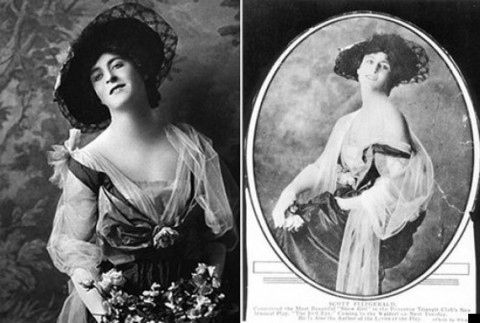 It has been said that the dominant influences on F. Scott Fitzgerald were literature, Zelda, alcohol, and Princeton. The photos above were taken during the novelist’s Princeton days, where he played an active role in The Princeton Triangle Club, writing scripts and lyrics for what’s now the oldest collegiate musical-comedy troupe in the US. After Fitzgerald failed several exams, he was barred from performing in the club’s 1916 musical production, The Evil Eye!. A shame, given that he co-wrote the script. But F. Scott wasn’t going to be completely denied. Yes, he posed in drag for a publicity photo that appeared in The New York Times on January 2, 1916. The newspaper called him “the most beautiful” girl in the show.
H/T Retronaut
Related Content:
F. Scott Fitzgerald Creates a List of 22 Essential Books, 1936
Ernest Hemingway to F. Scott Fitzgerald: “Kiss My Ass”
Find major works by F. Scott Fitzgerald in our Free eBooks and Free Audio Books collections.
Read More...Support Us
We're hoping to rely on loyal readers, rather than erratic ads. Please click the Donate button and support Open Culture. You can use Paypal, Venmo, Patreon, even Crypto! We thank you!

About Us

Open Culture scours the web for the best educational media. We find the free courses and audio books you need, the language lessons & educational videos you want, and plenty of enlightenment in between.
Advertise With Us

FREE UPDATES!
GET OUR DAILY EMAIL
Get the best cultural and educational resources on the web curated for you in a daily email. We never spam. Unsubscribe at any time.
FOLLOW ON SOCIAL MEDIA

Open Culture editor Dan Colman scours the web for the best educational media. He finds the free courses and audio books you need, the language lessons & movies you want, and plenty of enlightenment in between.
Advertise With Us

