Johnny Cash’s Short and Personal To-Do List
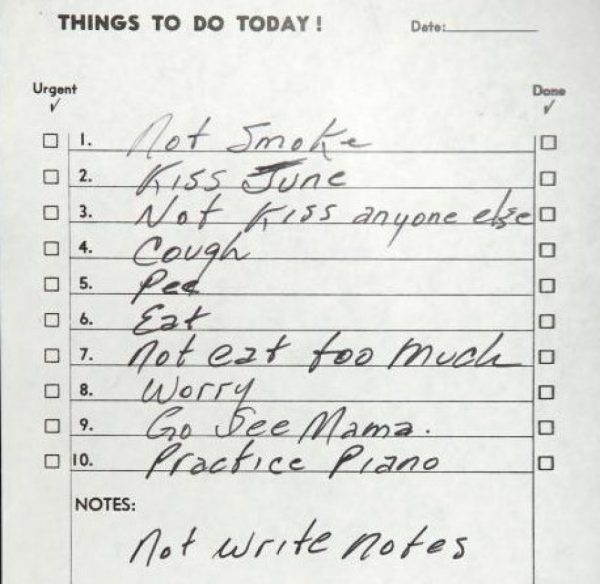
Johnny Cash wrote down at least two lists in his lifetime. Let’s start with the big one. In 1973, when his daughter Roseanne turned 18, the legendary musician pulled out a sheet of yellow legal paper and began writing down 100 Essential Country Songs, the songs she needed to know if she wanted to start her own musical career. The list, writes the website FolkWorks, didn’t construe country music narrowly. It was eclectic, taking in old folk songs, Appalachian ballads, and also protest songs, early country classics, and modern folks songs sung by artists like Bob Dylan. (Don’t miss our post on Dylan and Cash’s 1969 collaboration here.) This essential list never went public, at least not in full. Roseanne Cash guarded it closely until 2009, when she released an album featuring interpretations of 12 titles from her father’s list. The other 88 songs still remain a mystery.
Now on to that other list: Somewhere along the way (we’re not sure when) The Man in Black jotted down 10 “Things to Do Today!” This list feels almost like something you and I could have written, the stuff of mortals. Heck, in a given day, we all “Cough,” “Eat” and “Pee.” We struggle with will power (not eating too much, perhaps not smoking, maybe not fooling around with anyone but our spouse). And we’re hopefully good to our loved ones. So what sets Johnny Cash apart from us? Just June and that piano.
Johnny’s to-do list sold at auction for $6,250 in 2010.
via The New York Times via Lists of Note
If you would like to support the mission of Open Culture, consider making a donation to our site. It’s hard to rely 100% on ads, and your contributions will help us continue providing the best free cultural and educational materials to learners everywhere. You can contribute through PayPal, Patreon, and Venmo (@openculture). Thanks!
Read More...Herbie Hancock: All That’s Jazz!

“I think I was supposed to play jazz,” says Herbie Hancock. Hancock is one of the most noted jazz musicians of all time. He was born in Chicago in 1940, and it became apparent early on that he was a child piano prodigy. Herbie performed a Mozart piano concert with the Chicago Symphony Orchestra at age 11, then started playing jazz in high school and later double-majored in music and electrical engineering at Grinnell College. His fascination with musical gadgets led him to become one of the first jazz pianists to work with electronic keyboards. And his landmark albums blurred the boundaries of music, effortlessly mixing jazz with funk, soul, rhythm and the blues, forever changing the face of jazz. As Miles Davis once said, “Herbie was the step after Bud Powell and Thelonious Monk, and I haven’t heard anybody yet who has come after him.”
The documentary above — Herbie Hancock: All That’s Jazz — was produced for KCET’s signature news series “SoCal Connected.” It retraces the most important steps in Hancock’s career and shows us his home, the office where his award-winning music is composed and his private rituals. Very few people know that Herbie is a very religious person — he has been a practicing Buddhist for over forty years.
Bonus material:
- Correspondent Michael Okwu shares what it was like to spend time with Herbie Hancock.
- A wonderful performance of Herbie’s famous “Canteloupe Island” with Pat Metheny.
By profession, Matthias Rascher teaches English and History at a High School in northern Bavaria, Germany. In his free time he scours the web for good links and posts the best finds on Twitter.
Read More...
Peter Sellers: His Life in Home Movies
Peter Sellers was a compulsive home movie maker. His house was cluttered with cameras, cables and tape recorders, according to his first wife Anne Howe, and he liked to bring a camera along with him wherever he went, sometimes handing it to a companion and clowning around in front of the lens.
In 1995, fifteen years after Sellers’s death, producers from BBC Arena sorted through his extensive archive and assembled some of the best footage for a film called The Peter Sellers Story. In 2002 they shortened it into The Peter Sellers Story: As He Filmed It (above), which tells the story of the comedian’s life almost exclusively with footage from his own camera.
There are glimpses of some notable people from the actor’s circle, including Stanley Kubrick, Sophia Loren, Lord Snowdon, Princess Margaret, Britt Ekland, Blake Edwards, Spike Milligan and Orson Welles. The audio is pieced together from vintage performances and interviews, along with commentary by Sellers’s friends, family and colleagues. It’s a unique film, offering a personal look at the enigmatic and emotionally troubled genius who was able to slip confidently into an amazing range of personas–often in the same film–but was never sure of his own. As Sellers once told an interviewer:
I have no personality of my own, you see. I could never be a star because of this. I’m a character actor. I couldn’t play Peter Sellers the way Cary Grant plays Cary Grant, say–because I have no concrete image of myself. I look in the mirror and what I see is someone who has never grown up–a crashing sentimentalist who alternates between great heights and black depths. You know, it’s a funny thing, but when I’m doing a role I feel it’s the role doing the role, if you know what I mean. When someone tells me “You were great as so-and-so,” I feel they should be telling this to so-and-so, and when I finish a picture I feel a horrible sudden loss of identity.
The Peter Sellers Story: As He Filmed It will be added to our collection of 500 Free Movies Online.
Related Content:
Peter Sellers Performs The Beatles in Shakespearean Mode
Peter Sellers Reads The Beatles’ ‘She Loves You’ in Four Voices
Read More...
Hollywood by Helicopter, 1958
“This movie is going to be pretty obvious.” That’s not the best way to get the viewer’s attention. And the rest of the script, read by Bob Crane, is not much better: “Hey Kitty, look … Kitty, you didn’t look hard enough … See the thing that looks like a building? That’s a building!” Nor is the premise of the film very good: Kitty is a novice actress, and, before appearing in her first movie, she gets an aerial tour of Hollywood and its landmarks.
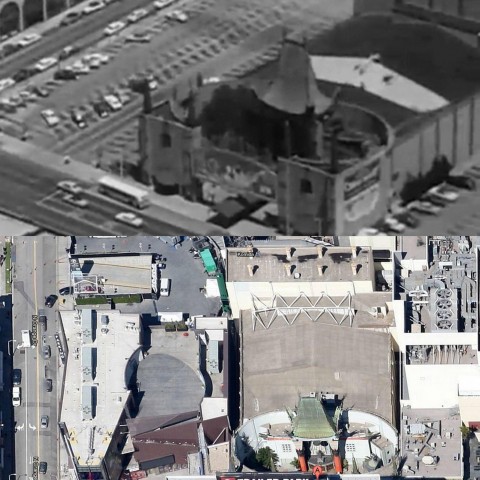
But from a historical perspective, this 1950s footage of the Los Angeles movie industry has its intriguing moments. It’s particularly interesting to see how much space there still was around some of the studios and movie theaters. Just compare the image of Grauman’s Chinese Theater on Hollywood Boulevard taken from the film with a Google Earth shot from today:
By profession, Matthias Rascher teaches English and History at a High School in northern Bavaria, Germany. In his free time he scours the web for good links and posts the best finds on Twitter.
Read More...Dylan Thomas Recites ‘Do Not Go Gentle into That Good Night’ and Other Poems
When Dylan Thomas was a little boy his father would read Shakespeare to him at bedtime. The boy loved the sound of the words, even if he was too young to understand the meaning. His father, David John Thomas, taught English at a grammar school in southern Wales but wanted to be a poet. He was bitterly disappointed with his station in life.
Many years later when the father lay on his deathbed, Dylan Thomas wrote a poem that captures the profound sense of empathy he felt for the dying old man. The poem, “Do Not Go Gentle into That Good Night,” was written in 1951, only two years before the poet’s own untimely death at the age of 39. Despite the impossibility of escaping death, the anguished son implores his father to “Rage, rage against the dying of the light.”
The poem is a beautiful example of the villanelle form, which features two rhymes and two alternating refrains in verse arranged into five tercets, or three-lined stanzas, and a concluding quatrain in which the two refrains are brought together as a couplet at the very end. You can hear Thomas’s famous 1952 recital of the poem above. To see the poem’s structure and read along as you listen, click here to open the text in a new window.
And to hear more of Thomas reciting his own works you can visit HarperAudio, where you will find a treasure trove of recordings from a number of writers, including these from Thomas:
- Part 1: “No Sun Shines,” “The Hand that Signed the Paper,” “Should Lanterns Shine,” “And Death Shall Have No Dominion,” and the first verse of “Alterwise by Owl Light.”
- Part 2: “Poem in October,” “This Side of the Truth,” Love in the Asylum,” and “The Hunchback in the Park.”
- Part 3: “Do Not Go Gentle into That Good Night,” “On the Marriage of a Virgin,” “In My Craft or Sullen Art,” and “Ceremony After a Fire Raid.”
All poems have been added to our collection of Free Audio Books.
Related content:
Anthony Hopkins Reads ‘Do Not Go Gentle into That Good Night’
Listening to Famous Poets Reading Their Own Work
Robert Frost Recites ‘Stopping by Woods on a Snowy Evening’
Read More...Toni Morrison, Nora Ephron, and Dozens More Offer Advice in Free Creative Writing “Master Class”
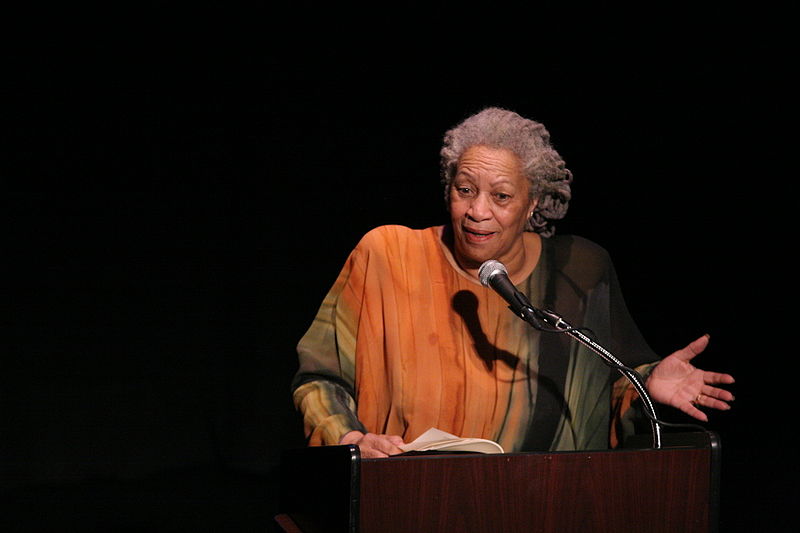
Image by Angela Radulescu, via Wikimedia Commons
If you’re anything like me, you yearn to become a good writer, a better writer, an inspiring writer, even, by learning from the writers you admire. But you neither have the time nor the money for an MFA program or expensive retreats and workshops with famous names. So you read W.H. Auden’s essays and Paris Review interviews with your favorite authors (or at least PR’s Twitter feed); you obsessively trawl the archives of The New York Times’ “Writers on Writing” series, and you relish every Youtube clip, no matter how lo-fi or truncated, of your literary heroes, speaking from beyond the grave, or from behind a podium at the 92nd Street Y.
Well, friend, you are in luck (okay, I’m still talking about me here, but maybe about you, too). The Washington, DC-based non-profit Academy of Achievement—whose mission is to “bring students face-to-face” with leaders in the arts, business, politics, science, and sports—has archived a series of talks from an incredibly diverse pool of poets and writers. They call this collection “Creative Writing: A Master Class,” and you can subscribe to it right now on iTunes and begin downloading free video and audio podcasts from Nora Ephron, John Updike, Toni Morrison, Carlos Fuentes, Norman Mailer, Wallace Stegner, and, well, you know how the list goes.
The Academy of Achievement’s website also features lengthy profiles–with text and downloadable audio and video–of several of the same writers from their “Master Class” series. For example, an interview with former U.S. poet-laureate Rita Dove is illuminating, both for writers and for teachers of writing. Dove talks about the aversion that many people have for poetry as a kind of fear inculcated by clumsy teachers. She explains:
At some point in their life, they’ve been given a poem to interpret and told, “That was the wrong answer.” You know. I think we’ve all gone through that. I went through that. And it’s unfortunate that sometimes in schools — this need to have things quantified and graded — we end up doing this kind of multiple choice approach to something that should be as ambiguous and ever-changing as life itself. So I try to ask them, “Have you ever heard a good joke?” If you’ve ever heard someone tell a joke just right, with the right pacing, then you’re already on the way to the poetry. Because it’s really about using words in very precise ways and also using gesture as it goes through language, not the gesture of your hands, but how language creates a mood. And you know, who can resist a good joke? When they get that far, then they can realize that poetry can also be fun.
Dove’s thoughts on her own life, her work, and the craft of poetry and teaching are well worth reading/watching in full. Another particularly notable interview from the Academy is with another former laureate, poet W.S. Merwin.
Merwin, a two-time Pulitzer Prize winner, discusses poetry as originating with language, and its loss as tantamount to extinction:
When we talk about the extinction of species, I think the endangered species of the arts and of language and all these things are related. I don’t think there is any doubt about that. I think poetry goes back to the invention of language itself. I think one of the big differences between poetry and prose is that prose is about something, it’s got a subject… poetry is about what can’t be said. Why do people turn to poetry when all of a sudden the Twin Towers get hit, or when their marriage breaks up, or when the person they love most in the world drops dead in the same room? Because they can’t say it. They can’t say it at all, and they want something that addresses what can’t be said.
If you’re anything like me, you find these two perspectives on poetry—as akin to jokes, as saying the unsayable—fascinating. These kinds of observations (not mechanical how-to’s, but original thoughts on the process and practice of writing itself) are the reason I pore over interviews and seminars with writers I admire. I found more than enough in this archive to keep me satisfied for months.
We’ve added “Creative Writing: A Master Class” to our ever-growing collection of Free Online Courses.
Image via Angela Radulescu
Josh Jones is a doctoral candidate in English at Fordham University and a co-founder and former managing editor of Guernica / A Magazine of Arts and Politics.
Related Content:
William S. Burroughs Teaches a Free Course on Creative Reading and Writing (1979)
Seven Tips From William Faulkner on How to Write Fiction
Read More...Remembering Neil Armstrong, the First Man on the Moon, with Historic Footage and a BBC Bio Film
Several weeks ago, we watched NASA scientists explode with applause when they landed their rugged rover, Curiosity, on Mars. Imagine how an earlier generation of scientists must have felt when, on July 20, 1969, Neil Armstrong took his first steps on the moon and then uttered his immortal words: “That’s one small step for man, one giant leap for mankind.” You can get goosebumps thinking about it.
Today, America lost a great one. Neil Armstrong has died at 82, after undergoing heart-bypass surgery earlier this month. Above, we bring you legendary footage from the Apollo 11 Mission. And here you can view high resolution images from that historic space flight. Below, we present an hour-long BBC documentary on the life and times of the pioneering astronaut.
Related Content:
“First Orbit”: Celebrating 50th Anniversary of Yuri Gagaran’s Space Flight
Dark Side of the Moon: A Mockumentary on Stanley Kubrick and the Moon Landing Hoax
125 Great Science Videos: From Astronomy to Physics & Psychology
Read More...When Asteroids Attack! Neil deGrasse Tyson and NASA Explain How To Stop an Armageddon
If pop culture has taught us non-scientists anything about asteroids, it’s that we should blow them up. From classic video game Asteroids to the Michael Bay disaster classic Armageddon, asteroids are either random bits of floating debris out to destroy us, or massive malignant space tumors hurtling our way to destroy us, which we’re told is how the dinosaurs died out. But, says superstar physicist Neil deGrasse Tyson—in Vice’s short video (above) “Blowing Up Asteroids with NASA and Neil deGrasse Tyson”—“We’re clever enough that we never have to go extinct by an asteroid. We have more choices available to us than Tyrannosaurus Rex did.” Choices like turning an asteroid into space dust? Probably not. Turns out, Armageddon wasn’t entirely scientifically accurate. In fact, NASA shows Michael Bay’s movie to its trainees to see how many scientific absurdities they can find. The record, as of 2007, was at 168.
So what to do! Well, it turns out that the chances of an asteroid colliding with the earth are slim, but still a bit too close for comfort. As Tyson explains above, there is, in fact, an asteroid headed our way, called Apophis, in 2029. If Apophis goes through a region called “the keyhole,” it will impact the earth seven years later. The probability of this occurring as of 2009 is 1 in 250,000. Yikes. Astronaut Mike Gernhardt, a primary investigator at NEEMO (NASA Extreme Environment Mission Operations) is on the case. His team uses underwater simulations in Key Largo, Florida to recreate an asteroid-like environment and explore it, collect samples, etc. in what NASA calls an “Analog Mission.” Just how any of this might prevent an asteroid from destroying the planet escapes me, to be honest (and the “blowing up” part of the video’s title doesn’t ever get an explanation). But the NEEMO project is still pretty cool, as you can witness in an interview with NEEMO Mission Manager Bill Todd below.
The Vice video is part of their Motherboard TV series, which informs us on its site that NEEMO, like everything cool these days, is likely to be defunded. Let’s hope they can figure out how save us from asteroid Armageddon before the money runs out.
via The Atlantic
Josh Jones is a doctoral candidate in English at Fordham University and a co-founder and former managing editor of Guernica / A Magazine of Arts and Politics.
Read More...Jim Henson’s Animated Film, Limbo, the Organized Mind, Presented by Johnny Carson (1974)
Not having grown up during the Muppets’ first and highest wave of popularity, I’ve always wondered how something like The Muppet Show could possibly have attained such mainstream cultural primacy. A friend of mine who did spend his childhood watching puppeteer Jim Henson’s array of creatures do their thing on national television offers a simple explanation: “It was the seventies.” Though Henson began his puppetry career twenty years before The Muppet Show’s 1974 pilot episode, his distinctively earnest yet presciently post-psychedelic vision seemed made for that decade. America responded by elevating his work into the zeitgeist, and not just the stuff properly involving Muppets. Above, you can watch a 1974 clip from The Tonight Show featuring a short performance from Henson and fellow Muppeteer Dave Goelz called Limbo, the Organized Mind.
Henson and Goelz treat Johnny Carson and the Tonight Show audience to a journey through the brain, as an abstracted, hand-operated face narrates the passage through organic structures like his medulla oblongata, and cerebrum, and the seats of things less definable, like thoughts of his family, thoughts of his enemies, his “extra-special section of good thoughts,” his evil thoughts, and his fears. The score comes from electronic composition pioneer Raymond Scott, whose 1964 album Soothing Sounds for Baby has won great respect among enthusiasts of ambient music. Watching Limbo, the Organized Mind in 2012 brings one obvious lament to mind: why don’t they make such delightfully eccentric and artistic television anymore? But of course they do make it, in stranger and less predictable ways than even Henson did, but mainly in the countless fragmented, comparatively marginal venues of modern media. Limbo aired on a show that half the people you knew would have seen. It was the seventies.
Related content:
Jim Henson’s Violent Wilkins Coffee Commercials (1957–1961)
Jim Henson’s Zany 1963 Robot Film Uncovered by AT&T: Watch Online
Jim Henson’s Short, Oscar-Nominated Film (1965)
Colin Marshall hosts and produces Notebook on Cities and Culture. Follow him on Twitter at @colinmarshall.
Read More...This is What Oliver Sacks Learned on LSD and Amphetamines
In this week’s issue of the New Yorker, neurologist and writer Oliver Sacks has an article titled “Altered States.” Subtitled “Self-experiments in chemistry,” it covers, to be blunter, what Sacks experienced and learned — or failed to learn, substance depending — when he began doing drugs.
His desire to conduct these self-experiments flared up in his thirties, when, among other sudden jolts of curiosity, he felt a suspicion that he had never really seen the color indigo. “One sunny Saturday in 1964, I developed a pharmacologic launchpad consisting of a base of amphetamine (for general arousal), LSD (for hallucinogenic intensity), and a touch of cannabis (for a little added delirium). About twenty minutes after taking this, I faced a white wall and exclaimed, ‘I want to see indigo now — now!’ ” The resulting experience, and surely many others besides, should appear in detail in Sacks’ upcoming book Hallucinations. While you need to subscribe to the magazine to read the New Yorker piece, anyone can watch the video above, which spends a few minutes with Sacks talking about what drugs taught him about the brain.
Every subject Sacks writes about seems to start with his interest in our unusual sensory experiences and end in the organic workings of our brains. His body of work comprises books on migraine, encephalitis, visual agnosia, deafness, autism, color blindness, and various other perceptual impairments. Thinking back to his self-induced hallucinations, he remembers feeling that “the drugs might sensitize me to experiences of a sort my patients could have,” making him more empathetic to what they were going through. On the other hand, he says, some drugs “gave me some very direct knowledge of what physiologists would call the reward systems of the brain,” producing “intense pleasure, sometimes pleasure of an almost orgasmic degree, with no particular content,” the kind that made him fear he would become one of those famous lab rats with an electrode connected to its brain’s pleasure center, pushing and pushing the lever to stimulate that center to the very end. But he stepped back, observed, wrote, and avoided that fate, or at least its equivalent in the human domain, living to tell the tale more eloquently than most any writer around.
(See also: more from Oliver Sacks on the New Yorker’s Out Loud podcast.)
Related content:
Oliver Sacks Talks Music with Jon Stewart
Colin Marshall hosts and produces Notebook on Cities and Culture. Follow him on Twitter at @colinmarshall.
Read More...Support Us
We're hoping to rely on loyal readers, rather than erratic ads. Please click the Donate button and support Open Culture. You can use Paypal, Venmo, Patreon, even Crypto! We thank you!

About Us

Open Culture scours the web for the best educational media. We find the free courses and audio books you need, the language lessons & educational videos you want, and plenty of enlightenment in between.
Advertise With Us

FREE UPDATES!
GET OUR DAILY EMAIL
Get the best cultural and educational resources on the web curated for you in a daily email. We never spam. Unsubscribe at any time.
FOLLOW ON SOCIAL MEDIA

Open Culture editor Dan Colman scours the web for the best educational media. He finds the free courses and audio books you need, the language lessons & movies you want, and plenty of enlightenment in between.
Advertise With Us


