George Harrison & The Concert for Bangladesh (1971)
In August 1971, George Harrison and Ravi Shankar staged two benefit concerts at Madison Square Garden in NYC to raise money for refugees in Bangladesh. (More on the concert here.) Also appearing on stage were Bob Dylan, Eric Clapton and Ringo Starr. Below, we’ve posted some footage from the show, and also included it in our YouTube playlist (feel free to subscribe to it). You can also watch other songs from the concert here and here.
Just as an fyi, a recording of the concert was released as an album in 1971 and then as a film in 1972. Proceeds from both still go to UNICEF.
Read More...Favorite Books of 2007
Quick fyi: The book critics of The New York Times have selected their favorite books of 2007. These are the books that they mention to friends, or recommend that you take on vacation. You’ll find here 30 good reads in all.
Now how about your favorite book of ’07? Share them with other Open Culture readers and list them in the comments below. (If we get enough of them, we’ll list them in a special blog post.)
Read More...Ten Discoveries That Rewrote History
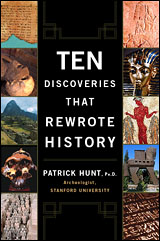
Patrick Hunt: “First I should say that not every archaeologist would agree that these are the ten most important discoveries of all time. On the other hand, the ten stories retold in this book are often regarded as among the most exciting archaeological discoveries of the modern era (since 1750). And no one would deny that these ten vital discoveries have forever changed the world of archaeology, transforming how and what we know about ancient history. Let me tell you a little about them.
1) Rosetta Stone: This exciting discovery in 1799 was the key to deciphering Egyptian hieroglyphs and unlocking the history of the ancient world texts. It provides a window into the real history of Egypt rather than an imaginary one; all other decipherings of ancient languages since the Rosetta Stone’s initial decoding in 1822 are based on its precedents. (See photo here.)
2) Troy: Its discovery and excavation beginning in 1870 proved once and for all that Troy was not just a myth based on Homer; Troy was a historical site where real people lived and fought. Its earliest excavator, the oft-maligned and often-unethical Heinrich Schliemann has been mostly credited — right or wrong — as being the “Father of Archaeology” and his techniques became the foundation of archaeological research, however greatly improved, afterward.
3) Nineveh and the Royal Assyrian Library: This riveting find beginning in 1849 by Austen Henry Layard, a sleuth of antiquity, eventually unearthed a whole lost library of cuneiform texts, including ones not only from ancient Assyria but also from far older Sumer, Akkad, Babylon and other great civilizations. This had a very significant impact on world literature, introducing such seminal works as the Epic of Gilgamesh.
4) King Tut’s Tomb: The dramatic opening of this royal tomb in 1922 — sought for years by a determined Howard Carter — was the first time in millennia a pharaoh’s tomb had actually been found intact; its treasure gave the world a unique opportunity to actually account for staggering Egyptian royal wealth. [Dan’s note: National Geographic has a nice web site on this archaeological find.]
5) Machu Picchu: The remarkable high jungle mountain discovery in 1911 of the remote Lost City of the Inca by Hiram Bingham made it possible for the world to finally see an undisturbed Inca royal city mysteriously abandoned on a mountaintop but neither conquered nor changed by the colonial world. (See photo here.)
6) Pompeii: Preserved by the eruption of Vesuvius in AD 79 and not dug out for almost two millennia, Pompeii (probably accidentally found by a farmer digging a well) is the single most important Roman site in the world; its artifacts offer the largest and fullest record of life in a Roman city. Pompeii’s misfortune is our great fortune. It preserves a city with thousands of objects virtually unchanged. (See images here.)
Read More...15 Most Viewed Posts in 2007
We dug back through the historical data and isolated the 15 most viewed posts of the year. If you’re looking for a trend, one will leap out. People like numbered lists. Hence another one:
1) 10 Unexpected Uses of the iPod
2) 25 UC Berkeley Courses Available via Free Video
3) 45 Free Cutting-Edge Books … Courtesy of Creative Commons
4) The War of the Worlds on Podcast: How H.G. Wells and Orson Welles Riveted A Nation
5) Our Ancestral Mind in the Modern World: An Interview with Satoshi Kanazawa
6) Free Beethoven and Mozart Recordings via Podcast
7) Life-Changing Books: Your Picks
8) 10 Free University Courses on iTunes
9) Podcast Primer
10) MP3 Music Blogs: For Your Listening Pleasure
11) Ten Discoveries That Rewrote History
12) The Hottest Course on iTunes (and the Future of Digital Education)
13) Ten Podcasts to Build Your Vocabulary
14) YouTube Gets Smart: The Launch of New University Channels
15) The Decline and Fall of the Roman (and American?) Empire: A Free Audiobook

Betting Against Google’s Answer to Wikipedia
As many now know, Google announced Friday that it’s testing a new content initiative — dubbed “knol” — that it hopes will rival Wikipedia. Realizing that Wikipedia entries rank first on 27% of all Google search result pages, the folks at Googleplex couldn’t resist launching a competitive product. In announcing “knol,” the company highlighted two problems that this new content product will address:
1) “There are millions of people who possess useful knowledge that they would love to share,” but they don’t share that knowledge “because it is not easy enough to do that.”
2) “The key idea behind the knol project is to highlight authors. Books have authors’ names right on the cover, news articles have bylines, scientific articles always have authors — but somehow the web evolved without a strong standard to keep authors names highlighted. We believe that knowing who wrote what will significantly help users make better use of web content.”
How “knol” attempts to solve these problems is fairly straightforward. It will provide experts with user-friendly templates for writing and publishing encyclopedia entries (or “knols”) on the web. And since a picture is apparently worth a thousand words, I recommend that you take a look at a sample screenshot here. Departing from Wikipedia, Google’s project will cater to the individual author, not communities of authors. And it will encourage many encyclopedia entries on the same topic, as opposed to one unified text. Google then assumes that the cream will rise to the top. If 20 people craft “knols” on “string theory,” then the best one — presumably the one that gets the most links from quality sites — will rise highest in the search rankings.
Google’s concept is not altogether bad. But it’s also one of the more ordinary ideas to come out of Mountain View, and I’m guessing that the results will fall short of corporate expectations. Here’s why:
Most fundamentally, the information generated by these “knols” will be substandard compared to what you’ll find on Wikipedia. Although the screenshot provided by Google nicely featured a Stanford University scholar writing on “Insomnia,” the reality is that few experts of this stature will take the time to contribute. Take my word for it. I’ve spent the past five years trying to get scholars from elite universities, including Stanford, to bring their ideas to the outside world, and it’s often not their first priority. They just have too many other things competing for their time. More often than not, Google’s knols will be written by authors with lesser, if not dubious, credentials. The mediocre entries will be many; the great ones, few. And this will leave Google’s content in a weaker position relative to Wikipedia.
To be clear, Wikipedia’s overall talent pool may not be much better. But Wikipedia’s model has an important built-in advantage. A community of writers focusing on the same text will correct one another and improve the overall product over time. The final text becomes greater than the sum of its authors. Meanwhile, Google’s model, which will produce a proliferation of lackluster entries on the same subject, doesn’t include any kind of strong self-correcting mechanism that will improve the entries. The company seems to think that user feedback, name recognition, and a share of ad revenue (which probably won’t amount to much) will do the trick. But that seems like wishful thinking, and I’m basing that on several years of working at About.com, which integrated many of the same elements into its model. Strike one against Google.
If you’re looking for Strikes 2 and 3, let me outline them briefly.
Strike 2 comes down to false premises: When you step back and examine Google’s reasons for creating project “knol,” they don’t hold up to scrutiny. These days, publishing on the web is fairly dummy proof. Free blogging software, Google Page Creator, Yahoo’s Geocities and Wikipedia — these tools have made it incredibly easy to publish to the web. (Somehow, writers have figured out how to post 2,125,453 articles to Wikipedia.) The argument that technology is holding back would-be encyclopedia writers just doesn’t fly. Nor does the notion that we’d get better quality encyclopedia entries if only authors could attach their names to what they write. On the one hand, anonymity hasn’t slowed down Wikipedia at all. On the other, many legitimate experts will see writing “knols” as being a slight step above “vanity” publishing, but not much more. In short, not a good use of their time.
Strike 3 turns on momentum and the lack of game-changing functionality: Not long after YouTube launched and proved the viability of video sharing, Google created its own competitive unit, Google Video. By the next year, Google realized it would never catch up and bought YouTube for $1.65 billion. Wikipedia, in comparison, has had a much longer head start. For six years, it has been refining its model, growing traffic, and gaining user loyalty. That’s a substantial and most likely insurmountable lead. True, once upon a time a young Google came out of nowhere and knocked an established Yahoo out of its leadership role. But that happened when Google brought its game-changing search technology to market. With “knol,” however, there’s no such game-changing technology on display — nothing that substantially changes how knowledge gets created. Google and its engineers certainly excel at managing knowledge and produce many great products (for which I’m personally thankful). But getting into the knowledge creation business may pose new challenges, ones that will require the Google staff to go beyond algorithms and thinking in terms of 0s and 1s.
Read More...
Even Ahmadinejad Blogs
Here it is in English. His Christmas wish is charming.
Rumor is that Mahmoud is busy setting up a Facebook page. Stay tuned for it, and be sure to give him a nice little poke.
Read More...Al Gore’s Nobel Presentation
Al Gore accepted his Nobel Prize earlier today in Oslo and delivered an accompanying speech that issued a stark warning (read text here, watch video here):
Read More...[W]ithout realizing it, we have begun to wage war on the earth itself. Now, we and the earth’s climate are locked in a relationship familiar to war planners: “Mutually assured destruction.”
More than two decades ago,scientists calculated that nuclear war could throw so much debris and smoke into the air that it would block life-giving sunlight from our atmosphere, causing a “nuclear winter.” Their eloquent warnings here in Oslo helped galvanize the world’s resolve to halt the nuclear arms race.
Now science is warning us that if we do not quickly reduce the global warming pollution that is trapping so much of the heat our planet normally radiates back out of the atmosphere, we are in danger of creating a permanent “carbon summer.”
As the American poet Robert Frost wrote, ” Some say the world will end in fire; some say in ice.” Either, he notes, “would suffice.”
But neither need be our fate. It is time to make peace with the planet.
Raising Sand
I just picked up a copy of the new Robert Plant & Alison Krauss album (CD — MP3), and I’m frankly hooked. As Amazon put it, only “King Kong and Bambi could be a more bizarre pairing,” but the results are brilliant. More on the new collaboration below.
Coppola is Back
Francis Ford Coppola, the director who brought us The Godfather and Apocalypse Now, has released his first film in a decade. Based on a novella by Mircea Eliade, a Romanian thinker principally known for his work on the history of religion, “Youth Without Youth” features Tim Roth playing the role of Dominic Matei, an elderly linguistics professor, who gets struck by lightning and finds his youth strangely restored. To publicize the film, Coppola has been doing a fair amount of press in New York. (The film is premiering there.) Here, you can listen to the interview he gave on WNYC’s Leonard Lopate Show (iTunes — Feed — Web Site). We’ve also posted below a video outtake from the interview. Finally, this Q&A session in The New York Post may also be of interest.
Related Posts:
Read More...
The 53 Places to Go in 2008
Courtesy of The New York Times.
Know of any podcasts or videos that we should feature on Open Culture? Email us your tips.
Read More...
Support Us
We're hoping to rely on loyal readers, rather than erratic ads. Please click the Donate button and support Open Culture. You can use Paypal, Venmo, Patreon, even Crypto! We thank you!

About Us

Open Culture scours the web for the best educational media. We find the free courses and audio books you need, the language lessons & educational videos you want, and plenty of enlightenment in between.
Advertise With Us

FREE UPDATES!
GET OUR DAILY EMAIL
Get the best cultural and educational resources on the web curated for you in a daily email. We never spam. Unsubscribe at any time.
FOLLOW ON SOCIAL MEDIA

Open Culture editor Dan Colman scours the web for the best educational media. He finds the free courses and audio books you need, the language lessons & movies you want, and plenty of enlightenment in between.
Advertise With Us


