The Improbable Invention of Chinese Typewriters & Computer Keyboards: Three Videos Tell the Techno-Cultural Story
Even if you don’t speak a word of Chinese, you surely know that the language uses not an alphabet, but ideographic characters: about 50,000 of them, all told, 3,000 to 5,000 of which must be memorized in order to achieve reasonable literacy. The potential for conflict between the Chinese writing system and twenty-first-century technology hardly needs explanation. How, in short, do Chinese people type? Youtuber Johnny Harris offers an explanation in the video above, beginning with the perhaps counterintuitive answer that Chinese people type with more or less the same keyboard everyone else does — when they’re using a computer, at any rate.
Our smartphone age has given rise to a number of different input systems, all designed to perform the same basic task of adapting the ancient and elaborate written Chinese language to digital modernity. In Harris’ telling, these technologies turn on two major developments: the creation of pinyin, a version of the Latin alphabet that phonetically represents Chinese characters, and the development of algorithms that predict which character the user wants to type next.
His explanation is breezy and not without its errors (the diagram about thirteen minutes in, for example, actually shows the Korean alphabet), and you might consider supplementing it with videos like expatriate Matthew Tye’s more detailed “How Do Chinese People Type?” above.
But if you truly want to understand the evolution of Chinese typing, you must begin with the Chinese typewriter — and so must read Tom Mullaney. A Professor of East Asian Language and Cultures at Stanford University, Mullaney published The Chinese Typewriter: A History five years ago, and has more recently been at work on a follow-up on the Chinese computer. In the lecture above, he recounts the Chinese typewriter’s once-impossible-seeming development in an hour and a half, connecting it to a host of cultural, linguistic, orthographic, and technological phenomena along the way. It’s a story of ingenuity, but also of survival. Chinese made it through the twentieth century without being mangled or abolished to meet the limitations of Western engineering, but not every writing system was quite so lucky.
Related content:
An Animated History of Writing: From Ancient Egypt to Modern Writing Systems
When IBM Created a Typewriter to Record Dance Movements (1973)
Based in Seoul, Colin Marshall writes and broadcasts on cities, language, and culture. His projects include the Substack newsletter Books on Cities, the book The Stateless City: a Walk through 21st-Century Los Angeles and the video series The City in Cinema. Follow him on Twitter at @colinmarshall, on Facebook, or on Instagram.
Read More...All of the Different Kinds of Acoustic Guitars, and the Different Woods They’re Made Of: The Ultimate Acoustic Guitar Guide
If you’re just starting out on acoustic guitar, buying your first instrument might seem simple enough…. Head to your local music shop (or ecommerce retailer), thrust out your hand, and say something like, “Give me a beginner guitar now!” Pay your money, take your lessons, Bob’s your uncle, right?
Ah, but say you encounter one of those things known as a guitar salesperson? And say that person has some questions… “Ok, we’ve got traditional-style dreadnoughts with cutaways or no cutaways. We’ve got concert sized guitars, parlor guitars, classical, all sorts!” And you, formerly confident shopper, now find yourself at sea. What’s the difference?
They’re already on to talking about different materials used in making guitars and you check out. You imagine a pursuit where you know what you’re doing: I could learn harmonica…. How many kinds of those are there?
Fear not, beginner, YouTube guitar educator Paul Davids is here to teach us the types of acoustic guitars we’re likely to encounter in the wild, as well as the different kinds of “tone woods” and why they make a difference.
Tone wood simply means the kinds of trees used to make the guitar – maple, mahogany, rosewood, spruce, etc. – and it’s called “tone wood” instead of just “wood” for a reason. Among makers and players of electric guitars, a never-ending argument persists about how much tone wood matters. There should be little debate when it comes to acoustic guitars.
The sound of an acoustic guitar comes from the pick, or the fingers, and from the neck, where the strings’ contact with the fretboard travels down to the resonating chamber of the body and gets sent out into the world. At each of these contact points, the properties of the wood in question naturally condition the shape of the sound waves.
Enlisting the help of Eastwood Guitars Pepijn ‘t Hart above, who donated the guitars in the first video for demonstration purposes, Davids demonstrates beyond question that different woods used to construct the back, sides, and top of an acoustic guitar have a tremendous effect on the tone.
From brighter to darker, treblier to bassier, or whatever you want to call the range of tones, you’ll hear them in these examples of different materials used to make the same sized guitars. Why is this important? As Hart explains, an acoustic guitar is basically its own amplifier. While you can adjust the tone somewhat with technique, the first thing you need to do as an acoustic guitar player is determine the best type of instrument you’ll need for the kind of music you’re playing.
Guitarists may also need to consider (eventually), the kinds of musicians they’re playing with. A heavy rock ensemble with rumbling bass and drums will require a much brighter guitar to cut through the mix, whereas accompanying a banjo player or violinist will call for more low end.
You can still grab the first beginner acoustic guitar you find online and call it a day. But if you’re serious about learning the instrument – and learning to play in a musical tradition, be it folk, blues, country, classical, rock, or whatever – you’ll need this essential information. Davids and Hart make it fun and easy to acquire in the two-part educational series above.
Related Content:
Musician Plays the Last Stradivarius Guitar in the World, the “Sabionari” Made in 1679
What Does a $275,000 Classical Guitar Sound Like?
Josh Jones is a writer and musician based in Durham, NC. Follow him at @jdmagness
Read More...Winnie the Pooh Went Into the Public Domain, and Someone Already Turned the Story Into a Slasher Film: Watch the Trailer for Winnie-The-Pooh: Blood and Honey
Deep in the Hundred Acre Wood
Where Christopher Robin plays
You’ll find the enchanted neighborhood
Of Christopher’s childhood days…
Those sweetly sentimental lyrics were penned not by A.A. Milne, creator of Winnie-The-Pooh but rather the Academy-Award winning songwriting team of brothers Robert and Richard Sherman, who also penned the scores of Mary Poppins, Chitty Chitty Bang Bang, and The Jungle Book.
If you are under the age of 60, chances are your concept of Pooh, Eeyore, Piglet, Kanga, Roo, Owl, Rabbit and Tigger is informed by Winnie the Pooh and Honey Tree, the 1966 Disney cartoon that launched a successful franchise, not E.H. Shepherd’s charming illustrations for the 1926 book, Winnie the Pooh, which entered the public domain this year.
This means that Milne’s work can be freely reproduced or reworked, though Disney retains the copyright to their animated character designs.
Jennifer Jenkins, director of the Center for the Study of the Public Domain at Duke University, told the Washington Post that the bulk of the inquiries she fielded in the lead up to 2022’s public domain titles becoming available had to do with Winnie the Pooh:
I can’t get over how people are freaking out about Winnie-the-Pooh in a good way. Everyone has a very specific story of the first time they read it or their parents gave them a doll or they [have] stories about their kids…It’s the Ted Lasso effect.We need a window into a world where people or animals behave with decency to one another.”
Ummm…
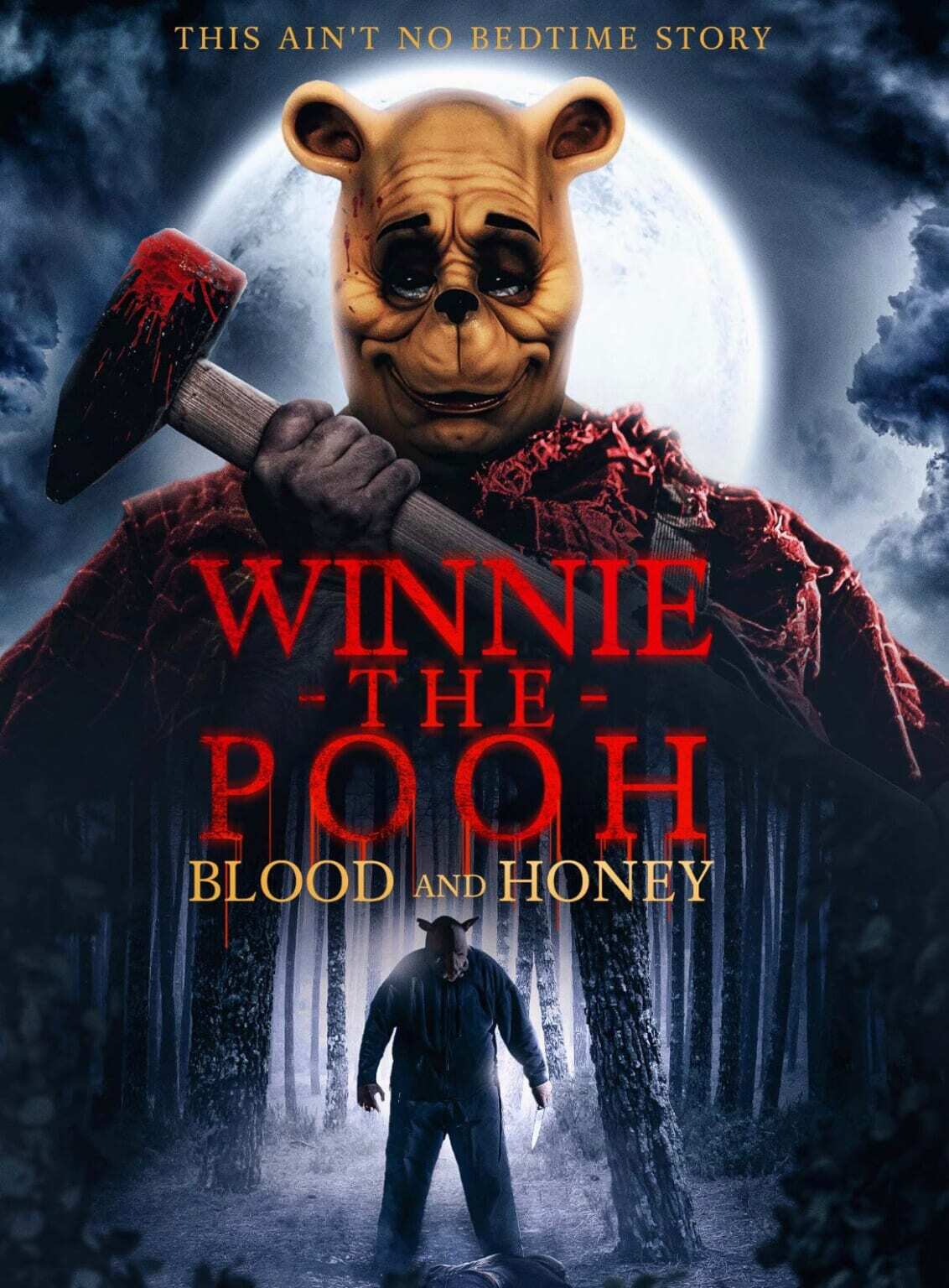
Judging by the trailer for their upcoming live action, low budget feature, Winnie the Pooh: Blood and Honey, Jagged Edge, a London-based horror production company, is not much interested in Ted Lasso good vibes, though they do manage to stay within the limits of the law, equipping a black clad Piglet with threatening tusks, and dressing the titular “silly old bear” in a red shirt that doesn’t exactly scream Tummy Song.
More like Texas Chainsaw Massacre.
Producer-Director Rhys Frake-Waterfield whose as-yet-unreleased credits include Peter Pan’s Neverland Nightmare and Spiders on a Plane told Variety that “we did as much as we could to make sure [the film] was only based on the 1926 version:”
When you see the cover for this and you see the trailers and the stills and all that, there’s no way anyone is going to think this is a child’s version of it.
Here’s hoping he’s right.
The trailer traffics freely in slasher flick tropes:
A bikini clad young woman relaxing, obliviously, in a hot tub.
A hand held camera tracking a desperate, and probably doomed, escape attempt through the woods.
Unnerving warnings written in blood (or possibly honey?)
The childish scrawl on the sign demarcating the 100 Acre Wood is both faithful to the original, and unmistakably sinister.
Equally disturbing is the lettering on Eeyore’s homemade grave marker. (SPOILER: as per Variety, a starving Pooh and Piglet ate him…and apparently discarded a human skull nearby.)
The “enchanted neighborhood of Christopher’s childhood days” has gone decidedly downhill.
Director Frake-Waterfield paints Pooh and Piglet as the primary villains, but surely the college-bound Christopher Robin deserves some of the blame for abandoning his old friends.
On the other hand, when a college-bound Andy tossed his beloved childhood playthings in a giveaway box at the beginning of Toy Story 3, Buzz and Woody did not go on a murderous rampage.
As Frake-Waterfield described Pooh and Piglet’s devolution to HuffPost:
Because they’ve had to fend for themselves so much, they’ve essentially become feral. So they’ve gone back to their animal roots. They’re no longer tame: they’re like a vicious bear and pig who want to go around and try and find prey.
An interview with Dread Central offers a graphic taste of the violent mayhem they inflict, even as Christopher Robin, as clueless as a bikini clad innocent in a hot tub, bleats, “We used to be friends, why are you doing this!?”
Unsurprisingly, the film’s tagline is “This Ain’t No Bedtime Story.”
View production photos, if you dare, here.
- Ayun Halliday is the Chief Primatologist of the East Village Inky zine and author, most recently, of Creative, Not Famous: The Small Potato Manifesto. Her allegiance has long been with the 1926 version. Follow her @AyunHalliday.
Related Content
Hear the Classic Winnie-the-Pooh Read by Author A.A. Milne in 1929
The Original Stuffed Animals That Inspired Winnie the Pooh
Read More...Kino Lorber Puts Online 75 Free Films
Even cinephiles who know little of the business of film distribution will have developed associations, however unconscious, between certain pre-feature corporate logos and the exhilarating cinematic experiences that tend to follow. What sort of picture comes to mind, for example, when you read the name Kino Lorber? Perhaps documentaries on such compelling subjects as New York Times street-fashion photographer Bill Cunningham or gone-viral Winnebago pitchman Jack Rebney; perhaps international genre spectacles of recent years like Ana Lily Amirpour’s A Girl Walks Home Alone at Night or Hélène Cattet and Bruno Forzani’s Let the Corpses Tan.
Then again, your own taste in Kino Lorber-distributed movies may run to the likes of Goodbye to Language, Jean-Luc Godard’s 2014 meditation originally screened in 3D — or Derek Jarman’s autobiographical last testament Blue, which plays out entirely on a solid field of the eponymous color.
These are just a few of the more than 75 films now available free to watch on Kino Lorber’s Youtube channel. (Note that the actual number of viewable films may vary depending on your location.) Spanning various eras, genres, origins, and forms, together they offer a sense of the niche Kino Lorber has carved out for itself during its 45 years in business so far.
You may spot an old favorite on Kino Lorber’s Youtube channel, but the greater joy of exploring it lies in discovering films you missed the first time around. Gabe Klinger’s Porto, for instance, went practically unseen despite its evocative vision of the title city and posthumous showcase of acclaimed actor Anton Yelchin. Boasting a cast of Phoebe Cates, Bridget Fonda, Tim Roth, and Eric Stoltz, Michael Steinberg’s Bodies, Rest & Motion screened at Cannes as an Un Certain Regard selection back in 1993; surely the time has come for its reappraisal as a distillation of Generation‑X ennui. Even Taika Waititi once made lesser-known movies in and about his native New Zealand. Thanks to Kino Lorber, his fans can can watch Boy, which launched him on the journey that has made him one of the most globally popular directors alive. See the complete playlist of films here.
Related content:
365 Free Movies Streaming on YouTube
Watch 70+ Soviet Films Free Online, Courtesy of Mosfilm, the Hollywood of the Soviet Union
Watch Hundreds of Polish Films Free Online: Feature Films, Documentaries, Animations & More
Based in Seoul, Colin Marshall writes and broadcasts on cities, language, and culture. His projects include the Substack newsletter Books on Cities, the book The Stateless City: a Walk through 21st-Century Los Angeles and the video series The City in Cinema. Follow him on Twitter at @colinmarshall, on Facebook, or on Instagram.
Read More...Taylor Hawkins Tribute Concert Streaming Live from Wembley Stadium: Watch It Online
The Foo Fighters have teamed up with Taylor Hawkins’ family to stream worldwide their all-star celebration of the legendary drummer. Above you can stream the Taylor Hawkins Tribute Concert taking place in Wembley Stadium. Note: if you missed the beginning, you can scroll the video back to the very start.
If you would like to support the mission of Open Culture, consider making a donation to our site. It’s hard to rely 100% on ads, and your contributions will help us continue providing the best free cultural and educational materials to learners everywhere. You can contribute through PayPal, Patreon, and Venmo (@openculture). Thanks!
Related Content
Watch the Foo Fighters’ Taylor Hawkins (RIP) Give a Drumming Masterclass
1,000 Musicians Perform “My Hero” in a Moving Tribute to Foo Fighters’ Drummer Taylor Hawkins
Read More...What Happens When Artificial Intelligence Creates Images to Match the Lyrics of Iconic Songs: David Bowie’s “Starman,” Led Zeppelin’s “Stairway to Heaven”, ELO’s “Mr. Blue Sky” & More
Lyricists must write concretely enough to be evocative, yet vaguely enough to allow each listener his personal interpretation. The nineteen-sixties and seventies saw an especially rich balance struck between resonant ambiguity and massive popularity — aided, as many involved parties have admitted, by the use of certain psychoactive substances. Half a century later, the visions induced by those same substances offer the closest comparison to the striking fruits of visual artificial-intelligence projects like Google’s Deep Dream a few years ago or DALL‑E today. Only natural, perhaps, that these advanced applications would sooner or later be fed psychedelic song lyrics.
The video at the top of the post presents the Electric Light Orchestra’s 1977 hit “Mr. Blue Sky” illustrated by images generated by artificial intelligence straight from its words. This came as a much-anticipated endeavor for Youtube channel SolarProphet, which has also put up similarly AI-accompanied presentations of such already goofy-image-filled comedy songs as Lemon Demon’s “The Ultimate Showdown” and Neil Cicierega’s “It’s Gonna Get Weird.”
Youtuber Daara has also created ten entries in this new genre, including Queen’s “Don’t Stop Me Now,” The Eagles’ “Hotel California,” and (the recently-featured-on-Open-Culture) Kate Bush’s “Running Up That Hill.”
Jut above appears a video for David Bowie’s “Starman” with AI-visualized lyrics, created by Youtuber Aidontknow. Created isn’t too strong a word, since DALL‑E and other applications currently available to the public provide a selection of images for each prompt, leaving it to human users to provide specifics about the aesthetic — and, in the case of these videos, to select the result that best suits each line. One delight of this particular production, apart from the boogieing children, is seeing how the AI imagines various starmen waiting in the sky, all of whom look suspiciously like early-seventies Bowie. Of all his songs of that period, surely “Life on Mars?” would be choice number one for an AI music video — but then, its imagery may well be too bizarre for current technology to handle.
Related content:
Discover DALL‑E, the Artificial Intelligence Artist That Lets You Create Surreal Artwork
Artificial Intelligence Program Tries to Write a Beatles Song: Listen to “Daddy’s Car”
Artificial Intelligence Creates Realistic Photos of People, None of Whom Actually Exist
Based in Seoul, Colin Marshall writes and broadcasts on cities, language, and culture. His projects include the Substack newsletter Books on Cities, the book The Stateless City: a Walk through 21st-Century Los Angeles and the video series The City in Cinema. Follow him on Twitter at @colinmarshall, on Facebook, or on Instagram.
Read More...Simone de Beauvoir’s Philosophy on Finding Meaning in Old Age

Image via Wikimedia Commons
In the legend of the Buddha, prince Siddhartha encounters the poor souls outside his palace walls and sees, for the first time, the human condition: debilitating illness, aging, death. He is shocked. As Simone de Beauvoir paraphrases in The Coming of Age, her groundbreaking study of the depredations of growing old, Siddhartha wonders, “What is the use of pleasures and delights, since I myself am the future dwelling-place of old age?”
Rather than deny his knowledge of suffering, the Buddha followed its logic to the end. “In this,” de Beauvoir writes ironically, “he differed from the rest of mankind… being born to save humanity.” We are mostly out to save ourselves – or our stubborn ideas of who we should be. The more wealth and power we have, the easier it may be to fight the transformations of age…. Until we cannot, since “growing, ripening, aging, dying – the passing of time is predestined.”
When she began to write about her own aging, de Beauvoir was besieged, she says, by “great numbers of people, particularly old people [who] told me, kindly or angrily but always at great length and again and again, that old age simply did not exist!” The hundreds and thousands of dollars spent to fight nature’s effect on our appearance only serves to “prolong,” she writes, our “dying youth.”
Obsessions with cosmetics and cosmetic surgery come from an ageism imposed from without by what scholar Kathleen Woodward calls “the youthful structure of the look” — a harsh gaze that turns the old into “The Other.” The aged are subject to a “stigmatizing social judgment, made worse by our internalization of it.” Ram Dass summarized the condition in 2019 by saying we live in “a very cruel culture” — an “aging society… with a youth mythology.”
The contradictions can be stark. Many of Ram Dass’ generation have become valuable fodder in marketing and politics for their reliability as voters or consumers, a major shift since 1972. But, for all the focus on baby boomers as a hated or a useful demographic, they are largely invisible outside of a certain wealthy class. Old age in the West is no less fraught with economic and social precarity than when de Beauvoir wrote.
De Beauvoir movingly describes conditions that were briefly evident in the media during the worst of the pandemic – the isolation, fear, and marginalization that older people face, especially those without means. “The presence of money cannot always alleviate” the pains of aging, wrote Elizabeth Hardwick in her 1972 review of de Beauvoir’s book in translation. “Its absence is a certain catastrophe.”
The problem, de Beauvoir pointed out, is that old age is almost synonymous with poverty. The elderly are deemed unproductive, unprofitable, a burden on the state and family. She quotes a Cambridge anthropologist, Dr. Leach, who stated at a conference, “in effect, ‘In a changing world, where machines have a very short run of life, men must not be used too long. Everyone over fifty-five should be scrapped.’”
The sentiment, expressed in 1968, sounds not unlike a phrase bandied around by business analysts thanks to Erik Brynjolkfsson’s call for human beings to “race with the machines.” It is, eventually, a race everyone loses. And the push for profitability over human flourishing comes back to haunt us all.
We carry this ostracism so far that we even reach the point of turning it against ourselves: for in the old person that we must become, we refuse to recognize ourselves.”
De Beauvoir’s response to the widespread cultural denial of aging was to write the first full-length philosophical study of aging in existence, “to break the conspiracy of silence,” she proclaimed. First published as La vieillesse in 1970, the book dared tread where no scholar or thinker had, as Woodward writes in a 2016 re-appraisal:
The Coming of Age is the inaugural and inimitable study of the scandalous treatment of aging and the elderly in today’s capitalist societies…. There was no established method or model for the study of aging. Beauvoir had to invent a way to pursue this enormous subject. What did she do? …. She surveyed and synthesized what she had found in multiple domains, including biology, anthropology, philosophy, and the historical and cultural record, drawing it all together to argue with no holds barred that the elderly are not only marginalized in contemporary capitalist societies, they are dehumanized.
The book is just as relevant in its major points, argues professor of philosophy Tove Pettersen, despite some sweeping generalizations that may not hold up now or didn’t then. But the exclusions suffered by aging women in capitalist societies are still especially cruel, as the philosopher argued. Women are still stigmatized for their desires after menopause and ceaselessly judged on their appearance at all times.
De Beauvoir’s study has been compared to the exhaustive work of Michel Foucault, who excavated such human conditions as madness, sexuality, and punishment. And like his studies, it can feel claustrophobic. Is there any way out of being Othered, pushed aside, and ignored by the next generation as we age? “Beauvoir claims that the oppressed are not always just passive victims,” says Pettersen, “and that not all oppression is total.”
We may be conditioned to see aging people as no longer useful or desirable, and to see ourselves that way as we age. But to wholly accept the logic of this judgment is to allow old age to become a “parody” of youth, writes de Beauvoir, as we chase after the past in misguided efforts to reclaim lost social status. We must resist the backward look that a youth-obsessed culture encourages by allowing ourselves to become something else, with a focus turned outward toward a future we won’t see.
As an old Zen master once pointed out, the leaves don’t go back on the tree. The leaves in fall and the tree in winter, however, are things of beauty and promise:
There is only one solution if old age is not to be an absurd parody of our former life, and that is to go on pursuing ends that give our existence a meaning — devotion to individuals, to groups or to causes, social, political, intellectual or creative work… In old age we should wish still to have passions strong enough to prevent us turning in on ourselves. One’s life has value so long as one attributes value to the life of others, by means of love, friendship, indignation, compassion.
Borrow de Beauvoir’s The Coming of Age from the Internet Archive and read it online for free. Or purchase a copy of your own.
Related Content:
Ram Dass (RIP) Offers Wisdom on Confronting Aging and Dying
Life Lessons From 100-Year-Olds: Timeless Advice in a Short Film
Josh Jones is a writer and musician based in Durham, NC. Follow him at @jdmagness
Read More...
The Atomic Café: The Cult Classic Documentary Made Entirely Out of Nuclear Weapons Propaganda from the Cold War (1982)
Some assume that the term “nuclear family” refers to the American household as conceived of in the 1950s: a working father, stay-at-home mother, and 2.3 kids under one suburban roof. This is a misconception — “nuclear” simply implies an exclusion of extended family members — but nevertheless an evocative one. For in American popular culture, the zenith of that family arrangement coincided with the zenith of nuclear weaponry. Nukes, one heard, that had won the war, at least against Japan, and nukes that would thenceforth secure the free world against the Red Menace.
Instilling this perception required the production and distribution of no small amount of propaganda, especially in the Cold War. It is out of just such propaganda, drawn from newsreels, television broadcasts, and other forms of media, that Kevin Rafferty, Pierce Rafferty, and Jayne Loader made their acclaimed documentary The Atomic Café.
It came out in 1982, when the public’s assumptions of American military benevolence — and its patience with the country’s seemingly permanent arms race against the Soviet Union — were running low. These decades-old clips of strenuously pious politicians, drawling bomber pilots, rambling Babbitts, and civil defense-ready nuclear (in both senses) families could hardly have met with more intense cynicism.
“I was an exact contemporary of those kids in this old documentary footage,” writes Roger Ebert in his review The Atomic Café. “Life magazine ran blueprints for fallout shelters, and Estes Kefauver barnstormed the nation with warnings about strontium 90 in the milk supply.” In one scene “girls in home ec classes display their canned goods designed for nuclear survival, and it is clear from their faces that they have no clue of how they would survive nuclear war, and little hope of doing so.” The film as a whole evokes a time when the United States “spent a good deal of its resources on addressing the possibility of nuclear war, however uselessly.” We no longer hear much about that possibility, perhaps because it has genuinely diminished, or perhaps because — as viewers of The Atomic Café will suspect even today — the propagandists are busy convincing us of something else entirely.
Related content:
How a Clean, Tidy Home Can Help You Survive the Atomic Bomb: A Cold War Film from 1954
Protect and Survive: 1970s British Instructional Films on How to Live Through a Nuclear Attack
Watch Chilling Footage of the Hiroshima & Nagasaki Bombings in Restored Color
See Every Nuclear Explosion in History: 2153 Blasts from 1945–2015
Based in Seoul, Colin Marshall writes and broadcasts on cities, language, and culture. His projects include the Substack newsletter Books on Cities, the book The Stateless City: a Walk through 21st-Century Los Angeles and the video series The City in Cinema. Follow him on Twitter at @colinmarshall, on Facebook, or on Instagram.
Read More...Christopher Hitchens’ Final Interview: Hear the Newly-Released Uncut Conversation with Richard Dawkins
Never was there such an exhilarating time and place to be interested in atheism than the internet of ten or fifteen years ago. “People compiled endless lists of arguments and counterarguments for or against atheism,” remembers blogger Scott Alexander. One atheist newsgroup “created a Dewey-Decimal-system-esque index of almost a thousand creationist arguments” and “painstakingly debunked all of them.” In turn, their creationist arch-enemies “went through and debunked all of their debunkings.” Readers could enjoy a host of atheism-themed web comics and “the now-infamous r/atheism subreddit, which at the time was one of Reddit’s highest-ranked, beating topics like ‘news,’ ‘humor,’ and — somehow — ‘sex.’ At the time, this seemed perfectly normal.”
This was the culture in which Richard Dawkins published The God Delusion, in 2006, and Christopher Hitchens published his God Is Not Great: How Religion Poisons Everything in 2007. “I’m not just doing what publishers like and coming up with a provocative subtitle,” Alexander quotes Hitchens as saying. “I mean to say it infects us in our most basic integrity. It says we can’t be moral without ‘Big Brother,’ without a totalitarian permission, means we can’t be good to one another without this, we must be afraid, we must also be forced to love someone whom we fear — the essence of sadomasochism, the essence of abjection, the essence of the master-slave relationship and that knows that death is coming and can’t wait to bring it on.”
Dawkins and Hitchens became known as two of the “Four Horsemen of the Non-Apocalypse,” a group of public intellectuals that also included Sam Harris and Daniel Dennett. The label stuck after all of them sat down for a two-hour conversation on video in the fall 2007, during which each man laid out his critique of the religious worldview. Four years later, Dawkins and Hitchens sat down for another recorded conversation, this time one-on-one and with a much different tone. Having suffered from cancer for more than a year, Hitchens seemed not to be long for this world, and indeed, he would be dead in just two months. But his condition hardly stopped him from speaking with his usual incisiveness on topics of great interest, and especially his and Dawkins’ shared bête noire of fundamentalist religion.
Dawkins, a biologist, sees in the power granted to religion a threat to hard-won scientific knowledge about the nature of reality; Hitchens, a writer and thinker in the tradition of George Orwell, saw it as one of the many forms of totalitarianism that has ever threatened the intellectual and bodily freedom of humankind. In this, Hitchens’ final interview (which was printed in Hitchens’ Last Interview book and whose uncut audio recording came available only this year), Dawkins expresses some concern that he’s become a “bore” with his usual anti-religious defense of science. Nonsense, Hitchens says: an honest scientist risks being called a bore just as an honest journalist risks being called strident, but nevertheless, “you’ve got to bang on.”
Related content:
Does God Exist? Christopher Hitchens Debates Christian Philosopher William Lane Craig (2009)
Is There an Afterlife? Christopher Hitchens Speculates in an Animated Video
Christopher Hitchens: No Deathbed Conversion for Me, Thanks, But it was Good of You to Ask
Richard Dawkins on Why We Should Believe in Science: “It Works … Bitches”
Based in Seoul, Colin Marshall writes and broadcasts on cities, language, and culture. His projects include the Substack newsletter Books on Cities, the book The Stateless City: a Walk through 21st-Century Los Angeles and the video series The City in Cinema. Follow him on Twitter at @colinmarshall, on Facebook, or on Instagram.
Read More...Watch a Jaw-Dropping Visualization of John Coltrane’s “Giant Steps” Solo
John Coltrane talked about his playing in educational terms, seeing himself as a student and, through his playing, as a teacher of new musical forms and possibilities. His most enduring lesson may come from what some critics call his first truly iconic and most influential album, 1960’s Giant Steps. On the recording’s title composition, Coltrane meant to challenge himself, and ended up challenging generations of musicians.
“The underlying harmonic movement of Coltrane’s 16-bar composition — often called the ‘Coltrane Changes’ — has long been a settled module in jazz education pedagogy,” writes Stuart Nicholson in an essay for Jazzwise. Citing Coltrane scholar and biographer Lewis Porter, Nicholson calls the composition “effectively an étude — or a thorough study — of third-related chord movement”: 26 chords and 10 key changes between 3 keys, B, G, and Eb.
This was new territory; with the title track to Giant Steps, Coltrane left the blues, which he’d stretched to the limit on Blue Train (his only record as a bandleader for Blue Note). He was recovering from his greatest life lesson — getting fired from Miles Davis’ band and getting clean — and following through on a realization he’d had in the early fifties after joining Dizzy Gillespie’s band: “What I didn’t know with Diz,” he said, “was that what I had to do was really express myself. You can only play so much of another man.”
Coltrane’s “other man” was Charlie Parker, but as he moved away from Parker as hero and began to study under Monk and Miles, he developed his own improvisational style, dubbed “sheets of sound,” and his own approach to playing chord progressions: the “Coltrane changes.” On “Giant Steps,” Coltrane pushed the diatonic scale almost to breaking (a creative intuition given that “diatonic” derives from a Greek word meaning “to stretch” or “extend”). Coltrane stretched, but he didn’t pull his changes out of thin air.
Many of the ideas were already there in the canon — in Jerome Kern’s 1917 “Till the Clouds Roll By” and Duke Ellington’s “Blue Rose,” notes Carl Woideck for the Library of Congress. “Not recognized at the time, the second half of ‘Giant Steps’ was taken directly from a passage in theorist Nicolas Slonimsky’s ‘Thesaurus of Scales and Melodic Patterns’ which visits the same three keys that the first half of Coltrane’s piece does.”
It took a mind and will like Coltrane’s to draw these threads together into the harmonic complexity of “Giant Steps.” The composition’s “relentless chord changes of key create a harmonic obstacle course that is difficult to navigate, more so at this rapid tempo,” Woideck writes. This is especially so for soloists, as pianist Tommy Flanagan found out when he almost lost the thread in his solo section.
In the visualization above by Harlan Brothers, we see Coltrane sail through his solo, bouncing off his band while they work through the changes. “Instead of just visualizing the sax solo,” writes Brothers, “I thought it would be super fun to be able to see how the entire quartet interacted,” including Flanagan, bassist Paul Chambers, and drummer Art Taylor. See Coltrane’s changes hit like colored drops of rain in a downpour in the animation and learn more about how it was made at Brother’s YouTube page.
Coltrane’s complexity is daunting for the most accomplished musicians. How much more so for non-musicians? It can seem like “you need a doctorate of music to go anywhere near his recordings,” Nicholson writes. But “nothing could be further from the truth.” With its dancing lines and circles, Brother’s visualization gives us another way to appreciate the “sheer joy of music making and the power and energy of his playing” that inspires students, serious fans, and newcomers alike through “universal values that still speak to us now.”
Related Content:
Josh Jones is a writer and musician based in Durham, NC. Follow him at @jdmagness
Read More...Support Us
We're hoping to rely on loyal readers, rather than erratic ads. Please click the Donate button and support Open Culture. You can use Paypal, Venmo, Patreon, even Crypto! We thank you!

About Us

Open Culture scours the web for the best educational media. We find the free courses and audio books you need, the language lessons & educational videos you want, and plenty of enlightenment in between.
Advertise With Us
FREE UPDATES!
GET OUR DAILY EMAIL
Get the best cultural and educational resources on the web curated for you in a daily email. We never spam. Unsubscribe at any time.
FOLLOW ON SOCIAL MEDIA
Open Culture editor Dan Colman scours the web for the best educational media. He finds the free courses and audio books you need, the language lessons & movies you want, and plenty of enlightenment in between.
Advertise With Us



.jpg)