When Eartha Kitt Spoke Truth to Power at a 1968 White House Luncheon
Actress Eartha Kitt amassed dozens of stage and screen credits, but is perhaps most fondly remembered for her iconic turn as Catwoman in the Batman TV series, a role she took over from white actress Julie Newmar.
The producers congratulated themselves on this “provocative, off-beat” casting, executives at network affiliates in Southern states expressed outrage, and Kitt’s 9‑year-old daughter, Kitt Shapiro, understood that her mother’s new gig was a “really big deal.”
As Shapiro recalled to Closer Weekly:
This was 1967, and there were no women of color at that time wearing skintight bodysuits, playing opposite a white male with sexual tension between them! She knew the importance of the role and she was proud of it. She really is a part of history. She was one of the first really beautiful black women — her, Lena Horne, Dorothy Dandridge — who were allowed to be sexy without being stereotyped. It does take a village, but I do think she helped blaze a trail.
Eartha Kitt was a trailblazer in other ways too.
Catwoman vs. the White House, director Scott Calonico’s short documentary for the New Yorker (above), uses vintage photos, clippings and footage to relate how Kitt disrupted a White House luncheon the month after her Batman debut, taking President Lyndon B. Johnson to task over the hardships faced by working parents.
Johnson was clearly under the impression that he was swinging by the White House Family Dining Room as a favor to his wife, Lady Bird, who was hosting 50 guests for the Women Doers’ Luncheon. The theme of the luncheon was “What Citizens Can Do to Help Insure Safe Streets.”
Chairman of the National Council on the Arts Roger Stevens had suggested that Kitt or actress Ruby Dee would be fine additions to the guest list in recognition for their activism with urban youth.
As Janet Mezzack details in her Presidential Studies Quarterly article, “Without Manners You Are Nothing”: Lady Bird Johnson, Eartha Kitt, and The Women Doers’ Luncheon of January 18, 1968, Kitt had an impressive track record of volunteerism.
She taught dance to Black children who could not afford lessons, testified before the House General Subcommittee on Education on behalf of the DC youth-led Rebels with a Cause, and established a non-profit organization in Watts where underprivileged youth studied traditional African and modern dance and “learned about personality development, poise, grooming, diction, and physical fitness.”
She was being vetted for a seat on President Johnson’s Citizens Advisory Board on Youth Opportunity, chaired by Vice President Hubert Humphrey.
Surely, a dream guest!
Mezzack writes:
Having selected Kitt as a guest for the upcoming luncheon, FBI clearance checks were conducted on her and other prospective guests at the White House. The FBI cleared her through normal channels. Because of previous embarrassing situations involving entertainers invited to White House functions, inquiries also were made of Roger Stevens office to determine if Kitt would “do anything to embarrass” the White House, “and the answer was no.”
Call it embarrassment for a good cause.
Johnson was unprepared for spontaneous interaction as hard hitting as Kitt’s, when she stood up to say:
Mr. President, you asked about delinquency across the United States, which we are all interested in and that’s why we’re here today. But what do we do about delinquent parents? The parents who have to go to work, for instance, who can’t spend the time with their children that they should. This is, I think, our main problem. What do we do with the children then, when the parents are off working?
Fumbling for an answer, Johnson intimated that the male policymakers behind recent Social Security Amendments that could offset costs of daycare were “really not the best judges of how to handle children.”
Perhaps Miss Kitt would like to take her concerns with the other women in attendance?
Understandably, Kitt seethed, and continued the conversation by confronting the First Lady over the war in Vietnam.
Director Calonico toggles between Kitt’s recollections of the exchange and excerpts from Mrs. Johnson’s White House audio diary, cobbling together a reconstruction that is surely faithful to the spirit of the thing, if not exactly word for word:
Kitt’s words as recalled by Mrs. Johnson:
You send the best in this country off to be shot and maimed. They rebel in the street. They will take pot and get high. They don’t want to go to school because they’re going to be snatched off from their mothers to be shot in Vietnam.
Kitt’s words as recalled by the speaker herself:
Mrs. Johnson, you are a mother too, although you have had daughters and not sons. I am a mother and I know the feeling of having a baby come out of my gut. I have a baby and then you send him off to war. No wonder the kids rebel and take pot, and Mrs. Johnson, in case you don’t understand the lingo, that’s marijuana.
That last comment seems funny now, and Calanico can’t resist infusing further dark humor with a shot of a masked Kitt tooling around in Catwoman’s campy Kittycar as the actress describes how the White House cancelled her ride home from the luncheon.
The next day’s newspapers were full of emotionally charged reports as to how Kitt’s remarks had left the hostess “stunned to tears” — a description both participants resisted.
Within weeks, North Vietnam launched the Tet Offensive, and Johnson announced he would not seek reelection.
Meanwhile Kitt’s outspokenness at the luncheon cast an instantaneous chill on her career, stateside.
She spent the next decade performing in Europe, unaware that the CIA had opened a file on her, compiling information from confidential sources in Paris and New York City as to her “loose morals.”
Her response to the most outrageous allegations in that file should make lifelong fans of feminists who were barely out of diapers when Halle Berry slipped into Catwoman’s skintight pajamas.
Calonico is right to punctuate this with Kitt’s triumphant growl.
- Ayun Halliday is the Chief Primatologist of the East Village Inky zine and author, most recently, of Creative, Not Famous: The Small Potato Manifesto. Follow her @AyunHalliday.
Read More...David Byrne Answers the Internet’s Burning Questions About David Byrne
Is David Byrne the same as he ever was? Where is David Byrne’s big suit? Did David Byrne design bike racks? Above, David Byrne answers burning (or, perhaps better said, Byrne-ing) questions about himself. This video comes from the WIRED Autocomplete Interview series, where famous people answer the internet’s most searched questions about themselves. Enjoy!
If you would like to support the mission of Open Culture, consider making a donation to our site. It’s hard to rely 100% on ads, and your contributions will help us continue providing the best free cultural and educational materials to learners everywhere. You can contribute through PayPal, Patreon, and Venmo (@openculture). Thanks!
Related Content
How David Byrne and Brian Eno Make Music Together: A Short Documentary
David Byrne: How Architecture Helped Music Evolve
Read More...What Made Botticelli’s The Birth of Venus a Revolutionary Painting
The Birth of Venus, we often hear, depicts the ideal woman. Yet half a millennium after Sandro Botticelli painted it, how many of us whose tastes run to the female form really see it that way? “I’ve always been struck by how Venus is strangely asexual, and her nudity is clinical,” says gallerist James Payne, creator of the Youtube channel Great Art Explained. “Maybe that’s because she represents sex as a necessary function: sex for procreation, the ultimate goal in a dynastic marriage.” This, safe to say, isn’t the sort of thing that gets most of us going in the 21st century. But this famous painting does something more important than to show us a naked woman: it reveals, as Payne puts it in a new video essay, “a dramatic shift in western art.”
If you accept the definition of the Renaissance that has it start in the 15th century, The Birth of Venus’ completion in the 1480s makes it quite an early Renaissance artwork indeed. In that period, “a renewed interest in ancient Greco-Roman culture led to an intellectual and artistic rebirth, a rise in humanist philosophy, and radical changes in ideas about religion, politics, and science.”
In art, Botticelli bridged “the gap between medieval Gothic art and the emerging humanism.” In the Middle Ages, Christianity’s dominance had been total, but “the Renaissance gave artists like Botticelli freedom to explore new subject matter, albeit within a Christian framework.” At the time, “the idea that art could be for pleasure, and not just to serve God, was new and radical.”
Botticelli’s “inclusion of a near-life-sized female nude was unprecedented in Western art,” and underscored her origin in not Christian scripture but Greek myth. With her “statue-like pose” and alabaster skin, Venus “is unreal, an idealized figure not bound by actual laws,” but her shy self-covering “makes voyeurs of us all.” Botticelli, in his religiousness, could have been “depicting Venus as an emblem of sacred or divine love,” but his genius lay in his ability “to take a pagan story, a nude female, and make them acceptable to contemporary Christian thinking.” Chaste and untouchable though the goddess may look in his rendering, knowledge of the painting’s daring, almost subversive conception makes it more exciting to behold. A bit of context, as Payne well knows, always gives art a charge.
Related content:
Botticelli’s 92 Surviving Illustrations of Dante’s Divine Comedy (1481)
Terry Gilliam Explains His Never-Ending Fascination with Botticelli’s “The Birth of Venus”
Michelangelo’s David: The Fascinating Story Behind the Renaissance Marble Creation
What Makes Leonardo’s Mona Lisa a Great Painting?: An Explanation in 15 Minutes
Based in Seoul, Colin Marshall writes and broadcasts on cities, language, and culture. His projects include the Substack newsletter Books on Cities, the book The Stateless City: a Walk through 21st-Century Los Angeles and the video series The City in Cinema. Follow him on Twitter at @colinmarshall or on Facebook.
Read More...How the 1968 Psychedelic Film Head Destroyed the Monkees & Became a Cult Classic
The 1960s moved very fast. The Beatles started 1963 as four freshly scrubbed moptops from Liverpool. By 1968 they were hairy hippies dabbling in drugs and mysticism. (And writing some of the best music of all time, don’t get me wrong!). Then there were the Monkees. Created by Bob Rafelson and Bert Schneider in 1966 as a loving homage to the Beatles 1964–65 Richard Lester films, it too quickly changed. By 1968, the show and the band had run its course. There was already no cultural space for four lovable…anythings. And while many elements killed the optimism and radical hope of the 1960s–Vietnam, bad acid, Manson, Altamont–hats off to Head, the cult movie that annihilated The Monkees as a band, the band movie as a concept, and the concept of light entertainment as being on the side of the viewer. Obscenity, who really cares? asked Dylan a few years before. Propaganda, all is phony. That’s Head.
What’s interesting about the Head story is trying to figure out the motivations of several of the players. The Monkees themselves were tired of being seen as an ersatz band, although by all accounts they were. Rafelson and company auditioned young actors and musicians and assembled the top four into the band/TV show. Most of the songs were written by Tin Pan Alley stalwarts like Neil Diamond or Carole King, or up and coming artists like Harry Nilsson. By being a fake band for two seasons of their show, however, the Monkees had turned into a real band. But what they were turning into was not the Monkees that the teens loved. Who had the appetite for destruction first? The monster? Or the mad scientists?
Having conquered television and the radio—-the Monkees had kept the Beatles and the Stones out of the Number One position in 1966-—Rafelson sought to conquer film, and by doing so, offer up a mea culpa of sorts: yes, this group was a prefabrication. Yes, we’re going to tear it all down. Inspired by experimental filmmakers like Stan Brakhage and Kenneth Anger, Rafelson, the band, and up-and-coming actor Jack Nicholson decamped in early 1968 to a resort motel in Ojai, CA. There they smoked a lot of weed, and recorded hours of conversations. Nicholson and Rafelson later dosed LSD and fashioned the tapes into a script.
Head is constructed in vignettes, jumping thru genres like a person with an itchy remote control finger. Vintage movie clips and crass commercials interrupt the action. The television—-which both sold happy propaganda alongside harrowing clips from Vietnam to Americans every night—-is not to be trusted.
“The band is constantly being chased, attacked, torn apart, caged, sucked up in a giant vacuum and imprisoned in a big black box that reappears throughout the movie,” critic Petra Mayer wrote in 2018, looking back at the cult film. “They can’t escape — not with philosophy, not with force. They never escape.”
A year earlier the Beatles had realized their own trap, and escaped thru the positive magic of Sgt. Pepper’s Lonely Hearts Club Band. In 1968, the Monkees didn’t get the luxury. Self-awareness and self-destruction continues as an occasional career move by unhappy pop artists-—Pink Floyd, Prince, Garth Brooks, David Bowie-—but the Monkees destroyed themselves first, and most spectacularly. Head cost $750,000 to make, and made $16,000 back.
“Most of our fans couldn’t get in because there was an age restriction and the intelligentsia wouldn’t go to see it anyway because they hated the Monkees,” said Dolenz. Rafelson and Nicholson made out okay. They would go on to Easy Rider and establish their film careers. The Monkees? Not as much.
Surprisingly, the one Monkee who spoke well of the film’s cult legacy was their most critical member, Michael Nesmith.
“It has a life that comes from literature,” he told interviewer Doug Gordon. “It has a life that comes from fiction. It has a life that comes from fantasy and the deep troves of making up stories and narrative. But it was telling a narrative, but the narrative that it was telling was very, very different than the one the television show was.”
Related Content:
Watch Frank Zappa Play Michael Nesmith (RIP) on The Monkees–and Vice Versa (1967)
How a Fake Cartoon Band Made “Sugar Sugar” the Biggest Selling Hit Single of 1969
Ted Mills is a freelance writer on the arts who currently hosts the Notes from the Shed podcast and is the producer of KCRW’s Curious Coast. You can also follow him on Twitter at @tedmills, and/or watch his films here.
Read More...“When The Levee Breaks” Performed by John Paul Jones & Musicians Around the World
From Playing for Change comes this: “When The Levee Breaks is a powerful, thought-provoking and emotionally-charged classic by Led Zeppelin, from their Led Zeppelin IV album. The song is a rework of the 1929 release by Kansas Joe McCoy and Memphis Minnie about the Great Mississippi Flood of 1927; the most destructive river flooding in U.S. history.” In the accompanying video above, we can see powerful scenes from the Katrina Flood of 2005–and Jones getting accompanied by “Stephen Perkins of Jane’s Addiction, Susan Tedeschi, Derek Trucks and over 20 musicians and dancers from seven different countries.”
Find more Playing for Change performances in the Relateds below.
If you would like to support the mission of Open Culture, consider making a donation to our site. It’s hard to rely 100% on ads, and your contributions will help us continue providing the best free cultural and educational materials to learners everywhere. You can contribute through PayPal, Patreon, and Venmo (@openculture). Thanks!
Related Content
“Stand By Me” Sung By Musicians Around the World
Read More...How to Actually Cook Salvador Dali’s Surrealist Recipes: Crayfish, Prawns, and Spitted Eggs
The sensual intelligence housed in the tabernacle of my palate beckons me to pay the greatest attention to food. — Salvador Dali
Looking for an easy, low-cost recipe for a quick weeknight supper?
Salvador Dali’s Bush of Crayfish in Viking Herb is not that recipe.
It’s presentation may be Surreal, but it’s not an entirely unrealistic thing to prepare as The Art Assignment’s Sarah Urist Green discovers, above.
The recipe, published in Les Diners de Gala, Dali’s over-the-top cult cookery book from 1973, has pedigree.
Dali got it off a chef at Paris’ fabled Tour d’Argent, who later had second thoughts about giving away trade secrets, and balked at sharing exact measurements for the dish:
Bush of Crawfish in Viking Herbs
In order to realize this dish, it is necessary to have crawfish of 2 ounces each. Prepare the following ingredients for a broth: ‘fumet’ (scented reduced bullion) of fish, of consommé, of white wine, Vermouth, Cognac, salt, pepper, sugar and dill (aromatic herb). Poach the crawfish in this broth for 20 minutes. Let it cool for 24 hours and arrange the crawfish in a dome. Strain the broth and serve in cups.
Green, the Indianapolis Museum of Art’s former curator of contemporary art, soldiers ahead with a Styrofoam topiary cone and a boxful of Fed-Ex’ed Louisiana crayfish, masking their demise with insets of Dali works such as 1929’s Sometimes I Spit with Pleasure on the Portrait of my Mother (The Sacred Heart).
Green, well aware that some viewers may have trouble with the “brutal realities” of cooking live crustaceans, namechecks Consider the Lobster, the heavily footnoted essay wherein author David Foster Wallace ruminates over ethics at the Maine Lobster Festival.
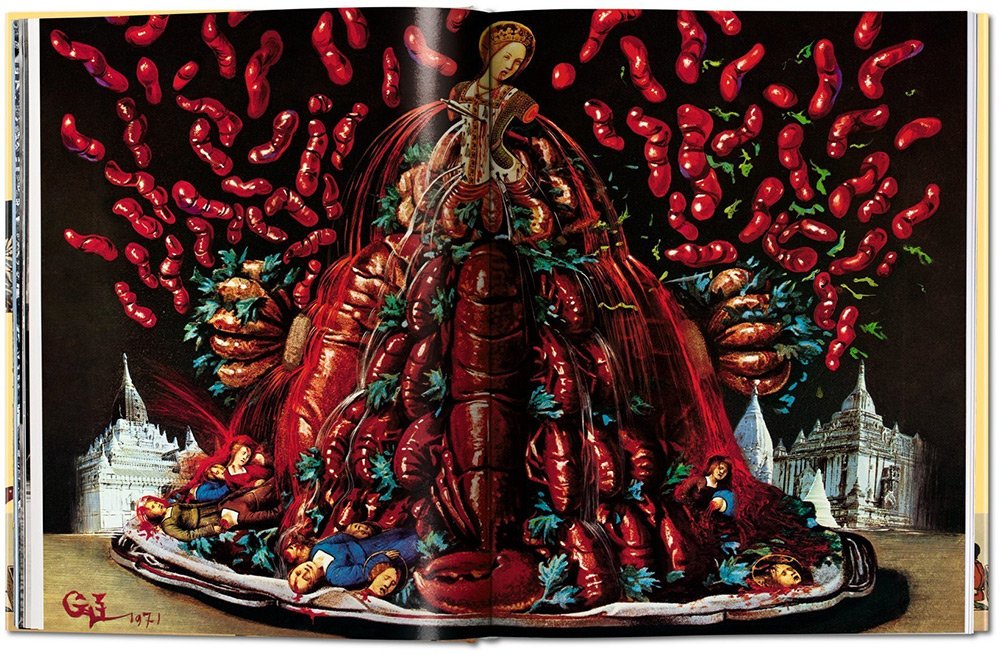
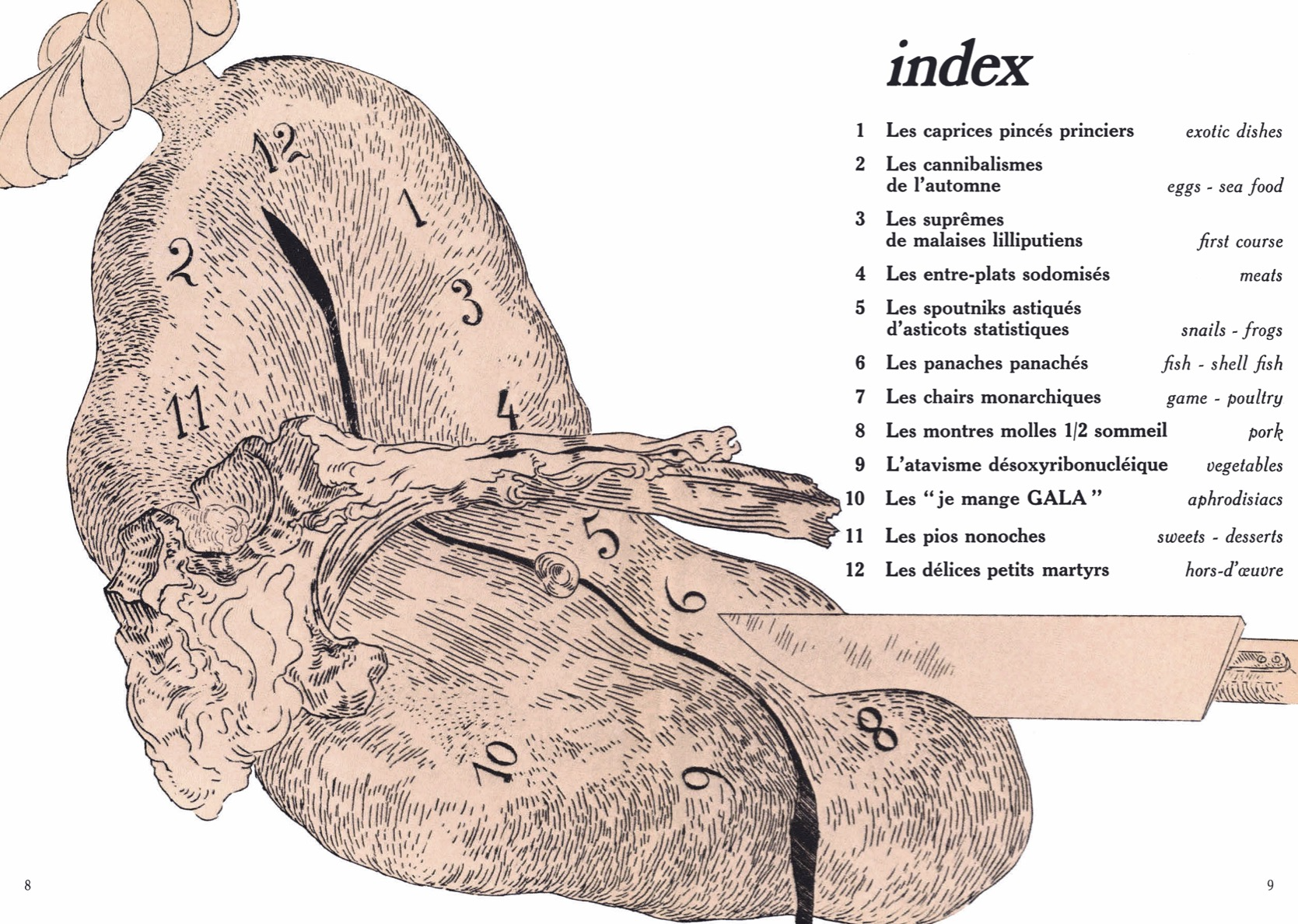
Green may seek repentance for the sin of poaching lobsters’ freshwater cousins, but Dali, who blamed his sex-related guilt on his Catholic upbringing, was unconflicted about enjoying the “delicious little martyrs”:
If I hate that detestable degrading vegetable called spinach, it is because it is shapeless, like Liberty. I attribute capital esthetic and moral values to food in general, and to spinach in particular. The opposite of shapeless spinach, is armor. I love eating suits of arms, in fact I love all shell fish… food that only a battle to peel makes it vulnerable to the conquest of our palate.
If your scruples, schedule or savings keep you from attempting Dali’s Surreal shellfish tower, you might try enlivening a less aspirational dish with Green’s wholesome, homemade fish stock:
Devin Lytle and Jared Nunn, test driving Dali’s Cassanova cocktail and Eggs on a Spit for History Bites on Buzzfeed’s Tasty channel, seem less surefooted than Green in both the kitchen and the realm of art history, but they’re totally down to speculate as to whether or not Dali and his wife, Gala, had a “healthy relationship.”
If you can stomach their snarky, self-referential asides, you might get a bang out of hearing them dish on Dali’s revulsion at being touched, Gala’s alleged penchant for bedding younger artists, and their highly unconventional marriage.
Despite some squeamishness about the eggs’ viscousness and some reservations about the surreal amount of butter required, Lytle and Nunn’s reaction upon tasting their Dali recreation suggest that it was worth the effort:
Cassanova cocktail
• The juice of 1 orange
• 1 tablespoon bitters (Campari)
• 1 teaspoon ginger
• 4 tablespoons brandy
• 2 tablespoons old brandy (Vielle Cure)
• 1 pinch Cayenne pepper
This is quite appropriate when circumstances such as exhaustion, overwork or simply excess of sobriety are calling for a pick-me-up.
Here is a well-tested recipe to fit the bill.
Let us stress another advantage of this particular pep-up concoction is that one doesn’t have to make the sour face that usually accompanies the absorption of a remedy.
At the bottom of a glass, combine pepper and ginger. Pour the bitters on top, then brandy and “Vielle Cure.” Refrigerate or even put in the freezer.
Thirty minutes later, remove from the freezer and stir the juice of the orange into the chilled glass.
Drink… and wait for the effect.
It is rather speedy.
Your best bet for preparing Eggs on a Spit, which Lytle compares to “an herby, scrambled frittata that looks like a brain”, are contained in artist Rosanna Shalloe’s modern adaption.
What would you do if you discovered an original, autographed copy of Les Diners de Gala in the attic of your new home?
A young man named Brandon takes it to Rick Harrison’s Gold & Silver Pawn Shop, hoping it will fetch $2500.
Harrison, star of the History Channel’s Pawn Stars, gives Brandon a quick primer on the Persistence of Memory, Dali’s famous “melting clocks” painting (failing to mention that the artist insisted the clocks should be interpreted as “the Camembert of time.”)
Brandon walks with something less than the hoped for sum, and Harrison takes the book home to attempt some of the dishes. (Not, however, Bush of Crayfish in Viking Herb, which he declares, “a little creepy, even for Dali.”)

Alas, his younger relatives are wary of Oasis Leek Pie’s star ingredient and refuse to entertain a single mouthful of whole fish, baked with guts and eyes.
They’re not alone. The below newsreel suggests that comedian Bob Hope had some reservations about Dalinian Gastro Esthetics, too.
We intend to ignore those charts and tables in which chemistry takes the place of gastronomy. If you are a disciple of one of those calorie-counters who turn the joys of eating into a form of punishment, close this book at once; it is too lively, too aggressive, and far too impertinent for you. — Salvador Dali
You can purchase a copy of Taschen’s recent reissue of Les Diners de Gala online.
Related Content
Salvador Dalí’s 1973 Cookbook Gets Reissued: Surrealist Art Meets Haute Cuisine
Walk Inside a Surrealist Salvador Dalí Painting with This 360º Virtual Reality Video
Salvador Dalí’s Tarot Cards, Cookbook & Wine Guide Re-Issued as Beautiful Art Books
- Ayun Halliday is the Chief Primatologist of the East Village Inky zine and author, most recently, of Creative, Not Famous: The Small Potato Manifesto. Follow her @AyunHalliday.
Read More...How Quentin Tarantino Remixes History: A Brief Study of Once Upon a Time… in Hollywood
For more than two hours, Quentin Tarantino’s Once Upon a Time… in Hollywood builds up to the Manson murders. Or rather, it seems to be building up to the Manson murders, but then takes a sharp turn on Cielo Drive; when the credits roll, the real-life killers are dead and the real-life victims alive. Such revisionist revenge is of a piece with other recent Tarantino pictures like Inglourious Basterds, which ends with the massacre of Hitler and Goebbels, among other Nazis, and Django Unchained, wherein the titular slave lays waste to the house of the master. Long well known for borrowing from other movies, Tarantino seems to have found just as rich a source of material in history books.
Once Upon a Time… in Hollywood “creates a new story using existing characters and situations, and many of them just happen to be real.” So says Kirby Ferguson in the video essay above, “Tarantino’s Copying: Then Vs. Now.” The film’s large cast of secondary characters includes such 1960s celebrities as Steve McQueen and Bruce Lee, as well as countless other figures recognizable mainly to the director’s fellow pop-culture obsessives.
Also portrayed is Charles Manson and the ragged young members of the “Manson Family” recruited to do his bidding, as well as are their intended victims of the night of August 8, 1969, most prominently the actress Sharon Tate. It is she, Ferguson argues, who ties together Once Upon a Time… in Hollywood’s various threads of fact and fiction.
Leonardo DiCaprio’s washed-up actor Rick Dalton and Brad Pitt’s blacklisted stuntman Cliff Booth, the film’s main characters, are wholly Tarantinian creations. 26 years old and pregnant with the child of her husband Roman Polanski (a version of whom also shows up in one scene), the rising Tate shares a métier with Dalton, and when the Manson family come for her in the film, they end up face-to-face with Booth (much to their misfortune), “but unlike both of them, she is a real person, and what is depicted of her is, broadly speaking, true.” Using these characters real and imagined, Tarantino “takes a dark, frightening, and just crushingly sad reality and gives it a happy ending with brutal retribution.” For all the postmodern borrowing and shuffled storytelling that launched him into Hollywood, the man knows how to give audiences just what they want — and somehow to surprise them even as he does it.
Related content:
A Deep Study of the Opening Scene of Quentin Tarantino’s Inglourious Basterds
How Quentin Tarantino Steals from Other Movies: A Video Essay
Quentin Tarantino’s Once Upon a Time… In Hollywood Examined on Pretty Much Pop #12
Based in Seoul, Colin Marshall writes and broadcasts on cities, language, and culture. His projects include the Substack newsletter Books on Cities, the book The Stateless City: a Walk through 21st-Century Los Angeles and the video series The City in Cinema. Follow him on Twitter at @colinmarshall or on Facebook.
Read More...The Enduring Appeal of Schulz’s Peanuts — Pretty Much Pop: A Culture Podcast #116

Animator/musician David Heatley, comedian Daniel Lobell, and academic/3anuts author Daniel Leonard join your Pretty Much Pop host Mark Linsenmayer to discuss Charlie Brown and his author Charles Schulz from Peanuts’ 1950 inception through the classic TV specials through to the various post-mortem products still emerging.
What’s the enduring appeal, and is it strictly for kids? We talk about the challenges of the strip format, the characters as archetypes, Schulz as depressed existentialist, religion in Peanuts, and whether the strip is actually supposed to be funny.
Some articles we used for the discussion include:
- “The Paradox of Peanuts” by Bruce Handy
- “All Your Life, Charlie Brown. All Your Life.” by Eric Schulmiller
- “A Charlie Brown Christmas may work even better now than it did 50 years ago” by David Grossman
- “10 Weirdest Charlie Brown Parodies Of All Time” by Phil Hall
- “Why Are Newspaper Comics So Terrible?” by Scott Meslow
Also, RIP Peter Robbins (the day before we recorded this). Here’s the 1982 Rerun comic Daniel Leonard reads us near the beginning. The biography that we keep referring to is David Michaelis’ Schulz and Peanuts: A Biography. Yes, Dondi was a real (bad) comic strip.
Check out David’s new album and other projects at davidheatley.com. Follow him @heatleycomics on Twitter and @davidheatley on Instgram.
Get Daniel Lobell’s Fair Enough comic at fairenoughcomic.com and read about the rest of his activities at dannylobell.com. Follow him @DanielLobell on Twitter and @daniellobell on Instagram.
Read Daniel Leonard’s 3anuts, and buy Peanuts and Philosophy, which contains one of his essays. Follow on Twitter @3anuts.
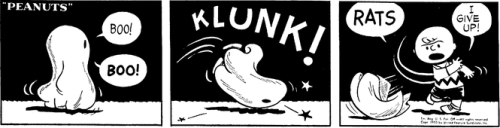
Here’s a 3eanuts example. Leaving off the last panel leaves us in despair!
This episode includes bonus discussion you can access by supporting the podcast at patreon.com/prettymuchpop or by choosing a paid subscription through Apple Podcasts. This podcast is part of the Partially Examined Life podcast network.
Pretty Much Pop: A Culture Podcast is the first podcast curated by Open Culture. Browse all Pretty Much Pop posts.
Read More...3,200-Year-Old Egyptian Tablet Records Excuses for Why People Missed Work: “The Scorpion Bit Him,” “Brewing Beer” & More
We marvel today at what we consider the wonders of ancient Egypt, but at some point, they all had to have been built by people more or less like ourselves. (This presumes, of course, that you’ve ruled out all the myriad theories involving supernatural beings or aliens from outer space.) Safe to say that, whenever in human history work has been done, work has been skipped, especially when that work is performed by large groups. It would’ve taken great numbers indeed to build the pyramids, but even less colossally scaled tombs couldn’t have been built alone. And when a tomb-builder took the day off, he needed an excuse suitable to be written in stone — on at any rate, on stone.
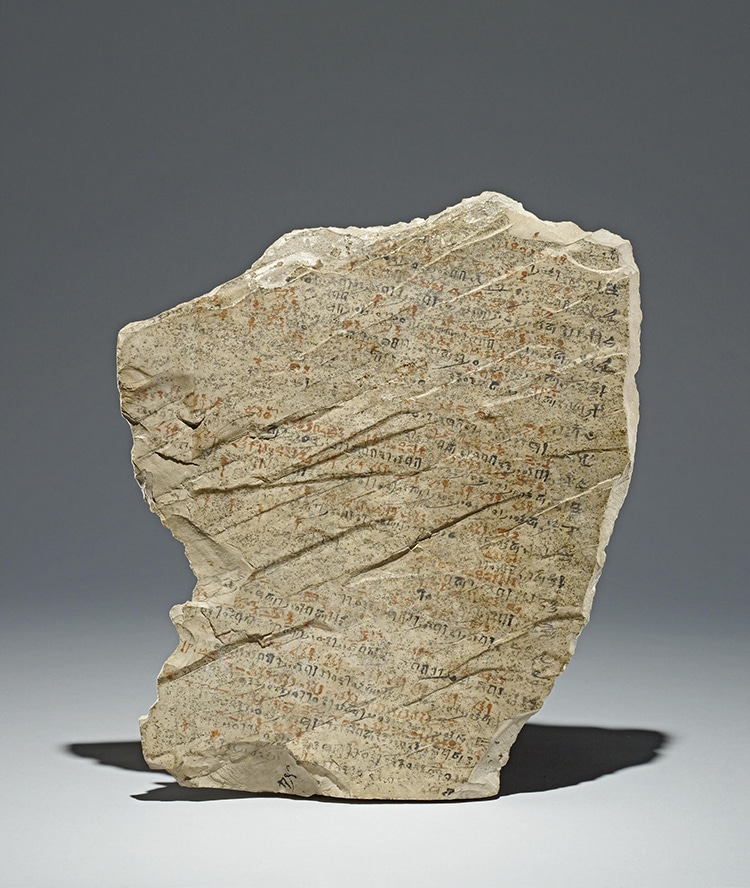
“Ancient Egyptian employers kept track of employee days off in registers written on tablets,” writes Madeleine Muzdakis at My Modern Met. One such artifact “held by the British Museum and dating to 1250 BCE is an incredible window into ancient work-life balance.” Called ostraca, these tablets were made of “flakes of limestone that were used as ‘notepads’ for private letters, laundry lists, records of purchases, and copies of literary works,” according to Egyptologist Jennifer Babcock.
Discovered along with thousands of others in the tomb builder’s village of Deir el-Medina, this particular ostracon, on view at the British Museum’s web site, offers a rich glimpse into the lives of that trade’s practitioners. Over the 280-day period covered by this 3,200-year-old ostracon, common excuses for absence include “brewing beer” and “his wife was bleeding.”
Beer, Muzdakis explains, “was a daily fortifying drink in Egypt and was even associated with gods such as Hathor. As such, brewing beer was a very important activity.” And alarming though that “bleeding” may sound, the reference is to menstruation: “Clearly men were needed on the home front to pick up some slack during this time. While one’s wife menstruating is not an excuse one hears nowadays, certainly the ancients seem to have had a similar work-life juggling act to perform.” Most of us today presumably have it easier than did the average ancient Egyptian laborer, or even artisan. Depending on where you live, maybe you, too, could call in sick to work with the excuse of having been bitten by a scorpion. But how well would it fly if you were to plead the need to feast, to embalm your brother, or to make an offering to a god?
Related content:
A 4,000-Year-Old Student ‘Writing Board’ from Ancient Egypt (with Teacher’s Corrections in Red)
Try the Oldest Known Recipe For Toothpaste: From Ancient Egypt, Circa the 4th Century BC
An Ancient Egyptian Homework Assignment from 1800 Years Ago: Some Things Are Truly Timeless
The Turin Erotic Papyrus: The Oldest Known Depiction of Human Sexuality (Circa 1150 B.C.E.)
Wonders of Ancient Egypt: A Free Online Course from the University of Pennsylvania
Based in Seoul, Colin Marshall writes and broadcasts on cities, language, and culture. His projects include the Substack newsletter Books on Cities, the book The Stateless City: a Walk through 21st-Century Los Angeles and the video series The City in Cinema. Follow him on Twitter at @colinmarshall or on Facebook.
Read More...P.J. O’Rourke (RIP) Explains Why You Can Never Win Over Your Political Adversaries by Mocking Them
Donald Trump, as his supporters and detractors alike can agree, is immune to humor. All the parody, satire, ridicule, and insult with which he was ceaselessly bombarded during his four years as the President of the United States of America had, to a first approximation, no effect whatsoever. If anything, it just made him more powerful. “There has been tremendous scorn for and fun made of Trump, and indeed Trump supporters,” says the late humorist P.J. O’Rourke in the clip above from a 2106 Intelligence Squared event. But “when you are angry at the establishment, and you see the establishment not just disagreeing with your candidate but mocking your candidate, there is an element that says, ‘They’re mocking me.’ ”
As a result, “every time you went out to make fun of Trump, you increased his support, because people were feeling scorned.” The result of the 2016 election, which happened the next month, would seem to have borne this out. “When people feel they are outsiders,” O’Rourke says, “you cannot convince them by mocking them.” This may, at first, sound somewhat rich coming from a writer who spent half a century turning everything that so much as approached the world of politics into joke material. But O’Rourke didn’t engage in mockery, per se; rather, he straightforwardly observed that which came before him. “Humor isn’t about being funny,” he once said in another interview. “It’s about putting emotional distance between yourself and the patterns of human behavior.”
I’ve long kept that observation in mind, as I have so much else O’Rourke wrote and said. If any one thing made me a writer, it was all the fifteen-minute breaks from my high-school job at the Gap I spent reading his books at the Borders on the other side of the mall. I took a rebellious pleasure, at that age and at that time, in getting laughs from the work of a writer who was clearly not a man of the left. Or rather, a writer who was formerly a man of the left: a self-confessed 1960s hippie, he like many of the Baby Boom generation underwent a political conversion after noticing the deductions from his paycheck. “I’d been struggling for years to achieve socialism in America,” goes one of his oft-quoted lines, “only to discover that we had it already.”
Yet O’Rourke was never a doctrinaire right-winger. Forged at the National Lampoon (for which he wrote the well known piece “How to Drive Fast on Drugs While Getting Your Wing-Wang Squeezed and Not Spill Your Drink”) he emerged as a 1980s libertarian-libertine. In recent decades, during which he often appeared as a convivial political outsider on shows like National Public Radio’s Wait, Wait… Don’t Tell Me, he shifted to the territory referenced in the title of his last book, 2020’s A Cry from the Far Middle. In the video above he reads its introduction, a dispatch from a time of not just “moron populism and idiot partisanship” but also a “grievous health crisis, lockdown isolation, economic collapse, and material deprivation.” Once a wisecracking correspondent from the world’s trouble spots, he knew to bet that even in America, “human nature will triumph over adversity and challenge. And I don’t mean that in a good way.”
You can read O’Rourke’s obituary here.
Related content:
Noam Chomsky on Whether the Rise of Trump Resembles the Rise of Fascism in 1930s Germany
Comedians Speaking Truth to Power: Lenny Bruce, George Carlin & Richard Pryor (NSFW)
Bill Hicks’ 12 Principles of Comedy
Based in Seoul, Colin Marshall writes and broadcasts on cities, language, and culture. His projects include the Substack newsletter Books on Cities, the book The Stateless City: a Walk through 21st-Century Los Angeles and the video series The City in Cinema. Follow him on Twitter at @colinmarshall or on Facebook.
Read More...Support Us
We're hoping to rely on loyal readers, rather than erratic ads. Please click the Donate button and support Open Culture. You can use Paypal, Venmo, Patreon, even Crypto! We thank you!

About Us

Open Culture scours the web for the best educational media. We find the free courses and audio books you need, the language lessons & educational videos you want, and plenty of enlightenment in between.
Advertise With Us
FREE UPDATES!
GET OUR DAILY EMAIL
Get the best cultural and educational resources on the web curated for you in a daily email. We never spam. Unsubscribe at any time.
FOLLOW ON SOCIAL MEDIA
Open Culture editor Dan Colman scours the web for the best educational media. He finds the free courses and audio books you need, the language lessons & movies you want, and plenty of enlightenment in between.
Advertise With Us

