Animals Laugh Too: UCLA Study Finds Laughter in 65 Species, from Rats to Cows
Every pet owner knows that animals love to play, but laughter seems reserved for humans, a few apes, and maybe a few birds good at mimicking humans and apes. As it turns out, according to a new article published in the journal Bioacoustics, laughter has been “documented in at least 65 species,” Jessica Wolf writes at UCLA Newsroom. “That list includes a variety of primates, domestic cows and dogs, foxes, seals, and mongooses, as well as three bird species, including parakeets and Australian magpies.” This is a far cry from just a few years ago when apes and rats were the “only known animals to get the giggles,” as Liz Langley wrote at National Geographic in 2015.
Yes, rats laugh. How do scientists know this? They tickle them, of course, as you can see in the video just above. (Rat tickling, it turns out, is good for the animals’ well being.) The purpose of this experiment was to better understand human touch — and tickling, says study author Michael Brecht, “is one of the most poorly understood forms of touch.”
Laughter, on the other hand, seems somewhat better understood, even among species separated from us by tens of millions of years of evolution. In their recent article, UCLA primatologist Sasha Winkler and UCLA professor of communication Greg Bryant describe how “play vocalizations” signal non-aggression during roughhousing. As Winkler puts it:
When we laugh, we are often providing information to others that we are having fun and also inviting others to join. Some scholars have suggested that this kind of vocal behavior is shared across many animals who play, and as such, laughter is our human version of an evolutionarily old vocal play signal.
Generally, humans are unlikely to recognize animal laughter as such or even perceive it at all. “Our review indicates that vocal play signals are usually inconspicuous,” the authors write. Rats, for example, make “ultrasonic vocalizations” beyond the range of human hearing. The play vocalizations of chimpanzees, on the other hand, are much more similar to human laughter, “although there are some differences,” Winkler notes in an interview. “Like, they vocalize in both the in-breath and out breath.”
Why study animal laughter? Beyond the inherent interest of the topic — an especially joyful one for scientific researchers — there’s the serious business of understanding how “human social complexity allowed laughter to evolve from a play-specific vocalization into a sophisticated pragmatic signal,” as Winkler and Bryant write. We use laughter to signal all kinds of intentions, not all of them playful. But no matter how many uses humans find for the vocal signal, we can see in this new review article how deeply non-aggressive play is embedded throughout the animal world and in our evolutionary history. Read “Play vocalisations and human laughter: a comparative review” here.
Related Content:
Eye of the Pangolin: The Search for an Animal on the Edge
Download Animals and Ethics 101: Thinking Critically About Animal Rights (Free)
Josh Jones is a writer and musician based in Durham, NC. Follow him at @jdmagness
Read More...75 Post-Punk and Hardcore Concerts from the 1980s Have Been Digitized & Put Online: Fugazi, GWAR, Lemonheads, Dain Bramage (with Dave Grohl) & More
Between 1985 and 1988, a teenager by the name of Sohrab Habibion was attending punk and post-punk shows around the Washington, DC area. What set him apart was the bulky video camera he’d bring to the show and let roll, documenting entire gigs in all their low-rez, lo-fi glory. Just a kid trying to document a great night out. Habibion might not have known at the time what an important time capsule he was creating, but these 60 or so tapes have now been digitized and uploaded to YouTube, thanks to Roswell Films and the DC Public Library’s Punk Archive.
“Please keep in mind that I was a teenager when I shot these shows,” Habibion writes, “and had zero proficiency with the equipment. And, as you might imagine, nobody was doing anything with the lights or the sound to make things any better. What you get here is what was recorded on my Betamax and probably best appreciated with a bit of generosity as a viewer.”
Highlights include the above full concert by Fugazi on December 28, 1987, a year before their first e.p. and playing songs that would turn up on their 1990’s classic debut Repeater; Descendents in 1987 at the height of their career; The Lemonheads when they were a punk band and not a power pop group; the insane and hilarious GWAR from 1988, the year of their debut; and another hometown punk band, Dain Bramage, which featured Dave Grohl on drums, long before he played with Nirvana and the Foo Fighters (see below).
Habibion went on to his own musical career: first as the frontman for post-hardcore band Edsel, and currently as part of the band SAVAK.
Habibion’s tape archive makes one wonder: who else is out there sitting on a trove of historic recordings? And where is that person’s equivalent of the DC Library? Who would help fund such a project? And who would see the worth of such recordings? Not only are Habibion’s tapes about the bands themselves, but they tell a separate history of music venues come and gone, of a time and place that will never come again. Watch the shows here.
Related Content
Ted Mills is a freelance writer on the arts who currently hosts the Notes from the Shed podcast and is the producer of KCRW’s Curious Coast. You can also follow him on Twitter at @tedmills, and/or watch his films here.
Read More...400,000+ Sound Recordings Made Before 1923 Have Entered the Public Domain
A century ago, the United States was deep into the Jazz Age. No writer is more closely associated with that heady era than F. Scott Fitzgerald, who (in addition to coining the verb to cocktail) took it upon himself to popularize its name. In 1922 he even titled a short story collection Tales from the Jazz Age, which entered the public domain not long ago. You may be more familiar with another work of Fitzgerald’s that followed Tales from the Jazz Age into freedom just last year: a novel called The Great Gatsby. But only this year have the actual sounds of the Jazz Age come into the public domain as well, thanks to the Music Modernization Act passed by U.S. Congress in 2018.
“According to the act, all sound recordings prior to 1923 will have their copyrights expire in the US on January 1, 2022,” says the Public Domain Review. This straightens out a tangled legal framework that previously wouldn’t have allowed the release of pre-1923 sound recordings until the distant year of 2067.
And so all of us now have free use of every sound recording from a more than 60-year period that “comprises a rich and varied playlist: experimental first dabblings, vaudeville, Broadway hits, ragtime, and the beginnings of popular jazz. Included will be the works of Scott Joplin, Thomas Edison’s experiments, the emotive warblings of Adelina Patti and the first recording of Swing Low, Sweet Chariot.”
If you’d like to have a listen to all this, the Public Domain Review recommends starting with its own audio collection, a search for all pre-1923 recordings on Internet Archive, and two projects from the Library of Congress: the National Jukebox and the Citizen DJ project, the latter of which “has plans to do something special with the pre-1923 recordings once they enter the public domain.” You might also have a look at the Association for Recorded Sound Collections’ list of ten notable pre-1923 recordings, which highlights such proto-jazz records as “Crazy Blues” and “Dixieland Jass Band One-Step” (along with the wholly non-jazz work of Enrico Caruso and Pablo Casals).
According to Alexis Rossi at the Internet Archive Blog, the sound recordings just liberated by the Music Modernization act come to about 400,000 in total. Among them you’ll find “early jazz classics like ‘Don’t Care Blues’ by Mamie Smith and her Jazz Hounds, ‘Ory’s Creole Trombone’ by Kid Ory’s Sunshine Orchestra, and ‘Jazzin’ Babies Blues’ by Ethel Waters.” Rossi also highlights the novelty songs such as Billy Murray’s 1914 rendition of “Fido is a Hot Dog Now,” “which seems to be about a dog who is definitely going to hell.” The Jazz Age soon to come would exhibit a more raucous but also more refined sensibility: as Fitzgerald wrote in 1931, with the era he defined (and that defined him) already past, “It was an age of miracles, it was an age of art, it was an age of excess, and it was an age of satire.”
Related content:
Free: The Great Gatsby & Other Major Works by F. Scott Fitzgerald
Hear the First Jazz Record, Which Launched the Jazz Age: “Livery Stable Blues” (1917)
The Cleanest Recordings of 1920s Louis Armstrong Songs You’ll Ever Hear
Great New Archive Lets You Hear the Sounds of New York City During the Roaring 20s
Based in Seoul, Colin Marshall writes and broadcasts on cities and culture. His projects include the book The Stateless City: a Walk through 21st-Century Los Angeles and the video series The City in Cinema. Follow him on Twitter at @colinmarshall or on Facebook.
Read More...In 1953, a Telephone-Company Executive Predicts the Rise of Modern Smartphones and Video Calls
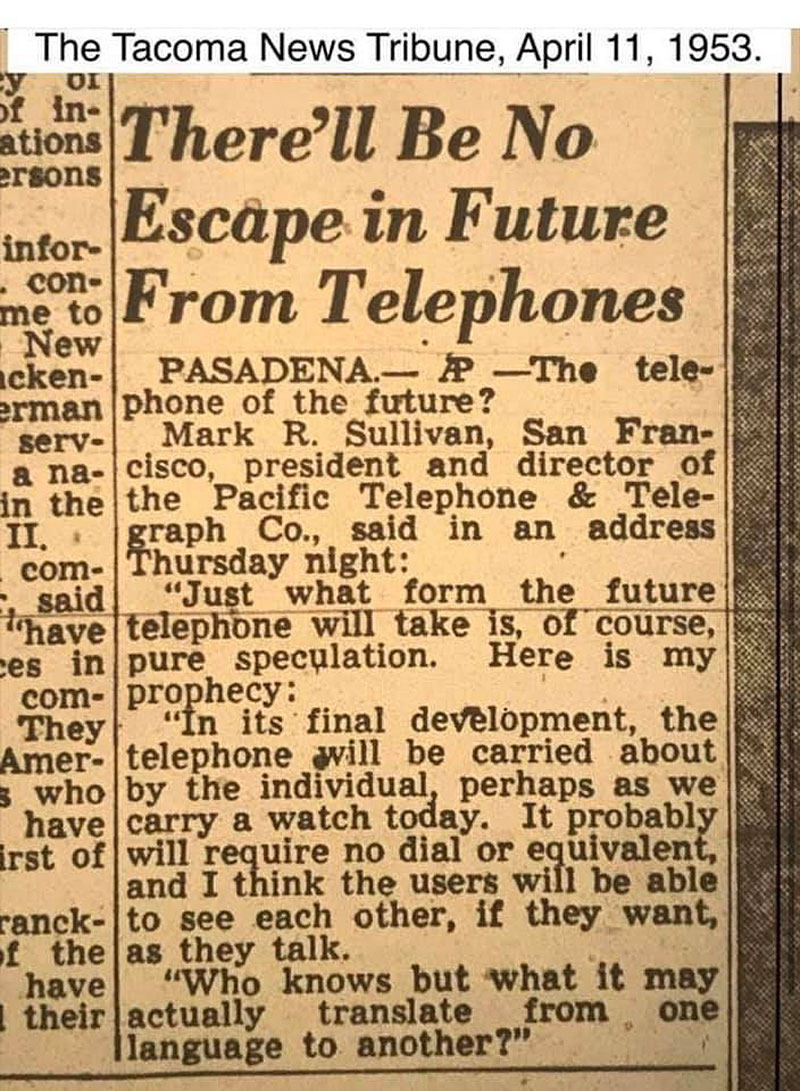
We live in the age of the smartphone, which took more than a few of us by surprise. But in all human history, not a single piece of technology has actually come out of nowhere. Long before smartphones came on the market in the 2000s, those close to the telecommunications industry had a sense of what form its most widely used device would eventually take. “Here is my prophecy: In its final development, the telephone will be carried about by the individual, perhaps as we carry a watch today,” said Pacific Telephone and Telegraph Company director Mark R. Sullivan in 1953. “It probably will require no dial or equivalent and I think the users will be able to see each other, if they want, as they talk. Who knows but it may actually translate from one language to another?”
Sullivan’s prescient-sounding words survive in the clipping of the Associated Press article seen at the top of the post. It’s worth remembering that the speech in question dates from a time when the rotary phone was the most advanced personal communication device in American households.
Just three years earlier, writes KQED’s Rae Alexandra, Sullivan “appeared in the San Francisco Examiner talking about the latest innovations in telephone technology. The advancement he was most proud of was a new device about the size of a small typewriter that automatically calculated how long people’s phone calls were.” However logical, pocket telephones with video-calling and translation capabilities would then have struck many as the stuff of science fiction.
Though born before the time of household electrification, Sullivan himself lived just long enough to see the debut of the first commercial cellphone “The Motorola DynaTAC 8000X was definitely not watch-sized and cost a whopping $3,995 in 1983 (about $11,000 today),” writes Alexandra, “but Sullivan might have seen this development as a step towards his long-ago vision — a sign that every one of his 1953 predictions would eventually come to fruition.” As printed in the Tacoma News Tribune, the AP article conveying those predictions to the public appeared under the headline “There’ll Be No Escape in Future from Telephones,” which sounds even more chilling today — in that very future — than it did nearly 70 years ago. But then, even the visions of actual science fiction are seldom wholly untroubled.
Related Content:
A 1947 French Film Accurately Predicted Our 21st-Century Addiction to Smartphones
When We All Have Pocket Telephones (1923)
Filmmaker Wim Wenders Explains How Mobile Phones Have Killed Photography
Based in Seoul, Colin Marshall writes and broadcasts on cities and culture. His projects include the book The Stateless City: a Walk through 21st-Century Los Angeles and the video series The City in Cinema. Follow him on Twitter at @colinmarshall or on Facebook.
Read More...Harper Lee Gives Advice to Young Writers in One of Her Only Interviews Captured on Audio (1964)
You know the character Boo Radley? Well, if you know Boo, then you understand why I wouldn’t be doing an interview. Because I am really Boo.
– Harper Lee, in a private conversation with Oprah Winfrey
Author Harper Lee loved writing but resisted interviews, granting just a handful in the fifty-six years that followed the publication of her Pulitzer Prize winning 1960 novel, To Kill a Mockingbird.
Go Set a Watchman, her second, and final, novel began as an early draft of To Kill a Mockingbird, and was published in 2015, a year before her death.
Roy Newquist, interviewing Lee in 1964 for WQXR’s Counterpoint, above, probably expected the hotshot young novelist had many more books in her when he solicited her advice for “the talented youngster who wants to carve a career as a creative writer.”
Presumably Lee did too. “I hope to goodness that every novel I do gets better and better, not worse and worse,” she remarked toward the end of the interview.
She obliged Newquist by offering some advice, but stopped short of offering career tips to those eager for the lowdown on how to write an instant bestseller that will be adapted for stage and screen, earn a perennial spot in middle school curriculums, and — just last week — be crowned the Best Book of the Past 125 Years in a New York Times readers’ poll, beating out titles by well regarded, and vastly more prolific authors on the order of J.R.R. Tolkien, George Orwell, Gabriel García Márquez, and Toni Morrison.
“People who write for reward by way of recognition or monetary gain don’t know what they’re doing. They’re in the category of those who write; they are not writers,” she drawled.
Harper Lee’s Advice to Young Writers
- Hope for the best and expect nothing in terms of recognition
- Write to please an audience of one: yourself
- Write to exorcise your divine discontent
- Gather material from the world around you, then turn inward and reflect
- Don’t major in writing
Listening to the recording, it occurs to us that this interview contains some more advice for young writers, or rather, those bringing up children in the digital age.
When Newquist wonders why it is that “such a disproportionate share of our sensitive and enduring fiction springs from writers born and reared in the South,” Lee, a native of Monroeville, Alabama, makes a strong case for cultivating an environment wherein children have no choice but to make their own fun:
I think … the absence of things to do and see and places to go means a great deal to our own private communication. We can’t go to see a play; we can’t go to see a big league baseball game when we want to. We entertain ourselves.
This was my childhood: If I went to a film once a month it was pretty good for me, and for all children like me. We had to use our own devices in our play, for our entertainment. We didn’t have much money. Nobody had any money. We didn’t have toys, nothing was done for us, so the result was that we lived in our imagination most of the time. We devised things; we were readers, and we would transfer everything we had seen on the printed page to the backyard in the form of high drama.
Did you never play Tarzan when you were a child? Did you never tramp through the jungle or refight the battle of Gettysburg in some form or fashion? We did. Did you never live in a tree house and find the whole world in the branches of a chinaberry tree? We did.
I think that kind of life naturally produces more writers than, say, an environment like 82nd Street in New York.
Hear that, parents and teachers of young writers?
- Nurture the creative spirit by regularly prying the digital device’s from young writers’ hands (and minds.)
Bite your tongue if, thus deprived, they trot off to the theater, the multiplex, or the sports stadium. Remember that iPhones hadn’t been invented when Lee was stumping for the tonic effects of her chinaberry tree. These days, any unplugged real world experience will be to the good.
If the young writers complain — and they surely will — subject yourself to the same terms.
Call it solidarity, self-care, or a way of upholding your New Year’s resolution…
Read an account of another Harper Lee interview, during her one day visit to Chicago to promote the 1962 film of To Kill a Mockingbird and attend a literary tea in her honor, here.
Related Content:
Harper Lee Gets a Request for a Photo; Offers Important Life Advice Instead (2006)
Writing Tips by Henry Miller, Elmore Leonard, Margaret Atwood, Neil Gaiman & George Orwell
Ayun Halliday is the Chief Primatologist of the East Village Inky zine and author, most recently, of Creative, Not Famous: The Small Potato Manifesto. Follow her @AyunHalliday.
Read More...What’s Entering the Public Domain in 2022: The Sun Also Rises, Winnie-the-Pooh, Buster Keaton Comedies & More
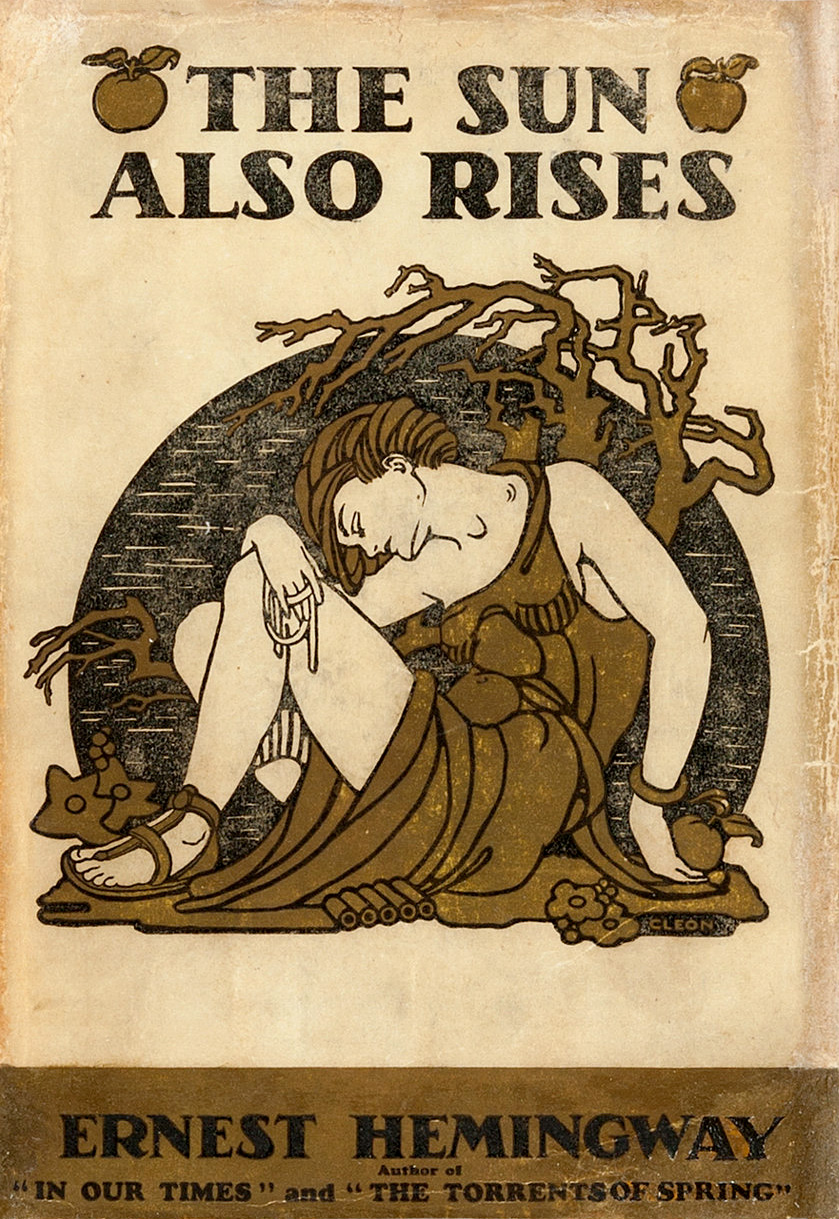
Ernest Hemingway “made the English language new, changed the rhythms of the way both his own and the next few generations would speak and write and think. The very grammar of a Hemingway sentence dictated, or was dictated by, a certain way of looking at the world, a way of looking but not joining, a way of moving through but not attaching, a kind of romantic individualism distinctly adapted to its time and source.” So writes the late Joan Didion, a writer hardly without influence herself, in a 1998 reflection on the author of such novels as A Farewell to Arms, For Whom the Bell Tolls, and The Old Man and the Sea.
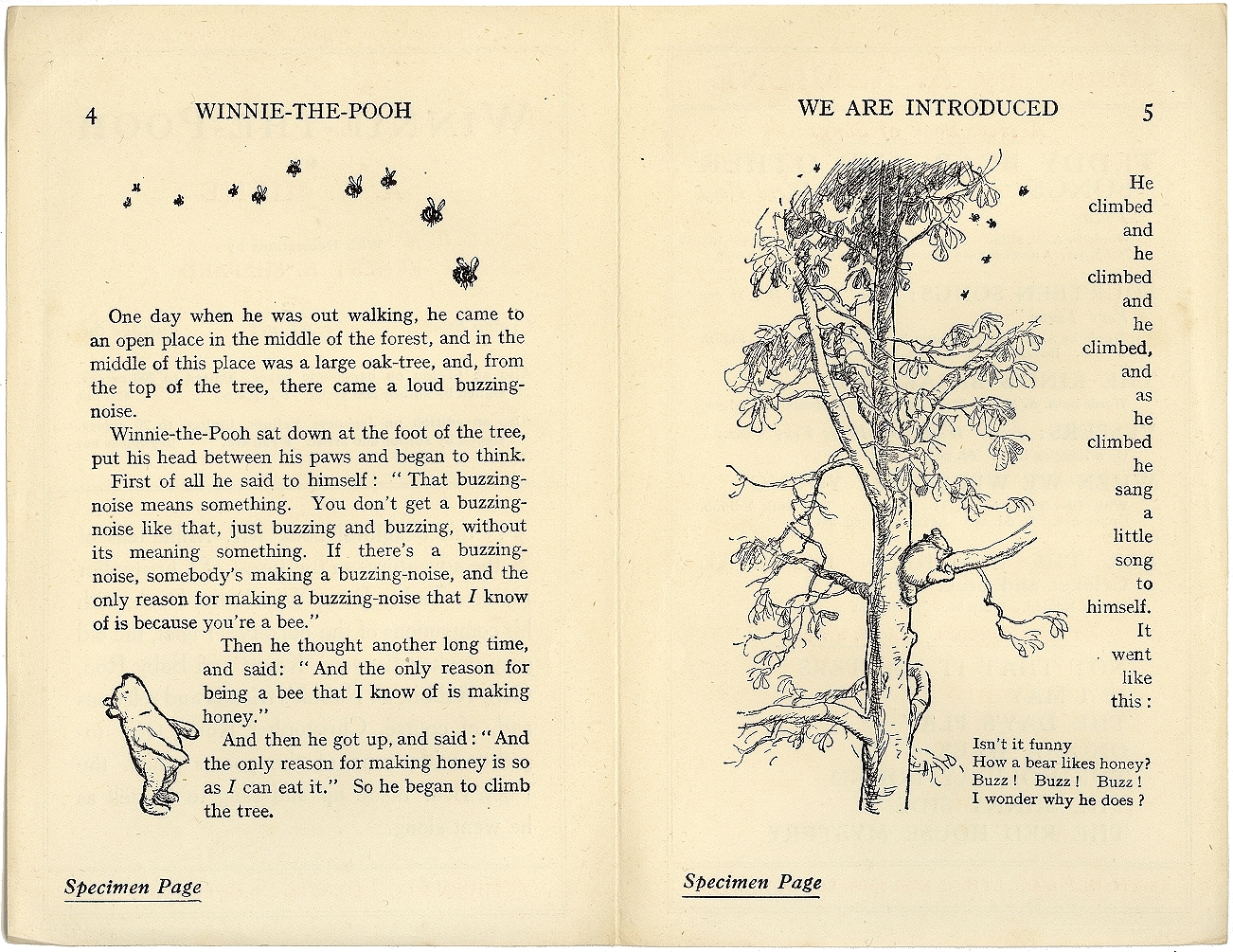
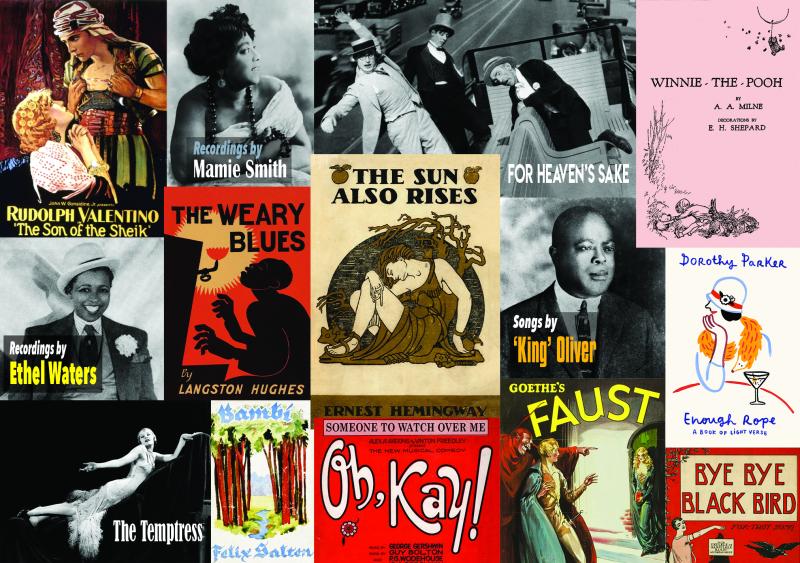
The literary phenomenon that was Hemingway began in earnest, as it were, with The Sun Also Rises. Having been published in 1926, his first full-length novel now stands on the brink of the public domain. So do a variety of other works that launched storied careers: William Faulkner’s first novel Soldiers’ Pay, for instance, or A.A. Milne’s Winnie-the-Pooh, which introduced the now-beloved titular bear to the reading public. Having celebrated his 90th anniversary back in 2016 with the addition of a new penguin character to the Hundred Acre Wood, Winnie-the-Pooh remains the core of what has developed into a formidable cultural industry.
The work of Hemingway, too, has inspired no small amount of commercial enterprise. (Didion writes of Thomasville Furniture Industries’ new “Ernest Hemingway Collection,” whose themes include “Kenya,” “Key West,” “Havana,” and “Ketchum.”) But now that work itself has begun to come legally available to all, free of charge: “anyone can rescue them from obscurity and make them available, where we can all discover, enjoy, and breathe new life into them.”
So writes Jennifer Jenkins, Director of Duke’s Center for the Study of the Public Domain, in her post on Public Domain Day 2022. In it she names a host of other 1926 books similarly set for liberation, including Langston Hughes’ The Weary Blues, T. E. Lawrence’s The Seven Pillars of Wisdom, Agatha Christie’s The Murder of Roger Ackroyd, and H. L. Mencken’s Notes on Democracy.
The deeper we get into the 21st century, the wider the variety of media that falls into the public domain. Jenkins highlights silent-film comedies like For Heaven’s Sake with Harold Lloyd and Battling Butler with Buster Keaton, as well — the mid-1920s having seen the dawn of the “talkie” — as sound pictures like Don Juan, the “first feature-length film to use the Vitaphone sound system.” Unlike in previous years, a large number of not just musical compositions but actual sound recordings will also come available for free reuse. These include records by jazz and blues singer Ethel Waters, operatic tenor Enrico Caruso, cellist Pablo Casals, and composer-pianist Sergei Rachmaninoff. And as for those waiting to reuse the work of Joan Didion, rest assured that The White Album will be yours on Public Domain Day 2091.
On a related note, the Public Domain Review has a nice post overviewing the sound recordings entering the public domain in ’22.
Related Content:
Ernest Hemingway’s Very First Published Stories, Free as an eBook
Hear the Classic Winnie-the-Pooh Read by Author A.A. Milne in 1929
Watch the Great Russian Composer Sergei Rachmaninoff in Home Movies
The Public Domain Project Makes 10,000 Film Clips, 64,000 Images & 100s of Audio Files Free to Use
Based in Seoul, Colin Marshall writes and broadcasts on cities and culture. His projects include the book The Stateless City: a Walk through 21st-Century Los Angeles and the video series The City in Cinema. Follow him on Twitter at @colinmarshall or on Facebook.
Read More...How Fashionable Dutch Women (Like the Girl with a Pearl Earring) Got Dressed in 1665
Remember how it felt to be bundled into tights, socks, jeans, a thick sweater, a snowsuit, mittens, only to realize that you really needed to pee?
Back in 1665, the Little Ice Age compelled the well-to-do ladies of Delft to turn themselves out with a similar eye toward keeping warm, but their ensembles had a distinct advantage over the Christmas Story snowsuit approach.
Relieving themselves was as easy as hiking their skirts, petticoats, and voluminous, lace-trimmed chemise. No flies for freezing fingers to fumble with. In fact, no drawers at all.
Historical costumer Pauline Loven, a creator of the Getting Dressed In… series, builds this elite outfit from the innermost layer out, above, noting that clothing was an avenue for well-to-do citizens to flaunt their wealth:
- A long, full, Linen or silk chemise trimmed with lace at the cuff
- A waist-tied hip pad to bolster several layers of cozy, lined petticoats
- An elegant silk gown comprised of several components:
- A flat fronted skirt tucked into pleats at the sides and back
- A laced up bodice stiffened with whale bone stays
- Detachable sleeves
- A stomacher for front-laced bodices
- A loose fitting, fur-trimmed velvet or silk jacket
- Silk or woolen thigh-high stockings gartered below the knee (created for the episode by heritage educator, and knitwear designer Sally Pointer)
- A linen or silk kerchief pinned or tied at the breast
- Square-toed leather shoes with a curved heel (created for the episode by Kevin Garlick, who specializes in handmade shoes for re-enactors.)
Fashionable accessories might include a foot warming, charcoal powered voeten stoof and understated jewelry, like the pearls Johannes Vermeer painted to such luminous effect.
If that doesn’t tip you off to the direction this historic recreation is headed, allow us to note that the attendant, who’s far from the focus of this episode, is garbed so as to suggest The Milkmaid by a certain Dutch Baroque Period painter who specialized in domestic interior scenes…and whose initials are J.V.
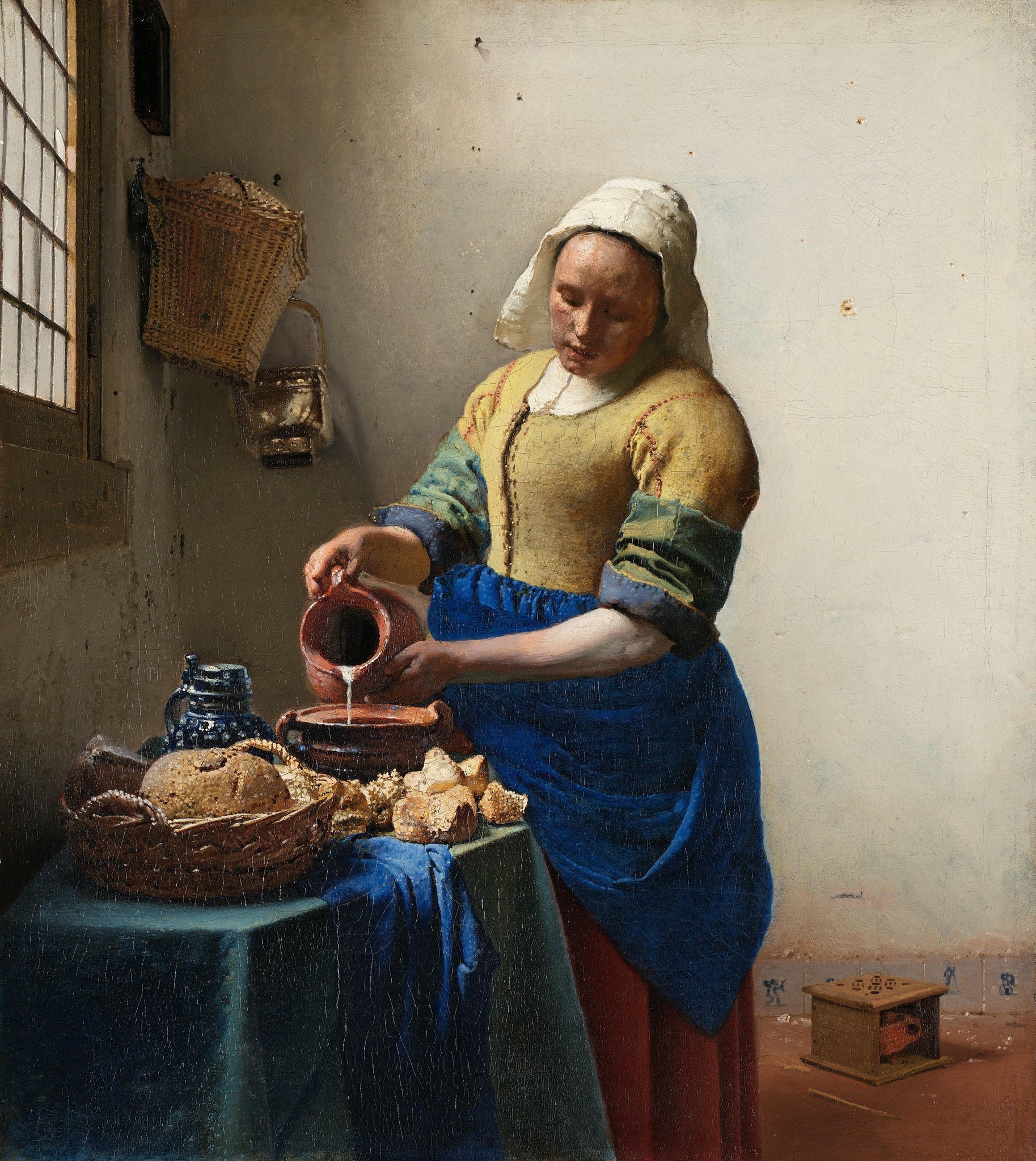
The finishing touch is a turban of yellow silk taffeta and blue silk dupion, an exotic element that may produce a sense of deja vu in art lovers … and anyone who relishes a good art-based recreation challenge.
View more of Pauline Loven’s work and Getting Dressed In… episodes focused on other periods at Crow’s Eye Productions’ YouTube channel.
Related Content:
A Pre-Pantone Guide to Colors: Dutch Book From 1692 Documents Every Color Under the Sun
Street Art for Book Lovers: Dutch Artists Paint Massive Bookcase Mural on the Side of a Building
Ayun Halliday is an author, theatermaker, and the Chief Primaologist of the East Village Inky zine. Her latest book, Creative, Not Famous: The Small Potato Manifesto, will be published in early 2022. Follow her @AyunHalliday.
Read More...Brian Eno Shares His Critical Take on Art & NFTs: “I Mainly See Hustlers Looking for Suckers”
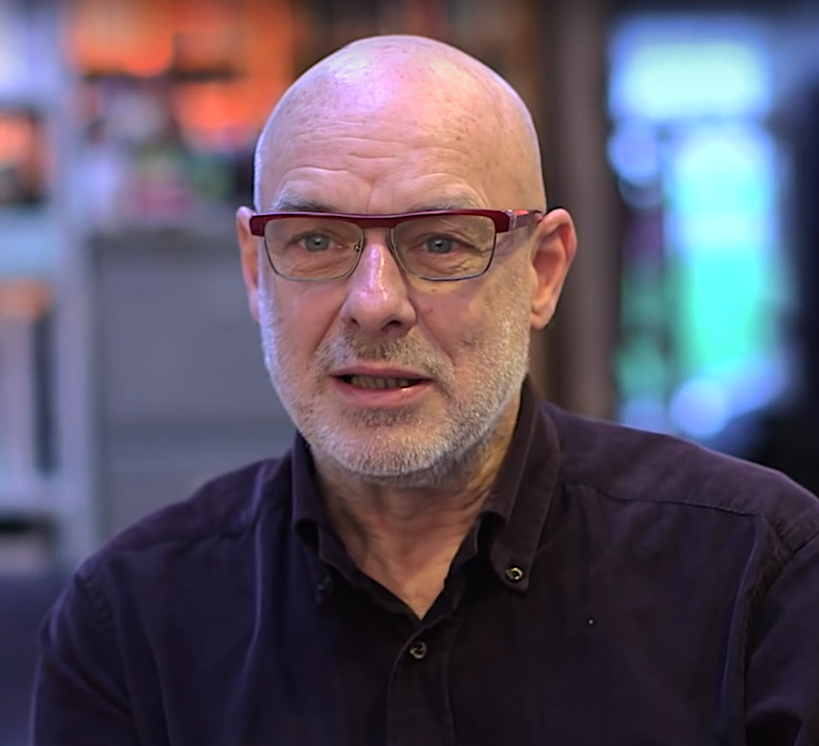
Image via Wikimedia Commons
It can feel, in our inequality-addled world, that we have little left in common — that there is no “we,” just us and them. But multiple crises driving us apart have the potential to unite the species. After all, a rapidly warming planet and global pandemic do threaten us all, even if they don’t threaten us equally. Do solutions exist in the creation of new forms of private property, new ways of moving capital around the world? Can the extinction-level byproducts of capitalist commodification and waste be mitigated by ingenious new forms of financialization? These seem to be the arguments made by purveyors of cryptocurrency and NFTs, an acronym meaning non fungible tokens and — if you haven’t noticed — the only thing anyone in the art world seems to talk about anymore. Why?
Brian Eno has put his opinion on the matter quite bluntly in a recent interview. “NFTs seem to me just a way for artists to get a little piece of the action from global capitalism,” he tells The Crypto Syllabus. “How sweet — now artists can become little capitalist assholes as well.” He obviously disapproves of using art solely to generate profit, but then if we know anything about Eno’s theory of creativity and influence over the past several decades, it’s that he believes the guiding reason for art is to generate more art.
“If I had primarily wanted to make money I would have had a different career as a different kind of person. I probably wouldn’t have chosen to be an artist.” There’s utterly no use in trying to peg Eno as technophobic or out of touch; quite the contrary. But the fictional financial products that have invaded every other sphere of life have no place in the arts, he argues.
When asked why NFTs are touted as a salvation for artists and the art world by cryptocurrency visionaries, including many of his friends and collaborators, Eno replies:
I can understand why the people who’ve done well from it are pleased, and it’s natural enough in a libertarian world to believe that something that benefits you must automatically be ‘right’ for the whole world. That belief is a version of what I call ‘automaticism’: the idea that if you leave things alone and let something or other – the market, nature, human will – take its course unimpeded you will automatically get a better result than you would by tinkering with it. The people who hold beliefs of this kind don’t have any qualms about tinkering themselves but just want a situation where nobody else gets to tinker. Especially the state.
That the sale of NFTs have only benefitted very few — to the tune of $69 million in a single sale in a recent high-profile case — doesn’t seem particularly troublesome to those who insist on their benefits. Nor do the creators of NFTs seem bothered by the enormous energy overhead required by the technology, “an ecological nightmare pyramid scheme,” writes Synthtopia — of which Eno says: “in a warming world a new technology that uses vast amounts of energy as ‘proof of work’ — that’s to say, simply to establish a certain age of exclusivity — really is quite insane.”
Eno readily answers questions about why NFTs seem so glamorous — it’s no great mystery, just a new form of accumulation, commodification and waste, one in particular that adds nothing to the world while hastening a climate collapse. NFTs are the “readymade reversed,” David Joselit argues: Where “Duchamp used the category of art to liberate materiality from commodifiable form; the NFT deploys the category of art to extract private property from freely available information.”
The discourse around NFTs also seems to liberate art from the category of art, and all that has meant to humankind for millennia as a communal practice, reducing creative productions to digital certificates of authenticity. “I am trying to keep an open mind about these questions,” Eno admits. “People I like and trust are convinced [NFTs] are the best thing since sliced bread, so I wish I could have a more positive view but right now I mainly see hustlers looking for suckers.”
Related Content:
What are Non-Fungible Tokens (NFTs)? And How Can a Work of Digital Art Sell for $69 Million
What Is Blockchain? Three Videos Explain the New Technology That Promises to Change Our World
Josh Jones is a writer and musician based in Durham, NC. Follow him at @jdmagness
Read More...Asleep at the Wheel Frontman Ray Benson Discusses Half a Hundred Years of Songwriting: Stream the Nakedly Examined Music Interview Online
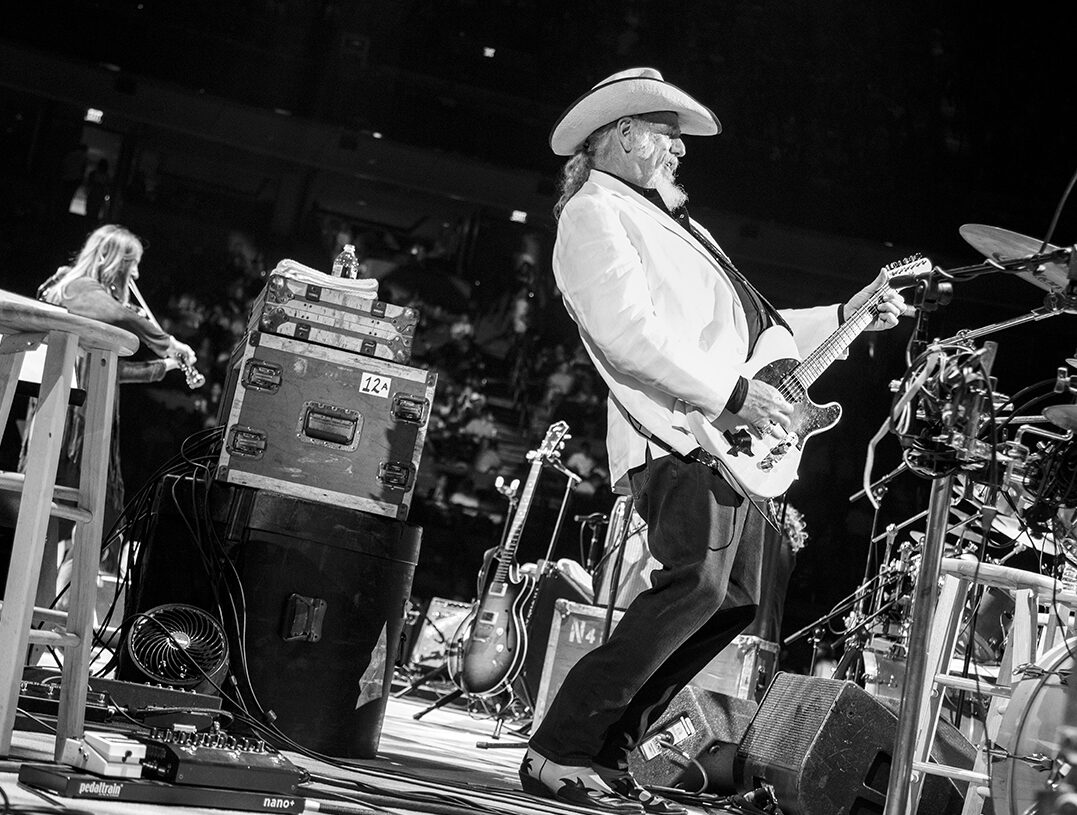
This week’s Nakedly Examined Music podcast features the Grammy-winning Texas swing band, Asleep at the Wheel, which Ray founded in 1969. They’ve released 26 albums of original tunes and classic covers while touring constantly, with Ray being the only consistent member through their various line-ups.
Your host Mark Linsenmayer talks with Ray about the title track from Half a Hundred Years (2021), “Pedernales Stroll” from Keepin’ Me Up Nights (1990), and “Am I High” from The Wheel (1977). Intro: “The Letter (That Johnny Walker Read)” from Texas Gold (1975). Closer: “The Road Will Hold Me Tonight” feat. Emmylou Harris and Willie Nelson, recorded in the early 80s but only released now on the new album. Learn more at asleepatthewheel.com.
Watch the video for “Half a Hundred Years.” Watch “Am I High?” live on 80s TV. Here’s the band live recently at the Paste Studio and playing their 25th Anniversary show on Austin City Limits in 1996. Their most famous tune is “Hot Rod Lincoln.” Here they are with Willie Nelson. Here’s a very old TV performance of “Take Me Back to Tulsa.” Hear all of “The Letter (That Johnny Walker Read).”
Image by Mike Shore.
Nakedly Examined Music is a podcast hosted by Mark Linsenmayer, who also hosts The Partially Examined Life Philosophy Podcast, Pretty Much Pop: A Culture Podcast, and Philosophy vs. Improv. He releases music under the name Mark Lint.
Read More...500 Years of Haircuts: One Youtuber Tries Out the Hair Styles That Were Fashionable Between 1500 and 2000
“In Mankiewicz’s Julius Caesar, all the characters are wearing fringes,” writes Roland Barthes in his well-known essay on Romans in film. “Some have them curly, some straggly, some tufted, some oily, all have them well combed.” This fringe, Barthes argues, is “quite simply the label of Roman-ness”: when it comes onscreen, “no one can doubt that he is in Ancient Rome.” Ever since cinema first told historical tales, hair has been among its most effective visual shorthands with which to establish an era. This is in part due to hairstyles themselves having varied since the beginning of recorded history, and — in one form or another — no doubt before it as well. But how many of them could we pull off today?
In the video above, Youtuber Morgan Donner addresses that question as directly as possible: by trying out half a millennium’s worth of hairstyles herself. As a woman, she’s been provided much more to work with by fashion history (to say nothing of biology) than have the successors of all those fringed Roman men. She begins in 1520, a period whose art reveals “a fairly consistent center-part kind of smooth look going on” with braids behind, all easy replicable. 110 years later “things get actually quite interesting,” since fashions begin to encompass not just hairstyles but haircuts, properly speaking, requiring different sections of hair to be different lengths — and requiring Donner to whip out her scissors.
About a century later, Donner takes note of a pattern whereby “styles get bigger and bigger and bigger, and then — foof — they deflate.” Such, it seems, has become the general tendency of not just culture but many other human pursuits as well: the gradual inflation of a bubble of extremity, followed by its sudden bursting. It’s in the 18th century that Donner’s project turns more complex, beginning to involve such things as lard, powder, and hair cushions. But she gets a bit of a respite when the 1800s come along, and “it’s almost like everyone collectively decided that they were tired of it, and you know what? Messy bun. That’s good enough.” Yet in hair as in all things, humanity never keeps it simple for long.
Viewers of film and television historical dramas (which themselves have been booming for some time now) will recognize more than a few of the hairstyles Donner gives herself throughout this video. But the deeper she gets into the 20th century, the more of them remain in living memory. Take the 1940s’ shoulder-length curls with pinned-back layers on top, which many of us will recognize from pictures of our grandmothers. That particular hairstyle doesn’t seem to have been revived since, but from the 1960s on, Donner works through a series of looks that have provided no little inspiration to our retromaniac 21st century. At the end of her historical-tonsorial journey, she fires up the clippers and buzzes herself completely — thus beginning hair Year Zero.
Related Content:
Get the Ancient Roman Look: A Hair & Makeup Video Tutorial
How a Baltimore Hairdresser Became a World-Renowned “Hair Archaeologist” of Ancient Rome
50 Years of Changing David Bowie Hair Styles in One Animated GIF
Based in Seoul, Colin Marshall writes and broadcasts on cities and culture. His projects include the book The Stateless City: a Walk through 21st-Century Los Angeles and the video series The City in Cinema. Follow him on Twitter at @colinmarshall or on Facebook.
Read More...Support Us
We're hoping to rely on loyal readers, rather than erratic ads. Please click the Donate button and support Open Culture. You can use Paypal, Venmo, Patreon, even Crypto! We thank you!

About Us

Open Culture scours the web for the best educational media. We find the free courses and audio books you need, the language lessons & educational videos you want, and plenty of enlightenment in between.
Advertise With Us
FREE UPDATES!
GET OUR DAILY EMAIL
Get the best cultural and educational resources on the web curated for you in a daily email. We never spam. Unsubscribe at any time.
FOLLOW ON SOCIAL MEDIA
Open Culture editor Dan Colman scours the web for the best educational media. He finds the free courses and audio books you need, the language lessons & movies you want, and plenty of enlightenment in between.
Advertise With Us



