Enjoy Classic Songs from A Charlie Brown Christmas, Performed by Vince Guaraldi Trio Drummer Jerry Granelli
We’re living in times where so much is done to manipulate us. And things last for, what, a news cycle? A few minutes? This [album] is something that’s lasted 50 years. And not only lasted, but grown … I think there’s just a humanness. — Jerry Granelli
As the Christmas season winds down, so too do marketing blitzes and consumerist frenzies that make it hard to see the holiday as anything but a year-end cash grab. But even the most cynical among us might admit to being moved each year by one Christmas classic, no matter our religious beliefs, capitalist sympathies, or lack thereof: that classic, of course, is The Charlie Brown Christmas Special. The talents of Charles Schulz, producer Lee Mendelson, and the Vince Guaraldi Trio combined to make a show not only bigger than its parts, but even more enduring, perhaps, than the juggernaut of Christmas commerce.
The choice of jazz for a primetime children’s Christmas special was inspired and edgy in 1965, though Guaraldi and his band weren’t originally booked for the holidays but for a never-completed documentary about Shultz that sparked the interest of corporate sponsor Coca-Cola. Mendelson realized the potential of the loose, breezy West Coast jazz of pianist Guaraldi, bassist Fred Marshall, and drummer Jerry Granelli for the newly-commissioned special, and the band imported much from their original music, improvising two new compositions and playing bluesy versions of “O Tannenbaum” and “Hark! The Herald Angels Sing.”
As Granelli remembers it, Coke execs weren’t pleased. “[A] little kid was going to come out and say what Christmas was all about, which wasn’t about shopping. And then the jazz music, which was improvised,” did not jive with the suits. Nonetheless the show aired, to the great delight of children and grown-ups everywhere for the past half century or so. Granelli himself feared pigeonholing and left the project with “some residual bad feelings over his paltry credit and royalties.” He later “spent decades avoiding any nostalgia trip to the land of Linus and Lucy,” Nate Chinen writes at WBGO. “But within the last decade” before his death in July 2021, “he leaned into Peanuts, recognizing the joy that Guaraldi’s soundtrack imparted, especially around the holidays.”
In the videos above, you can see Granelli play “Linus and Lucy” and “Skating” with his trio, with Chris Gestrin on Piano and Simon Fisk on bass, in 2014. Mentored by Dave Brubeck’s drummer, Joe Morello, Granelli toured the States in his early 20s, then joined the Vince Guaraldi Trio on returning to his home in the Bay Area. He “quickly found his footing, becoming an essential pat of the Guaraldi sound,” writes Chinen. Guaraldi’s original themes like “Linus and Lucy” and “Skating” “benefit immeasurably from Granelli’s whisper-soft brushwork.” The Trio went on to record with Brazilian bossa nova guitarist Bola Sete, and the drummer made his mark on the music world in other contexts, co-founding and teaching at the Creative Music Program of Naropa Institute (now Naropa University) in Boulder Colorado in the 1970s.
“Jazz is just a reflection of life,” Granelli told CBC Radio in 2020. “Life is improvised, life is uncertain. It’s not solid. It’s not permanent. The art I choose disappears after it’s played, it goes off into the ether. I love that.” That may be so, but Granelli’s contribution to the art of The Charlie Brown Christmas Special — music recorded in a 3‑hour session when he was only 24 years old — has now outlasted him, the last member of the Vince Guaraldi Trio to pass away. May he skate on in peace, wherever he is now.
Related Content:
How Innovative Jazz Pianist Vince Guaraldi Became the Composer of Beloved Charlie Brown Music
Umberto Eco Explains the Poetic Power of Charles Schulz’s Peanuts
Josh Jones is a writer and musician based in Durham, NC. Follow him at @jdmagness
Read More...Why Europe Has So Few Skyscrapers
Guy de Maupassant ate lunch at the restaurant in the base of the Eiffel Tower nearly every day, that being the only place in Paris where he wouldn’t have to look at the Eiffel Tower. 130 years later, the observation deck of the Tour Montparnasse is known to offer the most beautiful vista on the French capital — thanks precisely to the invisibility of the Tour Montparnasse. Spare a thought, if you will, for that highly conspicuous building, quite possibly the loneliest in Europe. Since its completion in 1973, it has stood as the sole skyscraper in Paris proper, its famous unsightliness having inspired a ban on the construction of buildings over seven stories high in the city center.
Paris isn’t alone in its lack of skyscrapers, a condition travelers from Asia and America notice in cities all over the Continent. In the video above, construction-themed Youtube channel The B1M explores the reasons for this relative paucity of tall towers in the capitals of Europe. “When skyscrapers first rose to prominence in the 19th century, first in Chicago and later in New York, many European cities were already firmly established with grand historic buildings and public spaces that left little room for large new structures,” says its narrator. At that time, a growing sense of cultural competition between America and Europe also meant that “each continent became wary of adopting the other’s concepts.”
Then came the Second World War, in the wake of whose devastation of Europe “an overwhelming desire to restore what had been destroyed took hold.” Few Continental cities held off the kind of demand for floor space that drove skyscraper construction in America. In the east, the Soviets built mostly “mid-rise, repetitive structures that sought to rehouse much of the population”; in the west, the restrictive phenomenon of “Brusselization” took hold in response to a wave of bulky postwar-modernist structures “that had little regard for architectural or cultural value.” This led to “a general dislike for modern buildings across Europe, with many seeing them as bland or soulless.”
No one who’s spent time in American city centers built up predominantly in the 1960s and 70s can dismiss those European detractors’ fears. But it would be a lie to claim that European cities have avoided skyscrapers entirely: even Paris has simply pushed them a few miles away, into unromantic business districts like La Défense. Ever-taller buildings have symbolized modernity for well over a century now, and no civilization can afford to keep modernity at too great a distance. Taking note of how attitudes toward skyscrapers have been “softening across the Continent” in the 21st century, this B1M video speculates on the possibility of a “skyscraper boom” in Europe. But even if that should happen, the Tour Montparnasse will surely continue standing alone.
Related Content:
Why Do People Hate Modern Architecture?: A Video Essay
The Creation & Restoration of Notre-Dame Cathedral, Animated
Based in Seoul, Colin Marshall writes and broadcasts on cities and culture. His projects include the book The Stateless City: a Walk through 21st-Century Los Angeles and the video series The City in Cinema. Follow him on Twitter at @colinmarshall or on Facebook.
Read More...The Omicron Variant Explained by Neil deGrasse Tyson & Regeneron President George Yancopoulos
What is the Omicron Variant? How do vaccines work? And what about monoclonal antibody therapy? On this episode of StarTalk, Neil deGrasse Tyson has a wide-ranging and quite informative conversation with George Yancopoulos, president of Regeneron, the company that created the monoclonal antibody therapy now being used in the fight against COVID-19. And there’s an interesting side note: During the 1970s, Tyson and Yancopoulos were high school classmates together at Bronx Science. They’ve both come a long way, and now they re-unite to explain the science behind the latest phase of the pandemic.
If you would like to support the mission of Open Culture, consider making a donation to our site. It’s hard to rely 100% on ads, and your contributions will help us continue providing the best free cultural and educational materials to learners everywhere. You can contribute through PayPal, Patreon, and Venmo (@openculture). Thanks!
Related Content
1,700 Free Online Courses from Top Universities.
Neil deGrasse Tyson Lists 8 (Free) Books Every Intelligent Person Should Read
MIT Presents a Free Course on the COVID-19 Pandemic
Read More...Doreen Ketchens’ Astonishing Rendition of “The House of the Rising Sun”: A World-Class Clarinetist Busks on the Streets of New Orleans
Dirtiness has no description. It is a feeling. — music transcriber George Collier
You may be able to read music and play the clarinet, but it’s extremely unlikely you — or anyone — will be able to play along with Doreen Ketchens’ “dirty” solo on “The House of the Rising Sun,” above, despite an assist from Tom Pickles’ scrolling transcription.
Download the transcription for free and keep trying.
It’s what Ketchens, a world renowned clarinetist and music educator, who has played for four US presidents and busks regularly in the French Quarter, would advise.
“You have to practice and be ready to perform at the drop of a hat” she told The Clarinet’s Ben Redwine, when he asked if she had any advice for young musicians hoping to make it professionally.
She’s also a strong advocate of listening robustly, not throwing in the towel when someone else gets the job instead of you, and letting your personality come through in your playing:
You don’t want to sound like you’re playing an etude book. This is for all types of music – even classical. You want to move the audience, you want to touch them.
Trained as a classical clarinetist, Ketchens cozied up to jazz shortly after she cozied up to the tuba player who would become her husband. “All of the sudden, jazz wasn’t so bad,” she says:
I started to listen to jazz so I could learn the tunes and fit in with his band. I started listening to Louis Armstrong. He is my biggest influence. Some people call me Mrs. Satchmo, I guess because that concept is in my head. I’ll hear something he plays, which I’ve heard thousands of times, and I’ll think, “What? How did he do that?” Then, I listened to the clarinetists who played with him: Edmund Hall, Buster Bailey, Barney Bigard. Those cats were awesome too! Edmund Hall had this thing he could do, where it sounds like he was playing two tones at the same time. People today might hum while they play to achieve something similar, but I don’t think that was what he was doing. Buster Bailey had a similar background to me, starting out with classical music, then learning jazz. Early on, I emulated Jerry Fuller, clarinetist with the Dukes of Dixieland. I would steal so many of his solos just so I could keep up with my husband’s band. Eventually, I realized what he was doing, and it translated into me being able to improvise. I’d start out transcribing solos, then playing by ear, copying what those clarinetists were doing. I don’t remember those solos now, but I’m sure that I still play snippets of them that creep into my improvisations.
However she got there, she possesses a singular ability to make her instrument growl and her command of 32nd notes makes us feel a little lightheaded.
Clarinetists abound in New Orleans, and they probably all cover “The House of the Rising Sun,” but you’ll be hard pressed to find a more exciting rendition than Ketchens’ on the corner of St. Peter and Royal, with husband Lawrence on tuba and daughter Dorian on drums. Here’s the full versions, sans transcription.
You want an encore? Of course you do.
How about Ketchens’ magnificent solo on “Just a Closer Walk With Thee” for the Louisiana Philharmonic Orchestra?
Find more astonishing, transcribed solos and a heaping helping of Jacob Collier on George Collier’s (no relation) YouTube Channel.
His transcriptions, and those of collaborator Tom Pickles, are available for free download here, unless the artist sells their own transcription, in which case he encourages you to support the artist with your purchase.
If you’re a music nerd who would like to discuss transcriptions, give feedback on others’ attempts, and upload your own, join his community on Discord.
Related Content:
Women of Jazz: Stream a Playlist of 91 Recordings by Great Female Jazz Musicians
Jazz Virtuoso Oscar Peterson Gives Dick Cavett a Dazzling Piano Lesson (1979)
Little Kid Merrily Grooves to ZZ Top While Waiting for the Bus
Ayun Halliday is an author, theatermaker, and the Chief Primaologist of the East Village Inky zine. Her latest book, Creative, Not Famous: The Small Potato Manifesto, will be published in early 2022. Follow her @AyunHalliday.
Read More...A Deep Study of the Opening Scene of Quentin Tarantino’s Inglourious Basterds
Quentin Tarantino loves a cat-and-mouse scene, when forces of power and potential violence enter rooms, commandeer them, and play with their hapless victims. Think of Samuel L. Jackson’s Jules taking care of two hapless, out of their depth frat boy dope dealers—all the while helping himself to their Kahuna burger—in Pulp Fiction. Terrifying, hilarious, and electrifying: it has become one of his hallmarks. By the time of 2009’s Inglourious Basterds, he had perfected it so much that he devotes the film’s opening 20 minutes to one suspense-filled meeting between an unctuous Nazi and a French farmer, who is trying to hide a Jewish family under his floorboards.
Markus Madlangbayan (aka emotiondesigner) only has two film appreciation essays up on his Youtube site, and it’s a shame he didn’t do more. Here he takes us through Tarantino’s farmhouse scene, shot by shot, examining the director’s camera placement and composition, explaining his reasoning, and demonstrating why Quentin is a master of his craft.
Most directors use a standard form of coverage to shoot dialog scenes—a master shot of the two actors speaking, and then a close up of each actor with a tighter “punch in” shot of a face to emphasize drama. But Tarantino rarely does that, finding more interesting solutions to show the power dynamics in play. Farmer LaPadite at first has the upper hand, bluffing his way successfully through Hans Landa’s interrogation. That is, until he doesn’t. Tarantino will move his camera in an arc, breaking the 180 rule, and switching the positions of the characters on screen, even though they haven’t moved from their seats. The director has literally turned the table on LaPadite, just as Landa has done.
Tarantino is also very parsimonious with his close-ups. He gives LaPadite one as we see him steel himself for the approaching Nazis. He gives Landa one when all the social niceties are over, and instead he reveals he has known all along that they are sitting right above a hiding space. And finally, Tarantino gives LaPadite (and the actor that plays him, Denis Ménochet) a tight close-up as dread and impending death pass over his face.
Essayist emotiondesigner doesn’t do this, but this scene is asking for comparison with the aforementioned scene from Pulp Fiction. In 1994, Tarantino was hot and full of energy, but it’s actually a very conventionally shot scene, filled with close-ups and wides, but not without its wit. Fifteen years later, this short film-within-a-film opening shows how far the director had come.
Related Content:
Quentin Tarantino Explains How to Write & Direct Movies
Ted Mills is a freelance writer on the arts who currently hosts the Notes from the Shed podcast and is the producer of KCRW’s Curious Coast. You can also follow him on Twitter at @tedmills, and/or watch his films here.
Read More...Is There Life After Death?: John Cleese and a Panel of Scientists Discuss That Eternal Question
“I am sixty-five years old,” said John Cleese as he began one year’s convocation address at my university, “which is nearly dead.” It got enough of a laugh that I’m not surprised to find, looking it up all these years later, that he seem to have deployed the line many times since. “I’m now incredibly old,” he said last year in a video urging compliance with coronavirus rules. “I’m nearly dead. I am 81 years of age.” Nevertheless, he remains decidedly non-dead (and indeed active on Twitter) today, though no doubt reality-based enough to accept that he’s no less mortal than his fellow Pythons Graham Chapman and Terry Jones, who’ve preceded him into the afterlife — if indeed there is an afterlife.
That very question animates the 80-minute conversation above. Put on by the University of Virginia’s Division of Perceptual Studies at the 2018 Tom Tom Festival, it places Cleese at the head of a panel of scientists charged with probing one question: is there life after death?
Many will find the evidence discussed here fairly persuasive, especially the documented “near-death experiences.” In these cases “we have heightened mental thoughts when your brain isn’t functioning; we have accurate perceptions from outside the body; we have meetings with deceased loved ones who you didn’t know had died; we have meetings with deceased loved ones whom you didn’t know, period; and we don’t have a good physical explanation for this.”
So says Bruce Greyson, Professor Emeritus of Psychiatry and Neurobehavioral Sciences at the University of Virginia, one of the panel’s five distinguished non-Pythons. The others are Jim B. Tucker, the Division of Perceptual Studies director; Edward Kelly, one of its Professors of Research; Emily Williams Kelly, one of its Assistant Professors of Research; and UVA Professor of Psychiatry and Neurobehavioral Sciences Kim Penberthy. Their work suggests to them that, while near-death experiences may not reflect the detachment of soul from body, neither do they seem to be straightforward hallucinations. The trouble with mounting a rigorous investigation into such a rare phenomenon is the necessarily small number of cases. These researchers might thus consider taking on Cleese himself as a subject; after all, the man’s self-professed state of near-death has lasted more than fifteen years now.
Related Content:
Is There an Afterlife? Christopher Hitchens Speculates in an Animated Video
Elie Wiesel (RIP) Talks About What Happens When We Die
Carl Sagan Answers the Ultimate Question: Is There a God? (1994)
John Cleese Plays the Devil, Makes a Special Appeal for Hell, 1966
Based in Seoul, Colin Marshall writes and broadcasts on cities and culture. His projects include the book The Stateless City: a Walk through 21st-Century Los Angeles and the video series The City in Cinema. Follow him on Twitter at @colinmarshall or on Facebook.
Read More...When Maurice Sendak Created a Dark Nutcracker Ballet
Children are the perfect audience for The Nutcracker.
(Well, children and the grandmothers who can’t wait for the toddler to start sitting still long enough to make the holiday-themed ballet an annual tradition…)
Maurice Sendak, the celebrated children’s book author and illustrator, agreed, but found the standard George Balanchine-choreographed version so treacly as to be unworthy of children, dubbing it the “most bland and banal of ballets.”
The 1983 production he collaborated on with Pacific Northwest Ballet artistic directors Kent Stowell and Francia Russell did away with the notion that children should be “coddled and sweetened and sugarplummed and kept away from the dark aspects of life when there is no way of doing that.”
Tchaikovsky’s famous score remained in place, but Sendak and Stowell ducked the source material for, well, more source material. As per the New York City Ballet’s website, the Russian Imperial Ballet’s chief ballet master, Marius Petipa, commissioned Tchaikovsky to write music for an adaptation of Alexander Dumas’ child-friendly story The Nutcracker of Nuremberg. But The Nutcracker of Nuremberg was inspired by the much darker E.T.A. Hoffman tale, 1816’s “The Nutcracker and the Mouse King.”
The “weird, dark qualities” of the original were much more in keeping with Sendak’s self proclaimed “obsessive theme”: “Children surviving childhood.”
Sendak wanted the ballet to focus more intently on Clara, the young girl who receives the Nutcracker as a Christmas present in Act I:
It’s about her victory over her fear and her growing feelings for the prince… She is overwhelmed with growing up and has no knowledge of what this means. I think the ballet is all about a strong emotional sense of something happening to her, which is bewildering.
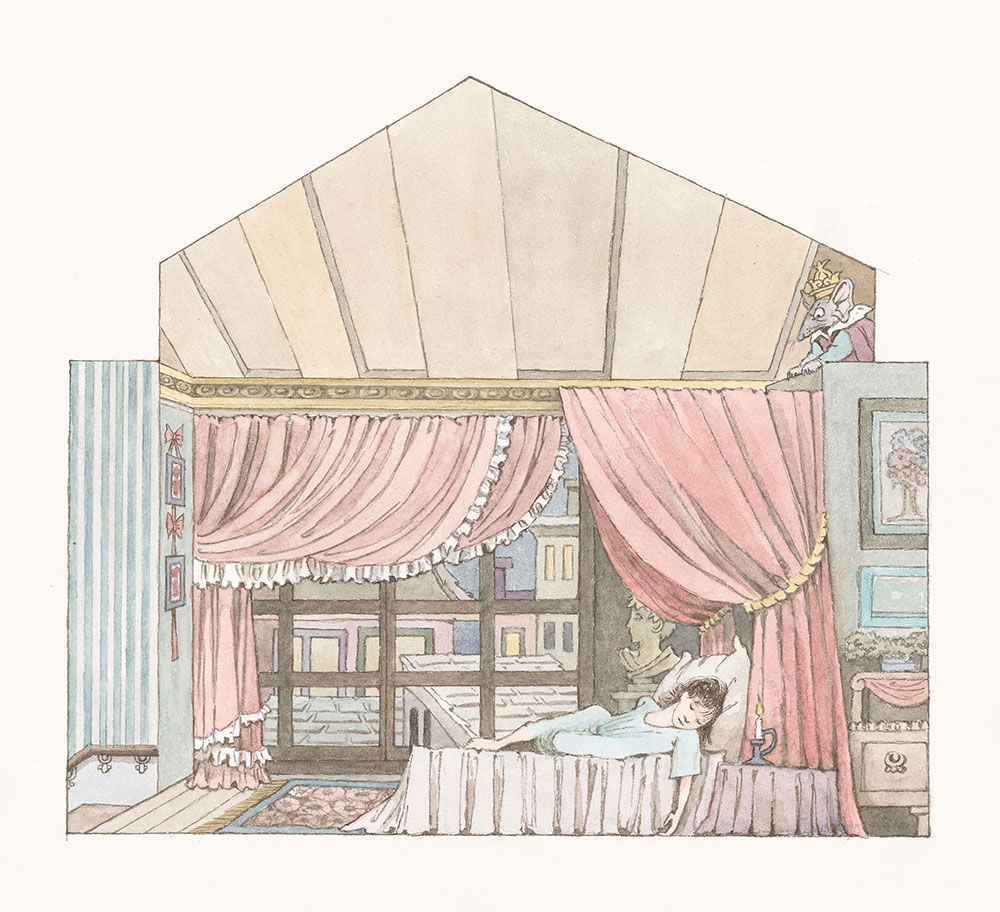
Balanchine must have felt differently. He benched Clara in Act II, letting the adult Sugarplum Fairy take centerstage, to guide the children through a passive tour of the Land of Sweets.
As Sendak scoffed to the Dallas Morning News:
It’s all very, very pretty and very, very beautiful… I always hated the Sugarplum Fairy. I always wanted to whack her.
“Like what kids really want is a candy kingdom. That shortchanges children’s feelings about life,” echoes Stowell, who revived the Sendak commission, featuring the illustrator’s sets and costumes every winter for 3 decades.
In lieu of the Sugar Plum Fairy, Sendak and Stowell introduced a dazzling caged peacock — a fan favorite played by the same dancer who plays Clara’s mother in Act I.
The threats, in the form of eccentric uncle Drosselmeier, a ferocious tiger, and a massive rat puppet with an impressive, pulsing tail, have a Freudian edge.
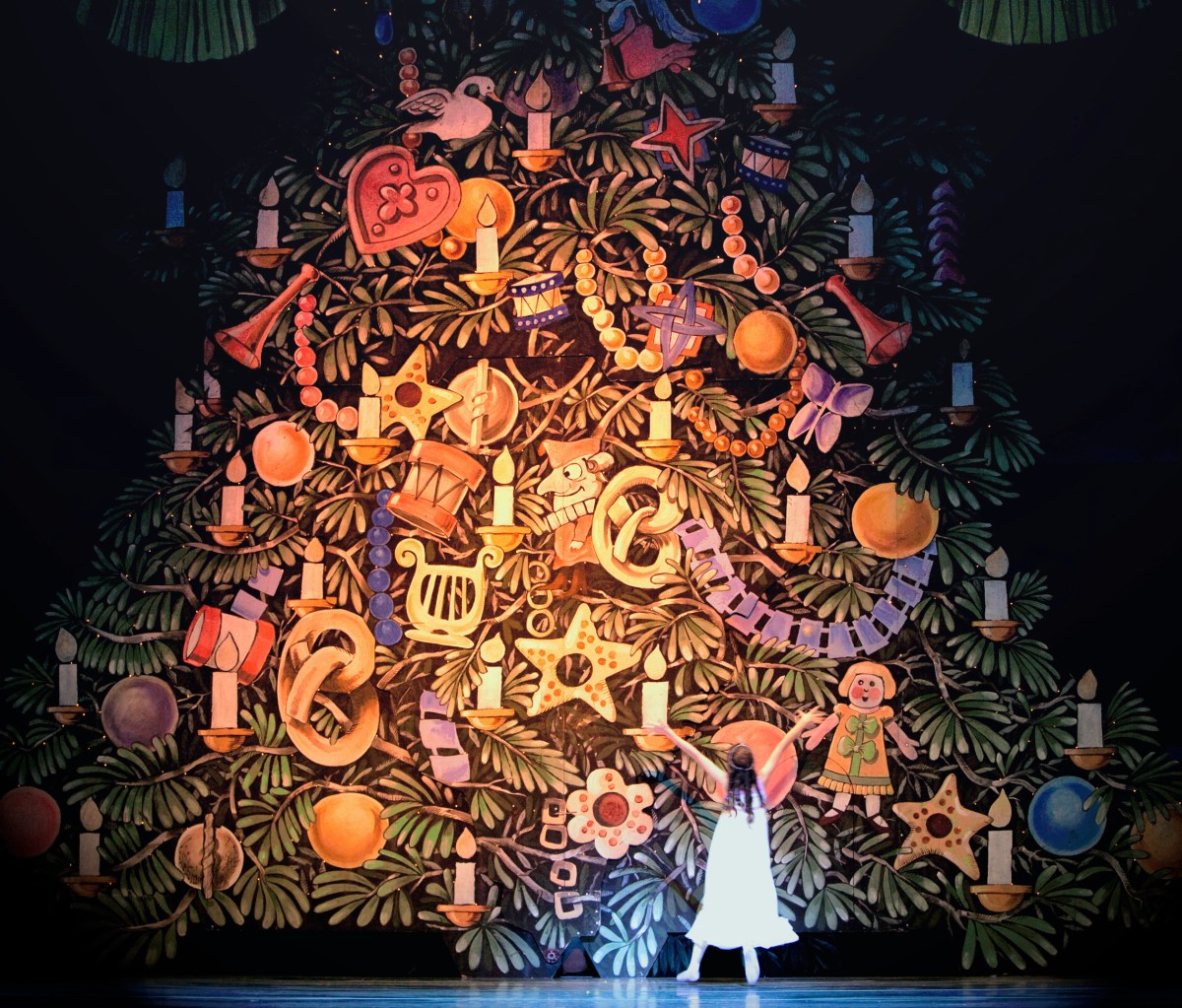
The painted backdrops, growing Christmas tree, and Nutcracker toy look as if they emerged from one of Sendak’s books. (He followed up the ballet by illustrating a new translation of the Hoffman original.)
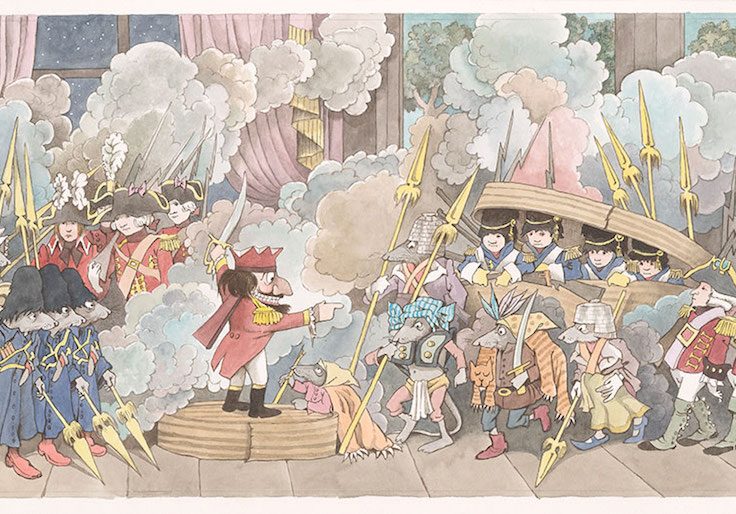
The Sendak-designed costumes are more understated, thought Pacific Northwest Ballet costumer Mark Zappone, who described working with Sendak as “an incredible joy and pleasure” and recalled the funny ongoing battle with the Act II Moors costumes to Seattle Met:
Maurice’s design had the women in quite billowy pants. So we ripped them out of the box, threw them on the girls upstairs in the studios, and Kent started rehearsing the Moors. And one by one, the girls got their legs stuck in those pants and—boom—hit the floor, all six of them. It was like, “Oh my God, what are we going to do about that one?” They ended up, for years, twisting the legs in their costumes and making a little tuck here and there. It was a rite of passage; if you were going to do the Moors, don’t forget to twist your pants around so you won’t get stuck in them.
Rent a filmed version of Maurice Sendak’s The Nutcracker on Amazon Prime. (Look for a Wild Thing cameo in the boating scene with Clara and her Prince.)
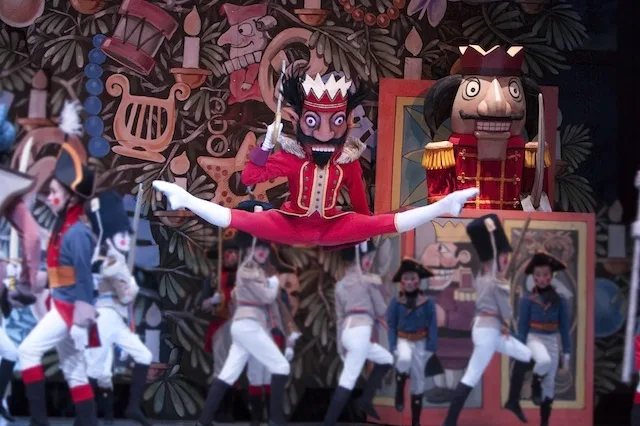
Related Content:
The Only Drawing from Maurice Sendak’s Short-Lived Attempt to Illustrate The Hobbit
Maurice Sendak Sent Beautifully Illustrated Letters to Fans — So Beautiful a Kid Ate One
Maurice Sendak Illustrates Tolstoy in 1963 (with a Little Help from His Editor)
Ayun Halliday is the Chief Primaologist of the East Village Inky zine and author, most recently, of Creative, Not Famous: The Small Potato Manifesto. Follow her @AyunHalliday.
Read More...Watch Bing Crosby’s Final Christmas Special, Featuring a Famous Duet with Bowie, and Bowie Introducing His New Song, “Heroes” (1977)
Bing Crosby died in October of 1977, but that didn’t stop him from appearing in living rooms all over America for Christmas. He’d already completed the shoot for his final CBS television special Bing Crosby’s Merrie Olde Christmas, along with such collaborators as Ron Moody, Stanley Baxter, the Trinity Boys Choir, Twiggy, and a young fellow by the name of David Bowie. Of course, Bowie had long since achieved his own dream of fame, at least to the younger generation; it was viewers who’d grown up listening to Crosby who needed an introduction. And they received a memorable one indeed, in the form of the Bowie-Crosby duet “Peace on Earth/Little Drummer Boy,” previously featured here on Open Culture.
This year you can watch Bing Crosby’s Merrie Olde Christmas in its hourlong entirety, which includes performances of “Have Yourself a Merry Little Christmas” and “Side by Side by Side” (from the late Stephen Sondheim’s Company), a (perhaps embellished) musical delineation of the extended Crosby family, and a session of literary reminiscence with none other than Charles Dickens.
The setup for all this is that Crosby, his wife, and children have all been brought to England by the invitation of the previously unknown Sir Percival Crosby, who desires to extend a hand to his “poor American relations” — and who happens to live next door to Bowie, that most English of all 1970s rock stars.
The search for Sir Crosby proceeds merrily, at one point prompting his famous relative to chat with Twiggy about the nature of love and loneliness, emotions “just as painful and just as beautiful as they ever were. Whether you’re a novelist, poet, or even a songwriter, it’s all in the way you sing.” These reflections lead into a stark music video for the title track of Bowie’s “ ‘Heroes’ ”, which had come out just weeks before (coincidentally, on the very day of Crosby’s death). Though a somewhat incongruous addition to such an old-fashioned production, it does vividly reflect a certain changing of the transatlantic pop-cultural guard.
In their scene together, Crosby and Bowie do exude an undeniable mutual respect, the younger man admitting even to have tried his hand at the older man’s signature holiday song, “White Christmas.” Having set off the 1940s Christmas-music boom by recording it 35 years before, Crosby sings it one last time himself to close out this special. Before doing so, he describes the Christmas season as “a time to look back with gratitude at being able to come this far, and a time to look ahead with hope and optimism.” Like all the elements of Bing Crosby’s Merrie Olde Christmas not involving David Bowie, these words were nothing new even then, but somehow they still manage to stoke our Christmas spirit all these decades later.
Related Content:
David Bowie & Bing Crosby Sing “The Little Drummer Boy/Peace on Earth” (1977)
David Bowie Sends a Christmas Greeting in the Voice of Elvis Presley
Revisit Kate Bush’s Peculiar Christmas Special, Featuring Peter Gabriel (1979)
Based in Seoul, Colin Marshall writes and broadcasts on cities and culture. His projects include the book The Stateless City: a Walk through 21st-Century Los Angeles and the video series The City in Cinema. Follow him on Twitter at @colinmarshall or on Facebook.
Read More...Watch Awesome Human Choreography That Reproduces the Murmurations of Starling Flocks
A number of choreographers have taken inspiration from the movement of birds.
Sadek Waff, creator of thrillingly precise “murmurations” such as the one above, is also inspired by street dance — particularly the popping hip hop moves known as Tutting and ToyMan.
The nature lover and founder of the dance troupe Géométrie Variable uses both to excellent effect, channeling a starling flock’s hive mind with human dancers, whose lower halves remain firmly rooted. It’s all about the hands and arms, punctuated with the occasional neck flex.
As he observes on his Instagram profile:
There is magic everywhere, the key is knowing how to look and listen in silence. Like a cloud of birds forming waves in the sky, each individual has their own identity but also has an irreplaceable place in the whole.
To achieve these kaleidoscopic murmurations, Waff’s dancers drill for hours, counting aloud in unison, refining their gestures to the point where the individual is subsumed by the group.
The use of mirrors can heighten the illusion:
The reflection brings a symmetrical dimension, like a calm body of water contemplating the spectacle from another point of view, adding an additional dimension, an extension of the image.
The larger the group, the more dazzling the effect, though a video featuring a smaller than usual group of dancers — 20 in total — is helpful for isolating the components Waff brings to bear in his avian-inspired work.
We’re particularly enthralled by the murmuration Waff created for the 2020 Paralympic Games’ closing ceremony in Tokyo, using both professionals and amateurs in matching black COVID-precaution masks to embody the event’s themes of “harmonious cacophony” and “moving forward.” (Notice that the front row of dancers are wheelchair users.)
See more of Sadek Waff’s murmurations on his YouTube channel and on Instagram.
Related Content:
A Dancer Pays a Gravity-Defying Tribute to Claude Debussy
The Evolution of Dance from 1950 to 2019: A 7‑Decade Joy Ride in 6 Minutes
Ayun Halliday is the Chief Primaologist of the East Village Inky zine and author, most recently, of Creative, Not Famous: The Small Potato Manifesto. Follow her @AyunHalliday.
Read More...Support Us
We're hoping to rely on loyal readers, rather than erratic ads. Please click the Donate button and support Open Culture. You can use Paypal, Venmo, Patreon, even Crypto! We thank you!

About Us

Open Culture scours the web for the best educational media. We find the free courses and audio books you need, the language lessons & educational videos you want, and plenty of enlightenment in between.
Advertise With Us
FREE UPDATES!
GET OUR DAILY EMAIL
Get the best cultural and educational resources on the web curated for you in a daily email. We never spam. Unsubscribe at any time.
FOLLOW ON SOCIAL MEDIA
Open Culture editor Dan Colman scours the web for the best educational media. He finds the free courses and audio books you need, the language lessons & movies you want, and plenty of enlightenment in between.
Advertise With Us

