Violinist Breaks a String While Performing Tchaikovsky in Concert, and Gracefully Recovers
Having evolved over centuries — indeed, millennia — the formal elegance and sonic beauty of stringed instruments continue to inspire their players toward ever-greater heights of virtuosity. But of course, the attainment of virtuosity itself doesn’t come easy, and whatever altitude you reach, you’ll still be dogged by some of the same problems you were as a novice. What violinist, for instance, could ever fully put out of their mind the possibility of a string’s breaking as they play, whether at home or in Carnegie Hall? Not celebrity player Ray Chen, surely, given that it’s happened to him at least twice in the past five years.
Being a Youtuber as well, Chen has turned these onstage misfortunes to his advantage. Just last week he put up “Violinist string BREAKS during Tchaikovsky,” a video that captures his latest such experience while playing with the Seattle Symphony Orchestra. Far from grinding to a halt, the performance continues with only a minor hitch.
After making a valiant attempt to soldier on short an E string, Chen switches to what appears to be the backup plan. Without the option of singing the blues while changing the string himself, as B.B. King did at Farm Aid, he swaps his instrument with that of the concertmaster, who passes it down the line. Unfazed, Chen continues playing right where he left off.
Chen followed a similar procedure after a string break in 2017, while playing in Brussels with the Taiwan Philharmonic. Then, as now, he uploaded the footage to his Youtube channel, where it has racked up more than 1.6 million views. The brief clip also captures his final toss onto the floor of the spare pack of strings he’d had the good sense to place in his pocket beforehand. The accolades posted in the comments below bring to mind the story of 19th-century violinist Carl Herman Unthan. Born without arms, Unthan became a virtuoso by playing instead with his feet — which he also used to change a string that broke on him in concert. This proved astonishing enough that he’s said later to have deliberately weakened strings in order to repeat the spectacle for other audiences. Just imagine if he’d had Youtube.
via Laughing Squid
Related Content:
B.B. King Changes Broken Guitar String Mid-Song at Farm Aid, 1985 and Doesn’t Miss a Beat
Why Violins Have F‑Holes: The Science & History of a Remarkable Renaissance Design
The Art and Science of Violin Making
A Gigantic Violin Floats Down Venice’s Grand Canal with a String Quartet on Top
Based in Seoul, Colin Marshall writes and broadcasts on cities, language, and culture. His projects include the Substack newsletter Books on Cities, the book The Stateless City: a Walk through 21st-Century Los Angeles and the video series The City in Cinema. Follow him on Twitter at @colinmarshall or on Facebook.
Read More...Rare Book Featuring the Concept Art for Jodorowsky’s Dune Goes Up for Auction (1975)
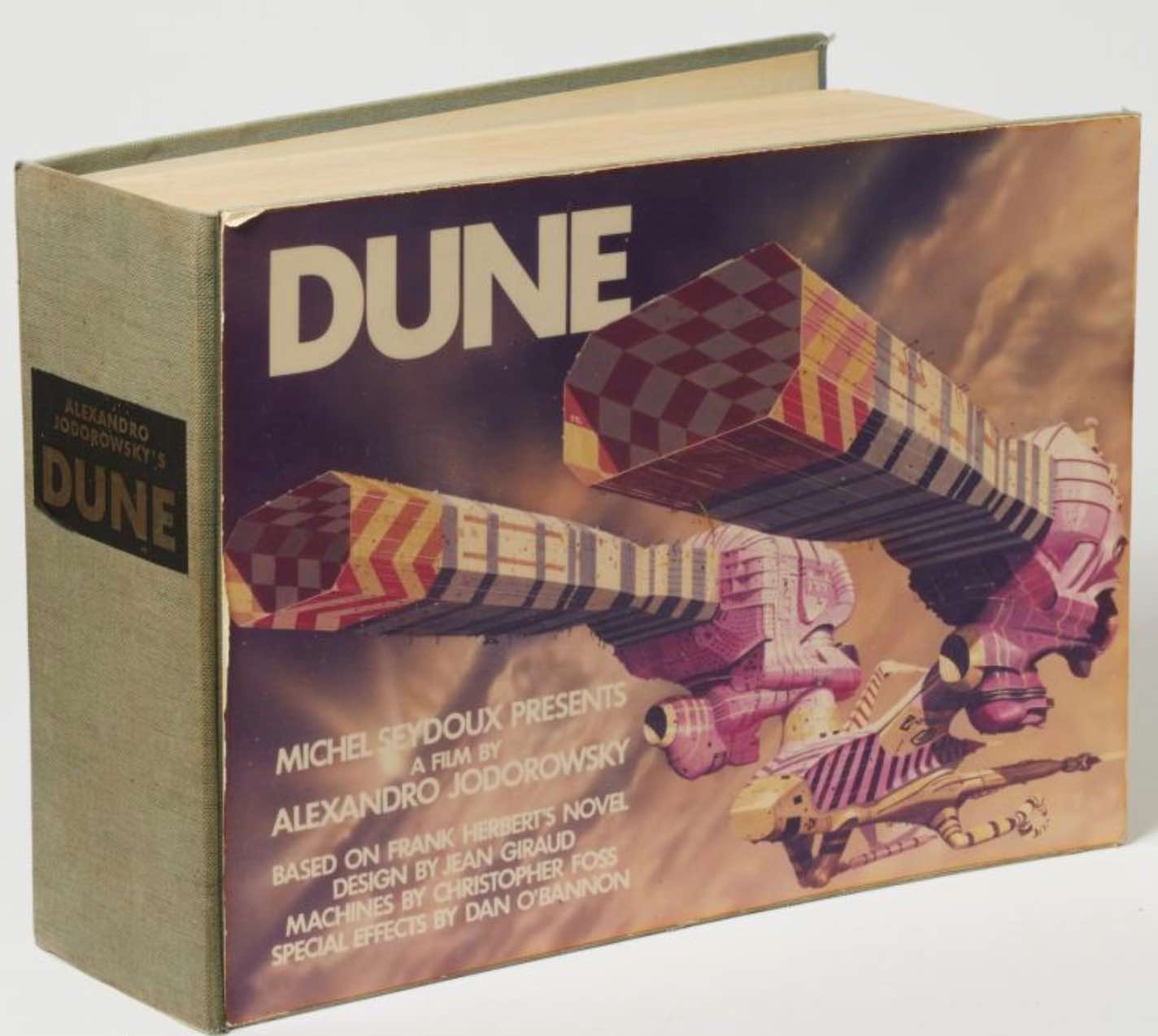
Denis Villeneuve’s new adaptation of Frank Herbert’s Dune has made a decently promising start to what looks set to shape up into an epic series of films. But however many installments it finally comprises, it’s unlikely to run anywhere near as long as Alejandro Jodorowsky’s version — had Jodorowsky actually made his version, that is. Previously featured here on Open Culture, that project promised to unite the talents of not just the creator of the Dune universe and the director of The Holy Mountain, but those of Mœbius, H.R. Giger, Salvador Dalí, Pink Floyd, Orson Welles, and Mick Jagger. Even David Lynch’s Dune, for all its large-scale weirdness, would surely play like My Dinner with Andre by comparison.
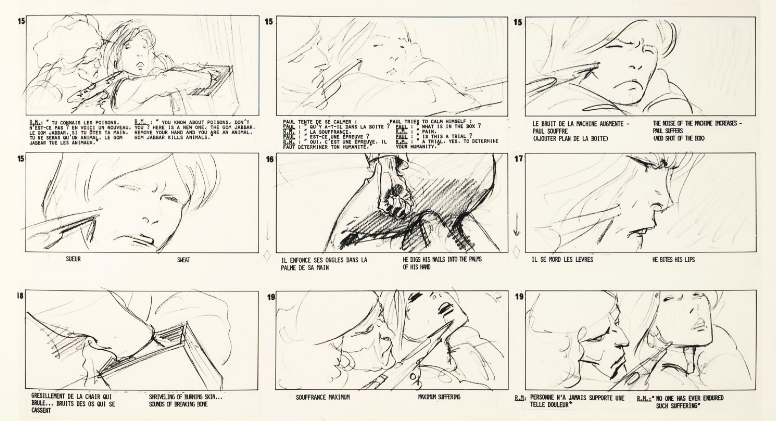
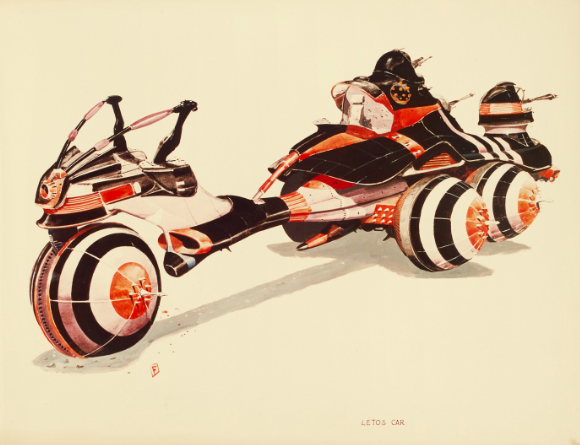
Alas, none of us will ever get to see Jodorowsky’s Dune, now one of the most storied of all unmade films. But one of us — one of the deep-pocketed among us, at least — now has a chance to own the book. Not Herbert’s novel: the book assembled circa 1985 as a pitching aid, meant to show studios the extensive pre-production work Jodorowsky, producer Michel Seydoux, and their collaborators had done.
“Filled with the script, storyboards, concept art, and more, the book is basically as close as anyone can get to seeing Jodorowsky’s version of Dune,” writes io9’s Germain Lussier. “But, of course, the director and his team only created a handful of copies and this was decades ago. This isn’t a book you can just get on Amazon.”
But you can get it at Christie’s, on whose auction block it’s expected to go for between €25,000 and €35,000 (around USD $30,000–40,000). Reckoning that only ten to twenty copies were ever printed, the house’s listing describes the book as “an extraordinary artifact” from “a doomed project which inspired legions of film-makers and moviegoers alike.” Despite all of Hollywood ultimately passing on this enormously ambitious adaptation, “all of this was not in vain.” Jodorowsky himself claims that, though unrealized, his Dune set a precedent for “a larger-than-life science fiction movie, outside of the scientific rigor of 2001: A Space Odyssey.” Its influence, according to Christie’s, is present in 1970s films like Star Wars and Alien. Would it be too much to sense a trace of the Jodorowskyan in Villeneuve’s Dune as well?
Related Content:
Mœbius’ Storyboards & Concept Art for Jodorowsky’s Dune
Alejandro Jodorowsky’s 82 Commandments For Living
Based in Seoul, Colin Marshall writes and broadcasts on cities, language, and culture. His projects include the Substack newsletter Books on Cities, the book The Stateless City: a Walk through 21st-Century Los Angeles and the video series The City in Cinema. Follow him on Twitter at @colinmarshall or on Facebook.
Read More...How Martin Luther King, Jr. Wrote His Momentous “I Have a Dream” Speech (1963)
Martin Luther King, Jr.’s “I Have a Dream” speech ranks as one of the most famous of American speeches. As Evan Puschak, the Nerdwriter, says in his video above, it’s “arguably the most important and well-known speech of the 20th century.” King’s popular vision of a peaceful, harmonious, multiracial democracy might explain why nine out of ten Americans have a positive attitude toward King now. That polling looks very different by party affiliation. Even so, many more Americans look fondly on King’s memory than supported (or now support) the racial and economic justice for which he fought. The current use of King as a whitewashed martyr figure, Michael Harriot argues, obscures the reality of “a dream yet unfulfilled,” as King once called the U.S.
Even after King’s “I Have a Dream” speech at the 1963 March on Washington and his 1964 Nobel Peace Prize win, only about 37% of Americans approved of his message in 1966 Gallup polling, a number that dropped even lower when he came out against the Vietnam war in 1967. Approval for MLK “only started to shift after his assassination in 1968,” writes Senior Data Scientist Linley Sanders at YouGov. King’s “Dream” speech at the Lincoln Memorial may be posthumously remembered as his finest hour by those who weren’t there. For thousands of people who were, his address was also a fiery summation of the major themes up to that point in dozens of speeches and sermons.
“Riddled with big difficult terms and full of rhetorical devices that are intentional and practiced,” Puschak says, the speech eloquently explained “why fully 100 years after… the Emancipation Proclamation,” Black Americans were still politically disenfranchised and economically disadvantaged. It did so through a series of dense allusions to the Emancipation Proclamation, the country’s founding documents, the song “My Country ‘Tis of Thee,” and other artifacts of American national identity, in an attempt to “frame civil rights in the larger American mythology so that those who identify with that mythology might incorporate this struggle into that story.”
The American story has justified oppression and fear of the same people fighting for full integration into the national polity during the Civil Rights movement, a problematic irony of which King was hardly unaware. He also drew from traditions older than the U.S. founding — the humanism of Shakespeare and the prophetic voices of the Old Testament, for example. These were indeed practiced maneuvers. (King very much lived down the C he once got in a public speaking class.) But the rousing refrains in his speech’s conclusion — which gave the speech its title and spread its fame around the world — were ad-libbed.
“I started out reading the speech, and I read it down to a point… the audience response was wonderful that day” King later remembered. “And all of a sudden this thing came to me that… I’d used many times before… ‘I have a dream.’ ” The reference didn’t come out of nowhere, says Clarence Jones, who helped King write the speech’s text just hours before it was delivered. Jones recalled that King’s favorite gospel singer Mahalia Jackson called out for the then-familiar (to her) theme:
As he was reading from the text of his prepared remarks, there came a point when Mahalia Jackson, who was sitting on the platform, said, “Tell them about the dream, Martin! Tell them about the dream.”
Now I have often speculated that she had heard him talk in other places… and make reference to the dream. On June 23, 1963, in Detroit, he had made very express reference to the dream.
When Mahalia shouted to him, I was standing about 50 feet behind him… and I saw it happening in real time. He just took the text of his speech and moved it to the left side of the lectern. … And I said to somebody standing next to me: “These people don’t know it, but they’re about to go to church.”
Before celebrating a redeemed interpretation of the American dream in his extemporaneous finale, King’s speech condemned the nation’s reality as morally corrupt and illegitimate. He urged restraint among his followers through nonviolent “direct action,” but foresaw worse to come before the country could realize its potential.
It would be fatal for the nation to overlook the urgency of the moment. This sweltering summer of the Negro’s legitimate discontent will not pass until there is an invigorating autumn of freedom and equality. 1963 is not an end, but a beginning. Those who hope that the Negro needed to blow off steam and will now be content will have a rude awakening if the nation returns to business as usual.
“There will be neither rest nor tranquility in America until the Negro is granted his citizenship rights,” King continued. “The whirlwinds of revolt will continue to shake the foundations of our nation until the bright day of justice emerges.” Maybe it’s little wonder many white Americans, hearing these remarks, turned away from King’s vision of racial justice, which required reckoning with “the unspeakable horrors of police brutality.” Ending the “unearned suffering” of Black Americans, King knew, would come at too great a cost to unearned privilege. Indeed, the FBI heard King’s words as a direct threat to the country’s historic power structure. After the “I Have Dream” speech, the Bureau seriously intensified its program to surveil, discredit, and destroy him.
Related Content:
Imagining the Martin Luther King and Malcolm X Debate That Never Happened
Josh Jones is a writer and musician based in Durham, NC. Follow him at @jdmagness
Read More...John Cleese Presents His 5‑Step Plan for Shorter, More Productive Meetings (1976)
Let’s face it, meetings are boring at best and at worst, chaotic, volatile, and potentially violent. And let’s also face it: to get through life as functioning adults, we’re going to have to sit through one or two of them — or even one or two of them a week.
Maybe we’re the one who calls the meetings, and maybe they all feel like a waste of time. One solution is to have more informal meetings. This can be especially tempting in the age of work-from-home, when it’s impossible to know how many meeting attendees are wearing pants. Fewer rules can raise the spontaneity quotient, but allowing for the unexpected can invite disaster as well as epiphany.
On the other end of the scale, we have the formality of parliamentary rules of order, such as those introduced by U.S. Army officer Henry Martyn Robert in 1876. Robert, whose father was the first president of Morehouse College, gained a wealth of experience with unproductive meetings as he traveled around the country with the Army. One particular meeting became a defining experience, as one account has it:
While in San Francisco, the local leader of his community didn’t show up for a church meeting. Henry Robert was asked to preside over the town hall (without any prior notice). Let’s just say that on this particular evening in 1876, he did a bad job. An hour into the meeting, people were screaming and the church actually erupted into open conflict.
Sadly, this sort of thing has become almost routine at town halls and school board meetings. But it needn’t be so at the office. Nor, says John Cleese in the brief video above, do meetings need to follow the formality of parliamentary procedure.
Cleese’s rules are simpler even than the simplified Roberts or Rosenberg’s Rules of Order, an even more simplified version of Robert’s Rules. Furthermore, Cleese avoids using words like “Rules” which can be a turn-off in our egalitarian times. Instead, he presents us with a “5‑Step Plan” for holding better and shorter meetings.
1. Plan — Clear your mind about the precise objectives of the meeting. Be clear why you need it and list the subjects.
2. Inform — Make sure everyone knows exactly what is being discussed, why, and what you want from the discussion. Anticipate what information and people may be needed and make sure they’re there.
3. Prepare — Prepare the logical sequence items. Prepare the time allocation to each item on the basis of its importance not its urgency.
4. Structure and Control — Take the evidence stage before the interpretation stage and that before the action stage and stop people jumping ahead or going back over ground.
5. Summarize all decision and record them straight away with the name of the person responsible for any action
Easy, right? Well, maybe not so easy in practice, but these steps can, at the very least, illuminate what’s wrong with your meetings, which may currently resemble one of Cleese’s many parodies of business culture. Nobody videophoned it in at the time, but trying to figure out who’s supposed to be doing what can still take up an afternoon. Let Cleese’s five steps bring order to the chaos.
Related Content:
Monty Python’s John Cleese Creates Ads for the American Philosophical Association
John Cleese’s Very Favorite Comedy Sketches
Josh Jones is a writer and musician based in Durham, NC. Follow him at @jdmagness
Read More...Watch the Jackson 5’s First Appearance on The Ed Sullivan Show (1969)
Who discovered the Jackson 5?
Motown founder Berry Gordy?
Empress of Soul Gladys Knight?
Diva Diana Ross?
Everyone in attendance for Amateur Night at the Apollo on August 13, 1967?
For many unsuspecting Americans, the answer may as well have been television host Ed Sullivan, who introduced the “sensational group” of five young brothers from Gary, Indiana to viewers in December 1969, two years after their Amateur Night triumph. Thirteen years earlier, a wall of sound emanating from a live in-studio audience of teenage girls told Sullivan’s home viewers that another young sensation — Elvis Presley — must be something special.
The Jackson 5 needed no such help.
While there are many close-ups of their fresh young faces, the control room wisely chose to zoom out much of the time, in appreciation of the brothers’ precision choreography.
The brightest star was the youngest, eleven-year-old Michael, taking lead vocals in purple fedora and fringed vest on a cover of Sly and the Family Stone’s “Stand.”
Jackie, Tito, Jermaine, and Marlon provide support for a bit of hokum that positions Michael at the center of an elementary school romance, by way of introduction to a full throated cover of Smokey Robinson’s “Who’s Loving You”:
We toasted our love during milk break. I gave her my cookies! We fell out during fingerpainting.
Author Carvell Wallace reflects on this moment in his 2015 New Yorker review of Steve Knopper’s biography MJ: The Genius of Michael Jackson:
Halfway through, he forgets his lines and freezes, looking back at his older brothers for help. It’s an alarmingly vulnerable moment, one only possible in the era of live television. You feel bad for him. It suddenly doesn’t seem right that a kid should be made to perform live in front of an entire country. Yet he somehow finds his way back and stumbles through.
When the music starts, we see something else entirely. The first note he sings is as confident, sure, and purposeful as any adult could ever be. He transforms from nervous child at a talent show into timeless embodiment of longing. Not only does he sing exactly on key but he appears to sing from the very bottom of his heart. He stares into the camera, shakes his head, and blinks back tears in perfect imitation of a sixties soul man. And it feels, for a moment, as though there are two different beings here. One is a child—a smart kid, to be sure, and cute, but not more special than any other child. He is subject to the same laws of life—pain, age, confusion, fear—as we all are. The other being seems to be a spirit of sorts, one who knows only the truest expression of human feeling. And this spirit appears to have randomly inhabited the body of this particular mortal kid. In so doing, it has sentenced him to a lifetime of indescribable enchantment and consummate suffering.
Michael’s explosive performance of the Jackson 5’s first national single, “I Want You Back,” released just two months before their Sullivan Show appearance, gives us that “spirit” in full force.
It’s also not hard to imagine that the brothers’ thrillingly executed choreography is the result of a literally punishing rehearsal regimen, a factor of the King of Pop’s troubled legacy.
The Sullivan Show appearance ensured that there would be no stopping this train. Five months later, when the Jacksons returned to the Sullivan Show, “I Want You Back” had sold over a million copies, as had “ABC,” which they performed as a medley.
Boyhood is fleeting, making Jacksonmania a carpe diem type situation.
The period from 1969 to 1972 saw an onslaught of Jackson 5‑related merch and a funky Saturday morning cartoon whose pilot tarted up the Diana Ross origin story with an escaped pet snake.
It was good while it lasted.
Related Content:
Ayun Halliday is the Chief Primaologist of the East Village Inky zine and author, most recently, of Creative, Not Famous: The Small Potato Manifesto. Follow her @AyunHalliday.
Read More...Board Game Ideology — Pretty Much Pop: A Culture Podcast #108

As board games are becoming increasingly popular with adults, we ask: What’s the relationship between a board game’s mechanics and its narrative? Does the “message” of a board game matter?
Your host Mark Linsenmayer is joined by game designer Tommy Maranges, educator Michelle Parrinello-Cason, and ex-philosopher Al Baker to talk about re-skinning games, designing player experiences, play styles, game complexity, and more.
Some of the games we mention include Puerto Rico, Monopoly, Settlers of Catan, Sorry, Munchkin, Sushi Go, Welcome To…, Codenames, Pandemic, Occam Horror, Terra Mystica, chess, Ticket to Ride, Splendor, Photosynthesis, Spirit Island, Escape from the Dark Castle, and Wingspan.
Some articles that fed our discussion included:
- “The Board Games That Ask You to Reenact Colonialism” by Luke Winkie
- “Board Games Are Getting Really, Really Popular” by Darron Cummings
- “8 Historical Board Games, from Diverse Designers, That Show Great Promise” by Charlie Hall
- “How a Board Game About Birds Became a Surprise Blockbuster” by Dan Kois
- “How Classic Board Games Are Bringing Families Closer During the Pandemic” by Drew Weisholtz
- “Keep Your Game Night Rolling (At A Safe Distance) With These 3 Online Services” by Petra Mayer
The two games Tommy created that we bring up are Secret Hitler and Inhuman Conditions.
This episode includes bonus discussion you can access by supporting the podcast at patreon.com/prettymuchpop or by choosing a paid subscription through Apple Podcasts. This podcast is part of the Partially Examined Life podcast network.
Pretty Much Pop: A Culture Podcast is the first podcast curated by Open Culture. Browse all Pretty Much Pop posts.
Read More...Wunderkind Musician Nandi Bushell Pays Tribute to Charlie Watts, Playing All of the Tracks on “Gimme Shelter”
We’ve featured 11-year-old Nandi Bushell here before. Perhaps you’ll recall her epic drum battle with Dave Grohl. Today she’s back, paying tribute to Charlie Watts and performing the individual tracks on the Stones’ “Gimme Shelter.” First comes the guitar; then the bass, percussion and vocals; and next the drums–all the while she’s having fun. And you will too. Enjoy.
If you would like to support the mission of Open Culture, consider making a donation to our site. It’s hard to rely 100% on ads, and your contributions will help us continue providing the best free cultural and educational materials to learners everywhere. You can contribute through PayPal, Patreon, and Venmo (@openculture). Thanks!
Related Content
The Rolling Stones’ “Gimme Shelter” Played by Musicians Around the World
Watch an Epic Drum Battle, Pitting a 9‑Year-Old Girl Against Foo Fighter Dave Grohl
Read More...An Introduction to the Chrysler Building, New York’s Art Deco Masterpiece, by John Malkovich (1994)
No old stuff for me, no bestial copyings of arches and columns and cornices. Me, I’m new.
— architect William Van Alen, designer of the Chrysler Building
Many people claim the Chrysler Building as their favorite New York City edifice and actor John Malkovich is one such:
It’s so crazy and vigorous in its execution, so breathtaking in its vision, so brilliantly eccentric.
Malkovich, who’s not shy about taking potshots at the city’s “violence and filth” in the BBC documentary short above, rhapsodizes over Detroit industrialist Walter P. Chrysler’s “latter day pyramid in Manhattan.”
Malkovich’s unmistakable voice, pegged by The Guardian as “wafting, whispery, and reedy” and which he himself poo poos as sounding like it belongs to someone who’s “labored under heavy narcotics for years,” pairs well with descriptions so plummy, one has to imagine he penned them himself. (No writer is credited.)
After showing us the open-to-the-public lobby’s “delicious Art Deco fittings,” ceiling mural, and intricate, veneered elevator doors, Malkovich gives us a tour of some off-limits upper floors.
Unlike the Empire State Building, which bested the Chrysler Building’s brief record as the world’s tallest building (1046 feet, 77 stories), you can’t purchase tickets to admire the view from the top.
But Malkovich has the star power to gain access to Celestial, the seventy-first floor observatory that has been closed to the public since 1945 and is currently occupied by a private firm.
He also has a wander around the barren Cloud Club, a supper club and speakeasy for gentleman one percenters. Its mishmash of styles represented a concession on architect Van Alen’s part. The building’s exterior was an elegant modernist homage to Chrysler’s hubcaps and hood ornaments, but between the 66th and 68th floor, the Cloud Club catered to the promiscuous tastes of the rich and powerful — Tudor, Olde English, Neo-Classical…
The New York Times reports that it boasted what “was reputed to be the grandest men’s room in all of New York.”
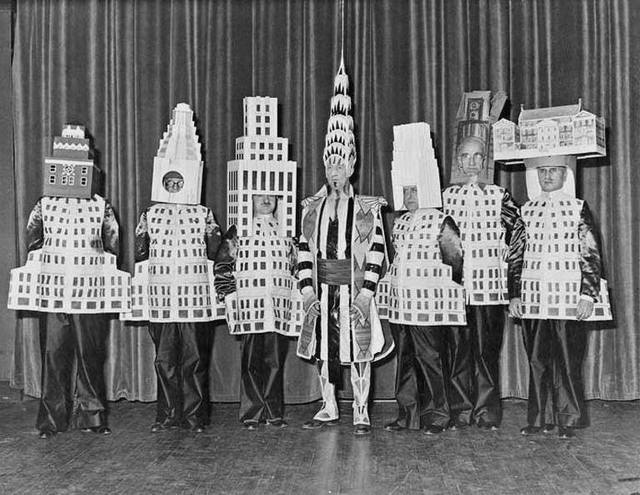
A Duke Ellington soundtrack and vintage footage featuring Van Alen costumed to resemble his famous creation supply a taste of the excitement that heralded the building’s 1930 opening, even if those with a fear of heights may swoon at the sight of pretty young things reclining on high beams and performing other feats of derring-do.
Malkovich, ever the cool customer, displays his lack of vertigo by casually propping a foot on the rooftop’s edge to commune with the iconic eagle-headed gargoyles.
The building’s unique flourishes caused a sensation, but not everyone was a fan.
Malkovich clearly savors his swipe at critics who decried the new building as too shiny:
Fortunately these critics are long dead so we can’t even call their offices and taunt them as they should be taunted.
He’s more temperate when it comes to author and social philosopher Lewis Mumford, whose beef with the skyscraper is understandable, given the historic context — the stock market crashed the day after the secretly constructed spire was riveted into place:
Such buildings show one of the real dangers of a plutocracy: it gives the masters of our civilization an unusual opportunity to exhibit their barbarous egos, with no sense of restraint or shame.
Nearly one hundred years later, barbarous egos continue to erect skyscraping temples to their own vanity, but as Malkovich points out, they’re far blander, if taller.
The Chrysler Building is now widely recognized as one of New York City’s most magnificent jewels, and the Landmarks Preservation Commission recently approved plans to construct a public observation deck on the Chrysler Building’s 61st floor, just above its iconic Art Deco eagles, though it’s too early to tell if it will be ready in time for a centennial celebration.
Until then, the general public must content itself with exploring the Chrysler Building’s lobby during weekday business hours.
Related Content:
Why Do People Hate Modern Architecture?: A Video Essay
Famous Architects Dress as Their Famous New York City Buildings (1931)
Ayun Halliday is the Chief Primatologist of the East Village Inky zine and author, most recently, of Creative, Not Famous: The Small Potato Manifesto. Follow her @AyunHalliday.
Read More...Michelangelo Entered a Competition to Put a Missing Arm Back on Laocoön and His Sons — and Lost
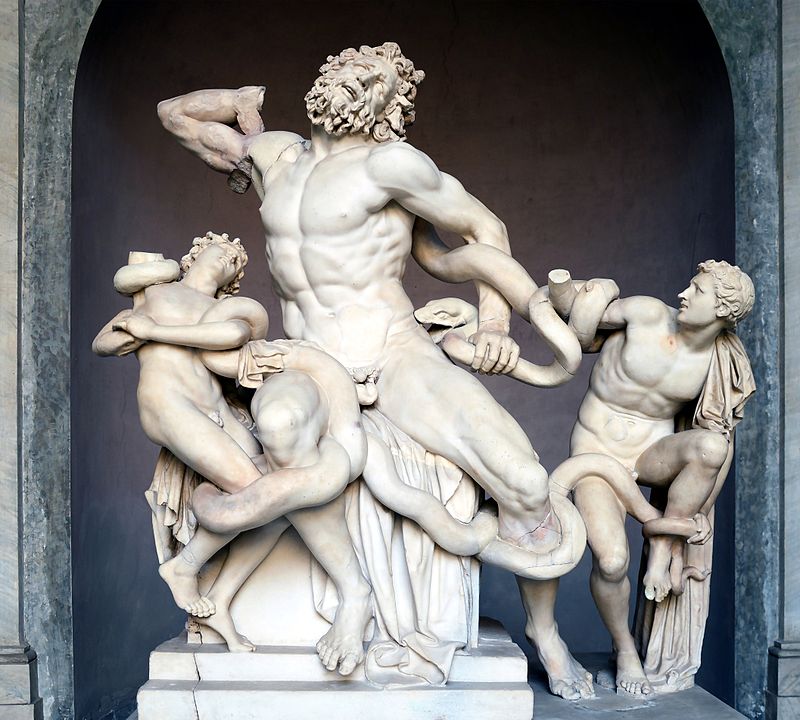
Not many ancient statues are as well-known as Laocoön and His Sons. Masterfully sculpted some time between the first century BC and the first century AD, it depicts the eponymous Trojan priest in an agonizing struggle with the serpents that will kill one or both of his sons. The details of the tale vary depending on the teller: Virgil describes Laocoön as a priest of Poseidon who dared to attempt exposing the famous Trojan Horse ruse, and Sophocles describes him as a priest of Apollo who violated his vow of celibacy. Whichever version of the story he heard, the sculptor clearly drew from it powerful enough inspiration to impress Pliny the Elder, in whose Natural History the piece figures.
Even among the more artistically sophisticated beholders of the Renaissance, Laocoön and His Sons proved a captivating piece of work. Unearthed from a Roman vineyard in 1506, it looked to have weathered the intervening millennium and half with much less wear and tear than most large artifacts from antiquity — though Laocoön himself was, conspicuously, missing an arm. Commissioned by Pope Julius II, Vatican architect Donato Bramante “held a contest to see who could come up with the best version of the arm restoration,” writes Kaushik Patowary at Amusing Planet. “Michelangelo suggested that Laocoön’s missing arm should be bent back as if the Trojan priest was trying to rip the serpent off his back.”
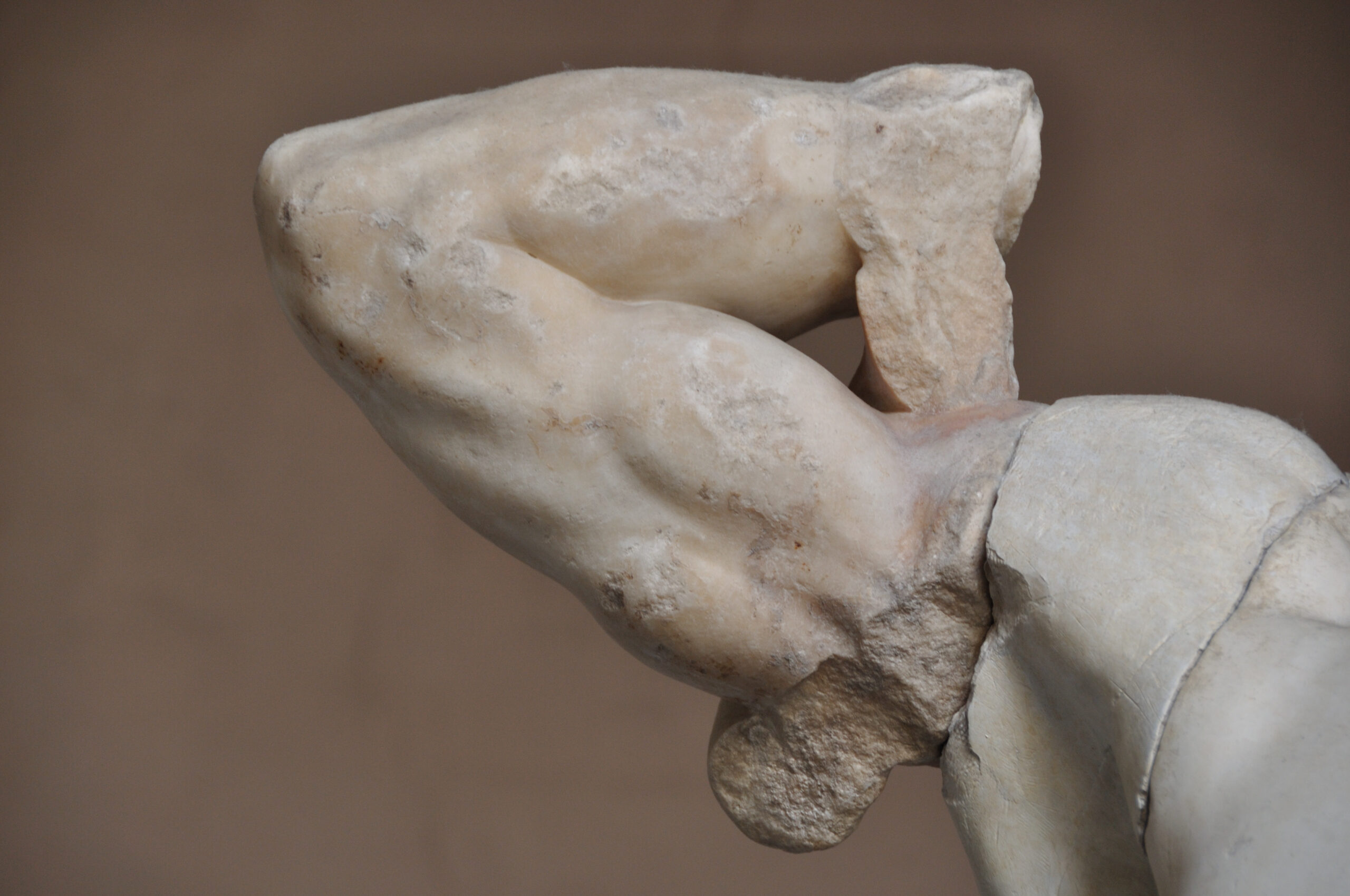
Michelangelo wasn’t the only Renaissance man in competition: “Raphael, who was a distant relative of Bramante, favored an extended arm. In the end, Jacopo Sansovino was declared the winner, whose version with an outstretched arm aligned with Raphael’s own vision of how the statue should look.” Laocoön was thus eventually restored with his arm outstreched, and kept that way until, “in a strange twist of fate, an antique backward-bent arm was discovered in a Roman workshop in 1906, a few hundred meters from where the statue group had been found four hundred years earlier.” Positioned just as Michelangelo had suggested, this disembodied marble limb turned out unmistakably to have come from Laocoön and His Sons — but about three and a half centuries too late, alas, for Michelangelo to lord it over Raphael.
Related Content:
A Creepy 19th Century Re-Creation of the Famous Ancient Roman Statue, Laocoön and His Sons
Michelangelo’s David: The Fascinating Story Behind the Renaissance Marble Creation
New Video Shows What May Be Michelangelo’s Lost & Now Found Bronze Sculptures
Based in Seoul, Colin Marshall writes and broadcasts on cities, language, and culture. His projects include the Substack newsletter Books on Cities, the book The Stateless City: a Walk through 21st-Century Los Angeles and the video series The City in Cinema. Follow him on Twitter at @colinmarshall or on Facebook.
Read More...The Nine Greatest Films You’ve Never Seen
Whether we know it or not, we have all absorbed a cinematic vocabulary and set of film historical references through the film and television we’ve watched throughout our lives. We can leave it to the filmmakers, critics, and cinephiles to memorize glossaries of techniques. It’s enough that we understand what’s happening on screen because hundreds of visual narratives have been constructed in more or less the same way. This language did not come out of a primordial soup but took shape over the last 120 years or so: from the Lumière Brothers and Georges Méliès to Wes Anderson and Denis Villeneuve and so on — each stage along the way absorbing influences and ideas from the most innovative films.
Take, for example, My Dinner with Andre, an intensely philosophical film that consists of only two main characters, one setting, and no real plot to speak of. Instead, the film exploits the techniques of shot/reverse shot to their fullest, creating extraordinary intimacy between two characters, and the viewer, with the camera. Louis Malle’s 1981 film became a standard for filmed existential conversations. Yet behind it stands an even more iconic conversation, one literally concerned with life and Death. Ingmar Bergman’s The Seventh Seal is a cinematic reference for countless movies, and a film that undoubtedly expanded the ways filmmakers could tell stories.
But there is another film we should see, says the Cinematic Cartography above, if we want to know where else the philosophical conversation in film might go: Hungarian director Zoltán Fábri’s 1976 The Fifth Seal, a grim morality play set in Nazi-occupied Hungary in which four friends in a bar propose a thought experiment that becomes terrifyingly real. The film cuts between the conversation on screen and scenes of Hieronymus Bosch’s The Garden of Earthly Delights. “All through the film,” one critic writes, “an intelligent viewer will note the characters in the film constantly reassess their philosophical stance or points of view, according to circumstances.”
The entire movement of the film turns on a single question, a stark restatement of the Hegelian master/slave dialectic. Rather than a philosophical conversation between two stable points of view, The Fifth Seal shows us perspectives that shift according to the characters’ self-perceptions, our perceptions of them, and the influence of Bosch on what we see, adding layers of dramatic irony and extra-diegetic tension. Influential in its own way, if The Fifth Seal had been as widely seen as The Seventh Seal, we might have seen cinema take a different turn in the last few decades. Such is the case with all nine films discussed. See them listed below, learn about them in brief in “The Greatest Films You Don’t Know,” above, and imagine the directions cinema might go if it took more cues from these undervalued classics.
0:00 Introduction (Ashes and Snow, A Time to Live A Time to Die, Strangers In Good Company, Borom Sarat, Dead Man’s Letter’s, Killer of Sheep, Napoleon, Still Life)
1:50 The Fifth Seal — Az ötödik pecsét (Dir: Zoltán Fábri)
7:29 The House Is Black — خانه سیاه است (Dir: Forough Farrokhzad)
9:57 Tie Xi Qu: West of The Tracks — 铁西区 (Dir: Wang Bing)
14:12 As I Was Moving Ahead Occasionally I Saw Brief Glimpses of Beauty (Dir: Jonas Mekas)
18:37 The Enclosed Valley — La vallée close (Dir: Jean-Claude Rousseau)
19:37 Pastoral: To Die in the Country — 田園に死す (Dir: Shūji Terayama)
23:44 Punishment Park (Dir: Peter Watkins)
28:03 The Cremator — Spalovač mrtvol (Dir: Juraj Herz) 30:28 O Pagador de Promessas (Dir: Anselmo Duarte)
31:39 Conclusion (Lucifer Rising, An Elephant Sitting Still, Marketa Lazarova, White Noise, Platform, The Burmese Harp)
If you would like to support the mission of Open Culture, consider making a donation to our site. It’s hard to rely 100% on ads, and your contributions will help us continue providing the best free cultural and educational materials to learners everywhere. You can contribute through PayPal, Patreon, and Venmo (@openculture). Thanks!
Related Content:
Martin Scorsese Creates a List of 39 Essential Foreign Films for a Young Filmmaker
Josh Jones is a writer and musician based in Durham, NC. Follow him at @jdmagness
Read More...Support Us
We're hoping to rely on loyal readers, rather than erratic ads. Please click the Donate button and support Open Culture. You can use Paypal, Venmo, Patreon, even Crypto! We thank you!

About Us

Open Culture scours the web for the best educational media. We find the free courses and audio books you need, the language lessons & educational videos you want, and plenty of enlightenment in between.
Advertise With Us
FREE UPDATES!
GET OUR DAILY EMAIL
Get the best cultural and educational resources on the web curated for you in a daily email. We never spam. Unsubscribe at any time.
FOLLOW ON SOCIAL MEDIA
Open Culture editor Dan Colman scours the web for the best educational media. He finds the free courses and audio books you need, the language lessons & movies you want, and plenty of enlightenment in between.
Advertise With Us

